Computer 1 Introduction to Microcomputers with Microsoft Word Next
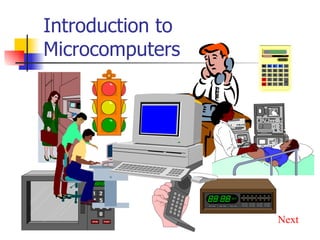
Introduction to Microcomputers Next
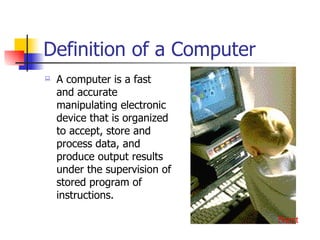
Definition of a Computer A computer is a fast and accurate manipulating electronic device that is organized to accept, store and process data, and produce output results under the supervision of stored program of instructions. Next
Computer Generations “ Consider the past and you’ll know the future.” - Chinese Proverbs Next
3000 B.C. Abacus , the first man-made device was invented.  It marked the beginning of computers. 1642 Blaise Pascal  designed an adding machine called the  Pascaline . 1674 Gottfried Wilhelm Leibniz  made improvements on Pascal’s machine and developed a mechanical calculating machine that can also divide and multiply and called it the Stepped Reckoner. Next
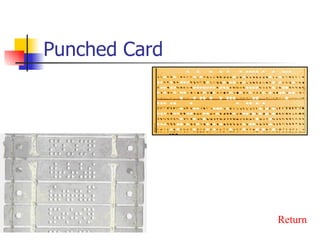
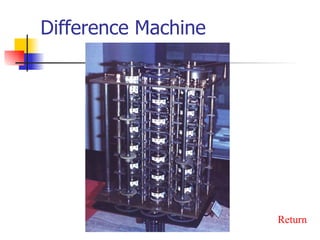
1801 Joseph Jacquard  developed the  mechanical loom  that uses  punched cards . 1822 Charles Babbage  designed an automatic mechanical calculating machine called  Difference Engine. 1833 Charles Babbage  designed the Analytical Engine which is the prototype of the modern computer. Next
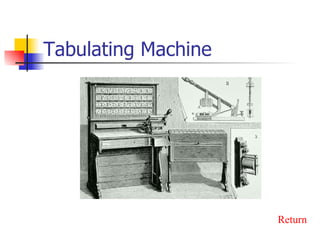
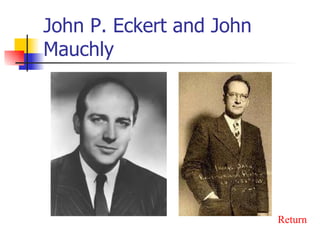
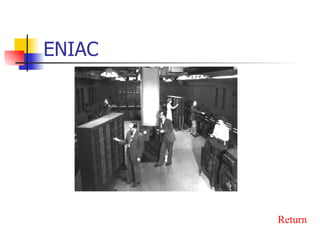
1890 Herman Hollerith  adopted the punched card concept of Joseph Jacquard and invented a  tabulating machine . 1943 A team composed of  John P. Eckert and John W. Mauchly  started building a machine using electronics capable of doing rapid calculations of large quantities of information.  It was called  ENIAC  (Electronic Numerical Integrator And Calculator/Computer). Next
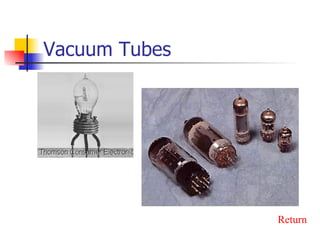
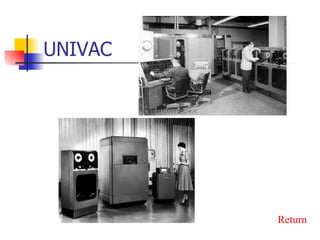
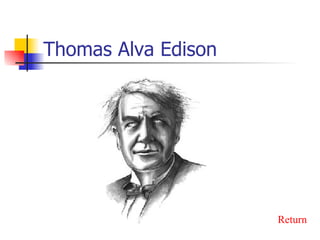
First Generation: The Vacuum Tubes Computers built in the technological era of development when the  vacuum tube  was the main electronic component.  It was invented by  Thomas Alva Edison . 1946, the ENIAC was completed.  It was the first electronic digital computer without moving parts.  It was programmable and capable of storing problem calculations. 1950, Remington Rand manufactured the first commercially available first generation computer.  It was called  UNIVAC  (UNIVersal Automatic Calculator). Next
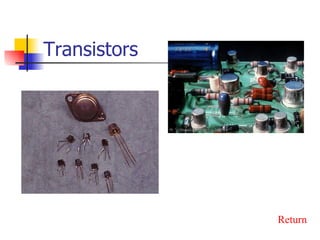
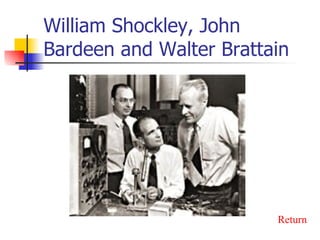
Second Generation: The Transistors Describes computers in the second era of computer technology development in which the  transistor  was introduced and quickly replaced the thousands of vacuum tubes used in electronic computers. Transistors are smaller, lighter, less expensive to produce, cheaper to operate, more reliable than vacuum tubes and consume less power. It was invented by  William Shockley, John Bardeen and Walter Brattain  in 1948. Next
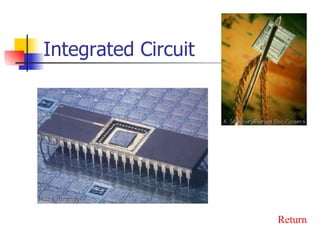
Third Generation: The Integrated Circuits Describes computers in the third era of computer technology development in which  Integrated Circuit (IC)  and miniaturization replaced the transistor-based computers. Computers with micro-circuits.  It is a complete electronic circuitry on a small chip of silicon.  Next
Fourth Generation: The Microprocessors The fourth generation computers were characterized by the use of microprocessor and further miniaturization of circuits, an increased in multiprogramming and the use of virtual storage memory. Next
Fifth Generation: Artificial Intelligence They will be able to take commands in a audio visual way and carry out instructions. Many of the operations which require low human intelligence will be performed by these computers. The goal for  fifth   generation   computers  is the ability to sense, reason and interact with people and the physical world. Next
Characteristics of a Computer It is a machine.   It is an inanimate object.  Machines do not feel pain and are senseless.  It needs outside intervention for it to run.  It can only do things for which it was designed. It is electronic.   It runs only on electrical energy.  It is made up of electronic circuits. Next
Continuation... It is automatic.   Once started, it continues to run without outside assistance.  The moment a particular computer, programmed to perform a task, is switched on, it will promptly do its job minus human interference. It can manipulate data.   Following specific rules, it can perform arithmetic functions.  Also, it can compare data. Next
Continuation... It has memory.   It has the capacity to remember what it has done.  It can store instructions in its memory and follow these through unaided. It has logical functions.   It can be given a set of instructions that tells what it must do and how it must be done.  It can produce results upon completion of these instructions. Next
Classification of Computers According to Purpose According to Data Handled According to Size/Performance Next
According to Purpose Special Purpose Computers Computers designed to perform only one specific task. General Purpose Computers Computers designed to perform countless applications and can store different programs.
Types of Data Discrete Data A representation of a variable that may assume any of several distinct states and is usually coded. Data that can be obtained through simple counting. Continuous Data Data that can be ascertained continuously in time. Data that can be obtained through measurement.
According to Data Handled Analog Computers Computers that operate on continuous data. Digital Computers Computers that operate on discrete data. Hybrid Computers Computers that carries the features of both analog and digital computers.
According to Size / Performance Supercomputers Mainframes Minicomputers Microcomputers
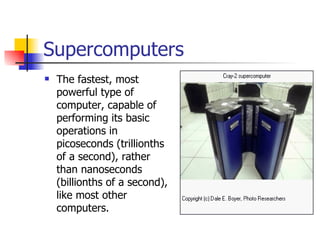
Supercomputers The fastest, most powerful type of computer, capable of performing its basic operations in picoseconds (trillionths of a second), rather than nanoseconds (billionths of a second), like most other computers.
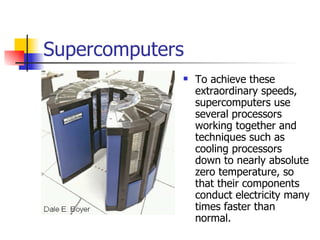
Supercomputers To achieve these extraordinary speeds, supercomputers use several processors working together and techniques such as cooling processors down to nearly absolute zero temperature, so that their components conduct electricity many times faster than normal.
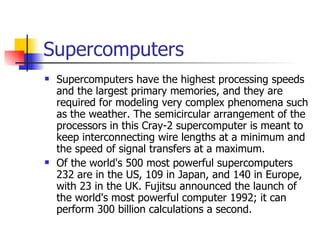
Supercomputers Supercomputers have the highest processing speeds and the largest primary memories, and they are required for modeling very complex phenomena such as the weather. The semicircular arrangement of the processors in this Cray-2 supercomputer is meant to keep interconnecting wire lengths at a minimum and the speed of signal transfers at a maximum. Of the world's 500 most powerful supercomputers 232 are in the US, 109 in Japan, and 140 in Europe, with 23 in the UK. Fujitsu announced the launch of the world's most powerful computer 1992; it can perform 300 billion calculations a second.
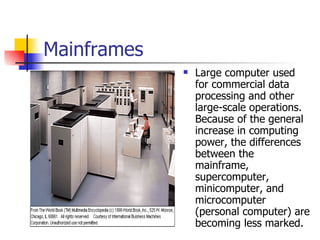
Mainframes Large computer used for commercial data processing and other large-scale operations. Because of the general increase in computing power, the differences between the mainframe, supercomputer, minicomputer, and microcomputer (personal computer) are becoming less marked.
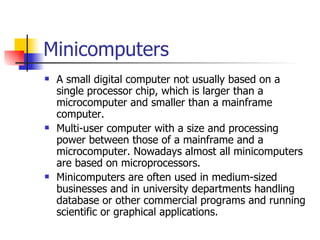
Minicomputers A small digital computer not usually based on a single processor chip, which is larger than a microcomputer and smaller than a mainframe computer. Multi-user computer with a size and processing power between those of a mainframe and a microcomputer. Nowadays almost all minicomputers are based on microprocessors.  Minicomputers are often used in medium-sized businesses and in university departments handling database or other commercial programs and running scientific or graphical applications.
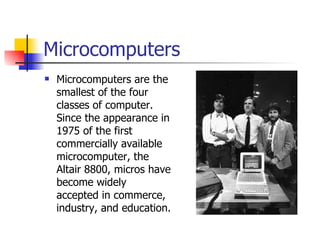
Microcomputers Microcomputers are the smallest of the four classes of computer. Since the appearance in 1975 of the first commercially available microcomputer, the Altair 8800, micros have become widely accepted in commerce, industry, and education.
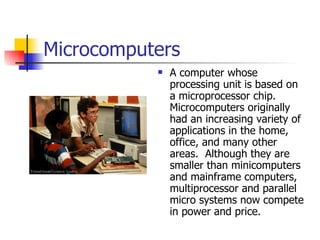
Microcomputers A computer whose processing unit is based on a microprocessor chip.  Microcomputers originally had an increasing variety of applications in the home, office, and many other areas.  Although they are smaller than minicomputers and mainframe computers, multiprocessor and parallel micro systems now compete in power and price.
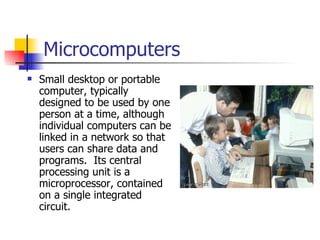
Microcomputers Small desktop or portable computer, typically designed to be used by one person at a time, although individual computers can be linked in a network so that users can share data and programs.  Its central processing unit is a microprocessor, contained on a single integrated circuit.
Capabilities of Computers Speed Computers can do billions of operations in a second. Reliability Failures are usually due to human errors, one way or the other. Storage Computers can keep huge amounts of data.
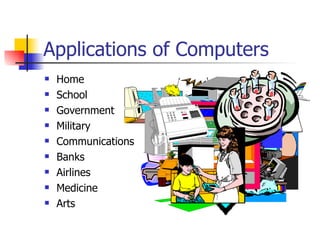
Applications of Computers Home School Government Military Communications Banks Airlines Medicine Arts                               
Overview of a Computer System Hardware Physical components of a computer. Software Programs we feed to a computer. Peopleware / Human Resources Personnel who use the computer.
 
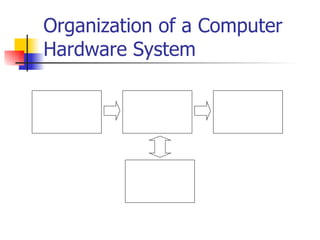
Organization of a Computer Hardware System
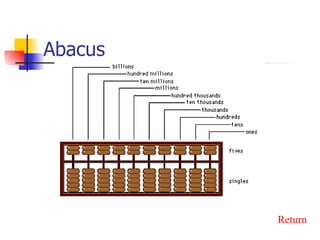
Abacus Return
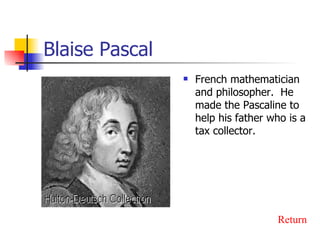
Blaise Pascal French mathematician and philosopher.  He made the Pascaline to help his father who is a tax collector. Return
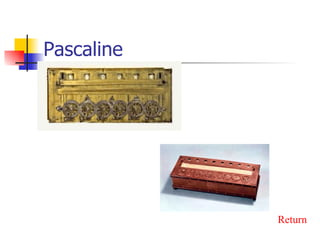
Pascaline Return
John P. Eckert and John Mauchly Return
ENIAC Return
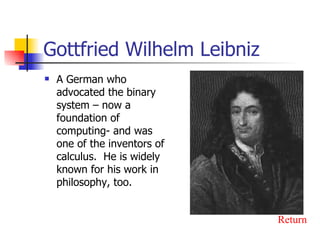
Gottfried Wilhelm Leibniz A German who advocated the binary system – now a foundation of computing- and was one of the inventors of calculus.  He is widely known for his work in philosophy, too. Return
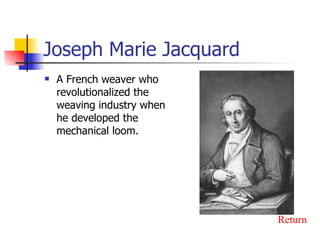
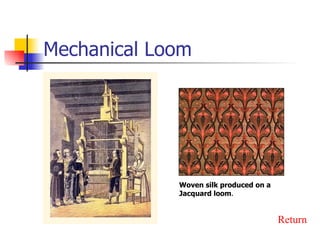
Joseph Marie Jacquard A French weaver who revolutionalized the weaving industry when he developed the mechanical loom. Return
Transistors Return
Vacuum Tubes Return
Integrated Circuit Return
Punched Card Return                                            
UNIVAC Return
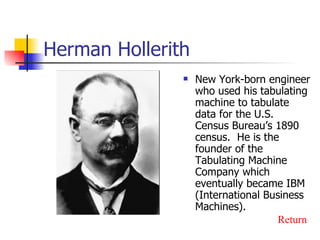
Herman Hollerith New York-born engineer who used his tabulating machine to tabulate data for the U.S. Census Bureau’s 1890 census.  He is the founder of the Tabulating Machine Company which eventually became IBM (International Business Machines). Return
Mechanical Loom Return Woven silk produced on a Jacquard loom .
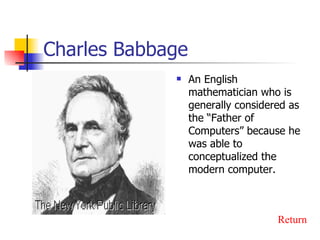
Charles Babbage An English mathematician who is generally considered as the “Father of Computers” because he was able to conceptualized the modern computer. Return
Tabulating Machine Return
William Shockley, John Bardeen and Walter Brattain Return
Thomas Alva Edison Return
Difference Machine Return

SRAS Computer 1

  • 1.
    Computer 1 Introductionto Microcomputers with Microsoft Word Next
  • 2.
  • 3.
    Definition of aComputer A computer is a fast and accurate manipulating electronic device that is organized to accept, store and process data, and produce output results under the supervision of stored program of instructions. Next
  • 4.
    Computer Generations “Consider the past and you’ll know the future.” - Chinese Proverbs Next
  • 5.
    3000 B.C. Abacus, the first man-made device was invented. It marked the beginning of computers. 1642 Blaise Pascal designed an adding machine called the Pascaline . 1674 Gottfried Wilhelm Leibniz made improvements on Pascal’s machine and developed a mechanical calculating machine that can also divide and multiply and called it the Stepped Reckoner. Next
  • 6.
    1801 Joseph Jacquard developed the mechanical loom that uses punched cards . 1822 Charles Babbage designed an automatic mechanical calculating machine called Difference Engine. 1833 Charles Babbage designed the Analytical Engine which is the prototype of the modern computer. Next
  • 7.
    1890 Herman Hollerith adopted the punched card concept of Joseph Jacquard and invented a tabulating machine . 1943 A team composed of John P. Eckert and John W. Mauchly started building a machine using electronics capable of doing rapid calculations of large quantities of information. It was called ENIAC (Electronic Numerical Integrator And Calculator/Computer). Next
  • 8.
    First Generation: TheVacuum Tubes Computers built in the technological era of development when the vacuum tube was the main electronic component. It was invented by Thomas Alva Edison . 1946, the ENIAC was completed. It was the first electronic digital computer without moving parts. It was programmable and capable of storing problem calculations. 1950, Remington Rand manufactured the first commercially available first generation computer. It was called UNIVAC (UNIVersal Automatic Calculator). Next
  • 9.
    Second Generation: TheTransistors Describes computers in the second era of computer technology development in which the transistor was introduced and quickly replaced the thousands of vacuum tubes used in electronic computers. Transistors are smaller, lighter, less expensive to produce, cheaper to operate, more reliable than vacuum tubes and consume less power. It was invented by William Shockley, John Bardeen and Walter Brattain in 1948. Next
  • 10.
    Third Generation: TheIntegrated Circuits Describes computers in the third era of computer technology development in which Integrated Circuit (IC) and miniaturization replaced the transistor-based computers. Computers with micro-circuits. It is a complete electronic circuitry on a small chip of silicon. Next
  • 11.
    Fourth Generation: TheMicroprocessors The fourth generation computers were characterized by the use of microprocessor and further miniaturization of circuits, an increased in multiprogramming and the use of virtual storage memory. Next
  • 12.
    Fifth Generation: ArtificialIntelligence They will be able to take commands in a audio visual way and carry out instructions. Many of the operations which require low human intelligence will be performed by these computers. The goal for fifth generation computers is the ability to sense, reason and interact with people and the physical world. Next
  • 13.
    Characteristics of aComputer It is a machine. It is an inanimate object. Machines do not feel pain and are senseless. It needs outside intervention for it to run. It can only do things for which it was designed. It is electronic. It runs only on electrical energy. It is made up of electronic circuits. Next
  • 14.
    Continuation... It isautomatic. Once started, it continues to run without outside assistance. The moment a particular computer, programmed to perform a task, is switched on, it will promptly do its job minus human interference. It can manipulate data. Following specific rules, it can perform arithmetic functions. Also, it can compare data. Next
  • 15.
    Continuation... It hasmemory. It has the capacity to remember what it has done. It can store instructions in its memory and follow these through unaided. It has logical functions. It can be given a set of instructions that tells what it must do and how it must be done. It can produce results upon completion of these instructions. Next
  • 16.
    Classification of ComputersAccording to Purpose According to Data Handled According to Size/Performance Next
  • 17.
    According to PurposeSpecial Purpose Computers Computers designed to perform only one specific task. General Purpose Computers Computers designed to perform countless applications and can store different programs.
  • 18.
    Types of DataDiscrete Data A representation of a variable that may assume any of several distinct states and is usually coded. Data that can be obtained through simple counting. Continuous Data Data that can be ascertained continuously in time. Data that can be obtained through measurement.
  • 19.
    According to DataHandled Analog Computers Computers that operate on continuous data. Digital Computers Computers that operate on discrete data. Hybrid Computers Computers that carries the features of both analog and digital computers.
  • 20.
    According to Size/ Performance Supercomputers Mainframes Minicomputers Microcomputers
  • 21.
    Supercomputers The fastest,most powerful type of computer, capable of performing its basic operations in picoseconds (trillionths of a second), rather than nanoseconds (billionths of a second), like most other computers.
  • 22.
    Supercomputers To achievethese extraordinary speeds, supercomputers use several processors working together and techniques such as cooling processors down to nearly absolute zero temperature, so that their components conduct electricity many times faster than normal.
  • 23.
    Supercomputers Supercomputers havethe highest processing speeds and the largest primary memories, and they are required for modeling very complex phenomena such as the weather. The semicircular arrangement of the processors in this Cray-2 supercomputer is meant to keep interconnecting wire lengths at a minimum and the speed of signal transfers at a maximum. Of the world's 500 most powerful supercomputers 232 are in the US, 109 in Japan, and 140 in Europe, with 23 in the UK. Fujitsu announced the launch of the world's most powerful computer 1992; it can perform 300 billion calculations a second.
  • 24.
    Mainframes Large computerused for commercial data processing and other large-scale operations. Because of the general increase in computing power, the differences between the mainframe, supercomputer, minicomputer, and microcomputer (personal computer) are becoming less marked.
  • 25.
    Minicomputers A smalldigital computer not usually based on a single processor chip, which is larger than a microcomputer and smaller than a mainframe computer. Multi-user computer with a size and processing power between those of a mainframe and a microcomputer. Nowadays almost all minicomputers are based on microprocessors. Minicomputers are often used in medium-sized businesses and in university departments handling database or other commercial programs and running scientific or graphical applications.
  • 26.
    Microcomputers Microcomputers arethe smallest of the four classes of computer. Since the appearance in 1975 of the first commercially available microcomputer, the Altair 8800, micros have become widely accepted in commerce, industry, and education.
  • 27.
    Microcomputers A computerwhose processing unit is based on a microprocessor chip. Microcomputers originally had an increasing variety of applications in the home, office, and many other areas. Although they are smaller than minicomputers and mainframe computers, multiprocessor and parallel micro systems now compete in power and price.
  • 28.
    Microcomputers Small desktopor portable computer, typically designed to be used by one person at a time, although individual computers can be linked in a network so that users can share data and programs. Its central processing unit is a microprocessor, contained on a single integrated circuit.
  • 29.
    Capabilities of ComputersSpeed Computers can do billions of operations in a second. Reliability Failures are usually due to human errors, one way or the other. Storage Computers can keep huge amounts of data.
  • 30.
    Applications of ComputersHome School Government Military Communications Banks Airlines Medicine Arts                               
  • 31.
    Overview of aComputer System Hardware Physical components of a computer. Software Programs we feed to a computer. Peopleware / Human Resources Personnel who use the computer.
  • 32.
  • 33.
    Organization of aComputer Hardware System
  • 34.
  • 35.
    Blaise Pascal Frenchmathematician and philosopher. He made the Pascaline to help his father who is a tax collector. Return
  • 36.
  • 37.
    John P. Eckertand John Mauchly Return
  • 38.
  • 39.
    Gottfried Wilhelm LeibnizA German who advocated the binary system – now a foundation of computing- and was one of the inventors of calculus. He is widely known for his work in philosophy, too. Return
  • 40.
    Joseph Marie JacquardA French weaver who revolutionalized the weaving industry when he developed the mechanical loom. Return
  • 41.
  • 42.
  • 43.
  • 44.
    Punched Card Return                                           
  • 45.
  • 46.
    Herman Hollerith NewYork-born engineer who used his tabulating machine to tabulate data for the U.S. Census Bureau’s 1890 census. He is the founder of the Tabulating Machine Company which eventually became IBM (International Business Machines). Return
  • 47.
    Mechanical Loom ReturnWoven silk produced on a Jacquard loom .
  • 48.
    Charles Babbage AnEnglish mathematician who is generally considered as the “Father of Computers” because he was able to conceptualized the modern computer. Return
  • 49.
  • 50.
    William Shockley, JohnBardeen and Walter Brattain Return
  • 51.
  • 52.