Paradigm Shift in Computing
Technology, ICT & its Applications -
Socio-economic and Environmental
Perspective
at
Gajadhar Bhagat College (Bhagalpur University) on
12th September, 2014
Dr. Sunil Kr Pandey
MCA, Ph.D.
Department of Information Technology
Institute of Technology & Science (ITS)
Ghaziabad
(Affiliated to U.P. Technical University, Lucknow)
2
Shift in Paradigms
 Past few decades, in the context of Information
Technology (IT), word have witnessed a paradigm shift
from:
• Mainframes to Tablets
• Our interactions with the devices have been changing from
Batch computing (mainframes), time-sharing (minis), personal
computing (PCs), to mobile computing (laptops, tablets, smart
phones) and now to clouds.
• In each generation, the infrastructure, the way we interact with
these computers, and how we use these, have been changing
unprecedented.
• The arrival of web have changed the model of building
applications by enabling everyone to become a content producer.
How the Technology is Impacting!
 It is evident from the fact that:
 in 1930, it used to take about 70 years to double the worldwide
information
 in 1970 it was reduced to 30 yrs, and
 it is projected that by 2015, this will take place at every 11 Hrs.
 In this scenario, amount of data is being posed is enormous and our
conventional methods of storage, manipulation and analysis are being
challenged very frequently
 This is posing the new challenges of:
 developing newer algorithms
 processing tools
 storage and access methods
 To cope up with this increased volume of data without compromising with the
quality and performance of the applications.
3
Technology Ahead
Over the next few years, we can expect different
trends which will include:
Location awareness
Context awareness
Augmented Reality etc.
Sensors and little devices start talking to each
other and to mobile devices and to the cloud.
To leverage these emerging trends, we need to keep
close watch on these developments and understand
the challenges these developments are posing on us.
4
ICT & Environment
 ICTs, fundamentally affect the way people live and work and how goods and services are
produced and delivered.
 Green ICTs are those that have positive impacts on environmental performance and
ecosystems, either :
 directly by reducing physical and energy inputs in their production use, disposal
and recycling or
 indirectly through their wider application and use in other equipment and systems.
 ICTs and their applications can have both positive and negative impacts on the
environment. For example:
 reductions in greenhouse gas emissions associated with ICT applications to improve energy
efficiency in buildings
 transport systems or electricity distribution must be balanced against increased emissions
resulting from their development
 production and operation and potential environmental degradation associated with their
uncontrolled disposal
 They offer opportunities to significantly improve environmental performance, but at the same
time the proliferation of electronic equipment and applications increases energy
consumption, exhausts scarce resources, and increases disposal and recycling challenges.
5
Levels of ICT Impacts on the
Environment
1. Direct Impacts:
 Direct impacts of ICTs on the environment (“first-order effects”)
refer to positive and negative impacts due directly to ICT goods
and services and related processes.
 Direct environmental impacts of ICT products come from ICT
manufacturing and services producing firms and related
intermediate goods producers, and from final consumers and users
of ICTs.
 ICT producers affect the natural environment during ICT goods and
services production and through related operations (e.g., operating
infrastructures, building functions, vehicle fleets and logistics).
 All of these production operations can have more or less environmental
impacts.
6
Contd….
 Consumers can choose energy-efficient and certified
“green” ICT equipment over other products.
 At the end of a product’s initial useful life, they can
choose to return equipment for re-use and recycling,
adopting “cradle-to-cradle” approaches to their
purchase and disposal of ICT goods and services.
 This lowers the burden on the natural environment
compared to disposal in a landfill, incineration or
uncontrolled dumping in developing countries.
7
8
IC’s – The Maddening Dictator
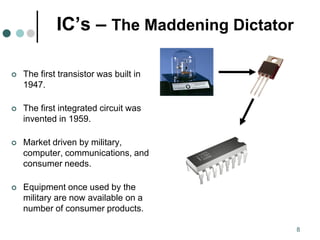
 The first transistor was built in
1947.
 The first integrated circuit was
invented in 1959.
 Market driven by military,
computer, communications, and
consumer needs.
 Equipment once used by the
military are now available on a
number of consumer products.
9
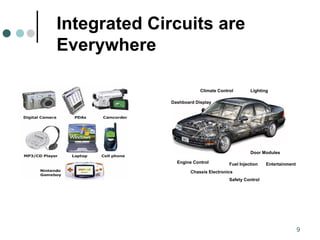
Integrated Circuits are
Everywhere
Engine Control
Climate Control
Dashboard Display
Chassis Electronics
Lighting
Door Modules
Fuel Injection Entertainment
Safety Control
10
An issue of concern –
The Power Consumption
 Desktop consumption has
reached 100 watts
 Total Personal Computer (400
million) energy usage in 2000
= 26 nuclear power plants
 2.4 Billion Computers in 2013
= How much energy usage ???
 Power is the bottleneck of
improving the system
performance
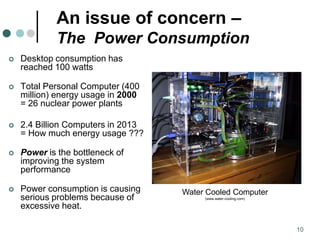
 Power consumption is causing
serious problems because of
excessive heat.
Water Cooled Computer
(www.water-cooling.com)
11
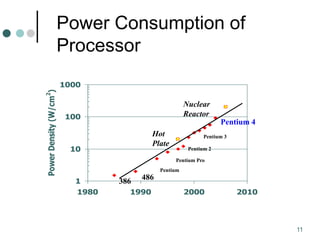
Power Consumption of
Processor
1
10
100
1000
1980 1990 2000 2010
PowerDensity(W/cm2
)
Hot
Plate
Nuclear
Reactor
386 486
Pentium
Pentium Pro
Pentium 2
Pentium 3
Pentium 4
12
The Current Situation
 Energy provisioning is arguably the most important
business, geo-political, and societal issue of our time
 Global Warming is influencing policies and laws which
require energy usage and greenhouse emissions to be
measured and controlled

 The cost of energy and increases in IT power
requirements present significant expense, supply, and
handling challenges for data centers
•“Intelligent Energy” Dr. Bernard S. Meyerson, IBM Fellow, VP Strategic Alliances and CTO, IBM
Systems & Technology Group, on ASE – Great Energy Efficiency Day, February 14, 2007 - Washington,
DC
13
Power Consumption
 As circuit speed increases, power consumption
grows
 Designing low power circuits has been the most
important issue
 Mobile applications demand long battery life
 Low power consumption is listed as the second
greatest challenge for the industry
What we can do?
 Do not use Computers? ????
 Can we afford to do this?
 Energy-efficient Computers
 What we can do as a Application
Developer –
 Develop energy efficient Algorithms
 Develop energy-efficient Programs
14
Green Computers - Energy efficient
Machines are now need of the Hour
 CPU Intel i3 Third Generation
consumes 35W
 CPU Intel i3 Fourth Generation
consumes 15W
 CPU Intel i5 Fifth Generation consumes
15W
 CPU AMD 6402 consumes 15W
15
16
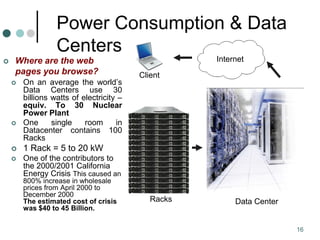
Power Consumption & Data
Centers
 On an average the world’s
Data Centers use 30
billions watts of electricity –
equiv. To 30 Nuclear
Power Plant
 One single room in
Datacenter contains 100
Racks
 1 Rack = 5 to 20 kW
 One of the contributors to
the 2000/2001 California
Energy Crisis This caused an
800% increase in wholesale
prices from April 2000 to
December 2000
The estimated cost of crisis
was $40 to 45 Billion.
Internet
Racks
Client
 Where are the web
pages you browse?
Data Center
17
Green Computing
 In order to achieve sustainable computing, we need
to rethink from a “Green Computing” perspective.
 Green Computing:
 Maximize energy efficiency
 Reduce of the use of hazardous materials such as lead
 Maximize recyclability of both a defunct product and of any
factory waste.
 “Green Computing” in view of energy efficiency at
the nanometer scale - design low power
consumption integrated circuits at 180nm and
below.
18
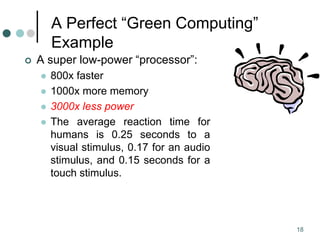
A Perfect “Green Computing”
Example
 A super low-power “processor”:
 800x faster
 1000x more memory
 3000x less power
 The average reaction time for
humans is 0.25 seconds to a
visual stimulus, 0.17 for an audio
stimulus, and 0.15 seconds for a
touch stimulus.
19
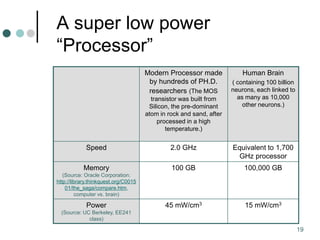
A super low power
“Processor”
Modern Processor made
by hundreds of PH.D.
researchers (The MOS
transistor was built from
Silicon, the pre-dominant
atom in rock and sand, after
processed in a high
temperature.)
Human Brain
( containing 100 billion
neurons, each linked to
as many as 10,000
other neurons.)
Speed 2.0 GHz Equivalent to 1,700
GHz processor
Memory
(Source: Oracle Corporation:
http://library.thinkquest.org/C0015
01/the_saga/compare.htm,
computer vs. brain)
100 GB 100,000 GB
Power
(Source: UC Berkeley, EE241
class)
45 mW/cm3 15 mW/cm3
20
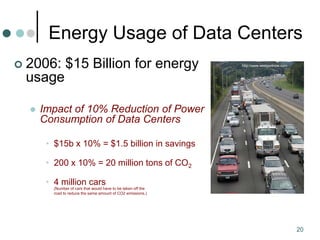
Energy Usage of Data Centers
 2006: $15 Billion for energy
usage
 Impact of 10% Reduction of Power
Consumption of Data Centers
• $15b x 10% = $1.5 billion in savings
• 200 x 10% = 20 million tons of CO2
• 4 million cars
(Number of cars that would have to be taken off the
road to reduce the same amount of CO2 emissions.)
http://www.westportnow.com
21
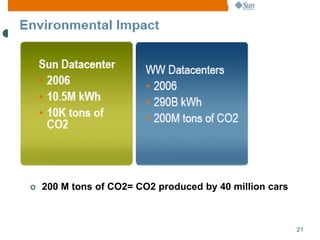
 200 M tons of CO2= CO2 produced by 40 million cars
22
What can we do about
power?
 Understand all levels of the computer
 Understand where power is dissipated
 Think about ways to reduce power
usage at all levels
23
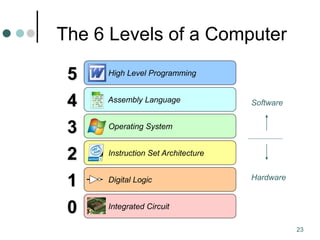
The 6 Levels of a Computer
Integrated Circuit
Digital Logic
Instruction Set Architecture
Operating System
Assembly Language
High Level Programming5
4
3
2
1
0
Hardware
Software
24
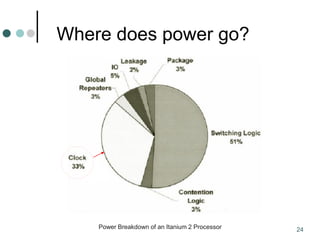
Where does power go?
Power Breakdown of an Itanium 2 Processor
Apr. 01, 2008 25
The Need for Both Sides
“The performance of software systems is dramatically
affected by how well software designers understand the
basic hardware technologies at work in a system. Similarly,
hardware designers must understand the far-reaching effects
their design decisions have on software applications.”
- John Hennessy, President of Stanford University
& David Patterson, UC Berkeley, President of ACM
“[Students] should know the device, layout, circuit, architecture,
algorithm, and system-6 levels.”
- Dr. Mehdi Hatamian, V.P, Broadcom, Nov.2006
26
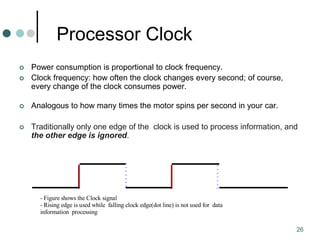
Processor Clock
 Power consumption is proportional to clock frequency.
 Clock frequency: how often the clock changes every second; of course,
every change of the clock consumes power.
 Analogous to how many times the motor spins per second in your car.
 Traditionally only one edge of the clock is used to process information, and
the other edge is ignored.
- Figure shows the Clock signal
- Rising edge is used while falling clock edge(dot line) is not used for data
information processing
27
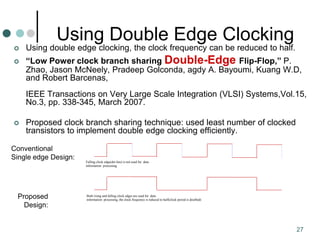
Using Double Edge Clocking
 Using double edge clocking, the clock frequency can be reduced to half.
 “Low Power clock branch sharing Double-Edge Flip-Flop,” P.
Zhao, Jason McNeely, Pradeep Golconda, agdy A. Bayoumi, Kuang W.D,
and Robert Barcenas,
IEEE Transactions on Very Large Scale Integration (VLSI) Systems,Vol.15,
No.3, pp. 338-345, March 2007.
 Proposed clock branch sharing technique: used least number of clocked
transistors to implement double edge clocking efficiently.
Falling clock edge(dot line) is not used for data
information processing
Both rising and falling clock edges are used for data
information processing, the clock frequency is reduced to half(clock period is doulbed)
Conventional
Single edge Design:
Proposed
Design:
28
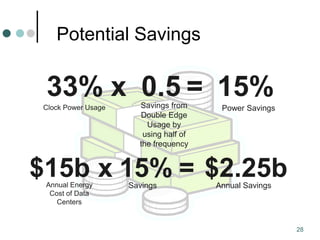
Potential Savings
Clock Power Usage Power SavingsSavings from
Double Edge
Usage by
using half of
the frequency
33% 0.5 15%x =
Annual Energy
Cost of Data
Centers
Annual SavingsSavings
$15b 15% $2.25bx =
29
Thank You!
Prof. Sunil Kr Pandey
Professor & Director (IT)
Institute of Technology & Science
Mohan Nagar, Ghaziabad, India
E-Mail:
sunilpandey@its.edu.in
sunil_pandey_97@yahoo.com

Green Commputing - Paradigm Shift in Computing Technology, ICT & its Applications - Socioeconomic and Environmental Perspective

  • 1.
    Paradigm Shift inComputing Technology, ICT & its Applications - Socio-economic and Environmental Perspective at Gajadhar Bhagat College (Bhagalpur University) on 12th September, 2014 Dr. Sunil Kr Pandey MCA, Ph.D. Department of Information Technology Institute of Technology & Science (ITS) Ghaziabad (Affiliated to U.P. Technical University, Lucknow)
  • 2.
    2 Shift in Paradigms Past few decades, in the context of Information Technology (IT), word have witnessed a paradigm shift from: • Mainframes to Tablets • Our interactions with the devices have been changing from Batch computing (mainframes), time-sharing (minis), personal computing (PCs), to mobile computing (laptops, tablets, smart phones) and now to clouds. • In each generation, the infrastructure, the way we interact with these computers, and how we use these, have been changing unprecedented. • The arrival of web have changed the model of building applications by enabling everyone to become a content producer.
  • 3.
    How the Technologyis Impacting!  It is evident from the fact that:  in 1930, it used to take about 70 years to double the worldwide information  in 1970 it was reduced to 30 yrs, and  it is projected that by 2015, this will take place at every 11 Hrs.  In this scenario, amount of data is being posed is enormous and our conventional methods of storage, manipulation and analysis are being challenged very frequently  This is posing the new challenges of:  developing newer algorithms  processing tools  storage and access methods  To cope up with this increased volume of data without compromising with the quality and performance of the applications. 3
  • 4.
    Technology Ahead Over thenext few years, we can expect different trends which will include: Location awareness Context awareness Augmented Reality etc. Sensors and little devices start talking to each other and to mobile devices and to the cloud. To leverage these emerging trends, we need to keep close watch on these developments and understand the challenges these developments are posing on us. 4
  • 5.
    ICT & Environment ICTs, fundamentally affect the way people live and work and how goods and services are produced and delivered.  Green ICTs are those that have positive impacts on environmental performance and ecosystems, either :  directly by reducing physical and energy inputs in their production use, disposal and recycling or  indirectly through their wider application and use in other equipment and systems.  ICTs and their applications can have both positive and negative impacts on the environment. For example:  reductions in greenhouse gas emissions associated with ICT applications to improve energy efficiency in buildings  transport systems or electricity distribution must be balanced against increased emissions resulting from their development  production and operation and potential environmental degradation associated with their uncontrolled disposal  They offer opportunities to significantly improve environmental performance, but at the same time the proliferation of electronic equipment and applications increases energy consumption, exhausts scarce resources, and increases disposal and recycling challenges. 5
  • 6.
    Levels of ICTImpacts on the Environment 1. Direct Impacts:  Direct impacts of ICTs on the environment (“first-order effects”) refer to positive and negative impacts due directly to ICT goods and services and related processes.  Direct environmental impacts of ICT products come from ICT manufacturing and services producing firms and related intermediate goods producers, and from final consumers and users of ICTs.  ICT producers affect the natural environment during ICT goods and services production and through related operations (e.g., operating infrastructures, building functions, vehicle fleets and logistics).  All of these production operations can have more or less environmental impacts. 6
  • 7.
    Contd….  Consumers canchoose energy-efficient and certified “green” ICT equipment over other products.  At the end of a product’s initial useful life, they can choose to return equipment for re-use and recycling, adopting “cradle-to-cradle” approaches to their purchase and disposal of ICT goods and services.  This lowers the burden on the natural environment compared to disposal in a landfill, incineration or uncontrolled dumping in developing countries. 7
  • 8.
    8 IC’s – TheMaddening Dictator  The first transistor was built in 1947.  The first integrated circuit was invented in 1959.  Market driven by military, computer, communications, and consumer needs.  Equipment once used by the military are now available on a number of consumer products.
  • 9.
    9 Integrated Circuits are Everywhere EngineControl Climate Control Dashboard Display Chassis Electronics Lighting Door Modules Fuel Injection Entertainment Safety Control
  • 10.
    10 An issue ofconcern – The Power Consumption  Desktop consumption has reached 100 watts  Total Personal Computer (400 million) energy usage in 2000 = 26 nuclear power plants  2.4 Billion Computers in 2013 = How much energy usage ???  Power is the bottleneck of improving the system performance  Power consumption is causing serious problems because of excessive heat. Water Cooled Computer (www.water-cooling.com)
  • 11.
    11 Power Consumption of Processor 1 10 100 1000 19801990 2000 2010 PowerDensity(W/cm2 ) Hot Plate Nuclear Reactor 386 486 Pentium Pentium Pro Pentium 2 Pentium 3 Pentium 4
  • 12.
    12 The Current Situation Energy provisioning is arguably the most important business, geo-political, and societal issue of our time  Global Warming is influencing policies and laws which require energy usage and greenhouse emissions to be measured and controlled   The cost of energy and increases in IT power requirements present significant expense, supply, and handling challenges for data centers •“Intelligent Energy” Dr. Bernard S. Meyerson, IBM Fellow, VP Strategic Alliances and CTO, IBM Systems & Technology Group, on ASE – Great Energy Efficiency Day, February 14, 2007 - Washington, DC
  • 13.
    13 Power Consumption  Ascircuit speed increases, power consumption grows  Designing low power circuits has been the most important issue  Mobile applications demand long battery life  Low power consumption is listed as the second greatest challenge for the industry
  • 14.
    What we cando?  Do not use Computers? ????  Can we afford to do this?  Energy-efficient Computers  What we can do as a Application Developer –  Develop energy efficient Algorithms  Develop energy-efficient Programs 14
  • 15.
    Green Computers -Energy efficient Machines are now need of the Hour  CPU Intel i3 Third Generation consumes 35W  CPU Intel i3 Fourth Generation consumes 15W  CPU Intel i5 Fifth Generation consumes 15W  CPU AMD 6402 consumes 15W 15
  • 16.
    16 Power Consumption &Data Centers  On an average the world’s Data Centers use 30 billions watts of electricity – equiv. To 30 Nuclear Power Plant  One single room in Datacenter contains 100 Racks  1 Rack = 5 to 20 kW  One of the contributors to the 2000/2001 California Energy Crisis This caused an 800% increase in wholesale prices from April 2000 to December 2000 The estimated cost of crisis was $40 to 45 Billion. Internet Racks Client  Where are the web pages you browse? Data Center
  • 17.
    17 Green Computing  Inorder to achieve sustainable computing, we need to rethink from a “Green Computing” perspective.  Green Computing:  Maximize energy efficiency  Reduce of the use of hazardous materials such as lead  Maximize recyclability of both a defunct product and of any factory waste.  “Green Computing” in view of energy efficiency at the nanometer scale - design low power consumption integrated circuits at 180nm and below.
  • 18.
    18 A Perfect “GreenComputing” Example  A super low-power “processor”:  800x faster  1000x more memory  3000x less power  The average reaction time for humans is 0.25 seconds to a visual stimulus, 0.17 for an audio stimulus, and 0.15 seconds for a touch stimulus.
  • 19.
    19 A super lowpower “Processor” Modern Processor made by hundreds of PH.D. researchers (The MOS transistor was built from Silicon, the pre-dominant atom in rock and sand, after processed in a high temperature.) Human Brain ( containing 100 billion neurons, each linked to as many as 10,000 other neurons.) Speed 2.0 GHz Equivalent to 1,700 GHz processor Memory (Source: Oracle Corporation: http://library.thinkquest.org/C0015 01/the_saga/compare.htm, computer vs. brain) 100 GB 100,000 GB Power (Source: UC Berkeley, EE241 class) 45 mW/cm3 15 mW/cm3
  • 20.
    20 Energy Usage ofData Centers  2006: $15 Billion for energy usage  Impact of 10% Reduction of Power Consumption of Data Centers • $15b x 10% = $1.5 billion in savings • 200 x 10% = 20 million tons of CO2 • 4 million cars (Number of cars that would have to be taken off the road to reduce the same amount of CO2 emissions.) http://www.westportnow.com
  • 21.
    21  200 Mtons of CO2= CO2 produced by 40 million cars
  • 22.
    22 What can wedo about power?  Understand all levels of the computer  Understand where power is dissipated  Think about ways to reduce power usage at all levels
  • 23.
    23 The 6 Levelsof a Computer Integrated Circuit Digital Logic Instruction Set Architecture Operating System Assembly Language High Level Programming5 4 3 2 1 0 Hardware Software
  • 24.
    24 Where does powergo? Power Breakdown of an Itanium 2 Processor
  • 25.
    Apr. 01, 200825 The Need for Both Sides “The performance of software systems is dramatically affected by how well software designers understand the basic hardware technologies at work in a system. Similarly, hardware designers must understand the far-reaching effects their design decisions have on software applications.” - John Hennessy, President of Stanford University & David Patterson, UC Berkeley, President of ACM “[Students] should know the device, layout, circuit, architecture, algorithm, and system-6 levels.” - Dr. Mehdi Hatamian, V.P, Broadcom, Nov.2006
  • 26.
    26 Processor Clock  Powerconsumption is proportional to clock frequency.  Clock frequency: how often the clock changes every second; of course, every change of the clock consumes power.  Analogous to how many times the motor spins per second in your car.  Traditionally only one edge of the clock is used to process information, and the other edge is ignored. - Figure shows the Clock signal - Rising edge is used while falling clock edge(dot line) is not used for data information processing
  • 27.
    27 Using Double EdgeClocking  Using double edge clocking, the clock frequency can be reduced to half.  “Low Power clock branch sharing Double-Edge Flip-Flop,” P. Zhao, Jason McNeely, Pradeep Golconda, agdy A. Bayoumi, Kuang W.D, and Robert Barcenas, IEEE Transactions on Very Large Scale Integration (VLSI) Systems,Vol.15, No.3, pp. 338-345, March 2007.  Proposed clock branch sharing technique: used least number of clocked transistors to implement double edge clocking efficiently. Falling clock edge(dot line) is not used for data information processing Both rising and falling clock edges are used for data information processing, the clock frequency is reduced to half(clock period is doulbed) Conventional Single edge Design: Proposed Design:
  • 28.
    28 Potential Savings Clock PowerUsage Power SavingsSavings from Double Edge Usage by using half of the frequency 33% 0.5 15%x = Annual Energy Cost of Data Centers Annual SavingsSavings $15b 15% $2.25bx =
  • 29.
    29 Thank You! Prof. SunilKr Pandey Professor & Director (IT) Institute of Technology & Science Mohan Nagar, Ghaziabad, India E-Mail: sunilpandey@its.edu.in sunil_pandey_97@yahoo.com