INDICES AND
STANDARD FORM
Mathematics
INDICES
2
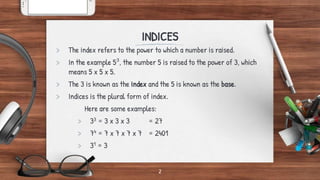
> The index refers to the power to which a number is raised.
> In the example 5³, the number 5 is raised to the power of 3, which
means 5 x 5 x 5.
> The 3 is known as the index and the 5 is known as the base.
> Indices is the plural form of index.
Here are some examples:
> 33 = 3 x 3 x 3 = 27
> 74 = 7 x 7 x 7 x 7 = 2401
> 31 = 3
LAWS OF INDICES
3
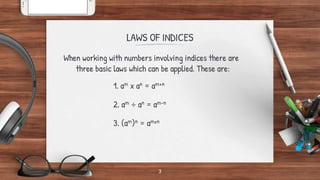
When working with numbers involving indices there are
three basic laws which can be applied. These are:
1. am x an = am+n
2. am ÷ an = am-n
3. (am)n = amxn
Worked examples
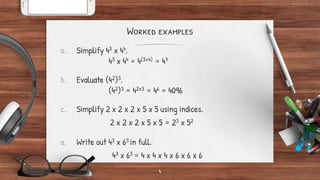
a. Simplify 43 x 44.
43 x 44 = 4(3+4) = 47
b. Evaluate (42)3.
(42)3 = 42x3 = 46 = 4096
c. Simplify 2 x 2 x 2 x 5 x 5 using indices.
2 x 2 x 2 x 5 x 5 = 23 x 52
a. Write out 43 x 63 in full.
43 x 63 = 4 x 4 x 4 x 6 x 6 x 6
4
The Zero Index
5
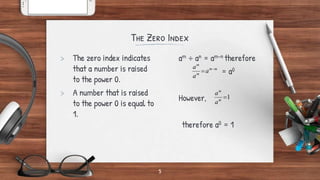
> The zero index indicates
that a number is raised
to the power 0.
> A number that is raised
to the power 0 is equal to
1.
am ÷ an = am-n therefore
= a0
However,
therefore a0 = 1
m
m
m
m
a
a
a 

1

m
m
a
a
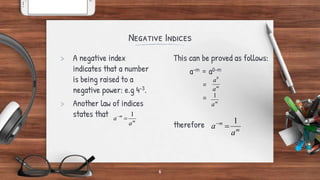
Negative Indices
6
> A negative index
indicates that a number
is being raised to a
negative power: e.g 4-3.
> Another law of indices
states that
This can be proved as follows:
a-m = a0-m
=
=
therefore
m
a
a0
m
m
a
a
1


m
m
a
a
1


m
a
1
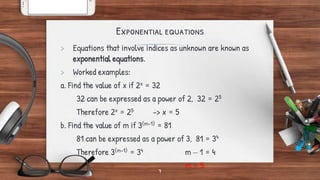
Exponential equations
> Equations that involve indices as unknown are known as
exponential equations.
> Worked examples:
a. Find the value of x if 2x = 32
32 can be expressed as a power of 2, 32 = 25
Therefore 2x = 25 -> x = 5
b. Find the value of m if 3(m-1) = 81
81 can be expressed as a power of 3, 81 = 34
Therefore 3(m-1) = 34 m – 1 = 4
m = 5
7
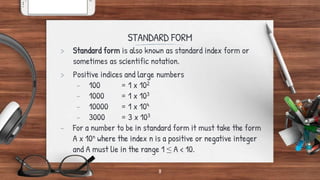
STANDARD FORM
> Standard form is also known as standard index form or
sometimes as scientific notation.
> Positive indices and large numbers
- 100 = 1 x 10²
- 1000 = 1 x 10³
- 10000 = 1 x 10⁴
- 3000 = 3 x 10³
- For a number to be in standard form it must take the form
A x 10n where the index n is a positive or negative integer
and A must lie in the range 1 ≤ A < 10.
8
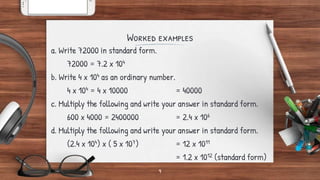
Worked examples
a. Write 72000 in standard form.
72000 = 7.2 x 10⁴
b. Write 4 x 10⁴ as an ordinary number.
4 x 104 = 4 x 10000 = 40000
c. Multiply the following and write your answer in standard form.
600 x 4000 = 2400000 = 2.4 x 10⁶
d. Multiply the following and write your answer in standard form.
(2.4 x 10⁴) x ( 5 x 10⁷) = 12 x 1011
= 1.2 x 10¹² (standard form)
9
Worked examples
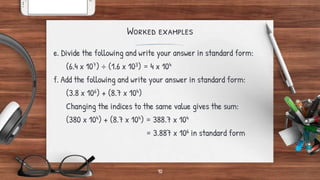
e. Divide the following and write your answer in standard form:
(6.4 x 10⁷) ÷ (1.6 x 10³) = 4 x 10⁴
f. Add the following and write your answer in standard form:
(3.8 x 10⁶) + (8.7 x 10⁴)
Changing the indices to the same value gives the sum:
(380 x 104) + (8.7 x 10⁴) = 388.7 x 104
= 3.887 x 10⁶ in standard form
10
Worked examples
g. Subtract the following and write your answer in standard form:
(6.5 x 10⁷) – (9.2 x 10⁵)
Changing the indices to the same value gives the sum:
(650 x 105) – (9.2 x 10⁵) = 640.8 x 105
= 6.408 x 10⁷ in standard form
11
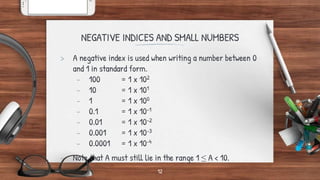
NEGATIVE INDICES AND SMALL NUMBERS
> A negative index is used when writing a number between 0
and 1 in standard form.
- 100 = 1 x 10²
- 10 = 1 x 101
- 1 = 1 x 100
- 0.1 = 1 x 10⁻¹
- 0.01 = 1 x 10⁻²
- 0.001 = 1 x 10⁻³
- 0.0001 = 1 x 10⁻⁴
- Note that A must still lie in the range 1 ≤ A < 10.
12
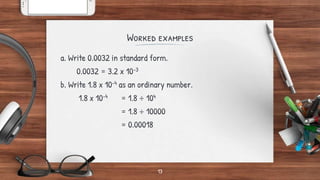
Worked examples
a. Write 0.0032 in standard form.
0.0032 = 3.2 x 10⁻³
b. Write 1.8 x 10⁻⁴ as an ordinary number.
1.8 x 10-4 = 1.8 ÷ 104
= 1.8 ÷ 10000
= 0.00018
13
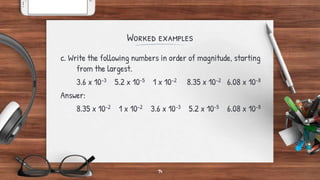
Worked examples
c. Write the following numbers in order of magnitude, starting
from the largest.
3.6 x 10⁻³ 5.2 x 10⁻⁵ 1 x 10⁻² 8.35 x 10⁻² 6.08 x 10⁻⁸
Answer:
8.35 x 10⁻² 1 x 10⁻² 3.6 x 10⁻³ 5.2 x 10⁻⁵ 6.08 x 10⁻⁸
14
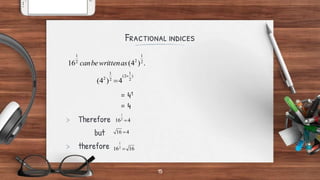
Fractional indices
= 41
= 4
> Therefore
but
> therefore
15
.
)
4
(
16 2
1
2
2
1
as
written
be
can
)
2
1
2
(
2
1
2
4
)
4
(


4
162
1

16
162
1

4
16 
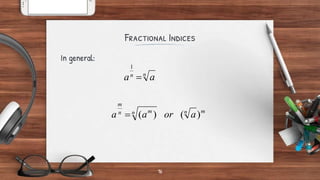
Fractional Indices
In general:
16
n
n
a
a 
1
m
n
n m
n
m
a
or
a
a )
(
)
(

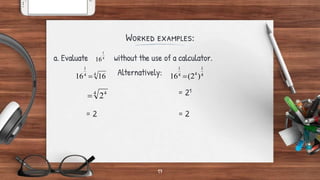
Worked examples:
a. Evaluate without the use of a calculator.
Alternatively:
= 21
= 2 = 2
17
4
4
1
16
16 
4
1
16
4 4
2

4
1
4
4
1
)
2
(
16 
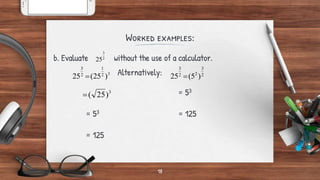
Worked examples:
b. Evaluate without the use of a calculator.
Alternatively:
= 53
= 53 = 125
= 125
18
3
2
1
2
3
)
25
(
25 
2
3
25
3
)
25
(

2
3
2
2
3
)
5
(
25 
Worked examples
c. Solve 32x = 2
32 is 25 so
or
therefore
d. Solve 125x = 5
125 is 53 so
or
therefore
19
2
32
5

2
325
1

5
1

x
5
125
3

5
1253
1

3
1

x
20
Thanks!

INDICES AND STANDARD FORM.pptx

  • 1.
  • 2.
    INDICES 2 > The indexrefers to the power to which a number is raised. > In the example 5³, the number 5 is raised to the power of 3, which means 5 x 5 x 5. > The 3 is known as the index and the 5 is known as the base. > Indices is the plural form of index. Here are some examples: > 33 = 3 x 3 x 3 = 27 > 74 = 7 x 7 x 7 x 7 = 2401 > 31 = 3
  • 3.
    LAWS OF INDICES 3 Whenworking with numbers involving indices there are three basic laws which can be applied. These are: 1. am x an = am+n 2. am ÷ an = am-n 3. (am)n = amxn
  • 4.
    Worked examples a. Simplify43 x 44. 43 x 44 = 4(3+4) = 47 b. Evaluate (42)3. (42)3 = 42x3 = 46 = 4096 c. Simplify 2 x 2 x 2 x 5 x 5 using indices. 2 x 2 x 2 x 5 x 5 = 23 x 52 a. Write out 43 x 63 in full. 43 x 63 = 4 x 4 x 4 x 6 x 6 x 6 4
  • 5.
    The Zero Index 5 >The zero index indicates that a number is raised to the power 0. > A number that is raised to the power 0 is equal to 1. am ÷ an = am-n therefore = a0 However, therefore a0 = 1 m m m m a a a   1  m m a a
  • 6.
    Negative Indices 6 > Anegative index indicates that a number is being raised to a negative power: e.g 4-3. > Another law of indices states that This can be proved as follows: a-m = a0-m = = therefore m a a0 m m a a 1   m m a a 1   m a 1
  • 7.
    Exponential equations > Equationsthat involve indices as unknown are known as exponential equations. > Worked examples: a. Find the value of x if 2x = 32 32 can be expressed as a power of 2, 32 = 25 Therefore 2x = 25 -> x = 5 b. Find the value of m if 3(m-1) = 81 81 can be expressed as a power of 3, 81 = 34 Therefore 3(m-1) = 34 m – 1 = 4 m = 5 7
  • 8.
    STANDARD FORM > Standardform is also known as standard index form or sometimes as scientific notation. > Positive indices and large numbers - 100 = 1 x 10² - 1000 = 1 x 10³ - 10000 = 1 x 10⁴ - 3000 = 3 x 10³ - For a number to be in standard form it must take the form A x 10n where the index n is a positive or negative integer and A must lie in the range 1 ≤ A < 10. 8
  • 9.
    Worked examples a. Write72000 in standard form. 72000 = 7.2 x 10⁴ b. Write 4 x 10⁴ as an ordinary number. 4 x 104 = 4 x 10000 = 40000 c. Multiply the following and write your answer in standard form. 600 x 4000 = 2400000 = 2.4 x 10⁶ d. Multiply the following and write your answer in standard form. (2.4 x 10⁴) x ( 5 x 10⁷) = 12 x 1011 = 1.2 x 10¹² (standard form) 9
  • 10.
    Worked examples e. Dividethe following and write your answer in standard form: (6.4 x 10⁷) ÷ (1.6 x 10³) = 4 x 10⁴ f. Add the following and write your answer in standard form: (3.8 x 10⁶) + (8.7 x 10⁴) Changing the indices to the same value gives the sum: (380 x 104) + (8.7 x 10⁴) = 388.7 x 104 = 3.887 x 10⁶ in standard form 10
  • 11.
    Worked examples g. Subtractthe following and write your answer in standard form: (6.5 x 10⁷) – (9.2 x 10⁵) Changing the indices to the same value gives the sum: (650 x 105) – (9.2 x 10⁵) = 640.8 x 105 = 6.408 x 10⁷ in standard form 11
  • 12.
    NEGATIVE INDICES ANDSMALL NUMBERS > A negative index is used when writing a number between 0 and 1 in standard form. - 100 = 1 x 10² - 10 = 1 x 101 - 1 = 1 x 100 - 0.1 = 1 x 10⁻¹ - 0.01 = 1 x 10⁻² - 0.001 = 1 x 10⁻³ - 0.0001 = 1 x 10⁻⁴ - Note that A must still lie in the range 1 ≤ A < 10. 12
  • 13.
    Worked examples a. Write0.0032 in standard form. 0.0032 = 3.2 x 10⁻³ b. Write 1.8 x 10⁻⁴ as an ordinary number. 1.8 x 10-4 = 1.8 ÷ 104 = 1.8 ÷ 10000 = 0.00018 13
  • 14.
    Worked examples c. Writethe following numbers in order of magnitude, starting from the largest. 3.6 x 10⁻³ 5.2 x 10⁻⁵ 1 x 10⁻² 8.35 x 10⁻² 6.08 x 10⁻⁸ Answer: 8.35 x 10⁻² 1 x 10⁻² 3.6 x 10⁻³ 5.2 x 10⁻⁵ 6.08 x 10⁻⁸ 14
  • 15.
    Fractional indices = 41 =4 > Therefore but > therefore 15 . ) 4 ( 16 2 1 2 2 1 as written be can ) 2 1 2 ( 2 1 2 4 ) 4 (   4 162 1  16 162 1  4 16 
  • 16.
    Fractional Indices In general: 16 n n a a 1 m n n m n m a or a a ) ( ) ( 
  • 17.
    Worked examples: a. Evaluatewithout the use of a calculator. Alternatively: = 21 = 2 = 2 17 4 4 1 16 16  4 1 16 4 4 2  4 1 4 4 1 ) 2 ( 16 
  • 18.
    Worked examples: b. Evaluatewithout the use of a calculator. Alternatively: = 53 = 53 = 125 = 125 18 3 2 1 2 3 ) 25 ( 25  2 3 25 3 ) 25 (  2 3 2 2 3 ) 5 ( 25 
  • 19.
    Worked examples c. Solve32x = 2 32 is 25 so or therefore d. Solve 125x = 5 125 is 53 so or therefore 19 2 32 5  2 325 1  5 1  x 5 125 3  5 1253 1  3 1  x
  • 20.