Appellate Practice & ProcedureClass #4:Handling an Appeal—Preparing Briefs (Part I)presented byD. Todd Smithhttp://texasappellatelawblog.comforSolo Practice University™
Introduction	Most appeals are won or lost on the briefing (aside from merits)	Purpose of brief is to persuade the court that your client should win	Focus today on basic strategies and appellant’s brief
The Basics	Legal writing ability is essential	Briefs should be brief; rarely approach page limits	Write for the justices, not yourself or your client	Use proper cite form	Go for helpful over adversarial
The Basics (cont’d)	Don’t assume the justices know the law, but don’t talk down to them, either	Favor party names over “alphabet soup” and “Appellant” or “Appellee” 		Edit, edit, edit!	If you can, put the brief down for a few days, then edit some more
The Basics (cont’d)	Have someone else proofread and cite-check	Have the brief copied and bound	As always, know and follow your jurisdiction’s rules, and be mindful of local practices
Appellant’s Brief
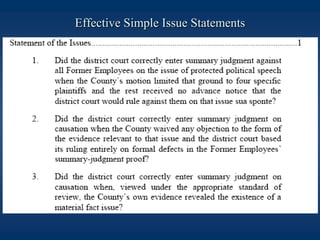
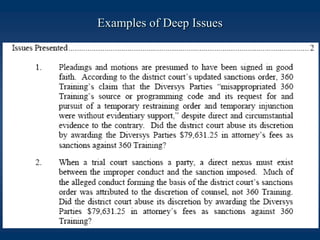
Issue Selection	Limit to 2 or 3 issues or points of error if possible	More than 3 puts lawyer’s credibility at risk	Simple statements/questions v. “deep issues”—largely a matter of preference or what court rules require	But avoid generic issues like “Did the trial court err by granting summary judgment for the defendant?”
Effective Simple Issue Statements
Examples of Deep Issues
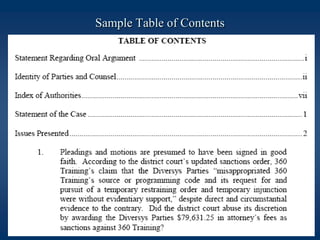
Tables/Indexes	First opportunity for advocacy	Correctness in formatting, cite form, etc. important	Restate issues and argument outline; previews what the case is about and kick-starts justices’ thinking	Insert last, after all editing is complete
Sample Table of Contents
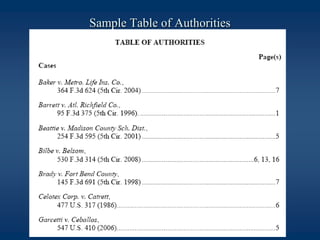
Sample Table of Authorities
Statement of Facts	Tell a story	Think thorough, but short—just enough to cover what is necessary to understand and decide the case	Disclose bad facts to protect credibility, but minimize their importance to the story	Avoid argument, but nothing wrong with phrasing favorably and persuasively if true to the record
Standards of Review	Abuse of discretion, plain error, de novo, etc.	A credible appellant’s brief will address them; good ones embrace them	Don’t just tell the appellate court that reversal is warranted because the standard is met; show it why
Summary of the ArgumentPrepare it near end of briefing process, right before tables/indexes	Distill your positions down to a few paragraphs	Justices will often read this section first
Argument and Authorities	Lead with the strongest, procedurally (rendition v. remand) and substantively	Rely on the strongest authorities you can find (i.e., case law from the highest relevant court and the court deciding the appeal) 	Confront weaknesses and authority contrary to your client’s position and explain how you overcome them
Argument and Authorities (cont’d)	Break text up with headings at least every few pages	Roman numeral outlines are an effective tool for organizing arguments and transitioning	Weave relevant facts into legal argument	Avoid substantive footnotes; usually, if an argument is worth including at all, it should go in the text
Relief Requested	Consider carefully what you want the court to do	Ask for that relief specifically and, if appropriate, in the alternative	As the appellant, you should request:reversal and rendition of judgment favoring your client;
reversal and modification of the trial court’s judgment; or
reversal and remand for further proceedings (i.e., new trial)Sample Briefs	Some are available through my JD Supra profile	I will be adding to my library in the coming months
Questions?	“Stop by” during office hours 	Participate in the official study group	Visit the Appellate Discussion Lounge
Next Time . . .

SPU #4

  • 1.
    Appellate Practice &ProcedureClass #4:Handling an Appeal—Preparing Briefs (Part I)presented byD. Todd Smithhttp://texasappellatelawblog.comforSolo Practice University™
  • 2.
    Introduction Most appeals arewon or lost on the briefing (aside from merits) Purpose of brief is to persuade the court that your client should win Focus today on basic strategies and appellant’s brief
  • 3.
    The Basics Legal writingability is essential Briefs should be brief; rarely approach page limits Write for the justices, not yourself or your client Use proper cite form Go for helpful over adversarial
  • 4.
    The Basics (cont’d) Don’tassume the justices know the law, but don’t talk down to them, either Favor party names over “alphabet soup” and “Appellant” or “Appellee” Edit, edit, edit! If you can, put the brief down for a few days, then edit some more
  • 5.
    The Basics (cont’d) Havesomeone else proofread and cite-check Have the brief copied and bound As always, know and follow your jurisdiction’s rules, and be mindful of local practices
  • 6.
  • 7.
    Issue Selection Limit to2 or 3 issues or points of error if possible More than 3 puts lawyer’s credibility at risk Simple statements/questions v. “deep issues”—largely a matter of preference or what court rules require But avoid generic issues like “Did the trial court err by granting summary judgment for the defendant?”
  • 8.
  • 9.
  • 10.
    Tables/Indexes First opportunity foradvocacy Correctness in formatting, cite form, etc. important Restate issues and argument outline; previews what the case is about and kick-starts justices’ thinking Insert last, after all editing is complete
  • 11.
  • 12.
    Sample Table ofAuthorities
  • 13.
    Statement of Facts Tella story Think thorough, but short—just enough to cover what is necessary to understand and decide the case Disclose bad facts to protect credibility, but minimize their importance to the story Avoid argument, but nothing wrong with phrasing favorably and persuasively if true to the record
  • 14.
    Standards of Review Abuseof discretion, plain error, de novo, etc. A credible appellant’s brief will address them; good ones embrace them Don’t just tell the appellate court that reversal is warranted because the standard is met; show it why
  • 15.
    Summary of theArgumentPrepare it near end of briefing process, right before tables/indexes Distill your positions down to a few paragraphs Justices will often read this section first
  • 16.
    Argument and Authorities Leadwith the strongest, procedurally (rendition v. remand) and substantively Rely on the strongest authorities you can find (i.e., case law from the highest relevant court and the court deciding the appeal) Confront weaknesses and authority contrary to your client’s position and explain how you overcome them
  • 17.
    Argument and Authorities(cont’d) Break text up with headings at least every few pages Roman numeral outlines are an effective tool for organizing arguments and transitioning Weave relevant facts into legal argument Avoid substantive footnotes; usually, if an argument is worth including at all, it should go in the text
  • 18.
    Relief Requested Consider carefullywhat you want the court to do Ask for that relief specifically and, if appropriate, in the alternative As the appellant, you should request:reversal and rendition of judgment favoring your client;
  • 19.
    reversal and modificationof the trial court’s judgment; or
  • 20.
    reversal and remandfor further proceedings (i.e., new trial)Sample Briefs Some are available through my JD Supra profile I will be adding to my library in the coming months
  • 21.
    Questions? “Stop by” duringoffice hours Participate in the official study group Visit the Appellate Discussion Lounge
  • 22.