Student Assignment
Feedback
Some areas commonly in need of attention
What went wrong?
How can I improve?
Feedback
Plan
Implement
Reflect
Review
Improve
Where is the feedback?
This is feedback
Your paper is marked up
Your result is given according to a
rubric
Discussions in class
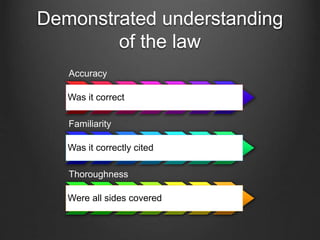
Demonstrated understanding
of the law
Accuracy
Was it correct
Familiarity
Was it correctly cited
Thoroughness
Were all sides covered
Examples of unfamiliarity with
the law: case law
Quoting a judge who does not exist
Asserting a statement of law from a case – where the
case did not find that. For example:
Re Edwards found a possessory interest, not a proprietary
interest
Referring to Supreme Court when citing a High Court
decision
Unfamiliarity with the law:
legislation
For involving state jurisdiction, each Australian jurisdiction
is likely to have legislation governing the issue.
Demonstrate your understanding of the issue by
identifying this, and justifying your use of a particular
example.
Eg: organ transplants are covered by most jurisdictions.
Identify the jurisdiction of the legislation you cite
Clarify that there are equivalent provisions in other
jurisdictions
Research
How wide; how deep; what quality…
Sources
Varied? Authoritative? Cited?
Second-
hand?
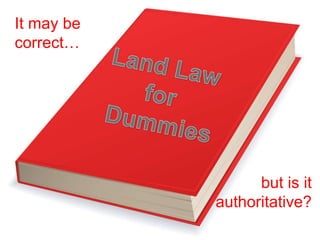
It may be
correct…
but is it
authoritative?
Did you explore
the issue?
Often a more circumspect
approach will garner support for
an argument.
This requires thinking around the
issue: are there other arguments?
Did you address these?
Did you read
widely?
Some students rely very heavily
on one or two authors for all
arguments.
The aim is to have a variety of
views, and to weave them into
your argument.
Did you over-
quote?
Use a variety of sources and
synthesise the sources into your
argument
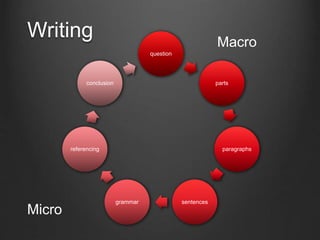
Writing
question
parts
paragraphs
sentencesgrammar
referencing
conclusion
Macro
Micro
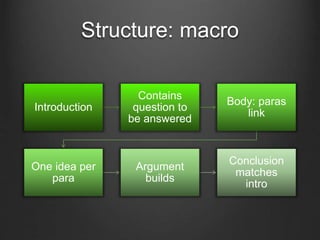
Structure: macro
Introduction
Contains
question to
be answered
Body: paras
link
One idea per
para
Argument
builds
Conclusion
matches
intro
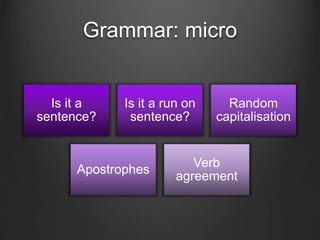
Grammar: micro
Is it a
sentence?
Is it a run on
sentence?
Random
capitalisation
Apostrophes
Verb
agreement
Does your
sentence
represent
a complete
thought?
Or is it a
fragment?
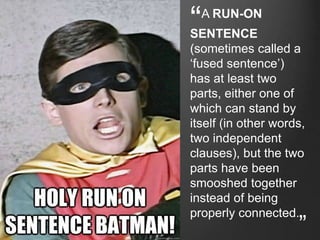
“A RUN-ON
SENTENCE
(sometimes called a
‘fused sentence’)
has at least two
parts, either one of
which can stand by
itself (in other words,
two independent
clauses), but the two
parts have been
smooshed together
instead of being
properly connected.
”
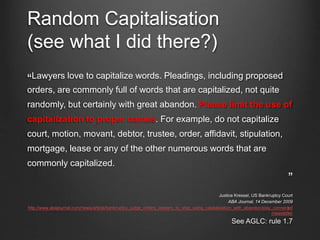
Random Capitalisation
(see what I did there?)
“Lawyers love to capitalize words. Pleadings, including proposed
orders, are commonly full of words that are capitalized, not quite
randomly, but certainly with great abandon. Please limit the use of
capitalization to proper names. For example, do not capitalize
court, motion, movant, debtor, trustee, order, affidavit, stipulation,
mortgage, lease or any of the other numerous words that are
commonly capitalized.
”
Justice Kressel, US Bankruptcy Court
ABA Journal, 14 December 2009
http://www.abajournal.com/news/article/bankruptcy_judge_orders_lawyers_to_stop_using_capitalization_with_abandon/stay_connected
/newsletter
See AGLC: rule 1.7
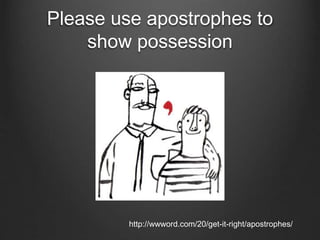
Please use apostrophes to
show possession
http://wwword.com/20/get-it-right/apostrophes/
Referencing
Australian Guide to Legal Citation (3rd ed)
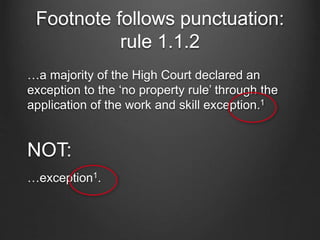
Footnote follows punctuation:
rule 1.1.2
…a majority of the High Court declared an
exception to the ‘no property rule’ through the
application of the work and skill exception.1
NOT:
…exception1.
Subsequent references: rule
1.4
Author’s surname, above n [footnote number], pinpoint.
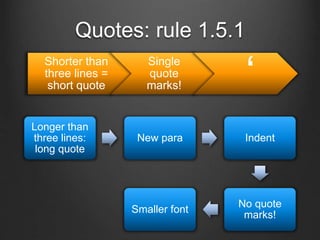
Quotes: rule 1.5.1
Longer than
three lines:
long quote
New para Indent
No quote
marks!
Smaller font
Shorter than
three lines =
short quote
Single
quote
marks! ‘
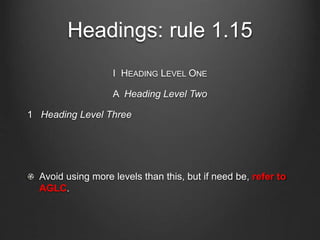
Headings: rule 1.15
I HEADING LEVEL ONE
A Heading Level Two
1 Heading Level Three
Avoid using more levels than this, but if need be, refer to
AGLC.
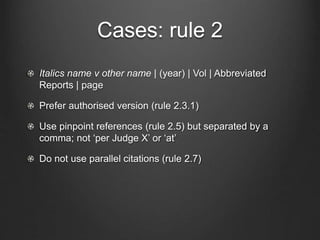
Cases: rule 2
Italics name v other name | (year) | Vol | Abbreviated
Reports | page
Prefer authorised version (rule 2.3.1)
Use pinpoint references (rule 2.5) but separated by a
comma; not ‘per Judge X’ or ‘at’
Do not use parallel citations (rule 2.7)
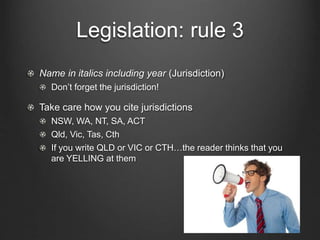
Legislation: rule 3
Name in italics including year (Jurisdiction)
Don’t forget the jurisdiction!
Take care how you cite jurisdictions
NSW, WA, NT, SA, ACT
Qld, Vic, Tas, Cth
If you write QLD or VIC or CTH…the reader thinks that you
are YELLING at them
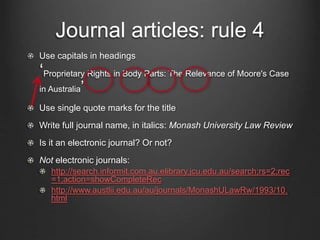
Journal articles: rule 4
Use capitals in headings
‘Proprietary Rights in Body Parts: The Relevance of Moore's Case
in Australia’
Use single quote marks for the title
Write full journal name, in italics: Monash University Law Review
Is it an electronic journal? Or not?
Not electronic journals:
http://search.informit.com.au.elibrary.jcu.edu.au/search;rs=2;rec
=1;action=showCompleteRec
http://www.austlii.edu.au/au/journals/MonashULawRw/1993/10.
html
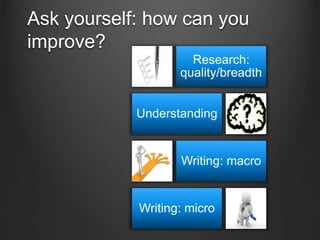
Ask yourself: how can you
improve?
Research:
quality/breadth
Understanding
Writing: macro
Writing: micro
Kate Galloway
April, 2015

Improving Law Student Research Assignments

  • 1.
    Student Assignment Feedback Some areascommonly in need of attention
  • 2.
    What went wrong? Howcan I improve?
  • 3.
  • 4.
    Where is thefeedback? This is feedback Your paper is marked up Your result is given according to a rubric Discussions in class
  • 5.
    Demonstrated understanding of thelaw Accuracy Was it correct Familiarity Was it correctly cited Thoroughness Were all sides covered
  • 6.
    Examples of unfamiliaritywith the law: case law Quoting a judge who does not exist Asserting a statement of law from a case – where the case did not find that. For example: Re Edwards found a possessory interest, not a proprietary interest Referring to Supreme Court when citing a High Court decision
  • 7.
    Unfamiliarity with thelaw: legislation For involving state jurisdiction, each Australian jurisdiction is likely to have legislation governing the issue. Demonstrate your understanding of the issue by identifying this, and justifying your use of a particular example. Eg: organ transplants are covered by most jurisdictions. Identify the jurisdiction of the legislation you cite Clarify that there are equivalent provisions in other jurisdictions
  • 8.
    Research How wide; howdeep; what quality…
  • 10.
  • 11.
    It may be correct… butis it authoritative?
  • 12.
    Did you explore theissue? Often a more circumspect approach will garner support for an argument. This requires thinking around the issue: are there other arguments? Did you address these?
  • 13.
    Did you read widely? Somestudents rely very heavily on one or two authors for all arguments. The aim is to have a variety of views, and to weave them into your argument.
  • 14.
    Did you over- quote? Usea variety of sources and synthesise the sources into your argument
  • 15.
  • 16.
    Structure: macro Introduction Contains question to beanswered Body: paras link One idea per para Argument builds Conclusion matches intro
  • 17.
    Grammar: micro Is ita sentence? Is it a run on sentence? Random capitalisation Apostrophes Verb agreement
  • 18.
  • 19.
    “A RUN-ON SENTENCE (sometimes calleda ‘fused sentence’) has at least two parts, either one of which can stand by itself (in other words, two independent clauses), but the two parts have been smooshed together instead of being properly connected. ”
  • 20.
    Random Capitalisation (see whatI did there?) “Lawyers love to capitalize words. Pleadings, including proposed orders, are commonly full of words that are capitalized, not quite randomly, but certainly with great abandon. Please limit the use of capitalization to proper names. For example, do not capitalize court, motion, movant, debtor, trustee, order, affidavit, stipulation, mortgage, lease or any of the other numerous words that are commonly capitalized. ” Justice Kressel, US Bankruptcy Court ABA Journal, 14 December 2009 http://www.abajournal.com/news/article/bankruptcy_judge_orders_lawyers_to_stop_using_capitalization_with_abandon/stay_connected /newsletter See AGLC: rule 1.7
  • 21.
    Please use apostrophesto show possession http://wwword.com/20/get-it-right/apostrophes/
  • 23.
    Referencing Australian Guide toLegal Citation (3rd ed)
  • 24.
    Footnote follows punctuation: rule1.1.2 …a majority of the High Court declared an exception to the ‘no property rule’ through the application of the work and skill exception.1 NOT: …exception1.
  • 25.
    Subsequent references: rule 1.4 Author’ssurname, above n [footnote number], pinpoint.
  • 26.
    Quotes: rule 1.5.1 Longerthan three lines: long quote New para Indent No quote marks! Smaller font Shorter than three lines = short quote Single quote marks! ‘
  • 27.
    Headings: rule 1.15 IHEADING LEVEL ONE A Heading Level Two 1 Heading Level Three Avoid using more levels than this, but if need be, refer to AGLC.
  • 28.
    Cases: rule 2 Italicsname v other name | (year) | Vol | Abbreviated Reports | page Prefer authorised version (rule 2.3.1) Use pinpoint references (rule 2.5) but separated by a comma; not ‘per Judge X’ or ‘at’ Do not use parallel citations (rule 2.7)
  • 29.
    Legislation: rule 3 Namein italics including year (Jurisdiction) Don’t forget the jurisdiction! Take care how you cite jurisdictions NSW, WA, NT, SA, ACT Qld, Vic, Tas, Cth If you write QLD or VIC or CTH…the reader thinks that you are YELLING at them
  • 30.
    Journal articles: rule4 Use capitals in headings ‘Proprietary Rights in Body Parts: The Relevance of Moore's Case in Australia’ Use single quote marks for the title Write full journal name, in italics: Monash University Law Review Is it an electronic journal? Or not? Not electronic journals: http://search.informit.com.au.elibrary.jcu.edu.au/search;rs=2;rec =1;action=showCompleteRec http://www.austlii.edu.au/au/journals/MonashULawRw/1993/10. html
  • 31.
    Ask yourself: howcan you improve? Research: quality/breadth Understanding Writing: macro Writing: micro
  • 32.