TRANSFER PROCEEDINGS BEFORE THE JUDICIAL PANEL ON
MULTIDISTRICT LITIGATION
Brandy Wingate Voss September 11, 2015
9/11/15 Copyright © 2015 Smith Law Group LLLP
2
Judicial Panel on Multidistrict Litigation
• Created in 2003
– Part of HB4’s tort reform package
– 5 members appointed by the chief justice of SCOTX
– Members must be active court of appeals justices or
administrative judges
9/11/15 Copyright © 2015 Smith Law Group LLLP
3
Where to Find the Law
• Texas Government Code 74.161-164
• Texas Rule of Judicial Administration 13
• Panel decisions
• Panel-created rules (the Panel has authority to
promulgate but has not done so yet)
• Panel website
9/11/15 Copyright © 2015 Smith Law Group LLLP
4
Deciding Whether to Request a Transfer
• Does Rule 13 apply to your case?
– Civil actions that involve one or more common
questions of fact and that were filed in a constitutional
county court, county court at law, probate court, or
district court on or after September 1, 2003; and
– Civil actions filed before September 1, 2003 that
involve asbestos- or silica-related injuries
• If not, see Rule 11
– If your case was pre-September 1, 2003 and does not
involve asbestos/silica, you may be able to get a
regional consolidation under Rule 11
9/11/15 Copyright © 2015 Smith Law Group LLLP
5
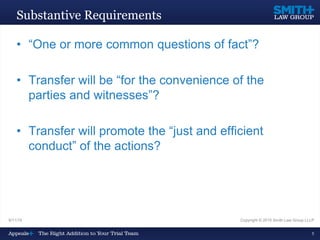
Substantive Requirements
• “One or more common questions of fact”?
• Transfer will be “for the convenience of the
parties and witnesses”?
• Transfer will promote the “just and efficient
conduct” of the actions?
9/11/15 Copyright © 2015 Smith Law Group LLLP
6
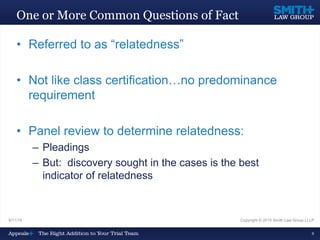
One or More Common Questions of Fact
• Referred to as “relatedness”
• Not like class certification…no predominance
requirement
• Panel review to determine relatedness:
– Pleadings
– But: discovery sought in the cases is the best
indicator of relatedness
9/11/15 Copyright © 2015 Smith Law Group LLLP
7
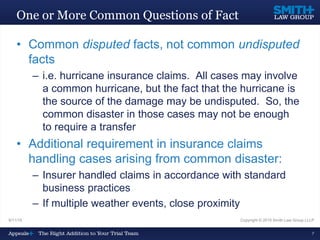
One or More Common Questions of Fact
• Common disputed facts, not common undisputed
facts
– i.e. hurricane insurance claims. All cases may involve
a common hurricane, but the fact that the hurricane is
the source of the damage may be undisputed. So, the
common disaster in those cases may not be enough
to require a transfer
• Additional requirement in insurance claims
handling cases arising from common disaster:
– Insurer handled claims in accordance with standard
business practices
– If multiple weather events, close proximity
9/11/15 Copyright © 2015 Smith Law Group LLLP
8
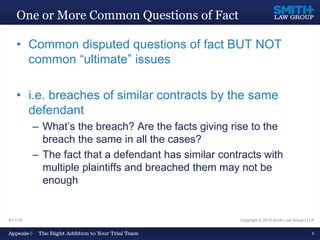
One or More Common Questions of Fact
• Common disputed questions of fact BUT NOT
common “ultimate” issues
• i.e. breaches of similar contracts by the same
defendant
– What’s the breach? Are the facts giving rise to the
breach the same in all the cases?
– The fact that a defendant has similar contracts with
multiple plaintiffs and breached them may not be
enough
9/11/15 Copyright © 2015 Smith Law Group LLLP
9
Practice Tips
• Both parties—submit outstanding discovery
requests
• If seeking MDL transfer
– Provide examples of overlapping discovery requests
Emphasize the number, significance, and complexity
of the common fact questions
– Cite to case law showing your “fact” question is truly a
fact question and not an ultimate issue
• If opposing MDL transfer
– Do the opposite
– Emphasize the number of individualized issues/point
out undisputed facts
9/11/15 Copyright © 2015 Smith Law Group LLLP
10
Practice tips
• If seeking MDL transfer, consider seeking Rule
174 consolidation either before you move to
transfer or even while your motion to transfer is
pending
• Does not provide same benefits as MDL, but can
streamline cases in the interim AND help you get
an MDL transfer
9/11/15 Copyright © 2015 Smith Law Group LLLP
11
Convenience/Efficiency
• Transfer if it would be for the convenience of the
parties and witnesses, and promote the just and
efficient conduct of the litigation
• Inquiry is whether an MDL pretrial court would
– Eliminate duplicative and repetitive discovery
– Minimize conflicting demands on witnesses
– Prevent inconsistent decisions on common issues
– Reduce necessary travel
– Enhance judicial efficiency
9/11/15 Copyright © 2015 Smith Law Group LLLP
12
Convenience/Efficiency
• Don’t have to show that witnesses have already
been inconvenienced
• But: cannot rely on bare assertions of possible
inconvenience—circumstances of the litigation
must at least make the assertion plausible
• Delay is not a good reason to deny a transfer
• Panel will not speculate about risk of inconsistent
rulings on key issues
9/11/15 Copyright © 2015 Smith Law Group LLLP
13
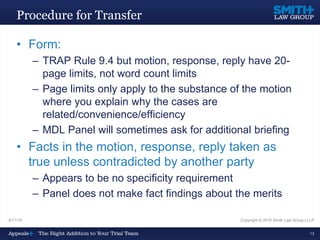
Procedure for Transfer
• Form:
– TRAP Rule 9.4 but motion, response, reply have 20-
page limits, not word count limits
– Page limits only apply to the substance of the motion
where you explain why the cases are
related/convenience/efficiency
– MDL Panel will sometimes ask for additional briefing
• Facts in the motion, response, reply taken as
true unless contradicted by another party
– Appears to be no specificity requirement
– Panel does not make fact findings about the merits
9/11/15 Copyright © 2015 Smith Law Group LLLP
14
Procedure for Transfer
• Certificate of conference required
– BUT: transfer is not dependent on how many parties
join/oppose the motion
• Certificate of compliance with Rule 9.4
• Appendix
– List cause number, style, and trial court of related
cases for which transfer sought
– List all parties in those cases and contact info for all
counsel
– Evidence? Not without leave of the Panel, but parties
routinely submit samples of pleadings, discovery, and
court orders
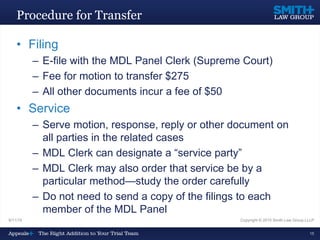
Procedure for Transfer
• Filing
– E-file with the MDL Panel Clerk (Supreme Court)
– Fee for motion to transfer $275
– All other documents incur a fee of $50
• Service
– Serve motion, response, reply or other document on
all parties in the related cases
– MDL Clerk can designate a “service party”
– MDL Clerk may also order that service be by a
particular method—study the order carefully
– Do not need to send a copy of the filings to each
member of the MDL Panel
9/11/15 Copyright © 2015 Smith Law Group LLLP
15
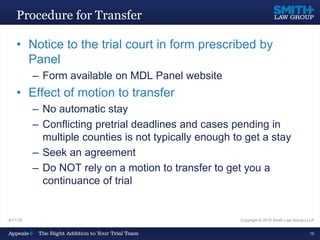
Procedure for Transfer
• Notice to the trial court in form prescribed by
Panel
– Form available on MDL Panel website
• Effect of motion to transfer
– No automatic stay
– Conflicting pretrial deadlines and cases pending in
multiple counties is not typically enough to get a stay
– Seek an agreement
– Do NOT rely on a motion to transfer to get you a
continuance of trial
9/11/15 Copyright © 2015 Smith Law Group LLLP
16
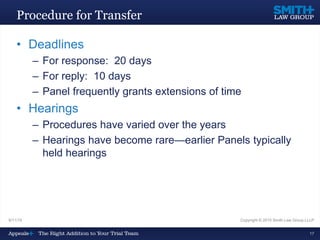
Procedure for Transfer
• Deadlines
– For response: 20 days
– For reply: 10 days
– Panel frequently grants extensions of time
• Hearings
– Procedures have varied over the years
– Hearings have become rare—earlier Panels typically
held hearings
9/11/15 Copyright © 2015 Smith Law Group LLLP
17
Decision
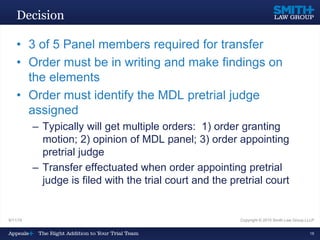
• 3 of 5 Panel members required for transfer
• Order must be in writing and make findings on
the elements
• Order must identify the MDL pretrial judge
assigned
– Typically will get multiple orders: 1) order granting
motion; 2) opinion of MDL panel; 3) order appointing
pretrial judge
– Transfer effectuated when order appointing pretrial
judge is filed with the trial court and the pretrial court
9/11/15 Copyright © 2015 Smith Law Group LLLP
18
Decision
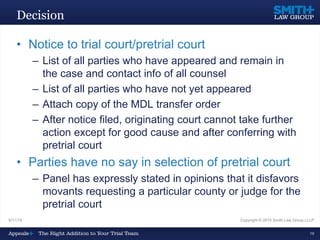
• Notice to trial court/pretrial court
– List of all parties who have appeared and remain in
the case and contact info of all counsel
– List of all parties who have not yet appeared
– Attach copy of the MDL transfer order
– After notice filed, originating court cannot take further
action except for good cause and after conferring with
pretrial court
• Parties have no say in selection of pretrial court
– Panel has expressly stated in opinions that it disfavors
movants requesting a particular county or judge for the
pretrial court
9/11/15 Copyright © 2015 Smith Law Group LLLP
19
Decision
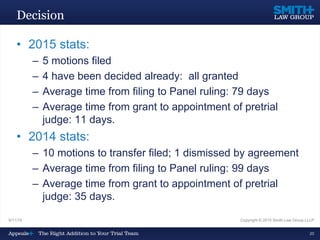
• 2015 stats:
– 5 motions filed
– 4 have been decided already: all granted
– Average time from filing to Panel ruling: 79 days
– Average time from grant to appointment of pretrial
judge: 11 days.
• 2014 stats:
– 10 motions to transfer filed; 1 dismissed by agreement
– Average time from filing to Panel ruling: 99 days
– Average time from grant to appointment of pretrial
judge: 35 days.
9/11/15 Copyright © 2015 Smith Law Group LLLP
20

2015-09-11 Advanced Appellate MDL Presentation

  • 1.
    TRANSFER PROCEEDINGS BEFORETHE JUDICIAL PANEL ON MULTIDISTRICT LITIGATION Brandy Wingate Voss September 11, 2015
  • 2.
    9/11/15 Copyright ©2015 Smith Law Group LLLP 2 Judicial Panel on Multidistrict Litigation • Created in 2003 – Part of HB4’s tort reform package – 5 members appointed by the chief justice of SCOTX – Members must be active court of appeals justices or administrative judges
  • 3.
    9/11/15 Copyright ©2015 Smith Law Group LLLP 3 Where to Find the Law • Texas Government Code 74.161-164 • Texas Rule of Judicial Administration 13 • Panel decisions • Panel-created rules (the Panel has authority to promulgate but has not done so yet) • Panel website
  • 4.
    9/11/15 Copyright ©2015 Smith Law Group LLLP 4 Deciding Whether to Request a Transfer • Does Rule 13 apply to your case? – Civil actions that involve one or more common questions of fact and that were filed in a constitutional county court, county court at law, probate court, or district court on or after September 1, 2003; and – Civil actions filed before September 1, 2003 that involve asbestos- or silica-related injuries • If not, see Rule 11 – If your case was pre-September 1, 2003 and does not involve asbestos/silica, you may be able to get a regional consolidation under Rule 11
  • 5.
    9/11/15 Copyright ©2015 Smith Law Group LLLP 5 Substantive Requirements • “One or more common questions of fact”? • Transfer will be “for the convenience of the parties and witnesses”? • Transfer will promote the “just and efficient conduct” of the actions?
  • 6.
    9/11/15 Copyright ©2015 Smith Law Group LLLP 6 One or More Common Questions of Fact • Referred to as “relatedness” • Not like class certification…no predominance requirement • Panel review to determine relatedness: – Pleadings – But: discovery sought in the cases is the best indicator of relatedness
  • 7.
    9/11/15 Copyright ©2015 Smith Law Group LLLP 7 One or More Common Questions of Fact • Common disputed facts, not common undisputed facts – i.e. hurricane insurance claims. All cases may involve a common hurricane, but the fact that the hurricane is the source of the damage may be undisputed. So, the common disaster in those cases may not be enough to require a transfer • Additional requirement in insurance claims handling cases arising from common disaster: – Insurer handled claims in accordance with standard business practices – If multiple weather events, close proximity
  • 8.
    9/11/15 Copyright ©2015 Smith Law Group LLLP 8 One or More Common Questions of Fact • Common disputed questions of fact BUT NOT common “ultimate” issues • i.e. breaches of similar contracts by the same defendant – What’s the breach? Are the facts giving rise to the breach the same in all the cases? – The fact that a defendant has similar contracts with multiple plaintiffs and breached them may not be enough
  • 9.
    9/11/15 Copyright ©2015 Smith Law Group LLLP 9 Practice Tips • Both parties—submit outstanding discovery requests • If seeking MDL transfer – Provide examples of overlapping discovery requests Emphasize the number, significance, and complexity of the common fact questions – Cite to case law showing your “fact” question is truly a fact question and not an ultimate issue • If opposing MDL transfer – Do the opposite – Emphasize the number of individualized issues/point out undisputed facts
  • 10.
    9/11/15 Copyright ©2015 Smith Law Group LLLP 10 Practice tips • If seeking MDL transfer, consider seeking Rule 174 consolidation either before you move to transfer or even while your motion to transfer is pending • Does not provide same benefits as MDL, but can streamline cases in the interim AND help you get an MDL transfer
  • 11.
    9/11/15 Copyright ©2015 Smith Law Group LLLP 11 Convenience/Efficiency • Transfer if it would be for the convenience of the parties and witnesses, and promote the just and efficient conduct of the litigation • Inquiry is whether an MDL pretrial court would – Eliminate duplicative and repetitive discovery – Minimize conflicting demands on witnesses – Prevent inconsistent decisions on common issues – Reduce necessary travel – Enhance judicial efficiency
  • 12.
    9/11/15 Copyright ©2015 Smith Law Group LLLP 12 Convenience/Efficiency • Don’t have to show that witnesses have already been inconvenienced • But: cannot rely on bare assertions of possible inconvenience—circumstances of the litigation must at least make the assertion plausible • Delay is not a good reason to deny a transfer • Panel will not speculate about risk of inconsistent rulings on key issues
  • 13.
    9/11/15 Copyright ©2015 Smith Law Group LLLP 13 Procedure for Transfer • Form: – TRAP Rule 9.4 but motion, response, reply have 20- page limits, not word count limits – Page limits only apply to the substance of the motion where you explain why the cases are related/convenience/efficiency – MDL Panel will sometimes ask for additional briefing • Facts in the motion, response, reply taken as true unless contradicted by another party – Appears to be no specificity requirement – Panel does not make fact findings about the merits
  • 14.
    9/11/15 Copyright ©2015 Smith Law Group LLLP 14 Procedure for Transfer • Certificate of conference required – BUT: transfer is not dependent on how many parties join/oppose the motion • Certificate of compliance with Rule 9.4 • Appendix – List cause number, style, and trial court of related cases for which transfer sought – List all parties in those cases and contact info for all counsel – Evidence? Not without leave of the Panel, but parties routinely submit samples of pleadings, discovery, and court orders
  • 15.
    Procedure for Transfer •Filing – E-file with the MDL Panel Clerk (Supreme Court) – Fee for motion to transfer $275 – All other documents incur a fee of $50 • Service – Serve motion, response, reply or other document on all parties in the related cases – MDL Clerk can designate a “service party” – MDL Clerk may also order that service be by a particular method—study the order carefully – Do not need to send a copy of the filings to each member of the MDL Panel 9/11/15 Copyright © 2015 Smith Law Group LLLP 15
  • 16.
    Procedure for Transfer •Notice to the trial court in form prescribed by Panel – Form available on MDL Panel website • Effect of motion to transfer – No automatic stay – Conflicting pretrial deadlines and cases pending in multiple counties is not typically enough to get a stay – Seek an agreement – Do NOT rely on a motion to transfer to get you a continuance of trial 9/11/15 Copyright © 2015 Smith Law Group LLLP 16
  • 17.
    Procedure for Transfer •Deadlines – For response: 20 days – For reply: 10 days – Panel frequently grants extensions of time • Hearings – Procedures have varied over the years – Hearings have become rare—earlier Panels typically held hearings 9/11/15 Copyright © 2015 Smith Law Group LLLP 17
  • 18.
    Decision • 3 of5 Panel members required for transfer • Order must be in writing and make findings on the elements • Order must identify the MDL pretrial judge assigned – Typically will get multiple orders: 1) order granting motion; 2) opinion of MDL panel; 3) order appointing pretrial judge – Transfer effectuated when order appointing pretrial judge is filed with the trial court and the pretrial court 9/11/15 Copyright © 2015 Smith Law Group LLLP 18
  • 19.
    Decision • Notice totrial court/pretrial court – List of all parties who have appeared and remain in the case and contact info of all counsel – List of all parties who have not yet appeared – Attach copy of the MDL transfer order – After notice filed, originating court cannot take further action except for good cause and after conferring with pretrial court • Parties have no say in selection of pretrial court – Panel has expressly stated in opinions that it disfavors movants requesting a particular county or judge for the pretrial court 9/11/15 Copyright © 2015 Smith Law Group LLLP 19
  • 20.
    Decision • 2015 stats: –5 motions filed – 4 have been decided already: all granted – Average time from filing to Panel ruling: 79 days – Average time from grant to appointment of pretrial judge: 11 days. • 2014 stats: – 10 motions to transfer filed; 1 dismissed by agreement – Average time from filing to Panel ruling: 99 days – Average time from grant to appointment of pretrial judge: 35 days. 9/11/15 Copyright © 2015 Smith Law Group LLLP 20

Editor's Notes

  • #3 Hon. David Peeples (Chair) Hon. Ann McClure Hon. Elizabeth Lang-Miers Hon. Harvey Brown Hon. David Puryear
  • #4 Texas Government Code 74.161-164 Legislative authority for judicial panel on multidistrict litigation and transfer proceedings; authorizes creation of rules by SCOTX Texas Rule of Judicial Administration 13 Panel decisions Many available on Westlaw MDL Panel website “list of available cases” www.txcourts.gov/about-texas-courts/multi-district-litigation-panel/available-multidistrict-litigation-cases.aspx Search function on tx courts website, search under the texas supreme court’s document search and it will pick up your search terms in the MDL panel opinions/document/etc. Panel-created rules (the Panel has authority to promulgate but has not done so yet) Panel website
  • #6 Three requirements, but the last two are usually analyzed together. And practically speaking, if you meet the first requirement, it’s pretty easy to meet the remaining requirements
  • #7 Referred to as “relatedness” Not like class certification…no predominance requirement Related questions do not have to predominate Cases do not have to be “congruent or anything close to it” Cases do not have to arise from a catastrophic event or even a common event BUT: “While the number of common fact questions necessary to cause cases to be related is not capable of a bright-line rule, cases involving complicated, numerous, or significant common fact questions are more likely to be considered related” Panel review to determine relatedness: Pleadings But: discovery sought in the cases is the best indicator of relatedness Pretrial discovery that overlaps is what the Panel is looking for because it implicates the MDL goals of convenience, efficiency and just handling of the cases Looking for discovery of the same witnesses in the cases, discovery directed at common business practices
  • #8 Common disputed facts, not common undisputed facts i.e. hurricane insurance claims. All cases may involve a common hurricane, but the fact that the hurricane is the source of the damage may be undisputed. So, the common disaster in those cases may not be enough to require a transfer Additional requirement in insurance claims handling cases arising from common disaster: Insurer handled claims in accordance with standard business practices If multiple weather events, close proximity
  • #10 Both parties—submit outstanding discovery requests If seeking MDL transfer Provide examples of overlapping discovery requests Emphasize the number, significance, and complexity of the common fact questions Cite to case law showing your “fact” question is truly a fact question and not an ultimate issue If opposing MDL transfer Do the opposite Emphasize the number of individualized issues
  • #11 If seeking MDL transfer, consider seeking Rule 174 consolidation either before you move to transfer or even while your motion to transfer is pending Does not provide same benefits as MDL, but can streamline cases in the interim AND help you get an MDL transfer Can take a little while to get an MDL transfer, although the Panel moves very quickly. Getting a rule 174 consolidation for pretrial purposes does not provide the same benefits as an MDL consolidation because there’s no procedure to make the pretrial court’s rulings binding on the originating trial court. BUT, it can avoid multiple hearings and inconsistent rulings initially In a recent decision from the panel, the Panel noted that the cases had been consolidated for pretrial purposes under Rule 174, which requires a finding that the cases have common issues of fact or law. In the past, parties have argued that pretrial consolidation under rule 174 or local rules would better serve the parties. Panel typically rejects those arguments where the requirements for an MDL transfer are otherwise met. The reason given by the Panel is the fact that the pretrial rulings would not be binding on the originating courts, so an MDL transfer provides greater efficiency
  • #12 Generally more convenient for witnesses and parties to litigate in one pretrial court rather than several This means if you meet the relatedness inquiry, you should be able to establish the convenience element Inquiry is whether an MDL pretrial court would Eliminate duplicative and repetitive discovery Minimize conflicting demands on witnesses Prevent inconsistent decisions on common issues Reduce necessary travel Enhance judicial efficiency
  • #13 Don’t have to show that witnesses have already been inconvenienced But: cannot rely on bare assertions of possible inconvenience—circumstances of the litigation must at least make the assertion plausible On the opposite side, however, if you are opposing a transfer, you’re not likely to be able to show any inconvenience for the parties and witnesses. And even if the venues are separated by a great distance, the discovery rules still would allow local depositions. Delay is not a good reason to deny a transfer Transfer permitted even if discovery substantially completed, and any cases completing the pretrial process after being transferred can be remanded for trial regardless of whether the remaining cases are ready Risk of inconsistent rulings on key issues is a big factor in the efficiency evaluation. BUT, the panel will not speculate about it. You have to identify the specific issues on which the rulings could be inconsistent, and the more complex and important the issues are, the more likely inconsistent rulings will weigh in favor of a transfer Some parties have argued that the litigation is already being handled efficiently because the parties are working well together. Panel rejects arguments like that and has held that there’s no reason to expect that the parties will not continue to be agreeable.
  • #14 Three ways Party files motion Trial court or regional presiding judge requests in writing MDL Panel initiates sua sponte through a show cause order Have never seen the second or third used Form: TRAP Rule 9.4 but motion, response, reply have 20-page limits, not word count limits So, go back to your old ways to skirt the page limits. Shorten up your appendix cites, use footnotes, etc. Page limits only apply to the substance of the motion where you explain why the cases are related/convenience/efficiency MDL Panel will sometimes ask for additional briefing Facts in the motion, response, reply taken as true unless contradicted by another party Appears to be no specificity requirement Panel does not make fact findings about the merits. Primarily concerned with the allegations, not proof of those allegations, and the status of the litigation
  • #15 Certificate of conference required BUT: transfer is not dependent on how many parties join/oppose the motion Certificate of compliance with Rule 9.4 Appendix List cause number, style, and trial court of related cases for which transfer sought List all parties in those cases and contact info for all counsel Evidence? Rule says that a party may file evidence with leave of the MDL Panel. Then it states that the Panel may order parties to submit evidence by affidavit or deposition and file documents, discovery, or stipulations from related cases. Based on this, I believe that documents, discovery, and stipulations from related cases is not “evidence,” and parties routinely submit samples of pleadings, discovery, court orders, Rule 11 agreements, etc. Most of the time, the parties don’t object, but if they do, then just file a motion for leave.
  • #16 Filing E-file with the MDL Panel Clerk (Supreme Court) Fee for motion to transfer $275 All other documents incur a fee of $50 Service Serve motion, response, reply or other document on all parties in the related cases MDL Clerk can designate a “service party” MDL Clerk may also order that service be by a particular method—study the order carefully Do not need to send a copy of the filings to each member of the MDL Panel…even though the rules require it. Blake handles that. And, you don’t have to include them in the certificate of service, which is typically already gigantic.
  • #17 Notice to the trial court in form prescribed by Panel Form available on MDL Panel website Effect of transfer No automatic stay Conflicting pretrial deadlines and cases pending in multiple counties is not typically enough to get a stay Seek an agreement Do NOT rely on a motion to transfer to get you a continuance of trial i.e. panel refused to stay cases against an insurance company despite numerous trial settings within days after the MDL motion to transfer.
  • #18 Deadlines For response: 20 days For reply: 10 days Panel frequently grants extensions of time Hearings Procedures have varied over the years Earlier cases: Clerk notifies parties to transfer proceeding of time and location and orders one party on each side to notify interested parties. Clerk sets a deadline for interested parties to notify clerk of desire to present oral argument. Order encouraged parties to coordinate to reduce the number of lawyers [WHAT??? GIVE UP AN ORAL ARGUMENT ARE YOU NUTS?] then after deadline, the clerk would send out a notice allocating the time for argument among the respective attorneys More recent cases, clerk allocates time per side (30 min or 1 hr) and order would not indicate which attorneys were entitled to argue. But the order would say “if interested attorneys are not able to agree on how to allocate the time, then counsel could ask the clerk to set up a call with the Panel Chair, who would hear the parties’ positions, consult with the full panel, and make a decision on allocating the time. Locations of the arguments varied depending on the cases. Not necessarily in the supreme court’s courtroom.
  • #19 3 of 5 Panel members required for transfer Order must be in writing and make findings on the elements Order must identify the MDL pretrial judge assigned Typically will get multiple orders: 1) order granting motion; 2) opinion of MDL panel; 3) order appointing pretrial judge Sometimes there’s a delay between granting the motion and appointing the pretrial judge. Transfer effectuated when order appointing pretrial judge is filed with the trial court
  • #20 Notice to trial court/pretrial court List of all parties who have appeared and remain in the case and contact info of all counsel List of all parties who have not yet appeared Attach copy of the MDL transfer order After notice filed, originating court cannot take further action except for good cause and after conferring with pretrial court Parties have no say in selection of pretrial court Panel has expressly stated in opinions that it disfavors movants requesting a particular county or judge for the pretrial court BUT, the panel has accepted a suggestion of multiple regional pretrial courts by a party, so think about how the MDL would work for your client, where the cases are located and how many there are, and you can suggest alternatively several regional pretrial courts. In one case, the Panel appointed three pretrial courts to consider “case-specific issues”, and then appointed the three pretrial judges to decide common issues as a panel. Interesting. That’s in re farmers insurance wind/hail storm litigation
  • #21 Time to decide the motion varies and is dependent upon the number of parties, extensions of time, and motions filed 2015 stats: 5 motions filed in 2015 4 have been decided already: all granted Average time from filing to Panel ruling: 79 days Average time from grant to appointment of pretrial judge: 11 days. 2014 stats: 10 motions to transfer filed; 1 dismissed by agreement Average time from filing to Panel ruling: 99 days Average time from grant to appointment of pretrial judge: 35 days. Number is a bit skewed because in four cases, the pretrial judge was appointed the same day, and in one case, it took 255 days. Not sure why.