Agile retrospectives: Why, What and How

Dmitriy Viktorov
AgileDays’10, St.Petersburg, September 17th 2010


Protecting the irreplaceable | f-secure.com
Postmortems in pre-Agile days


2   21 September,
3
When


4
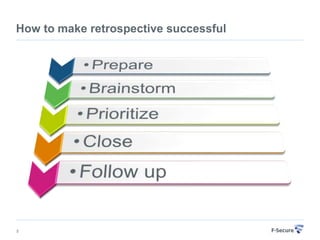
How to make retrospective successful


5
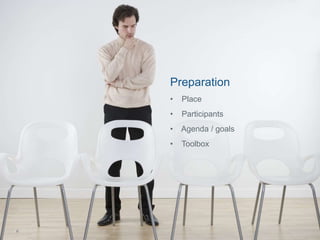
Preparation
    •   Place
    •   Participants
    •   Agenda / goals
    •   Toolbox


6
Conducting the retrospective
    • Check in (warm-up)
    • Collecting feedback
    • Facilitation techniques
    • Lead people, time, yourself


7
Check-in & Warm-up
• Get participants in the right mood
• Code of conduct
• Make agenda and goals visible
• Share context, display data,
  timeline


8
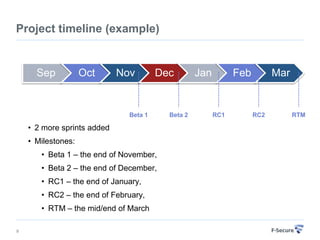
Project timeline (example)


      Sep           Oct      Nov        Dec        Jan         Feb         Mar


                               Beta 1     Beta 2         RC1         RC2         RTM

    • 2 more sprints added
    • Milestones:
       • Beta 1 – the end of November,
       • Beta 2 – the end of December,
       • RC1 – the end of January,
       • RC2 – the end of February,
       • RTM – the mid/end of March

9
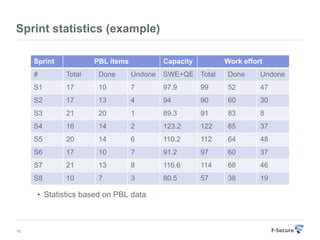
Sprint statistics (example)

     Sprint           PBL items            Capacity         Work effort
     #        Total    Done       Undone   SWE+QE Total     Done      Undone
     S1       17       10         7        97.9       99    52        47
     S2       17       13         4        94         90    60        30
     S3       21       20         1        89.3       91    83        8
     S4       16       14         2        123.2      122   85        37
     S5       20       14         6        110.2      112   64        48
     S6       17       10         7        91.2       97    60        37
     S7       21       13         8        116.6      114   68        46
     S8       10       7          3        80.5       57    38        19

      • Statistics based on PBL data


10
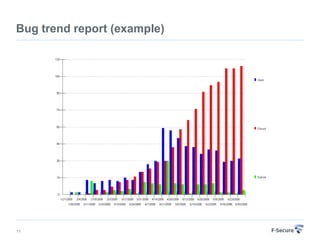
Bug trend report (example)


11
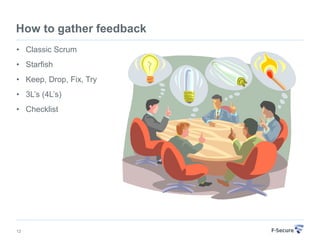
How to gather feedback
• Classic Scrum
• Starfish
• Keep, Drop, Fix, Try
• 3L’s (4L’s)
• Checklist


12
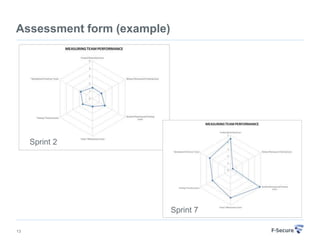
Assessment form (example)


     Sprint 2


                            Sprint 7

13
Leading the retrospective
• Time
     • Start and finish on time
     • Timebox activities
     • Have breaks
• People
     • Personalities (quiet, overbeating, passive, aggressive)
     • Introverts vs. extroverts
• You
     • Facilitator vs. team member
     • Let others talk


14
Analyze feedback
     • Group similar items
     • Separate team and company level items
     • Root cause analysis
     • Select top 3/5/10 items to work on
     • Discuss actions, owners and schedule


15
Group and separate items


16
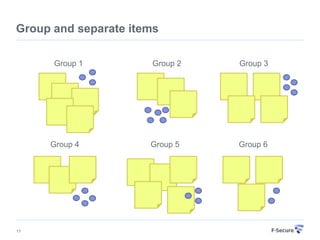
Group and separate items

      Group 1         Group 2   Group 3


     Group 4          Group 5   Group 6


17
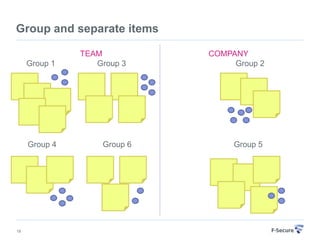
Group and separate items

               TEAM          COMPANY
     Group 1      Group 3         Group 2


     Group 4       Group 6        Group 5


18
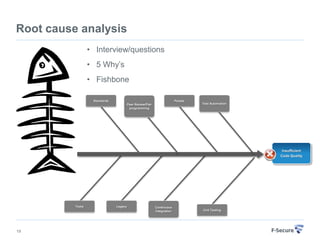
Root cause analysis
            • Interview/questions
            • 5 Why’s
            • Fishbone


19
Decide what, who and when
• Identify things that make difference
• Owner is not always the one who will do it
• Start with near-term improvements
• Get support for long-term improvements


20
Closing the retrospective
     • End in positive way
     • Appreciation
     • Celebrate (cake, champagne, fireworks)


21
Follow up
     • Share retrospective results
     • Make comments and actions visible
     • Add user stories, tasks to sprint/product backlog
     • Check the status regularly
     • Review on next retrospective


22
Smells
         • Reporting to management
         • Offline retrospective (by email)
         • Only a few participants
         • Everybody is happy
         • Blame game
         • Nobody talks about elephant
         • Looking for silver bullets
         • Retrospective in the team room
         • Too short retrospective meeting
         • Facilitator doesn’t facilitate


24
Agile retrospectives - why, what and how

Agile retrospectives - why, what and how

  • 1.
    Agile retrospectives: Why,What and How Dmitriy Viktorov AgileDays’10, St.Petersburg, September 17th 2010 Protecting the irreplaceable | f-secure.com
  • 2.
    Postmortems in pre-Agiledays 2 21 September,
  • 3.
  • 4.
  • 5.
    How to makeretrospective successful 5
  • 6.
    Preparation • Place • Participants • Agenda / goals • Toolbox 6
  • 7.
    Conducting the retrospective • Check in (warm-up) • Collecting feedback • Facilitation techniques • Lead people, time, yourself 7
  • 8.
    Check-in & Warm-up •Get participants in the right mood • Code of conduct • Make agenda and goals visible • Share context, display data, timeline 8
  • 9.
    Project timeline (example) Sep Oct Nov Dec Jan Feb Mar Beta 1 Beta 2 RC1 RC2 RTM • 2 more sprints added • Milestones: • Beta 1 – the end of November, • Beta 2 – the end of December, • RC1 – the end of January, • RC2 – the end of February, • RTM – the mid/end of March 9
  • 10.
    Sprint statistics (example) Sprint PBL items Capacity Work effort # Total Done Undone SWE+QE Total Done Undone S1 17 10 7 97.9 99 52 47 S2 17 13 4 94 90 60 30 S3 21 20 1 89.3 91 83 8 S4 16 14 2 123.2 122 85 37 S5 20 14 6 110.2 112 64 48 S6 17 10 7 91.2 97 60 37 S7 21 13 8 116.6 114 68 46 S8 10 7 3 80.5 57 38 19 • Statistics based on PBL data 10
  • 11.
    Bug trend report(example) 11
  • 12.
    How to gatherfeedback • Classic Scrum • Starfish • Keep, Drop, Fix, Try • 3L’s (4L’s) • Checklist 12
  • 13.
    Assessment form (example) Sprint 2 Sprint 7 13
  • 14.
    Leading the retrospective •Time • Start and finish on time • Timebox activities • Have breaks • People • Personalities (quiet, overbeating, passive, aggressive) • Introverts vs. extroverts • You • Facilitator vs. team member • Let others talk 14
  • 15.
    Analyze feedback • Group similar items • Separate team and company level items • Root cause analysis • Select top 3/5/10 items to work on • Discuss actions, owners and schedule 15
  • 16.
  • 17.
    Group and separateitems Group 1 Group 2 Group 3 Group 4 Group 5 Group 6 17
  • 18.
    Group and separateitems TEAM COMPANY Group 1 Group 3 Group 2 Group 4 Group 6 Group 5 18
  • 19.
    Root cause analysis • Interview/questions • 5 Why’s • Fishbone 19
  • 20.
    Decide what, whoand when • Identify things that make difference • Owner is not always the one who will do it • Start with near-term improvements • Get support for long-term improvements 20
  • 21.
    Closing the retrospective • End in positive way • Appreciation • Celebrate (cake, champagne, fireworks) 21
  • 22.
    Follow up • Share retrospective results • Make comments and actions visible • Add user stories, tasks to sprint/product backlog • Check the status regularly • Review on next retrospective 22
  • 23.
    Smells • Reporting to management • Offline retrospective (by email) • Only a few participants • Everybody is happy • Blame game • Nobody talks about elephant • Looking for silver bullets • Retrospective in the team room • Too short retrospective meeting • Facilitator doesn’t facilitate 24