Scrum Basics
Presented by Juan Banda
Problems in Software
Industry
•Releases take too
long
•Stabilization takes

too long
•Changes are hard

to make
•Quality is falling

•Death marches are

hurting morale
•People are not
communicating well
                       2
Roots of Scrum
•Lean
•Knowledge
Management by
Nonaka & Takeuchi
    •Built-in instability
    •Self-organizing

    project teams
    •Overlapping

    development phases
    •“Multilearning”

    •Subtle control

    •Organizational

    transfer of learning
                            3
Make your own path
There is no fixed and
•

patented Agile
process, only
Principles and
Values
•Principles and Values
are not something
fixed, they can guide
but not dictate how
things should be
Rules are rigid,
•
Principles and Values
are flexible like Agile
                          4
Scrum is a framework
•The framework
set the basic
rules that a team
uses to play a
game
•Each team has
its own style
•A team needs to
constantly
reinvent itself
                       5
Scrum comes handy
It will help you to build
•
better software in
shorter releases
cycles and with more
quality associated
Scrum is an
•
empirical process;
not a formal, rigid and
out of the box one
•Like a Swiss Army
tool, Scrum is nice,
shiny, easy to use,
made for last,
adaptable and not
                            6
expensive
Scrum four pillars
Scrum rests on four
legs of
•iterative

development that
generates
•increments of
functionality using
•self-organizing

teams that are
cross-functional


                      7
Scrum flow
This flow defines the
different artifacts
and ceremonies
within the Scrum
framework
One important
consideration is that
the flow is based on
an incremental and
iterative process


                        8
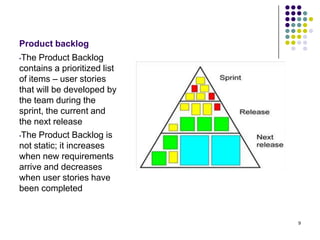
Product backlog
•The Product Backlog
contains a prioritized list
of items – user stories
that will be developed by
the team during the
sprint, the current and
the next release
•The Product Backlog is

not static; it increases
when new requirements
arrive and decreases
when user stories have
been completed


                              9
Sprint backlog
•The Sprint Backlog
is the list of user
stories that the
teams commits to
work in an sprint
•This list comes from
the Product Backlog
and should be
changed without the
team consensus and
the Product Owner’s
approval
                        10
Burn down charts
•The Burn Down char
is not exactly a
monitoring tool that
shows productivity
On the contrary, this
•

chart could be used as
a predictive tool for
planning next sprints
•It’s key that the
Scrum Master and the
team keep this chart
updated and know its
meaning
                         11
Scrum roles & responsibilities


                                 12
Chickens & pigs
These guys are fully
committed              These are not


                                       13
Team Responsibilities
Estimating size of
•

backlog items
•Committing to
increments of
deliverable software –
and delivering it
•   Tracks own progress
Is self-organizing –
•
but accountable to the
Product Owner for
delivering as promised
•Improving constantly
its own processes
                          14
Basic truths about
team motivation
•People are most
productive when they
manage themselves
•People take their

commitment more seriously
than other people’s
commitment for them
•People have many creative

moments during down time
•People always do the best

they can
•Under pressure to “work
harder” developers
automatically and
increasingly reduce quality

                              15
Basic truths about
team performance
•Teams and people do
their best work when
they aren’t interrupted
Teams improve most
•

when they solve their
own problems
•Broad-band, fact-to-
face communications
is the most productive
way for teams to work
together


                          16
Basic truths about
team composition
•Teams are more
productive than the
same number of
individuals
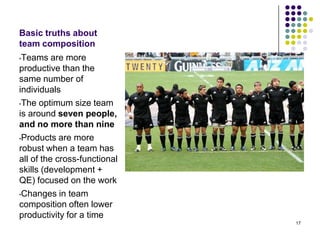
•The optimum size team

is around seven people,
and no more than nine
•Products are more

robust when a team has
all of the cross-functional
skills (development +
QE) focused on the work
•Changes in team

composition often lower
productivity for a time
                              17
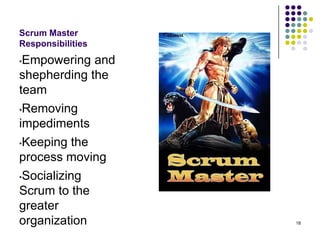
Scrum Master
Responsibilities
•Empowering and
shepherding the
team
•Removing
impediments
Keeping the
•

process moving
Socializing
•
Scrum to the
greater
organization       18
Additional resources
    Scrum Bolivia LinkedIn user group
    http://www.linkedin.com/groups?gid=2229883&
       goback=.gmp_2229883.gde_2229883_mem
       ber_72362318.anp_2229883_13173858743
       82_1


                                                  19
Thanks for attending

Scrum basics

  • 1.
  • 2.
    Problems in Software Industry •Releasestake too long •Stabilization takes too long •Changes are hard to make •Quality is falling •Death marches are hurting morale •People are not communicating well 2
  • 3.
    Roots of Scrum •Lean •Knowledge Managementby Nonaka & Takeuchi •Built-in instability •Self-organizing project teams •Overlapping development phases •“Multilearning” •Subtle control •Organizational transfer of learning 3
  • 4.
    Make your ownpath There is no fixed and • patented Agile process, only Principles and Values •Principles and Values are not something fixed, they can guide but not dictate how things should be Rules are rigid, • Principles and Values are flexible like Agile 4
  • 5.
    Scrum is aframework •The framework set the basic rules that a team uses to play a game •Each team has its own style •A team needs to constantly reinvent itself 5
  • 6.
    Scrum comes handy Itwill help you to build • better software in shorter releases cycles and with more quality associated Scrum is an • empirical process; not a formal, rigid and out of the box one •Like a Swiss Army tool, Scrum is nice, shiny, easy to use, made for last, adaptable and not 6 expensive
  • 7.
    Scrum four pillars Scrumrests on four legs of •iterative development that generates •increments of functionality using •self-organizing teams that are cross-functional 7
  • 8.
    Scrum flow This flowdefines the different artifacts and ceremonies within the Scrum framework One important consideration is that the flow is based on an incremental and iterative process 8
  • 9.
    Product backlog •The ProductBacklog contains a prioritized list of items – user stories that will be developed by the team during the sprint, the current and the next release •The Product Backlog is not static; it increases when new requirements arrive and decreases when user stories have been completed 9
  • 10.
    Sprint backlog •The SprintBacklog is the list of user stories that the teams commits to work in an sprint •This list comes from the Product Backlog and should be changed without the team consensus and the Product Owner’s approval 10
  • 11.
    Burn down charts •TheBurn Down char is not exactly a monitoring tool that shows productivity On the contrary, this • chart could be used as a predictive tool for planning next sprints •It’s key that the Scrum Master and the team keep this chart updated and know its meaning 11
  • 12.
    Scrum roles &responsibilities 12
  • 13.
    Chickens & pigs Theseguys are fully committed These are not 13
  • 14.
    Team Responsibilities Estimating sizeof • backlog items •Committing to increments of deliverable software – and delivering it • Tracks own progress Is self-organizing – • but accountable to the Product Owner for delivering as promised •Improving constantly its own processes 14
  • 15.
    Basic truths about teammotivation •People are most productive when they manage themselves •People take their commitment more seriously than other people’s commitment for them •People have many creative moments during down time •People always do the best they can •Under pressure to “work harder” developers automatically and increasingly reduce quality 15
  • 16.
    Basic truths about teamperformance •Teams and people do their best work when they aren’t interrupted Teams improve most • when they solve their own problems •Broad-band, fact-to- face communications is the most productive way for teams to work together 16
  • 17.
    Basic truths about teamcomposition •Teams are more productive than the same number of individuals •The optimum size team is around seven people, and no more than nine •Products are more robust when a team has all of the cross-functional skills (development + QE) focused on the work •Changes in team composition often lower productivity for a time 17
  • 18.
    Scrum Master Responsibilities •Empowering and shepherdingthe team •Removing impediments Keeping the • process moving Socializing • Scrum to the greater organization 18
  • 19.
    Additional resources Scrum Bolivia LinkedIn user group http://www.linkedin.com/groups?gid=2229883& goback=.gmp_2229883.gde_2229883_mem ber_72362318.anp_2229883_13173858743 82_1 19
  • 20.