DEPARTMENT OF CIVIL
ENGINEERING
SPRINKLER IRRIGATION
SYSTEM
Presented by:
Moti Ram 16CE69
Mohammad Samiullah 16CE177
Ali Raza 16CE157
Sumair Shaikh 16CE145
 INTRODUCTION
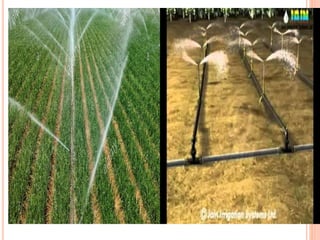
 The sprinkler method consist of applying the water
to the crop or soil in the form of a spray, somewhat
as in ordinary rain.
 Greatest advantage of its adaptabilities to use
where surface irrigation methods are not efficient.
 Sprinkler systems eliminate water conveyance
channels, thereby reducing water loss.
 Water is also distributed more evenly across crops
helping to avoid wastage(increased crop yields).
INTRODUCTION
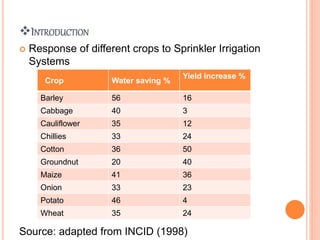
 Response of different crops to Sprinkler Irrigation
Systems
Source: adapted from INCID (1998)
Crop Water saving %
Yield increase %
Barley 56 16
Cabbage 40 3
Cauliflower 35 12
Chillies 33 24
Cotton 36 50
Groundnut 20 40
Maize 41 36
Onion 33 23
Potato 46 4
Wheat 35 24
 WHERE IT IS ADOPTED
 Slopes are excessive
 Topography is irregular.
 High permeable soil (sandy soil).
 When the water table is high(shallow depth of soil).
 Soil is erosive.
Sprinkler System can be classified under three heads:
I. Permanent system(pipes are buried),
II. Semi-permanent (main lines buried) ,
III. Portable (main and laterals are portable).
• ADVANTAGES
 One of the main advantages of the sprinkler irrigation
technology is more efficient use of water for irrigation in
agriculture (80% Efficiency is achieved).
 Irrigation is better controlled.
 Surface runoff are completely eliminated.
 Fertilizers can be uniformly applied.
 Increase in yield, Mobility of system.
 Land preparation is not required.
 No cultivation area is lost for making ditches.
 Requires Less Labor so useful where labor is costly an
scarce.
 Uniform Distribution of Water.
 COMPONENTS
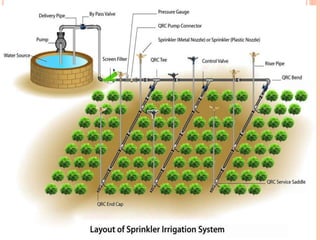
 Water source: tube well, open well, canal, pond, bore
well etc.
 Pumping unit: centrifugal pump
 Sprinkler: main, lateral pipe lines, riser pipe,
sprinklers (nozzles). field
 Sprinkler: vertical members, horizontal members,
catch canes, nozzles, display unit, riser pipe, pipes.
Lab
 Couplers: Couplers are used for connecting two pipes
and uncoupling quickly and easily.
 Others: valve, regulator and gauge, filters.
BARRIERS TO IMPLEMENTATION:
 climatic conditions, water resources and cost.
 Implementation costs are higher than that of
gravity-fed irrigation systems and large labour force
is needed to move pipes and sprinklers in a non-
permanent system.
 Mechanized sprinkler irrigation systems have a
relatively high energy demand.
 lack of access to finance for the purchase of
equipment, lack of local skills for design,
 CASE STUDY.
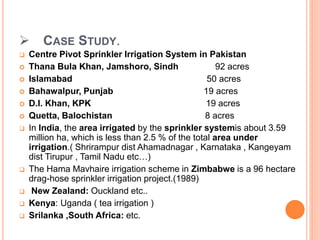
 Centre Pivot Sprinkler Irrigation System in Pakistan
 Thana Bula Khan, Jamshoro, Sindh 92 acres
 Islamabad 50 acres
 Bahawalpur, Punjab 19 acres
 D.I. Khan, KPK 19 acres
 Quetta, Balochistan 8 acres
 In India, the area irrigated by the sprinkler systemis about 3.59
million ha, which is less than 2.5 % of the total area under
irrigation.( Shrirampur dist Ahamadnagar , Karnataka , Kangeyam
dist Tirupur , Tamil Nadu etc…)
 The Hama Mavhaire irrigation scheme in Zimbabwe is a 96 hectare
drag-hose sprinkler irrigation project.(1989)
 New Zealand: Ouckland etc..
 Kenya: Uganda ( tea irrigation )
 Srilanka ,South Africa: etc.
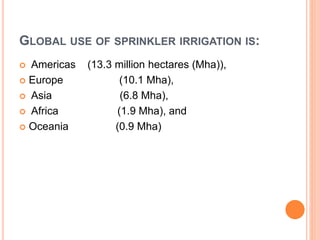
GLOBAL USE OF SPRINKLER IRRIGATION IS:
 Americas (13.3 million hectares (Mha)),
 Europe (10.1 Mha),
 Asia (6.8 Mha),
 Africa (1.9 Mha), and
 Oceania (0.9 Mha)
 MECHANISM
In a sprinkler system, water is distributed through a
system of pipes usually by pumping. It is then
sprayed into the air through sprinklers so that it
breaks up into small water drops which fall to the
ground. The pump supply system, sprinklers and
operating conditions must be designed to enable a
uniform application of water. Sprinklers are used to
irrigate crops, vegetation, or used for recreation, as a
cooling system.
 PROCEDURE
First of all we collect all the components required, then
 Set the sprinkler unit system.
 Supply the water from any source( water tank).
 Water should be free from slit, clay which may cause abrasion
action or choking of nozzle.
 keeping the pressure and riser height constant for determining
the best nozzle size.
 Change the nozzle e.g. (4.2mm , 4.5mm , 5mm )
 Note the collected water in catch cane from display unit.
 By using formula of cu (co-efficient of uniformity) we have to
select best nozzle size. The high value of cu shows best nozzle
size.
 Now using best nozzle size and keeping pressure
constant.
 We have to vary the riser height and by applying
same above procedure we have to select best riser
height.
 And using that best nozzle size and riser height
now we have to vary pressure and by applying
same above procedure we have to select best
pressure at which we get high value of cu.
 Now that sprinkler can be used to get maximum
crop cultivation.
Sprinkler irrigation system

Sprinkler irrigation system

  • 1.
    DEPARTMENT OF CIVIL ENGINEERING SPRINKLERIRRIGATION SYSTEM Presented by: Moti Ram 16CE69 Mohammad Samiullah 16CE177 Ali Raza 16CE157 Sumair Shaikh 16CE145
  • 2.
     INTRODUCTION  Thesprinkler method consist of applying the water to the crop or soil in the form of a spray, somewhat as in ordinary rain.  Greatest advantage of its adaptabilities to use where surface irrigation methods are not efficient.  Sprinkler systems eliminate water conveyance channels, thereby reducing water loss.  Water is also distributed more evenly across crops helping to avoid wastage(increased crop yields).
  • 3.
    INTRODUCTION  Response ofdifferent crops to Sprinkler Irrigation Systems Source: adapted from INCID (1998) Crop Water saving % Yield increase % Barley 56 16 Cabbage 40 3 Cauliflower 35 12 Chillies 33 24 Cotton 36 50 Groundnut 20 40 Maize 41 36 Onion 33 23 Potato 46 4 Wheat 35 24
  • 5.
     WHERE ITIS ADOPTED  Slopes are excessive  Topography is irregular.  High permeable soil (sandy soil).  When the water table is high(shallow depth of soil).  Soil is erosive. Sprinkler System can be classified under three heads: I. Permanent system(pipes are buried), II. Semi-permanent (main lines buried) , III. Portable (main and laterals are portable).
  • 6.
    • ADVANTAGES  Oneof the main advantages of the sprinkler irrigation technology is more efficient use of water for irrigation in agriculture (80% Efficiency is achieved).  Irrigation is better controlled.  Surface runoff are completely eliminated.  Fertilizers can be uniformly applied.  Increase in yield, Mobility of system.  Land preparation is not required.  No cultivation area is lost for making ditches.  Requires Less Labor so useful where labor is costly an scarce.  Uniform Distribution of Water.
  • 7.
     COMPONENTS  Watersource: tube well, open well, canal, pond, bore well etc.  Pumping unit: centrifugal pump  Sprinkler: main, lateral pipe lines, riser pipe, sprinklers (nozzles). field  Sprinkler: vertical members, horizontal members, catch canes, nozzles, display unit, riser pipe, pipes. Lab  Couplers: Couplers are used for connecting two pipes and uncoupling quickly and easily.  Others: valve, regulator and gauge, filters.
  • 8.
    BARRIERS TO IMPLEMENTATION: climatic conditions, water resources and cost.  Implementation costs are higher than that of gravity-fed irrigation systems and large labour force is needed to move pipes and sprinklers in a non- permanent system.  Mechanized sprinkler irrigation systems have a relatively high energy demand.  lack of access to finance for the purchase of equipment, lack of local skills for design,
  • 9.
     CASE STUDY. Centre Pivot Sprinkler Irrigation System in Pakistan  Thana Bula Khan, Jamshoro, Sindh 92 acres  Islamabad 50 acres  Bahawalpur, Punjab 19 acres  D.I. Khan, KPK 19 acres  Quetta, Balochistan 8 acres  In India, the area irrigated by the sprinkler systemis about 3.59 million ha, which is less than 2.5 % of the total area under irrigation.( Shrirampur dist Ahamadnagar , Karnataka , Kangeyam dist Tirupur , Tamil Nadu etc…)  The Hama Mavhaire irrigation scheme in Zimbabwe is a 96 hectare drag-hose sprinkler irrigation project.(1989)  New Zealand: Ouckland etc..  Kenya: Uganda ( tea irrigation )  Srilanka ,South Africa: etc.
  • 10.
    GLOBAL USE OFSPRINKLER IRRIGATION IS:  Americas (13.3 million hectares (Mha)),  Europe (10.1 Mha),  Asia (6.8 Mha),  Africa (1.9 Mha), and  Oceania (0.9 Mha)
  • 11.
     MECHANISM In asprinkler system, water is distributed through a system of pipes usually by pumping. It is then sprayed into the air through sprinklers so that it breaks up into small water drops which fall to the ground. The pump supply system, sprinklers and operating conditions must be designed to enable a uniform application of water. Sprinklers are used to irrigate crops, vegetation, or used for recreation, as a cooling system.
  • 13.
     PROCEDURE First ofall we collect all the components required, then  Set the sprinkler unit system.  Supply the water from any source( water tank).  Water should be free from slit, clay which may cause abrasion action or choking of nozzle.  keeping the pressure and riser height constant for determining the best nozzle size.  Change the nozzle e.g. (4.2mm , 4.5mm , 5mm )  Note the collected water in catch cane from display unit.  By using formula of cu (co-efficient of uniformity) we have to select best nozzle size. The high value of cu shows best nozzle size.
  • 14.
     Now usingbest nozzle size and keeping pressure constant.  We have to vary the riser height and by applying same above procedure we have to select best riser height.  And using that best nozzle size and riser height now we have to vary pressure and by applying same above procedure we have to select best pressure at which we get high value of cu.  Now that sprinkler can be used to get maximum crop cultivation.