“Software is eating the world”
128k LoC
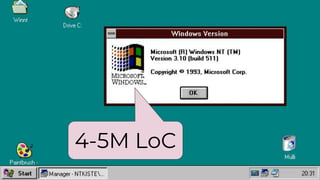
4-5M LoC
9M LoC
18M LoC
45M LoC
150M LoC
Machine Learning on Source Code
Francesc Campoy
VP of Product & DevRel
source{d}
Machine Learning for Large Scale Code Analysis
@francesc | #MLonCode
Francesc Campoy
Agenda
● Machine Learning on Source Code
● Research
● Use Cases
● The Future
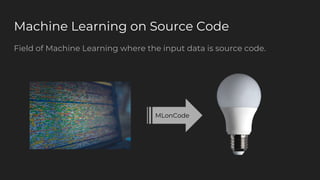
Machine Learning on Source Code
Field of Machine Learning where the input data is source code.
MLonCode
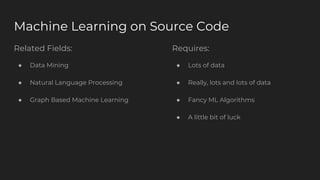
Machine Learning on Source Code
Requires:
● Lots of data
● Really, lots and lots of data
● Fancy ML Algorithms
● A little bit of luck
Related Fields:
● Data Mining
● Natural Language Processing
● Graph Based Machine Learning
Challenge #1
Data Retrieval
The datasets of ML on Code
● GH Archive: https://www.gharchive.org
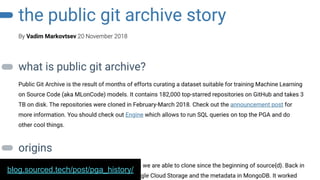
● Public Git Archive https://pga.sourced.tech
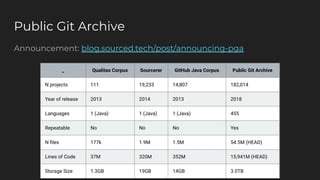
Announcement: blog.sourced.tech/post/announcing-pga
Public Git Archive
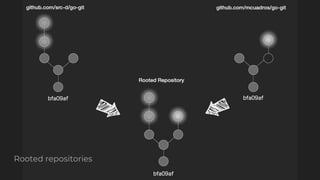
Rooted repositories
blog.sourced.tech/post/pga_history/
Challenge #2
Data Analysis
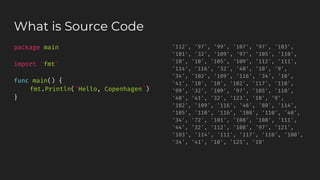
'112', '97', '99', '107', '97', '103',
'101', '32', '109', '97', '105', '110',
'10', '10', '105', '109', '112', '111',
'114', '116', '32', '40', '10', '9',
'34', '102', '109', '116', '34', '10',
'41', '10', '10', '102', '117', '110',
'99', '32', '109', '97', '105', '110',
'40', '41', '32', '123', '10', '9',
'102', '109', '116', '46', '80', '114',
'105', '110', '116', '108', '110', '40',
'34', '72', '101', '108', '108', '111',
'44', '32', '112', '108', '97', '121',
'103', '114', '111', '117', '110', '100',
'34', '41', '10', '125', '10'
package main
import “fmt”
func main() {
fmt.Println(“Hello, Copenhagen”)
}
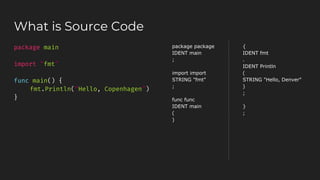
What is Source Code
package package
IDENT main
;
import import
STRING "fmt"
;
func func
IDENT main
(
)
What is Source Code
{
IDENT fmt
.
IDENT Println
(
STRING "Hello, Denver"
)
;
}
;
package main
import “fmt”
func main() {
fmt.Println(“Hello, Copenhagen”)
}
What is Source Code
package main
import “fmt”
func main() {
fmt.Println(“Hello, Copenhagen”)
}
What is Source Code
package main
import “fmt”
func main() {
fmt.Println(“Hello, Copenhagen”)
}
What is Source Code
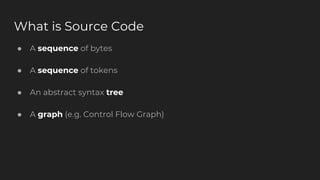
● A sequence of bytes
● A sequence of tokens
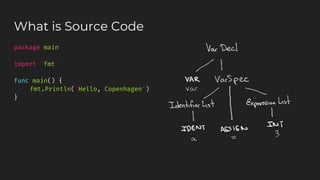
● An abstract syntax tree
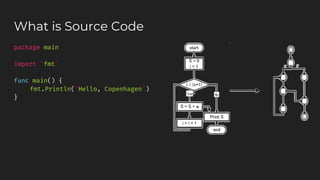
● A graph (e.g. Control Flow Graph)
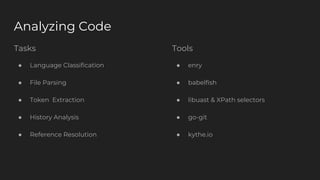
Tasks
● Language Classification
● File Parsing
● Token Extraction
● History Analysis
● Reference Resolution
Tools
● enry
● babelfish
● libuast & XPath selectors
● go-git
● kythe.io
Analyzing Code
source{d} engine
github.com/src-d/engine
babelfish
gitbase
jupiter
Demo time!
Challenge #3
Learning from Source Code
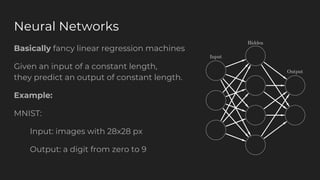
Neural Networks
Basically fancy linear regression machines
Given an input of a constant length,
they predict an output of constant length.
Example:
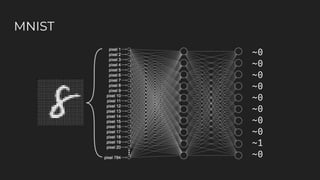
MNIST:
Input: images with 28x28 px
Output: a digit from zero to 9
MNIST
~0
~0
~0
~0
~0
~0
~0
~0
~1
~0
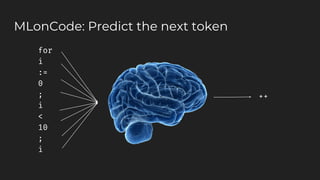
MLonCode: Predict the next token
for
i
:=
0
;
i
<
10
;
i
++
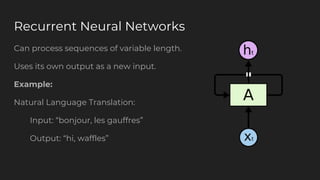
Recurrent Neural Networks
Can process sequences of variable length.
Uses its own output as a new input.
Example:
Natural Language Translation:
Input: “bonjour, les gauffres”
Output: “hi, waffles”
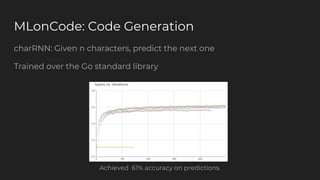
MLonCode: Code Generation
charRNN: Given n characters, predict the next one
Trained over the Go standard library
Achieved 61% accuracy on predictions.
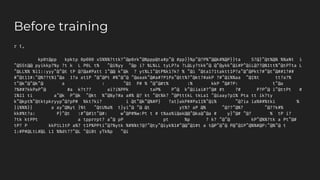
Before training
r t,
kp0t@pp kpktp 0p000 xS%%%?ttk?^@p0rk^@%ppp@ta#p^@ #pp}}%p^@?P%^@@k#%@P}}ta S?@}^@t%@% %%aNt i
^@SSt@@ pyikkp?%y ?t k L P0L t% ^@i%yy ^@p i? %L%LL tyLP?a ?L@Ly?tkk^@ @^@ykk^@i#P^@iL@??@%1tt%^@tPTta L
^@LL%% %i1::yyy^@^@t tP @?@a#Patt 1^@@ k^@k ? yt%L1^@tP%k1?k? % ^@i ^@ta1?1taktt1P?a^@^@Pkt?#^@t^@##1?##
#^@t11#:^@%??t%1^@a 1?a at1P ^@^@Pt #%^@^@ ^@aaak^@#a#?P1Pa^@tt%?^@kt?#akP ?#^@i%%aa ^@1%t tt?a?%
t^@k^@^@k^@ a : ^@1 P# % ^@^@#t% :% kkP ^@#?P: t^@a
?%##?kkPaP^@ #a k?t?? ai?i%PPk taP% P^@ k^@iiai#?^@# #t ?# P?P^@ i^@ttPt #
1%11 ti a^@k P^@k ^@kt %^@%y?#a a#% @? kt ^@t%k? ^@PtttkL tkLa1 ^@iaay?p1% Pta tt ik?ty
k^@kpt%^@tktpkryyp^@?pP# %kt?ki? i @t^@k^@%#P} ?at}akP##Pa11%^@i% ^@?ia ia%##%tki %
}i%%%}} a ay^@%yt }%t ^@tU%a% t}yi^@ ^@ @t yt%? aP @% ^@??^@%? ^@??k#%
kk#%t?a: P}^@t :#^@#1t^@#: w^@P#%w:Pt t # t%aa%i@ak@@^@ka@^@a # y}^@# ^@? % tP i?
?tk ktPPt a tpprrpt? a^@ pP pt %p ? k? ^@^@ kP^@%%?tk a Pt^@#
tP? P kkP1L1tP a%? t1P%PPti^@?%ytk %#%%t?@?^@ty^@iyk%1#^@@^@1#t a t@P^@^@ P@^@1P^@%%#@P:^@%^@ t
1:#P#@LtL#@L L1 %%dt??^@L ^@iBt yTk%p ^@i
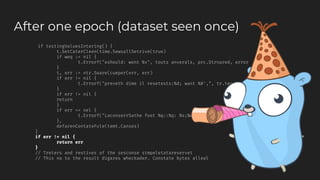
After one epoch (dataset seen once)
if testingValuesIntering() {
t.SetCaterCleen(time.SewsallSetrive(true)
if weq := nil {
t.Errorf("eshould: wont %v", touts anverals, prc.Strnared, error
}
t, err := ntr.Soare(cueper(err, err)
if err != nil {
t.Errorf("preveth dime il resetests:%d; want %#',", tr.test.Into
}
if err != nil {
return
}
if err == nel {
t.Errorf("LoconserrSathe foot %q::%q: %s;%want %d", d, err)
},
defarenContateFule(temt.Canses)
}
if err != nil {
return err
}
// Treters and restives of the sesconse stmpeletatareservet
// This no to the result digares wheckader. Constate bytes alleal
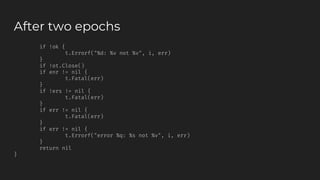
After two epochs
if !ok {
t.Errorf("%d: %v not %v", i, err)
}
if !ot.Close()
if enr != nil {
t.Fatal(err)
}
if !ers != nil {
t.Fatal(err)
}
if err != nil {
t.Fatal(err)
}
if err != nil {
t.Errorf("error %q: %s not %v", i, err)
}
return nil
}
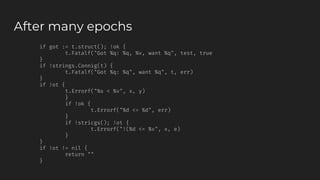
if got := t.struct(); !ok {
t.Fatalf("Got %q: %q, %v, want %q", test, true
}
if !strings.Connig(t) {
t.Fatalf("Got %q: %q", want %q", t, err)
}
if !ot {
t.Errorf("%s < %v", x, y)
}
if !ok {
t.Errorf("%d <= %d", err)
}
if !stricgs(); !ot {
t.Errorf("!(%d <= %v", x, e)
}
}
if !ot != nil {
return ""
}
After many epochs
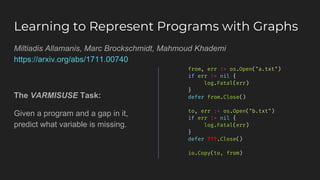
Learning to Represent Programs with Graphs
from, err := os.Open("a.txt")
if err != nil {
log.Fatal(err)
}
defer from.Close()
to, err := os.Open("b.txt")
if err != nil {
log.Fatal(err)
}
defer ???.Close()
io.Copy(to, from)
Miltiadis Allamanis, Marc Brockschmidt, Mahmoud Khademi
https://arxiv.org/abs/1711.00740
The VARMISUSE Task:
Given a program and a gap in it,
predict what variable is missing.
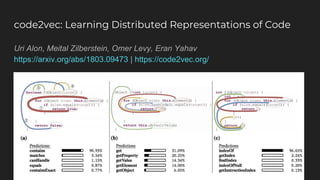
code2vec: Learning Distributed Representations of Code
Uri Alon, Meital Zilberstein, Omer Levy, Eran Yahav
https://arxiv.org/abs/1803.09473 | https://code2vec.org/
Much more research
github.com/src-d/awesome-machine-learning-on-source-code
Challenge #4
What can we build?
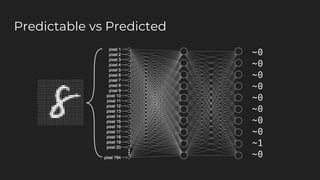
Predictable vs Predicted
~0
~0
~0
~0
~0
~0
~0
~0
~1
~0
A
G
o
PR
An attention model for code reviews.
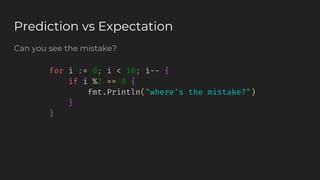
Can you see the mistake?
Prediction vs Expectation
for i := 0; i < 10; i-- {
if i %2 == 0 {
fmt.Println("where's the mistake?")
}
}
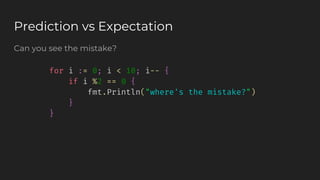
Can you see the mistake?
Prediction vs Expectation
for i := 0; i < 10; i-- {
if i %2 == 0 {
fmt.Println("where's the mistake?")
}
}
Can you see the mistake?
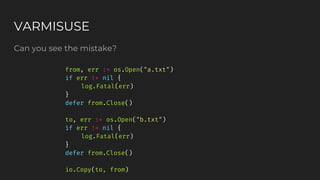
VARMISUSE
from, err := os.Open("a.txt")
if err != nil {
log.Fatal(err)
}
defer from.Close()
to, err := os.Open("b.txt")
if err != nil {
log.Fatal(err)
}
defer from.Close()
io.Copy(to, from)
Can you see the mistake?
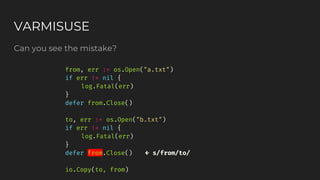
VARMISUSE
from, err := os.Open("a.txt")
if err != nil {
log.Fatal(err)
}
defer from.Close()
to, err := os.Open("b.txt")
if err != nil {
log.Fatal(err)
}
defer from.Close() ← s/from/to/
io.Copy(to, from)
Is this a good name?
func XXX(list []string, text string) bool {
for _, s := range list {
if s == text {
return true
}
}
return false
}
Suggestions:
● Contains
● Has
func XXX(list []string, text string) int {
for i, s := range list {
if s == text {
return i
}
}
return -1
}
Suggestions:
● Find
● Index
code2vec: Learning Distributed Representations of Code
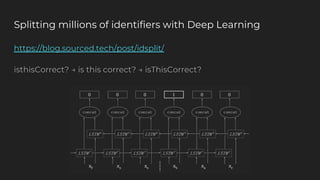
Splitting millions of identifiers with Deep Learning
https://blog.sourced.tech/post/idsplit/
isthisCorrect? → is this correct? → isThisCorrect?
Demo time!
learning Go
code2vec.org
neural splitter
source: WOCinTech
Assisted code review! src-d/lookout
putting everything together
lookout
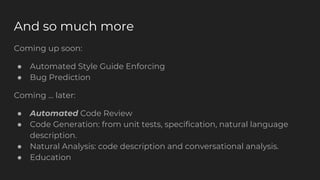
Coming up soon:
● Automated Style Guide Enforcing
● Bug Prediction
Coming … later:
● Automated Code Review
● Code Generation: from unit tests, specification, natural language
description.
● Natural Analysis: code description and conversational analysis.
● Education
And so much more
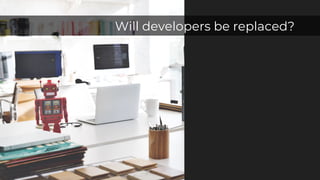
Will developers be replaced?
Developers will be empowered.
Want to know more?
● sourced.tech (pssh, we’re hiring)
● bit.ly/awesome-mloncode
● francesc@sourced.tech
● come say hi, I have stickers
Thanks
francesc

Machine Learning on Code - SF meetup

  • 1.
  • 2.
  • 3.
  • 4.
  • 5.
  • 6.
  • 7.
  • 13.
    Machine Learning onSource Code Francesc Campoy
  • 14.
    VP of Product& DevRel source{d} Machine Learning for Large Scale Code Analysis @francesc | #MLonCode Francesc Campoy
  • 15.
    Agenda ● Machine Learningon Source Code ● Research ● Use Cases ● The Future
  • 16.
  • 17.
    Machine Learning onSource Code Field of Machine Learning where the input data is source code. MLonCode
  • 18.
    Machine Learning onSource Code Requires: ● Lots of data ● Really, lots and lots of data ● Fancy ML Algorithms ● A little bit of luck Related Fields: ● Data Mining ● Natural Language Processing ● Graph Based Machine Learning
  • 19.
  • 20.
    The datasets ofML on Code ● GH Archive: https://www.gharchive.org ● Public Git Archive https://pga.sourced.tech
  • 21.
  • 22.
  • 23.
  • 24.
  • 25.
    '112', '97', '99','107', '97', '103', '101', '32', '109', '97', '105', '110', '10', '10', '105', '109', '112', '111', '114', '116', '32', '40', '10', '9', '34', '102', '109', '116', '34', '10', '41', '10', '10', '102', '117', '110', '99', '32', '109', '97', '105', '110', '40', '41', '32', '123', '10', '9', '102', '109', '116', '46', '80', '114', '105', '110', '116', '108', '110', '40', '34', '72', '101', '108', '108', '111', '44', '32', '112', '108', '97', '121', '103', '114', '111', '117', '110', '100', '34', '41', '10', '125', '10' package main import “fmt” func main() { fmt.Println(“Hello, Copenhagen”) } What is Source Code
  • 26.
    package package IDENT main ; importimport STRING "fmt" ; func func IDENT main ( ) What is Source Code { IDENT fmt . IDENT Println ( STRING "Hello, Denver" ) ; } ; package main import “fmt” func main() { fmt.Println(“Hello, Copenhagen”) }
  • 27.
    What is SourceCode package main import “fmt” func main() { fmt.Println(“Hello, Copenhagen”) }
  • 28.
    What is SourceCode package main import “fmt” func main() { fmt.Println(“Hello, Copenhagen”) }
  • 29.
    What is SourceCode ● A sequence of bytes ● A sequence of tokens ● An abstract syntax tree ● A graph (e.g. Control Flow Graph)
  • 30.
    Tasks ● Language Classification ●File Parsing ● Token Extraction ● History Analysis ● Reference Resolution Tools ● enry ● babelfish ● libuast & XPath selectors ● go-git ● kythe.io Analyzing Code
  • 31.
  • 32.
  • 33.
  • 34.
    Neural Networks Basically fancylinear regression machines Given an input of a constant length, they predict an output of constant length. Example: MNIST: Input: images with 28x28 px Output: a digit from zero to 9
  • 35.
  • 36.
    MLonCode: Predict thenext token for i := 0 ; i < 10 ; i ++
  • 37.
    Recurrent Neural Networks Canprocess sequences of variable length. Uses its own output as a new input. Example: Natural Language Translation: Input: “bonjour, les gauffres” Output: “hi, waffles”
  • 38.
    MLonCode: Code Generation charRNN:Given n characters, predict the next one Trained over the Go standard library Achieved 61% accuracy on predictions.
  • 39.
    Before training r t, kp0t@ppkpktp 0p000 xS%%%?ttk?^@p0rk^@%ppp@ta#p^@ #pp}}%p^@?P%^@@k#%@P}}ta S?@}^@t%@% %%aNt i ^@SSt@@ pyikkp?%y ?t k L P0L t% ^@i%yy ^@p i? %L%LL tyLP?a ?L@Ly?tkk^@ @^@ykk^@i#P^@iL@??@%1tt%^@tPTta L ^@LL%% %i1::yyy^@^@t tP @?@a#Patt 1^@@ k^@k ? yt%L1^@tP%k1?k? % ^@i ^@ta1?1taktt1P?a^@^@Pkt?#^@t^@##1?## #^@t11#:^@%??t%1^@a 1?a at1P ^@^@Pt #%^@^@ ^@aaak^@#a#?P1Pa^@tt%?^@kt?#akP ?#^@i%%aa ^@1%t tt?a?% t^@k^@^@k^@ a : ^@1 P# % ^@^@#t% :% kkP ^@#?P: t^@a ?%##?kkPaP^@ #a k?t?? ai?i%PPk taP% P^@ k^@iiai#?^@# #t ?# P?P^@ i^@ttPt # 1%11 ti a^@k P^@k ^@kt %^@%y?#a a#% @? kt ^@t%k? ^@PtttkL tkLa1 ^@iaay?p1% Pta tt ik?ty k^@kpt%^@tktpkryyp^@?pP# %kt?ki? i @t^@k^@%#P} ?at}akP##Pa11%^@i% ^@?ia ia%##%tki % }i%%%}} a ay^@%yt }%t ^@tU%a% t}yi^@ ^@ @t yt%? aP @% ^@??^@%? ^@??k#% kk#%t?a: P}^@t :#^@#1t^@#: w^@P#%w:Pt t # t%aa%i@ak@@^@ka@^@a # y}^@# ^@? % tP i? ?tk ktPPt a tpprrpt? a^@ pP pt %p ? k? ^@^@ kP^@%%?tk a Pt^@# tP? P kkP1L1tP a%? t1P%PPti^@?%ytk %#%%t?@?^@ty^@iyk%1#^@@^@1#t a t@P^@^@ P@^@1P^@%%#@P:^@%^@ t 1:#P#@LtL#@L L1 %%dt??^@L ^@iBt yTk%p ^@i
  • 40.
    After one epoch(dataset seen once) if testingValuesIntering() { t.SetCaterCleen(time.SewsallSetrive(true) if weq := nil { t.Errorf("eshould: wont %v", touts anverals, prc.Strnared, error } t, err := ntr.Soare(cueper(err, err) if err != nil { t.Errorf("preveth dime il resetests:%d; want %#',", tr.test.Into } if err != nil { return } if err == nel { t.Errorf("LoconserrSathe foot %q::%q: %s;%want %d", d, err) }, defarenContateFule(temt.Canses) } if err != nil { return err } // Treters and restives of the sesconse stmpeletatareservet // This no to the result digares wheckader. Constate bytes alleal
  • 41.
    After two epochs if!ok { t.Errorf("%d: %v not %v", i, err) } if !ot.Close() if enr != nil { t.Fatal(err) } if !ers != nil { t.Fatal(err) } if err != nil { t.Fatal(err) } if err != nil { t.Errorf("error %q: %s not %v", i, err) } return nil }
  • 42.
    if got :=t.struct(); !ok { t.Fatalf("Got %q: %q, %v, want %q", test, true } if !strings.Connig(t) { t.Fatalf("Got %q: %q", want %q", t, err) } if !ot { t.Errorf("%s < %v", x, y) } if !ok { t.Errorf("%d <= %d", err) } if !stricgs(); !ot { t.Errorf("!(%d <= %v", x, e) } } if !ot != nil { return "" } After many epochs
  • 43.
    Learning to RepresentPrograms with Graphs from, err := os.Open("a.txt") if err != nil { log.Fatal(err) } defer from.Close() to, err := os.Open("b.txt") if err != nil { log.Fatal(err) } defer ???.Close() io.Copy(to, from) Miltiadis Allamanis, Marc Brockschmidt, Mahmoud Khademi https://arxiv.org/abs/1711.00740 The VARMISUSE Task: Given a program and a gap in it, predict what variable is missing.
  • 44.
    code2vec: Learning DistributedRepresentations of Code Uri Alon, Meital Zilberstein, Omer Levy, Eran Yahav https://arxiv.org/abs/1803.09473 | https://code2vec.org/
  • 45.
  • 46.
  • 47.
  • 48.
    A G o PR An attention modelfor code reviews.
  • 51.
    Can you seethe mistake? Prediction vs Expectation for i := 0; i < 10; i-- { if i %2 == 0 { fmt.Println("where's the mistake?") } }
  • 52.
    Can you seethe mistake? Prediction vs Expectation for i := 0; i < 10; i-- { if i %2 == 0 { fmt.Println("where's the mistake?") } }
  • 53.
    Can you seethe mistake? VARMISUSE from, err := os.Open("a.txt") if err != nil { log.Fatal(err) } defer from.Close() to, err := os.Open("b.txt") if err != nil { log.Fatal(err) } defer from.Close() io.Copy(to, from)
  • 54.
    Can you seethe mistake? VARMISUSE from, err := os.Open("a.txt") if err != nil { log.Fatal(err) } defer from.Close() to, err := os.Open("b.txt") if err != nil { log.Fatal(err) } defer from.Close() ← s/from/to/ io.Copy(to, from)
  • 55.
    Is this agood name? func XXX(list []string, text string) bool { for _, s := range list { if s == text { return true } } return false } Suggestions: ● Contains ● Has func XXX(list []string, text string) int { for i, s := range list { if s == text { return i } } return -1 } Suggestions: ● Find ● Index code2vec: Learning Distributed Representations of Code
  • 56.
    Splitting millions ofidentifiers with Deep Learning https://blog.sourced.tech/post/idsplit/ isthisCorrect? → is this correct? → isThisCorrect?
  • 57.
  • 58.
    source: WOCinTech Assisted codereview! src-d/lookout
  • 59.
  • 60.
    Coming up soon: ●Automated Style Guide Enforcing ● Bug Prediction Coming … later: ● Automated Code Review ● Code Generation: from unit tests, specification, natural language description. ● Natural Analysis: code description and conversational analysis. ● Education And so much more
  • 61.
  • 62.
  • 63.
    Want to knowmore? ● sourced.tech (pssh, we’re hiring) ● bit.ly/awesome-mloncode ● francesc@sourced.tech ● come say hi, I have stickers
  • 64.