Tree data structure
Plan
1. Definition of the tree
2. Tree Traversals
3. Binary Search Tree Operations: Find, Insert,
Delete
1. Tree
In computer science, a tree is a widely
used abstract data type (ADT) that simulates a
hierarchical tree structure, with a root value and
subtrees of children with a parent node,
represented as a set of linked nodes.
A tree data structure can be defined recursively as a
collection of nodes (starting at a root node), where
each node is a data structure consisting of a value,
together with a list of references to nodes (the
"children"), with the constraints that no reference is
duplicated, and none points to the root.
Tree
Alternatively, a tree can be defined abstractly as a
whole (globally) as an ordered tree, with a value assigned
to each node. Both these perspectives are useful: while a
tree can be analyzed mathematically as a whole, when
actually represented as a data structure it is usually
represented and worked with separately by node (rather
than as a set of nodes and an adjacency list of edges
between nodes, as one may represent a digraph, for
instance). For example, looking at a tree as a whole, one
can talk about "the parent node" of a given node, but in
general as a data structure a given node only contains the
list of its children, but does not contain a reference to its
parent (if any).
Example
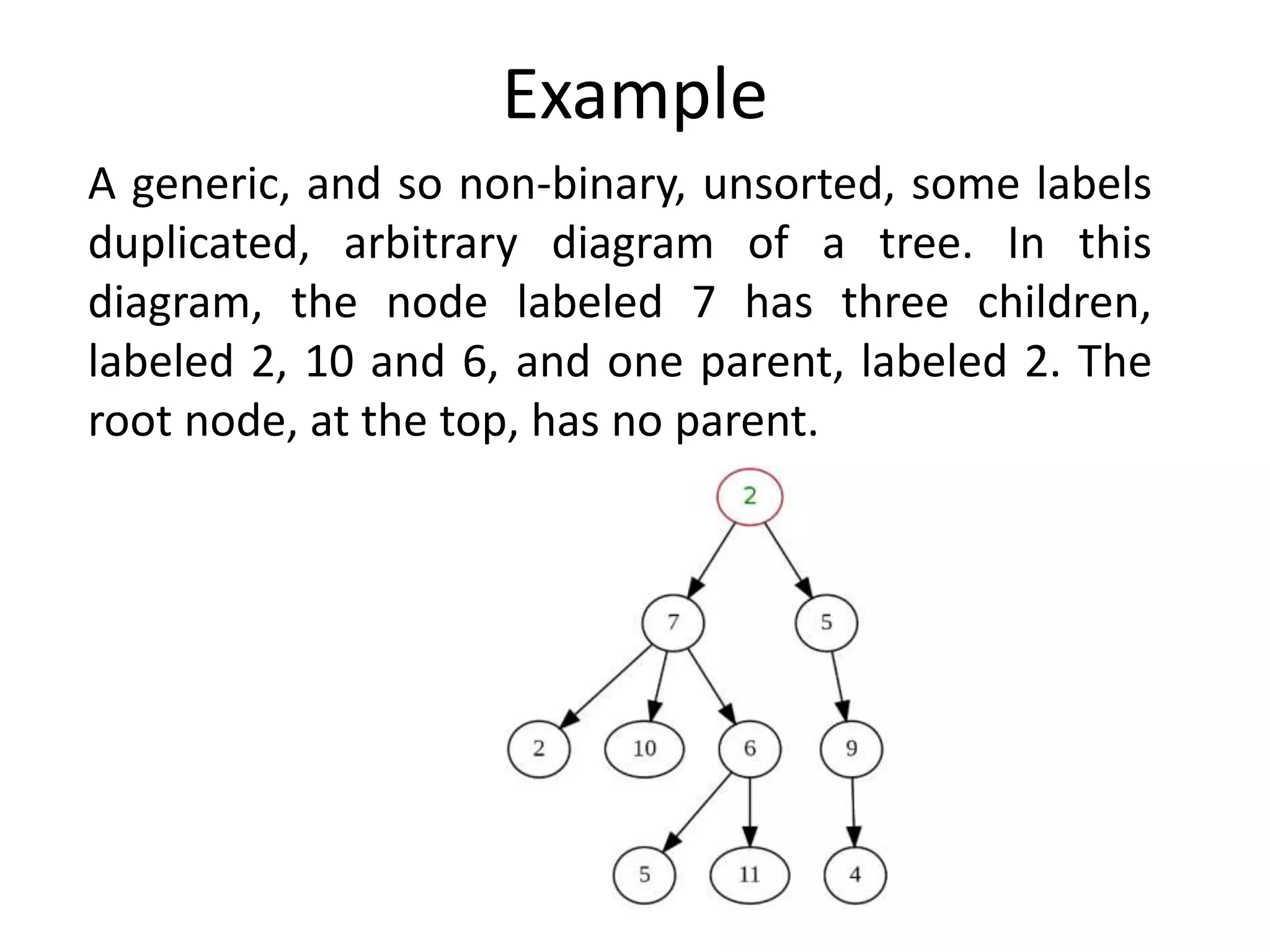
A generic, and so non-binary, unsorted, some labels
duplicated, arbitrary diagram of a tree. In this
diagram, the node labeled 7 has three children,
labeled 2, 10 and 6, and one parent, labeled 2. The
root node, at the top, has no parent.
A tree is a nonlinear data structure,
compared to arrays, linked lists, stacks and
queues which are linear data structures. A tree
can be empty with no nodes or a tree is a
structure consisting of one node called the root
and zero or one or more subtrees.
Preliminary definition
Example
Mathematical definition
Mathematically, an unordered tree (or
"algebraic tree") can be defined as an algebraic
structure (X,parent) where X is the non-empty
carrier set of nodes and parent is a function
on X which assigns each node x its "parent"
node, parent(x). The structure is subject to the
condition that every non-empty subalgebra must
have the same fixed point. That is, there must be a
unique "root" node r, such that parent(r) = r and for
every node x, some iterative
application parent(parent(...parent(x)...)) equals r.
There are several equivalent definitions. As
the closest alternative, one can define
unordered trees
as partial algebras (X, parent) which are
obtained from the total algebras described
above by letting parent(r) be undefined. That is,
the root r is the only node on which
the parent function is not defined and for every
node x, the root is reachable from x in
the directed graph (X, parent).
Mathematical definition
A tree is a basic linked data structure that
is richer than a list.
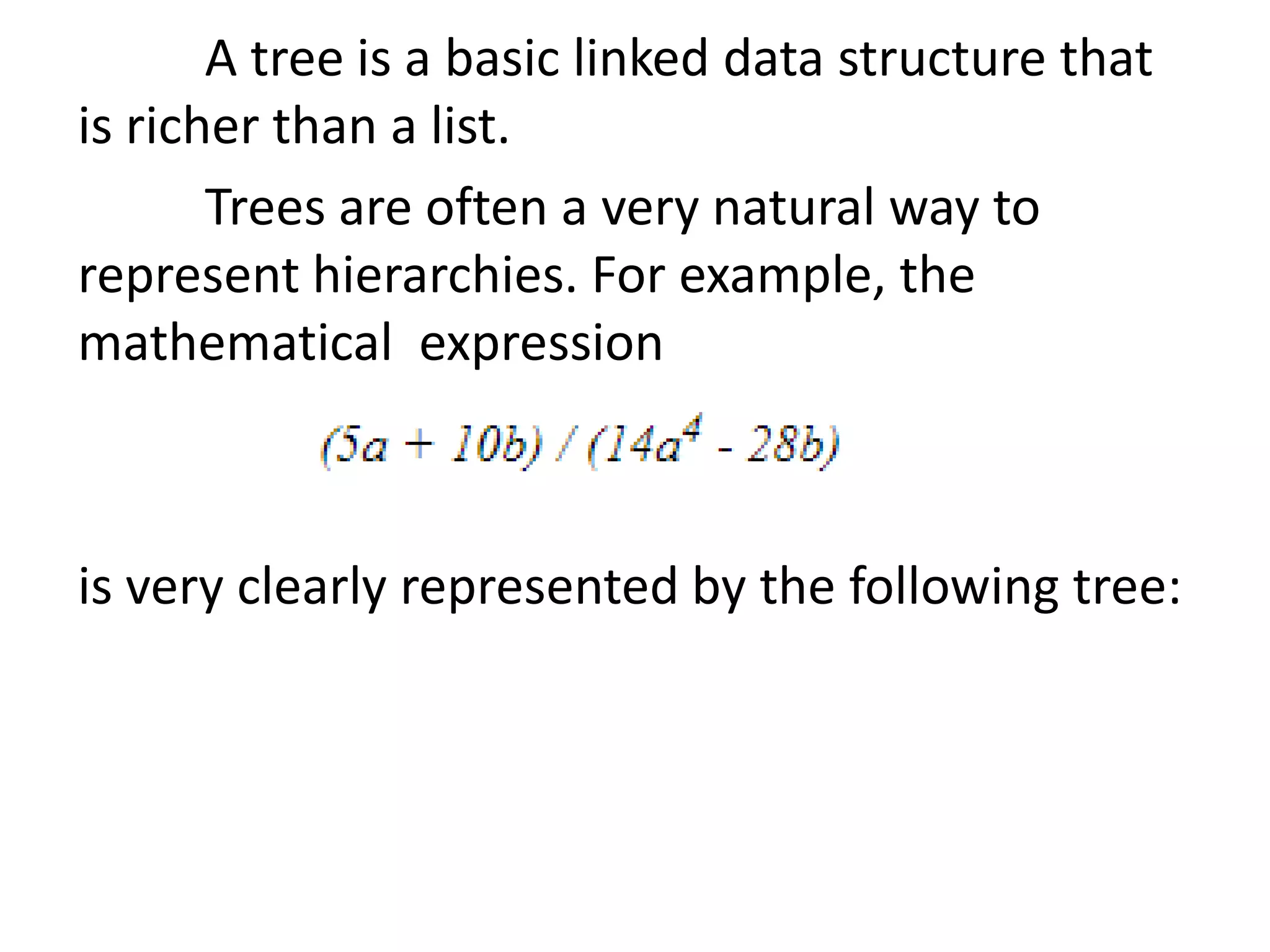
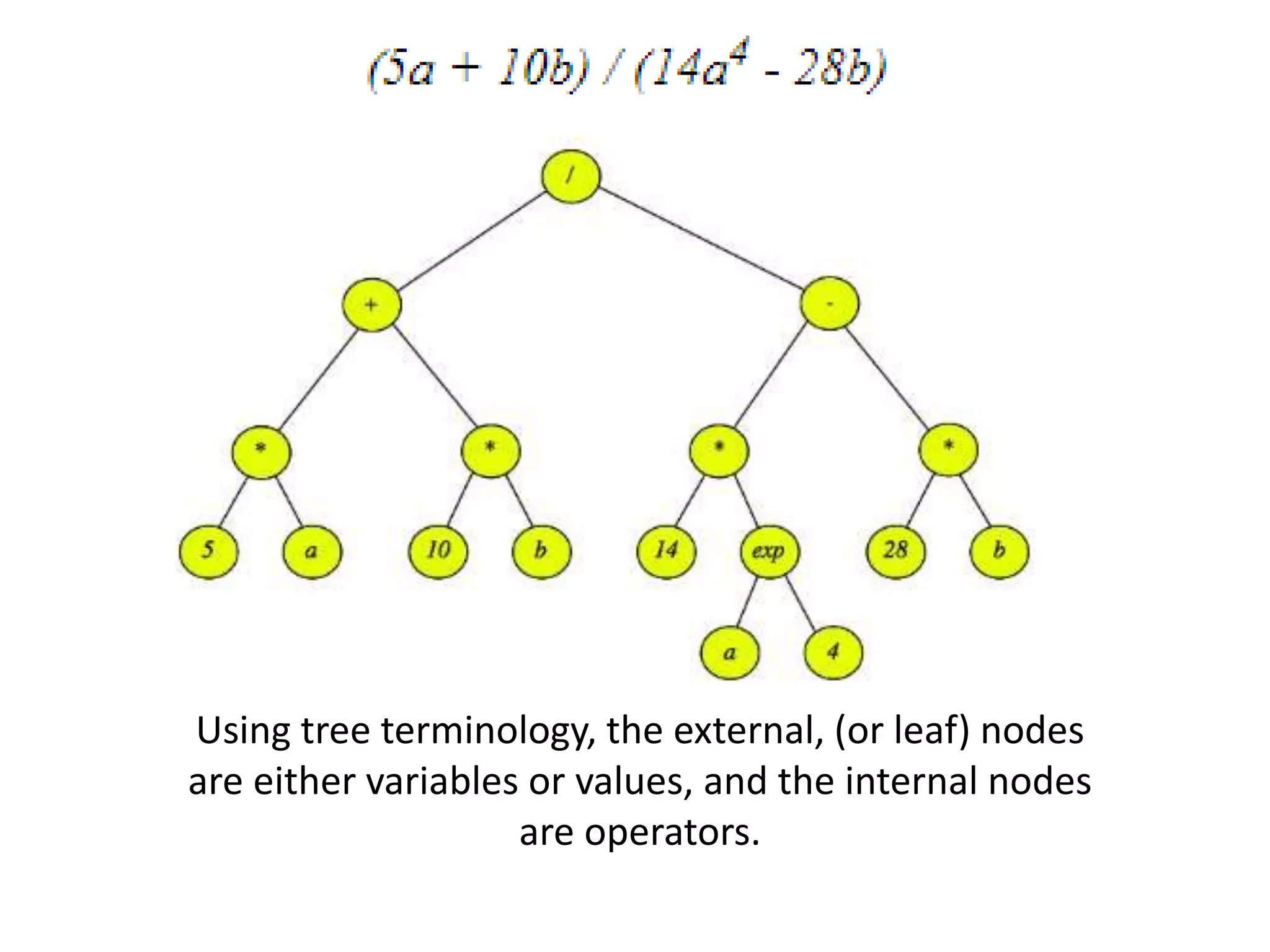
Trees are often a very natural way to
represent hierarchies. For example, the
mathematical expression
is very clearly represented by the following tree:
Using tree terminology, the external, (or leaf) nodes
are either variables or values, and the internal nodes
are operators.
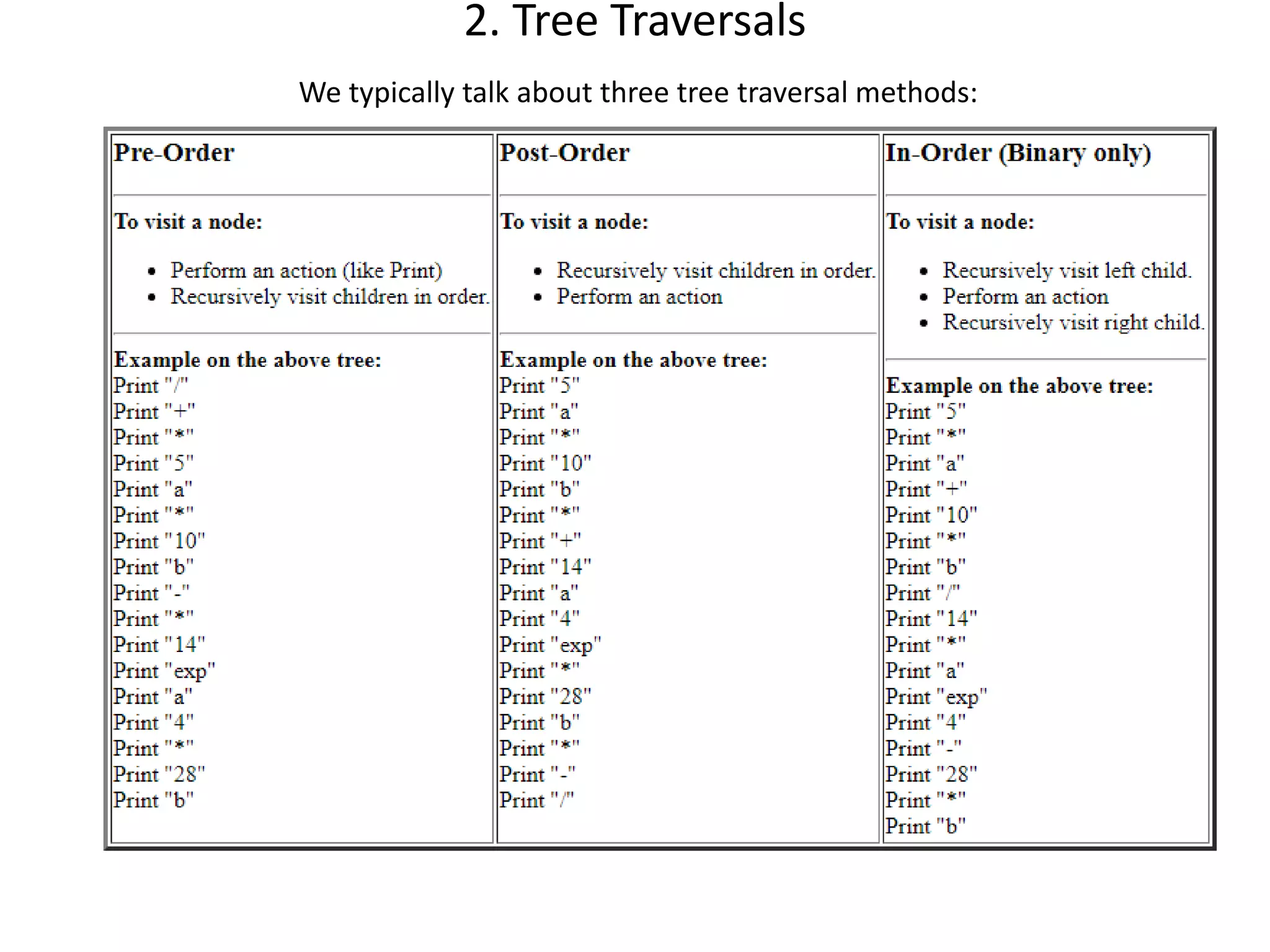
2. Tree Traversals
We typically talk about three tree traversal methods:
• Example Question: "Which of the above
traversals would allow you to evaluate the
expression of the above tree?"
• Answer: A post-order traversal -- for each
operator in an internal node, you need to first
evaluate each of its children before you can
perform the operation. For example, you need to
evaluate the left subtree of "/" and then the right
subtree before you divide the two answers to get
the final evaluation of the expression.
Binary Search Trees
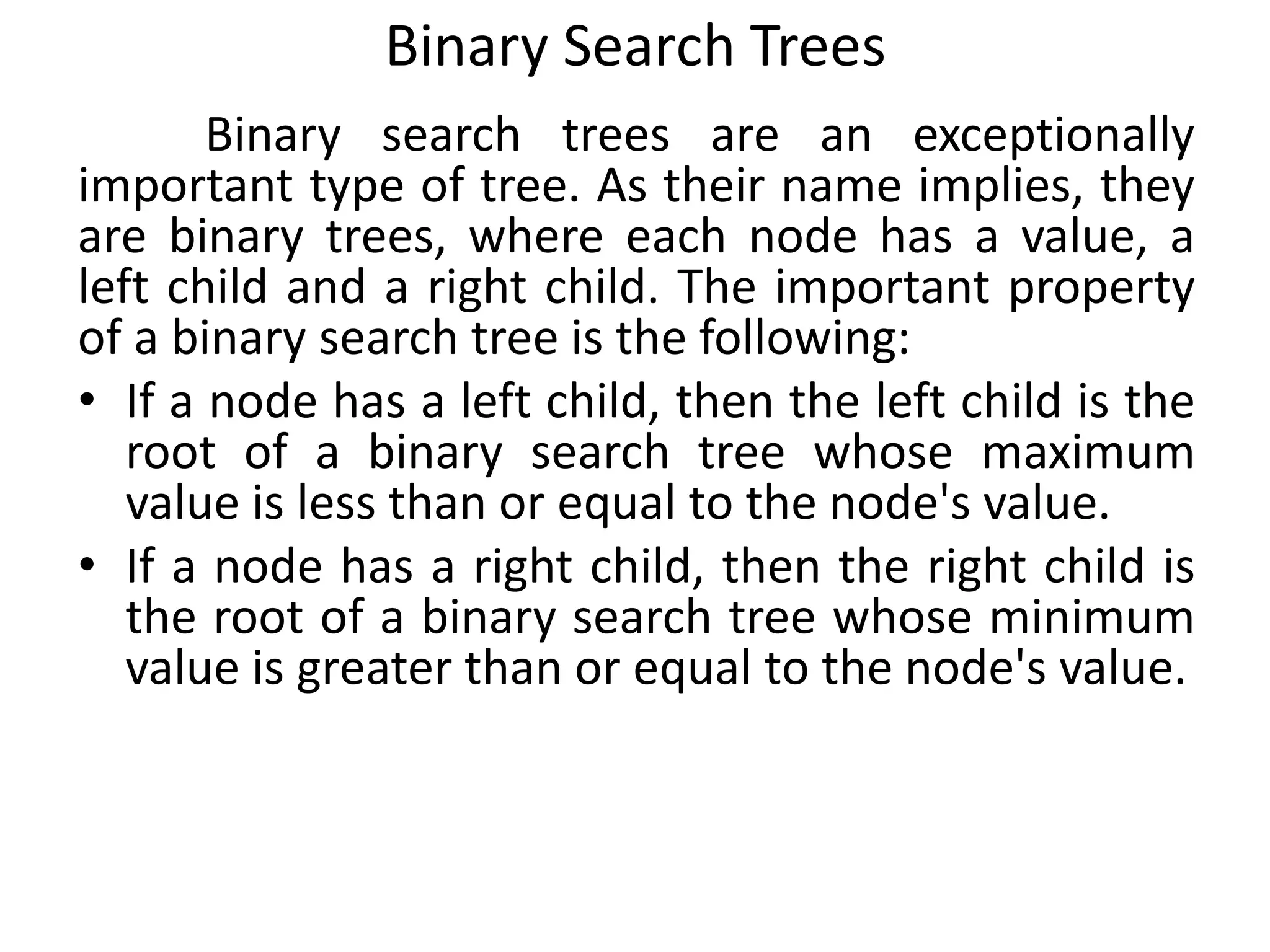
Binary search trees are an exceptionally
important type of tree. As their name implies, they
are binary trees, where each node has a value, a
left child and a right child. The important property
of a binary search tree is the following:
• If a node has a left child, then the left child is the
root of a binary search tree whose maximum
value is less than or equal to the node's value.
• If a node has a right child, then the right child is
the root of a binary search tree whose minimum
value is greater than or equal to the node's value.
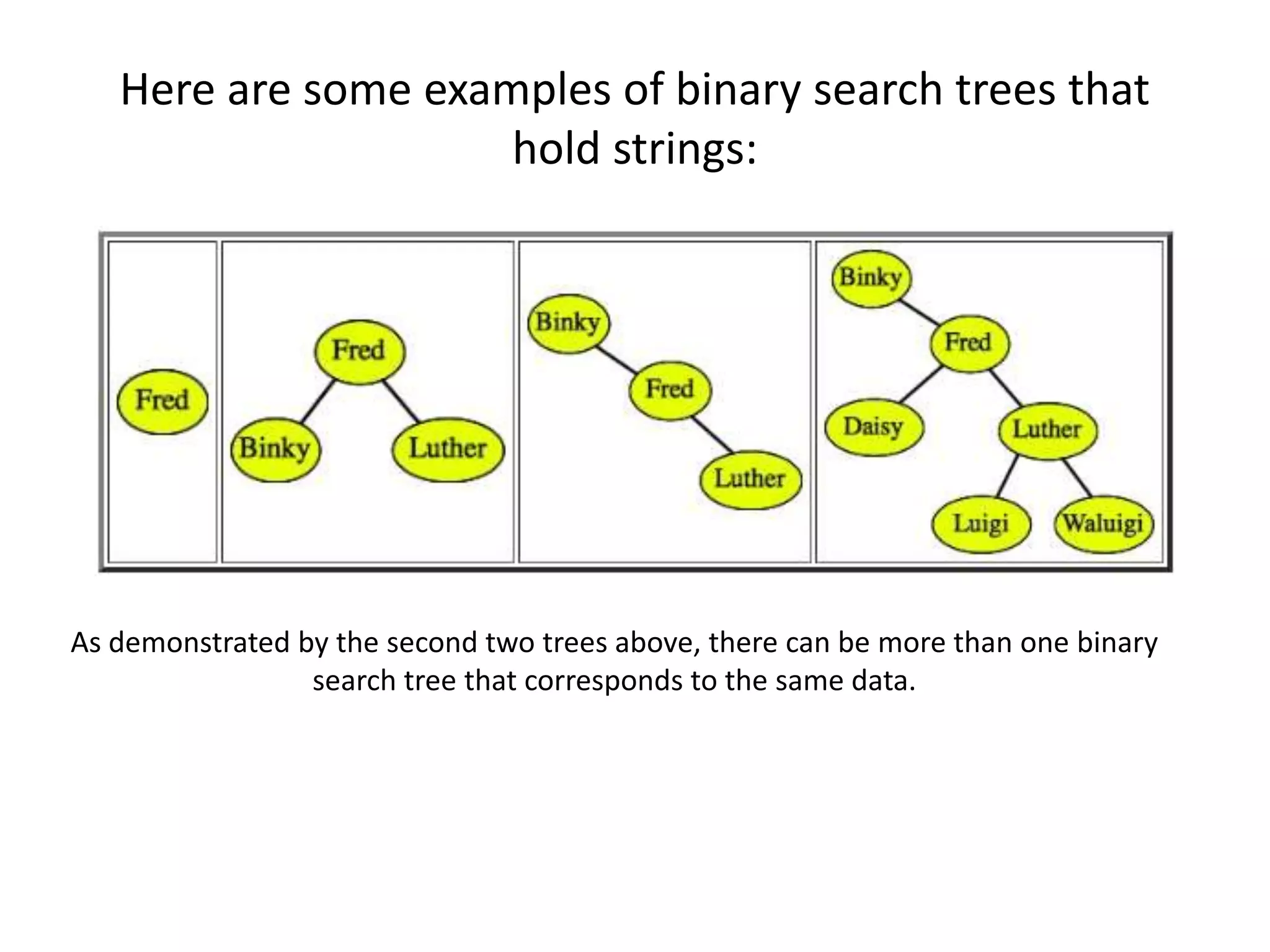
Here are some examples of binary search trees that
hold strings:
As demonstrated by the second two trees above, there can be more than one binary
search tree that corresponds to the same data.
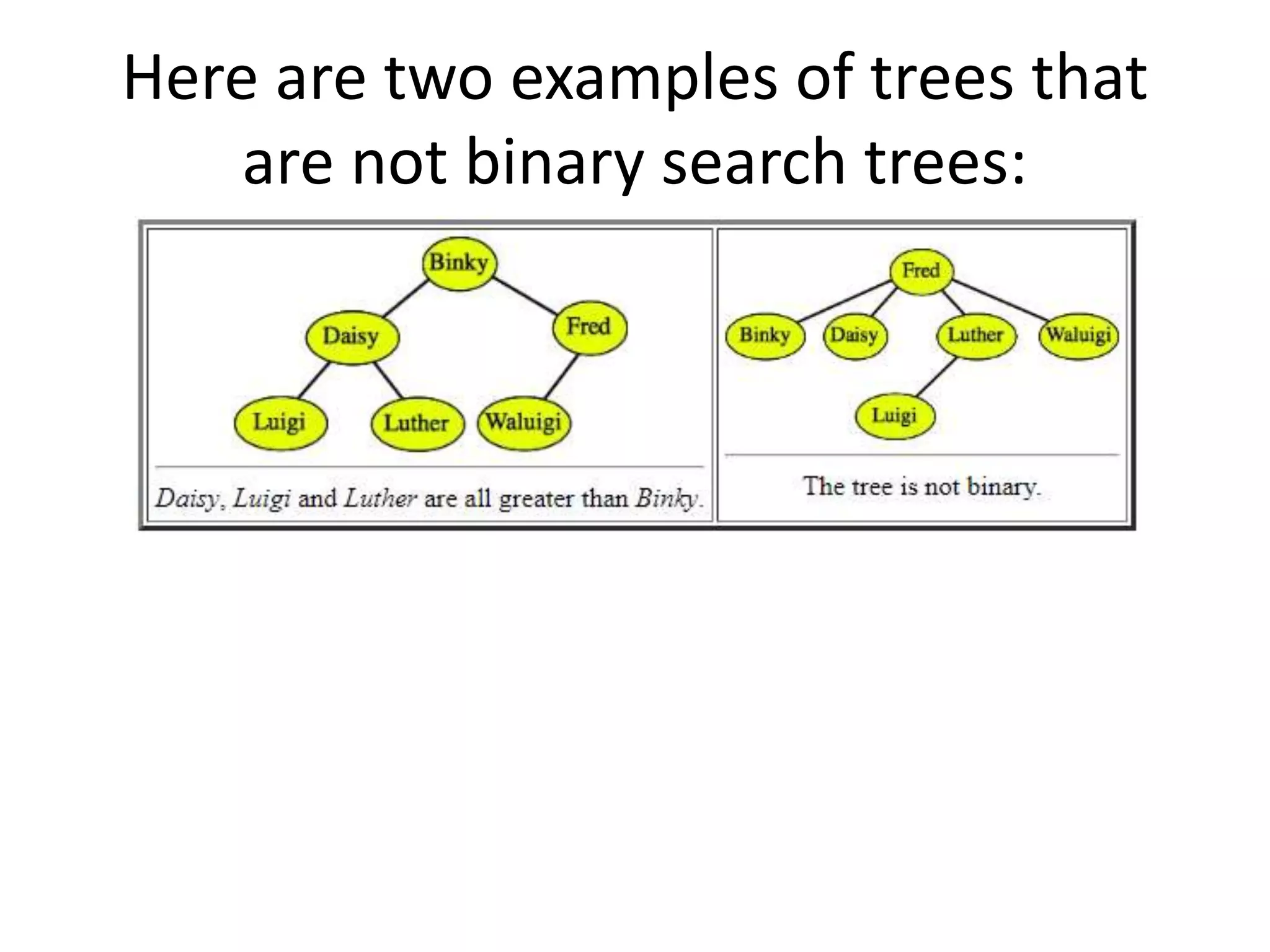
Here are two examples of trees that
are not binary search trees:
Binary search trees have nice properties.
For example, you can sort the data by
performing an in-order traversal. You can also
find a piece of data simply by traversing a single
path from the root to the data, or to where the
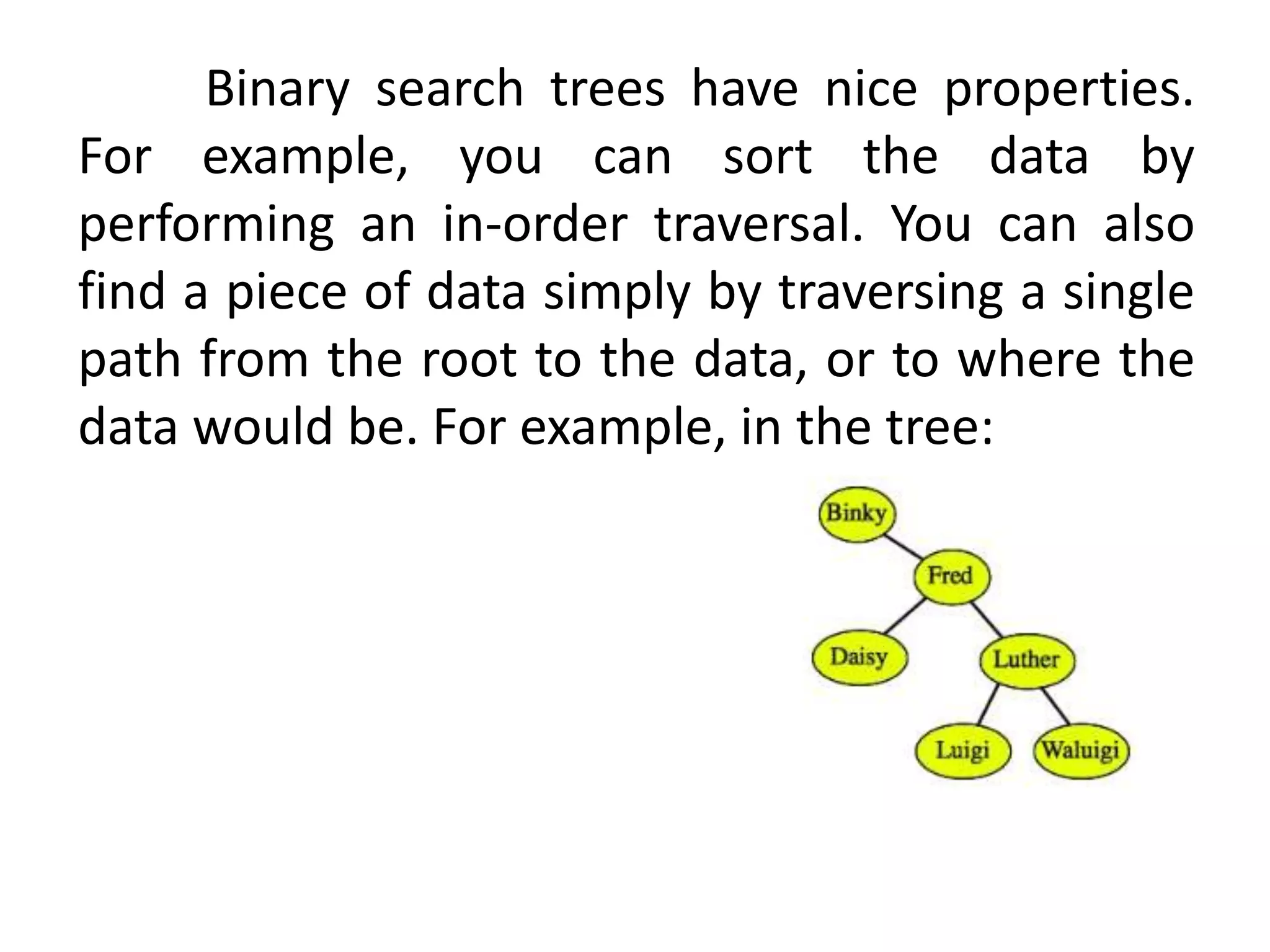
data would be. For example, in the tree:
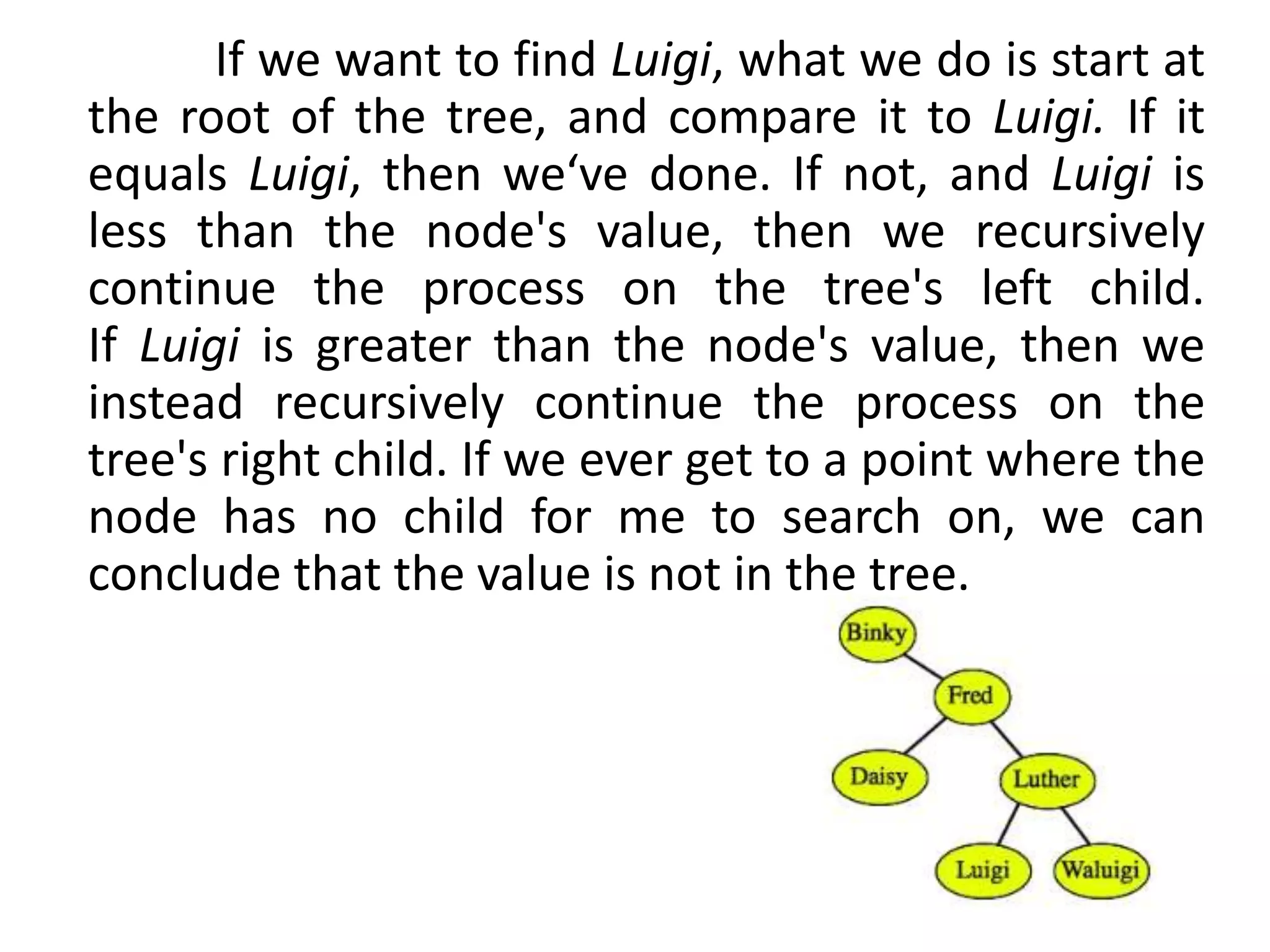
If we want to find Luigi, what we do is start at
the root of the tree, and compare it to Luigi. If it
equals Luigi, then we‘ve done. If not, and Luigi is
less than the node's value, then we recursively
continue the process on the tree's left child.
If Luigi is greater than the node's value, then we
instead recursively continue the process on the
tree's right child. If we ever get to a point where the
node has no child for me to search on, we can
conclude that the value is not in the tree.
Continuing the example of finding Luigi, we would:
• We start at Binky. Since Luigi is greater
than Binky, we will continue searching on Binky's
right child.
• We are next at Fred. Again, Luigi is greater
than Fred, so we continue searching on Fred's
right child.
• Now we are at Luther. Luigi is less than Luther, so
we continue searching on Luther's left child.
• We have found Luigi.
Similarly, suppose we try to find Calista:
• We start at Binky. Since Calista is greater than Binky,
we'll continue searching on Binky's right child.
• We are next at Fred. Calista is less than Fred, so we
continue searching on Fred's left child.
• Now we are at Daisy. Calista is less than Daisy, so we
continue searching on Daisy's left child.
• However, Daisy has no left child. We can conclude
that Calista is not in the search tree.
3. Binary Search Tree Operations: Find, Insert, Delete
We have just described how to find a value
in a binary search tree. Insertion is a pretty simple
matter too. To insert a value s, assume that s is
not int the tree, and find where s should be.
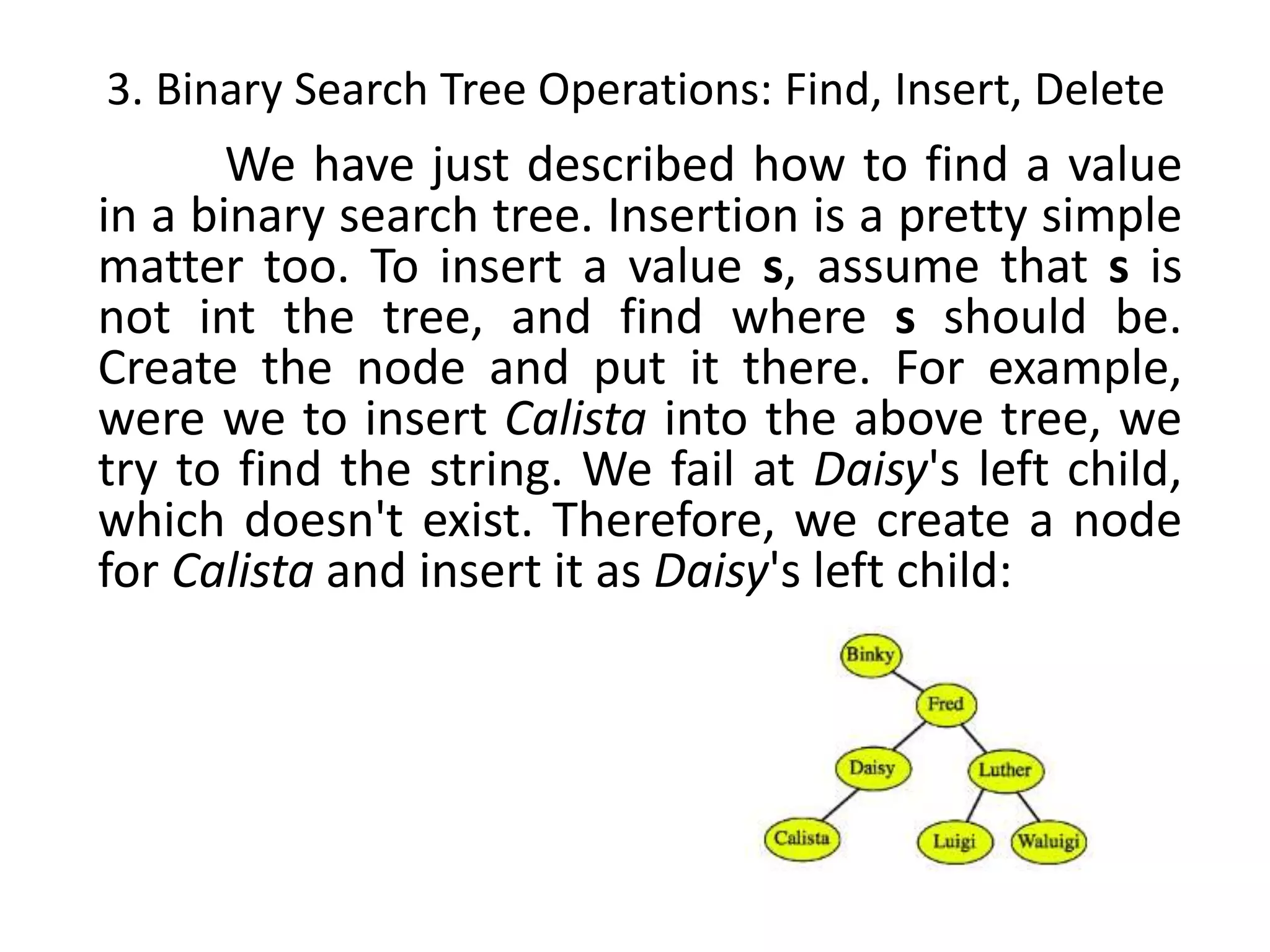
Create the node and put it there. For example,
were we to insert Calista into the above tree, we
try to find the string. We fail at Daisy's left child,
which doesn't exist. Therefore, we create a node
for Calista and insert it as Daisy's left child:
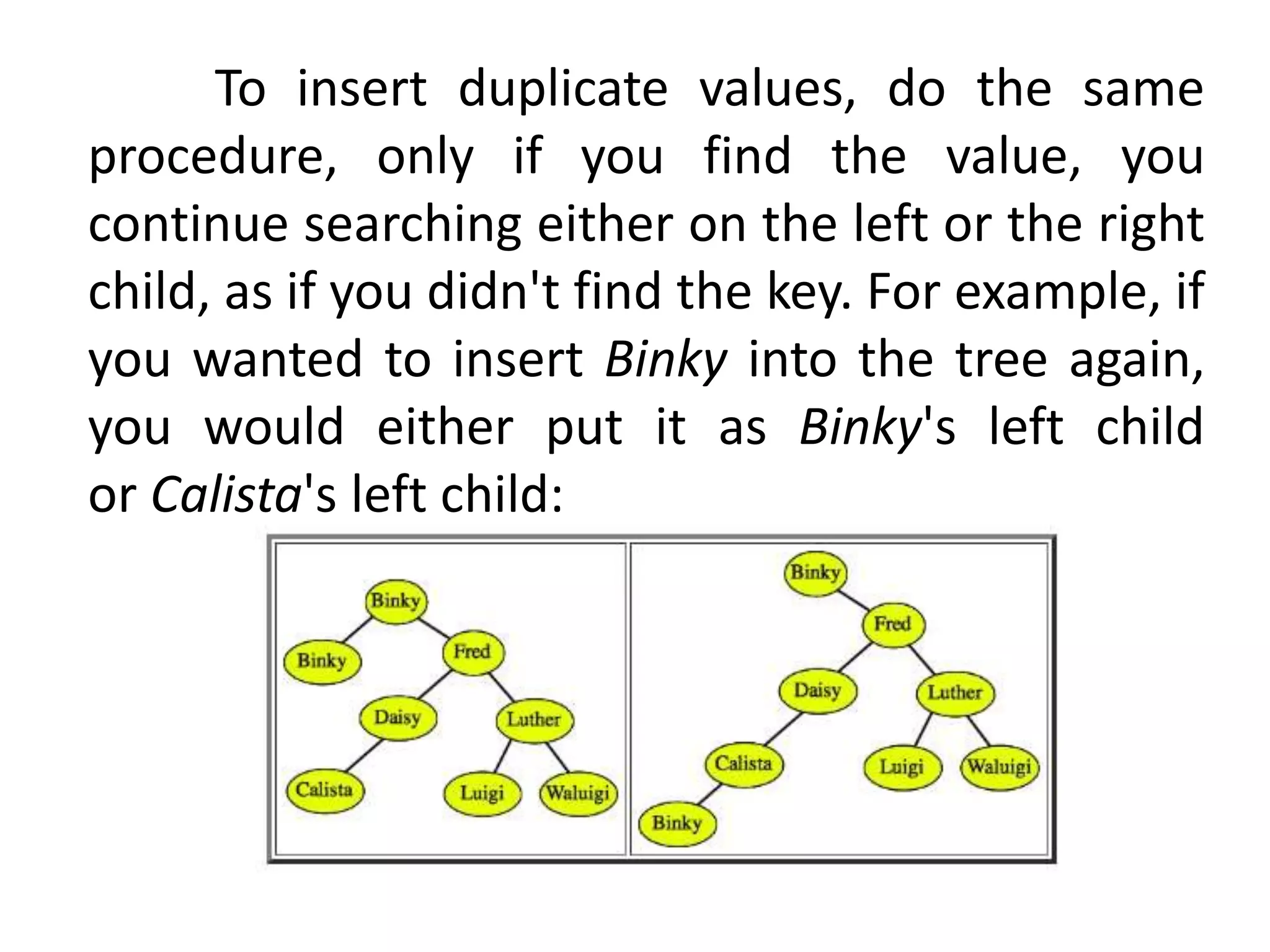
To insert duplicate values, do the same
procedure, only if you find the value, you
continue searching either on the left or the right
child, as if you didn't find the key. For example, if
you wanted to insert Binky into the tree again,
you would either put it as Binky's left child
or Calista's left child:
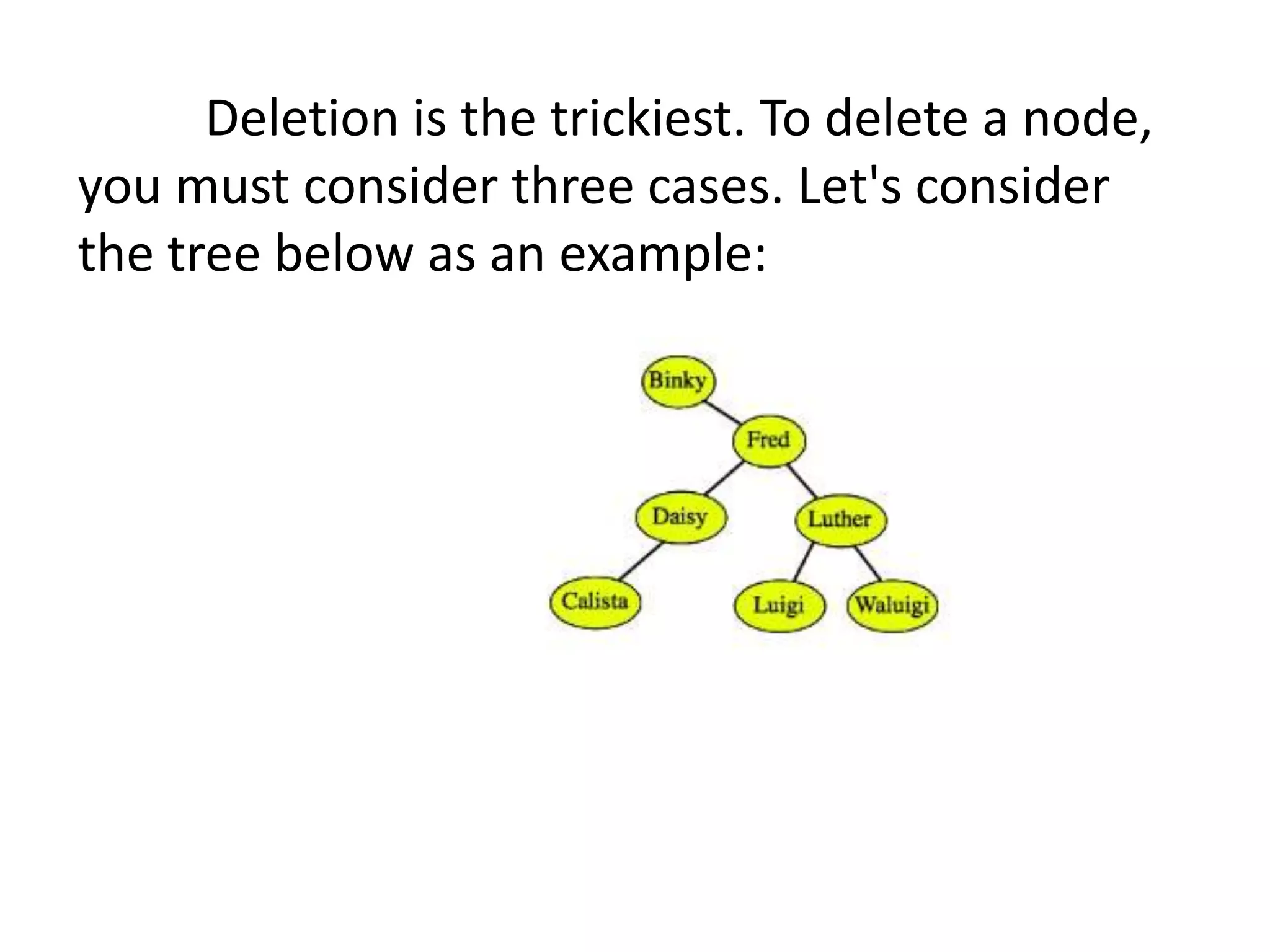
Deletion is the trickiest. To delete a node,
you must consider three cases. Let's consider
the tree below as an example:
• Case 1: The node has no children (it's a leaf node).
You can simply delete it. I won't draw an example,
but you should see very easily that
deleting Calista, Luigi or Waluigi just removes them
from the tree.
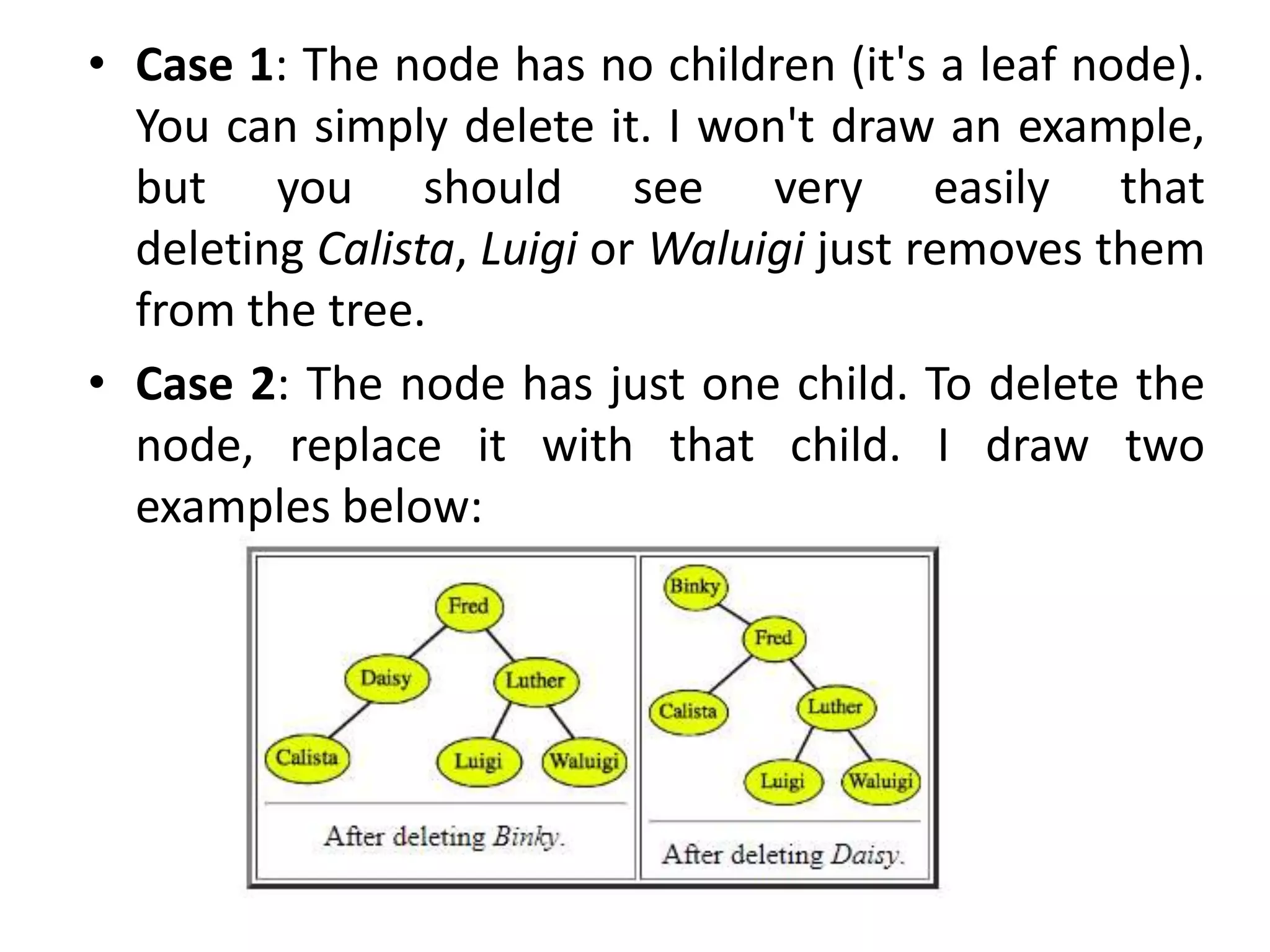
• Case 2: The node has just one child. To delete the
node, replace it with that child. I draw two
examples below:
• Case 3: The node has two children. In this case, you find
the node in the tree whose value is the greatest value less
than (or equal to) the node's value. That will be the
rightmost node in the subtree rooted by the left child. That
node will not have a right child. First, delete it. Then use it
to replace the node that you are deleting.
Alternatively, you can replace it with the leftmost
node in the tree rooted by the node's right child. Both will
work.
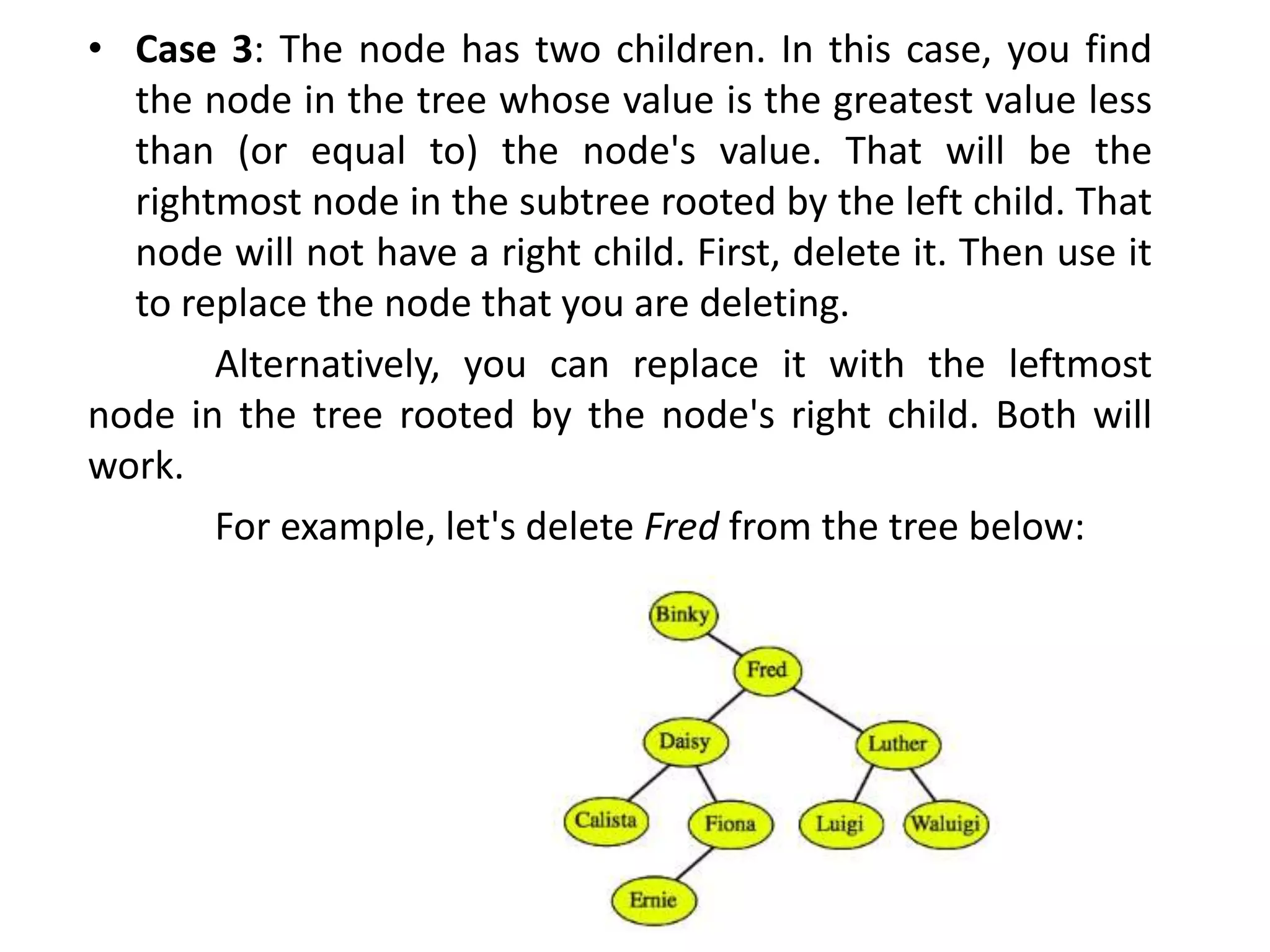
For example, let's delete Fred from the tree below:
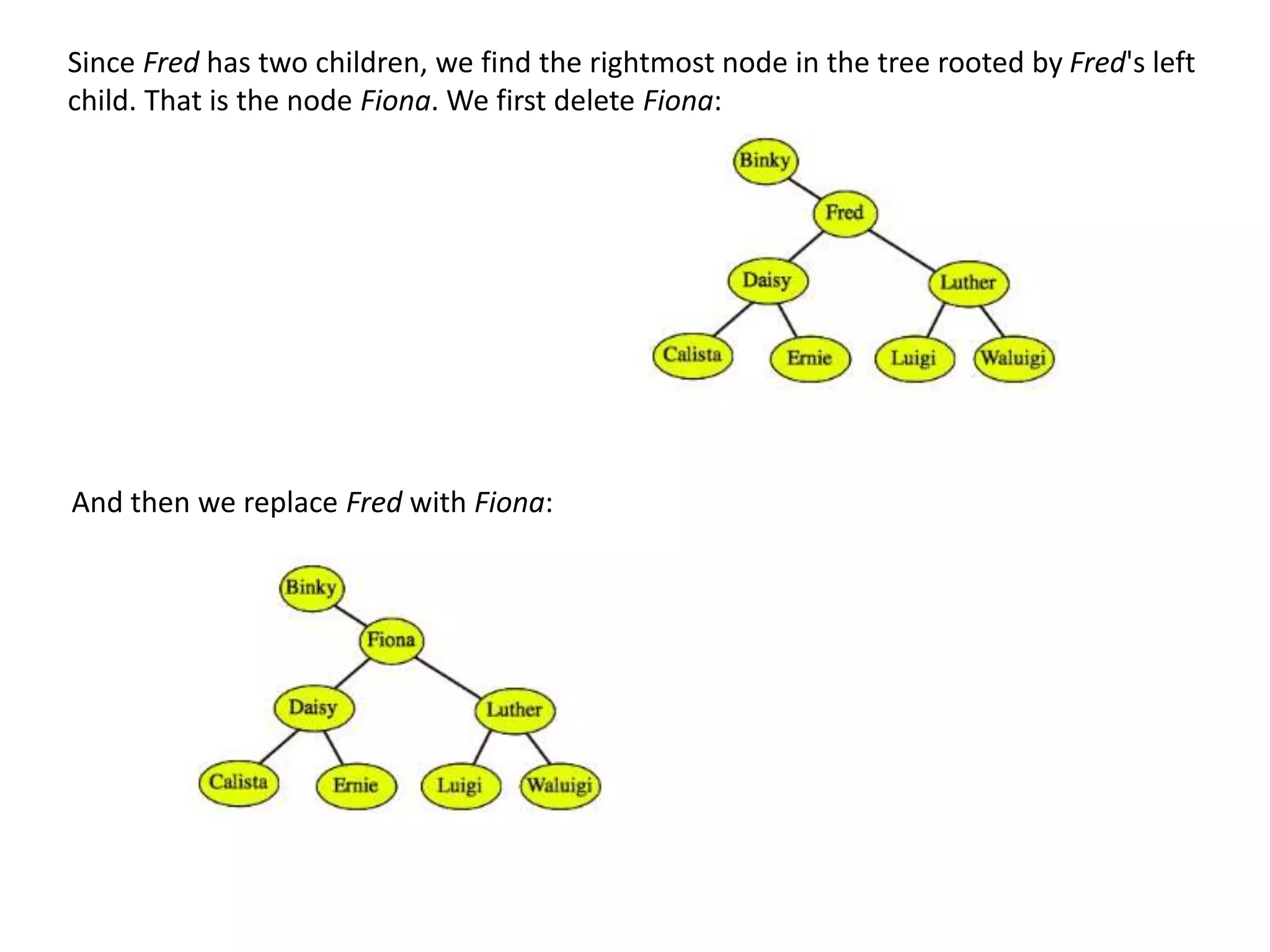
Since Fred has two children, we find the rightmost node in the tree rooted by Fred's left
child. That is the node Fiona. We first delete Fiona:
And then we replace Fred with Fiona:
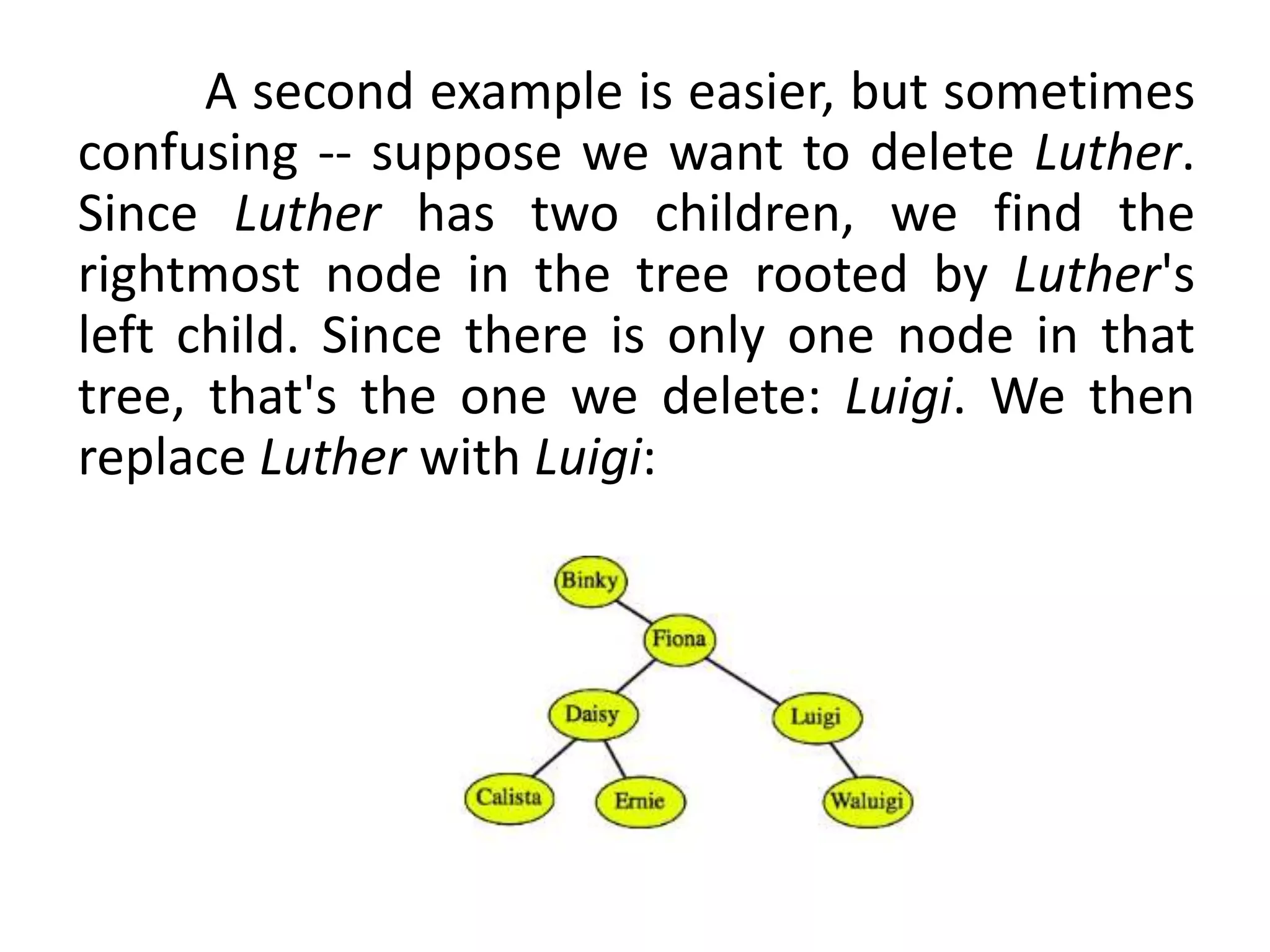
A second example is easier, but sometimes
confusing -- suppose we want to delete Luther.
Since Luther has two children, we find the
rightmost node in the tree rooted by Luther's
left child. Since there is only one node in that
tree, that's the one we delete: Luigi. We then
replace Luther with Luigi:

Tree data structure.pptx

  • 1.
  • 2.
    Plan 1. Definition ofthe tree 2. Tree Traversals 3. Binary Search Tree Operations: Find, Insert, Delete
  • 3.
    1. Tree In computerscience, a tree is a widely used abstract data type (ADT) that simulates a hierarchical tree structure, with a root value and subtrees of children with a parent node, represented as a set of linked nodes. A tree data structure can be defined recursively as a collection of nodes (starting at a root node), where each node is a data structure consisting of a value, together with a list of references to nodes (the "children"), with the constraints that no reference is duplicated, and none points to the root.
  • 4.
    Tree Alternatively, a treecan be defined abstractly as a whole (globally) as an ordered tree, with a value assigned to each node. Both these perspectives are useful: while a tree can be analyzed mathematically as a whole, when actually represented as a data structure it is usually represented and worked with separately by node (rather than as a set of nodes and an adjacency list of edges between nodes, as one may represent a digraph, for instance). For example, looking at a tree as a whole, one can talk about "the parent node" of a given node, but in general as a data structure a given node only contains the list of its children, but does not contain a reference to its parent (if any).
  • 5.
    Example A generic, andso non-binary, unsorted, some labels duplicated, arbitrary diagram of a tree. In this diagram, the node labeled 7 has three children, labeled 2, 10 and 6, and one parent, labeled 2. The root node, at the top, has no parent.
  • 6.
    A tree isa nonlinear data structure, compared to arrays, linked lists, stacks and queues which are linear data structures. A tree can be empty with no nodes or a tree is a structure consisting of one node called the root and zero or one or more subtrees. Preliminary definition
  • 7.
  • 8.
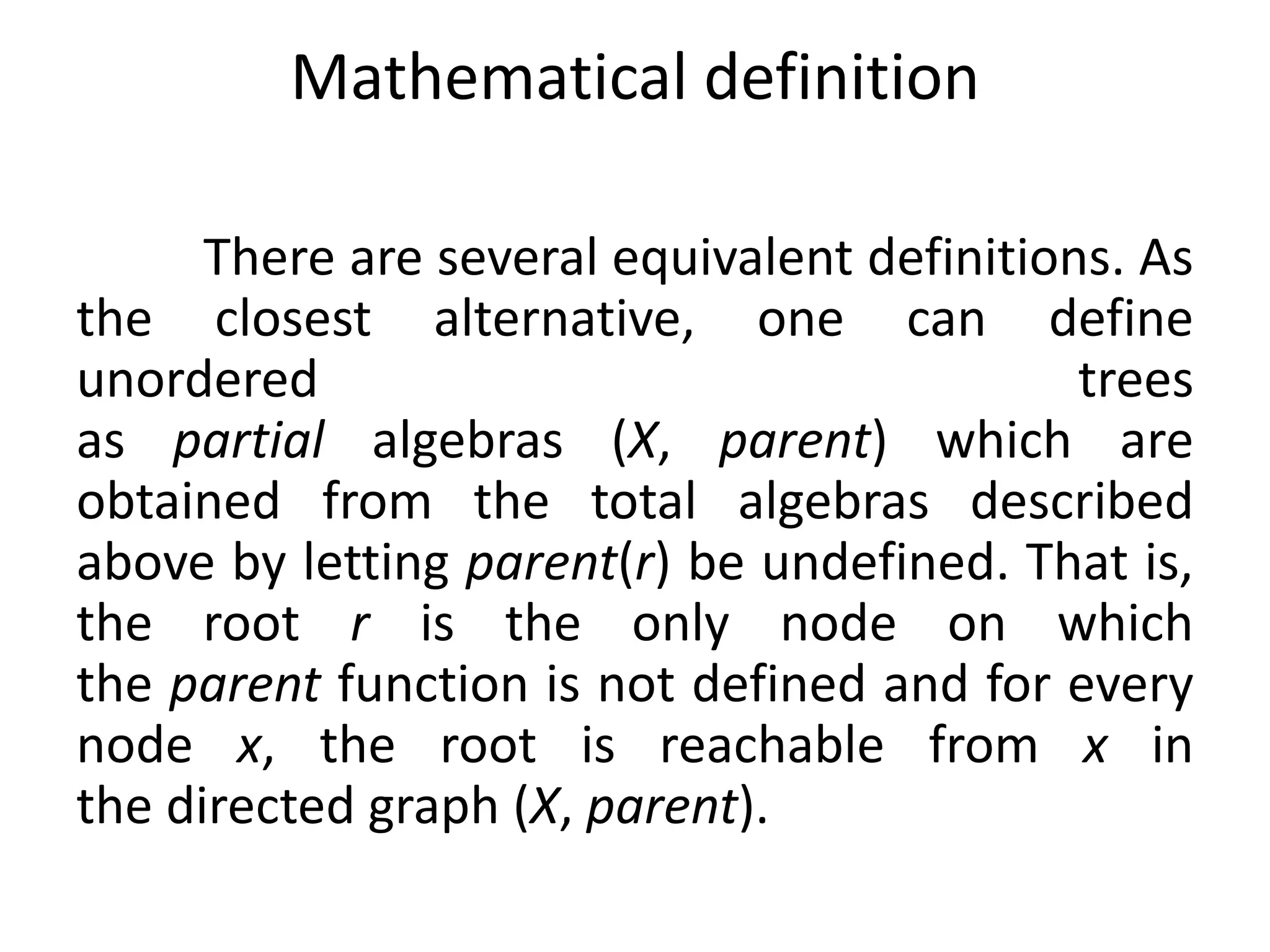
    Mathematical definition Mathematically, anunordered tree (or "algebraic tree") can be defined as an algebraic structure (X,parent) where X is the non-empty carrier set of nodes and parent is a function on X which assigns each node x its "parent" node, parent(x). The structure is subject to the condition that every non-empty subalgebra must have the same fixed point. That is, there must be a unique "root" node r, such that parent(r) = r and for every node x, some iterative application parent(parent(...parent(x)...)) equals r.
  • 9.
    There are severalequivalent definitions. As the closest alternative, one can define unordered trees as partial algebras (X, parent) which are obtained from the total algebras described above by letting parent(r) be undefined. That is, the root r is the only node on which the parent function is not defined and for every node x, the root is reachable from x in the directed graph (X, parent). Mathematical definition
  • 10.
    A tree isa basic linked data structure that is richer than a list. Trees are often a very natural way to represent hierarchies. For example, the mathematical expression is very clearly represented by the following tree:
  • 11.
    Using tree terminology,the external, (or leaf) nodes are either variables or values, and the internal nodes are operators.
  • 12.
    2. Tree Traversals Wetypically talk about three tree traversal methods:
  • 13.
    • Example Question:"Which of the above traversals would allow you to evaluate the expression of the above tree?" • Answer: A post-order traversal -- for each operator in an internal node, you need to first evaluate each of its children before you can perform the operation. For example, you need to evaluate the left subtree of "/" and then the right subtree before you divide the two answers to get the final evaluation of the expression.
  • 14.
    Binary Search Trees Binarysearch trees are an exceptionally important type of tree. As their name implies, they are binary trees, where each node has a value, a left child and a right child. The important property of a binary search tree is the following: • If a node has a left child, then the left child is the root of a binary search tree whose maximum value is less than or equal to the node's value. • If a node has a right child, then the right child is the root of a binary search tree whose minimum value is greater than or equal to the node's value.
  • 15.
    Here are someexamples of binary search trees that hold strings: As demonstrated by the second two trees above, there can be more than one binary search tree that corresponds to the same data.
  • 16.
    Here are twoexamples of trees that are not binary search trees:
  • 17.
    Binary search treeshave nice properties. For example, you can sort the data by performing an in-order traversal. You can also find a piece of data simply by traversing a single path from the root to the data, or to where the data would be. For example, in the tree:
  • 18.
    If we wantto find Luigi, what we do is start at the root of the tree, and compare it to Luigi. If it equals Luigi, then we‘ve done. If not, and Luigi is less than the node's value, then we recursively continue the process on the tree's left child. If Luigi is greater than the node's value, then we instead recursively continue the process on the tree's right child. If we ever get to a point where the node has no child for me to search on, we can conclude that the value is not in the tree.
  • 19.
    Continuing the exampleof finding Luigi, we would: • We start at Binky. Since Luigi is greater than Binky, we will continue searching on Binky's right child. • We are next at Fred. Again, Luigi is greater than Fred, so we continue searching on Fred's right child. • Now we are at Luther. Luigi is less than Luther, so we continue searching on Luther's left child. • We have found Luigi.
  • 20.
    Similarly, suppose wetry to find Calista: • We start at Binky. Since Calista is greater than Binky, we'll continue searching on Binky's right child. • We are next at Fred. Calista is less than Fred, so we continue searching on Fred's left child. • Now we are at Daisy. Calista is less than Daisy, so we continue searching on Daisy's left child. • However, Daisy has no left child. We can conclude that Calista is not in the search tree.
  • 21.
    3. Binary SearchTree Operations: Find, Insert, Delete We have just described how to find a value in a binary search tree. Insertion is a pretty simple matter too. To insert a value s, assume that s is not int the tree, and find where s should be. Create the node and put it there. For example, were we to insert Calista into the above tree, we try to find the string. We fail at Daisy's left child, which doesn't exist. Therefore, we create a node for Calista and insert it as Daisy's left child:
  • 22.
    To insert duplicatevalues, do the same procedure, only if you find the value, you continue searching either on the left or the right child, as if you didn't find the key. For example, if you wanted to insert Binky into the tree again, you would either put it as Binky's left child or Calista's left child:
  • 23.
    Deletion is thetrickiest. To delete a node, you must consider three cases. Let's consider the tree below as an example:
  • 24.
    • Case 1:The node has no children (it's a leaf node). You can simply delete it. I won't draw an example, but you should see very easily that deleting Calista, Luigi or Waluigi just removes them from the tree. • Case 2: The node has just one child. To delete the node, replace it with that child. I draw two examples below:
  • 25.
    • Case 3:The node has two children. In this case, you find the node in the tree whose value is the greatest value less than (or equal to) the node's value. That will be the rightmost node in the subtree rooted by the left child. That node will not have a right child. First, delete it. Then use it to replace the node that you are deleting. Alternatively, you can replace it with the leftmost node in the tree rooted by the node's right child. Both will work. For example, let's delete Fred from the tree below:
  • 26.
    Since Fred hastwo children, we find the rightmost node in the tree rooted by Fred's left child. That is the node Fiona. We first delete Fiona: And then we replace Fred with Fiona:
  • 27.
    A second exampleis easier, but sometimes confusing -- suppose we want to delete Luther. Since Luther has two children, we find the rightmost node in the tree rooted by Luther's left child. Since there is only one node in that tree, that's the one we delete: Luigi. We then replace Luther with Luigi: