SDLC - Iterative Model
Iterative Model
 In the Iterative model, iterative process starts with a
simple implementation of a small set of the software
requirements and iteratively enhances the evolving
versions until the complete system is implemented and
ready to be deployed.
Iterative Model
 An iterative life cycle model does not attempt to start
with a full specification of requirements.
 Instead, development begins by specifying and
implementing just part of the software, which is then
reviewed to identify further requirements.
 This process is then repeated, producing a new version
of the software at the end of each iteration of the
model
Iterative Model - Design
 Iterative process starts with a simple implementation of a
subset of the software requirements and iteratively
enhances the evolving versions until the full system is
implemented.
 At each iteration, design modifications are made and new
functional capabilities are added.
 The basic idea behind this method is to develop a system
through repeated cycles (iterative) and in smaller portions at
a time (incremental).
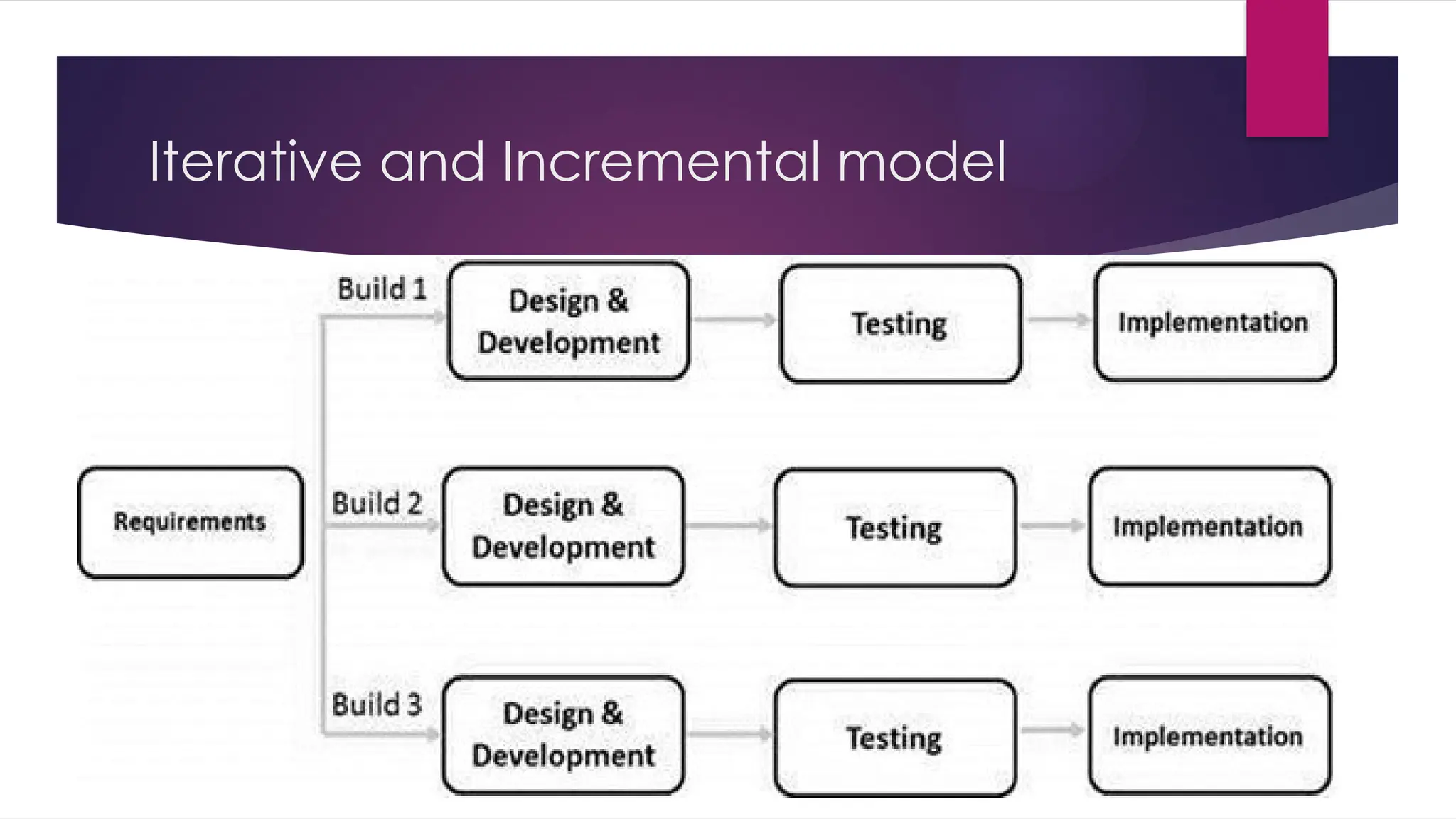
Iterative and Incremental model
 Iterative and Incremental development is a
combination of both iterative design or iterative
method and incremental build model for development.
 "During software development, more than one iteration
of the software development cycle may be in progress
at the same time.
 " This process may be described as an "incremental
build" approach."
 In this incremental model, the whole requirement is
divided into various builds.
 During each iteration, the development module goes
through the requirements, design, implementation and
testing phases.
 Each subsequent release of the module adds function
to the previous release. The process continues till the
complete system is ready as per the requirement.
 The key to a successful use of an iterative software
development lifecycle is difficult validation of
requirements, and verification & testing of each version
of the software against those requirements within each
cycle of the model.
 As the software evolves through successive cycles, tests
must be repeated and extended to verify each version
of the software.
Iterative Model - Application
 Like other SDLC models, Iterative and incremental
development has some specific applications in the
software industry.
 This model is most often used in the following scenarios −
 Requirements of the complete system are clearly
defined and understood.
 Major requirements must be defined; however, some
functionalities or requested enhancements may evolve
with time.
Iterative Model - Application
 There is a time to the market constraint.
 A new technology is being used and is being learnt by
the development team while working on the project.
 Resources with needed skill sets are not available and
are planned to be used on contract basis for specific
iterations.
 There are some high-risk features and goals which may
change in the future.
Iterative Model - Pros and Cons
 The advantage of this model is that there is a working
model of the system at a very early stage of
development, which makes it easier to find functional or
design flaws.
 Finding issues at an early stage of development enables
to take corrective measures in a limited budget
Iterative Model - Pros and Cons
 The advantages of the Iterative and Incremental SDLC Model are as follows −
 Some working functionality can be developed quickly and early in the
life cycle.
 Results are obtained early and occasionally.
 Parallel development can be planned.
 Progress can be measured.
 Less costly to change the scope/requirements.
 Testing and debugging during smaller iteration is easy.
Iterative Model - Pros and Cons
 Risks are identified and resolved during iteration; and
each iteration is an easily managed milestone.
 Easier to manage risk - High risk part is done first.
 With every increment, operational product is delivered.
 Issues, challenges and risks identified from each
increment can be utilized/applied to the next increment.
 Risk analysis is better.
Iterative Model - Pros and Cons
 It supports changing requirements.
 Initial Operating time is less.
 Better suited for large and mission-critical projects.
 During the life cycle, software is produced early
which facilitates customer evaluation and feedback.
Iterative Model - Pros and Cons
The disadvantages of the Iterative and Incremental SDLC Model are
as follows −
 More resources may be required.
 Although cost of change is lesser, but it is not very suitable for
changing requirements.
 More management attention is required.
 System architecture or design issues may arise because not all
requirements are gathered in the beginning of the entire life cycle.
Iterative Model - Pros and Cons
 Defining increments may require definition of the complete system.
 Not suitable for smaller projects.
 Management complexity is more.
 End of project may not be known which is a risk.
 Highly skilled resources are required for risk analysis.
 Projects progress is highly dependent upon the risk analysis phase.
Spiral Model
Spiral Model
 The spiral model combines the idea of iterative development
with the systematic, controlled aspects of the waterfall model.
 This Spiral model is a combination of iterative development
process model and sequential linear development model i.e. the
waterfall model with a very high emphasis on risk analysis.
 It allows incremental releases of the product or incremental
refinement through each iteration around the spiral.
Spiral Model - Design
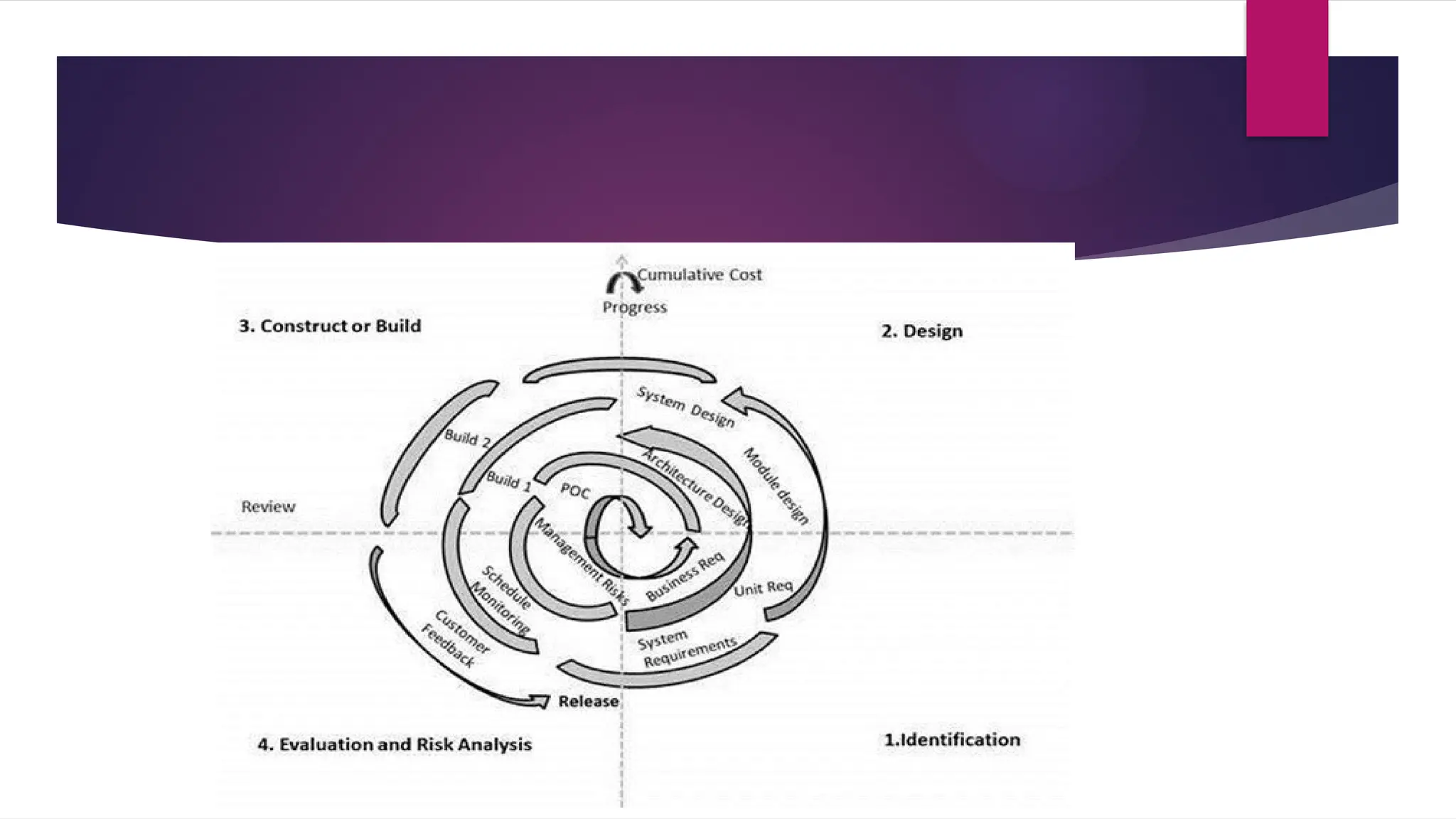
 The spiral model has four phases. A software project
repeatedly passes through these phases in iterations called
Spirals.
Identification
 This phase starts with gathering the business requirements in
the baseline spiral.
 In the subsequent spirals as the product matures, identification
of system requirements, subsystem requirements and unit
requirements are all done in this phase.
Identification
 This phase also includes understanding the system
requirements by continuous communication between
the customer and the system analyst.
 At the end of the spiral, the product is deployed in the
identified market.
Design
 The Design phase starts with the conceptual design in
the baseline spiral and involves architectural design,
logical design of modules, physical product design and
the final design in the subsequent spirals.
Construct or Build
 The Construct phase refers to production of the actual
software product at every spiral.
 In the baseline spiral, when the product is just thought of and
the design is being developed a POC (Proof of Concept) is
developed in this phase to get customer feedback.
 Then in the subsequent spirals with higher clarity on
requirements and design details a working model of the
software called build is produced with a version number.
These builds are sent to the customer for feedback.
Evaluation and Risk Analysis
 Risk Analysis includes identifying, estimating and monitoring the
technical feasibility and management risks, such as schedule
slippage and cost overrun.
 After testing the build, at the end of first iteration, the
customer evaluates the software and provides feedback.
 Based on the customer evaluation, the software
development process enters the next iteration and
subsequently follows the linear approach to implement
the feedback suggested by the customer.
 The process of iterations along the spiral continues
throughout the life of the software.
Spiral Model Application
 The Spiral Model is widely used in the software industry
as it is in sync with the natural development process of
any product, i.e. learning with maturity which involves
minimum risk for the customer as well as the
development firms.
Uses of a Spiral Model
 The following pointers explain the typical uses of a Spiral Model
 When there is a budget constraint and risk evaluation is
important.
 For medium to high-risk projects.
 Long-term project commitment because of potential changes
to economic priorities as the requirements change with time.
 Customer is not sure of their requirements which is usually the
case.
Uses of a Spiral Model
 Requirements are complex and need evaluation to get
clarity.
 New product line which should be released in phases to
get enough customer feedback.
 Significant changes are expected in the product during
the development cycle.
Spiral Model - Pros and Cons
The advantages of the Spiral SDLC Model are as follows −
 Changing requirements can be accommodated.
 Allows extensive use of prototypes.
 Requirements can be captured more accurately.
 Users see the system early.
 Development can be divided into smaller parts and the
risky parts can be developed earlier which helps in
better risk management.
Spiral Model - Pros and Cons
The disadvantages of the Spiral SDLC Model are as follows −
 Management is more complex.
 End of the project may not be known early.
 Not suitable for small or low risk projects and could be expensive
for small projects.
 Process is complex
 Spiral may go on indefinitely.
 Large number of intermediate stages requires excessive
documentation.

433512735-LEcture-3-SDLC-Iterative-Model.pptx

  • 1.
  • 2.
    Iterative Model  Inthe Iterative model, iterative process starts with a simple implementation of a small set of the software requirements and iteratively enhances the evolving versions until the complete system is implemented and ready to be deployed.
  • 3.
    Iterative Model  Aniterative life cycle model does not attempt to start with a full specification of requirements.  Instead, development begins by specifying and implementing just part of the software, which is then reviewed to identify further requirements.  This process is then repeated, producing a new version of the software at the end of each iteration of the model
  • 4.
    Iterative Model -Design  Iterative process starts with a simple implementation of a subset of the software requirements and iteratively enhances the evolving versions until the full system is implemented.  At each iteration, design modifications are made and new functional capabilities are added.  The basic idea behind this method is to develop a system through repeated cycles (iterative) and in smaller portions at a time (incremental).
  • 5.
  • 6.
     Iterative andIncremental development is a combination of both iterative design or iterative method and incremental build model for development.  "During software development, more than one iteration of the software development cycle may be in progress at the same time.  " This process may be described as an "incremental build" approach."
  • 7.
     In thisincremental model, the whole requirement is divided into various builds.  During each iteration, the development module goes through the requirements, design, implementation and testing phases.  Each subsequent release of the module adds function to the previous release. The process continues till the complete system is ready as per the requirement.
  • 8.
     The keyto a successful use of an iterative software development lifecycle is difficult validation of requirements, and verification & testing of each version of the software against those requirements within each cycle of the model.  As the software evolves through successive cycles, tests must be repeated and extended to verify each version of the software.
  • 9.
    Iterative Model -Application  Like other SDLC models, Iterative and incremental development has some specific applications in the software industry.  This model is most often used in the following scenarios −  Requirements of the complete system are clearly defined and understood.  Major requirements must be defined; however, some functionalities or requested enhancements may evolve with time.
  • 10.
    Iterative Model -Application  There is a time to the market constraint.  A new technology is being used and is being learnt by the development team while working on the project.  Resources with needed skill sets are not available and are planned to be used on contract basis for specific iterations.  There are some high-risk features and goals which may change in the future.
  • 11.
    Iterative Model -Pros and Cons  The advantage of this model is that there is a working model of the system at a very early stage of development, which makes it easier to find functional or design flaws.  Finding issues at an early stage of development enables to take corrective measures in a limited budget
  • 12.
    Iterative Model -Pros and Cons  The advantages of the Iterative and Incremental SDLC Model are as follows −  Some working functionality can be developed quickly and early in the life cycle.  Results are obtained early and occasionally.  Parallel development can be planned.  Progress can be measured.  Less costly to change the scope/requirements.  Testing and debugging during smaller iteration is easy.
  • 13.
    Iterative Model -Pros and Cons  Risks are identified and resolved during iteration; and each iteration is an easily managed milestone.  Easier to manage risk - High risk part is done first.  With every increment, operational product is delivered.  Issues, challenges and risks identified from each increment can be utilized/applied to the next increment.  Risk analysis is better.
  • 14.
    Iterative Model -Pros and Cons  It supports changing requirements.  Initial Operating time is less.  Better suited for large and mission-critical projects.  During the life cycle, software is produced early which facilitates customer evaluation and feedback.
  • 15.
    Iterative Model -Pros and Cons The disadvantages of the Iterative and Incremental SDLC Model are as follows −  More resources may be required.  Although cost of change is lesser, but it is not very suitable for changing requirements.  More management attention is required.  System architecture or design issues may arise because not all requirements are gathered in the beginning of the entire life cycle.
  • 16.
    Iterative Model -Pros and Cons  Defining increments may require definition of the complete system.  Not suitable for smaller projects.  Management complexity is more.  End of project may not be known which is a risk.  Highly skilled resources are required for risk analysis.  Projects progress is highly dependent upon the risk analysis phase.
  • 17.
  • 18.
    Spiral Model  Thespiral model combines the idea of iterative development with the systematic, controlled aspects of the waterfall model.  This Spiral model is a combination of iterative development process model and sequential linear development model i.e. the waterfall model with a very high emphasis on risk analysis.  It allows incremental releases of the product or incremental refinement through each iteration around the spiral.
  • 19.
    Spiral Model -Design  The spiral model has four phases. A software project repeatedly passes through these phases in iterations called Spirals. Identification  This phase starts with gathering the business requirements in the baseline spiral.  In the subsequent spirals as the product matures, identification of system requirements, subsystem requirements and unit requirements are all done in this phase.
  • 20.
    Identification  This phasealso includes understanding the system requirements by continuous communication between the customer and the system analyst.  At the end of the spiral, the product is deployed in the identified market.
  • 21.
    Design  The Designphase starts with the conceptual design in the baseline spiral and involves architectural design, logical design of modules, physical product design and the final design in the subsequent spirals.
  • 22.
    Construct or Build The Construct phase refers to production of the actual software product at every spiral.  In the baseline spiral, when the product is just thought of and the design is being developed a POC (Proof of Concept) is developed in this phase to get customer feedback.  Then in the subsequent spirals with higher clarity on requirements and design details a working model of the software called build is produced with a version number. These builds are sent to the customer for feedback.
  • 23.
    Evaluation and RiskAnalysis  Risk Analysis includes identifying, estimating and monitoring the technical feasibility and management risks, such as schedule slippage and cost overrun.  After testing the build, at the end of first iteration, the customer evaluates the software and provides feedback.
  • 25.
     Based onthe customer evaluation, the software development process enters the next iteration and subsequently follows the linear approach to implement the feedback suggested by the customer.  The process of iterations along the spiral continues throughout the life of the software.
  • 26.
    Spiral Model Application The Spiral Model is widely used in the software industry as it is in sync with the natural development process of any product, i.e. learning with maturity which involves minimum risk for the customer as well as the development firms.
  • 27.
    Uses of aSpiral Model  The following pointers explain the typical uses of a Spiral Model  When there is a budget constraint and risk evaluation is important.  For medium to high-risk projects.  Long-term project commitment because of potential changes to economic priorities as the requirements change with time.  Customer is not sure of their requirements which is usually the case.
  • 28.
    Uses of aSpiral Model  Requirements are complex and need evaluation to get clarity.  New product line which should be released in phases to get enough customer feedback.  Significant changes are expected in the product during the development cycle.
  • 29.
    Spiral Model -Pros and Cons The advantages of the Spiral SDLC Model are as follows −  Changing requirements can be accommodated.  Allows extensive use of prototypes.  Requirements can be captured more accurately.  Users see the system early.  Development can be divided into smaller parts and the risky parts can be developed earlier which helps in better risk management.
  • 30.
    Spiral Model -Pros and Cons The disadvantages of the Spiral SDLC Model are as follows −  Management is more complex.  End of the project may not be known early.  Not suitable for small or low risk projects and could be expensive for small projects.  Process is complex  Spiral may go on indefinitely.  Large number of intermediate stages requires excessive documentation.

Editor's Notes

  • #12 From time to time
  • #18 Spiral Model is a combination of a waterfall model and iterative model. Each phase in spiral model begins with a design goal and ends with the client reviewing the progress.
  • #21 The process of logical design involves arranging data into a series of logical relationships called entities and attributes.  Physical design relates to the actual input and output processes of the system. It focuses on how data is entered into a system, verified, processed, and displayed as output
  • #23 failure to meet a standard or deadline
  • #30 Software prototyping is the activity of creating prototypes of software applications, i.e., incomplete versions of the software program being developed.