








“PREPARATION AND
                             EVALUATION OF
                               DIRECTLY
                             COMPRESSIBLE
2nd EVALUATION SEMINAR
                               SPHERICAL
                           AGGLOMERATES OF
                         HYDROCHLOROTHIAZIDE
   Presented by:                   ”
  SHANKAR.GAVARO                   Under the
        JI                        guidance of
    M.PHARM 2nd                   Dr. B.G.Desai
       YEAR
  PHARMACEUTICS
CONTENTS
•   Introduction
•   Need for study
•   Methodology
•   Optimization
•   Formulation
•   Evaluation
•   Conclusion
•   Review of Literature
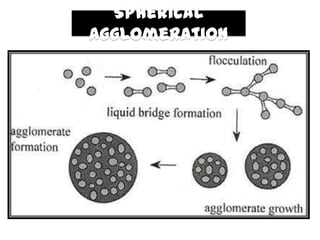
Spherical
Agglomeration
Need for study
• Spherical agglomeration process is a multiple unit
  process in which crystallization, agglomeration and
  spheronization can be carried out simultaneously in one
  step.

• The resultant crystals obtained show better solubility
  profile, flow properties, and compressibility

•   Hydrochlorothiazide, abbreviated HCTZ, HCT, or HZT, is a
    first-line diuretic drug of the thiazide class that acts by
    inhibiting the kidneys' ability to retain water.

•   It is variably absorbed from GI tract and has got
    bioavailability of ~ 70%.

•   Hydrochlorothiazide suffers from poor flow and
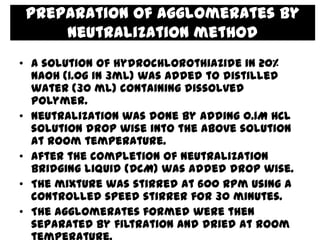
Preparation of agglomerates by
     Neutralization method
• A solution of hydrochlorothiazide in 20%
  NaOH (1.0g in 3ml) was added to distilled
  water (30 ml) containing dissolved
  polymer.
• Neutralization was done by adding 0.1M HCl
  solution drop wise into the above solution
  at room temperature.
• After the completion of neutralization
  bridging liquid (DCM) was added drop wise.
• The mixture was stirred at 600 rpm using a
  controlled speed stirrer for 30 minutes.
• The agglomerates formed were then
  separated by filtration and dried at room
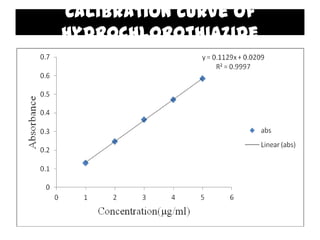
Calibration curve of
Hydrochlorothiazide
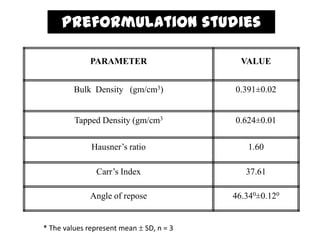
Preformulation studies

             PARAMETER                      VALUE


        Bulk Density (gm/cm3)             0.391±0.02


        Tapped Density (gm/cm3            0.624±0.01

             Hausner’s ratio                 1.60

               Carr’s Index                  37.61

             Angle of repose              46.340±0.120


* The values represent mean   SD, n = 3
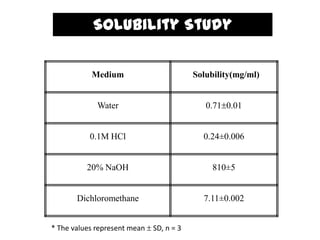
Solubility Study

           Medium                         Solubility(mg/ml)


             Water                           0.71 0.01


           0.1M HCl                         0.24±0.006


          20% NaOH                             810±5


       Dichloromethane                      7.11±0.002


* The values represent mean   SD, n = 3
Optimization
o Effect of bridging liquid on properties of agglomer


       Bridging liquid                 Observation


                          Agglomerates were very fine, irregularly
          Toluene
                             shaped with poor flow properties.


                             Process of agglomeration was time
        Chloroform
                         consuming and agglomerates were sticky.


                         Agglomerates formed were spherical, free
      Dichloromethane
                         flowing with good micromeritic properties.
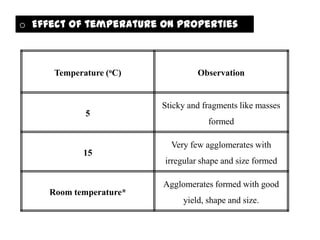
o Effect of temperature on properties
of agglomerates:


      Temperature (oC)            Observation


                         Sticky and fragments like masses
             5
                                     formed

                           Very few agglomerates with
            15
                         irregular shape and size formed

                         Agglomerates formed with good
     Room temperature*
                              yield, shape and size.
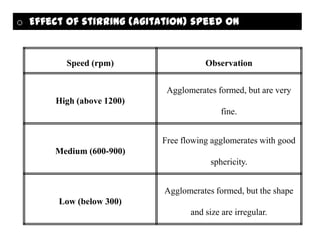
o Effect of stirring (agitation) speed on
properties of agglomerates:

         Speed (rpm)                  Observation


                            Agglomerates formed, but are very
       High (above 1200)
                                           fine.


                           Free flowing agglomerates with good
       Medium (600-900)
                                       sphericity.


                           Agglomerates formed, but the shape
       Low (below 300)
                                  and size are irregular.
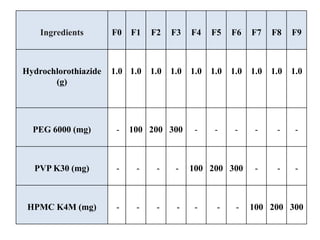
Formulation
Ingredients       F0   F1   F2    F3    F4    F5    F6    F7    F8    F9


Hydrochlorothiazide   1.0 1.0   1.0   1.0   1.0   1.0   1.0   1.0   1.0   1.0
       (g)


  PEG 6000 (mg)        -   100 200 300       -     -     -     -     -     -


  PVP K30 (mg)         -    -    -     -    100 200 300        -     -     -


 HPMC K4M (mg)         -    -    -     -     -     -     -    100 200 300
Characterization of
            agglomerates

• FTIR
• DSC
• SEM
EVALUATION
Pre-compression
          parameters
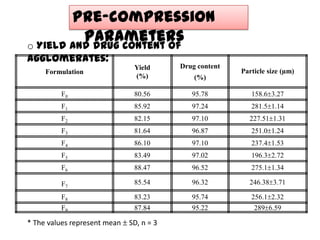
o Yield and drug content of
agglomerates:
                               Yield      Drug content
     Formulation                                         Particle size (µm)
                               (%)            (%)

         F0                    80.56         95.78          158.6 3.27
         F1                    85.92         97.24          281.5 1.14
         F2                    82.15         97.10         227.51 1.31
         F3                    81.64         96.87          251.0 1.24
         F4                    86.10         97.10          237.4 1.53
         F5                    83.49         97.02          196.3 2.72
         F6                    88.47         96.52          275.1 1.34

         F7                    85.54         96.32         246.38 3.71

         F8                    83.23         95.74          256.1 2.32
         F9                    87.84         95.22           289 6.59

* The values represent mean   SD, n = 3
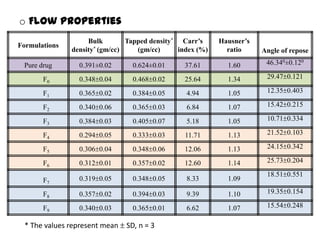
o Flow properties
                    Bulk        Tapped density* Carr’s     Hausner’s
Formulations
               density* (gm/cc)    (gm/cc)     index (%)     ratio     Angle of repose

 Pure drug       0.391±0.02      0.624±0.01      37.61       1.60       46.340±0.120

       F0        0.348 0.04      0.468 0.02      25.64       1.34       29.47 0.121

       F1        0.365 0.02      0.384 0.05      4.94        1.05       12.35 0.403

       F2        0.340 0.06      0.365 0.03      6.84        1.07       15.42 0.215

       F3        0.384 0.03      0.405 0.07      5.18        1.05       10.71 0.334

       F4        0.294 0.05      0.333 0.03      11.71       1.13       21.52 0.103

       F5        0.306 0.04      0.348 0.06      12.06       1.13       24.15 0.342

       F6        0.312 0.01      0.357 0.02      12.60       1.14       25.73 0.204
                                                                        18.51 0.551
       F7        0.319 0.05      0.348 0.05      8.33        1.09

       F8        0.357 0.02      0.394 0.03      9.39        1.10       19.35 0.154

       F9        0.340 0.03      0.365 0.01      6.62        1.07       15.54 0.248

 * The values represent mean   SD, n = 3
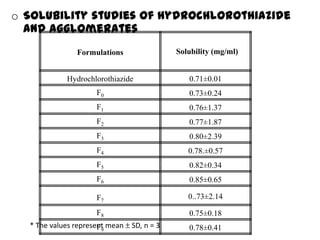
o Solubility studies of hydrochlorothiazide
  and agglomerates
               Formulations                 Solubility (mg/ml)


            Hydrochlorothiazide                0.71±0.01
                     F0                        0.73±0.24
                     F1                        0.76±1.37
                     F2                        0.77±1.87
                     F3                        0.80±2.39
                     F4                        0.78.±0.57
                     F5                        0.82±0.34
                     F6                        0.85±0.65

                     F7                        0..73±2.14

                     F8                        0.75±0.18
  * The values represent mean
                      F9        SD, n = 3      0.78±0.41
Post compression
                           parameters
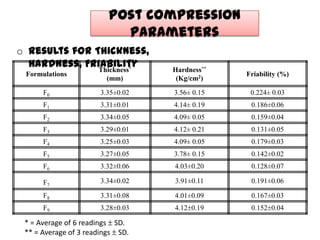
o Results for Thickness,
  Hardness, Friability
               Thickness*         Hardness**
 Formulations                                  Friability (%)
                        (mm)       (Kg/cm2)

      F0              3.35±0.02   3.56± 0.15    0.224± 0.03
      F1              3.31±0.01   4.14± 0.19    0.186±0.06
      F2              3.34±0.05   4.09± 0.05    0.159±0.04
      F3              3.29±0.01   4.12± 0.21    0.131±0.05
      F4              3.25±0.03   4.09± 0.05    0.179±0.03
      F5              3.27±0.05   3.78± 0.15    0.142±0.02
      F6              3.32±0.06   4.03±0.20     0.128±0.07

      F7              3.34±0.02   3.91±0.11     0.191±0.06

      F8              3.31±0.08   4.01±0.09     0.167±0.03
      F9              3.28±0.03   4.12 0.19     0.152 0.04

 * = Average of 6 readings SD.
 ** = Average of 3 readings SD.
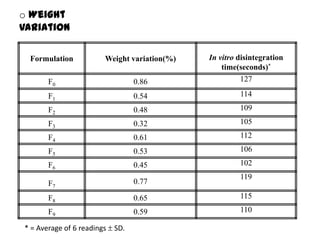
o Weight
variation

 Formulation            Weight variation(%)   In vitro disintegration
                                                  time(seconds)*
       F0                         0.86                  127

       F1                         0.54                 114
       F2                         0.48                 109
       F3                         0.32                 105
       F4                         0.61                 112
       F5                         0.53                 106
       F6                         0.45                 102
                                                       119
       F7                         0.77

       F8                         0.65                 115
       F9                         0.59                 110

* = Average of 6 readings   SD.
In vitro
Dissolution
   Study
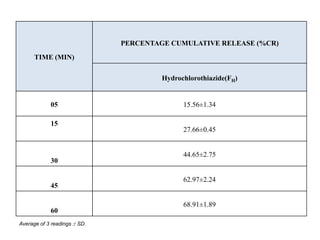
PERCENTAGE CUMULATIVE RELEASE (%CR)
      TIME (MIN)

                                       Hydrochlorothiazide(FH)


            05                               15.56±1.34

            15
                                             27.66±0.45


                                             44.65±2.75
            30

                                             62.97±2.24
            45

                                             68.91±1.89
            60
Average of 3 readings   SD.
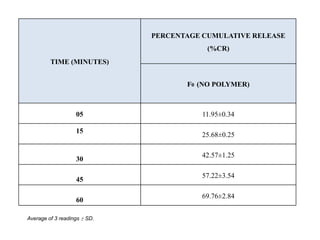
PERCENTAGE CUMULATIVE RELEASE
                                          (%CR)
         TIME (MINUTES)


                                     F0 (NO POLYMER)


                   05                    11.95±0.34

                   15
                                        25.68±0.25

                                        42.57±1.25
                   30

                                        57.22±3.54
                   45

                                        69.76±2.84
                   60

Average of 3 readings   SD.
PERCENTAGE CUMULATIVE RELEASE (%CR)
   TIME (min.)
                                 F1               F2              F3
          05                  14.18±2.47       15.14±1.36      16.16±2.35
          15                  27.88±1.58       28.84±2.54      31.10±3.12
          30                  48.29±2.66       45.83±1.98      51.74±1.34
          45                  60.49±0.84       61.12±0.51      65.60±2.25
          60                  71.65±0.35       73.72±0.77      75.02±0.86
Average of 3 readings   SD.
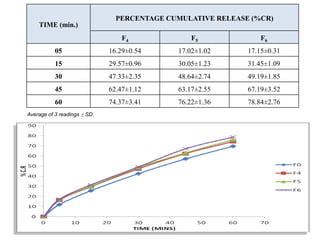
PERCENTAGE CUMULATIVE RELEASE (%CR)
    TIME (min.)
                                 F4             F5              F6
           05                 16.29±0.54     17.02±1.02      17.15±0.31
           15                 29.57±0.96     30.05±1.23      31.45±1.09
           30                 47.33±2.35     48.64±2.74      49.19±1.85
           45                 62.47±1.12     63.17±2.55      67.19±3.52
           60                 74.37±3.41     76.22±1.36      78.84±2.76
Average of 3 readings   SD.
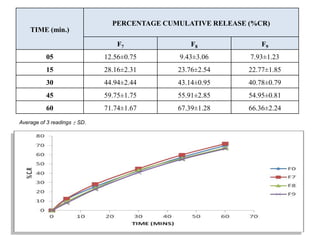
PERCENTAGE CUMULATIVE RELEASE (%CR)
    TIME (min.)

                                 F7              F8              F9
          05                  12.56±0.75      9.43±3.06       7.93±1.23
          15                  28.16±2.31      23.76±2.54      22.77±1.85
          30                  44.94±2.44      43.14±0.95      40.78±0.79
          45                  59.75±1.75      55.91±2.85      54.95±0.81
          60                  71.74±1.67      67.39±1.28      66.36±2.24
Average of 3 readings   SD.
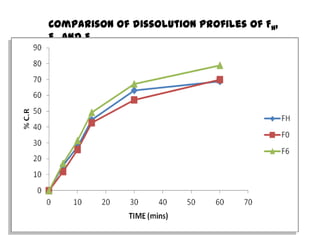
Comparison of dissolution profiles of FH,
F0 and F6
CONCLUSION
• The present study indicates that the process of
  spherical      agglomeration       contributed
  significantly in improving the flow properties
  of the drug thereby making it suitable for
  direct compression. Addition of polymers was
  further helpful in improving the solubility of
  the drug.

• Hence it can be concluded that spherical
  agglomeration is a useful tool which can be
  explored in large scale to render a poorly
  compressible    drug   suitable   for   direct
REVIEW
    OF
LITERATURE
• Jyothikattaa         et   al     developed        spherical
  agglomerates of Benzoic acid. After screening of
  different methods, the influence of the amount of
  the bridging liquid, the solute concentration and
  the stirring rate was investigated. It was found that
  favorable properties were obtained if the optimum
  amount of bridging liquid was added during the
  crystallization.
• Gupta    et     al    prepared       Celecoxib    spherical
  agglomerates with PVP using acetone, water and
  chloroform as solvent, non-solvent and bridging
  liquid   respectively.         The   crystals     exhibited
  significantly    improved      micromeritic      properties
  compared to pure drug. The aqueous solubility and
  dissolution rate of the drug from crystals were
• Dixit et al prepared spherical agglomerates of
  Indomethacin    by     solvent     change    method.
  Dissolution     profile     of     the      spherical
  agglomerates was compared with commercial
  and    recrystallized        sample.        Spherical
  agglomerates           exhibited            decreased
  crystallinity    and      improved     Micromeritic
  properties.
THANK YOU

Spherical agglomeration

  • 1.
    “PREPARATION AND EVALUATION OF DIRECTLY COMPRESSIBLE 2nd EVALUATION SEMINAR SPHERICAL AGGLOMERATES OF HYDROCHLOROTHIAZIDE Presented by: ” SHANKAR.GAVARO Under the JI guidance of M.PHARM 2nd Dr. B.G.Desai YEAR PHARMACEUTICS
  • 2.
    CONTENTS • Introduction • Need for study • Methodology • Optimization • Formulation • Evaluation • Conclusion • Review of Literature
  • 3.
  • 4.
    Need for study •Spherical agglomeration process is a multiple unit process in which crystallization, agglomeration and spheronization can be carried out simultaneously in one step. • The resultant crystals obtained show better solubility profile, flow properties, and compressibility • Hydrochlorothiazide, abbreviated HCTZ, HCT, or HZT, is a first-line diuretic drug of the thiazide class that acts by inhibiting the kidneys' ability to retain water. • It is variably absorbed from GI tract and has got bioavailability of ~ 70%. • Hydrochlorothiazide suffers from poor flow and
  • 5.
    Preparation of agglomeratesby Neutralization method • A solution of hydrochlorothiazide in 20% NaOH (1.0g in 3ml) was added to distilled water (30 ml) containing dissolved polymer. • Neutralization was done by adding 0.1M HCl solution drop wise into the above solution at room temperature. • After the completion of neutralization bridging liquid (DCM) was added drop wise. • The mixture was stirred at 600 rpm using a controlled speed stirrer for 30 minutes. • The agglomerates formed were then separated by filtration and dried at room
  • 6.
  • 7.
    Preformulation studies PARAMETER VALUE Bulk Density (gm/cm3) 0.391±0.02 Tapped Density (gm/cm3 0.624±0.01 Hausner’s ratio 1.60 Carr’s Index 37.61 Angle of repose 46.340±0.120 * The values represent mean SD, n = 3
  • 8.
    Solubility Study Medium Solubility(mg/ml) Water 0.71 0.01 0.1M HCl 0.24±0.006 20% NaOH 810±5 Dichloromethane 7.11±0.002 * The values represent mean SD, n = 3
  • 9.
  • 10.
    o Effect ofbridging liquid on properties of agglomer Bridging liquid Observation Agglomerates were very fine, irregularly Toluene shaped with poor flow properties. Process of agglomeration was time Chloroform consuming and agglomerates were sticky. Agglomerates formed were spherical, free Dichloromethane flowing with good micromeritic properties.
  • 11.
    o Effect oftemperature on properties of agglomerates: Temperature (oC) Observation Sticky and fragments like masses 5 formed Very few agglomerates with 15 irregular shape and size formed Agglomerates formed with good Room temperature* yield, shape and size.
  • 12.
    o Effect ofstirring (agitation) speed on properties of agglomerates: Speed (rpm) Observation Agglomerates formed, but are very High (above 1200) fine. Free flowing agglomerates with good Medium (600-900) sphericity. Agglomerates formed, but the shape Low (below 300) and size are irregular.
  • 13.
  • 14.
    Ingredients F0 F1 F2 F3 F4 F5 F6 F7 F8 F9 Hydrochlorothiazide 1.0 1.0 1.0 1.0 1.0 1.0 1.0 1.0 1.0 1.0 (g) PEG 6000 (mg) - 100 200 300 - - - - - - PVP K30 (mg) - - - - 100 200 300 - - - HPMC K4M (mg) - - - - - - - 100 200 300
  • 15.
    Characterization of agglomerates • FTIR • DSC • SEM
  • 16.
  • 17.
    Pre-compression parameters o Yield and drug content of agglomerates: Yield Drug content Formulation Particle size (µm) (%) (%) F0 80.56 95.78 158.6 3.27 F1 85.92 97.24 281.5 1.14 F2 82.15 97.10 227.51 1.31 F3 81.64 96.87 251.0 1.24 F4 86.10 97.10 237.4 1.53 F5 83.49 97.02 196.3 2.72 F6 88.47 96.52 275.1 1.34 F7 85.54 96.32 246.38 3.71 F8 83.23 95.74 256.1 2.32 F9 87.84 95.22 289 6.59 * The values represent mean SD, n = 3
  • 18.
    o Flow properties Bulk Tapped density* Carr’s Hausner’s Formulations density* (gm/cc) (gm/cc) index (%) ratio Angle of repose Pure drug 0.391±0.02 0.624±0.01 37.61 1.60 46.340±0.120 F0 0.348 0.04 0.468 0.02 25.64 1.34 29.47 0.121 F1 0.365 0.02 0.384 0.05 4.94 1.05 12.35 0.403 F2 0.340 0.06 0.365 0.03 6.84 1.07 15.42 0.215 F3 0.384 0.03 0.405 0.07 5.18 1.05 10.71 0.334 F4 0.294 0.05 0.333 0.03 11.71 1.13 21.52 0.103 F5 0.306 0.04 0.348 0.06 12.06 1.13 24.15 0.342 F6 0.312 0.01 0.357 0.02 12.60 1.14 25.73 0.204 18.51 0.551 F7 0.319 0.05 0.348 0.05 8.33 1.09 F8 0.357 0.02 0.394 0.03 9.39 1.10 19.35 0.154 F9 0.340 0.03 0.365 0.01 6.62 1.07 15.54 0.248 * The values represent mean SD, n = 3
  • 19.
    o Solubility studiesof hydrochlorothiazide and agglomerates Formulations Solubility (mg/ml) Hydrochlorothiazide 0.71±0.01 F0 0.73±0.24 F1 0.76±1.37 F2 0.77±1.87 F3 0.80±2.39 F4 0.78.±0.57 F5 0.82±0.34 F6 0.85±0.65 F7 0..73±2.14 F8 0.75±0.18 * The values represent mean F9 SD, n = 3 0.78±0.41
  • 20.
    Post compression parameters o Results for Thickness, Hardness, Friability Thickness* Hardness** Formulations Friability (%) (mm) (Kg/cm2) F0 3.35±0.02 3.56± 0.15 0.224± 0.03 F1 3.31±0.01 4.14± 0.19 0.186±0.06 F2 3.34±0.05 4.09± 0.05 0.159±0.04 F3 3.29±0.01 4.12± 0.21 0.131±0.05 F4 3.25±0.03 4.09± 0.05 0.179±0.03 F5 3.27±0.05 3.78± 0.15 0.142±0.02 F6 3.32±0.06 4.03±0.20 0.128±0.07 F7 3.34±0.02 3.91±0.11 0.191±0.06 F8 3.31±0.08 4.01±0.09 0.167±0.03 F9 3.28±0.03 4.12 0.19 0.152 0.04 * = Average of 6 readings SD. ** = Average of 3 readings SD.
  • 21.
    o Weight variation Formulation Weight variation(%) In vitro disintegration time(seconds)* F0 0.86 127 F1 0.54 114 F2 0.48 109 F3 0.32 105 F4 0.61 112 F5 0.53 106 F6 0.45 102 119 F7 0.77 F8 0.65 115 F9 0.59 110 * = Average of 6 readings SD.
  • 22.
  • 23.
    PERCENTAGE CUMULATIVE RELEASE(%CR) TIME (MIN) Hydrochlorothiazide(FH) 05 15.56±1.34 15 27.66±0.45 44.65±2.75 30 62.97±2.24 45 68.91±1.89 60 Average of 3 readings SD.
  • 24.
    PERCENTAGE CUMULATIVE RELEASE (%CR) TIME (MINUTES) F0 (NO POLYMER) 05 11.95±0.34 15 25.68±0.25 42.57±1.25 30 57.22±3.54 45 69.76±2.84 60 Average of 3 readings SD.
  • 25.
    PERCENTAGE CUMULATIVE RELEASE(%CR) TIME (min.) F1 F2 F3 05 14.18±2.47 15.14±1.36 16.16±2.35 15 27.88±1.58 28.84±2.54 31.10±3.12 30 48.29±2.66 45.83±1.98 51.74±1.34 45 60.49±0.84 61.12±0.51 65.60±2.25 60 71.65±0.35 73.72±0.77 75.02±0.86 Average of 3 readings SD.
  • 26.
    PERCENTAGE CUMULATIVE RELEASE(%CR) TIME (min.) F4 F5 F6 05 16.29±0.54 17.02±1.02 17.15±0.31 15 29.57±0.96 30.05±1.23 31.45±1.09 30 47.33±2.35 48.64±2.74 49.19±1.85 45 62.47±1.12 63.17±2.55 67.19±3.52 60 74.37±3.41 76.22±1.36 78.84±2.76 Average of 3 readings SD.
  • 27.
    PERCENTAGE CUMULATIVE RELEASE(%CR) TIME (min.) F7 F8 F9 05 12.56±0.75 9.43±3.06 7.93±1.23 15 28.16±2.31 23.76±2.54 22.77±1.85 30 44.94±2.44 43.14±0.95 40.78±0.79 45 59.75±1.75 55.91±2.85 54.95±0.81 60 71.74±1.67 67.39±1.28 66.36±2.24 Average of 3 readings SD.
  • 28.
    Comparison of dissolutionprofiles of FH, F0 and F6
  • 29.
  • 30.
    • The presentstudy indicates that the process of spherical agglomeration contributed significantly in improving the flow properties of the drug thereby making it suitable for direct compression. Addition of polymers was further helpful in improving the solubility of the drug. • Hence it can be concluded that spherical agglomeration is a useful tool which can be explored in large scale to render a poorly compressible drug suitable for direct
  • 31.
    REVIEW OF LITERATURE
  • 32.
    • Jyothikattaa et al developed spherical agglomerates of Benzoic acid. After screening of different methods, the influence of the amount of the bridging liquid, the solute concentration and the stirring rate was investigated. It was found that favorable properties were obtained if the optimum amount of bridging liquid was added during the crystallization. • Gupta et al prepared Celecoxib spherical agglomerates with PVP using acetone, water and chloroform as solvent, non-solvent and bridging liquid respectively. The crystals exhibited significantly improved micromeritic properties compared to pure drug. The aqueous solubility and dissolution rate of the drug from crystals were
  • 33.
    • Dixit etal prepared spherical agglomerates of Indomethacin by solvent change method. Dissolution profile of the spherical agglomerates was compared with commercial and recrystallized sample. Spherical agglomerates exhibited decreased crystallinity and improved Micromeritic properties.
  • 34.