FORMULATION AND EVALUATION OF FLURBIPROFEN FLOATING
MICROSPHERES
By
k.Vasanthi
Rg.no:13IS1S0313
Under Supervision Of
D.Vinay kumar (Asst.professer)
JNTU KAKINADA.
Submitted to
Jawaharlal Nehru technological university
Kakinada-533003
CONTENTS
 Introduction
 Literature review
 Drug profile
 Excipients used in the present study
 Objective and plan of work
 Experimental work
Analytical methods
Formulation development
Preparation & Evaluation of floating microspheres
 Results and discussion
 Summary and Conclusion
INTRODUCTION
FLOATING DRUG DELIVERY SYSTEMS
Floating systems are the low density systems that have sufficient buoyancy to float and remain in stomach for prolonged
period of time.
The floating microspheres enhance bioavailability and improve pharmacokinetic and pharmacodynamics profiles of the
drugs by retaining the drug in stomach.
Floating microspheres release the drug in controlled manner to achieve zero-order release kinetics for a prolonged
period of time.
Effervescent System
Non Effervescent Systems
APPROACHES TO GASTRO RETENTIVE DOSAGE FORMS
High Density Systems
Swelling and Expanding Systems
Incorporating Delaying Excipients
Modified Systems
Mucoadhesive & Bioadhesive Systems
FLOATING MICROSPHERES
Floating microspheres are gastro-retentive drug delivery systems based on non-effervescent approach.
Microspheres are defined as small, insoluble, free flowing spherical particles consisting of proteins or synthetic
polymers, ideally having a size less than 200 micrometer.
The system floats over gastric contents, the drug is released slowly at desired rate.
.
MECHANISM OF FLOTATION OF MICROSPHERES
When microspheres come in contact with gastric fluid, polymers hydrate to form a colloidal gel barrier The air trapped by the swollen
polymer lowers the density and confers buoyancy to the microspheres.
The mechanism of drug release from microspheres can occur in the following ways
Diffusion
Erosion
Osmosis
LITERATURE REVIEW
Ahmed laith et al., formulated and evaluated Flurbiprofen solid dispersion and microsphere for prolonging the duration
of action of the drug. Microspheres were prepared by solvent evaporation method an using ethyl cellulose and different
types of Eduragit polymers.
Dhoka. V et al., prepared floating microspheres of cefpodoxime proxetil using Ethyl cellulose and HPMC as a release
retarded material by solvent evaporation technique. It was observed the increase in concentration of ethyl cellulose
increases the entrapment efficiency and mean particle size of the microspheres.
Satish V. Shirolkar et al., prepared floating microspheres of Pioglitazone hydrochloride using ethyl cellulose and HPMC K100M The
studies revealed that increase in concentration of hydrophillic polymer (HPMC) increased the drug release from the floating mcirospheres.
Arjun Sony et al., were prepared Floating microspheres of Flupirtine Maleate with the help of Ethyl Cellulose, Hydroxypropyl methyl
cellulose polymer & Tween 80 as a surfactant with ethanol, dicholromethane as solvents. Different formulations were characterized.
Ramya Shivani B. et al., formulated and evaluated floating microspheres of omeprazole microspheres by solvent evaporation method
using ethyl cellulose, eudragit s100, dcm, pva. From the study it was concluded that formulation which has been prepared at 1:5 organic to
aqueous phase ratio at 1:30 drug to polymer concentration was yielding the best floating microspheres which were floating for a period of
24 hrs.
DRUG PROFILE
FLURBIPROFEN
PHYSICO CHEMICAL PROPERTIES
Description White or slightly yellow crystalline powder
Chemical
formulae
C15H13FO2.
Molecular
weight
244.2609. g/mol
Solubility Practically insoluble in water, freely soluble in most organic
solvents. It dissolves in aqueous solutions of alkali hydroxides
and carbonates
Melting point 110-111 °C
Drug Category NSAID
Structure
PHARMACOKINETIC PARAMETERS
Cmax <10 mcg/mL
Tmax 1.5 hr
Bioavailability 96%
Onset of action 1-2hr
Plasma protein binding >99%
Vol. of distribution 14L
Biological half life 4.7-5.7 hr
Metabolism hepatic, P450 enzyme CYP2C9
EXCIPIENTS USED FOR THE PREPARATION OF FLOATING MICROSPHERES
Ethyl cellulose
Hydroxy propyl methyl cellulose K 15 M
Tween 80
Ethanol
Dichloromethane
Hydrochloric acid
EXCIPIENTS USED IN PRESENT STUDY
OBJECTIVE AND PLAN OF WORK
 The aim of this study is to develop and evaluate Flurbiprofen floating microspheres using
polymers like HPMC K15 M and EC.
 To formulate Flurbiprofen floating microspheres using polymers like HPMC K15 and EC
 To conduct the pre-formulation studies i.e. solubility studies, drug-Excipient compatibility studies
etc.
 To evaluate the characteristics of the formulated microspheres according to the pharmacopoeia
standards
 Evaluate the release kinetics of various formulations prepared.
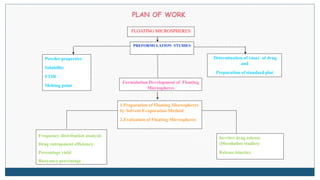
PLAN OF WORK
FLOATING MICROSPHERES
PREFORMULATION STUDIES
Determination of λmax of drug
and
Preparation of standard plot
Powder properties
Solubility
FTIR
Melting point
Formulation Development of Floating
Microspheres
1.Preparation of Floating Microspheres
by Solvent Evaporation Method
2.Evaluation of Floating Microspheres
Stability studies
In-vitro drug release
(Dissolution studies)
Release kinetics
Frequency distribution analysis
Drug entrapment efficiency
Percentage yield
Buoyancy percentage
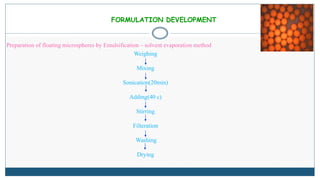
FORMULATION DEVELOPMENT
Preparation of floating microspheres by Emulsification – solvent evaporation method
Weighing
Mixing
Sonication(20min)
Adding(40 c)
Stirring
Filteration
Washing
Drying
Formulation of the floating microspheres
INGREDIENTS
FORMULATION
F1 F2 F3 F4 F5 F6
Flurbiprofen
1 1 1 1 1 1
HPMC K15M
1 1 1 1 1 1
Ethyl cellulose
1 2 3 4 5 6
Tween 80
0.5% 0.5% 0.5% 0.5% 0.5% 0.5%
Dichloromethane : Ethanol
1:1 1:1 1:1 1:1 1:1 1:1
Formulation of Flurbiprofen floating microspheres
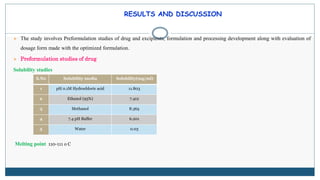
RESULTS AND DISCUSSION
 The study involves Preformulation studies of drug and excipients, formulation and processing development along with evaluation of
dosage form made with the optimized formulation.
 Preformulation studies of drug
Solubility studies
Melting point 110-111 o C
S.No Solubility media Solubility(mg/ml)
1 pH 0.1M Hydrochloric acid 11.803
2 Ethanol (95%) 7.412
3 Methanol 8.365
4 7.4 pH Buffer 6.201
5 Water 0.03
Drug-excipient Compatibility Study
Compatibility Study By FT-IR
FTIR spectra of FBP microspheres FTIR Spectra of Hpmc K15 M
FTIR Spectra of ethyl cellulose
ANALYTICAL METHOD DEVELOPMENT BY UV SPECTROPHOTOMETER
S.No
Concentration
In Mcg/Ml
Absorbance At
247nm
1 0
0
2 2
0.066
3 4
0.120
4 6
0.191
5 8
0.249
6 10
0.315
7 12
0.381
y = 0.0126x
R² = 0.9994
0
0.05
0.1
0.15
0.2
0.25
0.3
0.35
0.4
0.45
0 10 20 30 40
Concentration(µg/ml)
Absorbence
EVALUATION OF FLOATING MICROSPHERES
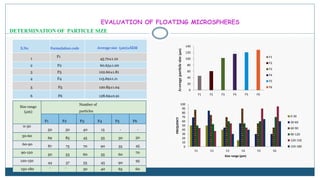
DETERMINATION OF PARTICLE SIZE
S.No Formulation code Average size (µm)±SEM
1
F1
45.70±1.10
2 F2 60.63±1.00
3 F3 102.60±1.81
4 F4 115.69±1.11
5 F5 120.85±1.04
6 F6 128.69±0.91
0
20
40
60
80
100
120
140
F1 F2 F3 F4 F5 F6
Averageparticlesize(µm)
F1
F2
F3
F4
F5
F6
Size range
(µm)
Number of
particles
F1 F2 F3 F4 F5 F6
0-30
50 50 40 15 - -
30-60
69 85 45 55 30 30
60-90
87 75 70 90 55 45
90-120
50 53 60 55 60
70
120-150
44 37 55 45 90
95
150-180 - - 30 40 65 60
0
10
20
30
40
50
60
70
80
90
100
F1 F2 F3 F4 F5 F6
FREQUENCY
Size range (µm)
0-30
30-60
60-90
90-120
120-150
150-180
PERCENTAGE DRUG ENTRAPMENT EFFICIENCY AND BUOYANCY TIME
Sl.no
Formulation
Code
Percentage yield Entrapment
Efficiency (%)
% Buoyancy
time
1 F1
60.23 53.75±1.03 65.82±0.01
2 F2
65.45 59.72±1.15 74.59±0.69
3 F3
79.35 62.35±2.25 79.41 ± 0.60
4 F4
85.02 70.81±1.11 81.76 ± 1.02
5 F5
89.65 78.89±0.98 88.70 ± 0.80
6 F6
93.77 89.60±1.12 91.83 ± 1.01
0
10
20
30
40
50
60
70
80
90
100
F1 F2 F3 F4 F5 F6
%ENTRAPMENT
Formulations
F1
F2
F3
F4
F5
F6
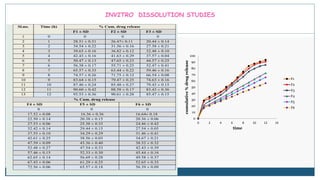
INVITRO DISSOLUTION STUDIES
0
10
20
30
40
50
60
70
80
90
100
0 2 4 6 8 10 12 14
cumulative%drugrelease
time
F1
F2
F3
F4
F5
F6
Sl.no. Time (h) % Cum. drug release
F1 ± SD F2 ± SD F3 ± SD
1 0 0 0 0
2 1 28.51 ± 0.31 26.47± 0.11 20.44 ± 0.14
3 2 34.54 ± 0.22 31.56 ± 0.16 27.58 ± 0.21
4 3 39.65 ± 0.16 36.82 ± 0.12 32.48 ± 0.10
5 4 42.43 ± 0.16 41.63 ± 0.29 37.57 ± 0.04
6 5 50.47 ± 0.13 47.65 ± 0.23 44.57 ± 0.25
7 6 56.38 ± 0.17 55.71 ± 0.25 52.47 ± 0.41
8 7 65.57 ± 0.33 63.44 ± 0.22 59.46 ± 0.16
9
5
2
9
8 74.57 ± 0.26 71.75 ± 0.12 66.54 ± 0.08
10 9 83.64 ± 0.15 79.47 ± 0.25 74.63 ± 0.16
11 10 87.46 ± 0.24 85.48 ± 0.27 79.43 ± 0.15
12 11 90.60 ± 0.42 88.58 ± 0.17 83.43 ± 0.36
13 12 93.53 ± 0.36 90.61 ± 0.28 85.47 ± 0.15
% Cum. drug release
F4 ± SD F5 ± SD F6 ± SD
0 0 0
17.52 ± 0.08 16.36 ± 0.36 16.64± 0.18
22.50 ± 0.14 20.38 ± 0.15 20.36 ± 0.06
27.53 ± 0.06 25.38 ± 0.33 24.46 ± 0.42
432.42 ± 0.14 29.44 ± 0.15 27.54 ± 0.05
37.55 ± 0.10 34.29 ± 0.29 31.46 ± 0.41
42.61 ± 0.25 38.56 ± 0.03 34.67 ± 0.21
47.59 ± 0.09 43.36 ± 0.40 38.52 ± 0.32
52.48 ± 0.27 47.54 ± 0.33 42.43 ± 0.39
57.46 ± 0.15 52.33 ± 0.30 45.44 ± 0.16
62.65 ± 0.14 56.69 ± 0.28 49.58 ± 0.37
67.43 ± 0.06 61.29 ± 0.25 52.65 ± 0.35
72.56 ± 0.06 65.57 ± 0.18 56.39 ± 0.09
RELEASE KINETICS OF FBP FLOATING MICROSPHERES
Zero order release kinetics data of FBP floating microspheres First order release kinetics data of FBP floating microspheres
Higuchi matrix release kinetics data of FBP floating microspheres Peppas release kinetics data of FBP floating microspheres
0
0.5
1
1.5
2
2.5
0 0.2 0.4 0.6 0.8 1 1.2
Log%cumulativedrugrelease
Log time (hrs)
F1
F2
F3
F4
F5
F6
-20
0
20
40
60
80
100
0 1 2 3 4
%Cumulativedrugrelease
Root time (hrs)
F2
F3
F4
F5
F6
F1
0
0.5
1
1.5
2
2.5
0 2 4 6 8 10 12 14
Log%cumulativedrug
remainedtobereleased
Time (hrs)
F1
F2
F3
F4
F5
F60
10
20
30
40
50
60
70
80
90
100
0 5 10 15
%cumulativedrugrelease
Time (hrs)
F1
F2
F3
F4
F5
F6
Regression co-efficient (r2) values of zero order and diffusion exponent (n) of Peppas model for
FBP floating microspheres
Formulation Zero order
Peppas plot
r2 value
‘n’ value
F1 0.9554 0.9404 0.5291
F2 0.9665 0.9511 0.5506
F3 0.9770 0.9762 0.6205
F4 0.9767 0.9792 0.9895
F5 0.9779 0.9765 0.9591
F6 0.9783 0.9746 0.9736
CONCLUSION
It can be concluded that
 Preformulation studies like melting point, solubility and UV analysis of were complied with standards.
 The FTIR Spectra revealed that, there was no interaction between polymers and Flurbiprofen.
 As the drug to polymer ratio was increased, the mean particle size of Flurbiprofen floating microspheres was also
increased.
 Entrapment efficiency increase with increase in the polymer concentration.
 The study also indicated that the amount of drug release decreases with an increase in the polymer concentration.
 The invitro performance of Flurbiprofen floating microspheres showed prolonged and controlled release of drug.
REFERENCES
 Dutta et. Al :Floating microspheres: Recent trends in the development of gastroretentive floating drug delievery system.
 Jain AK, Jain CP, Tanwar YS, Naruka, PS. Formulation characterization and in vitro evaluation of floating microspheres of Famotidine as a gastro
retentive dosage form. Asian J Pharm 2009;3(3):222-6
 Srivastava AK, Devendra NR, Wadhwa S. Floating microspheres of Cimetidine formulation, characterization and in vitro evaluation. Acta Pharm
2005;55:277-85.
 Li S, Lin S, Daggy BP, Mirchandani HL, Chien YW. Effect of HPMC and carbopol on the release and floating properties of gastric floating drug
delivery system using factorial design. Int J Pharm 2003;253(1-2):13-22.
 Kaiser DG, Brooks CD, Lomen PL (1986). Pharmacokinetics of flurbiprofen. The American Journal of Medicine, 80, 10-15.
 Shah SH, Patel JK, Patel NV. Stomach specific floating drug delivery system. Int J Pharm Tech Res 2009;1(3):623-33
 Trivedi P., Verma A.M.L., Garud N., Preperation and Charecterization of Acclofenac Microspheres,Asian Journal of pharmaceutics. 2(2), 2008, 110-115.
 www.drugbank.ca/drugs(DB00559)
 United States Pharmacopoeia.
Thank You…

Ppt vassu

  • 1.
    FORMULATION AND EVALUATIONOF FLURBIPROFEN FLOATING MICROSPHERES By k.Vasanthi Rg.no:13IS1S0313 Under Supervision Of D.Vinay kumar (Asst.professer) JNTU KAKINADA. Submitted to Jawaharlal Nehru technological university Kakinada-533003
  • 2.
    CONTENTS  Introduction  Literaturereview  Drug profile  Excipients used in the present study  Objective and plan of work  Experimental work Analytical methods Formulation development Preparation & Evaluation of floating microspheres  Results and discussion  Summary and Conclusion
  • 3.
    INTRODUCTION FLOATING DRUG DELIVERYSYSTEMS Floating systems are the low density systems that have sufficient buoyancy to float and remain in stomach for prolonged period of time. The floating microspheres enhance bioavailability and improve pharmacokinetic and pharmacodynamics profiles of the drugs by retaining the drug in stomach. Floating microspheres release the drug in controlled manner to achieve zero-order release kinetics for a prolonged period of time. Effervescent System Non Effervescent Systems
  • 4.
    APPROACHES TO GASTRORETENTIVE DOSAGE FORMS High Density Systems Swelling and Expanding Systems Incorporating Delaying Excipients Modified Systems Mucoadhesive & Bioadhesive Systems
  • 5.
    FLOATING MICROSPHERES Floating microspheresare gastro-retentive drug delivery systems based on non-effervescent approach. Microspheres are defined as small, insoluble, free flowing spherical particles consisting of proteins or synthetic polymers, ideally having a size less than 200 micrometer. The system floats over gastric contents, the drug is released slowly at desired rate. .
  • 6.
    MECHANISM OF FLOTATIONOF MICROSPHERES When microspheres come in contact with gastric fluid, polymers hydrate to form a colloidal gel barrier The air trapped by the swollen polymer lowers the density and confers buoyancy to the microspheres. The mechanism of drug release from microspheres can occur in the following ways Diffusion Erosion Osmosis
  • 7.
    LITERATURE REVIEW Ahmed laithet al., formulated and evaluated Flurbiprofen solid dispersion and microsphere for prolonging the duration of action of the drug. Microspheres were prepared by solvent evaporation method an using ethyl cellulose and different types of Eduragit polymers. Dhoka. V et al., prepared floating microspheres of cefpodoxime proxetil using Ethyl cellulose and HPMC as a release retarded material by solvent evaporation technique. It was observed the increase in concentration of ethyl cellulose increases the entrapment efficiency and mean particle size of the microspheres.
  • 8.
    Satish V. Shirolkaret al., prepared floating microspheres of Pioglitazone hydrochloride using ethyl cellulose and HPMC K100M The studies revealed that increase in concentration of hydrophillic polymer (HPMC) increased the drug release from the floating mcirospheres. Arjun Sony et al., were prepared Floating microspheres of Flupirtine Maleate with the help of Ethyl Cellulose, Hydroxypropyl methyl cellulose polymer & Tween 80 as a surfactant with ethanol, dicholromethane as solvents. Different formulations were characterized. Ramya Shivani B. et al., formulated and evaluated floating microspheres of omeprazole microspheres by solvent evaporation method using ethyl cellulose, eudragit s100, dcm, pva. From the study it was concluded that formulation which has been prepared at 1:5 organic to aqueous phase ratio at 1:30 drug to polymer concentration was yielding the best floating microspheres which were floating for a period of 24 hrs.
  • 9.
    DRUG PROFILE FLURBIPROFEN PHYSICO CHEMICALPROPERTIES Description White or slightly yellow crystalline powder Chemical formulae C15H13FO2. Molecular weight 244.2609. g/mol Solubility Practically insoluble in water, freely soluble in most organic solvents. It dissolves in aqueous solutions of alkali hydroxides and carbonates Melting point 110-111 °C Drug Category NSAID Structure
  • 10.
    PHARMACOKINETIC PARAMETERS Cmax <10mcg/mL Tmax 1.5 hr Bioavailability 96% Onset of action 1-2hr Plasma protein binding >99% Vol. of distribution 14L Biological half life 4.7-5.7 hr Metabolism hepatic, P450 enzyme CYP2C9
  • 11.
    EXCIPIENTS USED FORTHE PREPARATION OF FLOATING MICROSPHERES Ethyl cellulose Hydroxy propyl methyl cellulose K 15 M Tween 80 Ethanol Dichloromethane Hydrochloric acid EXCIPIENTS USED IN PRESENT STUDY
  • 12.
    OBJECTIVE AND PLANOF WORK  The aim of this study is to develop and evaluate Flurbiprofen floating microspheres using polymers like HPMC K15 M and EC.  To formulate Flurbiprofen floating microspheres using polymers like HPMC K15 and EC  To conduct the pre-formulation studies i.e. solubility studies, drug-Excipient compatibility studies etc.  To evaluate the characteristics of the formulated microspheres according to the pharmacopoeia standards  Evaluate the release kinetics of various formulations prepared.
  • 13.
    PLAN OF WORK FLOATINGMICROSPHERES PREFORMULATION STUDIES Determination of λmax of drug and Preparation of standard plot Powder properties Solubility FTIR Melting point Formulation Development of Floating Microspheres 1.Preparation of Floating Microspheres by Solvent Evaporation Method 2.Evaluation of Floating Microspheres Stability studies In-vitro drug release (Dissolution studies) Release kinetics Frequency distribution analysis Drug entrapment efficiency Percentage yield Buoyancy percentage
  • 14.
    FORMULATION DEVELOPMENT Preparation offloating microspheres by Emulsification – solvent evaporation method Weighing Mixing Sonication(20min) Adding(40 c) Stirring Filteration Washing Drying
  • 15.
    Formulation of thefloating microspheres INGREDIENTS FORMULATION F1 F2 F3 F4 F5 F6 Flurbiprofen 1 1 1 1 1 1 HPMC K15M 1 1 1 1 1 1 Ethyl cellulose 1 2 3 4 5 6 Tween 80 0.5% 0.5% 0.5% 0.5% 0.5% 0.5% Dichloromethane : Ethanol 1:1 1:1 1:1 1:1 1:1 1:1 Formulation of Flurbiprofen floating microspheres
  • 16.
    RESULTS AND DISCUSSION The study involves Preformulation studies of drug and excipients, formulation and processing development along with evaluation of dosage form made with the optimized formulation.  Preformulation studies of drug Solubility studies Melting point 110-111 o C S.No Solubility media Solubility(mg/ml) 1 pH 0.1M Hydrochloric acid 11.803 2 Ethanol (95%) 7.412 3 Methanol 8.365 4 7.4 pH Buffer 6.201 5 Water 0.03
  • 17.
    Drug-excipient Compatibility Study CompatibilityStudy By FT-IR FTIR spectra of FBP microspheres FTIR Spectra of Hpmc K15 M FTIR Spectra of ethyl cellulose
  • 18.
    ANALYTICAL METHOD DEVELOPMENTBY UV SPECTROPHOTOMETER S.No Concentration In Mcg/Ml Absorbance At 247nm 1 0 0 2 2 0.066 3 4 0.120 4 6 0.191 5 8 0.249 6 10 0.315 7 12 0.381 y = 0.0126x R² = 0.9994 0 0.05 0.1 0.15 0.2 0.25 0.3 0.35 0.4 0.45 0 10 20 30 40 Concentration(µg/ml) Absorbence
  • 19.
    EVALUATION OF FLOATINGMICROSPHERES DETERMINATION OF PARTICLE SIZE S.No Formulation code Average size (µm)±SEM 1 F1 45.70±1.10 2 F2 60.63±1.00 3 F3 102.60±1.81 4 F4 115.69±1.11 5 F5 120.85±1.04 6 F6 128.69±0.91 0 20 40 60 80 100 120 140 F1 F2 F3 F4 F5 F6 Averageparticlesize(µm) F1 F2 F3 F4 F5 F6 Size range (µm) Number of particles F1 F2 F3 F4 F5 F6 0-30 50 50 40 15 - - 30-60 69 85 45 55 30 30 60-90 87 75 70 90 55 45 90-120 50 53 60 55 60 70 120-150 44 37 55 45 90 95 150-180 - - 30 40 65 60 0 10 20 30 40 50 60 70 80 90 100 F1 F2 F3 F4 F5 F6 FREQUENCY Size range (µm) 0-30 30-60 60-90 90-120 120-150 150-180
  • 20.
    PERCENTAGE DRUG ENTRAPMENTEFFICIENCY AND BUOYANCY TIME Sl.no Formulation Code Percentage yield Entrapment Efficiency (%) % Buoyancy time 1 F1 60.23 53.75±1.03 65.82±0.01 2 F2 65.45 59.72±1.15 74.59±0.69 3 F3 79.35 62.35±2.25 79.41 ± 0.60 4 F4 85.02 70.81±1.11 81.76 ± 1.02 5 F5 89.65 78.89±0.98 88.70 ± 0.80 6 F6 93.77 89.60±1.12 91.83 ± 1.01 0 10 20 30 40 50 60 70 80 90 100 F1 F2 F3 F4 F5 F6 %ENTRAPMENT Formulations F1 F2 F3 F4 F5 F6
  • 21.
    INVITRO DISSOLUTION STUDIES 0 10 20 30 40 50 60 70 80 90 100 02 4 6 8 10 12 14 cumulative%drugrelease time F1 F2 F3 F4 F5 F6 Sl.no. Time (h) % Cum. drug release F1 ± SD F2 ± SD F3 ± SD 1 0 0 0 0 2 1 28.51 ± 0.31 26.47± 0.11 20.44 ± 0.14 3 2 34.54 ± 0.22 31.56 ± 0.16 27.58 ± 0.21 4 3 39.65 ± 0.16 36.82 ± 0.12 32.48 ± 0.10 5 4 42.43 ± 0.16 41.63 ± 0.29 37.57 ± 0.04 6 5 50.47 ± 0.13 47.65 ± 0.23 44.57 ± 0.25 7 6 56.38 ± 0.17 55.71 ± 0.25 52.47 ± 0.41 8 7 65.57 ± 0.33 63.44 ± 0.22 59.46 ± 0.16 9 5 2 9 8 74.57 ± 0.26 71.75 ± 0.12 66.54 ± 0.08 10 9 83.64 ± 0.15 79.47 ± 0.25 74.63 ± 0.16 11 10 87.46 ± 0.24 85.48 ± 0.27 79.43 ± 0.15 12 11 90.60 ± 0.42 88.58 ± 0.17 83.43 ± 0.36 13 12 93.53 ± 0.36 90.61 ± 0.28 85.47 ± 0.15 % Cum. drug release F4 ± SD F5 ± SD F6 ± SD 0 0 0 17.52 ± 0.08 16.36 ± 0.36 16.64± 0.18 22.50 ± 0.14 20.38 ± 0.15 20.36 ± 0.06 27.53 ± 0.06 25.38 ± 0.33 24.46 ± 0.42 432.42 ± 0.14 29.44 ± 0.15 27.54 ± 0.05 37.55 ± 0.10 34.29 ± 0.29 31.46 ± 0.41 42.61 ± 0.25 38.56 ± 0.03 34.67 ± 0.21 47.59 ± 0.09 43.36 ± 0.40 38.52 ± 0.32 52.48 ± 0.27 47.54 ± 0.33 42.43 ± 0.39 57.46 ± 0.15 52.33 ± 0.30 45.44 ± 0.16 62.65 ± 0.14 56.69 ± 0.28 49.58 ± 0.37 67.43 ± 0.06 61.29 ± 0.25 52.65 ± 0.35 72.56 ± 0.06 65.57 ± 0.18 56.39 ± 0.09
  • 22.
    RELEASE KINETICS OFFBP FLOATING MICROSPHERES Zero order release kinetics data of FBP floating microspheres First order release kinetics data of FBP floating microspheres Higuchi matrix release kinetics data of FBP floating microspheres Peppas release kinetics data of FBP floating microspheres 0 0.5 1 1.5 2 2.5 0 0.2 0.4 0.6 0.8 1 1.2 Log%cumulativedrugrelease Log time (hrs) F1 F2 F3 F4 F5 F6 -20 0 20 40 60 80 100 0 1 2 3 4 %Cumulativedrugrelease Root time (hrs) F2 F3 F4 F5 F6 F1 0 0.5 1 1.5 2 2.5 0 2 4 6 8 10 12 14 Log%cumulativedrug remainedtobereleased Time (hrs) F1 F2 F3 F4 F5 F60 10 20 30 40 50 60 70 80 90 100 0 5 10 15 %cumulativedrugrelease Time (hrs) F1 F2 F3 F4 F5 F6
  • 23.
    Regression co-efficient (r2)values of zero order and diffusion exponent (n) of Peppas model for FBP floating microspheres Formulation Zero order Peppas plot r2 value ‘n’ value F1 0.9554 0.9404 0.5291 F2 0.9665 0.9511 0.5506 F3 0.9770 0.9762 0.6205 F4 0.9767 0.9792 0.9895 F5 0.9779 0.9765 0.9591 F6 0.9783 0.9746 0.9736
  • 24.
    CONCLUSION It can beconcluded that  Preformulation studies like melting point, solubility and UV analysis of were complied with standards.  The FTIR Spectra revealed that, there was no interaction between polymers and Flurbiprofen.  As the drug to polymer ratio was increased, the mean particle size of Flurbiprofen floating microspheres was also increased.  Entrapment efficiency increase with increase in the polymer concentration.  The study also indicated that the amount of drug release decreases with an increase in the polymer concentration.  The invitro performance of Flurbiprofen floating microspheres showed prolonged and controlled release of drug.
  • 25.
    REFERENCES  Dutta et.Al :Floating microspheres: Recent trends in the development of gastroretentive floating drug delievery system.  Jain AK, Jain CP, Tanwar YS, Naruka, PS. Formulation characterization and in vitro evaluation of floating microspheres of Famotidine as a gastro retentive dosage form. Asian J Pharm 2009;3(3):222-6  Srivastava AK, Devendra NR, Wadhwa S. Floating microspheres of Cimetidine formulation, characterization and in vitro evaluation. Acta Pharm 2005;55:277-85.  Li S, Lin S, Daggy BP, Mirchandani HL, Chien YW. Effect of HPMC and carbopol on the release and floating properties of gastric floating drug delivery system using factorial design. Int J Pharm 2003;253(1-2):13-22.  Kaiser DG, Brooks CD, Lomen PL (1986). Pharmacokinetics of flurbiprofen. The American Journal of Medicine, 80, 10-15.  Shah SH, Patel JK, Patel NV. Stomach specific floating drug delivery system. Int J Pharm Tech Res 2009;1(3):623-33  Trivedi P., Verma A.M.L., Garud N., Preperation and Charecterization of Acclofenac Microspheres,Asian Journal of pharmaceutics. 2(2), 2008, 110-115.  www.drugbank.ca/drugs(DB00559)  United States Pharmacopoeia.
  • 26.