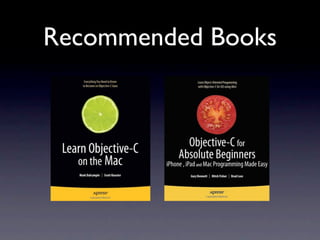
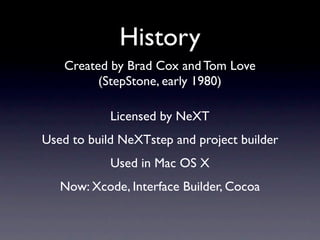
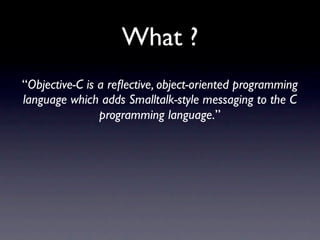
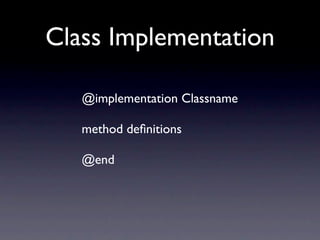
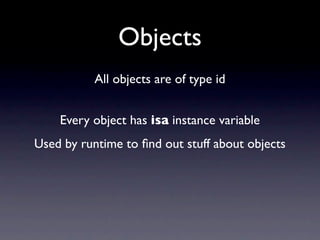
Objective-C is an object-oriented programming language that adds Smalltalk-style messaging to C. It allows programmers to define classes and objects that send and receive messages. Key features include classes and objects, memory management through retain counts, categories to add methods to classes, and protocols to define method requirements. Objective-C code uses square brackets [] to send messages between objects and uses dot syntax as a shorthand. Recommended resources for learning more about Objective-C include Apple's documentation and books focused on Cocoa and Objective-C.



![Make objects do stuff
[receiver message];
Runtime resolves target of the message
Receiving object interprets message](https://image.slidesharecdn.com/objective-c-101006083354-phpapp02/85/Objective-c-16-320.jpg)
![Message examples
[myRect display];
[myRect setWidth:20];
[myRect setOriginX:10 y:20];](https://image.slidesharecdn.com/objective-c-101006083354-phpapp02/85/Objective-c-17-320.jpg)
![Messaging how-to
[object <keyword>:(type)<argument>]](https://image.slidesharecdn.com/objective-c-101006083354-phpapp02/85/Objective-c-18-320.jpg)
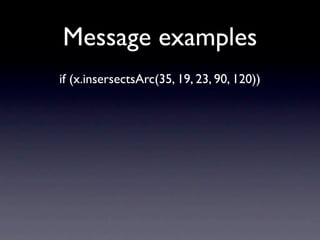
![Message examples
if (x.insersectsArc(35, 19, 23, 90, 120))
if ([x intersectsArcWithRadius:35
centeredAtX:19
Y:23
fromAngle:90
toAngle:120])](https://image.slidesharecdn.com/objective-c-101006083354-phpapp02/85/Objective-c-20-320.jpg)
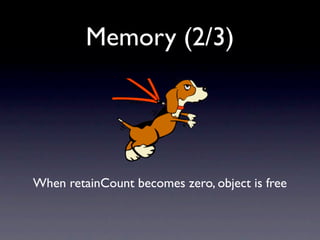
![Memory (1/3)
retainCount
new/alloc/copy: retainCount = 1
[object retain]: retainCount increase
[object release]: retainCount decrease](https://image.slidesharecdn.com/objective-c-101006083354-phpapp02/85/Objective-c-21-320.jpg)
![Memory (3/3)
NSArray *cars = [[NSArray alloc] init...];
Car *car = [[Car alloc] init];
[cars addObject:car];
[car release];
car = nil;](https://image.slidesharecdn.com/objective-c-101006083354-phpapp02/85/Objective-c-24-320.jpg)


![dot syntax
car.color = whatever;
[car setColor:whatever];
[car setValue:whatever forKey:@”color”];](https://image.slidesharecdn.com/objective-c-101006083354-phpapp02/85/Objective-c-30-320.jpg)