1
CSE 459.22
Programming in C++
2
Overview
• Sign roster list
• Syllabus and Course Policies
• Introduction to C++
• About Lab 1
• Fill Questionnaire
3
Introduction to C++
• Programming Concept
• Basic C++
• C++ Extension from C
4
Focus
• Focus on
– Programming Concepts
– Programming Design Techniques
• Don’t get lost in
– Language Technical Details
5
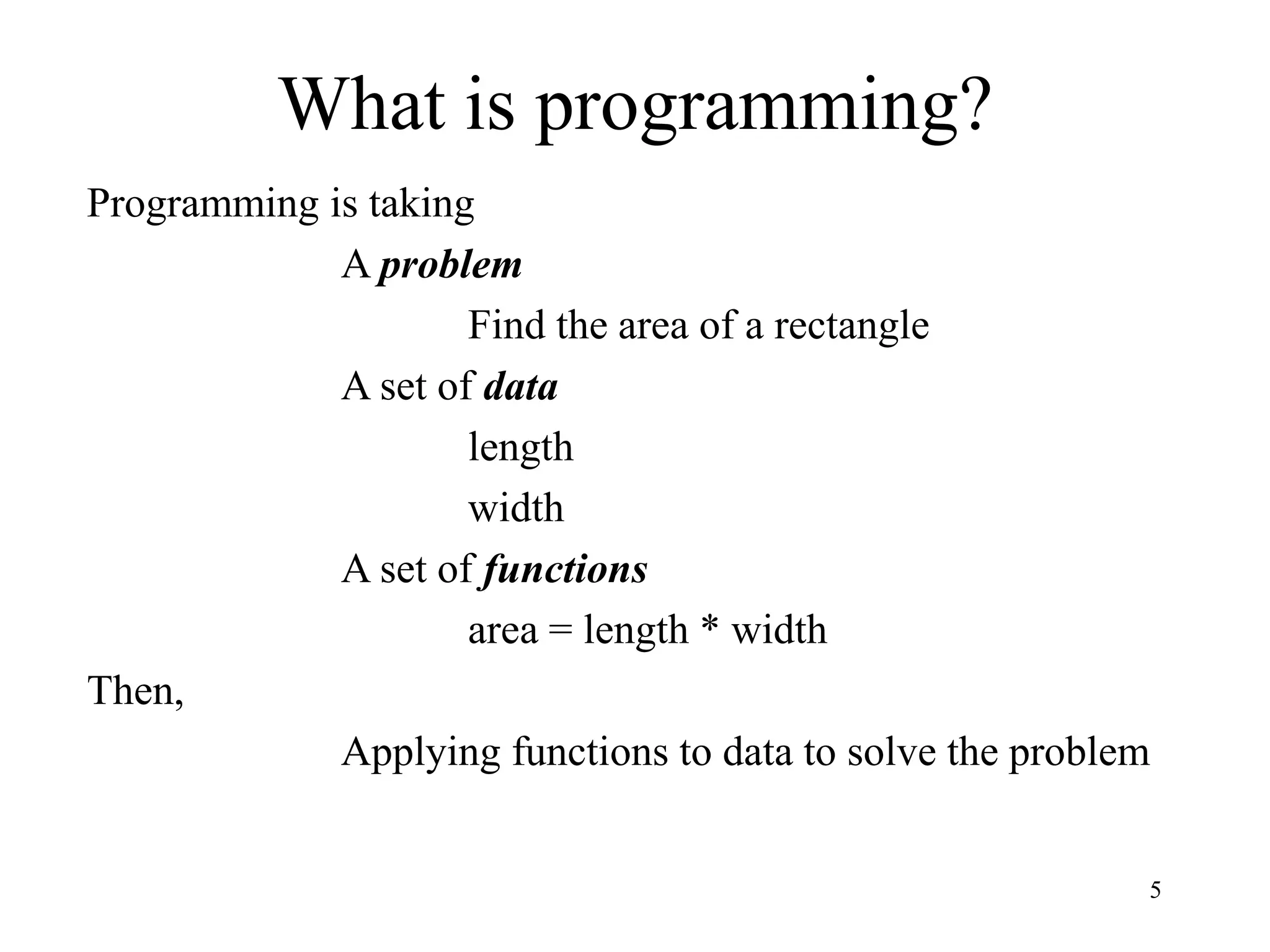
What is programming?
Programming is taking
A problem
Find the area of a rectangle
A set of data
length
width
A set of functions
area = length * width
Then,
Applying functions to data to solve the problem
6
Programming Concept Evolution
• Unstructured
• Procedural
• Object-Oriented
7
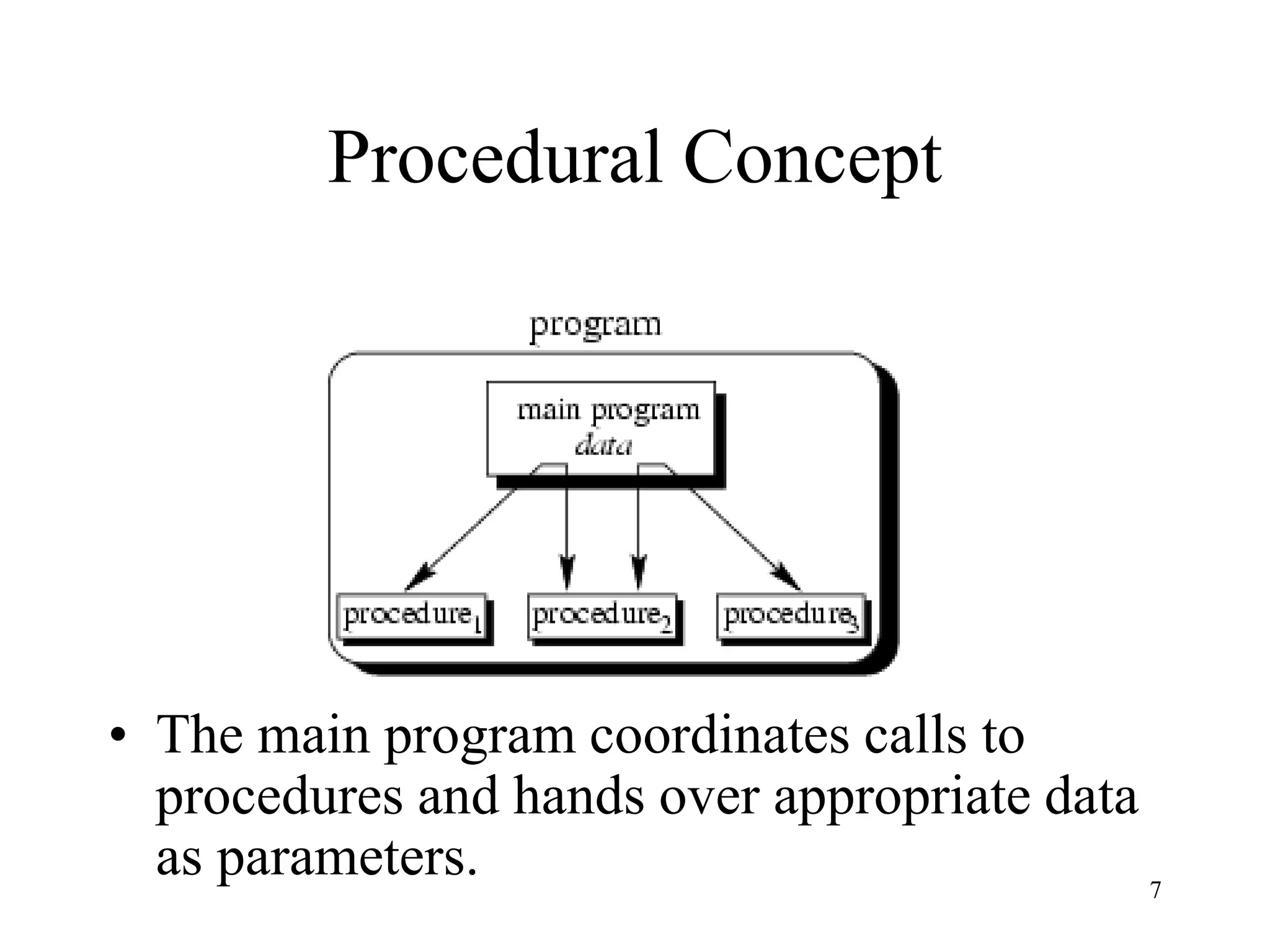
Procedural Concept
• The main program coordinates calls to
procedures and hands over appropriate data
as parameters.
8
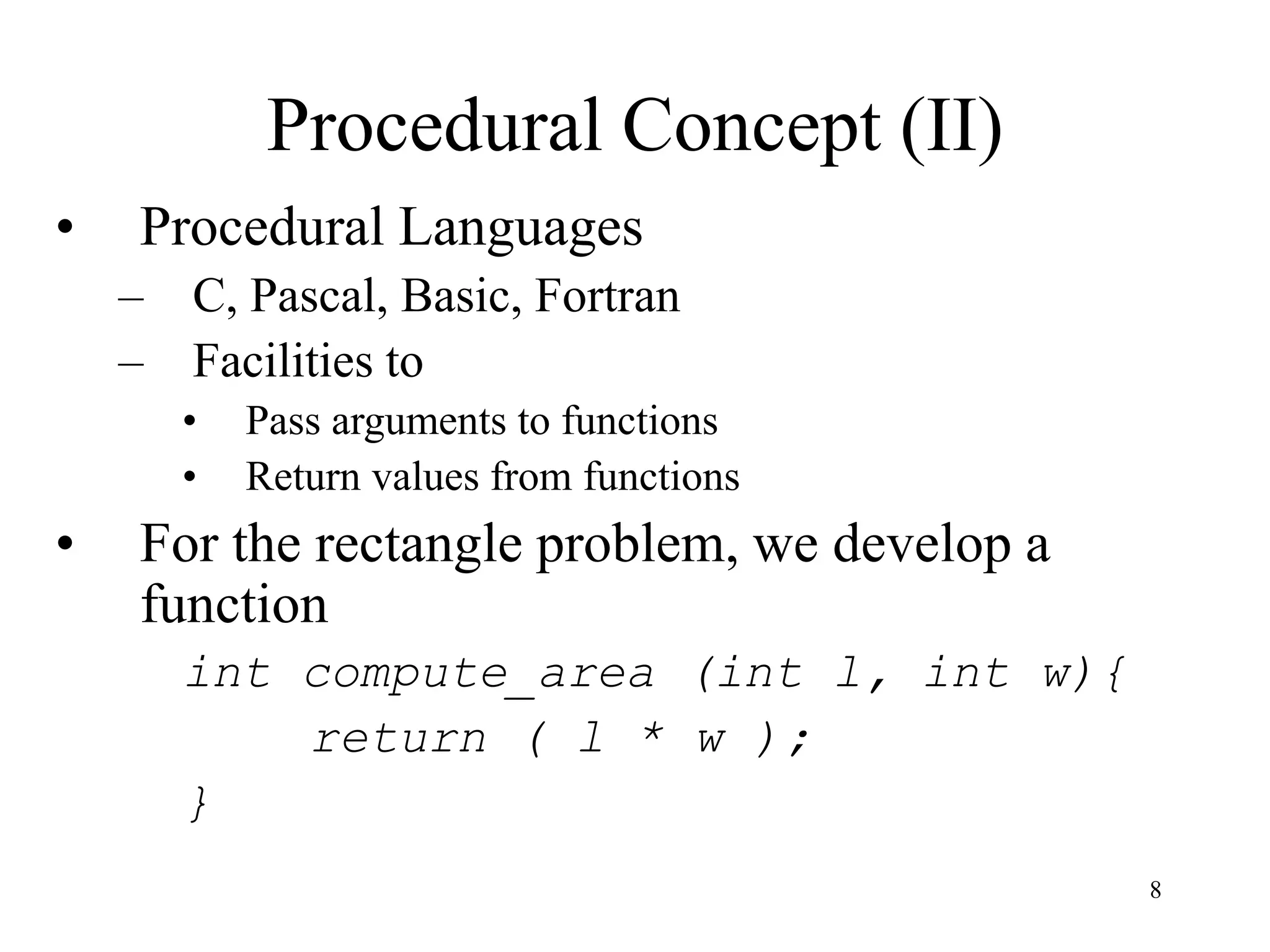
Procedural Concept (II)
• Procedural Languages
– C, Pascal, Basic, Fortran
– Facilities to
• Pass arguments to functions
• Return values from functions
• For the rectangle problem, we develop a
function
int compute_area (int l, int w){
return ( l * w );
}
9
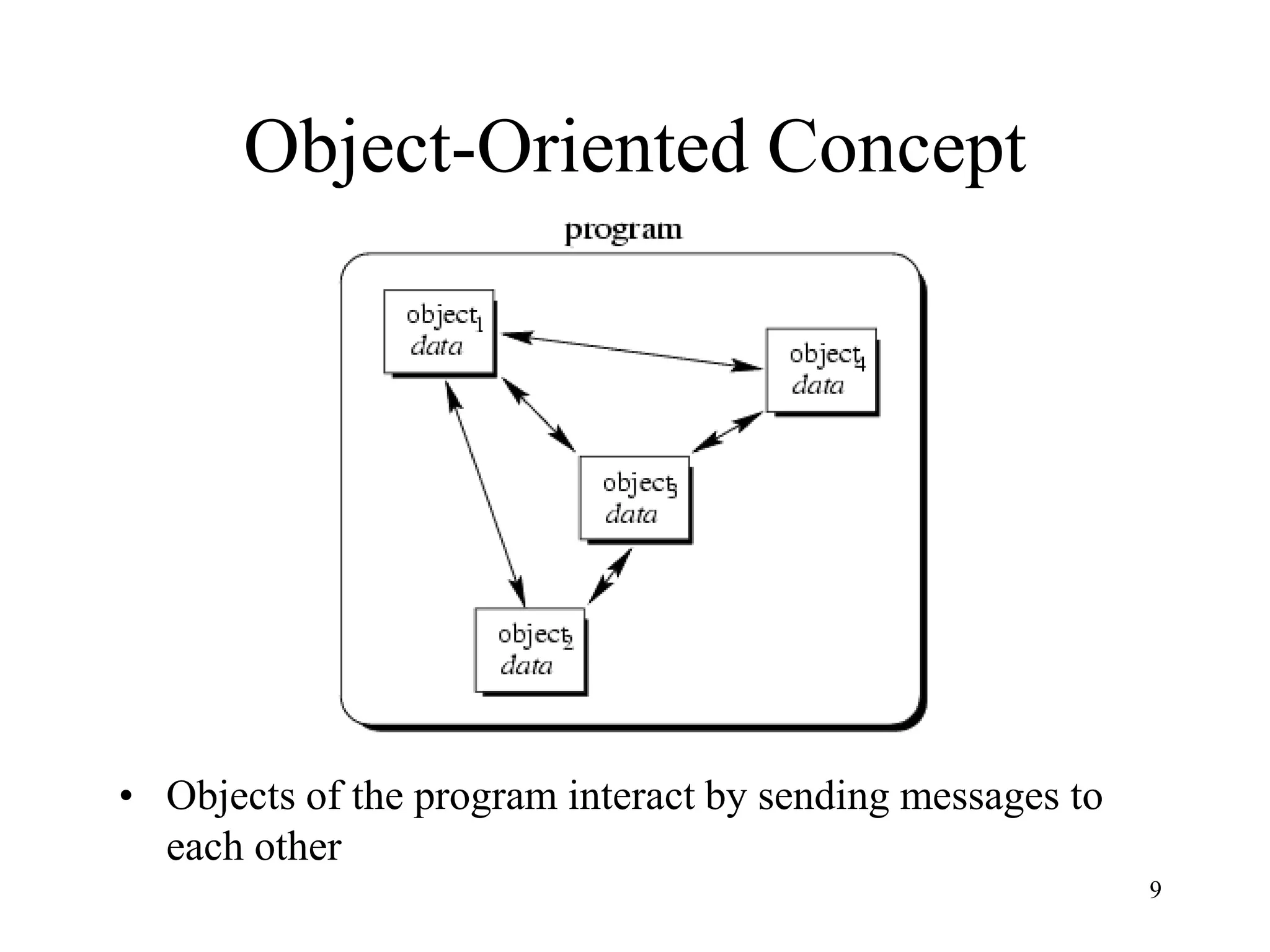
Object-Oriented Concept
• Objects of the program interact by sending messages to
each other
10
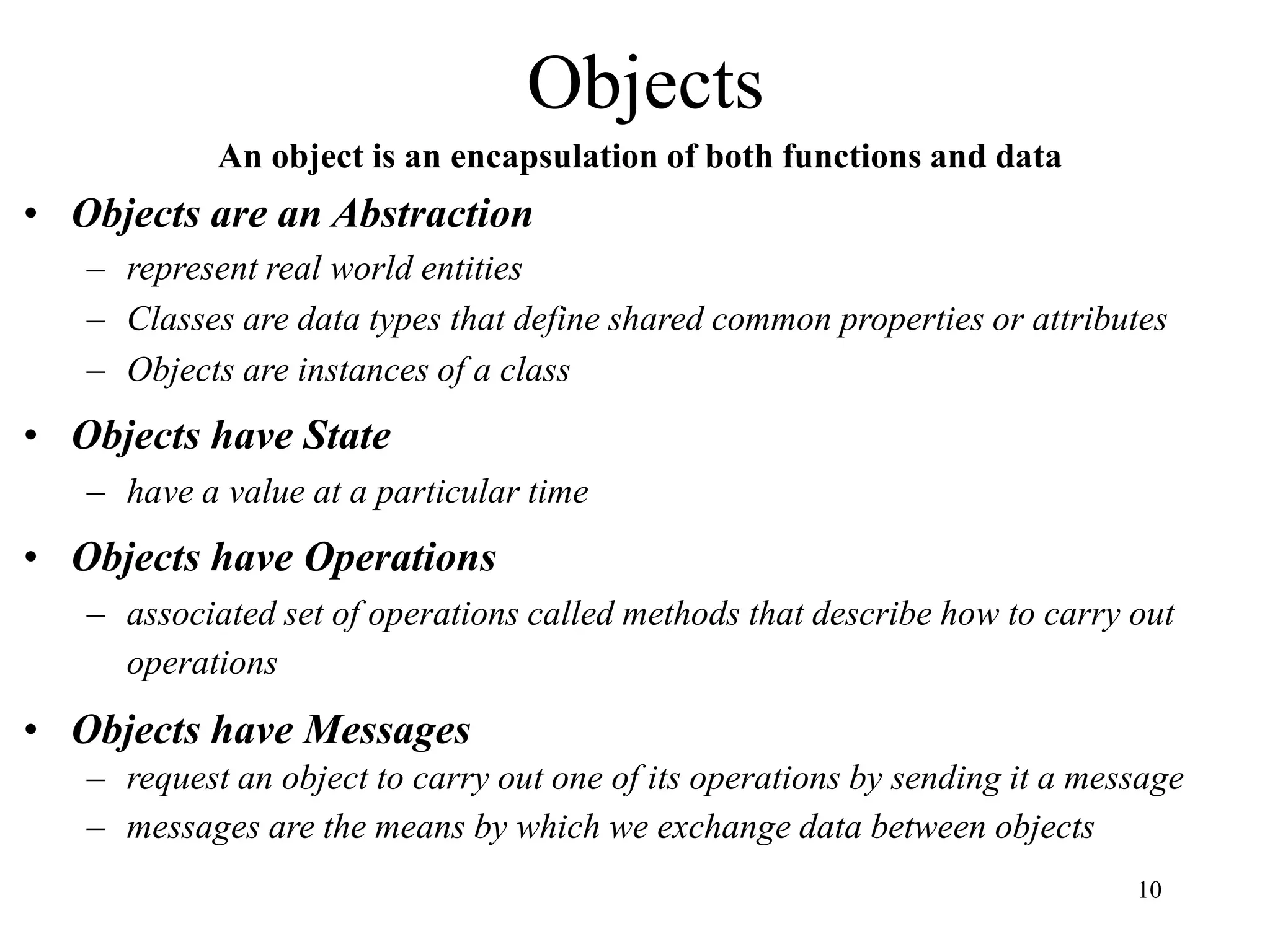
Objects
An object is an encapsulation of both functions and data
• Objects are an Abstraction
– represent real world entities
– Classes are data types that define shared common properties or attributes
– Objects are instances of a class
• Objects have State
– have a value at a particular time
• Objects have Operations
– associated set of operations called methods that describe how to carry out
operations
• Objects have Messages
– request an object to carry out one of its operations by sending it a message
– messages are the means by which we exchange data between objects
11
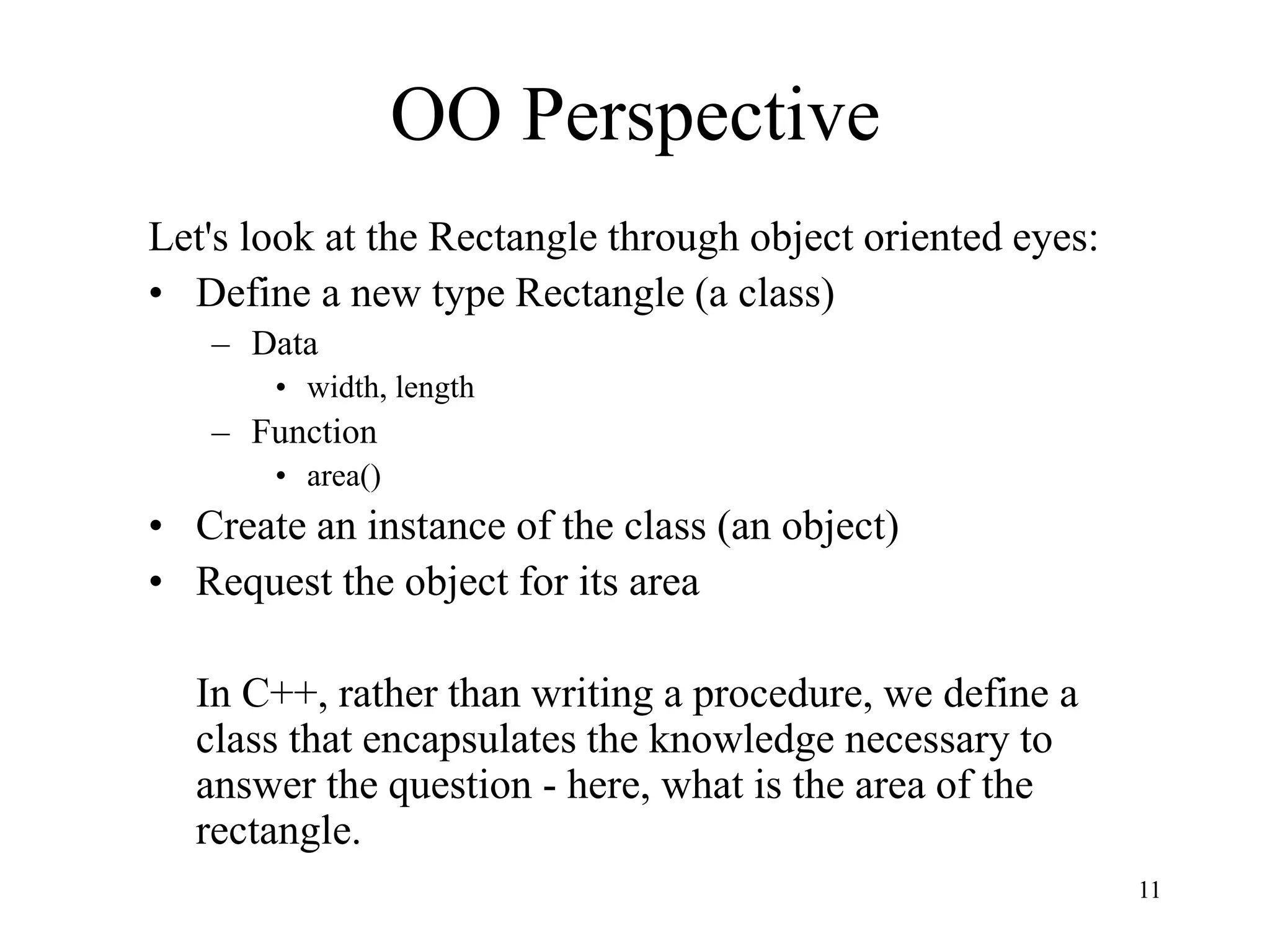
OO Perspective
Let's look at the Rectangle through object oriented eyes:
• Define a new type Rectangle (a class)
– Data
• width, length
– Function
• area()
• Create an instance of the class (an object)
• Request the object for its area
In C++, rather than writing a procedure, we define a
class that encapsulates the knowledge necessary to
answer the question - here, what is the area of the
rectangle.
12
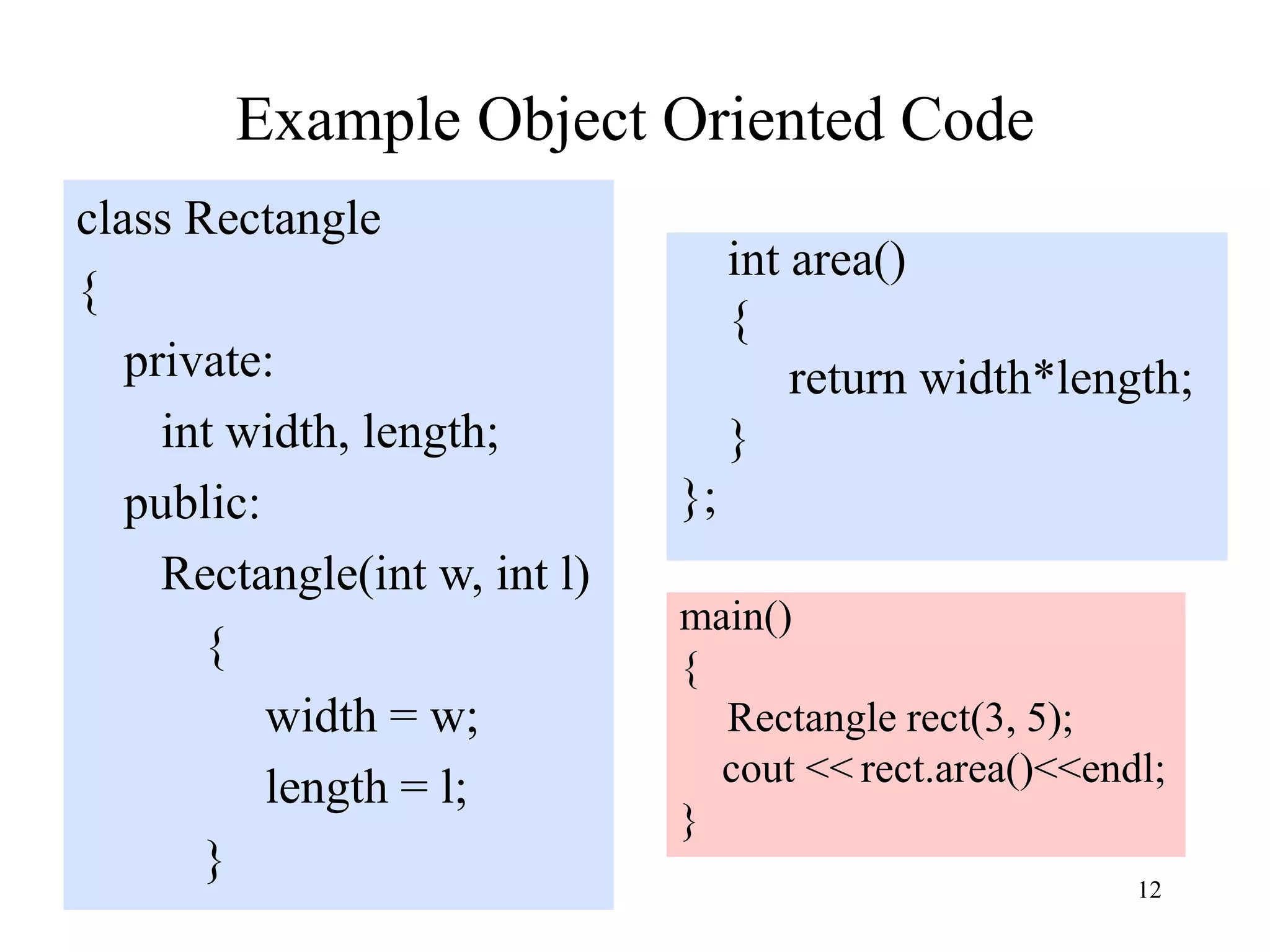
class Rectangle
{
private:
int width, length;
public:
Rectangle(int w, int l)
{
width = w;
length = l;
}
main()
{
Rectangle rect(3, 5);
cout << rect.area()<<endl;
}
int area()
{
return width*length;
}
};
Example Object Oriented Code
13
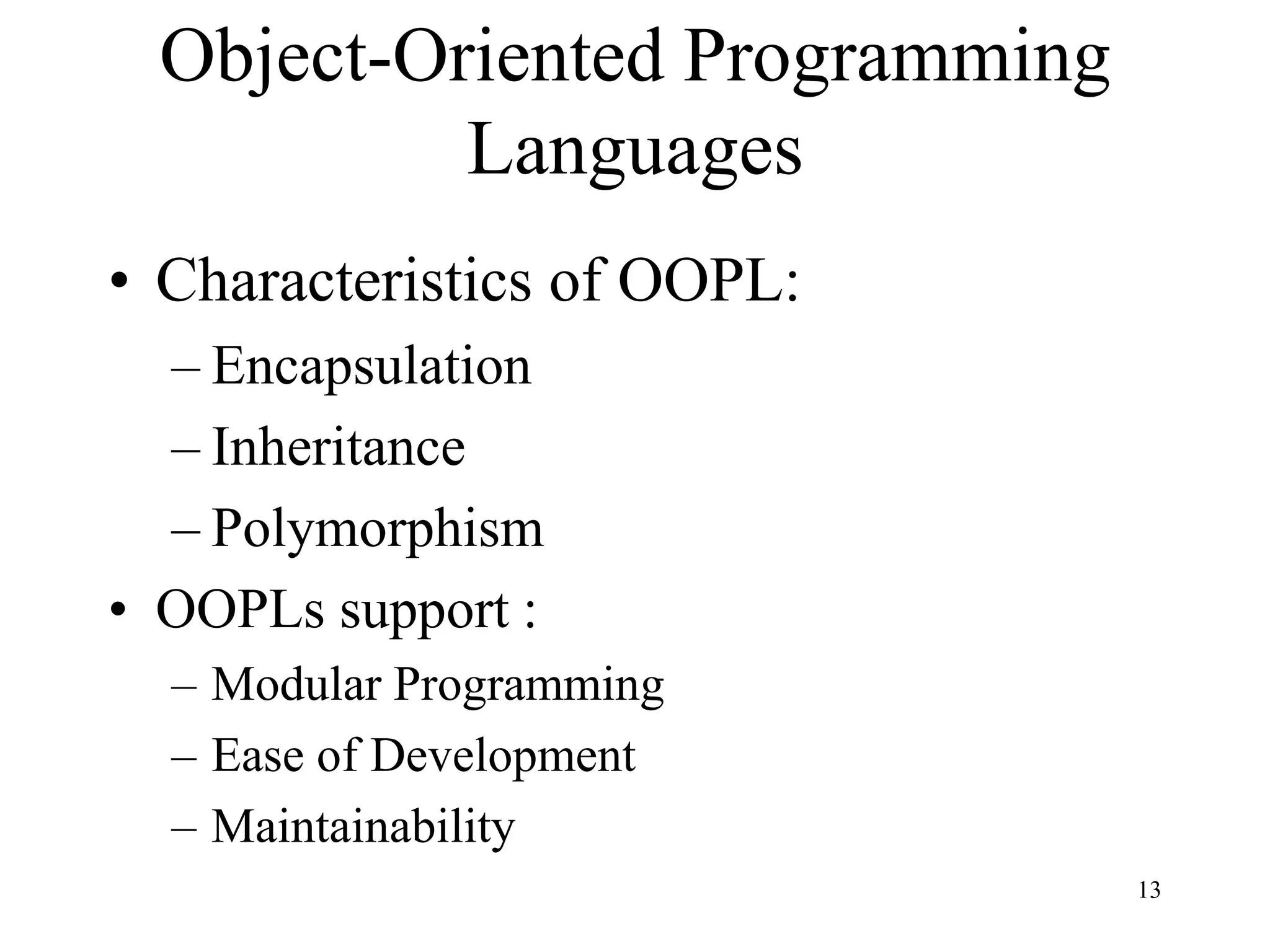
Object-Oriented Programming
Languages
• Characteristics of OOPL:
– Encapsulation
– Inheritance
– Polymorphism
• OOPLs support :
– Modular Programming
– Ease of Development
– Maintainability
14
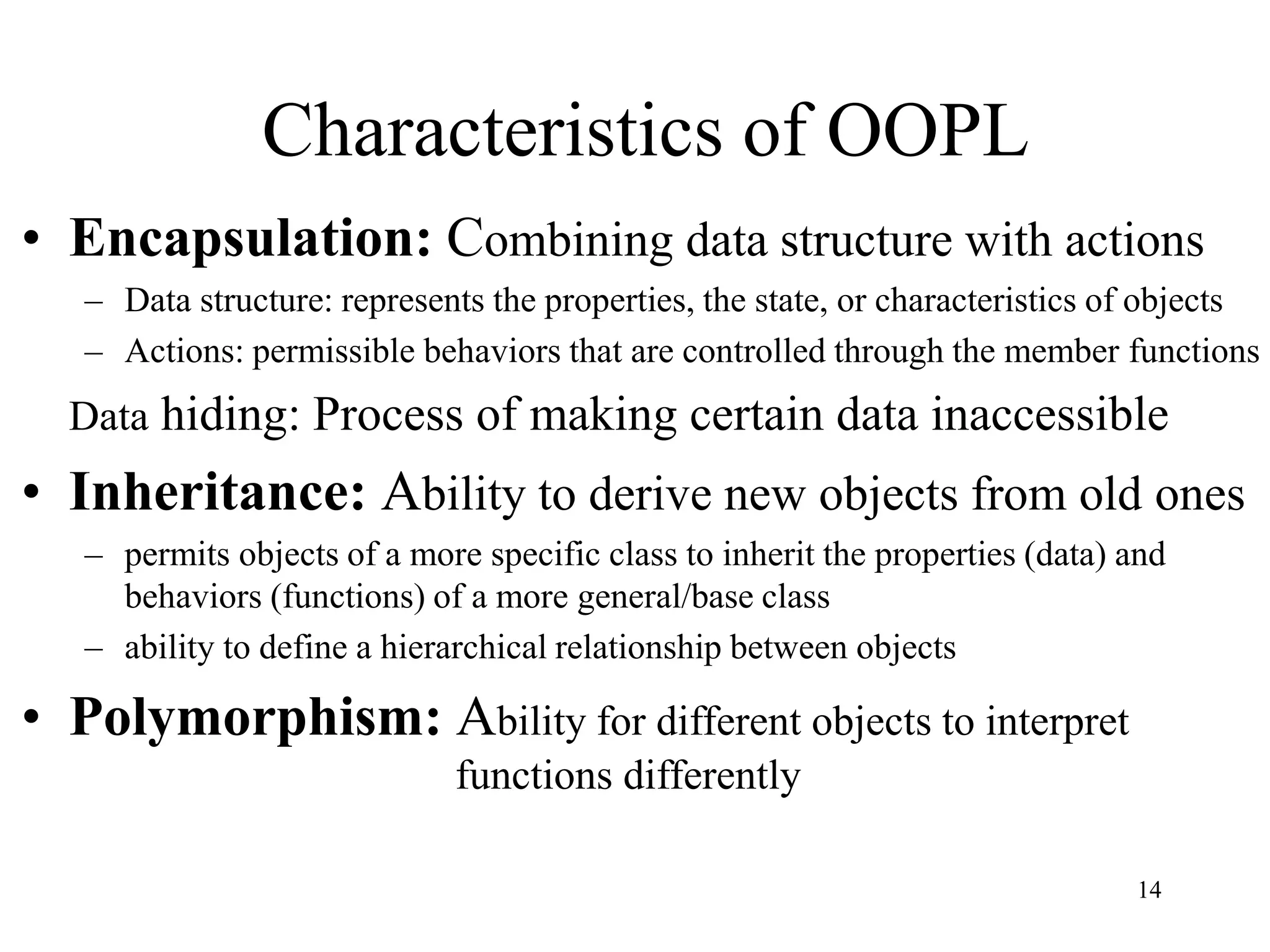
Characteristics of OOPL
• Encapsulation: Combining data structure with actions
– Data structure: represents the properties, the state, or characteristics of objects
– Actions: permissible behaviors that are controlled through the member functions
Data hiding: Process of making certain data inaccessible
• Inheritance: Ability to derive new objects from old ones
– permits objects of a more specific class to inherit the properties (data) and
behaviors (functions) of a more general/base class
– ability to define a hierarchical relationship between objects
• Polymorphism: Ability for different objects to interpret
functions differently
15
Basic C++
• Inherit all ANSI C directives
• Inherit all C functions
• You don’t have to write OOP programming
in C++
16
Basic C++ Extension from C
• comments
/* You can still use the old comment style, */
/* but you must be // very careful about mixing them */
// It's best to use this style for 1 line or partial lines
/* And use this style when your comment
consists of multiple lines */
• cin and cout (and #include <iostream.h>)
cout << "hey";
char name[10];
cin >> name;
cout << "Hey " << name << ", nice name." << endl;
cout << endl; // print a blank line
• declaring variables almost anywhere
// declare a variable when you need it
for (int k = 1; k < 5; k++){
cout << k;
}
17
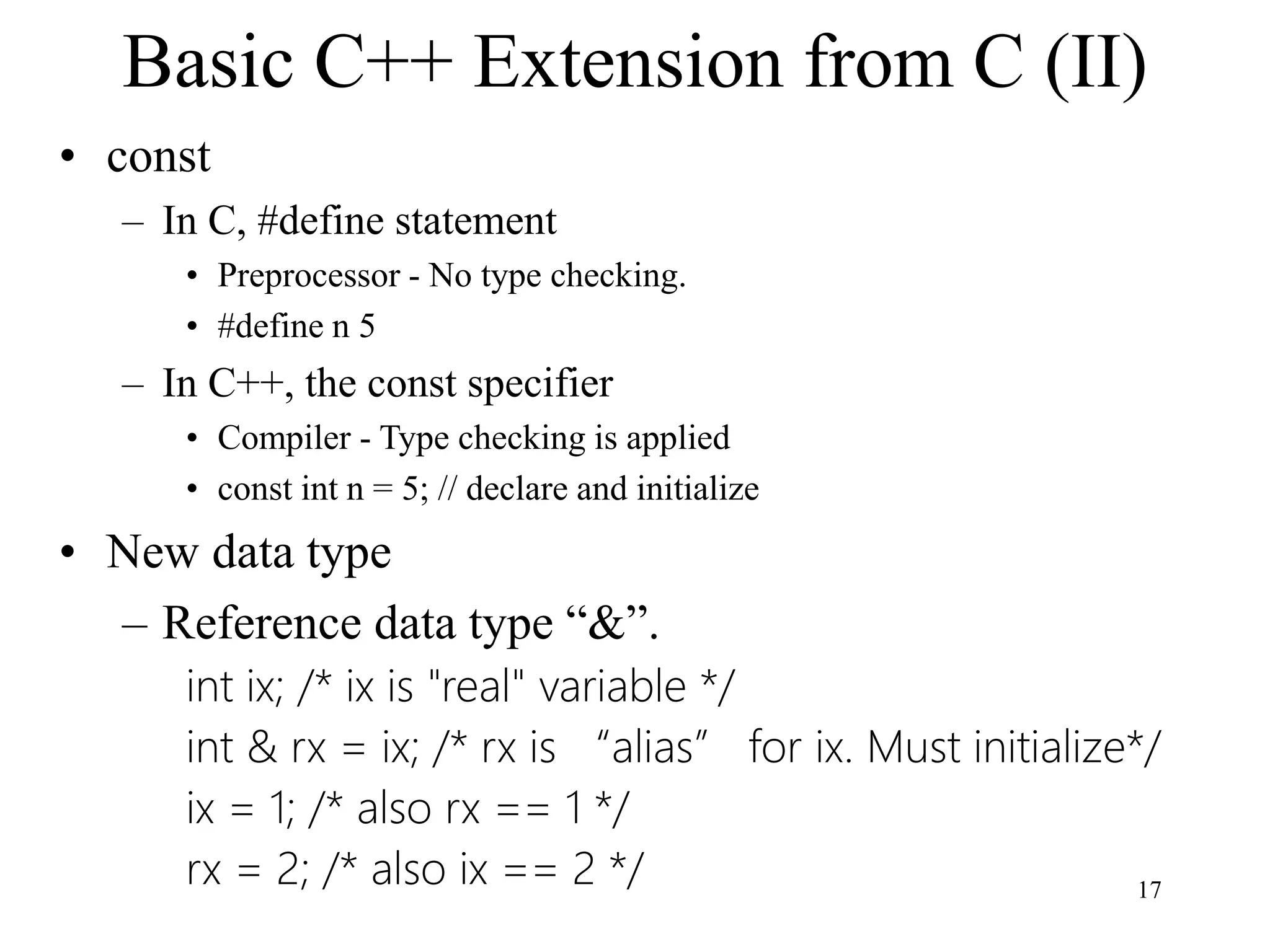
Basic C++ Extension from C (II)
• const
– In C, #define statement
• Preprocessor - No type checking.
• #define n 5
– In C++, the const specifier
• Compiler - Type checking is applied
• const int n = 5; // declare and initialize
• New data type
– Reference data type “&”.
int ix; /* ix is "real" variable */
int & rx = ix; /* rx is “alias” for ix. Must initialize*/
ix = 1; /* also rx == 1 */
rx = 2; /* also ix == 2 */
18
C++ - Advance Extension
• C++ allows function overloading
– In C++, functions can use the same names, within
the same scope, if each can be distinguished by its
name and signature
– The signature specifies the number, type, and order
of the parameters expressed as a comma separated
list of argument types
19
C++
• Is a better C
• Expressive
• Supports Data Abstraction
• Supports OOP
• Supports Generic Programming
– Containers
• Stack of char, int, double etc
– Generic Algorithms
• sort(), copy(), search() any container Stack/Vector/List
20
Take Home Message
• There are many different kinds of programming
paradigms, OOP is one among them.
• In OOP, programmers see the execution of the
program as a collection of dialoging objects.
• The main characteristics of OOPL include
encapsulation, inheritance, and polymorphism.
Lecture1

  • 1.
  • 2.
    2 Overview • Sign rosterlist • Syllabus and Course Policies • Introduction to C++ • About Lab 1 • Fill Questionnaire
  • 3.
    3 Introduction to C++ •Programming Concept • Basic C++ • C++ Extension from C
  • 4.
    4 Focus • Focus on –Programming Concepts – Programming Design Techniques • Don’t get lost in – Language Technical Details
  • 5.
    5 What is programming? Programmingis taking A problem Find the area of a rectangle A set of data length width A set of functions area = length * width Then, Applying functions to data to solve the problem
  • 6.
    6 Programming Concept Evolution •Unstructured • Procedural • Object-Oriented
  • 7.
    7 Procedural Concept • Themain program coordinates calls to procedures and hands over appropriate data as parameters.
  • 8.
    8 Procedural Concept (II) •Procedural Languages – C, Pascal, Basic, Fortran – Facilities to • Pass arguments to functions • Return values from functions • For the rectangle problem, we develop a function int compute_area (int l, int w){ return ( l * w ); }
  • 9.
    9 Object-Oriented Concept • Objectsof the program interact by sending messages to each other
  • 10.
    10 Objects An object isan encapsulation of both functions and data • Objects are an Abstraction – represent real world entities – Classes are data types that define shared common properties or attributes – Objects are instances of a class • Objects have State – have a value at a particular time • Objects have Operations – associated set of operations called methods that describe how to carry out operations • Objects have Messages – request an object to carry out one of its operations by sending it a message – messages are the means by which we exchange data between objects
  • 11.
    11 OO Perspective Let's lookat the Rectangle through object oriented eyes: • Define a new type Rectangle (a class) – Data • width, length – Function • area() • Create an instance of the class (an object) • Request the object for its area In C++, rather than writing a procedure, we define a class that encapsulates the knowledge necessary to answer the question - here, what is the area of the rectangle.
  • 12.
    12 class Rectangle { private: int width,length; public: Rectangle(int w, int l) { width = w; length = l; } main() { Rectangle rect(3, 5); cout << rect.area()<<endl; } int area() { return width*length; } }; Example Object Oriented Code
  • 13.
    13 Object-Oriented Programming Languages • Characteristicsof OOPL: – Encapsulation – Inheritance – Polymorphism • OOPLs support : – Modular Programming – Ease of Development – Maintainability
  • 14.
    14 Characteristics of OOPL •Encapsulation: Combining data structure with actions – Data structure: represents the properties, the state, or characteristics of objects – Actions: permissible behaviors that are controlled through the member functions Data hiding: Process of making certain data inaccessible • Inheritance: Ability to derive new objects from old ones – permits objects of a more specific class to inherit the properties (data) and behaviors (functions) of a more general/base class – ability to define a hierarchical relationship between objects • Polymorphism: Ability for different objects to interpret functions differently
  • 15.
    15 Basic C++ • Inheritall ANSI C directives • Inherit all C functions • You don’t have to write OOP programming in C++
  • 16.
    16 Basic C++ Extensionfrom C • comments /* You can still use the old comment style, */ /* but you must be // very careful about mixing them */ // It's best to use this style for 1 line or partial lines /* And use this style when your comment consists of multiple lines */ • cin and cout (and #include <iostream.h>) cout << "hey"; char name[10]; cin >> name; cout << "Hey " << name << ", nice name." << endl; cout << endl; // print a blank line • declaring variables almost anywhere // declare a variable when you need it for (int k = 1; k < 5; k++){ cout << k; }
  • 17.
    17 Basic C++ Extensionfrom C (II) • const – In C, #define statement • Preprocessor - No type checking. • #define n 5 – In C++, the const specifier • Compiler - Type checking is applied • const int n = 5; // declare and initialize • New data type – Reference data type “&”. int ix; /* ix is "real" variable */ int & rx = ix; /* rx is “alias” for ix. Must initialize*/ ix = 1; /* also rx == 1 */ rx = 2; /* also ix == 2 */
  • 18.
    18 C++ - AdvanceExtension • C++ allows function overloading – In C++, functions can use the same names, within the same scope, if each can be distinguished by its name and signature – The signature specifies the number, type, and order of the parameters expressed as a comma separated list of argument types
  • 19.
    19 C++ • Is abetter C • Expressive • Supports Data Abstraction • Supports OOP • Supports Generic Programming – Containers • Stack of char, int, double etc – Generic Algorithms • sort(), copy(), search() any container Stack/Vector/List
  • 20.
    20 Take Home Message •There are many different kinds of programming paradigms, OOP is one among them. • In OOP, programmers see the execution of the program as a collection of dialoging objects. • The main characteristics of OOPL include encapsulation, inheritance, and polymorphism.