International Journal of Trend in Scientific Research and Development (IJTSRD)
Volume: 3 | Issue: 4 | May-Jun 2019 Available Online: www.ijtsrd.com e-ISSN: 2456 - 6470
@ IJTSRD | Unique Paper ID – IJTSRD24034 | Volume – 3 | Issue – 4 | May-Jun 2019 Page: 1003
Spectrum Handoff Decision
Schemes and Cognitive Radio Network
Harera Mehmood Khan1, Harjit Singh Kainth2
1M.Tech Scholar, 2Assistant Professor
1,2Department of Electrical & Electronics Engineering, ARNI University, Kangra, Himachal Pradesh, India
How to cite this paper: Harera
Mehmood Khan | Harjit Singh Kainth
"Spectrum Handoff Decision Schemes
and Cognitive Radio Network"
Published in International Journal of
Trend in Scientific Research and
Development
(ijtsrd), ISSN: 2456-
6470, Volume-3 |
Issue-4, June 2019,
pp.1003-1005, URL:
https://www.ijtsrd.c
om/papers/ijtsrd24
034.pdf
Copyright © 2019 by author(s) and
International Journal of Trend in
Scientific Research and Development
Journal. This is an Open Access article
distributed under
the terms of the
Creative Commons
Attribution License (CC BY 4.0)
(http://creativecommons.org/licenses/
by/4.0)
ABSTRACT
Due to the growth and spread of wireless devices in the unlicensed spectrum
bands, such as ISM, the bands become more and more crowded and therefore
affect the performance of the wireless networks negatively. Thus, the cognitive
spectrum access principles are required to utilize the existing spectrum bands
more efficiently. There are many advantages of cognitive radio technology but
there exists some obstacles like the CRT (Cognitive Radio Technology) is used
over a heterogeneous radiospectrumof licensed and unlicensedspectrumbands
and as for survey huge work in done in licensed spectrum bands and very small
of work done in the amalgamation licensed and unlicensed bands for data
transportation.
Keywords: FSA, SPTF, FCC, CRN
I. INTRODUCTION
With most of our activities involving some kind of access to network in one way
or other, wireless communication has now become extremely important in
modern society. This has caused the applications and services,standards, andthe
total of wireless users, to increase with every passing day, considering that the
larger part of the limited available radio spectrum resources have been allocated
well and can restrict this growth [1]. Also, finally, the amount of expansion is
determined by the existing radio spectrum; the regulatory authorities and
government bodies have taken up a stringent procedure/approach toward the
distribution and licensing of radio frequencyspectrumtodisparateorganizations
(e.g., service providers, military applications, cellular
telephony, service providers, and TV), all of these individual
entities own absolute transmissions to their assigned
frequency channels. By using this strict approach, the main
method of accessing a radio spectrum resource is basedona
fixed spectrum allocation method, knownasFixed Spectrum
Access (FSA). An expansive report compiled by the (SPTF)
Spectrum Policy Task Force [2] and issued by (FCC) The
Federal Communication Commission, which conclusively
proved the fact that a lot of the assigned (licensed)spectrum
underwent quite low utilization efficiency, such as those
dedicated to a military applications, analogue cellular
telephony or TV, which are not completely utilized. The
survey has uncovered temporal(time-related) as well as
spatial(geographic) variations in the exploitation of radio
spectrum, extending from 16-86% in the bands as low as
3GHz and below, while extending lower tan this at high
frequencies[3].
II. LITERATURE REVIEW
Dhivya and Murugesh(2017) the research paper entitled
“A STUDY ON QUANTITATIVE PARAMETERS OFSPECTRUM
HANDOFF IN COGNITIVE RADIONETWORKS” describes the
need of dynamic allocation of spectrum band in an efficient
manner. The paper outlines the features of Cognitive Radio
networks that makes possible for unlicensed users to use
licensed spectrum absolutely free with switching from
primary user to secondary due to interference engine and
enables secondary users tousechannelbasedonavailability.
The paper also describes the concept of spectrum mobility
and its objectives. It is very important to select an effective
spectrum handoff strategy for achieving better spectrum
mobility.
Preetha and S. Kalaivani (2017) the research paper
entitled “A Collaborative Scheme with Power Adaptation-
Equalization and Spectrum Handoff for Mobile Cognitive
Radio Networks” isaboutpoweradaptation equalizationand
spectrum handoff scheme for cognitive radio networks of
mobile based. The paper also describes how to offer better
communication services to unlicensed users. The paper
outlines the spectrum handoff concept and its objective to
offer licensed users better accessibility to channel with
minimum delay.
Hernández et al (2017) the research paper entitled
“Multivariable Adaptive Handoff Spectral Model for
Cognitive Radio Networks” defines multivariable adaptive
spectrum handoff model for the cognitive radio networks.
The paper describes MAPMFF with four algorithms for
decision making with different approaches fuzzy, feedback
statistics, predictive and multichannel. The paper also
outlines the analysis made between the proposed
algorithms.
IJTSRD24034
International Journal of Trend in Scientific Research and Development (IJTSRD) @ www.ijtsrd.com eISSN: 2456-6470
@ IJTSRD | Unique Paper ID – IJTSRD24034 | Volume – 3 | Issue – 4 | May-Jun 2019 Page: 1004
Mardeni et al (2016) the researchpaperentitled “Spectrum
Handoff Schemes in Cognitive Radio Network Using Particle
Swarm Optimization” define spectrum mobility. The paper
describes three spectrum handoffstrategiesthatcanbeused
to reduce the handoff delaywhich areproactive, reactiveand
hybrid. The paper also describes the implementation of PSO
(particle swarm optimization) to minimize the service time
of spectrum handoff to the optimal value.
Tiwari and Rastogi (2016) the research paper titled
“Spectrum Handoff in Cognitive Radio Network” describes
the modern wireless technology and thespectrumband. The
paper focus on implementation of cognitive radio networks
for resolving problem of spectrum scarcitythrough dynamic
spectrum access. The paper also outlines the importance of
cognitive radio technology and the best solution for
spectrum inefficiency and spectrum shortage problems. At
last the paper clearly demonstrates the spectrum handoff
concept.
Hossain and Sarkar (2012) the research paper entitled
“Spectrum Management in Cognitive Radio Networks:
Modeling and performance Evaluation” describes the
cognitive radio networks and its importance in today
wireless computing. The paper outlines the challenge of
sharing licensed spectrum with other licensed userswithout
interfering. To address this the paper presents a proactive
spectrum managementschemestouseunoccupiedspectrum
with minimum latency.
Yan et al (2010) presents the 4G heterogeneous network
with vertical handover decision algorithm. It increases the
required QoS performance in wide range applications. This
algorithm is categorized into four groups based on the
handover decision criterion. These four groups are used to
evaluate the complexity of implementation and efficiency.
Daojing et al (2011) proposed an improved handoff
algorithm with parameters namely, stateof mobilenodeand
network conditions during handoff decision. The
experimental results show that the proposed algorithm has
reduced the bandwidth utilization, handoff dropping rate
and handoff rate.
Yen et al (2013) compares the performance of Mobile IPv6
and Proxy Mobile IPv6 handoff techniques. Mobile IPv6
handoff technique has more packet loss and latency than
proxy mobile IPv6 technique. When the handover speed is
fast, it requires fast handover mobile Internet Protocol
FMIPv6.
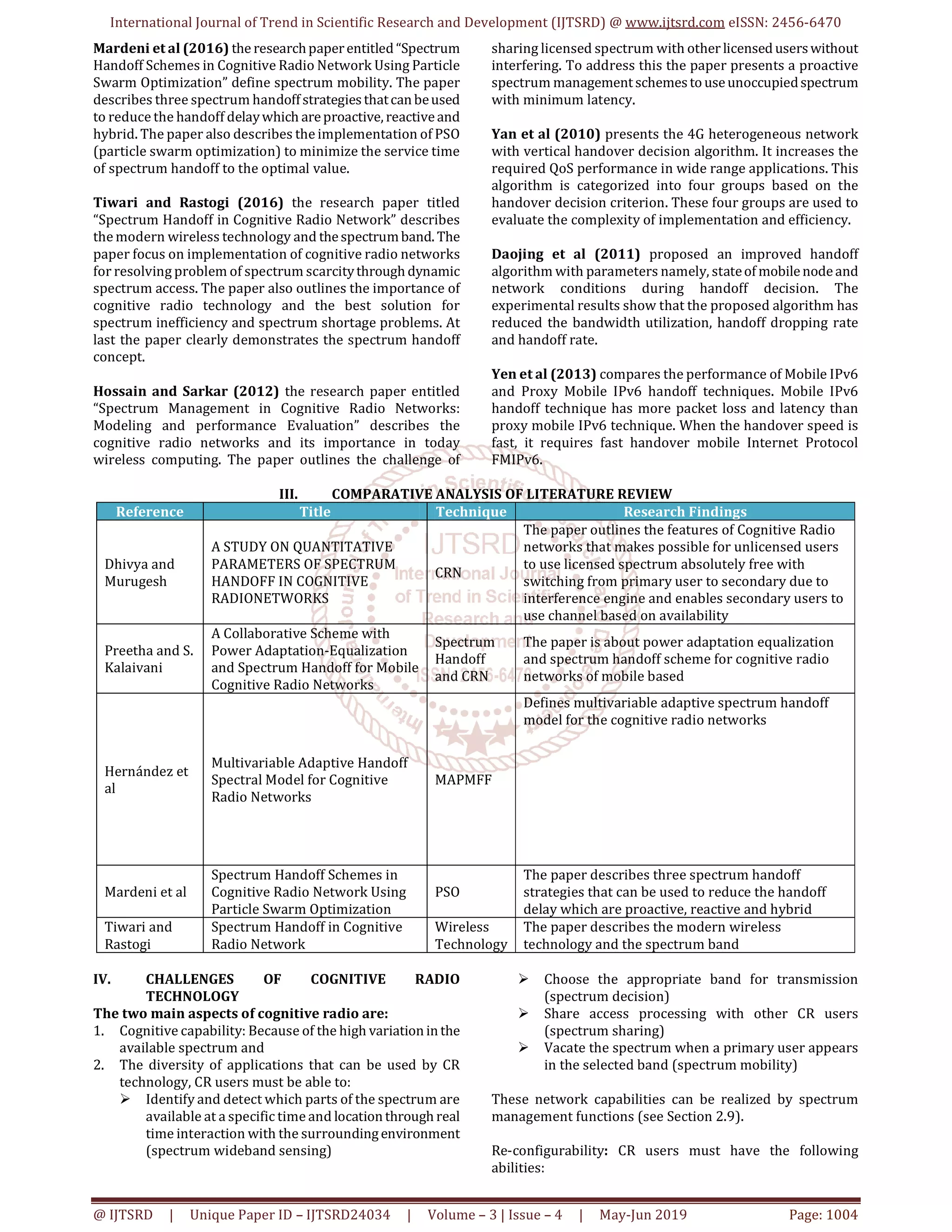
III. COMPARATIVE ANALYSIS OF LITERATURE REVIEW
Reference Title Technique Research Findings
Dhivya and
Murugesh
A STUDY ON QUANTITATIVE
PARAMETERS OF SPECTRUM
HANDOFF IN COGNITIVE
RADIONETWORKS
CRN
The paper outlines the features of Cognitive Radio
networks that makes possible for unlicensed users
to use licensed spectrum absolutely free with
switching from primary user to secondary due to
interference engine and enables secondary users to
use channel based on availability
Preetha and S.
Kalaivani
A Collaborative Scheme with
Power Adaptation-Equalization
and Spectrum Handoff for Mobile
Cognitive Radio Networks
Spectrum
Handoff
and CRN
The paper is about power adaptation equalization
and spectrum handoff scheme for cognitive radio
networks of mobile based
Hernández et
al
Multivariable Adaptive Handoff
Spectral Model for Cognitive
Radio Networks
MAPMFF
Defines multivariable adaptive spectrum handoff
model for the cognitive radio networks
Mardeni et al
Spectrum Handoff Schemes in
Cognitive Radio Network Using
Particle Swarm Optimization
PSO
The paper describes three spectrum handoff
strategies that can be used to reduce the handoff
delay which are proactive, reactive and hybrid
Tiwari and
Rastogi
Spectrum Handoff in Cognitive
Radio Network
Wireless
Technology
The paper describes the modern wireless
technology and the spectrum band
IV. CHALLENGES OF COGNITIVE RADIO
TECHNOLOGY
The two main aspects of cognitive radio are:
1. Cognitive capability: Because of the high variationinthe
available spectrum and
2. The diversity of applications that can be used by CR
technology, CR users must be able to:
Identify and detect which parts of the spectrum are
available at a specific time and locationthrough real
time interaction with the surroundingenvironment
(spectrum wideband sensing)
Choose the appropriate band for transmission
(spectrum decision)
Share access processing with other CR users
(spectrum sharing)
Vacate the spectrum when a primary user appears
in the selected band (spectrum mobility)
These network capabilities can be realized by spectrum
management functions (see Section 2.9).
Re-configurability: CR users must have the following
abilities:
International Journal of Trend in Scientific Research and Development (IJTSRD) @ www.ijtsrd.com eISSN: 2456-6470
@ IJTSRD | Unique Paper ID – IJTSRD24034 | Volume – 3 | Issue – 4 | May-Jun 2019 Page: 1005
They must be able to adapt to the modulation scheme in
order to improve spectrum access process.
They must be able to operate on different systems with
different protocols in a wideband frequency range
supported by its hardware design. Using this capability,
the best networks and channels canbeselected andthen
CR users are able to reconfigure themselves to be
compatible with the new environment.
They must be able to frequency agility, which meansthe
ability of the CR user can change its transmission
frequency.
They must be able to control the transmission power,
for example, transmitting power control can be used to
control the power level dynamically, which reduces the
emitted power to allow greater sharing of the spectrum
when a higher power level is not necessary.
V. CONCLUSION
The research paper presents the reviewofspectrumhandoff
decisions with literature survey. The paper reviews basic
fundamentals of Spectrum Handoff Decision Schemes in
Cognitive Radio Networks.
REFERENCES:
[1] A. Wyglinski and M. Nekovee, "Cognitive radio
communications and networks,"IEEE Communications
Magazine, vol. 46, pp. 30-31, 2008.
[2] E. FCC, "Docket No 02-135," SpectrumPolicyTaskForce
Report, 2002.
[3] S. M. Mishra, D. Cabric, C. Chang, D. Willkomm, B. Van
Schewick, S. Wolisz, and B. Brodersen, "A real time
cognitive radio test bed for physical and link layer
experiments," 2005, pp. 562-567.
[4] S. Huang, X. Liu, and Z. Ding, "Optimal transmission
strategies for dynamic spectrum access in cognitive
radio networks," Mobile Computing, IEEE Transactions
on, vol. 8, pp. 1636-1648, 2009.
[5] I. F. Akyildiz, W. Y. Lee, M. C. Vuran, and S. Mohanty, "A
survey on spectrum management in cognitive radio
networks," CommunicationsMagazine, IEEE,vol.46,pp.
40-48, 2008.
[6] S. Haykin, "Cognitive radio: brain-empowered wireless
communications, "Selected Areas in Communications,
IEEE Journal on, vol. 23, pp. 201-220, 2005.
[7] B. A. Fette, Cognitive radio technology: Academic Press,
2009.
[8] L. Kleinrock, "Queueing Systems, Vol. II: Computer
Applications," ed:Wiley, New York, 1976.
[9] L. Kleinrock, "Queueing systems, vol. I: Theory," ed:
Wiley, New York, 1975.
[10] Available:http://www.cse.fau.edu/~bob/publications/
encyclopedia.pdf
[11] J. Walraevens, D. Fiems, and H. Bruneel, "Performance
analysis of priorityqueueing systems in discrete time,"
in Network performance engineering, ed: Springer,
2011, pp. 203-232.
[12] M. Tanner, Practical Queueing Analysis: McGraw-Hill,
1995.
[13] D. Efrosinin and A. Winkler, "Queueing system with a
constant retrialrate,non-reliableserver andthreshold-
based recovery," European journal of operational
research, vol. 210, pp. 594-605, 2011.
[14] B. Choi and Y. Chang, "Single server retrial queueswith
priority calls, "Mathematical and Computer modelling,
vol. 30, pp. 7-32, 1999.

Spectrum Handoff Decision Schemes and Cognitive Radio Network

  • 1.
    International Journal ofTrend in Scientific Research and Development (IJTSRD) Volume: 3 | Issue: 4 | May-Jun 2019 Available Online: www.ijtsrd.com e-ISSN: 2456 - 6470 @ IJTSRD | Unique Paper ID – IJTSRD24034 | Volume – 3 | Issue – 4 | May-Jun 2019 Page: 1003 Spectrum Handoff Decision Schemes and Cognitive Radio Network Harera Mehmood Khan1, Harjit Singh Kainth2 1M.Tech Scholar, 2Assistant Professor 1,2Department of Electrical & Electronics Engineering, ARNI University, Kangra, Himachal Pradesh, India How to cite this paper: Harera Mehmood Khan | Harjit Singh Kainth "Spectrum Handoff Decision Schemes and Cognitive Radio Network" Published in International Journal of Trend in Scientific Research and Development (ijtsrd), ISSN: 2456- 6470, Volume-3 | Issue-4, June 2019, pp.1003-1005, URL: https://www.ijtsrd.c om/papers/ijtsrd24 034.pdf Copyright © 2019 by author(s) and International Journal of Trend in Scientific Research and Development Journal. This is an Open Access article distributed under the terms of the Creative Commons Attribution License (CC BY 4.0) (http://creativecommons.org/licenses/ by/4.0) ABSTRACT Due to the growth and spread of wireless devices in the unlicensed spectrum bands, such as ISM, the bands become more and more crowded and therefore affect the performance of the wireless networks negatively. Thus, the cognitive spectrum access principles are required to utilize the existing spectrum bands more efficiently. There are many advantages of cognitive radio technology but there exists some obstacles like the CRT (Cognitive Radio Technology) is used over a heterogeneous radiospectrumof licensed and unlicensedspectrumbands and as for survey huge work in done in licensed spectrum bands and very small of work done in the amalgamation licensed and unlicensed bands for data transportation. Keywords: FSA, SPTF, FCC, CRN I. INTRODUCTION With most of our activities involving some kind of access to network in one way or other, wireless communication has now become extremely important in modern society. This has caused the applications and services,standards, andthe total of wireless users, to increase with every passing day, considering that the larger part of the limited available radio spectrum resources have been allocated well and can restrict this growth [1]. Also, finally, the amount of expansion is determined by the existing radio spectrum; the regulatory authorities and government bodies have taken up a stringent procedure/approach toward the distribution and licensing of radio frequencyspectrumtodisparateorganizations (e.g., service providers, military applications, cellular telephony, service providers, and TV), all of these individual entities own absolute transmissions to their assigned frequency channels. By using this strict approach, the main method of accessing a radio spectrum resource is basedona fixed spectrum allocation method, knownasFixed Spectrum Access (FSA). An expansive report compiled by the (SPTF) Spectrum Policy Task Force [2] and issued by (FCC) The Federal Communication Commission, which conclusively proved the fact that a lot of the assigned (licensed)spectrum underwent quite low utilization efficiency, such as those dedicated to a military applications, analogue cellular telephony or TV, which are not completely utilized. The survey has uncovered temporal(time-related) as well as spatial(geographic) variations in the exploitation of radio spectrum, extending from 16-86% in the bands as low as 3GHz and below, while extending lower tan this at high frequencies[3]. II. LITERATURE REVIEW Dhivya and Murugesh(2017) the research paper entitled “A STUDY ON QUANTITATIVE PARAMETERS OFSPECTRUM HANDOFF IN COGNITIVE RADIONETWORKS” describes the need of dynamic allocation of spectrum band in an efficient manner. The paper outlines the features of Cognitive Radio networks that makes possible for unlicensed users to use licensed spectrum absolutely free with switching from primary user to secondary due to interference engine and enables secondary users tousechannelbasedonavailability. The paper also describes the concept of spectrum mobility and its objectives. It is very important to select an effective spectrum handoff strategy for achieving better spectrum mobility. Preetha and S. Kalaivani (2017) the research paper entitled “A Collaborative Scheme with Power Adaptation- Equalization and Spectrum Handoff for Mobile Cognitive Radio Networks” isaboutpoweradaptation equalizationand spectrum handoff scheme for cognitive radio networks of mobile based. The paper also describes how to offer better communication services to unlicensed users. The paper outlines the spectrum handoff concept and its objective to offer licensed users better accessibility to channel with minimum delay. Hernández et al (2017) the research paper entitled “Multivariable Adaptive Handoff Spectral Model for Cognitive Radio Networks” defines multivariable adaptive spectrum handoff model for the cognitive radio networks. The paper describes MAPMFF with four algorithms for decision making with different approaches fuzzy, feedback statistics, predictive and multichannel. The paper also outlines the analysis made between the proposed algorithms. IJTSRD24034
  • 2.
    International Journal ofTrend in Scientific Research and Development (IJTSRD) @ www.ijtsrd.com eISSN: 2456-6470 @ IJTSRD | Unique Paper ID – IJTSRD24034 | Volume – 3 | Issue – 4 | May-Jun 2019 Page: 1004 Mardeni et al (2016) the researchpaperentitled “Spectrum Handoff Schemes in Cognitive Radio Network Using Particle Swarm Optimization” define spectrum mobility. The paper describes three spectrum handoffstrategiesthatcanbeused to reduce the handoff delaywhich areproactive, reactiveand hybrid. The paper also describes the implementation of PSO (particle swarm optimization) to minimize the service time of spectrum handoff to the optimal value. Tiwari and Rastogi (2016) the research paper titled “Spectrum Handoff in Cognitive Radio Network” describes the modern wireless technology and thespectrumband. The paper focus on implementation of cognitive radio networks for resolving problem of spectrum scarcitythrough dynamic spectrum access. The paper also outlines the importance of cognitive radio technology and the best solution for spectrum inefficiency and spectrum shortage problems. At last the paper clearly demonstrates the spectrum handoff concept. Hossain and Sarkar (2012) the research paper entitled “Spectrum Management in Cognitive Radio Networks: Modeling and performance Evaluation” describes the cognitive radio networks and its importance in today wireless computing. The paper outlines the challenge of sharing licensed spectrum with other licensed userswithout interfering. To address this the paper presents a proactive spectrum managementschemestouseunoccupiedspectrum with minimum latency. Yan et al (2010) presents the 4G heterogeneous network with vertical handover decision algorithm. It increases the required QoS performance in wide range applications. This algorithm is categorized into four groups based on the handover decision criterion. These four groups are used to evaluate the complexity of implementation and efficiency. Daojing et al (2011) proposed an improved handoff algorithm with parameters namely, stateof mobilenodeand network conditions during handoff decision. The experimental results show that the proposed algorithm has reduced the bandwidth utilization, handoff dropping rate and handoff rate. Yen et al (2013) compares the performance of Mobile IPv6 and Proxy Mobile IPv6 handoff techniques. Mobile IPv6 handoff technique has more packet loss and latency than proxy mobile IPv6 technique. When the handover speed is fast, it requires fast handover mobile Internet Protocol FMIPv6. III. COMPARATIVE ANALYSIS OF LITERATURE REVIEW Reference Title Technique Research Findings Dhivya and Murugesh A STUDY ON QUANTITATIVE PARAMETERS OF SPECTRUM HANDOFF IN COGNITIVE RADIONETWORKS CRN The paper outlines the features of Cognitive Radio networks that makes possible for unlicensed users to use licensed spectrum absolutely free with switching from primary user to secondary due to interference engine and enables secondary users to use channel based on availability Preetha and S. Kalaivani A Collaborative Scheme with Power Adaptation-Equalization and Spectrum Handoff for Mobile Cognitive Radio Networks Spectrum Handoff and CRN The paper is about power adaptation equalization and spectrum handoff scheme for cognitive radio networks of mobile based Hernández et al Multivariable Adaptive Handoff Spectral Model for Cognitive Radio Networks MAPMFF Defines multivariable adaptive spectrum handoff model for the cognitive radio networks Mardeni et al Spectrum Handoff Schemes in Cognitive Radio Network Using Particle Swarm Optimization PSO The paper describes three spectrum handoff strategies that can be used to reduce the handoff delay which are proactive, reactive and hybrid Tiwari and Rastogi Spectrum Handoff in Cognitive Radio Network Wireless Technology The paper describes the modern wireless technology and the spectrum band IV. CHALLENGES OF COGNITIVE RADIO TECHNOLOGY The two main aspects of cognitive radio are: 1. Cognitive capability: Because of the high variationinthe available spectrum and 2. The diversity of applications that can be used by CR technology, CR users must be able to: Identify and detect which parts of the spectrum are available at a specific time and locationthrough real time interaction with the surroundingenvironment (spectrum wideband sensing) Choose the appropriate band for transmission (spectrum decision) Share access processing with other CR users (spectrum sharing) Vacate the spectrum when a primary user appears in the selected band (spectrum mobility) These network capabilities can be realized by spectrum management functions (see Section 2.9). Re-configurability: CR users must have the following abilities:
  • 3.
    International Journal ofTrend in Scientific Research and Development (IJTSRD) @ www.ijtsrd.com eISSN: 2456-6470 @ IJTSRD | Unique Paper ID – IJTSRD24034 | Volume – 3 | Issue – 4 | May-Jun 2019 Page: 1005 They must be able to adapt to the modulation scheme in order to improve spectrum access process. They must be able to operate on different systems with different protocols in a wideband frequency range supported by its hardware design. Using this capability, the best networks and channels canbeselected andthen CR users are able to reconfigure themselves to be compatible with the new environment. They must be able to frequency agility, which meansthe ability of the CR user can change its transmission frequency. They must be able to control the transmission power, for example, transmitting power control can be used to control the power level dynamically, which reduces the emitted power to allow greater sharing of the spectrum when a higher power level is not necessary. V. CONCLUSION The research paper presents the reviewofspectrumhandoff decisions with literature survey. The paper reviews basic fundamentals of Spectrum Handoff Decision Schemes in Cognitive Radio Networks. REFERENCES: [1] A. Wyglinski and M. Nekovee, "Cognitive radio communications and networks,"IEEE Communications Magazine, vol. 46, pp. 30-31, 2008. [2] E. FCC, "Docket No 02-135," SpectrumPolicyTaskForce Report, 2002. [3] S. M. Mishra, D. Cabric, C. Chang, D. Willkomm, B. Van Schewick, S. Wolisz, and B. Brodersen, "A real time cognitive radio test bed for physical and link layer experiments," 2005, pp. 562-567. [4] S. Huang, X. Liu, and Z. Ding, "Optimal transmission strategies for dynamic spectrum access in cognitive radio networks," Mobile Computing, IEEE Transactions on, vol. 8, pp. 1636-1648, 2009. [5] I. F. Akyildiz, W. Y. Lee, M. C. Vuran, and S. Mohanty, "A survey on spectrum management in cognitive radio networks," CommunicationsMagazine, IEEE,vol.46,pp. 40-48, 2008. [6] S. Haykin, "Cognitive radio: brain-empowered wireless communications, "Selected Areas in Communications, IEEE Journal on, vol. 23, pp. 201-220, 2005. [7] B. A. Fette, Cognitive radio technology: Academic Press, 2009. [8] L. Kleinrock, "Queueing Systems, Vol. II: Computer Applications," ed:Wiley, New York, 1976. [9] L. Kleinrock, "Queueing systems, vol. I: Theory," ed: Wiley, New York, 1975. [10] Available:http://www.cse.fau.edu/~bob/publications/ encyclopedia.pdf [11] J. Walraevens, D. Fiems, and H. Bruneel, "Performance analysis of priorityqueueing systems in discrete time," in Network performance engineering, ed: Springer, 2011, pp. 203-232. [12] M. Tanner, Practical Queueing Analysis: McGraw-Hill, 1995. [13] D. Efrosinin and A. Winkler, "Queueing system with a constant retrialrate,non-reliableserver andthreshold- based recovery," European journal of operational research, vol. 210, pp. 594-605, 2011. [14] B. Choi and Y. Chang, "Single server retrial queueswith priority calls, "Mathematical and Computer modelling, vol. 30, pp. 7-32, 1999.