
Opportunistic Multiple Access
for Cognitive Radio Networks
Presented by
Praktan B Patil
Guide
Prof. Anant R More
RMD Sinhgad School of Engineering, Warje
Outline
• Present practices
• Concept of Cognitive radio
• Techniques for spectrum sensing
• Spectrum sensing techniques
• Opportunistic multiple access
• Advantages
• References
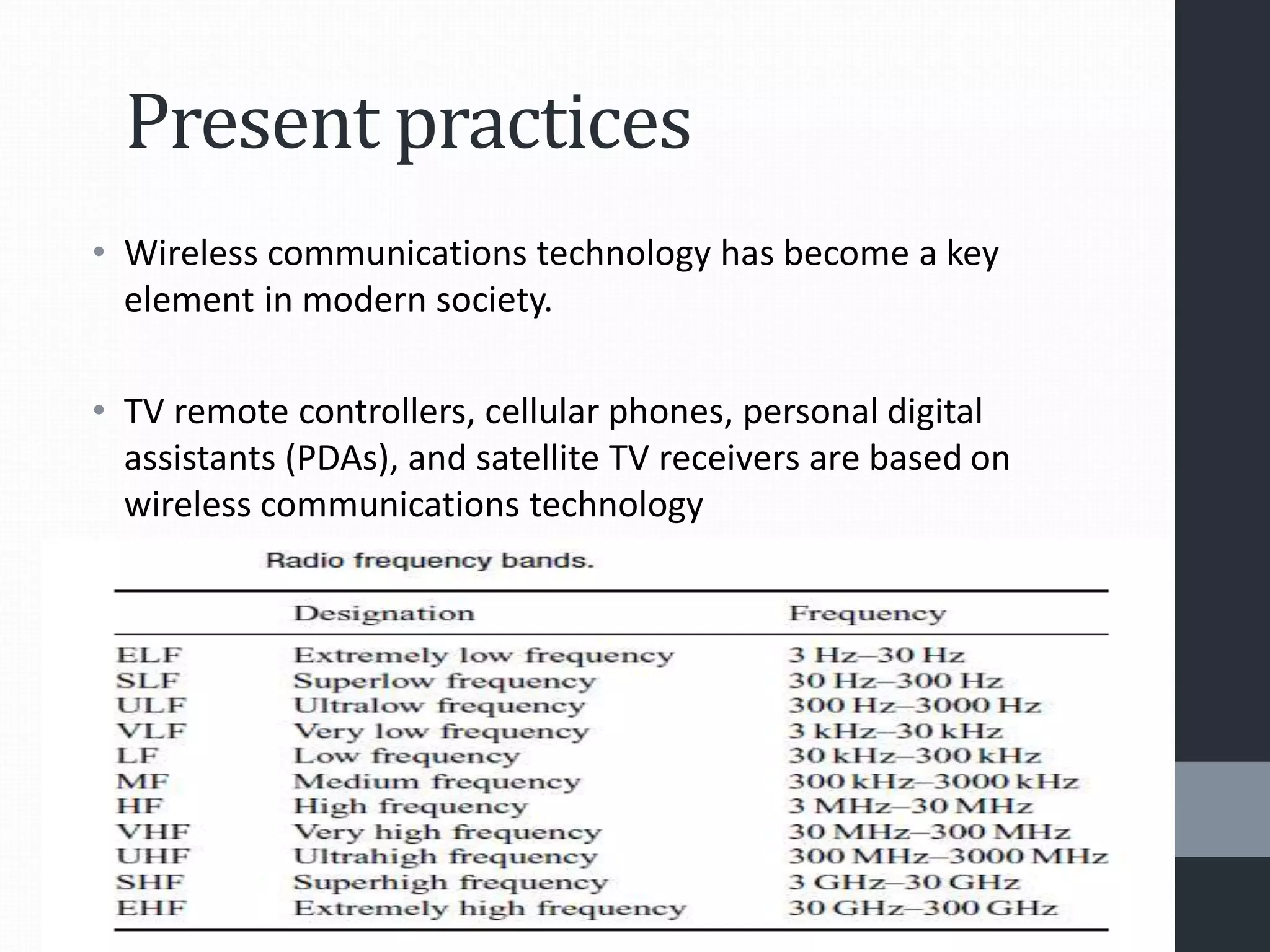
Present practices
• Wireless communications technology has become a key
element in modern society.
• TV remote controllers, cellular phones, personal digital
assistants (PDAs), and satellite TV receivers are based on
wireless communications technology
Present practices
• Wireless communications systems can be broadly categorized as
• follows:
• • high-power wide area systems (or cellular systems), which support
mobile users roaming over a wide geographic area;
• • low-power local area systems, for example cordless telephone
systems, which are implemented with relatively simpler technology;
• • low-speed wide area systems, which are designed for mobile data
services with relatively low data rates (e.g. paging systems);
• • high-speed local area systems, which are designed for high speed and
local communications (e.g. wireless LANs).
• The first two categories are voice-oriented systems while the remaining
two are data-oriented systems.
Next generation’s Wireless
network
• High transmission rate: New wireless applications and services, e.g.
video and file transfer, require higher data rate to reduce the data
transmission time and support a number of users.
• QoS support: Various types of traffic, e.g. voice, video, and data, will
be supported by the next generation wireless system.
• Integration of different wireless access technologies: Next generation
wireless networks will use the IP technology to glue the different
wireless access technologies to a converged wireless system.
• It enables seamless mobility through providing wireless connectivity
anytime and anywhere.
Limitations of conventional
technology
• Fixed type of spectrum usage:
• Licensed for a large region: When a spectrum is licensed, it is
usually allocated to a particular user or wireless service
provider in a large region (e.g. an entire city or state).
• Large chunk of licensed spectrum: A wireless service provider
is generally licensed with a large chunk of radio spectrum to
obtain license for a small spectrum band to use in a certain
area for a short period of time to meet a temporary peak
traffic load.
• Prohibit spectrum access by unlicensed users:
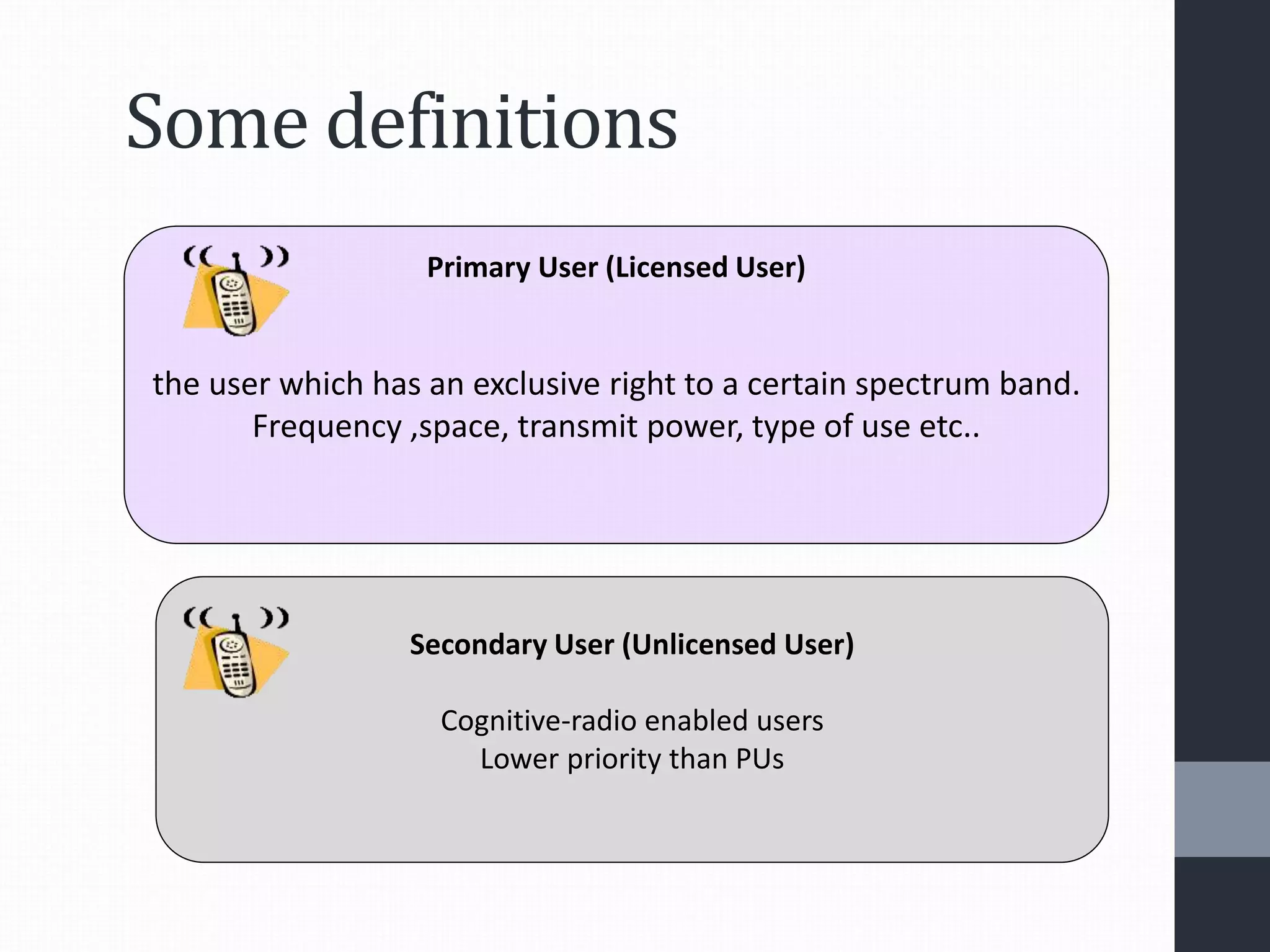
Some definitions
Primary User (Licensed User)
the user which has an exclusive right to a certain spectrum band.
Frequency ,space, transmit power, type of use etc..
Secondary User (Unlicensed User)
Cognitive-radio enabled users
Lower priority than PUs
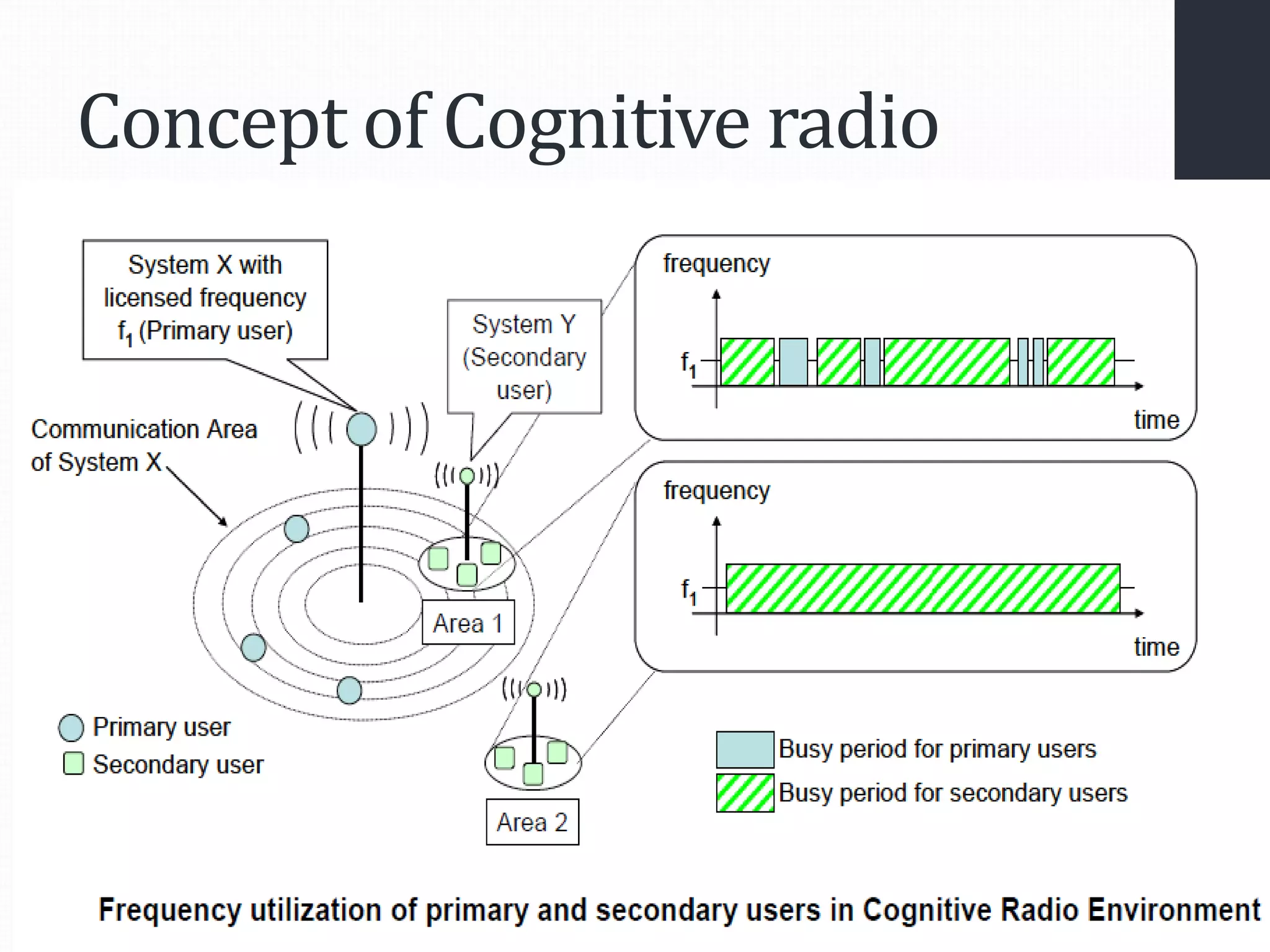
Concept of Cognitive radio
• An intelligent radio that can be programmed and configured
dynamically.
• Automatically detects available channels in wireless spectrum.
• Accordingly changes its transmission or reception parameters.
• The two main objectives of cognitive radio are:
• (1) to achieve highly reliable and highly efficient wireless
communications,
• (2) to improve the utilization of the frequency spectrum.
Concept of Cognitive radio
Why cognitive radio
• The motivation behind cognitive radio is-
• scarcity of the available frequency spectrum, increasing
demand,
• Most of the available radio spectrum has already been
allocated to existing wireless systems,
• Note that, in the conventional system without CR, the
frequency band cannot be utilized by any user at any location.
• Thus, CR allows users to utilize a frequency band more densely
in time and space,
• Thereby leading to a drastic increase of the total spectrum
efficiency.
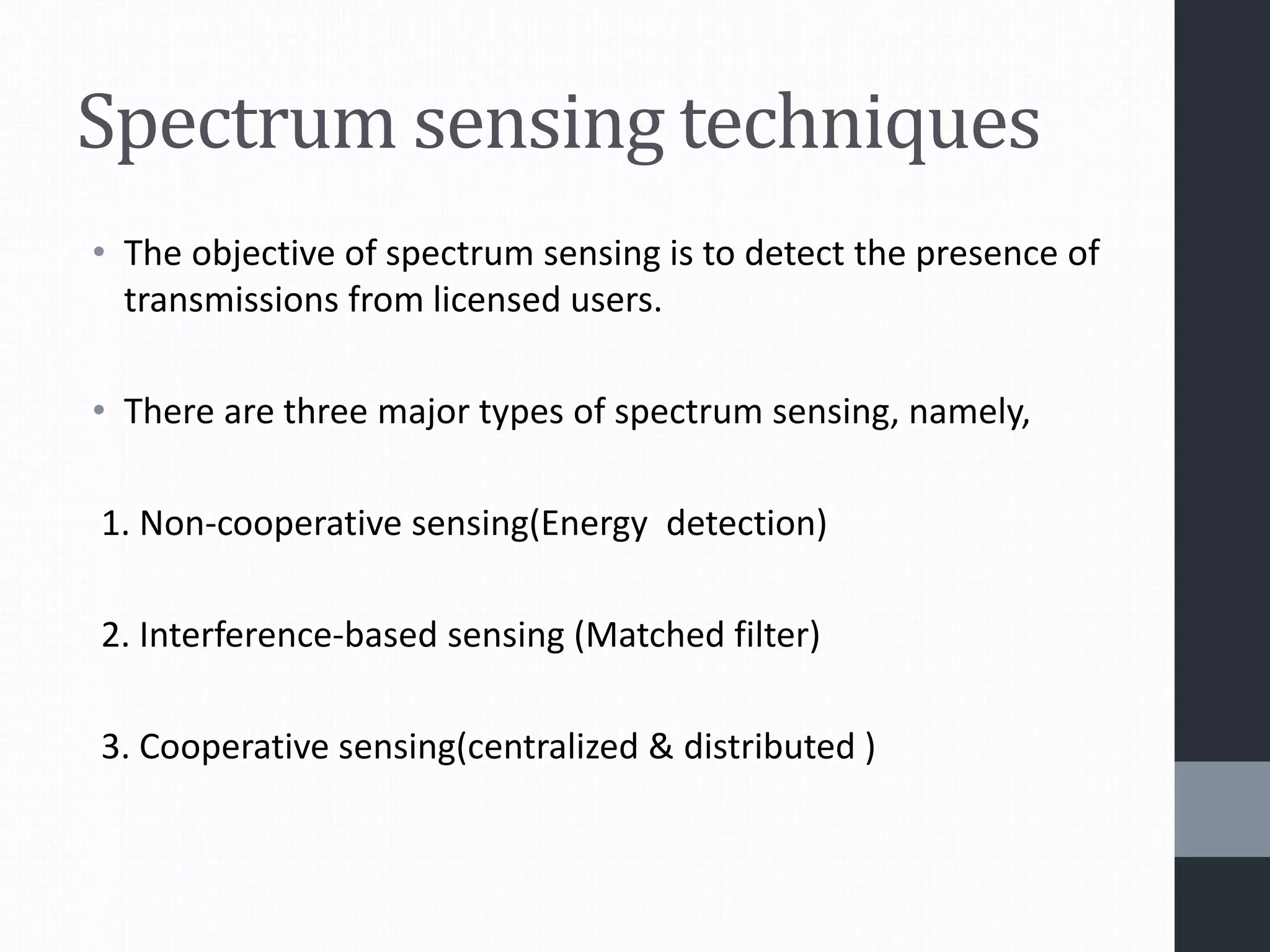
Spectrum sensing techniques
• The objective of spectrum sensing is to detect the presence of
transmissions from licensed users.
• There are three major types of spectrum sensing, namely,
1. Non-cooperative sensing(Energy detection)
2. Interference-based sensing (Matched filter)
3. Cooperative sensing(centralized & distributed )
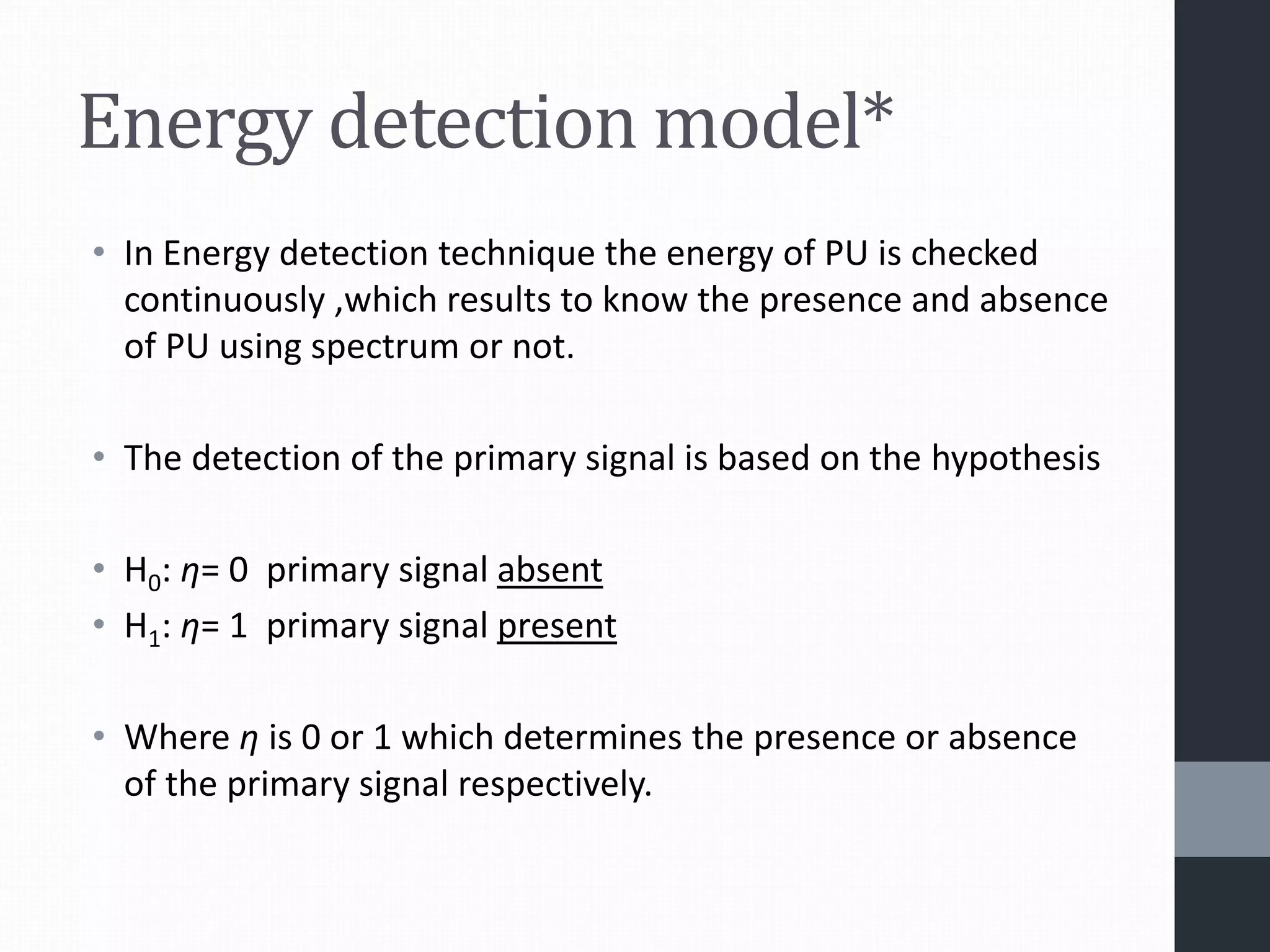
Energy detection model*
• In Energy detection technique the energy of PU is checked
continuously ,which results to know the presence and absence
of PU using spectrum or not.
• The detection of the primary signal is based on the hypothesis
• H0: η= 0 primary signal absent
• H1: η= 1 primary signal present
• Where η is 0 or 1 which determines the presence or absence
of the primary signal respectively.
Matched filter sensing
• If SU know information about a PU’s signal a priori, then the
optimal detection method is the matched filtering.
• Matched Filter detection technique is used for detection of
the primary user.
• Here the received signal is correlated with the already known
signal in order to identify the primary user.
• Hence a perfect knowledge of the signal like
1.operating frequency,
2. modulation technique required to apply this technique.
Cooperative sensing technique
• Used to reduce the probability of false alarm and improve
spectrum sensing.
• Hence to improve spectrum sensing the concept of
cooperative sensing has come up.
• In centralized cooperative sensing a central controller collects
information from the users and decides which band is vacant.
• whereas in distributed cooperative sensing the SU distribute
information among themselves to decide the status of the
band, hence a central controller is not required.
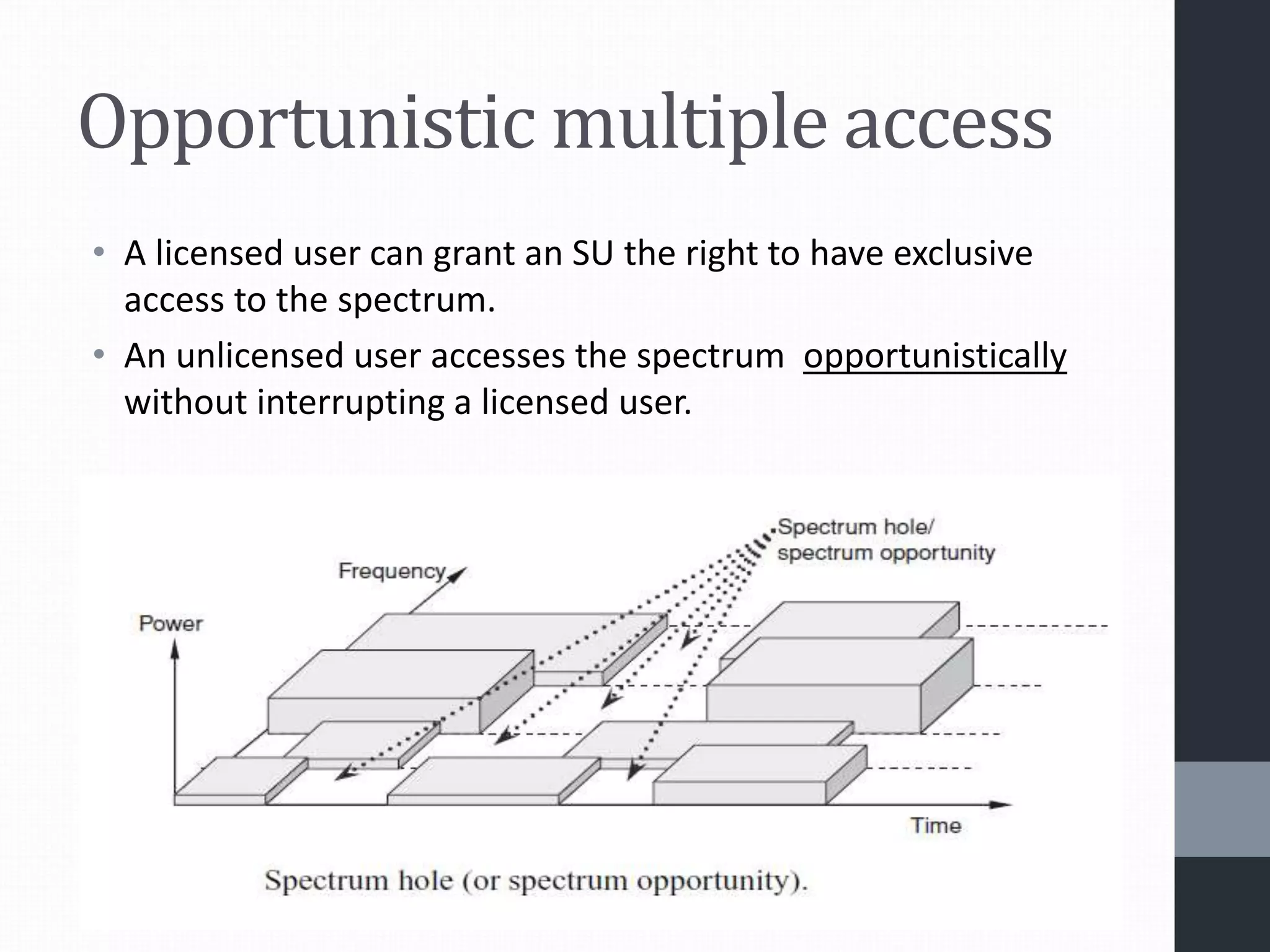
Opportunistic multiple access
• A licensed user can grant an SU the right to have exclusive
access to the spectrum.
• An unlicensed user accesses the spectrum opportunistically
without interrupting a licensed user.
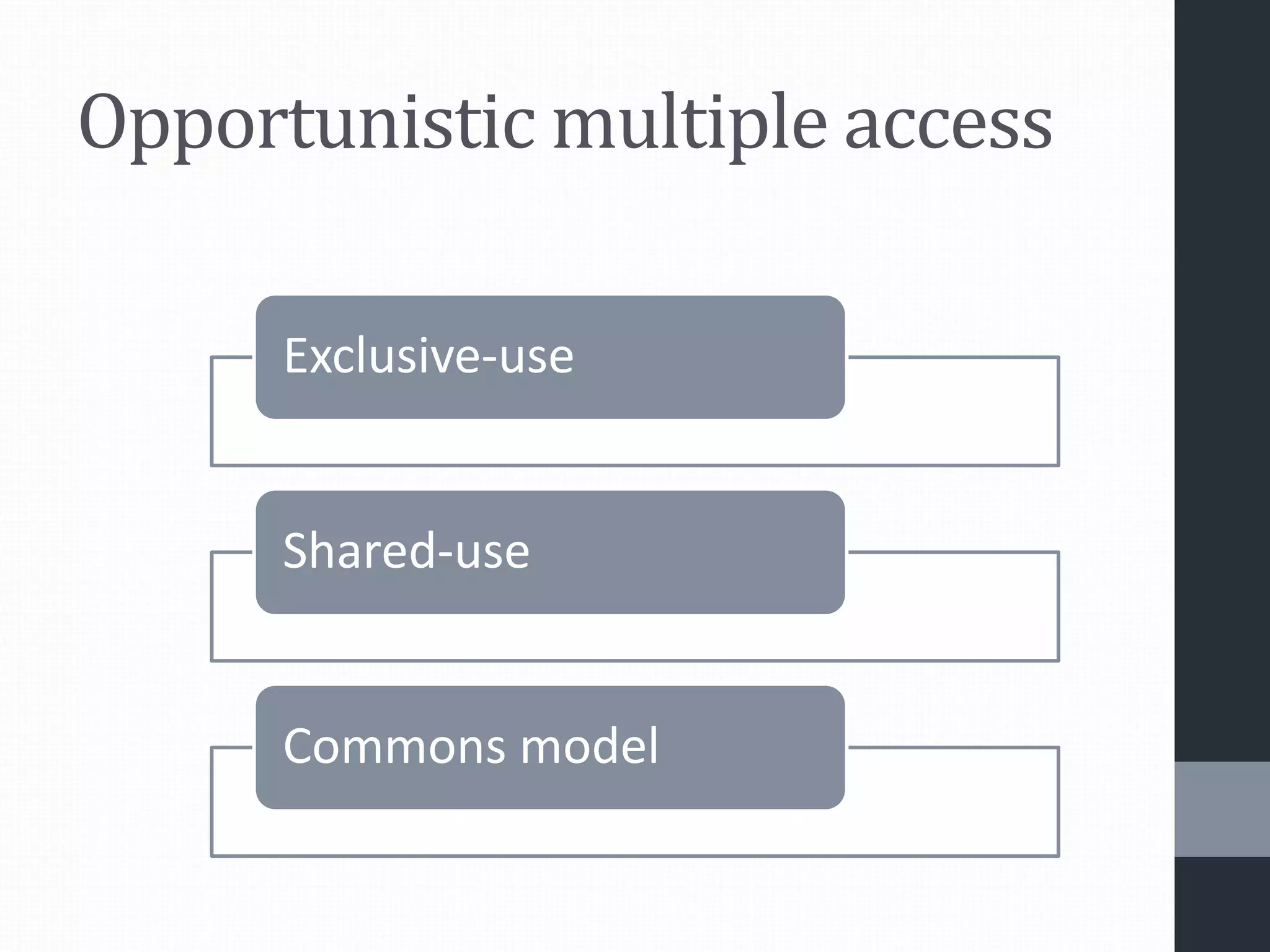
Opportunistic multiple access
Exclusive-use
Shared-use
Commons model
Opportunistic multiple access
• In the exclusive-use model, a licensed user can grant an
unlicensed user the right to have exclusive access to the
spectrum.
• In a shared-use model, an unlicensed user accesses the
spectrum opportunistically without interrupting a licensed
user. ***
• In a commons model, an unlicensed user can access the
spectrum freely.
Shared-use spectrum access
model
• In the shared-use spectrum access model, the radio spectrum
can be simultaneously shared between a primary user (i.e. a
licensed user) and a secondary user (i.e. an unlicensed user).
• In this model, unlicensed users can opportunistically access
the radio spectrum
• If an unlicensed user does not interrupt a primary user (e.g.
the collision probability is maintained below the target level),
• spectrum access by an unlicensed user is allowed and it
remains transparent to a primary user.
References
1. J. N. Laneman, D. N. C. Tse, , and G. W. Wornell, “Cooperative Diversity in Wireless
Networks: Efficient Protocols and Outage Behavior,” IEEE Trans. Inf. Theory, vol. 50,
pp. 3062–3080, Dec. 2004.
2. A. K. Sadek, W. Su, and K. J. R. Liu, “Multinode Cooperative Communications in
Wireless Networks,” IEEE Trans. Signal Proc., vol. 55, no. 1, pp. 341–355, Jan. 2007.
3. A. K. Sadek, K. J. R. Liu, and A. Epheremides, “Cognitive Multiple Access via
Cooperation: Protocol Design and Performance Analysis,” IEEE Trans. Inf. Theory, vol.
53, no. 10, pp. 3677–3696, Oct. 2007.
4. “Federal communications commission: spectrum policy task force report,” Federal
Communications
5. N. Benvenuto, S. Pupolin, and G. Guidotti, “Performance Evaluation of Multiple
Access Spread Spectrum Systems in the Presence of Interference,” IEEE Trans. Veh.
Technol., vol. 37, no. 2, pp. 73–77, 1988.
6. www.encyclopedia.org/cognitiveradio
Thank you!


OPPORTUNISTIC MULTIPLE ACCESS TECHNIQUES FOR COGNITIVE RADIO NETWORK

  • 1.
    Opportunistic Multiple Access forCognitive Radio Networks Presented by Praktan B Patil Guide Prof. Anant R More RMD Sinhgad School of Engineering, Warje
  • 2.
    Outline • Present practices •Concept of Cognitive radio • Techniques for spectrum sensing • Spectrum sensing techniques • Opportunistic multiple access • Advantages • References
  • 3.
    Present practices • Wirelesscommunications technology has become a key element in modern society. • TV remote controllers, cellular phones, personal digital assistants (PDAs), and satellite TV receivers are based on wireless communications technology
  • 4.
    Present practices • Wirelesscommunications systems can be broadly categorized as • follows: • • high-power wide area systems (or cellular systems), which support mobile users roaming over a wide geographic area; • • low-power local area systems, for example cordless telephone systems, which are implemented with relatively simpler technology; • • low-speed wide area systems, which are designed for mobile data services with relatively low data rates (e.g. paging systems); • • high-speed local area systems, which are designed for high speed and local communications (e.g. wireless LANs). • The first two categories are voice-oriented systems while the remaining two are data-oriented systems.
  • 5.
    Next generation’s Wireless network •High transmission rate: New wireless applications and services, e.g. video and file transfer, require higher data rate to reduce the data transmission time and support a number of users. • QoS support: Various types of traffic, e.g. voice, video, and data, will be supported by the next generation wireless system. • Integration of different wireless access technologies: Next generation wireless networks will use the IP technology to glue the different wireless access technologies to a converged wireless system. • It enables seamless mobility through providing wireless connectivity anytime and anywhere.
  • 6.
    Limitations of conventional technology •Fixed type of spectrum usage: • Licensed for a large region: When a spectrum is licensed, it is usually allocated to a particular user or wireless service provider in a large region (e.g. an entire city or state). • Large chunk of licensed spectrum: A wireless service provider is generally licensed with a large chunk of radio spectrum to obtain license for a small spectrum band to use in a certain area for a short period of time to meet a temporary peak traffic load. • Prohibit spectrum access by unlicensed users:
  • 7.
    Some definitions Primary User(Licensed User) the user which has an exclusive right to a certain spectrum band. Frequency ,space, transmit power, type of use etc.. Secondary User (Unlicensed User) Cognitive-radio enabled users Lower priority than PUs
  • 8.
    Concept of Cognitiveradio • An intelligent radio that can be programmed and configured dynamically. • Automatically detects available channels in wireless spectrum. • Accordingly changes its transmission or reception parameters. • The two main objectives of cognitive radio are: • (1) to achieve highly reliable and highly efficient wireless communications, • (2) to improve the utilization of the frequency spectrum.
  • 9.
  • 10.
    Why cognitive radio •The motivation behind cognitive radio is- • scarcity of the available frequency spectrum, increasing demand, • Most of the available radio spectrum has already been allocated to existing wireless systems, • Note that, in the conventional system without CR, the frequency band cannot be utilized by any user at any location. • Thus, CR allows users to utilize a frequency band more densely in time and space, • Thereby leading to a drastic increase of the total spectrum efficiency.
  • 11.
    Spectrum sensing techniques •The objective of spectrum sensing is to detect the presence of transmissions from licensed users. • There are three major types of spectrum sensing, namely, 1. Non-cooperative sensing(Energy detection) 2. Interference-based sensing (Matched filter) 3. Cooperative sensing(centralized & distributed )
  • 12.
    Energy detection model* •In Energy detection technique the energy of PU is checked continuously ,which results to know the presence and absence of PU using spectrum or not. • The detection of the primary signal is based on the hypothesis • H0: η= 0 primary signal absent • H1: η= 1 primary signal present • Where η is 0 or 1 which determines the presence or absence of the primary signal respectively.
  • 13.
    Matched filter sensing •If SU know information about a PU’s signal a priori, then the optimal detection method is the matched filtering. • Matched Filter detection technique is used for detection of the primary user. • Here the received signal is correlated with the already known signal in order to identify the primary user. • Hence a perfect knowledge of the signal like 1.operating frequency, 2. modulation technique required to apply this technique.
  • 14.
    Cooperative sensing technique •Used to reduce the probability of false alarm and improve spectrum sensing. • Hence to improve spectrum sensing the concept of cooperative sensing has come up. • In centralized cooperative sensing a central controller collects information from the users and decides which band is vacant. • whereas in distributed cooperative sensing the SU distribute information among themselves to decide the status of the band, hence a central controller is not required.
  • 15.
    Opportunistic multiple access •A licensed user can grant an SU the right to have exclusive access to the spectrum. • An unlicensed user accesses the spectrum opportunistically without interrupting a licensed user.
  • 16.
  • 17.
    Opportunistic multiple access •In the exclusive-use model, a licensed user can grant an unlicensed user the right to have exclusive access to the spectrum. • In a shared-use model, an unlicensed user accesses the spectrum opportunistically without interrupting a licensed user. *** • In a commons model, an unlicensed user can access the spectrum freely.
  • 18.
    Shared-use spectrum access model •In the shared-use spectrum access model, the radio spectrum can be simultaneously shared between a primary user (i.e. a licensed user) and a secondary user (i.e. an unlicensed user). • In this model, unlicensed users can opportunistically access the radio spectrum • If an unlicensed user does not interrupt a primary user (e.g. the collision probability is maintained below the target level), • spectrum access by an unlicensed user is allowed and it remains transparent to a primary user.
  • 19.
    References 1. J. N.Laneman, D. N. C. Tse, , and G. W. Wornell, “Cooperative Diversity in Wireless Networks: Efficient Protocols and Outage Behavior,” IEEE Trans. Inf. Theory, vol. 50, pp. 3062–3080, Dec. 2004. 2. A. K. Sadek, W. Su, and K. J. R. Liu, “Multinode Cooperative Communications in Wireless Networks,” IEEE Trans. Signal Proc., vol. 55, no. 1, pp. 341–355, Jan. 2007. 3. A. K. Sadek, K. J. R. Liu, and A. Epheremides, “Cognitive Multiple Access via Cooperation: Protocol Design and Performance Analysis,” IEEE Trans. Inf. Theory, vol. 53, no. 10, pp. 3677–3696, Oct. 2007. 4. “Federal communications commission: spectrum policy task force report,” Federal Communications 5. N. Benvenuto, S. Pupolin, and G. Guidotti, “Performance Evaluation of Multiple Access Spread Spectrum Systems in the Presence of Interference,” IEEE Trans. Veh. Technol., vol. 37, no. 2, pp. 73–77, 1988. 6. www.encyclopedia.org/cognitiveradio
  • 20.

Editor's Notes