
Subject: concrete technology
Specific gravity and absorption of
fine aggregate
Experiment No: 5
Name:
Rezhwan Hama Karim
Group: B
Year of Study:
2019-2020
Date:
16/12/2019
University Of Halabja
Civil Engineering Department.2nd stage
Concrete lap
2
Contents:
Introduction………………………………………………………………….……..3
References …………………………………………………….……….…………..3
Purpose Of This Experiment …………………………….………………….3
Materials And Equipment………………………………..…………….……3
Procedure …………………………………………………………………..………6
Data analysis..…………………………………………….………………………7
Discussion………………………………………………..……….……………...9
Conclusion …………………………………………….……….………………..9
3
Introduction
Specific gravity of fine aggregate (sand) is the ratio of the weight of given volume
of aggregates to the weight of equal volume of water. But absorbed water is the water that
lies close to solid surfaces under the influence of attractive forces
References
1. ASTM C127-07, ASTM C128-07a
2. ASTM D75-92
3. BS EN 1097-3:1998
Purpose of this experiment
To determine the bulk and apparent specific gravities of fine aggregates so they can be used
for calculation of volume occupied by the aggregate in various mixtures containing
aggregate, absorption, computation of voids in aggregate.
Materials and equipment
A-Materials:-
1-fine aggregate (all particles passing No.4 (4.775mm)sieve)
4
B-Equipment:-
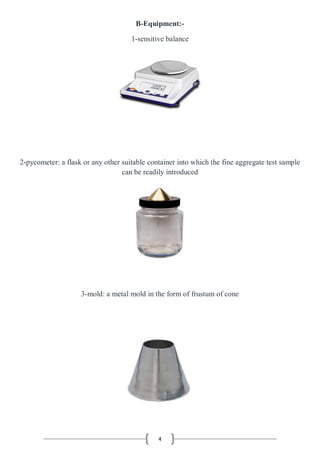
1-sensitive balance
2-pycometer: a flask or any other suitable container into which the fine aggregate test sample
can be readily introduced
3-mold: a metal mold in the form of frustum of cone
5
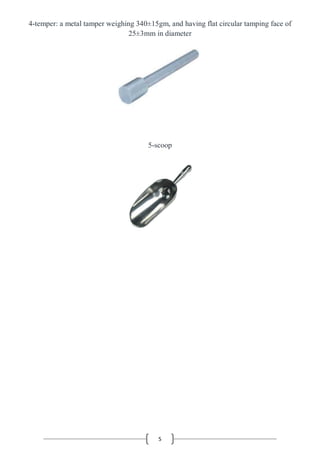
4-temper: a metal tamper weighing 340±15gm, and having flat circular tamping face of
25±3mm in diameter
5-scoop
6
Procedure
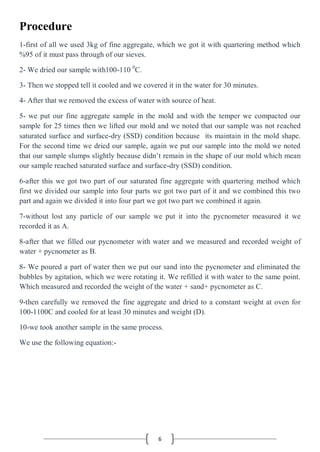
1-first of all we used 3kg of fine aggregate, which we got it with quartering method which
%95 of it must pass through of our sieves.
2- We dried our sample with100-110 0
C.
3- Then we stopped tell it cooled and we covered it in the water for 30 minutes.
4- After that we removed the excess of water with source of heat.
5- we put our fine aggregate sample in the mold and with the temper we compacted our
sample for 25 times then we lifted our mold and we noted that our sample was not reached
saturated surface and surface-dry (SSD) condition because its maintain in the mold shape.
For the second time we dried our sample, again we put our sample into the mold we noted
that our sample slumps slightly because didn’t remain in the shape of our mold which mean
our sample reached saturated surface and surface-dry (SSD) condition.
6-after this we got two part of our saturated fine aggregate with quartering method which
first we divided our sample into four parts we got two part of it and we combined this two
part and again we divided it into four part we got two part we combined it again.
7-without lost any particle of our sample we put it into the pycnometer measured it we
recorded it as A.
8-after that we filled our pycnometer with water and we measured and recorded weight of
water + pycnometer as B.
8- We poured a part of water then we put our sand into the pycnometer and eliminated the
bubbles by agitation, which we were rotating it. We refilled it with water to the same point.
Which measured and recorded the weight of the water + sand+ pycnometer as C.
9-then carefully we removed the fine aggregate and dried to a constant weight at oven for
100-1100C and cooled for at least 30 minutes and weight (D).
10-we took another sample in the same process.
We use the following equation:-
7
Data analysis:-
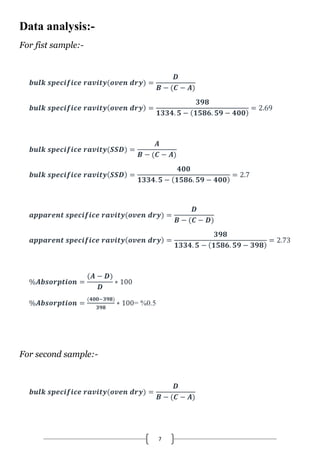
For fist sample:-
= %0.5
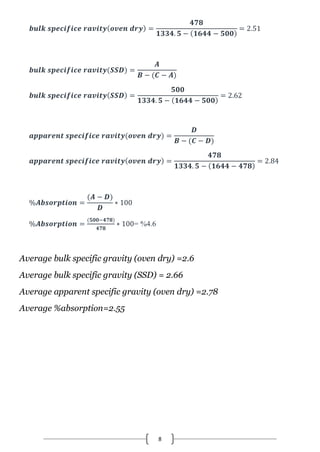
For second sample:-
8
= %4.6
Average bulk specific gravity (oven dry) =2.6
Average bulk specific gravity (SSD) = 2.66
Average apparent specific gravity (oven dry) =2.78
Average %absorption=2.55
9
Discussion
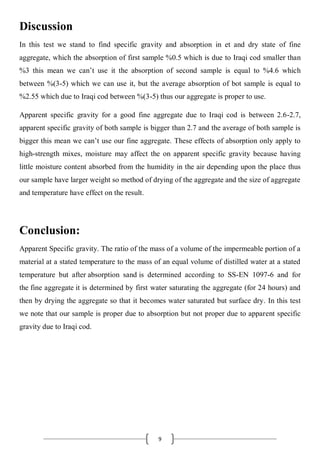
In this test we stand to find specific gravity and absorption in et and dry state of fine
aggregate, which the absorption of first sample %0.5 which is due to Iraqi cod smaller than
%3 this mean we can’t use it the absorption of second sample is equal to %4.6 which
between %(3-5) which we can use it, but the average absorption of bot sample is equal to
%2.55 which due to Iraqi cod between %(3-5) thus our aggregate is proper to use.
Apparent specific gravity for a good fine aggregate due to Iraqi cod is between 2.6-2.7,
apparent specific gravity of both sample is bigger than 2.7 and the average of both sample is
bigger this mean we can’t use our fine aggregate. These effects of absorption only apply to
high-strength mixes, moisture may affect the on apparent specific gravity because having
little moisture content absorbed from the humidity in the air depending upon the place thus
our sample have larger weight so method of drying of the aggregate and the size of aggregate
and temperature have effect on the result.
Conclusion:
Apparent Specific gravity. The ratio of the mass of a volume of the impermeable portion of a
material at a stated temperature to the mass of an equal volume of distilled water at a stated
temperature but after absorption sand is determined according to SS-EN 1097-6 and for
the fine aggregate it is determined by first water saturating the aggregate (for 24 hours) and
then by drying the aggregate so that it becomes water saturated but surface dry. In this test
we note that our sample is proper due to absorption but not proper due to apparent specific
gravity due to Iraqi cod.
10
.

Specific gravity and absorption of fine aggregate

  • 1.
    Subject: concrete technology Specificgravity and absorption of fine aggregate Experiment No: 5 Name: Rezhwan Hama Karim Group: B Year of Study: 2019-2020 Date: 16/12/2019 University Of Halabja Civil Engineering Department.2nd stage Concrete lap
  • 2.
    2 Contents: Introduction………………………………………………………………….……..3 References …………………………………………………….……….…………..3 Purpose OfThis Experiment …………………………….………………….3 Materials And Equipment………………………………..…………….……3 Procedure …………………………………………………………………..………6 Data analysis..…………………………………………….………………………7 Discussion………………………………………………..……….……………...9 Conclusion …………………………………………….……….………………..9
  • 3.
    3 Introduction Specific gravity offine aggregate (sand) is the ratio of the weight of given volume of aggregates to the weight of equal volume of water. But absorbed water is the water that lies close to solid surfaces under the influence of attractive forces References 1. ASTM C127-07, ASTM C128-07a 2. ASTM D75-92 3. BS EN 1097-3:1998 Purpose of this experiment To determine the bulk and apparent specific gravities of fine aggregates so they can be used for calculation of volume occupied by the aggregate in various mixtures containing aggregate, absorption, computation of voids in aggregate. Materials and equipment A-Materials:- 1-fine aggregate (all particles passing No.4 (4.775mm)sieve)
  • 4.
    4 B-Equipment:- 1-sensitive balance 2-pycometer: aflask or any other suitable container into which the fine aggregate test sample can be readily introduced 3-mold: a metal mold in the form of frustum of cone
  • 5.
    5 4-temper: a metaltamper weighing 340±15gm, and having flat circular tamping face of 25±3mm in diameter 5-scoop
  • 6.
    6 Procedure 1-first of allwe used 3kg of fine aggregate, which we got it with quartering method which %95 of it must pass through of our sieves. 2- We dried our sample with100-110 0 C. 3- Then we stopped tell it cooled and we covered it in the water for 30 minutes. 4- After that we removed the excess of water with source of heat. 5- we put our fine aggregate sample in the mold and with the temper we compacted our sample for 25 times then we lifted our mold and we noted that our sample was not reached saturated surface and surface-dry (SSD) condition because its maintain in the mold shape. For the second time we dried our sample, again we put our sample into the mold we noted that our sample slumps slightly because didn’t remain in the shape of our mold which mean our sample reached saturated surface and surface-dry (SSD) condition. 6-after this we got two part of our saturated fine aggregate with quartering method which first we divided our sample into four parts we got two part of it and we combined this two part and again we divided it into four part we got two part we combined it again. 7-without lost any particle of our sample we put it into the pycnometer measured it we recorded it as A. 8-after that we filled our pycnometer with water and we measured and recorded weight of water + pycnometer as B. 8- We poured a part of water then we put our sand into the pycnometer and eliminated the bubbles by agitation, which we were rotating it. We refilled it with water to the same point. Which measured and recorded the weight of the water + sand+ pycnometer as C. 9-then carefully we removed the fine aggregate and dried to a constant weight at oven for 100-1100C and cooled for at least 30 minutes and weight (D). 10-we took another sample in the same process. We use the following equation:-
  • 7.
    7 Data analysis:- For fistsample:- = %0.5 For second sample:-
  • 8.
    8 = %4.6 Average bulkspecific gravity (oven dry) =2.6 Average bulk specific gravity (SSD) = 2.66 Average apparent specific gravity (oven dry) =2.78 Average %absorption=2.55
  • 9.
    9 Discussion In this testwe stand to find specific gravity and absorption in et and dry state of fine aggregate, which the absorption of first sample %0.5 which is due to Iraqi cod smaller than %3 this mean we can’t use it the absorption of second sample is equal to %4.6 which between %(3-5) which we can use it, but the average absorption of bot sample is equal to %2.55 which due to Iraqi cod between %(3-5) thus our aggregate is proper to use. Apparent specific gravity for a good fine aggregate due to Iraqi cod is between 2.6-2.7, apparent specific gravity of both sample is bigger than 2.7 and the average of both sample is bigger this mean we can’t use our fine aggregate. These effects of absorption only apply to high-strength mixes, moisture may affect the on apparent specific gravity because having little moisture content absorbed from the humidity in the air depending upon the place thus our sample have larger weight so method of drying of the aggregate and the size of aggregate and temperature have effect on the result. Conclusion: Apparent Specific gravity. The ratio of the mass of a volume of the impermeable portion of a material at a stated temperature to the mass of an equal volume of distilled water at a stated temperature but after absorption sand is determined according to SS-EN 1097-6 and for the fine aggregate it is determined by first water saturating the aggregate (for 24 hours) and then by drying the aggregate so that it becomes water saturated but surface dry. In this test we note that our sample is proper due to absorption but not proper due to apparent specific gravity due to Iraqi cod.
  • 10.