Charleston Conference – Shotgun Session
November 4, 2016
Anna Perricci
EAST Project Manager
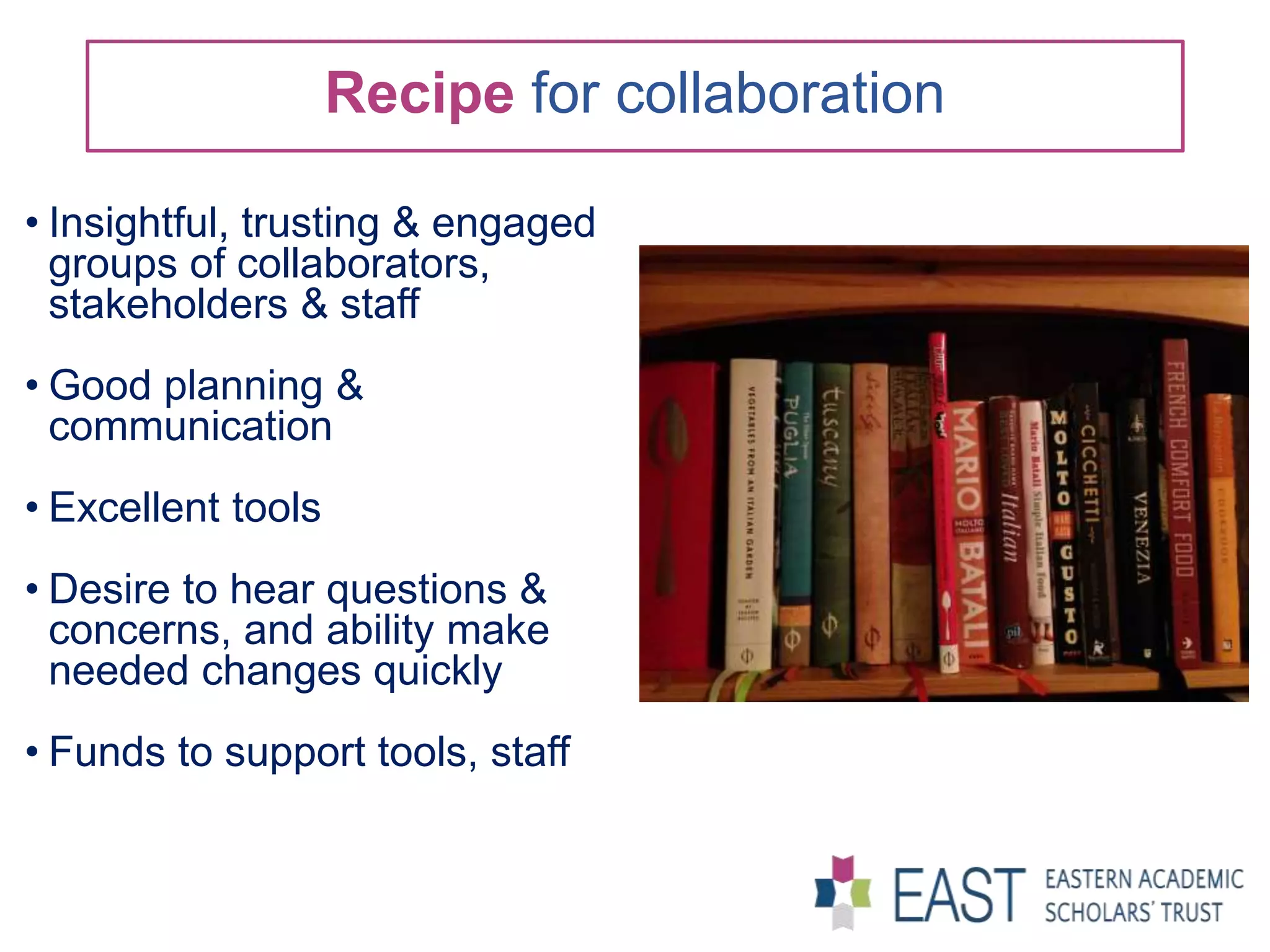
Recipe for collaboration
• Insightful, trusting & engaged
groups of collaborators,
stakeholders & staff
• Good planning &
communication
• Excellent tools
• Desire to hear questions &
concerns, and ability make
needed changes quickly
• Funds to support tools, staff
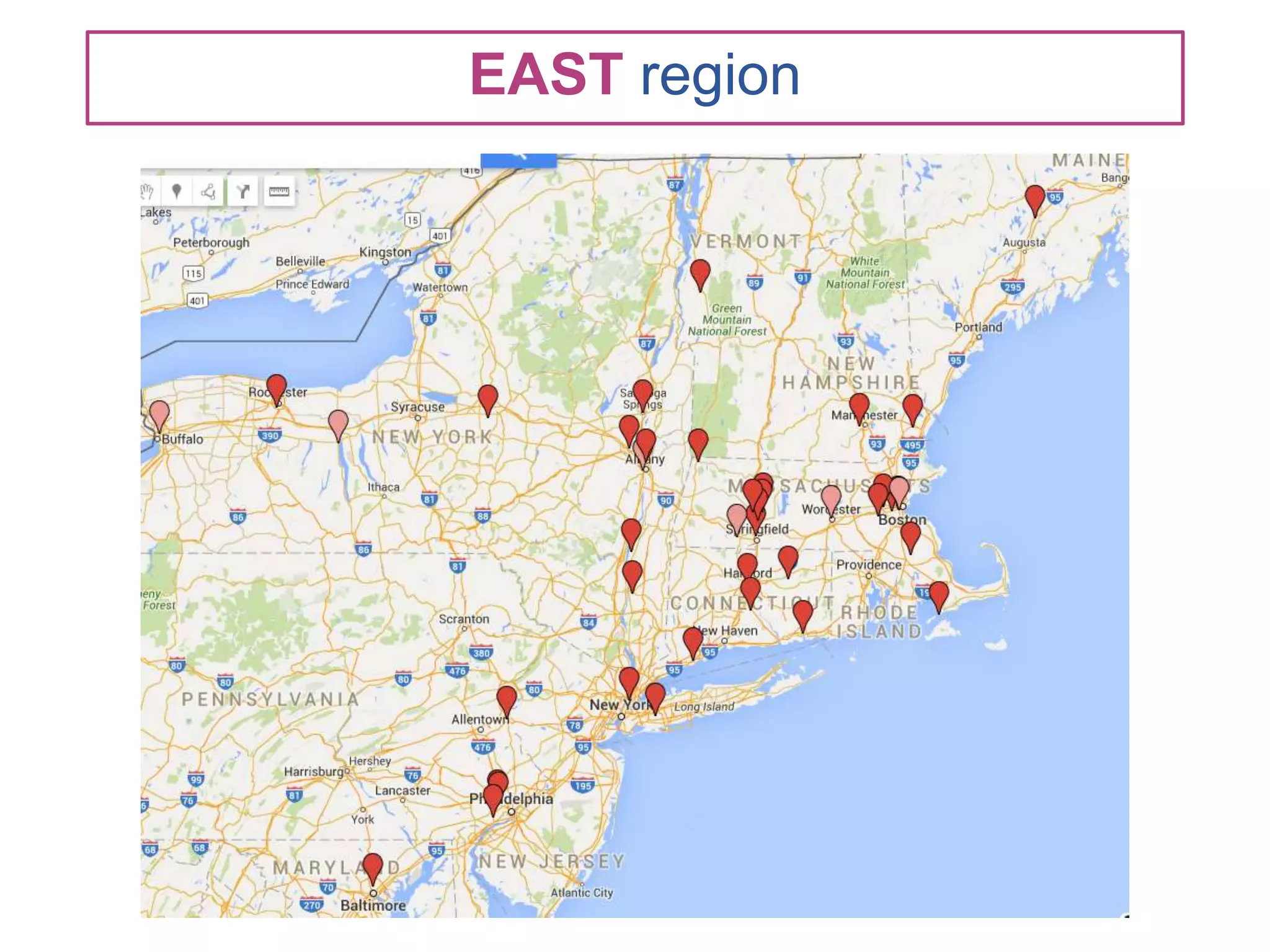
EAST region
EAST milestones
• 40 Retention Partner libraries will retain over 6 million
monographic holdings for 15 years (4.3 million titles)
• Completed a Validation Sample Study & further
analysis of results
• Major Operating Policies, governance documents,
Memorandum of Understanding to be signed by partner
libraries
Collection analysis
• Records for 16.5 million in scope monographs
submitted & ingested into GreenGlass (fall 2015)
• Data summaries approved by libraries (Jan-Feb, 2016)
• GreenGlass for EAST launched (March 2016)
• Retention modeling (March-May, 2016)
• Retention model approved (June 2016)
• Allocations for retention generated & reviewed by
libraries (June-July, 2016)
In GreenGlass we found
Title holdings
16,573,071
Title sets
4,749,042
Title sets held by one library in the group
50% (2,359,033 title sets)
Title sets with > 10 aggregate uses
20% (939,819 title sets)
Title sets represented in HathiTrust
39% (1,865,115 title sets)
Collection Analysis group
• Helen Anderson, University of
Rochester
• Richard Bleiler, University of
Connecticut
• Karen Bohrer, Worcester Polytechnic
Institute
• Berry Chamness, Bryn Mawr College
• Charles Getchell, Saint Anselm College
• Lorraine Huddy, CTW Consortium
• Susan Raidy-Klein, UMass Dartmouth
• Ray Schmidt, Wellesley College
• Debbi Smith, Adelphi University
Ruth Fisher
Sustainable
Collection Services
(OCLC)
EAST Project
Team
• Matthew Revitt
• Sara Amato
• Lizanne Payne
• Anna Perricci
• Lizanne Payne
• Susan Stearns
Keys to Success in a short timeframe
• 2 month window to agree the retention model across
EAST kept all on task
• Seeing immediate results in GreenGlass modeling
allowed for quick decision-making
• Collection analysis subgroup was focused & effective
• Seeking EAST member opinions about retention rules
created buy-in
• Getting that buy-in led to smoother approval by the
Executive Committee
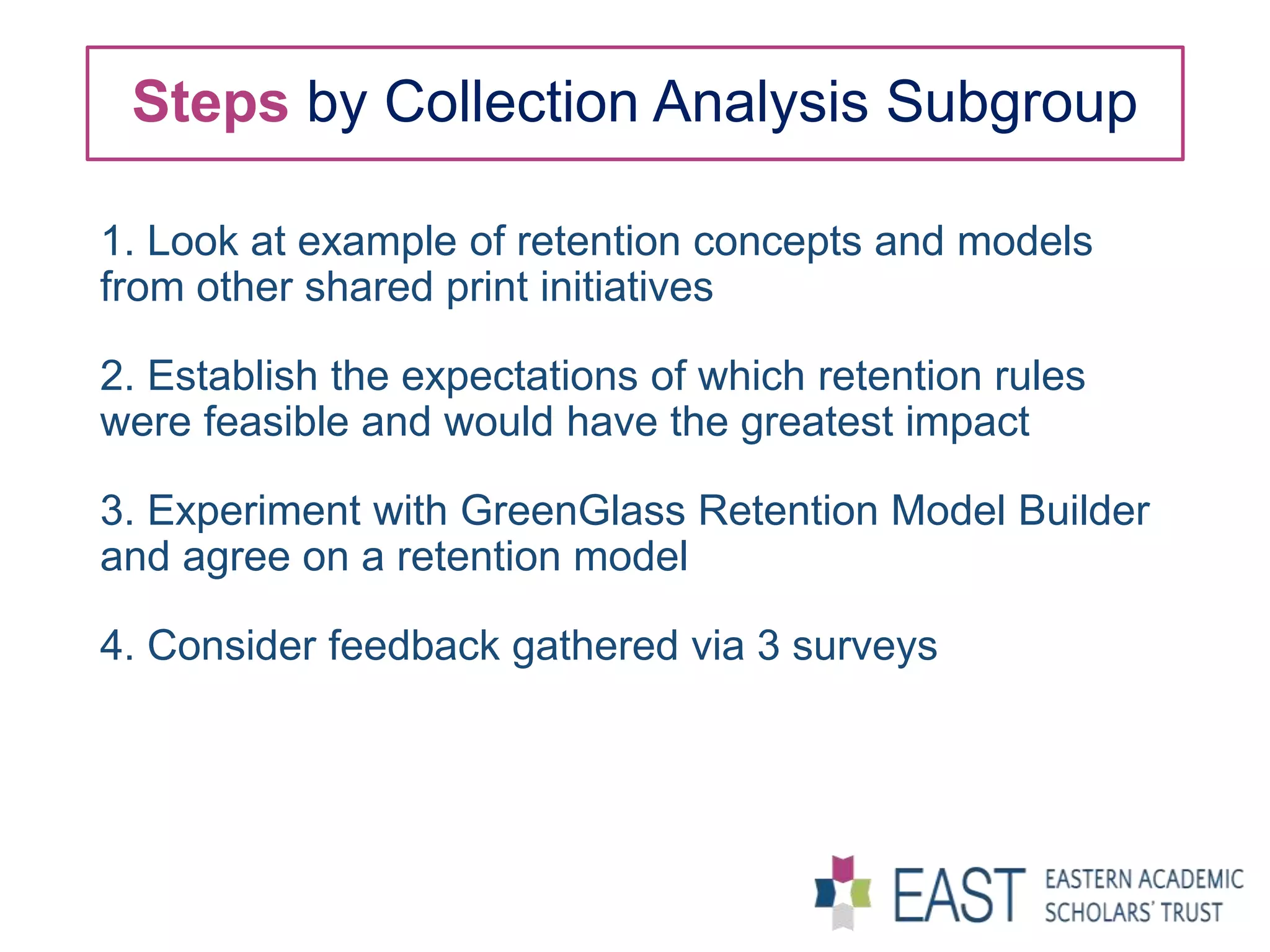
Steps by Collection Analysis Subgroup
1. Look at example of retention concepts and models
from other shared print initiatives
2. Establish the expectations of which retention rules
were feasible and would have the greatest impact
3. Experiment with GreenGlass Retention Model Builder
and agree on a retention model
4. Consider feedback gathered via 3 surveys
Together we used GreenGlass
• Ruth Fischer provided training and excellent
instructional videos explaining each retention model
• Many collection analysis group members attended
weekly office hours to discuss modeling
• Google Site for documentation and to support
GreenGlass users:
https://sites.google.com/a/blc.org/east-collection-
analysis/
• As of 11/1/16, EAST has 265 registered GreenGlass
user accounts
Retention rules
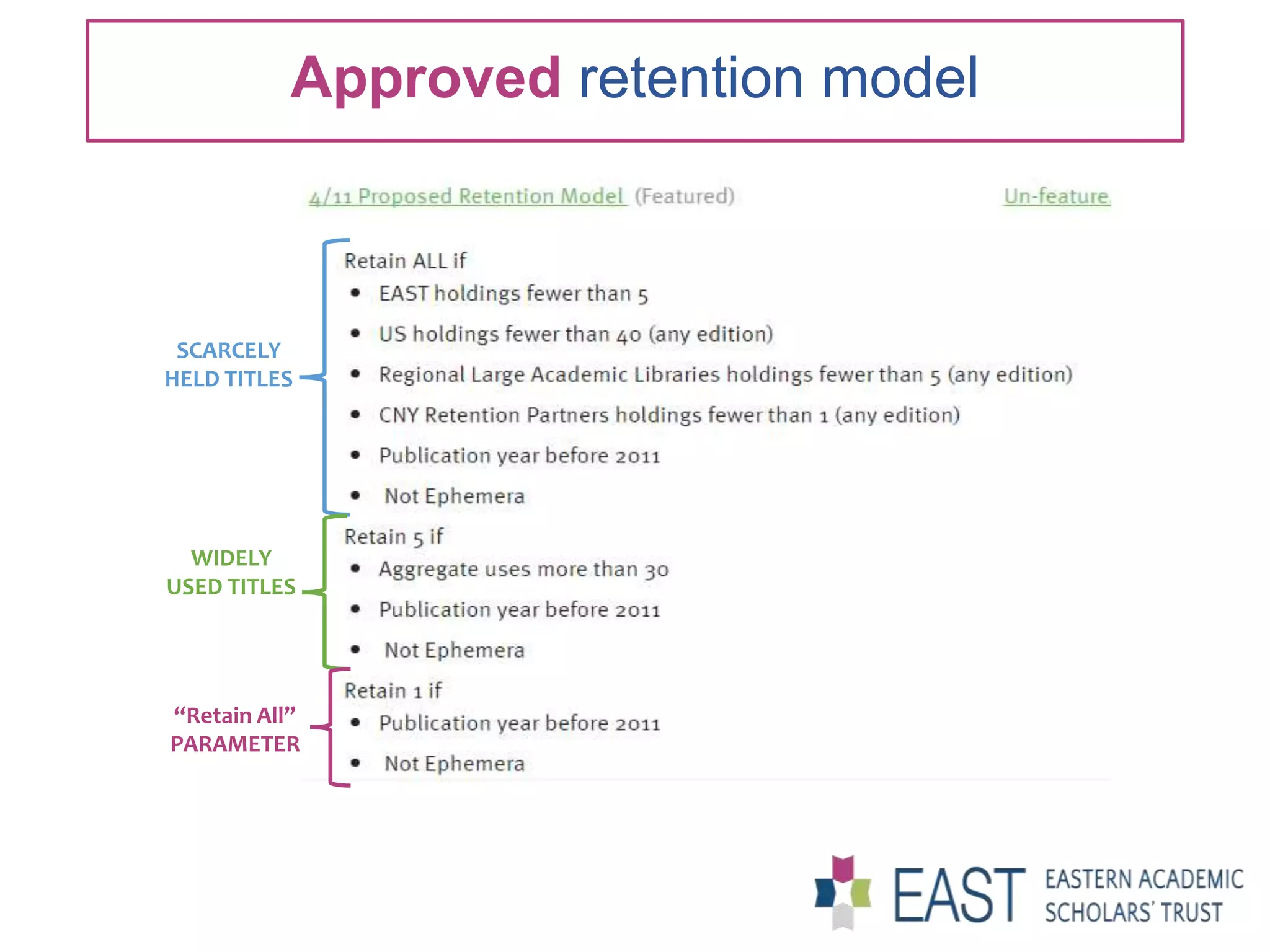
1. Retention of ALL existing holdings for titles that are
scarcely held
2. Retention of up to FIVE holdings for titles with
significant use across EAST
3. Retention of ONE holding for titles that fall outside the
above criteria
EXCLUSIONS:
Recently Published (2011 or later)
“Ephemera” (non scholarly materials)
Approved retention model
SCARCELY
HELD TITLES
WIDELY
USED TITLES
“Retain All”
PARAMETER
Actual retention allocations
• Five College Library Repository Collection: 92%
• UMass Amherst: 90% (1,329,076 holdings)
• Yeshiva University: 59%
• Other Retention Partners: 28-30%
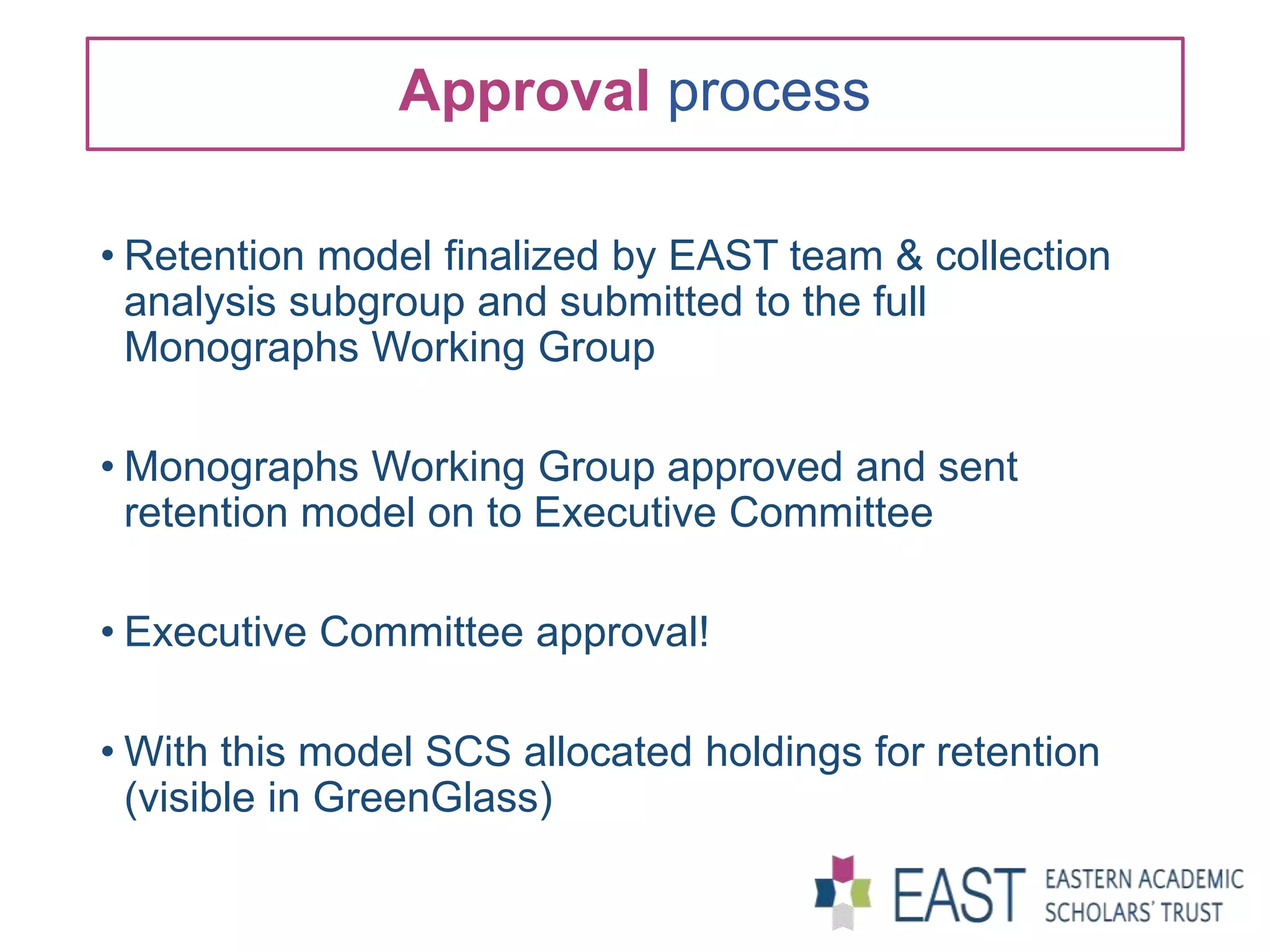
Approval process
• Retention model finalized by EAST team & collection
analysis subgroup and submitted to the full
Monographs Working Group
• Monographs Working Group approved and sent
retention model on to Executive Committee
• Executive Committee approval!
• With this model SCS allocated holdings for retention
(visible in GreenGlass)
Reviewing allocations
• Time for review: June 24 – July 29, 2016
• Removed lost, damaged or out of scope materials
• Automated catalog check (like what was done for the
validation sample study)
• Thinking about the good of all EAST stakeholders not
just local interests & needs
• 21 of 40 libraries reported exclusions/rejections
• Low: 1 to high: 7181 [due to data error]
• Total: 29,988
Retention commitments
• Retention commitments reloaded into GreenGlass so
libraries can see & work around retention commitments
• There is a workflow for pulling deselection lists that
exclude the retained items
• New ALL Retentions GreenGlass account geared to
Supporting Partners to support responsible deselection
Lessons learned
• Our aggressive timeline was successfully executed
largely because of good communication, periodically
collecting/taking feedback & needing to keep things
moving fast
• SCS was an ideal partner: responsive, met every
deadline & GreenGlass is an outstanding tool
• Member dues & grants from the Mellon and Davis
Educational Foundations have given EAST enough
resources to thrive in its implementation phase
• All ingredients for strong collaborations were present
It’s 2031:
Do You Know Where Your
Scholarly Monographs Are?
2:30pm - 3:10pm
Grand Ballroom 2
Gaillard Center
Learn more about EAST today
Thank you
Anna Perricci
aperricci@blc.org

Retention Modeling for the Eastern Academic Scholars' Trust (EAST)

  • 1.
    Charleston Conference –Shotgun Session November 4, 2016 Anna Perricci EAST Project Manager
  • 2.
    Recipe for collaboration •Insightful, trusting & engaged groups of collaborators, stakeholders & staff • Good planning & communication • Excellent tools • Desire to hear questions & concerns, and ability make needed changes quickly • Funds to support tools, staff
  • 3.
  • 4.
    EAST milestones • 40Retention Partner libraries will retain over 6 million monographic holdings for 15 years (4.3 million titles) • Completed a Validation Sample Study & further analysis of results • Major Operating Policies, governance documents, Memorandum of Understanding to be signed by partner libraries
  • 5.
    Collection analysis • Recordsfor 16.5 million in scope monographs submitted & ingested into GreenGlass (fall 2015) • Data summaries approved by libraries (Jan-Feb, 2016) • GreenGlass for EAST launched (March 2016) • Retention modeling (March-May, 2016) • Retention model approved (June 2016) • Allocations for retention generated & reviewed by libraries (June-July, 2016)
  • 6.
    In GreenGlass wefound Title holdings 16,573,071 Title sets 4,749,042 Title sets held by one library in the group 50% (2,359,033 title sets) Title sets with > 10 aggregate uses 20% (939,819 title sets) Title sets represented in HathiTrust 39% (1,865,115 title sets)
  • 7.
    Collection Analysis group •Helen Anderson, University of Rochester • Richard Bleiler, University of Connecticut • Karen Bohrer, Worcester Polytechnic Institute • Berry Chamness, Bryn Mawr College • Charles Getchell, Saint Anselm College • Lorraine Huddy, CTW Consortium • Susan Raidy-Klein, UMass Dartmouth • Ray Schmidt, Wellesley College • Debbi Smith, Adelphi University Ruth Fisher Sustainable Collection Services (OCLC) EAST Project Team • Matthew Revitt • Sara Amato • Lizanne Payne • Anna Perricci • Lizanne Payne • Susan Stearns
  • 8.
    Keys to Successin a short timeframe • 2 month window to agree the retention model across EAST kept all on task • Seeing immediate results in GreenGlass modeling allowed for quick decision-making • Collection analysis subgroup was focused & effective • Seeking EAST member opinions about retention rules created buy-in • Getting that buy-in led to smoother approval by the Executive Committee
  • 9.
    Steps by CollectionAnalysis Subgroup 1. Look at example of retention concepts and models from other shared print initiatives 2. Establish the expectations of which retention rules were feasible and would have the greatest impact 3. Experiment with GreenGlass Retention Model Builder and agree on a retention model 4. Consider feedback gathered via 3 surveys
  • 10.
    Together we usedGreenGlass • Ruth Fischer provided training and excellent instructional videos explaining each retention model • Many collection analysis group members attended weekly office hours to discuss modeling • Google Site for documentation and to support GreenGlass users: https://sites.google.com/a/blc.org/east-collection- analysis/ • As of 11/1/16, EAST has 265 registered GreenGlass user accounts
  • 11.
    Retention rules 1. Retentionof ALL existing holdings for titles that are scarcely held 2. Retention of up to FIVE holdings for titles with significant use across EAST 3. Retention of ONE holding for titles that fall outside the above criteria EXCLUSIONS: Recently Published (2011 or later) “Ephemera” (non scholarly materials)
  • 12.
    Approved retention model SCARCELY HELDTITLES WIDELY USED TITLES “Retain All” PARAMETER
  • 14.
    Actual retention allocations •Five College Library Repository Collection: 92% • UMass Amherst: 90% (1,329,076 holdings) • Yeshiva University: 59% • Other Retention Partners: 28-30%
  • 15.
    Approval process • Retentionmodel finalized by EAST team & collection analysis subgroup and submitted to the full Monographs Working Group • Monographs Working Group approved and sent retention model on to Executive Committee • Executive Committee approval! • With this model SCS allocated holdings for retention (visible in GreenGlass)
  • 16.
    Reviewing allocations • Timefor review: June 24 – July 29, 2016 • Removed lost, damaged or out of scope materials • Automated catalog check (like what was done for the validation sample study) • Thinking about the good of all EAST stakeholders not just local interests & needs • 21 of 40 libraries reported exclusions/rejections • Low: 1 to high: 7181 [due to data error] • Total: 29,988
  • 17.
    Retention commitments • Retentioncommitments reloaded into GreenGlass so libraries can see & work around retention commitments • There is a workflow for pulling deselection lists that exclude the retained items • New ALL Retentions GreenGlass account geared to Supporting Partners to support responsible deselection
  • 18.
    Lessons learned • Ouraggressive timeline was successfully executed largely because of good communication, periodically collecting/taking feedback & needing to keep things moving fast • SCS was an ideal partner: responsive, met every deadline & GreenGlass is an outstanding tool • Member dues & grants from the Mellon and Davis Educational Foundations have given EAST enough resources to thrive in its implementation phase • All ingredients for strong collaborations were present
  • 19.
    It’s 2031: Do YouKnow Where Your Scholarly Monographs Are? 2:30pm - 3:10pm Grand Ballroom 2 Gaillard Center Learn more about EAST today
  • 20.

Editor's Notes

  • #15 Thank you! to the 5 Colleges Depository, UMass Amherst and Yeshiva University for retaining a much higher percentage on behalf of EAST. There were other libraries willing to retain more than the average – but they would have made a marginal difference overall … small libraries … just slightly above average.