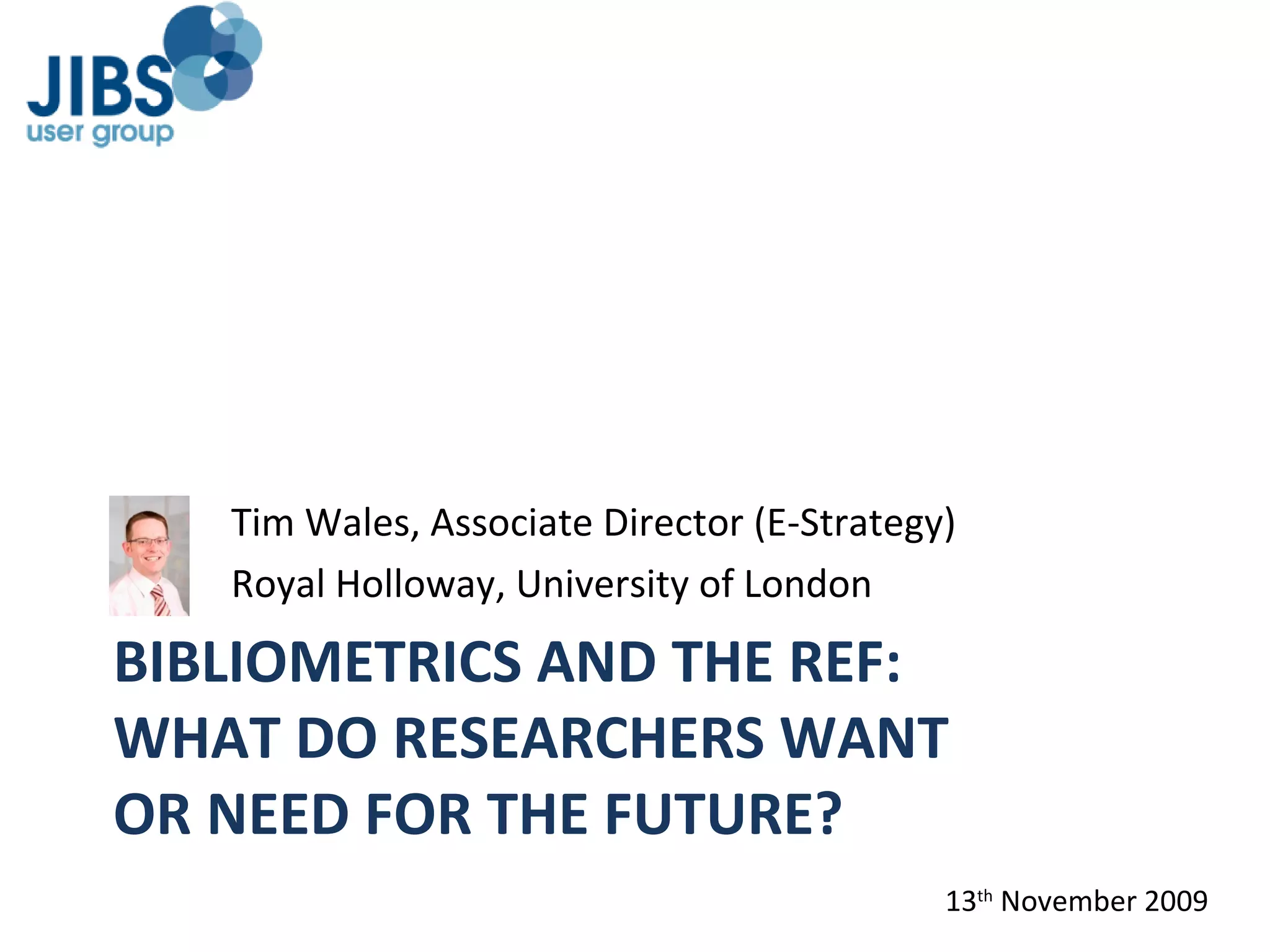











BIBLIOMETRICS AND THE REF: WHAT DO RESEARCHERS WANT  OR NEED FOR THE FUTURE? Tim Wales, Associate Director (E-Strategy) Royal Holloway, University of London 13 th  November 2009
BRIEF BIO Pro A&I
Source: http://www.flickr.com/photos/25552808@N04/2847690523/ University College London
King’s College London (former Pharmacy Library) Source: http:// http://www.flickr.com/photos/albedo/541536327
Source: http://www.flickr.com/photos/25552808@N04/2847690523/ City University
London Business School Source: http://www.flickr.com/photos/ashishaggarwal/2983190165/
http://www.flickr.com/photos/dannybull/4017080101/ Open University
Trinity College, Bridgeford University Source: http:// www.flickr.com/photos/bathintime/3726752408/ Royal Holloway, University of London
REF (BIBLIOMETRIC) UPDATE
Source: http://www.flickr.com/photos/treacle/66010614/
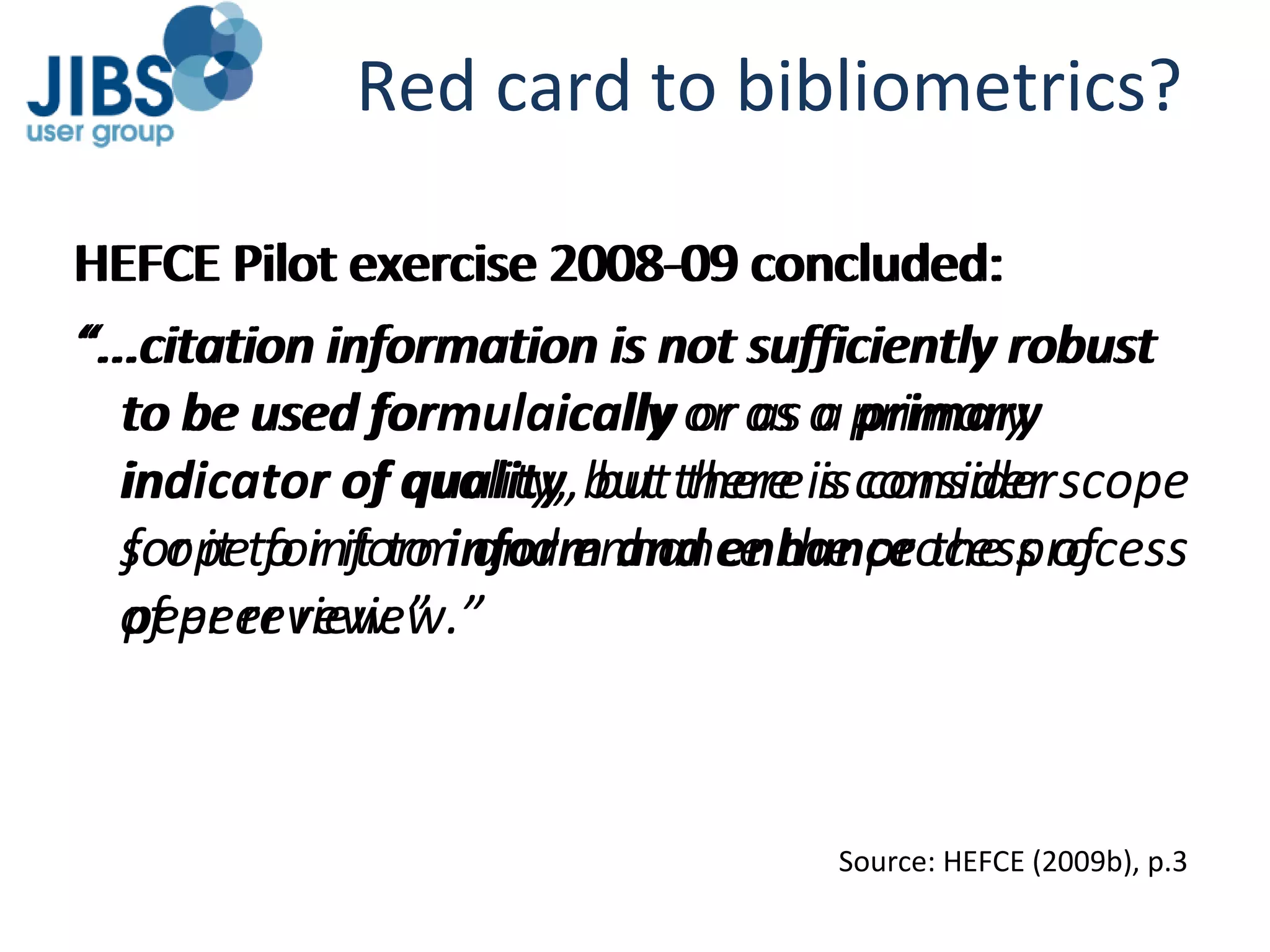
Red card to bibliometrics? HEFCE Pilot exercise 2008-09 concluded: “ ...citation information is not sufficiently robust to be used formulaically   or as a primary indicator of quality, but there is consider scope for it to inform and enhance the process of peer review.”  HEFCE Pilot exercise 2008-09 concluded: “ ...citation information is not sufficiently robust to be used  formulaically  or as a  primary indicator of quality , but there is consider scope for it to  inform and enhance  the process of peer review.”  Source: HEFCE (2009b), p.3
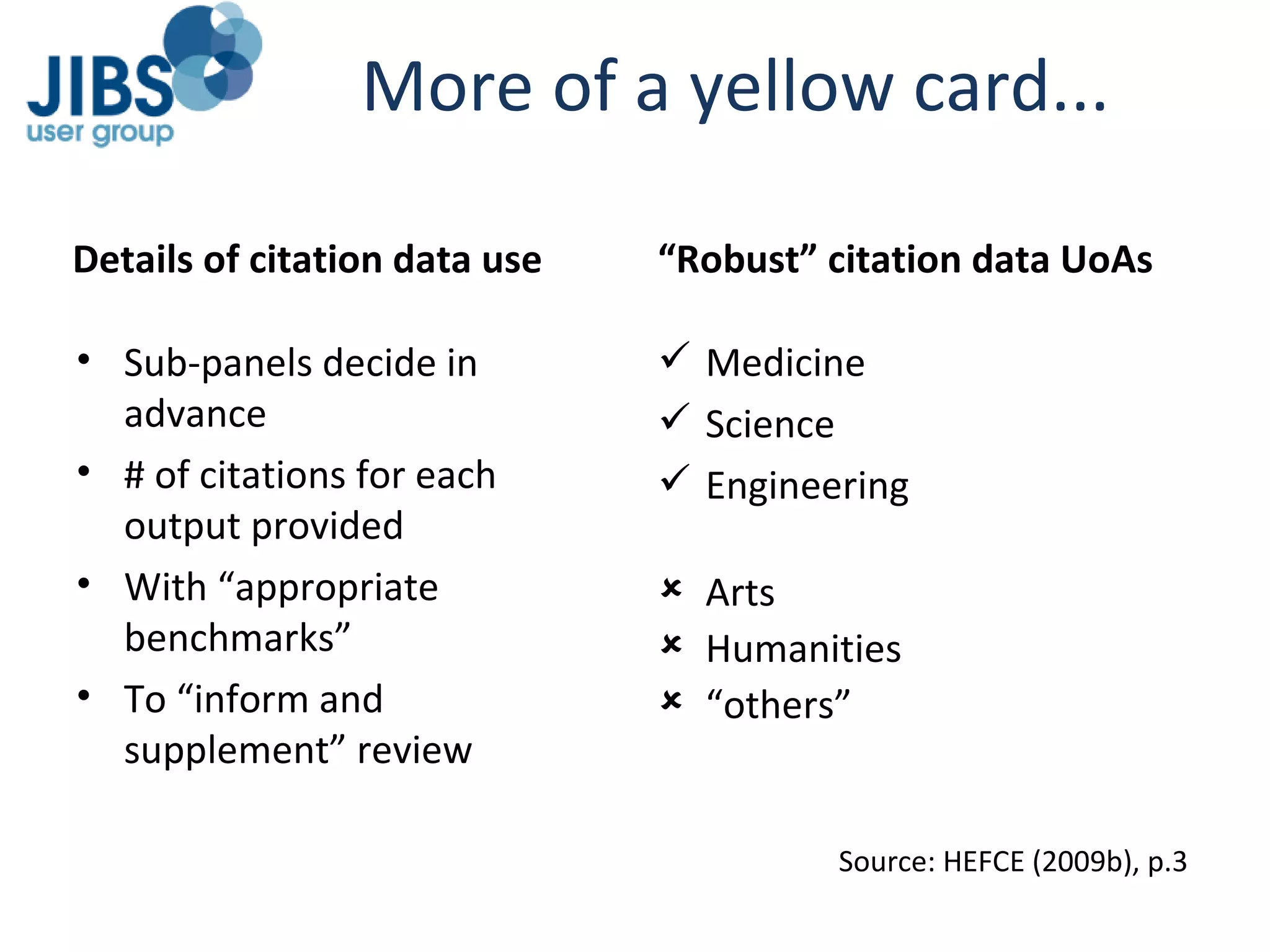
More of a yellow card... Details of citation data use Sub-panels decide in advance # of citations for each output provided With “appropriate benchmarks” To “inform and supplement” review “ Robust” citation data UoAs Medicine Science Engineering Arts Humanities “ others” Source: HEFCE (2009b), p.3
...with final warning(s) Clear guidelines on using the data robustly to take account of the known limitations and to avoid bias Panels will not make judgements about quality of outputs solely on the basis of citation information; expert information must be applied All submitted outputs will be treated equally, whether or not citation information available Source: HEFCE (2009b), p.3 Clear guidelines on using the data  robustly  to take account of the known limitations and to avoid bias Panels will not make judgements about quality of outputs solely on the basis of citation information;  expert information must be applied All submitted outputs will be  treated equally , whether or not citation information available
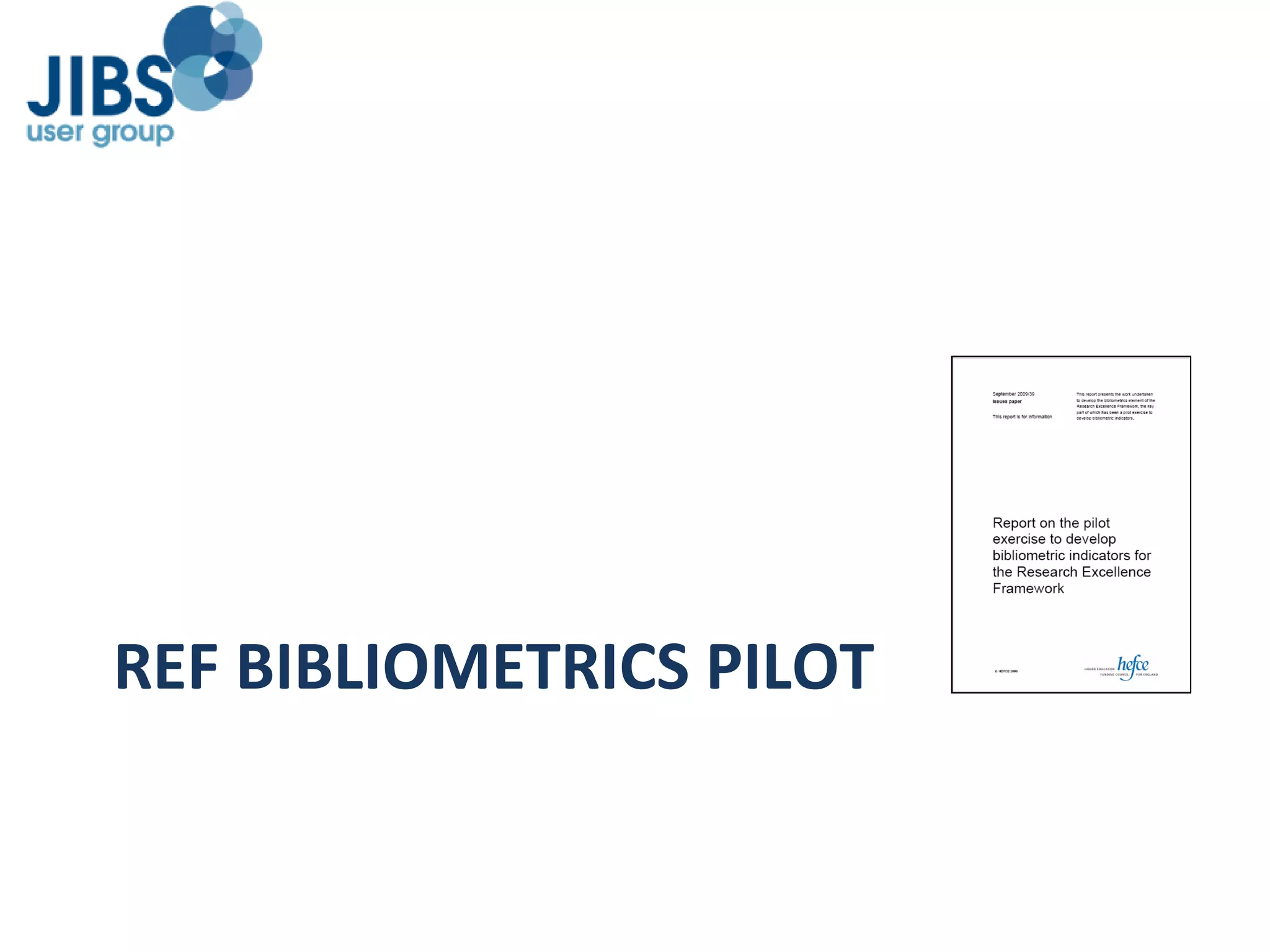
REF BIBLIOMETRICS PILOT
Methodology Thomson Reuters Web of Science and Elsevier Scopus citation data used 22 HEIs took part 35 UoAs from 2008 RAE used (Coverage greater than 40% in citation databases) Publications between 2001 and 2006 inclusive + citation data to 2007 3 data gathering models tested Journal articles + review papers only
Bibliometric models Publication data by institutional address Publication data by staff, all outputs Publication data by staff, selected outputs
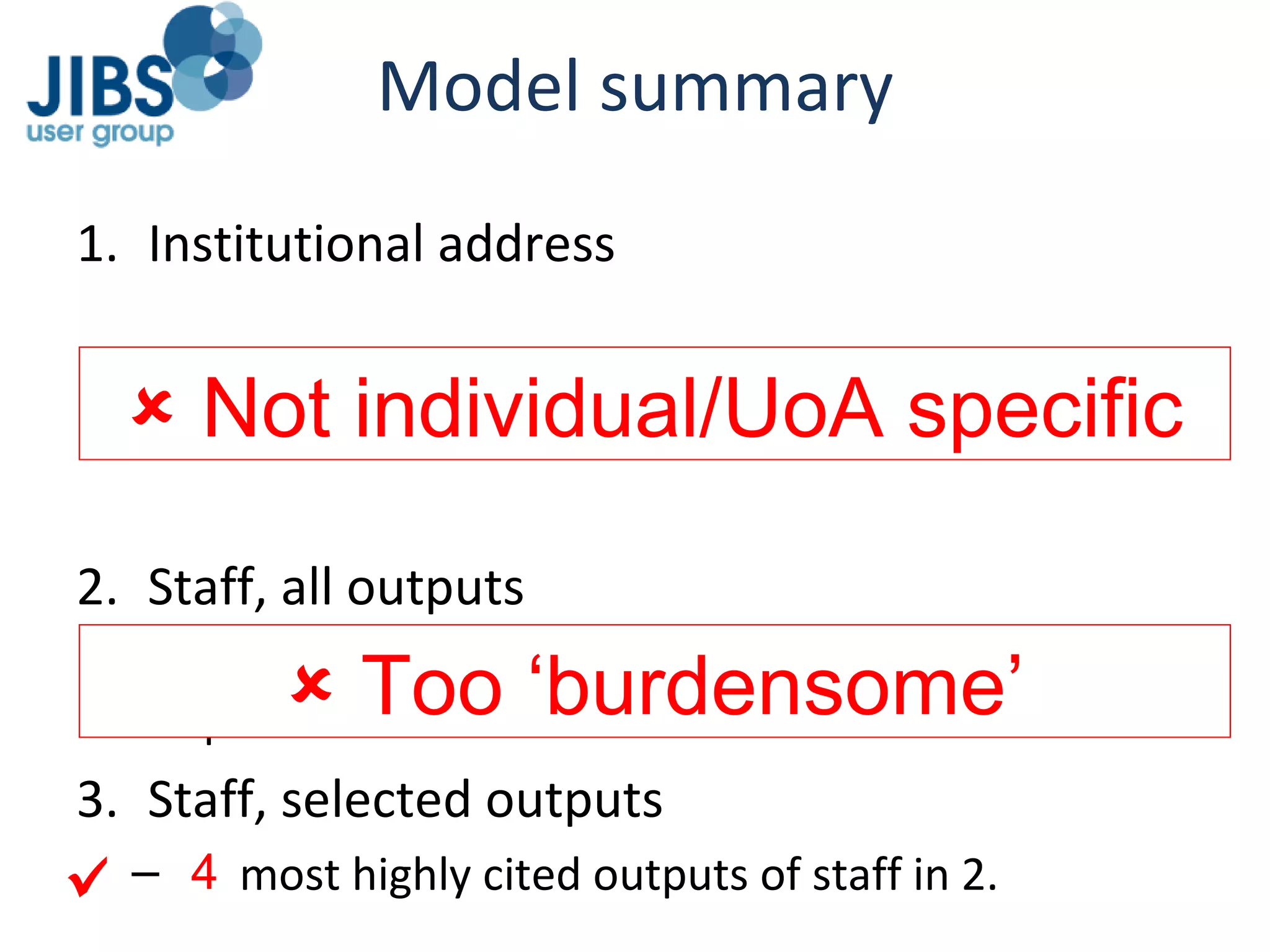
Model summary Institutional address Papers assigned to HEIs on basis of author address in WoS/Scopus Also assigned to subject categories based on destination journal Staff, all outputs All papers by staff submitted to RAE2008 for the pilot UoAs Staff, selected outputs 6 most highly cited outputs of staff in 2.    Too ‘burdensome’    Not individual/UoA specific 4 
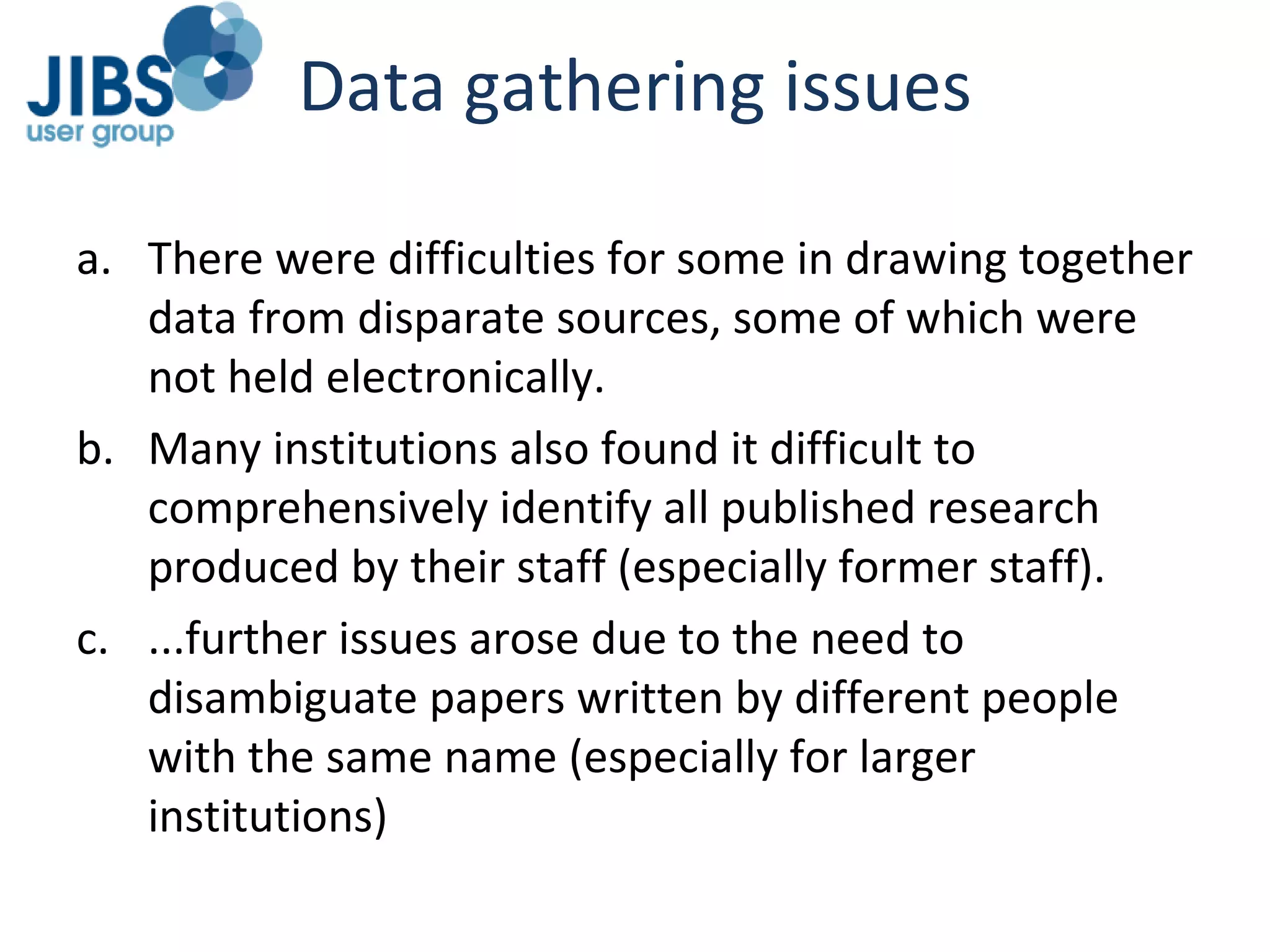
Data gathering issues There were difficulties for some in drawing together data from disparate sources, some of which were not held electronically.  Many institutions also found it difficult to comprehensively identify all published research produced by their staff (especially former staff). ...further issues arose due to the need to disambiguate papers written by different people with the same name (especially for larger institutions)
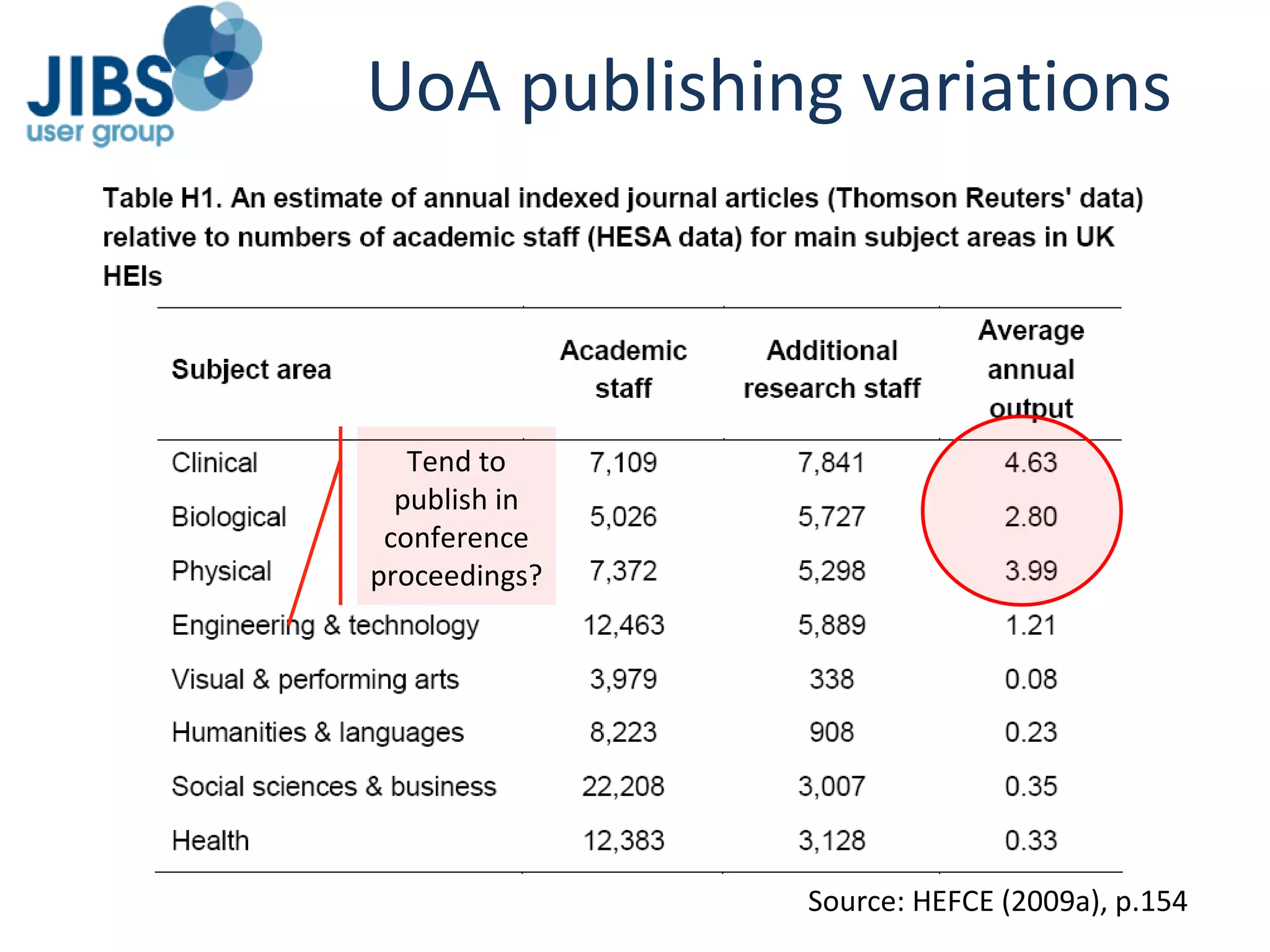
UoA publishing variations Tend to publish in conference proceedings? Source: HEFCE (2009a), p.154
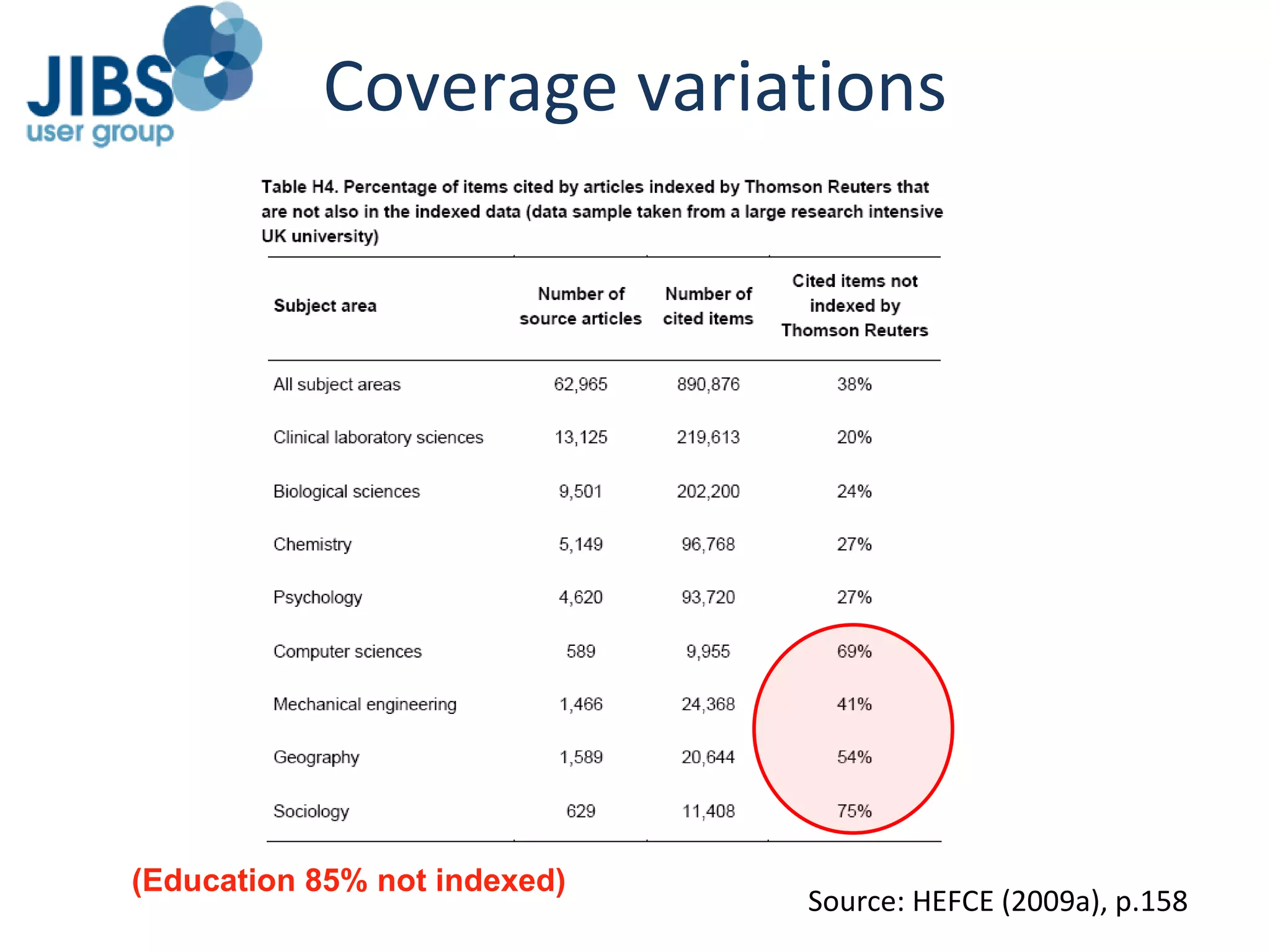
Coverage variations Source: HEFCE (2009a), p.158 (Education 85% not indexed)
WHAT ABOUT RESEARCHERS?
 
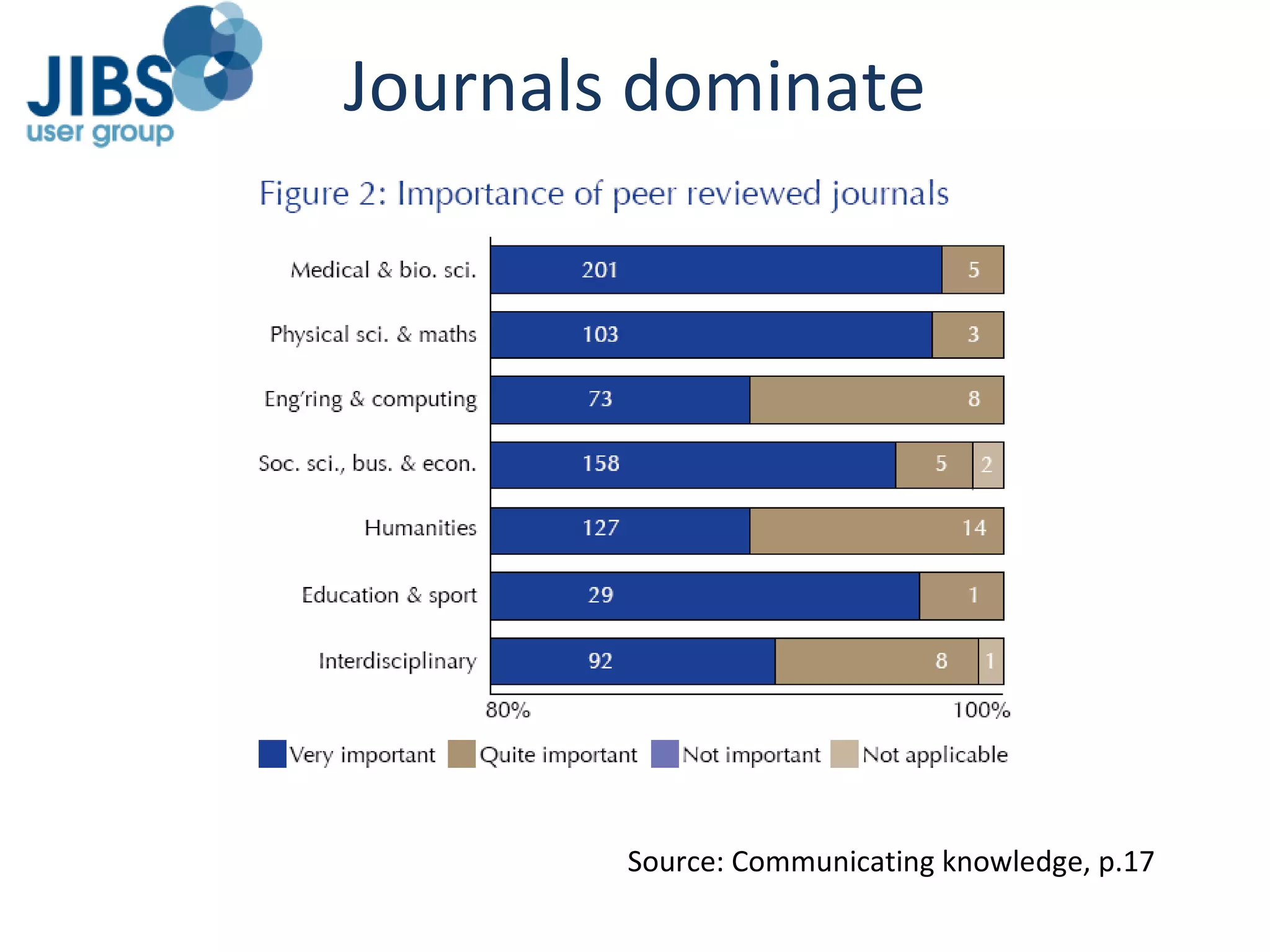
Journals dominate Source: Communicating knowledge, p.17
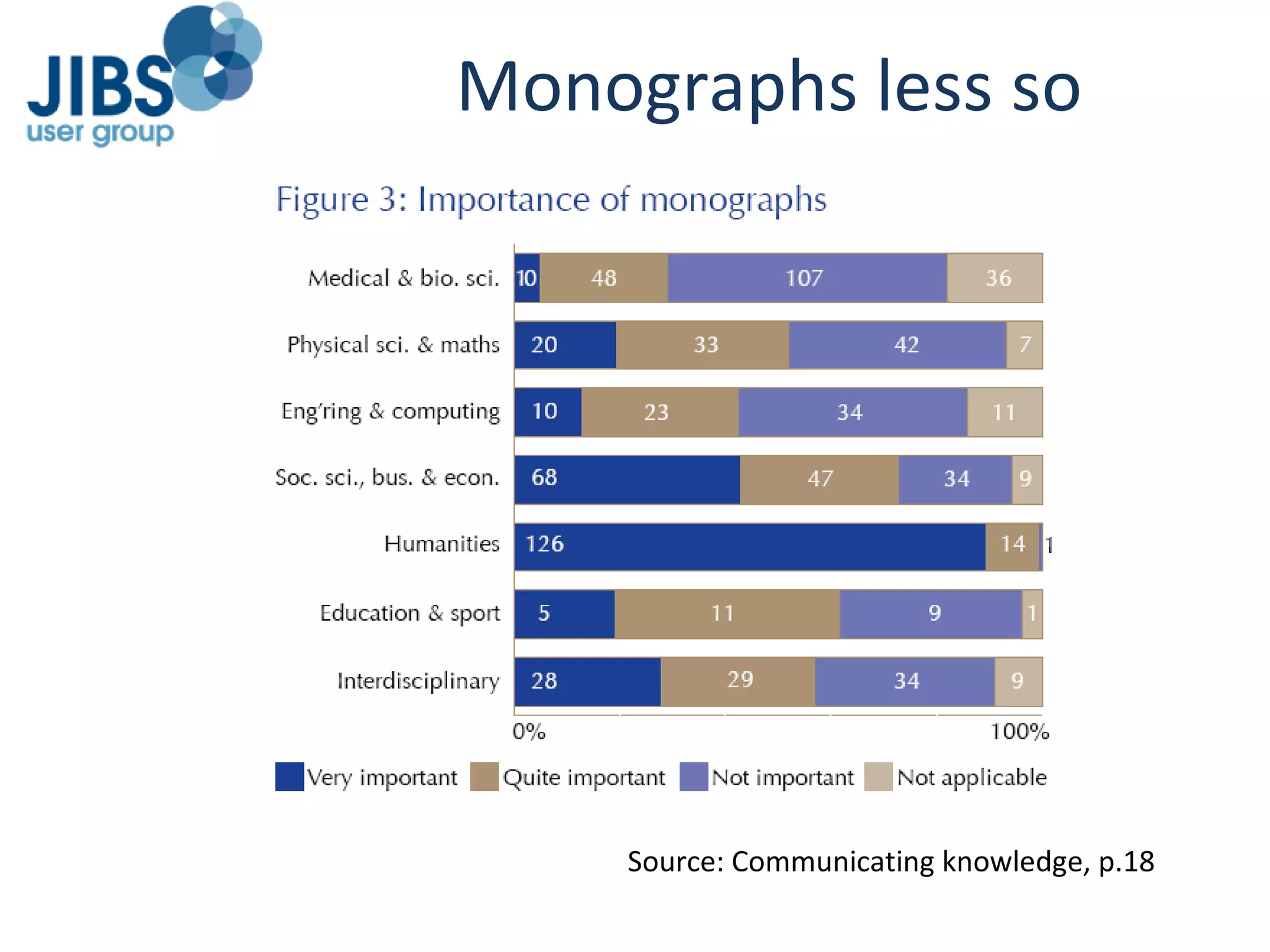
Monographs less so Source: Communicating knowledge, p.18
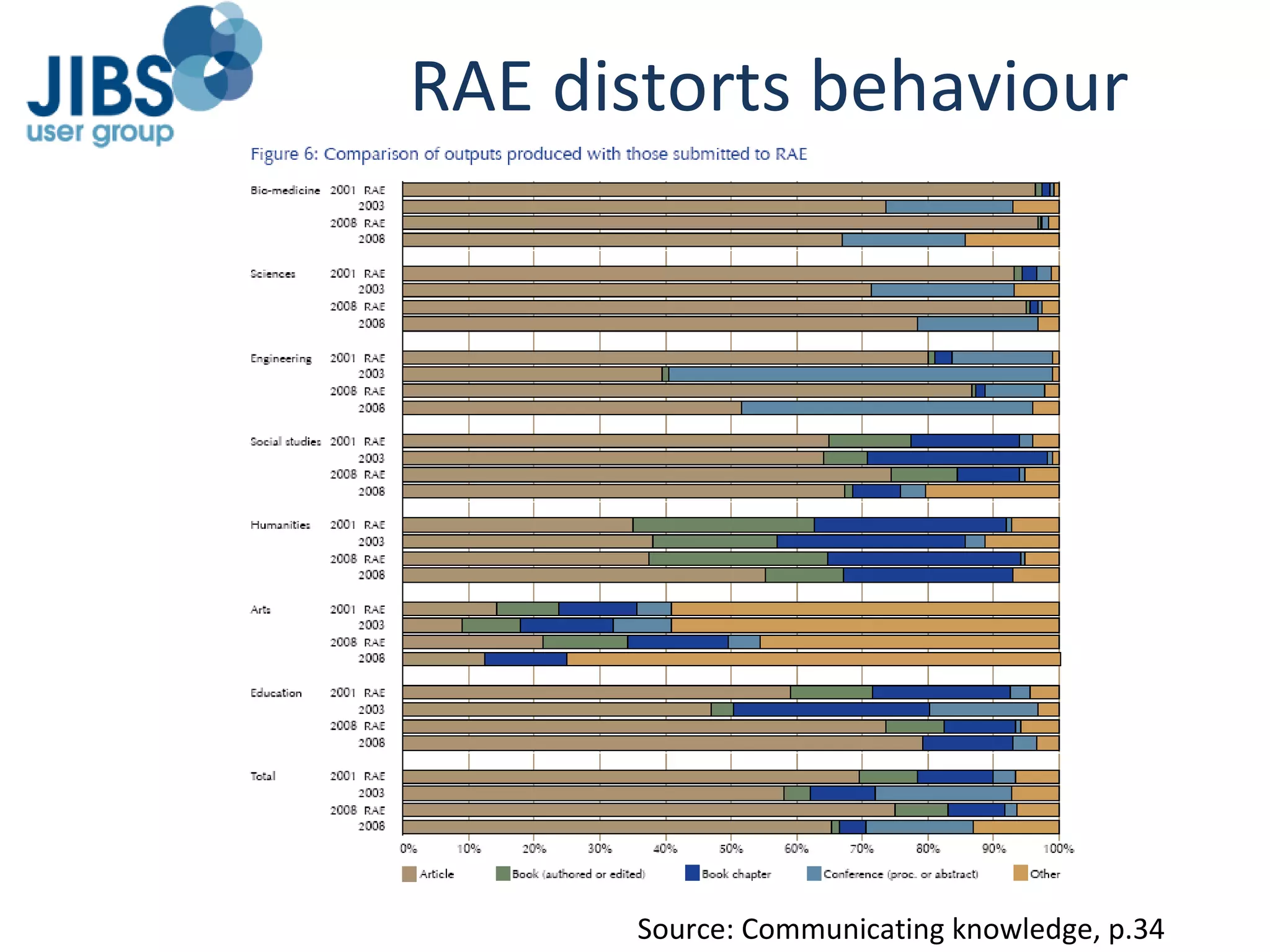
RAE distorts behaviour Source: Communicating knowledge, p.34
UK researchers need TLC Many researchers are confused by the mixed messages they are receiving as to how best to communicate their findings.... Funders, learned societies and publishers may also wish to consider whether they might take more of a lead in helping to devise guidelines on good practice [in attribtion & listing of authors] Research timescales need to be carefully considered in any arrangements for the assessment of performance. Source: Communicating knowledge, pp.6-7
RESEARCHERS NEED E-A&I ISB research
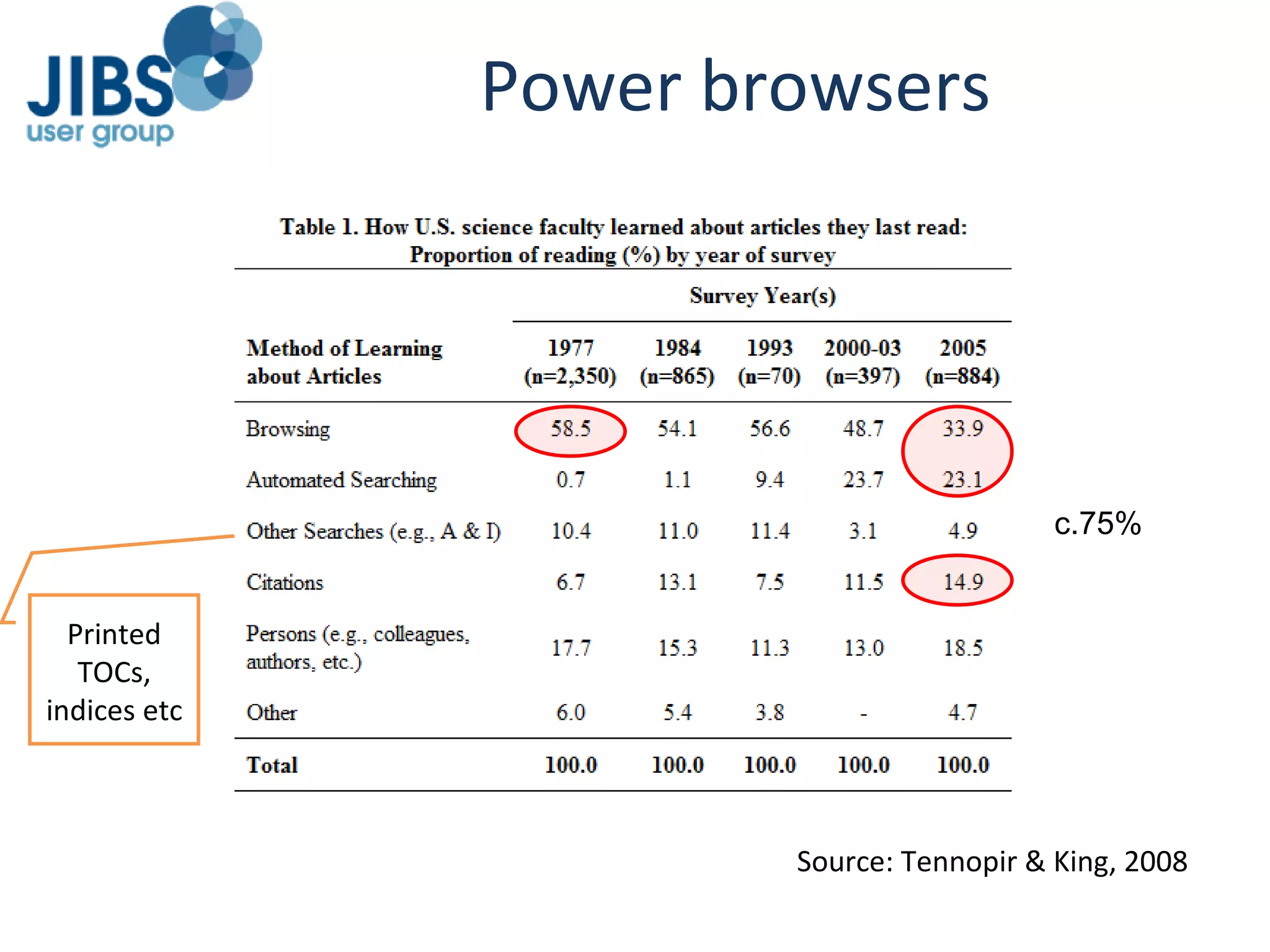
Power browsers Source: Tennopir & King, 2008 Printed TOCs, indices etc c.75%
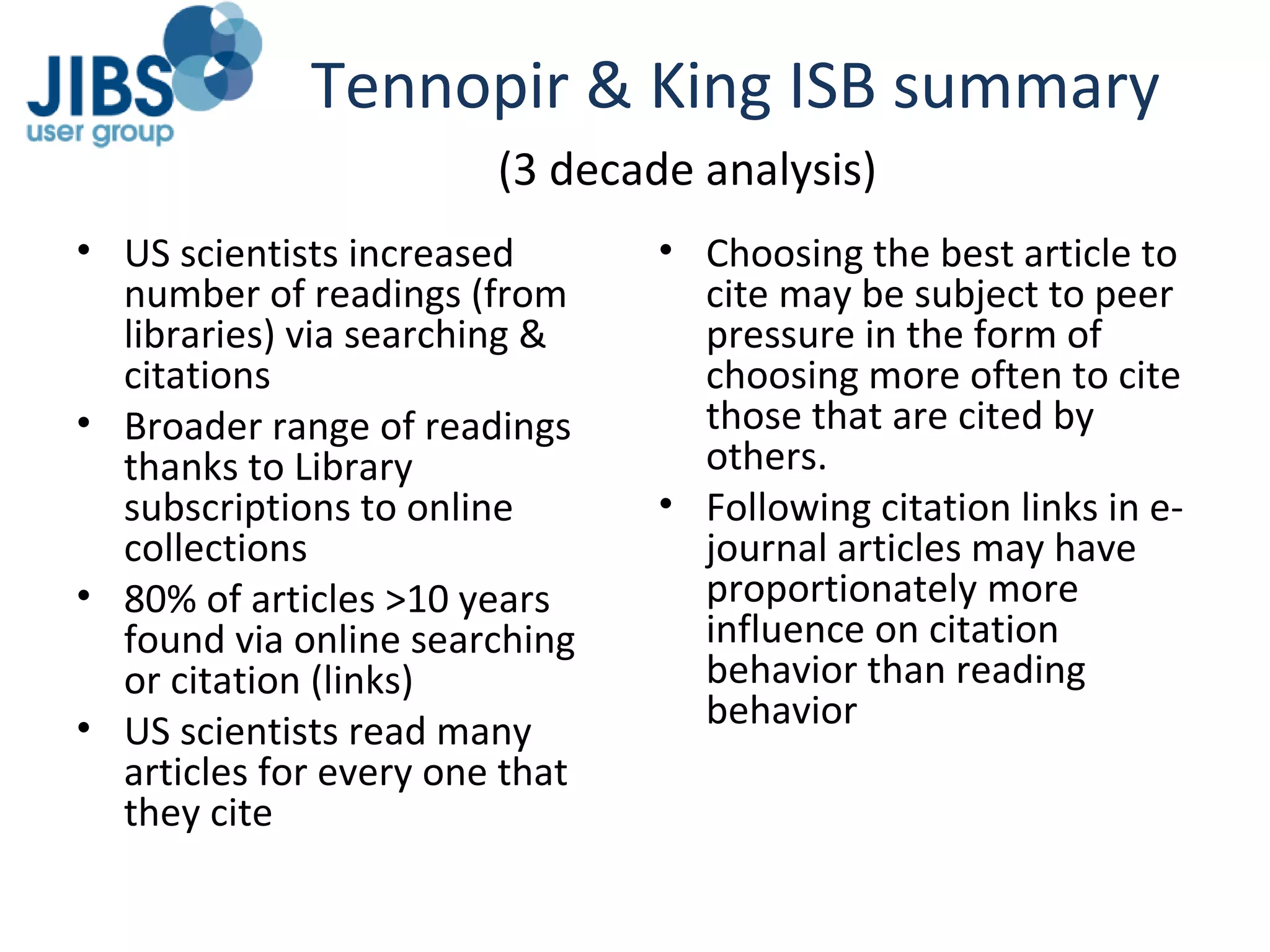
Tennopir & King ISB summary US scientists increased number of readings (from libraries) via searching & citations Broader range of readings thanks to Library subscriptions to online collections 80% of articles >10 years found via online searching or citation (links) US scientists read many articles for every one that they cite Choosing the best article to cite may be subject to peer pressure in the form of choosing more often to cite those that are cited by others. Following citation links in e-journal articles may have proportionately more influence on citation behavior than reading behavior (3 decade analysis)
 
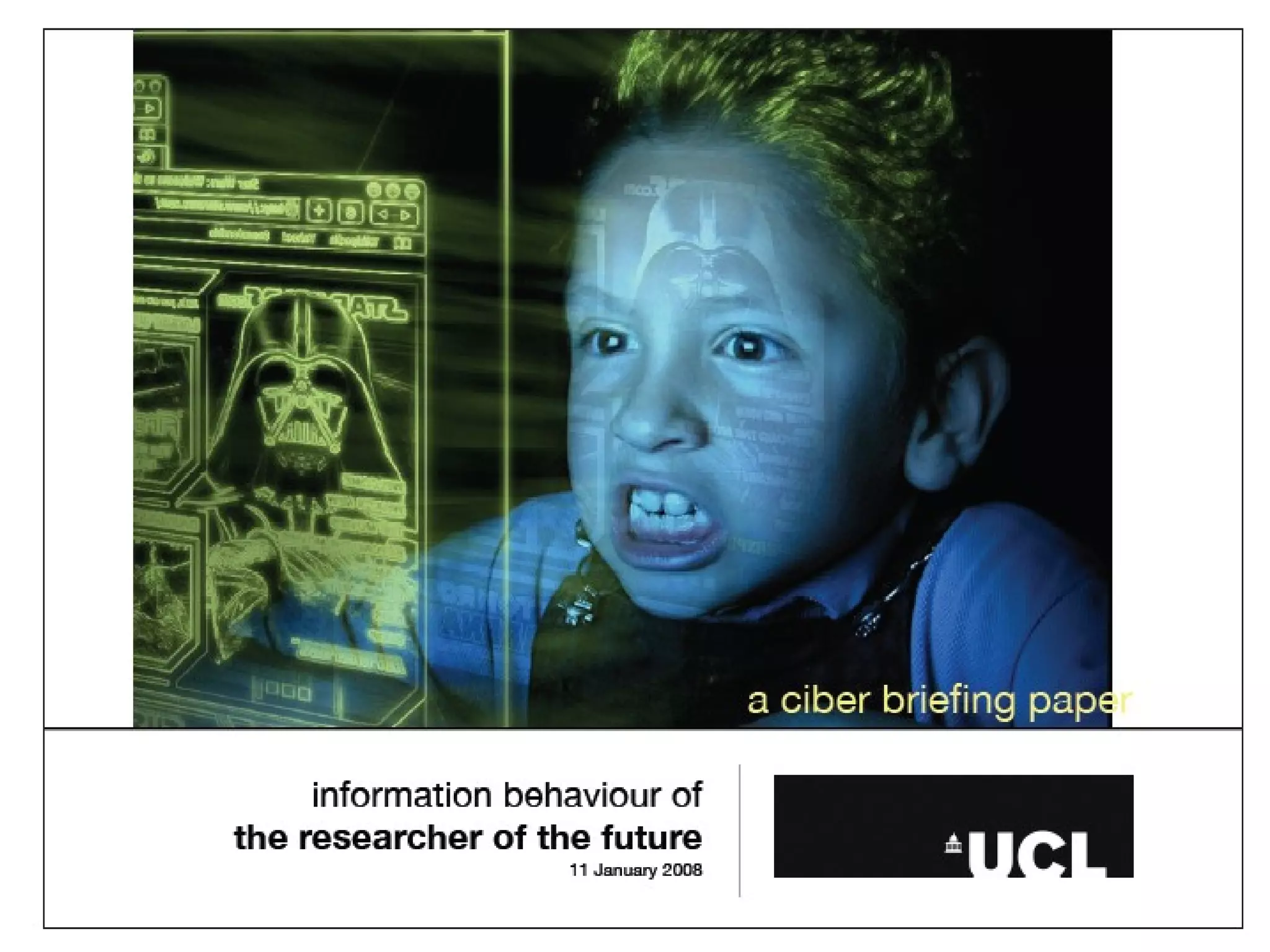
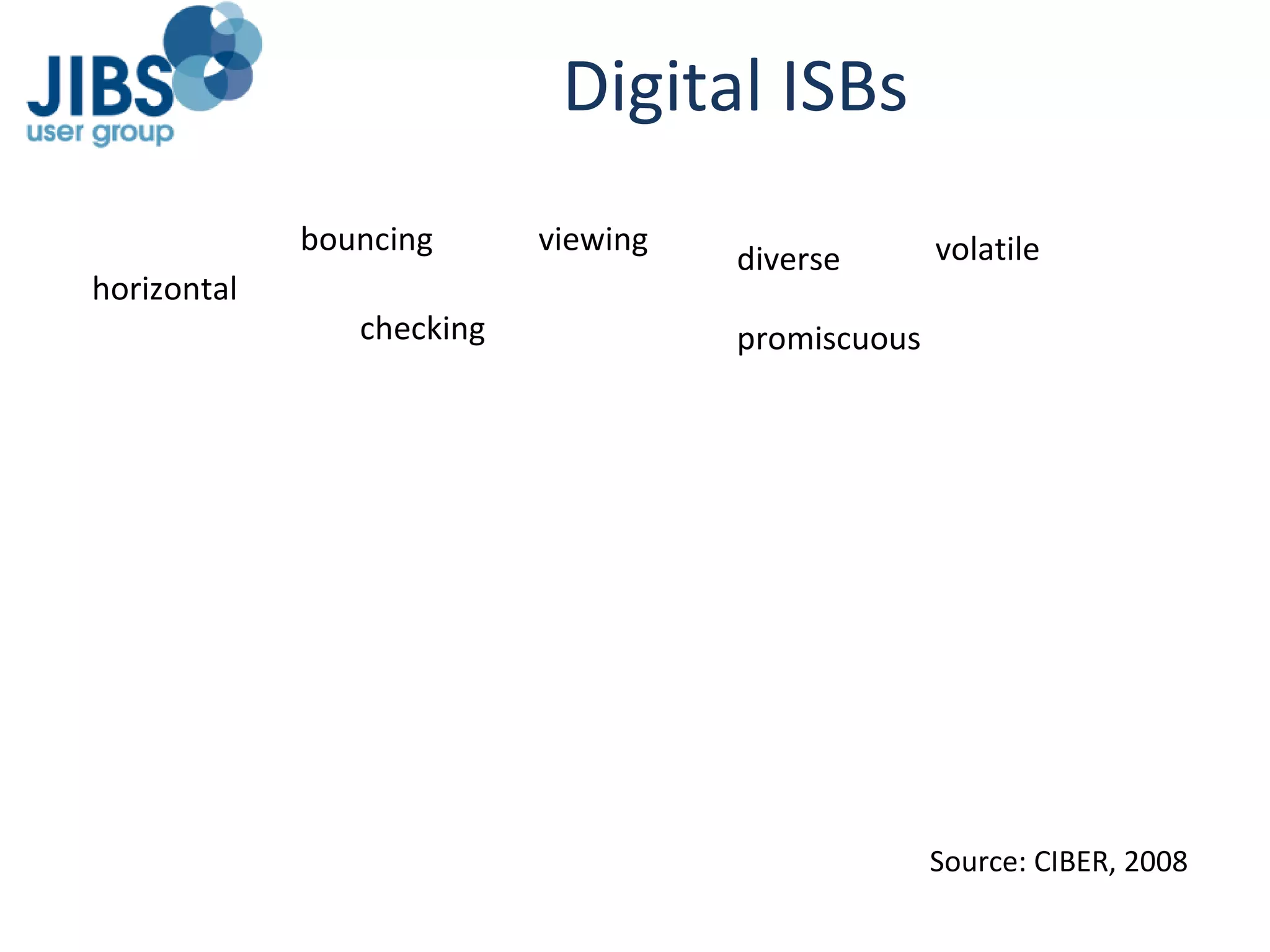
Digital ISBs Horizontal information seeking Viewers  Power browsers “ 60% of e-journal users view no more than 3 pages” “ Average time on e-book or e-journal sites: 4-8 mins” “ Power browse horizontally through titles, contents pages and abstracts going for quick wins” horizontal bouncing checking viewing promiscuous diverse volatile Source: CIBER, 2008
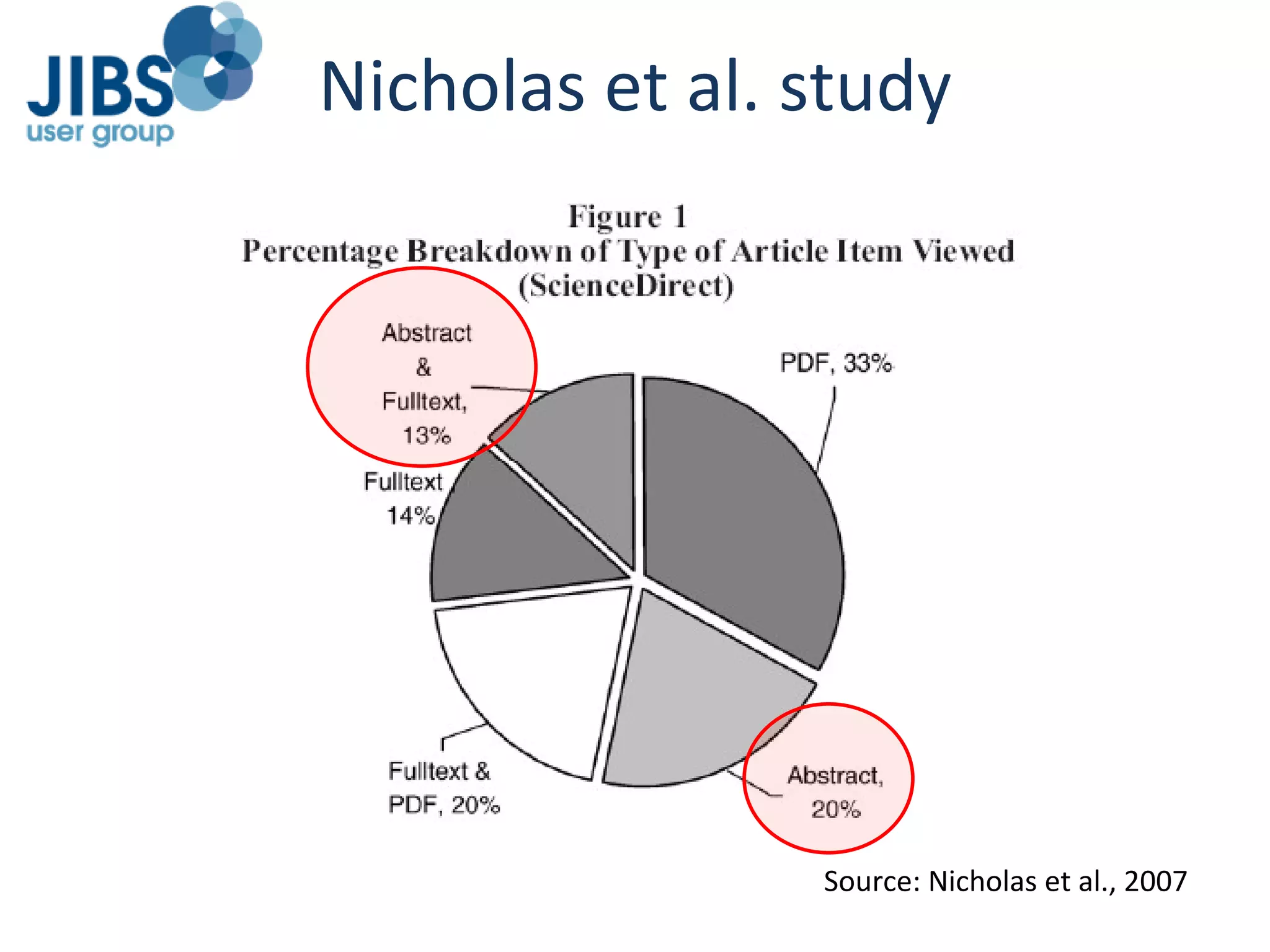
Nicholas et al. study Source: Nicholas et al., 2007
OK, WHAT’S MY POINT?
Given that... The HEFCE Bibliometric pilot found that HEIs had major difficulties in sourcing and providing accurate publication data efficiently There is still a limited need for citation data for REF RAE submission trends and external ISB research indicate an increase in journal article publishing and use across most disciplines Today’s and tomorrow’s researchers value A&I data from libraries to aid power browsing and identifying articles to cite
It follows that... HEIs and researchers need a REF compliant system that: contains all of an HEI’s publication data for current and former staff Provides citation and benchmarking data for those UoAs that will be using it in the REF Harnesses researchers use of Library A&I databases to good effect Interfaces with existing bibliographic and web systems, e.g. OA repository to help promote individual outputs and raise profiles
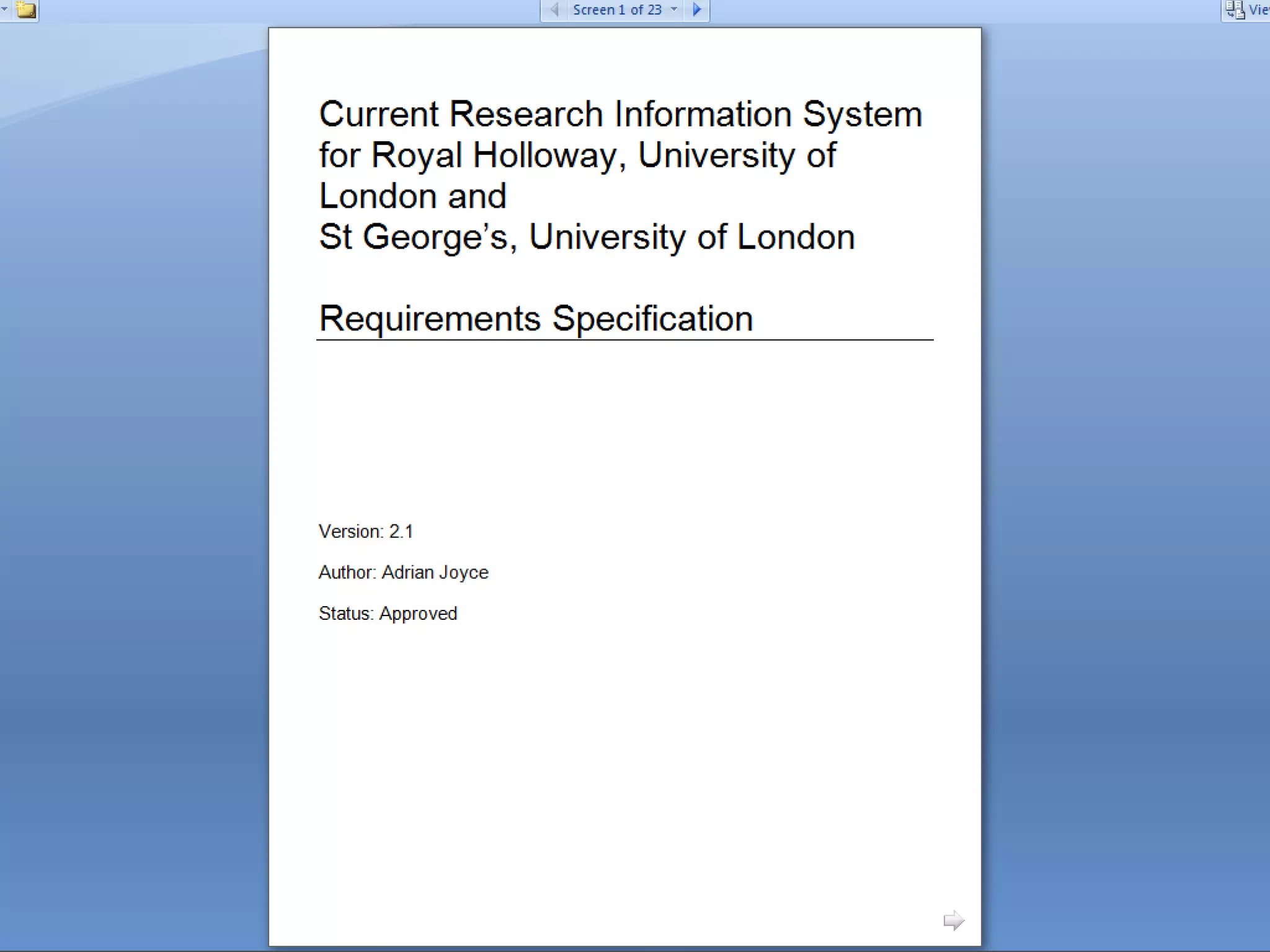
RESEARCH INFORMATION SYSTEMS (RIS) The answer?
Source: http://www.flickr.com/photos/roadsidepictures/244926428/
[email_address] Web of Science PubMed etc Research Managers Institutional Repository Importing of bibliographic data Researchers Validation of bibliographic data Submission of research artefacts Depositing research artefacts Research Management System Library staff Querying of research output data HEFCE HR ID Mgt CMS Querying RHUL Systems Submission of bibliographic data WWW Updating researchers’ websites Grants REF
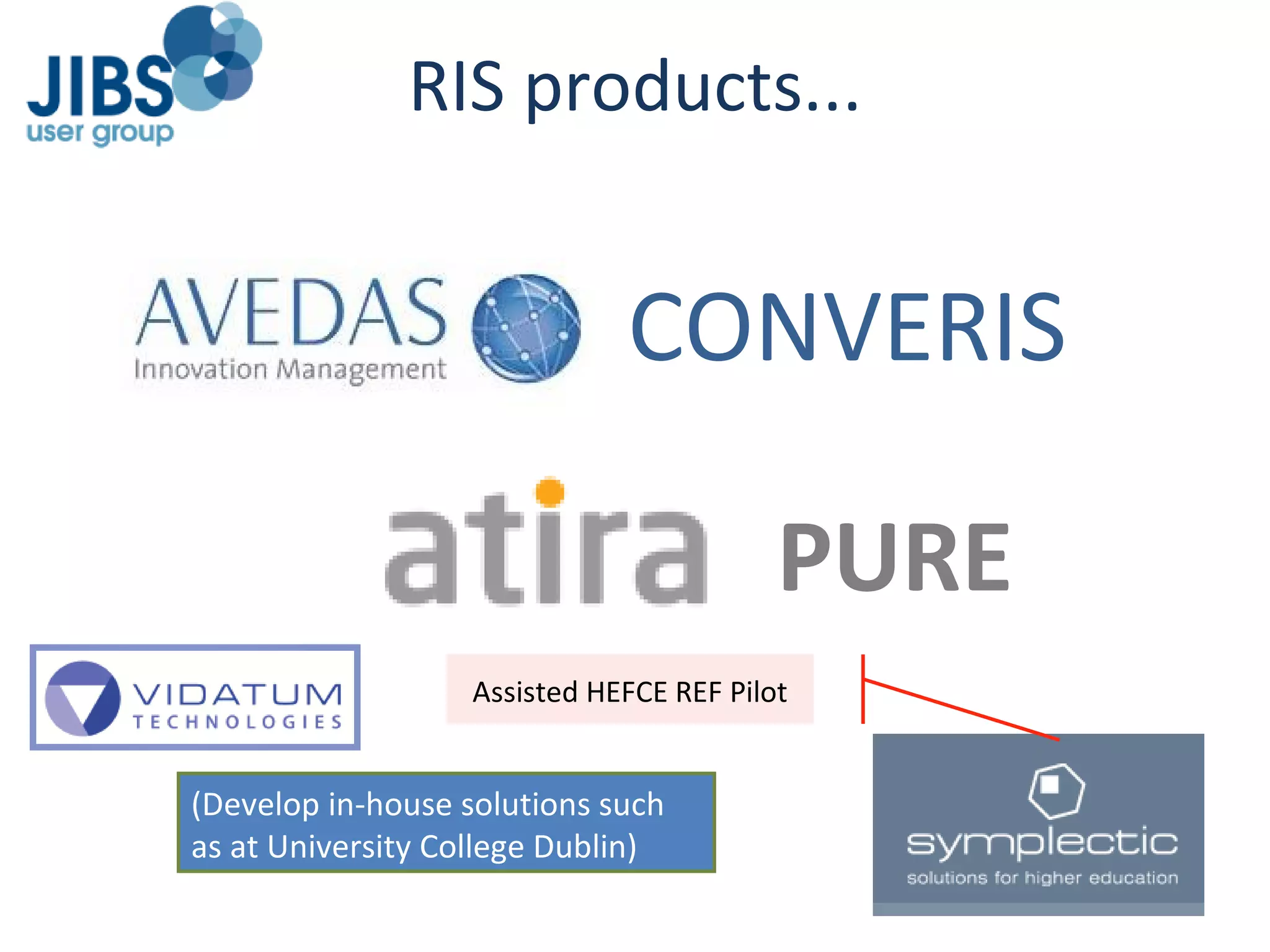
RIS products... Assisted HEFCE REF Pilot PURE CONVERIS (Develop in-house solutions such as at University College Dublin)


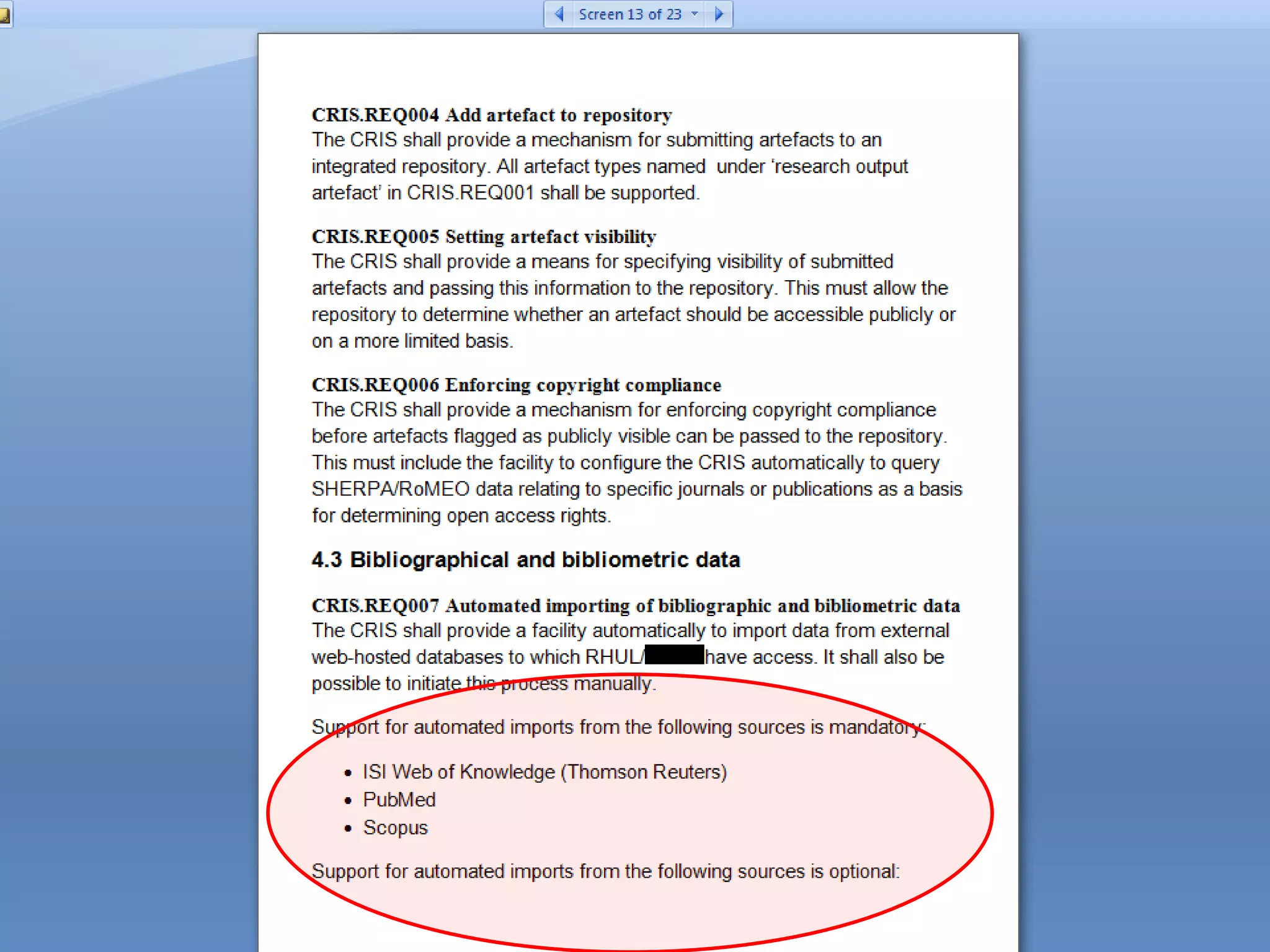
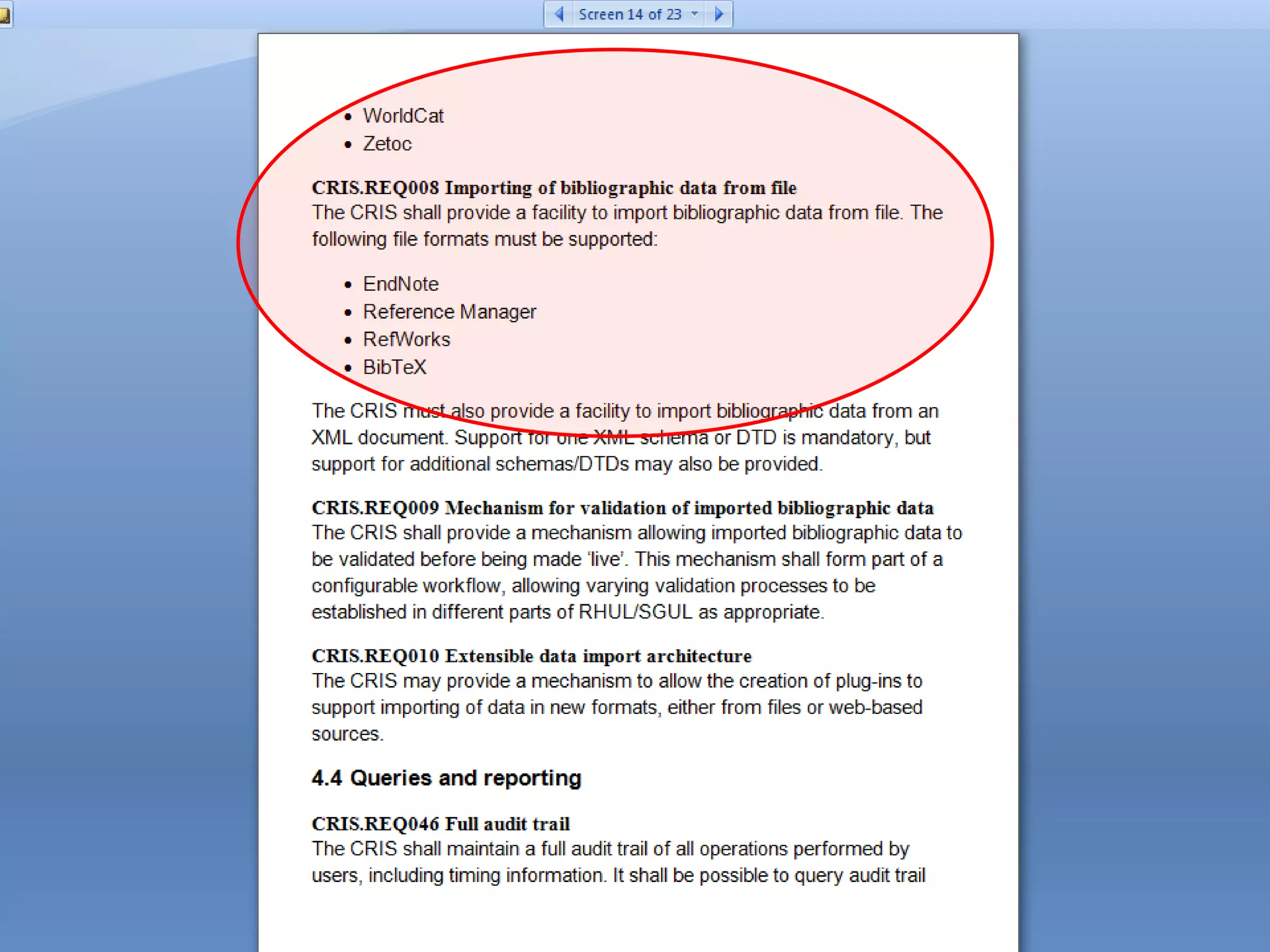
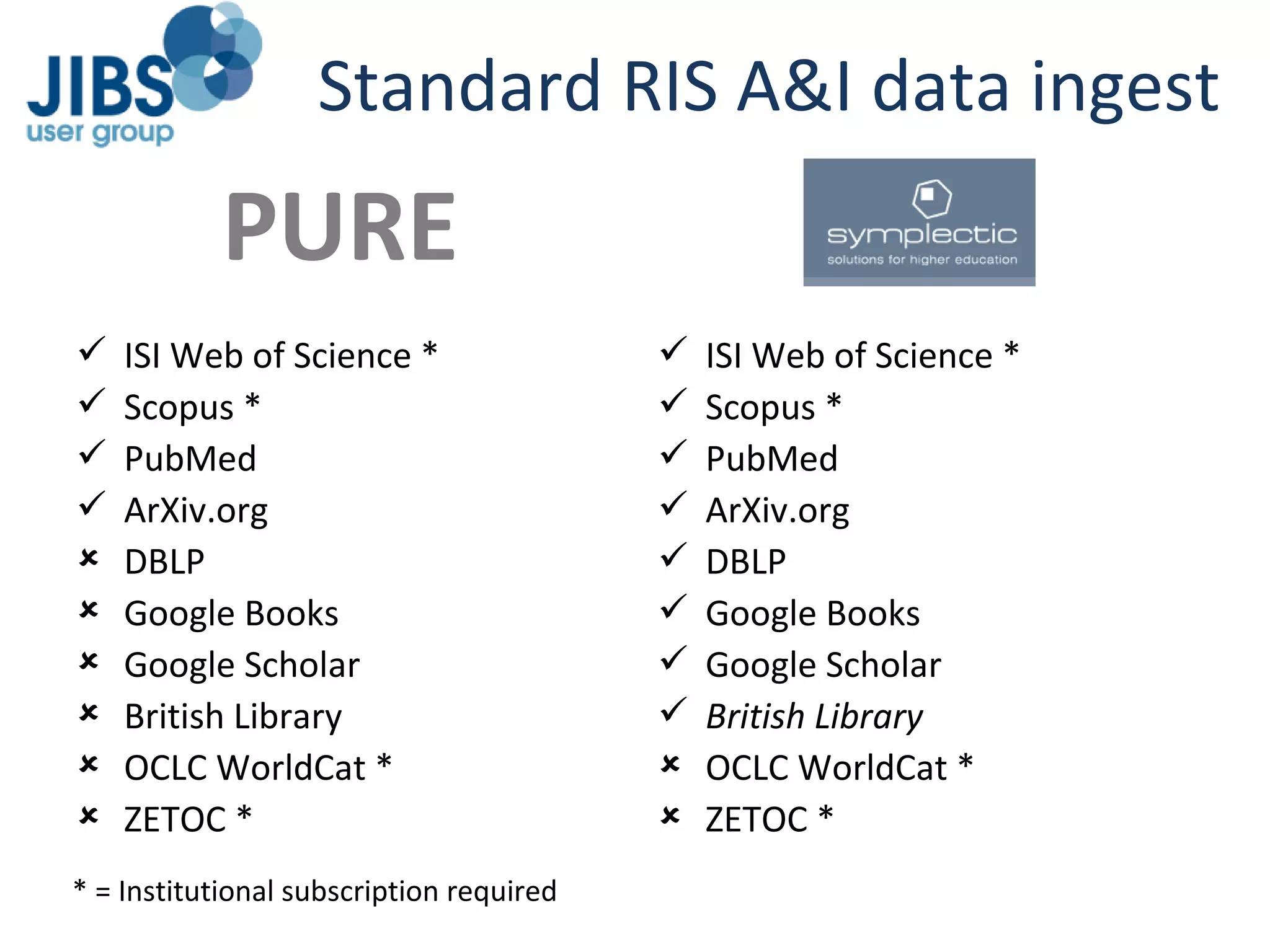
Standard RIS A&I data ingest PURE ISI Web of Science * Scopus * PubMed ArXiv.org DBLP Google Books Google Scholar British Library OCLC WorldCat * ZETOC * Symplectic ISI Web of Science * Scopus * PubMed ArXiv.org DBLP Google Books Google Scholar British Library OCLC WorldCat * ZETOC * * = Institutional subscription required
EVENTS DEAR BOY, EVENTS (Harold Macmillan 1894-1986)
2009 Merger Royal Holloway St George’s  Medical School Merge..err?
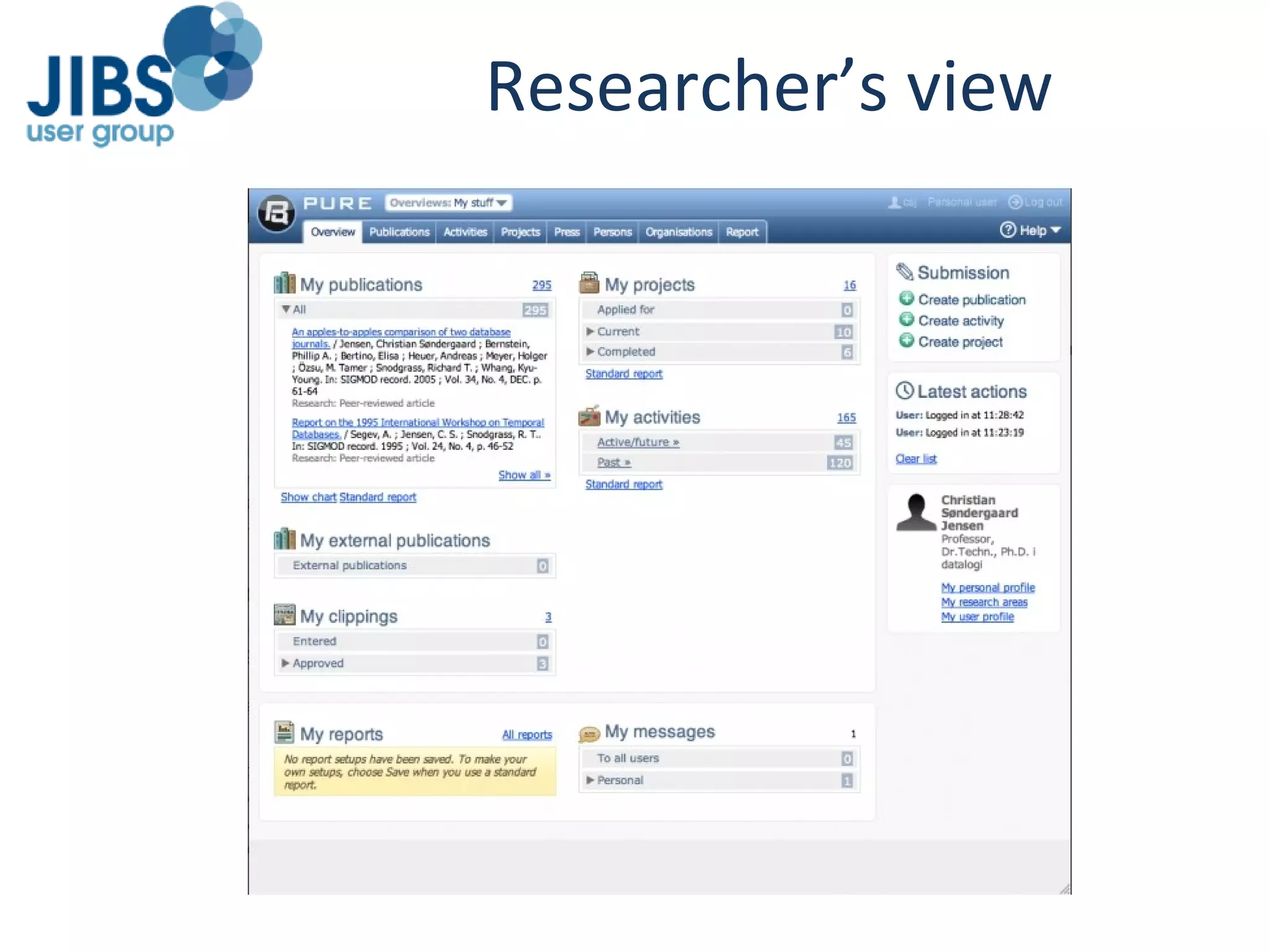
PURE V3 SCREENSHOTS RIS example
Researcher’s view
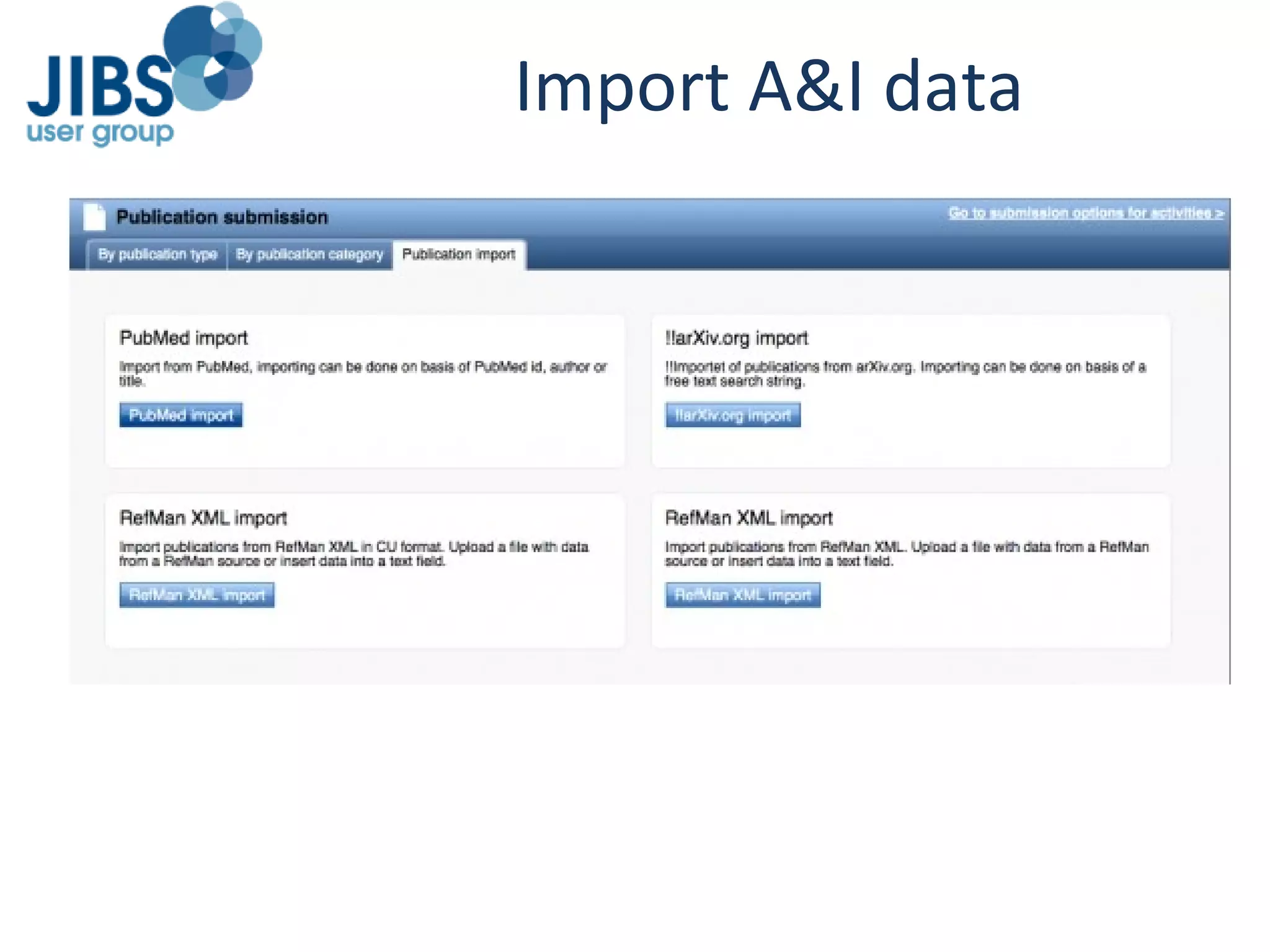
Import A&I data
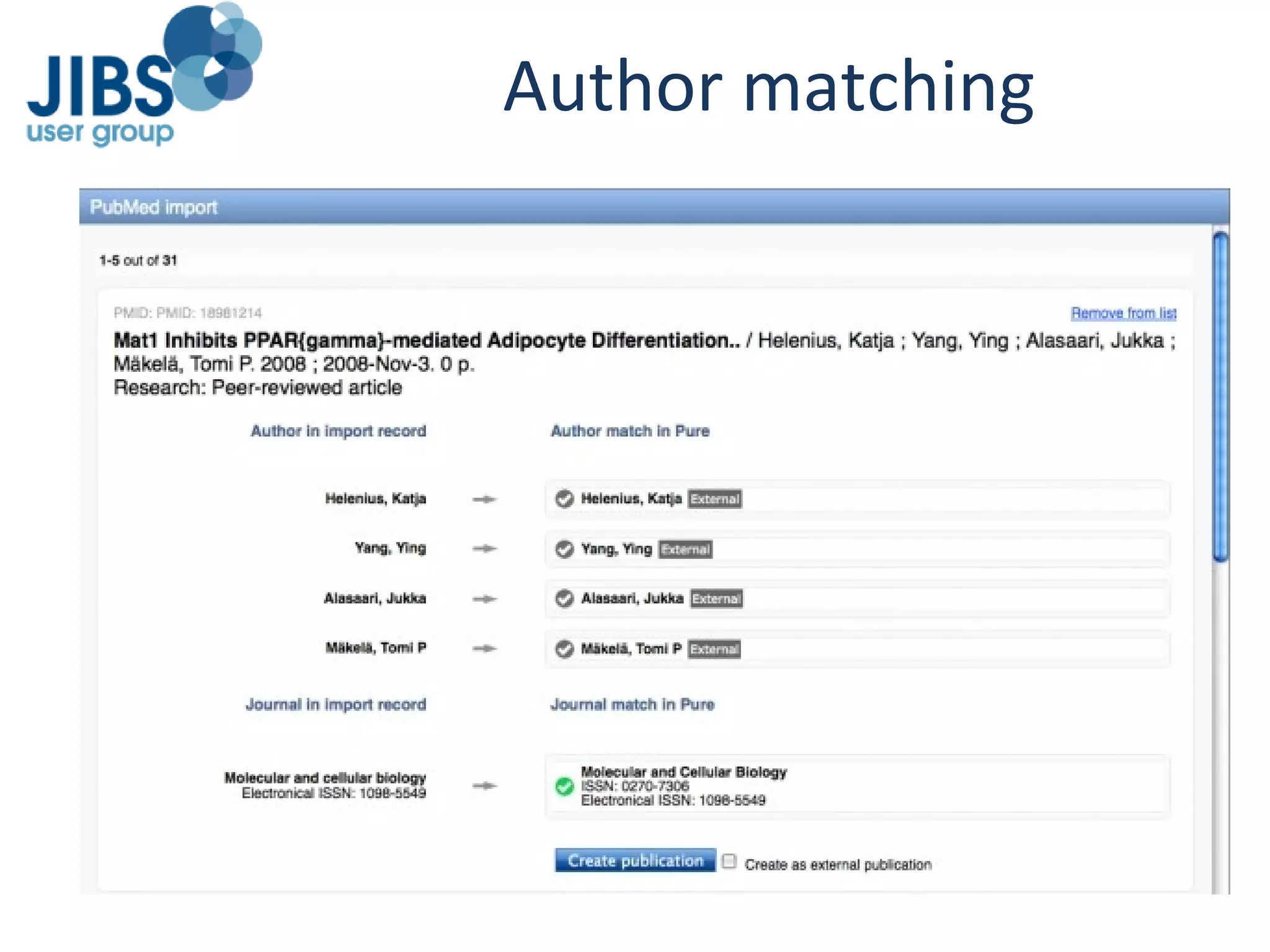
Author matching
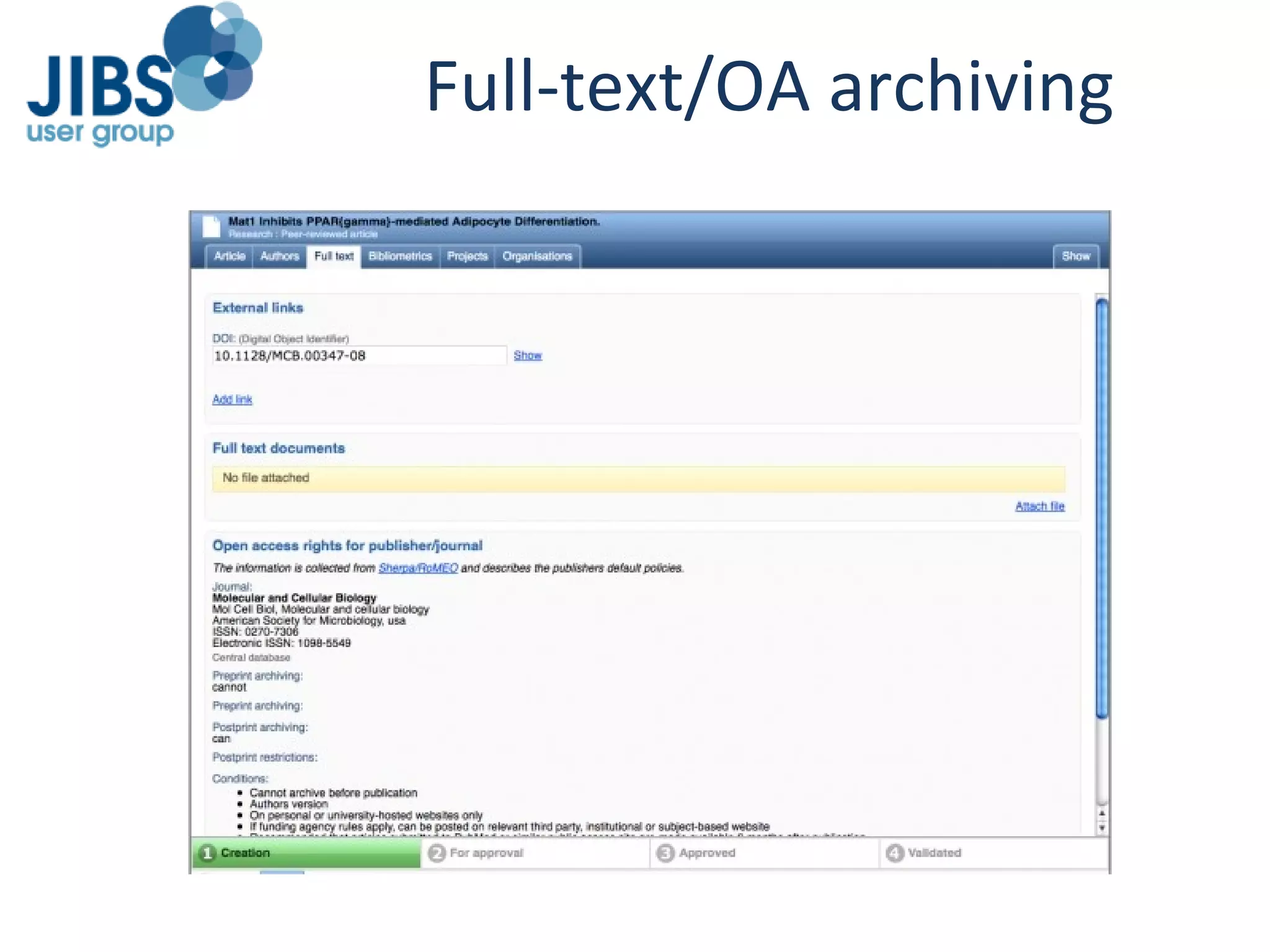
Full-text/OA archiving
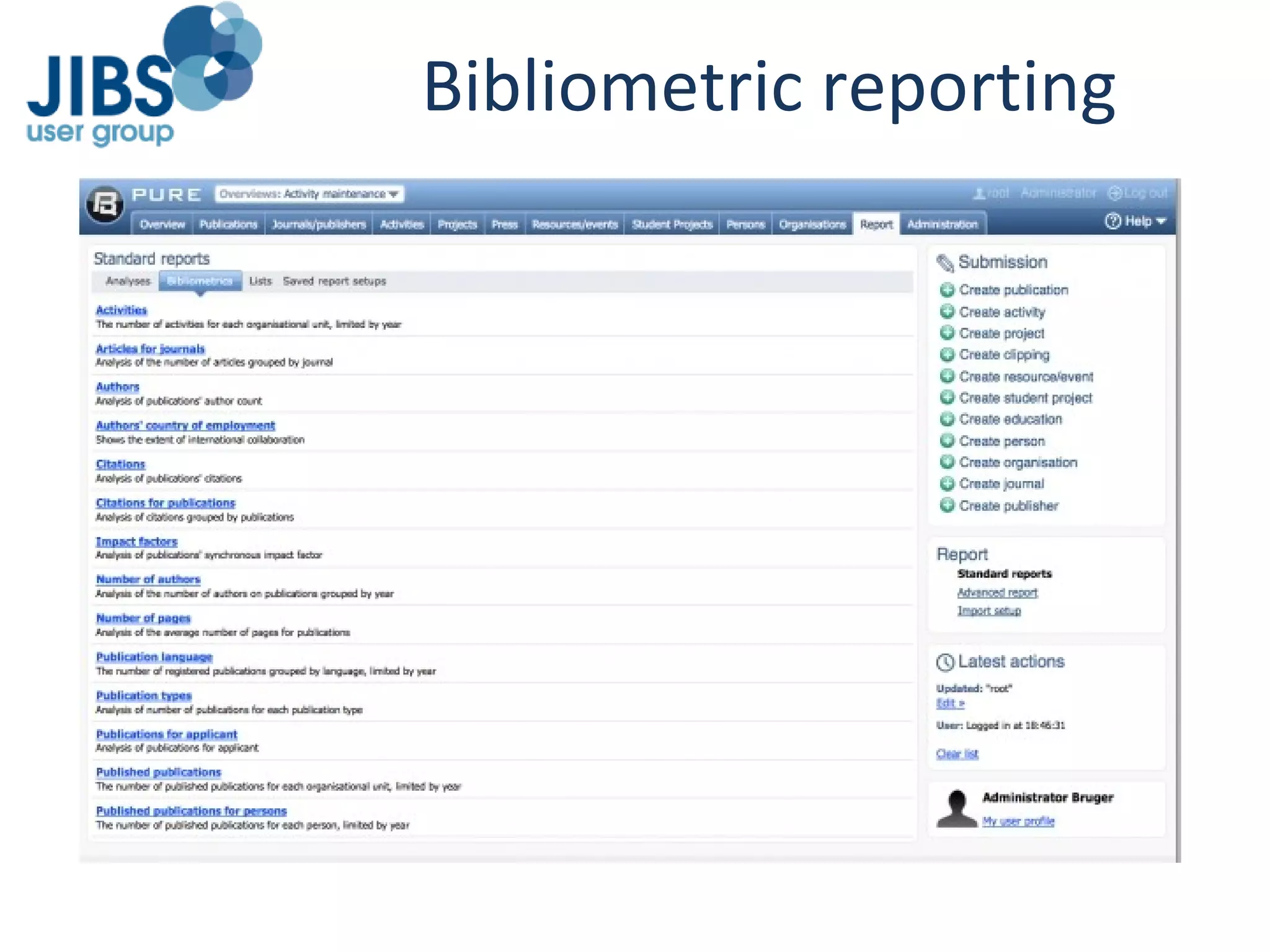
Bibliometric reporting
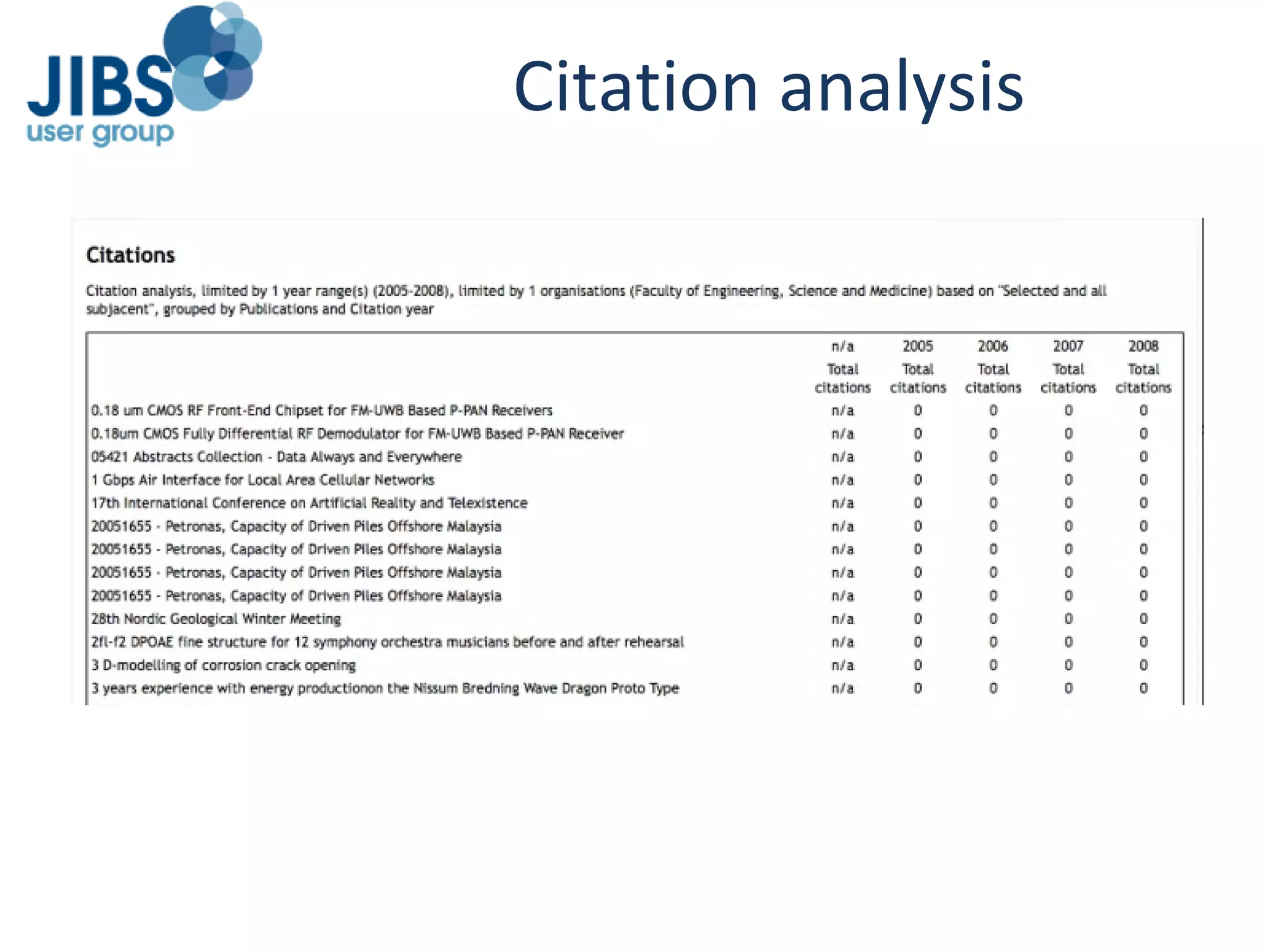
Citation analysis
Conclusion – Long live A&I A&I services have a new and vital role to play in HEI REF/general research administration thanks to the new market for RIS Reduce manual ingest of bibliographic data Sometimes are the only means of identifying past HEI research Facilitate output benchmarking thanks to controlled vocabularies and added-value metadata
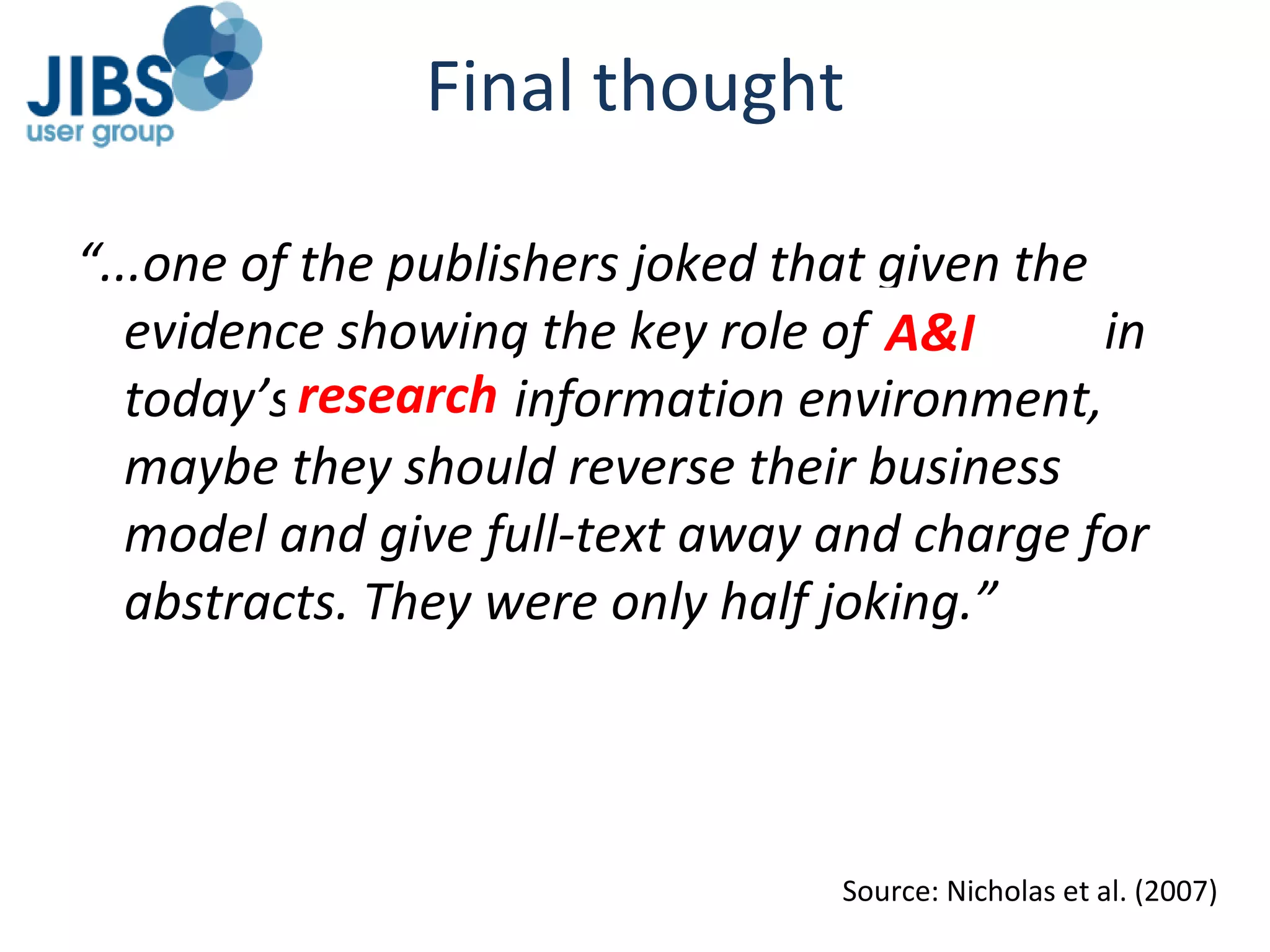
“ ...one of the publishers joked that given the evidence showing the key role of abstracts in today’s crowded information environment, maybe they should reverse their business model and give full-text away and charge for abstracts. They were only half joking.” Final thought Source: Nicholas et al. (2007) A&I research
References & Thanks CIBER (2008) Information behaviour of the researcher of the future. Available from:  http://tinyurl.com/c377rk HEFCE (2009a) Report on the pilot exercise to develop bibliometric indicators for the Research Excellence Framework. Available  from:  http://tinyurl.com/yhru5so HEFCE (2009b) The Research Excellence Framework: A brief guide to the proposals. Available from:  http://tinyurl.com/yljnw44 Nicholas, D., Huntingdon, P. & Jamali, H.R. (2007) The Use, Users, and Role of Abstracts in the Digital Scholarly Environment.  Journal of Academic Librarianship  Vol.33(4),pp.446-453. RIN (2009) Communicating knowledge: how and why researchers publish their findings. Available from:  http://tinyurl.com/ydumxyt Tennopir, C. & King, D. (2008) Electronic Journals and Changes in Scholarly Article Seeking and Reading Patterns.  D-Lib Magazine , Vol.14(11/12). Available from:  http://tinyurl.com/5sd3td Thanks to Adrian Joyce (Business Analyst, RHUL) for RIS material PURE screenshots (c) copyright Atira A/S 2009 [email_address] @timwales
http://www.flickr.com/photos/nickbush/450151862/

JIBS 2009 Bibliometrics And The REF 2009-11-13

  • 1.
    BIBLIOMETRICS AND THEREF: WHAT DO RESEARCHERS WANT OR NEED FOR THE FUTURE? Tim Wales, Associate Director (E-Strategy) Royal Holloway, University of London 13 th November 2009
  • 2.
  • 3.
  • 4.
    King’s College London(former Pharmacy Library) Source: http:// http://www.flickr.com/photos/albedo/541536327
  • 5.
  • 6.
    London Business SchoolSource: http://www.flickr.com/photos/ashishaggarwal/2983190165/
  • 7.
  • 8.
    Trinity College, BridgefordUniversity Source: http:// www.flickr.com/photos/bathintime/3726752408/ Royal Holloway, University of London
  • 9.
  • 10.
  • 11.
    Red card tobibliometrics? HEFCE Pilot exercise 2008-09 concluded: “ ...citation information is not sufficiently robust to be used formulaically or as a primary indicator of quality, but there is consider scope for it to inform and enhance the process of peer review.” HEFCE Pilot exercise 2008-09 concluded: “ ...citation information is not sufficiently robust to be used formulaically or as a primary indicator of quality , but there is consider scope for it to inform and enhance the process of peer review.” Source: HEFCE (2009b), p.3
  • 12.
    More of ayellow card... Details of citation data use Sub-panels decide in advance # of citations for each output provided With “appropriate benchmarks” To “inform and supplement” review “ Robust” citation data UoAs Medicine Science Engineering Arts Humanities “ others” Source: HEFCE (2009b), p.3
  • 13.
    ...with final warning(s)Clear guidelines on using the data robustly to take account of the known limitations and to avoid bias Panels will not make judgements about quality of outputs solely on the basis of citation information; expert information must be applied All submitted outputs will be treated equally, whether or not citation information available Source: HEFCE (2009b), p.3 Clear guidelines on using the data robustly to take account of the known limitations and to avoid bias Panels will not make judgements about quality of outputs solely on the basis of citation information; expert information must be applied All submitted outputs will be treated equally , whether or not citation information available
  • 14.
  • 15.
    Methodology Thomson ReutersWeb of Science and Elsevier Scopus citation data used 22 HEIs took part 35 UoAs from 2008 RAE used (Coverage greater than 40% in citation databases) Publications between 2001 and 2006 inclusive + citation data to 2007 3 data gathering models tested Journal articles + review papers only
  • 16.
    Bibliometric models Publicationdata by institutional address Publication data by staff, all outputs Publication data by staff, selected outputs
  • 17.
    Model summary Institutionaladdress Papers assigned to HEIs on basis of author address in WoS/Scopus Also assigned to subject categories based on destination journal Staff, all outputs All papers by staff submitted to RAE2008 for the pilot UoAs Staff, selected outputs 6 most highly cited outputs of staff in 2.  Too ‘burdensome’  Not individual/UoA specific 4 
  • 18.
    Data gathering issuesThere were difficulties for some in drawing together data from disparate sources, some of which were not held electronically. Many institutions also found it difficult to comprehensively identify all published research produced by their staff (especially former staff). ...further issues arose due to the need to disambiguate papers written by different people with the same name (especially for larger institutions)
  • 19.
    UoA publishing variationsTend to publish in conference proceedings? Source: HEFCE (2009a), p.154
  • 20.
    Coverage variations Source:HEFCE (2009a), p.158 (Education 85% not indexed)
  • 21.
  • 22.
  • 23.
    Journals dominate Source:Communicating knowledge, p.17
  • 24.
    Monographs less soSource: Communicating knowledge, p.18
  • 25.
    RAE distorts behaviourSource: Communicating knowledge, p.34
  • 26.
    UK researchers needTLC Many researchers are confused by the mixed messages they are receiving as to how best to communicate their findings.... Funders, learned societies and publishers may also wish to consider whether they might take more of a lead in helping to devise guidelines on good practice [in attribtion & listing of authors] Research timescales need to be carefully considered in any arrangements for the assessment of performance. Source: Communicating knowledge, pp.6-7
  • 27.
  • 28.
    Power browsers Source:Tennopir & King, 2008 Printed TOCs, indices etc c.75%
  • 29.
    Tennopir & KingISB summary US scientists increased number of readings (from libraries) via searching & citations Broader range of readings thanks to Library subscriptions to online collections 80% of articles >10 years found via online searching or citation (links) US scientists read many articles for every one that they cite Choosing the best article to cite may be subject to peer pressure in the form of choosing more often to cite those that are cited by others. Following citation links in e-journal articles may have proportionately more influence on citation behavior than reading behavior (3 decade analysis)
  • 30.
  • 31.
    Digital ISBs Horizontalinformation seeking Viewers Power browsers “ 60% of e-journal users view no more than 3 pages” “ Average time on e-book or e-journal sites: 4-8 mins” “ Power browse horizontally through titles, contents pages and abstracts going for quick wins” horizontal bouncing checking viewing promiscuous diverse volatile Source: CIBER, 2008
  • 32.
    Nicholas et al.study Source: Nicholas et al., 2007
  • 33.
  • 34.
    Given that... TheHEFCE Bibliometric pilot found that HEIs had major difficulties in sourcing and providing accurate publication data efficiently There is still a limited need for citation data for REF RAE submission trends and external ISB research indicate an increase in journal article publishing and use across most disciplines Today’s and tomorrow’s researchers value A&I data from libraries to aid power browsing and identifying articles to cite
  • 35.
    It follows that...HEIs and researchers need a REF compliant system that: contains all of an HEI’s publication data for current and former staff Provides citation and benchmarking data for those UoAs that will be using it in the REF Harnesses researchers use of Library A&I databases to good effect Interfaces with existing bibliographic and web systems, e.g. OA repository to help promote individual outputs and raise profiles
  • 36.
  • 37.
  • 38.
    [email_address] Web ofScience PubMed etc Research Managers Institutional Repository Importing of bibliographic data Researchers Validation of bibliographic data Submission of research artefacts Depositing research artefacts Research Management System Library staff Querying of research output data HEFCE HR ID Mgt CMS Querying RHUL Systems Submission of bibliographic data WWW Updating researchers’ websites Grants REF
  • 39.
    RIS products... AssistedHEFCE REF Pilot PURE CONVERIS (Develop in-house solutions such as at University College Dublin)
  • 40.
  • 41.
  • 42.
  • 43.
    Standard RIS A&Idata ingest PURE ISI Web of Science * Scopus * PubMed ArXiv.org DBLP Google Books Google Scholar British Library OCLC WorldCat * ZETOC * Symplectic ISI Web of Science * Scopus * PubMed ArXiv.org DBLP Google Books Google Scholar British Library OCLC WorldCat * ZETOC * * = Institutional subscription required
  • 44.
    EVENTS DEAR BOY,EVENTS (Harold Macmillan 1894-1986)
  • 45.
    2009 Merger RoyalHolloway St George’s Medical School Merge..err?
  • 46.
  • 47.
  • 48.
  • 49.
  • 50.
  • 51.
  • 52.
  • 53.
    Conclusion – Longlive A&I A&I services have a new and vital role to play in HEI REF/general research administration thanks to the new market for RIS Reduce manual ingest of bibliographic data Sometimes are the only means of identifying past HEI research Facilitate output benchmarking thanks to controlled vocabularies and added-value metadata
  • 54.
    “ ...one ofthe publishers joked that given the evidence showing the key role of abstracts in today’s crowded information environment, maybe they should reverse their business model and give full-text away and charge for abstracts. They were only half joking.” Final thought Source: Nicholas et al. (2007) A&I research
  • 55.
    References & ThanksCIBER (2008) Information behaviour of the researcher of the future. Available from: http://tinyurl.com/c377rk HEFCE (2009a) Report on the pilot exercise to develop bibliometric indicators for the Research Excellence Framework. Available from: http://tinyurl.com/yhru5so HEFCE (2009b) The Research Excellence Framework: A brief guide to the proposals. Available from: http://tinyurl.com/yljnw44 Nicholas, D., Huntingdon, P. & Jamali, H.R. (2007) The Use, Users, and Role of Abstracts in the Digital Scholarly Environment. Journal of Academic Librarianship Vol.33(4),pp.446-453. RIN (2009) Communicating knowledge: how and why researchers publish their findings. Available from: http://tinyurl.com/ydumxyt Tennopir, C. & King, D. (2008) Electronic Journals and Changes in Scholarly Article Seeking and Reading Patterns. D-Lib Magazine , Vol.14(11/12). Available from: http://tinyurl.com/5sd3td Thanks to Adrian Joyce (Business Analyst, RHUL) for RIS material PURE screenshots (c) copyright Atira A/S 2009 [email_address] @timwales
  • 56.