Reed Reactor Special Requal Lecture
Reactors of the Future
Generations III+ through V
Ian Flower
What will we cover?
Tour of Reactor Designs
Generation III+
Generation IV
Generation V
Limitations/Advantages of Each
Road Map for the future
Reed Reactor Special Requal Lecture
Where are we?
Reed Reactor Special Requal Lecture
Advanced Reactors
Improvements on current designs:
ABWR (Advanced Boiling Water Reactor)
ESBWR (Economic Simplified BWR)
Subcritical Reactors
Thorium-Based Reactors
Reed Reactor Special Requal Lecture
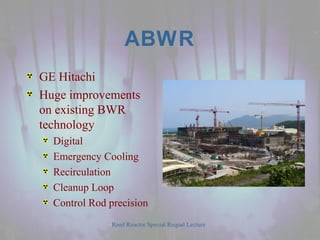
ABWR
GE Hitachi
Huge improvements
on existing BWR
technology
Digital
Emergency Cooling
Recirculation
Cleanup Loop
Control Rod precision
Reed Reactor Special Requal Lecture
ESBWR
No Recirculation
Pumps
Core is shorter
Gravity makes it
passively safe.
Reed Reactor Special Requal Lecture
Generation IV
Goals
Environmental Friendliness
Minimization of Waste
Fuel Utilization
Efficiency
Lower costs
Passive Safety
Eliminate need for offsite
emergency response
Terrorist-proof reactors
Designs
GFR (Gas-cooled Fast)
LFR (Lead-cooled Fast)
SFR (Sodium-cooled Fast)
MSR (Molten-Salt Reactor)
SCWR (SuperCritical
Water)
VHTR (Very High
Temperature)
Reed Reactor Special Requal Lecture
Gas-cooled Fast
Reactor
Reed Reactor Special Requal Lecture
Gas-cooled Fast
Reactor
GFR
CO2 or He
Higher Temperature
Non activated coolant
No flashes to steam
Have to consider:
Neutron absorption leads to
positive void coefficient
Fuel Elements
Ceramics
Good at High Temperature
Retain Fission Fragments
Reed Reactor Special Requal Lecture
A Note About Fast
Reactors
No Moderator
Difficult to control
Control rods are too
slow to make
adjustments
Stabilized instead by:
Doppler Broadening
Neutron Poisons
Neutron Reflector
Acceptable fuels
Uranium, Obviously
But more things, too!
Thorium yields U233
Transuranics
Breeder potential
Reed Reactor Special Requal Lecture
Sodium-cooled Fast
Reactor
Reed Reactor Special Requal Lecture
Sodium-cooled Fast
Reactor
The closest to construction
Cons:
Sodium activates
Sodium is really reactive
Pros:
Can reuse high-level waste
soon
Sodium can be kept at
atmospheric pressure
Sodium is a bad moderator
Several reactors connected
to same water system
Reed Reactor Special Requal Lecture
Another Note About
Fast Reactors
Excess heat can be
used to produce
Hydrogen fuel
I’ll leave the
deciphering of this
diagram to others
Reed Reactor Special Requal Lecture
Lead-cooled Fast
Reactor
Reed Reactor Special Requal Lecture
Lead-cooled Fast
Reactor
I know what you’re
thinking.
WHY LEAD?!
Shielding
Terrorism-Prevention
Non moderator
Non-reacting
Thermal conductivity
High Boiling Point
But current designs
would have cores that
last 10-30 years!
Reed Reactor Special Requal Lecture
A Final Note on Fast
Reactors
Nuclear Fuel Cycle
Life cycle of nuclear
fuel from mining to
disposal
Open Fuel Cycle (aka
once through)
Use the fuel once,
dispose of it
Closed Fuel Cycle
Fuel is reprocessed
Reed Reactor Special Requal Lecture
Molten Salt Reactor
Reed Reactor Special Requal Lecture
Two types:
•LFTR
•UF4
Molten Salt Reactor
Pros:
Leaks are easy to contain
High temperature leads to
good thermal efficiency
Work in all sizes
Already proven technology
Terrorist-proof
Refuel as you go
Cons:
Chemical processing plants
can pose additional risks
Reed Reactor Special Requal Lecture
A Note on the Thorium
Fuel Cycle
Thorium is 3-4 times as abundant as U238
Thorium comes in the isotope you want
Higher Melting Point
Higher Thermal conductivity
Reed Reactor Special Requal Lecture
What the H is
Supercritical Water?
Reed Reactor Special Requal Lecture
Supercritical Water
Reactor
Reed Reactor Special Requal Lecture
Supercritical Water
Reactor
Supercritical Water: not as
good of a moderator
Pros:
Could operate as a Thermal
Reactor or Fast Reactor
Much more efficient energy
gain
Simpler Designs
Don’t have to be as large
Cons:
Need better materials
Need to figure out how to
start up
Not sure how it will work
Reed Reactor Special Requal Lecture
Why would we still use
Thermal Reactors?
To augment the cycle
that we already have:
Fast reactors make the
waste disposal needs of
thermal reactors
obsolete
Thermal reactors
generate lots of power
Thermal reactors are
easy to build and
control
Reed Reactor Special Requal Lecture
Very High Temperature
Reactor
Reed Reactor Special Requal Lecture
Very High Temperature
Reactor
Most common design:
Pebble Bed Reactor
Tennis-ball sized spheres of
moderator and fissile material
Ceramics
Cooled by a gas, can be
cooled naturally
Pros:
Economic
Hydrogen Production
Safer than current reactors
Cons:
Materials research needed
Reed Reactor Special Requal Lecture
Generation V
Theoretical Designs:
Nuclear Thermal Rocket
Nuclear Lightbulb (Rocket)
Fission Fragment Reactor (Rocket)
There is a trend here
Reed Reactor Special Requal Lecture
Nuclear Thermal
Rocket
Pass a working fluid
through a reactor
Create thrust
Liquid Core designs
Liquid mixture of
fuel/working gas
Gas Core designs
Toroidal pocket of
gaseous fuel
Reed Reactor Special Requal Lecture
Nuclear Thermal
Rocket
Problems:
Not incredibly efficient
unless Liquid/Gas
Liquid/Gas are hard to
build
Pros:
Liquid/Gas would be
amazing
Reed Reactor Special Requal Lecture
Nuclear Lightbulb
Gas Core
Very Hot
Approx. 25000 C
Hotter than the surface
of the sun
EM produced all
Ultraviolet
Quartz wall divides
core and propellant
Reed Reactor Special Requal Lecture
Nuclear Lightbulb
As a Power Reactor?
Closed loop
Working gas instead of
propellant
Pros:
Efficient conversion of
energy to power
Cons:
25000 C? Wow!
Neutron Flux would be
unwieldy Reed Reactor Special Requal Lecture
Gas Core EM Reactor
Reed Reactor Special Requal Lecture
Nuclear Lightbulb
Photo-Voltaics
Photo-Voltaics
Fission Fragment
Rocket
The concept:
Fission produces heavy, high energy
byproducts
Exhaust the fission fragments!
Reed Reactor Special Requal Lecture
Fission Fragment
Rocket
Reed Reactor Special Requal Lecture
a fissionable filaments,
b revolving disks,
c reactor core,
d fragments exhaust
A fission fragments ejected for propulsion
B reactor
C fission fragments decelerated for power generation
d moderator (BeO or LiH),
e containment field generator,
f RF induction coil
Fission Fragment
Reactor
But what about
power?
Part C produce
electricity
Pros:
Skip the Carnot Cycle
Incredibly efficient
Isotopic Separation
Reed Reactor Special Requal Lecture
Timeline
Viability:
Show that it all works
in theory
Performance
Show that it all works
individually in practice
Demonstration
Build large prototypes
and watch carefully
Reed Reactor Special Requal Lecture
Two Graphs For You
Reed Reactor Special Requal Lecture

Reactors of the Future

  • 1.
    Reed Reactor SpecialRequal Lecture Reactors of the Future Generations III+ through V Ian Flower
  • 2.
    What will wecover? Tour of Reactor Designs Generation III+ Generation IV Generation V Limitations/Advantages of Each Road Map for the future Reed Reactor Special Requal Lecture
  • 3.
    Where are we? ReedReactor Special Requal Lecture
  • 4.
    Advanced Reactors Improvements oncurrent designs: ABWR (Advanced Boiling Water Reactor) ESBWR (Economic Simplified BWR) Subcritical Reactors Thorium-Based Reactors Reed Reactor Special Requal Lecture
  • 5.
    ABWR GE Hitachi Huge improvements onexisting BWR technology Digital Emergency Cooling Recirculation Cleanup Loop Control Rod precision Reed Reactor Special Requal Lecture
  • 6.
    ESBWR No Recirculation Pumps Core isshorter Gravity makes it passively safe. Reed Reactor Special Requal Lecture
  • 7.
    Generation IV Goals Environmental Friendliness Minimizationof Waste Fuel Utilization Efficiency Lower costs Passive Safety Eliminate need for offsite emergency response Terrorist-proof reactors Designs GFR (Gas-cooled Fast) LFR (Lead-cooled Fast) SFR (Sodium-cooled Fast) MSR (Molten-Salt Reactor) SCWR (SuperCritical Water) VHTR (Very High Temperature) Reed Reactor Special Requal Lecture
  • 8.
  • 9.
    Gas-cooled Fast Reactor GFR CO2 orHe Higher Temperature Non activated coolant No flashes to steam Have to consider: Neutron absorption leads to positive void coefficient Fuel Elements Ceramics Good at High Temperature Retain Fission Fragments Reed Reactor Special Requal Lecture
  • 10.
    A Note AboutFast Reactors No Moderator Difficult to control Control rods are too slow to make adjustments Stabilized instead by: Doppler Broadening Neutron Poisons Neutron Reflector Acceptable fuels Uranium, Obviously But more things, too! Thorium yields U233 Transuranics Breeder potential Reed Reactor Special Requal Lecture
  • 11.
  • 12.
    Sodium-cooled Fast Reactor The closestto construction Cons: Sodium activates Sodium is really reactive Pros: Can reuse high-level waste soon Sodium can be kept at atmospheric pressure Sodium is a bad moderator Several reactors connected to same water system Reed Reactor Special Requal Lecture
  • 13.
    Another Note About FastReactors Excess heat can be used to produce Hydrogen fuel I’ll leave the deciphering of this diagram to others Reed Reactor Special Requal Lecture
  • 14.
  • 15.
    Lead-cooled Fast Reactor I knowwhat you’re thinking. WHY LEAD?! Shielding Terrorism-Prevention Non moderator Non-reacting Thermal conductivity High Boiling Point But current designs would have cores that last 10-30 years! Reed Reactor Special Requal Lecture
  • 16.
    A Final Noteon Fast Reactors Nuclear Fuel Cycle Life cycle of nuclear fuel from mining to disposal Open Fuel Cycle (aka once through) Use the fuel once, dispose of it Closed Fuel Cycle Fuel is reprocessed Reed Reactor Special Requal Lecture
  • 17.
    Molten Salt Reactor ReedReactor Special Requal Lecture Two types: •LFTR •UF4
  • 18.
    Molten Salt Reactor Pros: Leaksare easy to contain High temperature leads to good thermal efficiency Work in all sizes Already proven technology Terrorist-proof Refuel as you go Cons: Chemical processing plants can pose additional risks Reed Reactor Special Requal Lecture
  • 19.
    A Note onthe Thorium Fuel Cycle Thorium is 3-4 times as abundant as U238 Thorium comes in the isotope you want Higher Melting Point Higher Thermal conductivity Reed Reactor Special Requal Lecture
  • 20.
    What the His Supercritical Water? Reed Reactor Special Requal Lecture
  • 21.
  • 22.
    Supercritical Water Reactor Supercritical Water:not as good of a moderator Pros: Could operate as a Thermal Reactor or Fast Reactor Much more efficient energy gain Simpler Designs Don’t have to be as large Cons: Need better materials Need to figure out how to start up Not sure how it will work Reed Reactor Special Requal Lecture
  • 23.
    Why would westill use Thermal Reactors? To augment the cycle that we already have: Fast reactors make the waste disposal needs of thermal reactors obsolete Thermal reactors generate lots of power Thermal reactors are easy to build and control Reed Reactor Special Requal Lecture
  • 24.
    Very High Temperature Reactor ReedReactor Special Requal Lecture
  • 25.
    Very High Temperature Reactor Mostcommon design: Pebble Bed Reactor Tennis-ball sized spheres of moderator and fissile material Ceramics Cooled by a gas, can be cooled naturally Pros: Economic Hydrogen Production Safer than current reactors Cons: Materials research needed Reed Reactor Special Requal Lecture
  • 26.
    Generation V Theoretical Designs: NuclearThermal Rocket Nuclear Lightbulb (Rocket) Fission Fragment Reactor (Rocket) There is a trend here Reed Reactor Special Requal Lecture
  • 27.
    Nuclear Thermal Rocket Pass aworking fluid through a reactor Create thrust Liquid Core designs Liquid mixture of fuel/working gas Gas Core designs Toroidal pocket of gaseous fuel Reed Reactor Special Requal Lecture
  • 28.
    Nuclear Thermal Rocket Problems: Not incrediblyefficient unless Liquid/Gas Liquid/Gas are hard to build Pros: Liquid/Gas would be amazing Reed Reactor Special Requal Lecture
  • 29.
    Nuclear Lightbulb Gas Core VeryHot Approx. 25000 C Hotter than the surface of the sun EM produced all Ultraviolet Quartz wall divides core and propellant Reed Reactor Special Requal Lecture
  • 30.
    Nuclear Lightbulb As aPower Reactor? Closed loop Working gas instead of propellant Pros: Efficient conversion of energy to power Cons: 25000 C? Wow! Neutron Flux would be unwieldy Reed Reactor Special Requal Lecture
  • 31.
    Gas Core EMReactor Reed Reactor Special Requal Lecture Nuclear Lightbulb Photo-Voltaics Photo-Voltaics
  • 32.
    Fission Fragment Rocket The concept: Fissionproduces heavy, high energy byproducts Exhaust the fission fragments! Reed Reactor Special Requal Lecture
  • 33.
    Fission Fragment Rocket Reed ReactorSpecial Requal Lecture a fissionable filaments, b revolving disks, c reactor core, d fragments exhaust A fission fragments ejected for propulsion B reactor C fission fragments decelerated for power generation d moderator (BeO or LiH), e containment field generator, f RF induction coil
  • 34.
    Fission Fragment Reactor But whatabout power? Part C produce electricity Pros: Skip the Carnot Cycle Incredibly efficient Isotopic Separation Reed Reactor Special Requal Lecture
  • 35.
    Timeline Viability: Show that itall works in theory Performance Show that it all works individually in practice Demonstration Build large prototypes and watch carefully Reed Reactor Special Requal Lecture
  • 36.
    Two Graphs ForYou Reed Reactor Special Requal Lecture

Editor's Notes

  • #6 In construction.
  • #7 Soon.
  • #9 600 MW 850C
  • #10 GA announced design in 2010
  • #12 Power: 150-1500 MW Pressure: 0.5 MPa (Atmoshperic: 0.1 Mpa) Temperature: 550C
  • #13 2015, maybe?
  • #15 Power: 120-1200 MW Temperate: 550-800C
  • #16 Pb melts at, 327C. Pb/Bi melts at 135 degrees C, so coolant can be melted to be brought to power after shutdown. 2019 in Russia, US soonish
  • #17 SNF: 3% of the mass consists of fission products of  235 U and  239 Pu About 1% of the mass is  239 Pu and  240 Pu  resulting from conversion of  238 U, which may be considered either as a useful byproduct, or as dangerous and inconvenient waste. 96% of the mass is the remaining uranium: most of the original  238 U and a little  235 U. Usually  235 U would be less than 0.83% of the mass along with 0.4%  236 U Traces of the  minor actinides  are present in spent reactor fuel.
  • #18 Power: 1000MW Pressure: 0.5 MPa (Atmoshperic: 0.1 Mpa) Temperature: 700C
  • #19 When cold, the fuel salts radiogenically produce corrosive, chemically reactive fluorine gas. Although a very slow process, the salts should be defueled and wastes removed before extended shutdowns to avoid (non-radioactive) fluorine gas production. Unfortunately, this was discovered the unpleasant way, while the MSRE (Oakridge) was shut-down over a 20-year period. Japan is building a 100-200 MW reactor, but full sized ones are 20 years away and no plans are under way yet.
  • #21 Water: 22.1 Mpa, 374C
  • #22 1700 MW Pressure: 25 Mpa Temperature: 550C
  • #23   The SCWR concept is being investigated by 32 organizations in 13 countries.
  • #25 600MW Temperatures >1000C
  • #26 Two full-scale pebble-bed HTGRs, each with 100 - 195 MW e  of electrical production capacity are under construction in China at the present as of November 2009. The US is thinking about it.