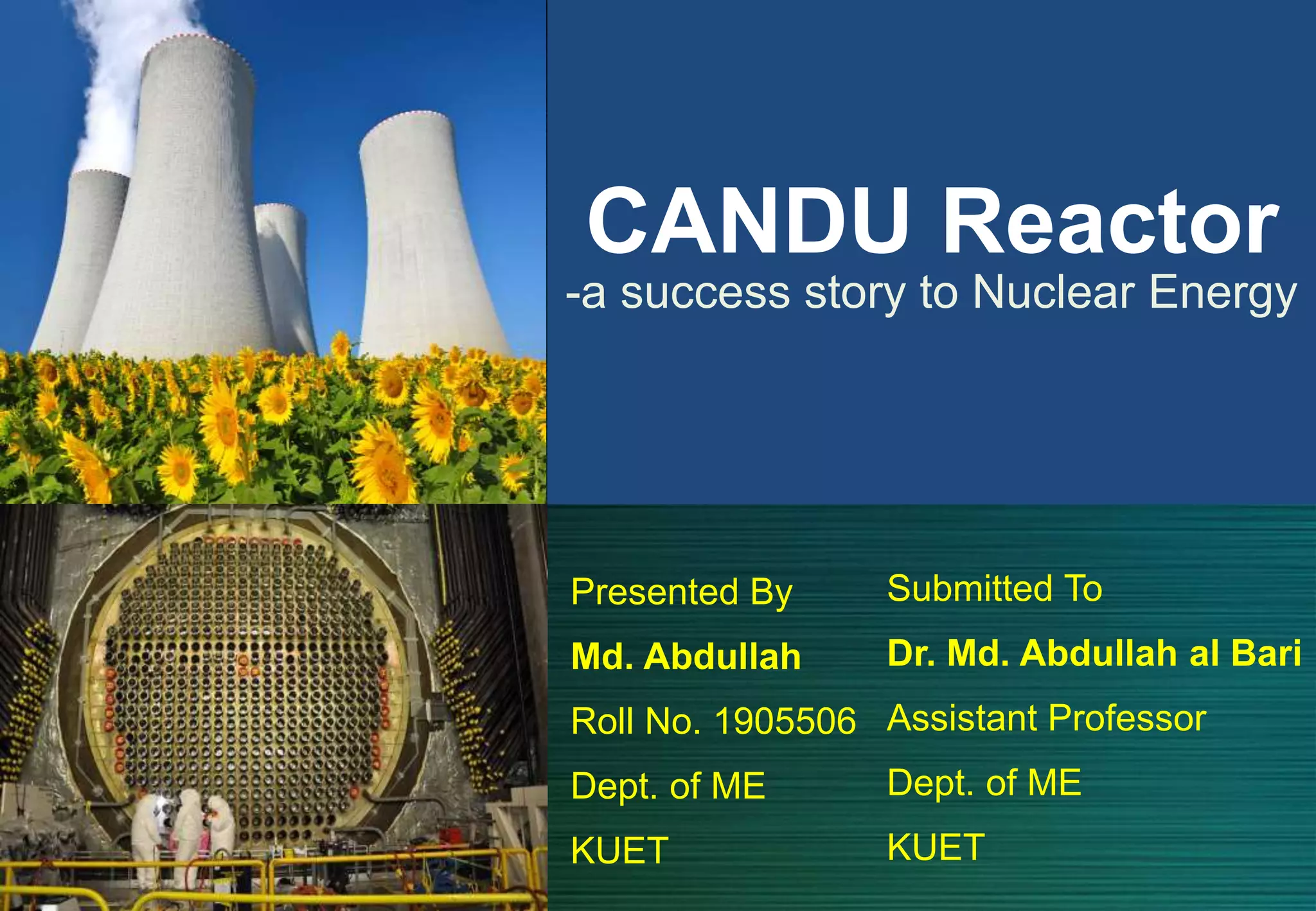
CANDU Reactor
-a success story to Nuclear Energy
Presented By
Md. Abdullah
Roll No. 1905506
Dept. of ME
KUET
Submitted To
Dr. Md. Abdullah al Bari
Assistant Professor
Dept. of ME
KUET
Outline
 Understanding a Nuclear Reactor
 CANDU Reactors Design
 The Pros and Cons
 CANDU reactors contribution to global Nuclear Energy
Understanding of a Nuclear Reactor…
Nuclear Reactor
 It is a system used to initiate and contain a nuclear
chain reaction.
 These nuclear reactions produce thermal
energy through either nuclear fission (in practice)
or nuclear fusion (in development).
 Used for the generation of electricity.
 however they can be used for propulsion in vehicles
such as submarines or naval vessels.
3
Understanding of a Nuclear Reactor…
Components of a Nuclear Reactor
1. Fuel- Uranium
2. Moderator- usually water, may be heavy water or
Graphite which slows down the neutrons.
3. Control Roads- neutron-absorbing material such as
cadmium, hafnium or boron used to control the rate of
reaction.
4. Coolant- a fluid circulating through the core so as to
transfer the heat from it.
4
Understanding of a Nuclear Reactor…
Components of a Nuclear Reactor
5. Pressure Vessel or Pressure Tubes- usually a
robust steel vessel containing the reactor core and
moderator/coolant, but it may be a series of tubes holding
the fuel and conveying the coolant through the
surrounding moderator.
6. Steam Generator- produce steam and power
generator.
7. Containment- a structure designed to protect it from
outside intrusion and to protect those outside from the
effects of radiation.
5
Understanding of a Nuclear Reactor…
Current Technologies of Nuclear Reactor
1. Pressurized water reactors (PWR)- [moderator: high-
pressure water; coolant: high-pressure water]
2. Boiling water reactors (BWR)- [moderator: low-
pressure water; coolant: low-pressure water]
3. Pressurized Heavy Water Reactor (PHWR)-
[moderator: high-pressure heavy water; coolant: high-
pressure heavy water]
4. Reaktor Bolshoy Moschnosti Kanalniy (High Power
Channel Reactor) (RBMK)- [moderator: graphite;
coolant: high-pressure water]
Source: https://en.wikipedia.org/wiki/Nuclear_reactor#Reactor_types
6
Understanding of a Nuclear Reactor…
Current Technologies of Nuclear Reactor
5. Gas-cooled reactor (GCR) and advanced gas-cooled
reactor (AGR)- [moderator: graphite; coolant: carbon
dioxide]
6. Liquid-metal fast-breeder reactor (LMFBR)- [moderator:
none; coolant: liquid metal]
7. Pebble-bed reactors (PBR)- [moderator: graphite;
coolant: helium]
8. Molten salt reactors (MSR)- [moderator: graphite;
coolant: molten salt mixture]
9. Aqueous Homogeneous Reactor (AHR)- [moderator:
high-pressure light or heavy water; coolant: high-
pressure light or heavy water]
Source: https://en.wikipedia.org/wiki/Nuclear_reactor#Reactor_types
7
Understanding of a Nuclear Reactor…
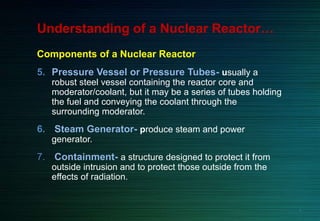
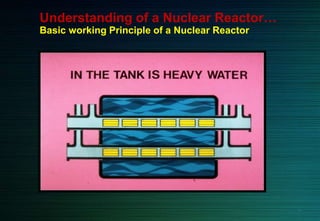
Basic working Principle of a Nuclear Reactor
8
Understanding of a Nuclear Reactor…
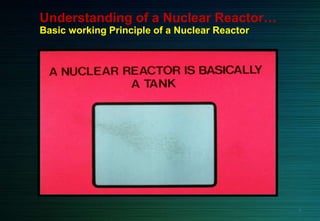
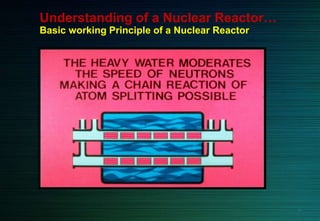
Basic working Principle of a Nuclear Reactor
9
Understanding of a Nuclear Reactor…
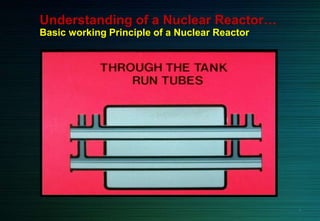
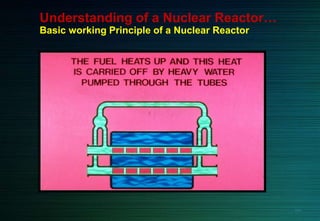
Basic working Principle of a Nuclear Reactor
10
Understanding of a Nuclear Reactor…
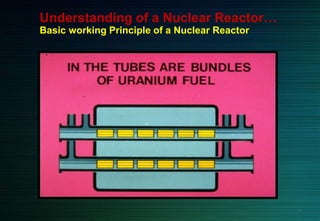
Basic working Principle of a Nuclear Reactor
11
Understanding of a Nuclear Reactor…
Basic working Principle of a Nuclear Reactor
12
Understanding of a Nuclear Reactor…
Basic working Principle of a Nuclear Reactor
1313
Understanding of a Nuclear Reactor…
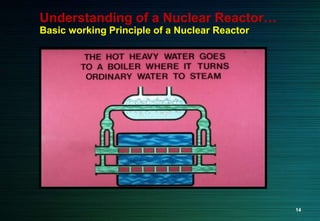
Basic working Principle of a Nuclear Reactor
14
CANDU Reactors Design
Introduction
The CANDU (CANada Deuterium Uranium) reactor is a
pressurized heavy water reactor (PHWR) of Canadian
Design and it uses deuterium oxide as a moderator and
uranium as a fuel.
Atomic Energy of Canada Limited (AECL) developed the
CANDU reactor technology starting in the 1950s and 1960s.
CANDU Reactors Design
There are two types of Candu designs are currently being
used.
1. Candu 6- The original design is about 500 MWe when
multi reactor installed and about 600 MWe for single
stand
2. Candu 9- about 900 MWe.
CANDU Reactors Design
Characteristics of Elements
Fuel
Use natural or un-enriched Uranium (composed of 0.7%
Uranium-235 and remaining mostly 99.3% Uranium-238).
Fuel in the form of uranium oxide powder is packed into pellets
and placed in the fuel rods.
The fuel bundle (37 Rods) is approximately 50 cm in length and
10 cm in diameter.
Source: https://energyeducation.ca/encyclopedia/CANDU_reactor
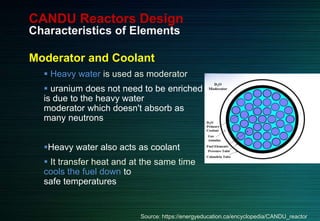
Moderator and Coolant
 Heavy water is used as moderator
 uranium does not need to be enriched
is due to the heavy water
moderator which doesn't absorb as
many neutrons
Heavy water also acts as coolant
 It transfer heat and at the same time
cools the fuel down to
safe temperatures
Source: https://energyeducation.ca/encyclopedia/CANDU_reactor
CANDU Reactors Design
Characteristics of Elements
Steam Generator
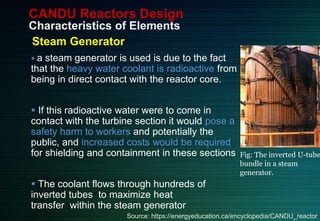
 a steam generator is used is due to the fact
that the heavy water coolant is radioactive from
being in direct contact with the reactor core.
 If this radioactive water were to come in
contact with the turbine section it would pose a
safety harm to workers and potentially the
public, and increased costs would be required
for shielding and containment in these sections
 The coolant flows through hundreds of
inverted tubes to maximize heat
transfer within the steam generator
Fig: The inverted U-tube
bundle in a steam
generator.
Source: https://energyeducation.ca/encyclopedia/CANDU_reactor
CANDU Reactors Design
Characteristics of Elements
On-line Refueling
In a conventional design with a pressurized core, refuelling
the system requires the core to shut down and the pressure
vessel to be opened.
Due to the arrangement used in CANDU, only the single
tube being refuelled needs to be depressurized. This allows
the CANDU system to be continually refuelled without
shutting down, another major design goal.
Source: https://energyeducation.ca/encyclopedia/CANDU_reactor
CANDU Reactors Design
Characteristics of Elements
Reactor Building
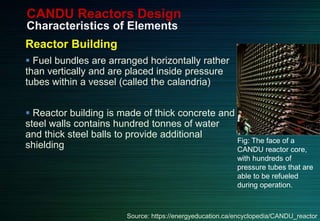
 Fuel bundles are arranged horizontally rather
than vertically and are placed inside pressure
tubes within a vessel (called the calandria)
 Reactor building is made of thick concrete and
steel walls contains hundred tonnes of water
and thick steel balls to provide additional
shielding
Fig: The face of a
CANDU reactor core,
with hundreds of
pressure tubes that are
able to be refueled
during operation.
Source: https://energyeducation.ca/encyclopedia/CANDU_reactor
CANDU Reactors Design
Characteristics of Elements
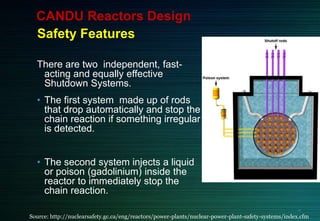
There are two independent, fast-
acting and equally effective
Shutdown Systems.
• The first system made up of rods
that drop automatically and stop the
chain reaction if something irregular
is detected.
• The second system injects a liquid
or poison (gadolinium) inside the
reactor to immediately stop the
chain reaction.
Safety Features
Source: http://nuclearsafety.gc.ca/eng/reactors/power-plants/nuclear-power-plant-safety-systems/index.cfm
CANDU Reactors Design
22
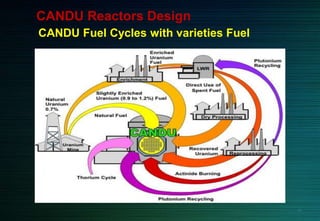
CANDU Fuel Cycles with varieties Fuel
CANDU Reactors Design
23
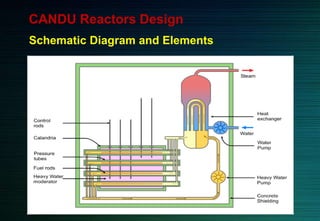
Schematic Diagram and Elements
CANDU Reactors Design
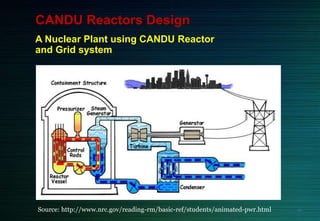
A Nuclear Plant using CANDU Reactor
and Grid system
Source: http://www.nrc.gov/reading-rm/basic-ref/students/animated-pwr.html
CANDU Reactors Design
25
 They use natural, unenriched uranium as a fuel.
 can be refueled while operating at full power, while most
other designs must be shut down for refueling.
 As natural uranium does not require enrichment, fuel
costs for CANDU reactors are very low.
 CANDU uses about 15% less uranium than a pressurized
water reactor for each megawatt of electricity produced.
 Heavy water is always available. It can be produced
locally and re-used.
The Pros and Cons
26
 Heavy water is expensive.
 CANDU reactors could also be produce plutonium for
nuclear weapons.
 Heavy water absorbs few neutrons, and when it does,
it produces radioactive tritium. Tritium is a significant
radiation hazard.
The Pros and Cons
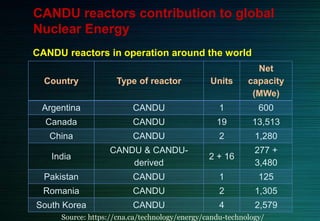
CANDU reactors in operation around the world
Country Type of reactor Units
Net
capacity
(MWe)
Argentina CANDU 1 600
Canada CANDU 19 13,513
China CANDU 2 1,280
India
CANDU & CANDU-
derived
2 + 16
277 +
3,480
Pakistan CANDU 1 125
Romania CANDU 2 1,305
South Korea CANDU 4 2,579
Source: https://cna.ca/technology/energy/candu-technology/
CANDU reactors contribution to global
Nuclear Energy
Thank You
29

Candu reactor

  • 1.
    CANDU Reactor -a successstory to Nuclear Energy Presented By Md. Abdullah Roll No. 1905506 Dept. of ME KUET Submitted To Dr. Md. Abdullah al Bari Assistant Professor Dept. of ME KUET
  • 2.
    Outline  Understanding aNuclear Reactor  CANDU Reactors Design  The Pros and Cons  CANDU reactors contribution to global Nuclear Energy
  • 3.
    Understanding of aNuclear Reactor… Nuclear Reactor  It is a system used to initiate and contain a nuclear chain reaction.  These nuclear reactions produce thermal energy through either nuclear fission (in practice) or nuclear fusion (in development).  Used for the generation of electricity.  however they can be used for propulsion in vehicles such as submarines or naval vessels. 3
  • 4.
    Understanding of aNuclear Reactor… Components of a Nuclear Reactor 1. Fuel- Uranium 2. Moderator- usually water, may be heavy water or Graphite which slows down the neutrons. 3. Control Roads- neutron-absorbing material such as cadmium, hafnium or boron used to control the rate of reaction. 4. Coolant- a fluid circulating through the core so as to transfer the heat from it. 4
  • 5.
    Understanding of aNuclear Reactor… Components of a Nuclear Reactor 5. Pressure Vessel or Pressure Tubes- usually a robust steel vessel containing the reactor core and moderator/coolant, but it may be a series of tubes holding the fuel and conveying the coolant through the surrounding moderator. 6. Steam Generator- produce steam and power generator. 7. Containment- a structure designed to protect it from outside intrusion and to protect those outside from the effects of radiation. 5
  • 6.
    Understanding of aNuclear Reactor… Current Technologies of Nuclear Reactor 1. Pressurized water reactors (PWR)- [moderator: high- pressure water; coolant: high-pressure water] 2. Boiling water reactors (BWR)- [moderator: low- pressure water; coolant: low-pressure water] 3. Pressurized Heavy Water Reactor (PHWR)- [moderator: high-pressure heavy water; coolant: high- pressure heavy water] 4. Reaktor Bolshoy Moschnosti Kanalniy (High Power Channel Reactor) (RBMK)- [moderator: graphite; coolant: high-pressure water] Source: https://en.wikipedia.org/wiki/Nuclear_reactor#Reactor_types 6
  • 7.
    Understanding of aNuclear Reactor… Current Technologies of Nuclear Reactor 5. Gas-cooled reactor (GCR) and advanced gas-cooled reactor (AGR)- [moderator: graphite; coolant: carbon dioxide] 6. Liquid-metal fast-breeder reactor (LMFBR)- [moderator: none; coolant: liquid metal] 7. Pebble-bed reactors (PBR)- [moderator: graphite; coolant: helium] 8. Molten salt reactors (MSR)- [moderator: graphite; coolant: molten salt mixture] 9. Aqueous Homogeneous Reactor (AHR)- [moderator: high-pressure light or heavy water; coolant: high- pressure light or heavy water] Source: https://en.wikipedia.org/wiki/Nuclear_reactor#Reactor_types 7
  • 8.
    Understanding of aNuclear Reactor… Basic working Principle of a Nuclear Reactor 8
  • 9.
    Understanding of aNuclear Reactor… Basic working Principle of a Nuclear Reactor 9
  • 10.
    Understanding of aNuclear Reactor… Basic working Principle of a Nuclear Reactor 10
  • 11.
    Understanding of aNuclear Reactor… Basic working Principle of a Nuclear Reactor 11
  • 12.
    Understanding of aNuclear Reactor… Basic working Principle of a Nuclear Reactor 12
  • 13.
    Understanding of aNuclear Reactor… Basic working Principle of a Nuclear Reactor 1313
  • 14.
    Understanding of aNuclear Reactor… Basic working Principle of a Nuclear Reactor 14
  • 15.
    CANDU Reactors Design Introduction TheCANDU (CANada Deuterium Uranium) reactor is a pressurized heavy water reactor (PHWR) of Canadian Design and it uses deuterium oxide as a moderator and uranium as a fuel. Atomic Energy of Canada Limited (AECL) developed the CANDU reactor technology starting in the 1950s and 1960s.
  • 16.
    CANDU Reactors Design Thereare two types of Candu designs are currently being used. 1. Candu 6- The original design is about 500 MWe when multi reactor installed and about 600 MWe for single stand 2. Candu 9- about 900 MWe.
  • 17.
    CANDU Reactors Design Characteristicsof Elements Fuel Use natural or un-enriched Uranium (composed of 0.7% Uranium-235 and remaining mostly 99.3% Uranium-238). Fuel in the form of uranium oxide powder is packed into pellets and placed in the fuel rods. The fuel bundle (37 Rods) is approximately 50 cm in length and 10 cm in diameter. Source: https://energyeducation.ca/encyclopedia/CANDU_reactor
  • 18.
    Moderator and Coolant Heavy water is used as moderator  uranium does not need to be enriched is due to the heavy water moderator which doesn't absorb as many neutrons Heavy water also acts as coolant  It transfer heat and at the same time cools the fuel down to safe temperatures Source: https://energyeducation.ca/encyclopedia/CANDU_reactor CANDU Reactors Design Characteristics of Elements
  • 19.
    Steam Generator  asteam generator is used is due to the fact that the heavy water coolant is radioactive from being in direct contact with the reactor core.  If this radioactive water were to come in contact with the turbine section it would pose a safety harm to workers and potentially the public, and increased costs would be required for shielding and containment in these sections  The coolant flows through hundreds of inverted tubes to maximize heat transfer within the steam generator Fig: The inverted U-tube bundle in a steam generator. Source: https://energyeducation.ca/encyclopedia/CANDU_reactor CANDU Reactors Design Characteristics of Elements
  • 20.
    On-line Refueling In aconventional design with a pressurized core, refuelling the system requires the core to shut down and the pressure vessel to be opened. Due to the arrangement used in CANDU, only the single tube being refuelled needs to be depressurized. This allows the CANDU system to be continually refuelled without shutting down, another major design goal. Source: https://energyeducation.ca/encyclopedia/CANDU_reactor CANDU Reactors Design Characteristics of Elements
  • 21.
    Reactor Building  Fuelbundles are arranged horizontally rather than vertically and are placed inside pressure tubes within a vessel (called the calandria)  Reactor building is made of thick concrete and steel walls contains hundred tonnes of water and thick steel balls to provide additional shielding Fig: The face of a CANDU reactor core, with hundreds of pressure tubes that are able to be refueled during operation. Source: https://energyeducation.ca/encyclopedia/CANDU_reactor CANDU Reactors Design Characteristics of Elements
  • 22.
    There are twoindependent, fast- acting and equally effective Shutdown Systems. • The first system made up of rods that drop automatically and stop the chain reaction if something irregular is detected. • The second system injects a liquid or poison (gadolinium) inside the reactor to immediately stop the chain reaction. Safety Features Source: http://nuclearsafety.gc.ca/eng/reactors/power-plants/nuclear-power-plant-safety-systems/index.cfm CANDU Reactors Design 22
  • 23.
    CANDU Fuel Cycleswith varieties Fuel CANDU Reactors Design 23
  • 24.
    Schematic Diagram andElements CANDU Reactors Design
  • 25.
    A Nuclear Plantusing CANDU Reactor and Grid system Source: http://www.nrc.gov/reading-rm/basic-ref/students/animated-pwr.html CANDU Reactors Design 25
  • 26.
     They usenatural, unenriched uranium as a fuel.  can be refueled while operating at full power, while most other designs must be shut down for refueling.  As natural uranium does not require enrichment, fuel costs for CANDU reactors are very low.  CANDU uses about 15% less uranium than a pressurized water reactor for each megawatt of electricity produced.  Heavy water is always available. It can be produced locally and re-used. The Pros and Cons 26
  • 27.
     Heavy wateris expensive.  CANDU reactors could also be produce plutonium for nuclear weapons.  Heavy water absorbs few neutrons, and when it does, it produces radioactive tritium. Tritium is a significant radiation hazard. The Pros and Cons
  • 28.
    CANDU reactors inoperation around the world Country Type of reactor Units Net capacity (MWe) Argentina CANDU 1 600 Canada CANDU 19 13,513 China CANDU 2 1,280 India CANDU & CANDU- derived 2 + 16 277 + 3,480 Pakistan CANDU 1 125 Romania CANDU 2 1,305 South Korea CANDU 4 2,579 Source: https://cna.ca/technology/energy/candu-technology/ CANDU reactors contribution to global Nuclear Energy
  • 29.