Speak Up National Findings
Annual Congressional Briefing
October 23, 2019
Julie A. Evans, Ed.D.
CEO, Project Tomorrow
@JulieEvans_PT
jevans@tomorrow.org
Digital Learning:
Peril or Promise for
our K-12 Students
Welcome to this year’s
Speak Up Briefing!
Be part of the discussion: @SpeakUpEd
▪ Nonprofit education organization supporting K-12 education since 1996
▪ Mission is to ensure today’s students are well prepared for the future
▪ Programs and research focus on role of innovation and new learning models
within the education ecosystem. We believe in the power of transformational
teaching and learning to support student preparation for college and career
success.
About Project Tomorrow
Speak Up Research Project on Digital Learning: supporting the
development of new leadership capacities within K-12 schools
and districts through the effective use of insights and views from
key stakeholder audiences
Today’s discussion
▪ Welcome to this year’s briefing!
▪ Opening remarks from Christina Fleming, Blackboard
▪ About the Speak Up Research Project
o Selected research findings from Speak Up 2018-19
o Conversations with our expert panel
▪ Let’s talk! What are your questions, ideas, comments, insights?
▪ Closing remarks from Richard Quinones, iboss
▪ Wrap up call to action
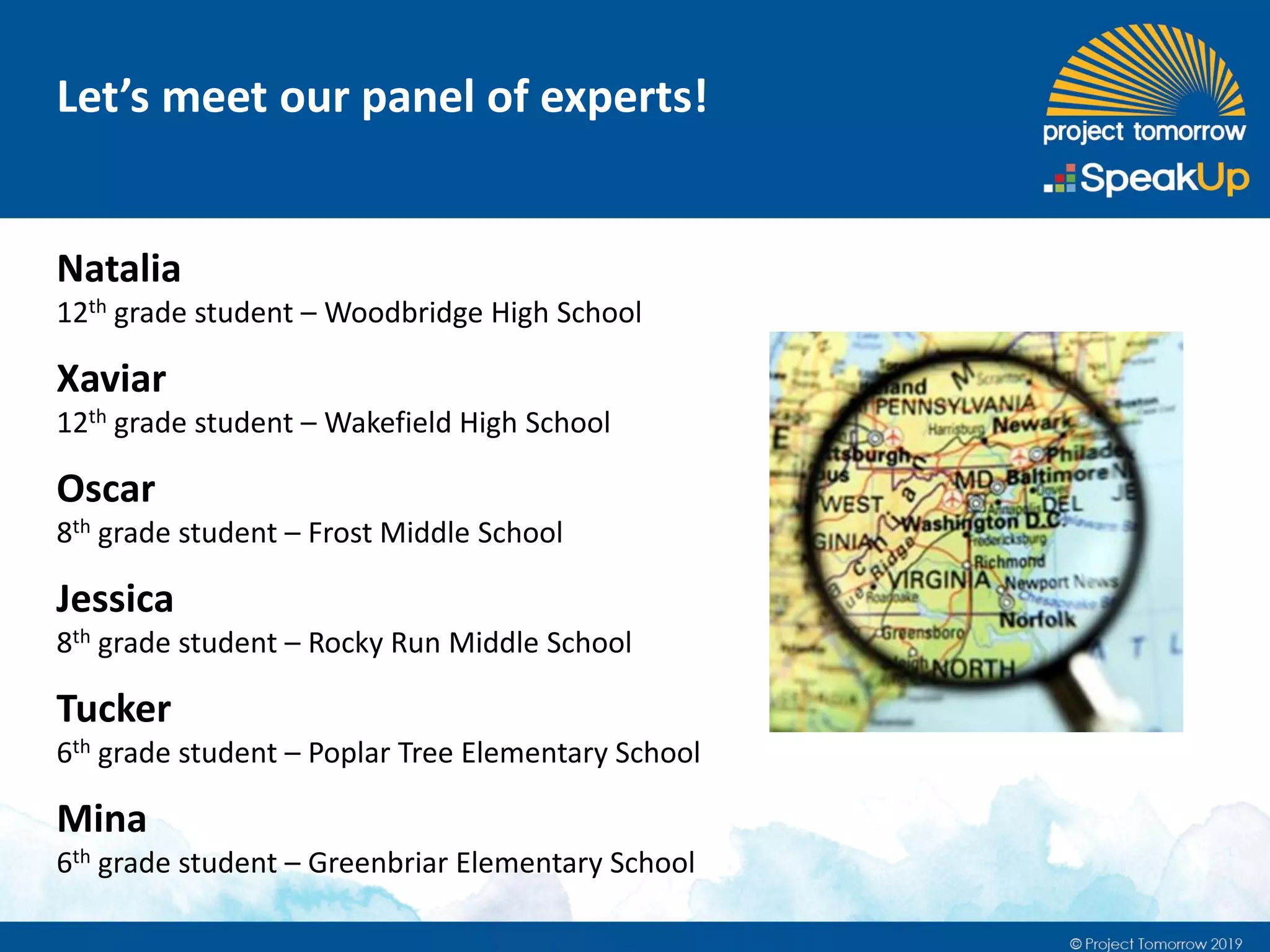
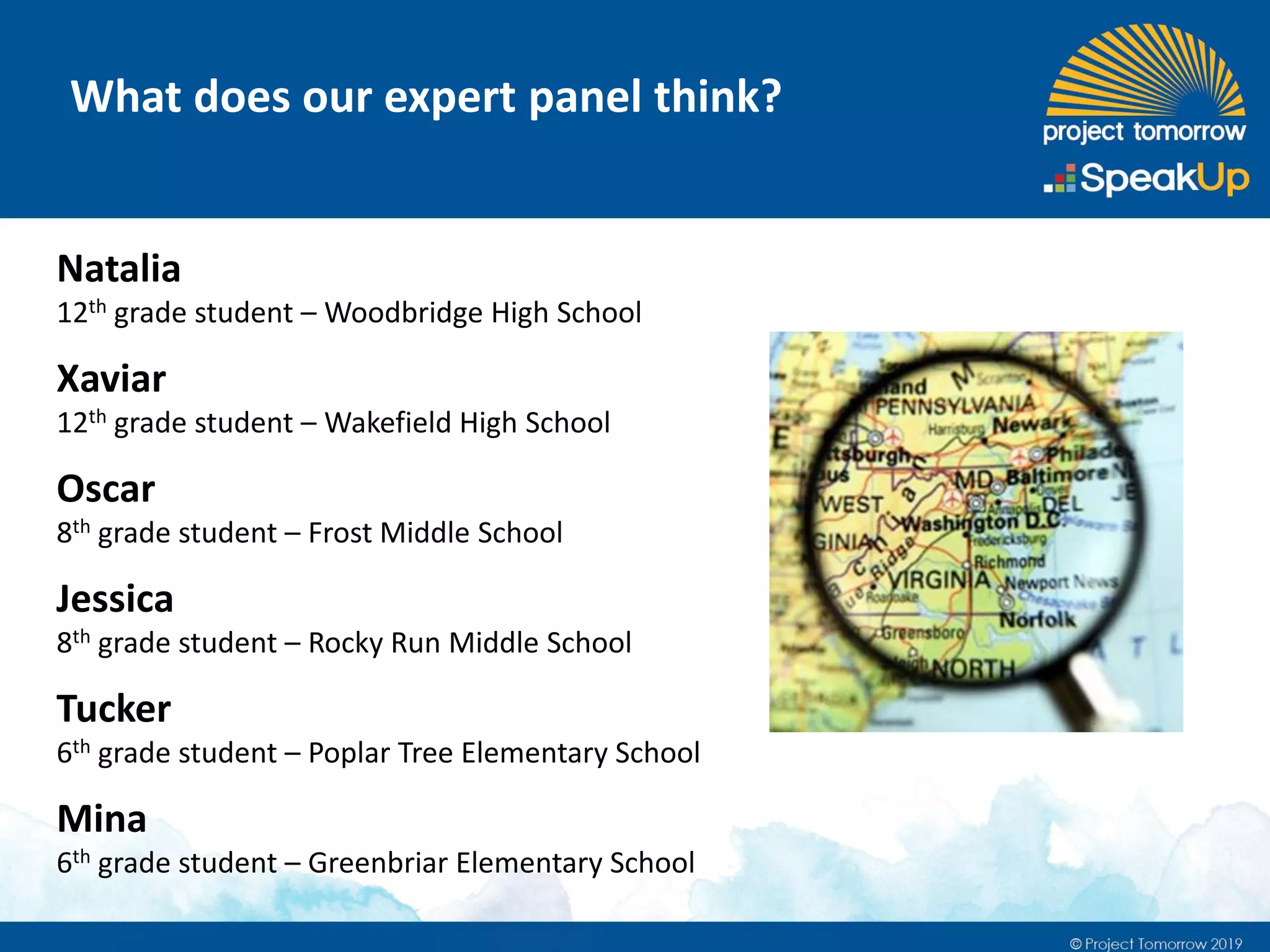
Natalia
12th grade student – Woodbridge High School
Xaviar
12th grade student – Wakefield High School
Oscar
8th grade student – Frost Middle School
Jessica
8th grade student – Rocky Run Middle School
Tucker
6th grade student – Poplar Tree Elementary School
Mina
6th grade student – Greenbriar Elementary School
Let’s meet our panel of experts!
Thank you!
Senator Tammy Baldwin
Wisconsin
We are very proud of our partnerships with these
organizations and many others!
Project Tomorrow salutes the following innovative
companies and organizations for their support of
Speak Up 2018-2019
Project Tomorrow salutes the following innovative
companies and organizations for their support of
Speak Up 2018-2019
Opening Remarks
Christina Fleming
Vice President
Blackboard
About the Speak Up Project
(www.tomorrow.org/speakup)
▪ Annual research project since 2003
▪ Facilitated 100% through schools and districts
▪ We provide education leaders with a suite of
online surveys they can use to collect feedback
from their K-12 stakeholders all year long
▪ All K-12 schools – public, private, parochial,
charter, virtual - are eligible to participate
▪ Schools get summary report with all locally
collected data + state and national data for
benchmarks
▪ Project Tomorrow manages all data collection
and reporting for schools as a 100% free
service
Since 2003, over 5.7 million K-12 stakeholders have submitted a Speak Up survey
✓ K-12 students
✓ Teachers
✓ Librarians and Media
Specialists
✓ Parents
✓ School site
administrators
✓ District administrators
✓ Technology leaders
✓ Public Information
Officers
✓ Community members
About the Speak Up Project
(www.tomorrow.org/speakup)
Activities:
How are education stakeholders
implementing new learning models
especially using technology?
Attitudes:
What do they value or care about
with those new learning
experiences?
Aspirations:
What their goals or desires for
higher impact with these new
learning models?
Surveys built for . . . . To learn about their ….
Speak Up is all about translating the views
and ideas of K-12 stakeholders into assets
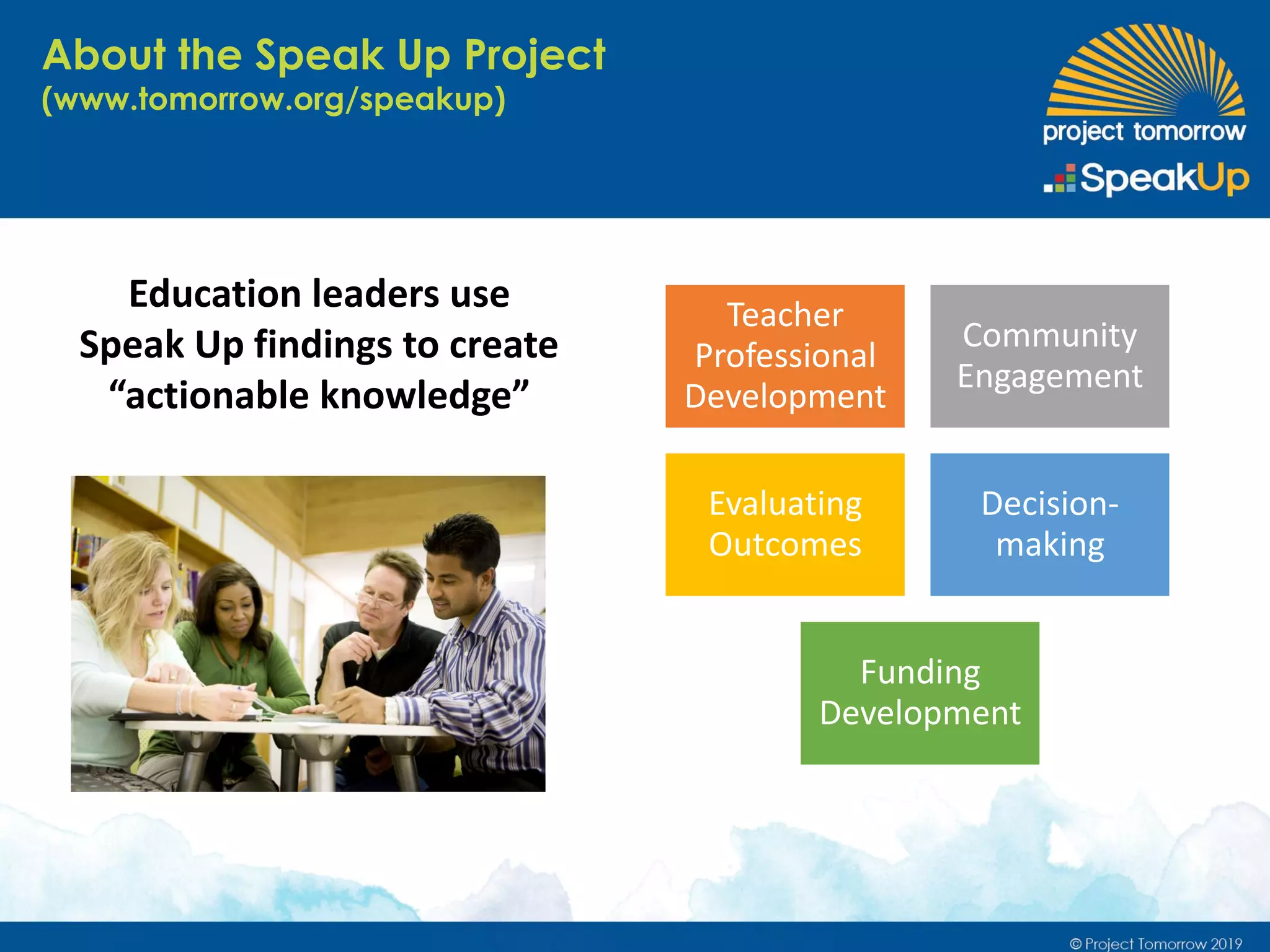
Education leaders use
Speak Up findings to create
“actionable knowledge”
About the Speak Up Project
(www.tomorrow.org/speakup)
Teacher
Professional
Development
Community
Engagement
Evaluating
Outcomes
Decision-
making
Funding
Development
Survey Audience # of Surveys Submitted
K-12 Students 289,273
Teachers & Librarians 26,951
Parents 21,951
Administrators 2,190
Community Members 3,861
National participation in Speak Up 2018-19
School demographics: 26% urban, 41% rural, 33% suburban, 59% title 1 eligible
Digital Learning: Peril or Promise for our K-12 Students
Why this topic this year?
✓ Assessment of progress
✓ Realistic view of impact
✓ Appreciating concerns
✓ What’s next?
How we will be tackling these important questions …
Digital Learning: Peril or Promise for our K-12 Students
▪ Students and digital learning today
▪ Defining the value of digital learning
▪ Addressing new concerns about digital
learning
How we will be tackling these important questions …
Digital Learning: Peril or Promise for our K-12 Students
Students and digital learning today:
▪ What technology or digital learning environments are
implemented in schools today?
▪ What access do students have to mobile devices in school?
▪ What digital content and online resources are students using
in school?
▪ What tools are students using outside of school to support
self-directed learning?
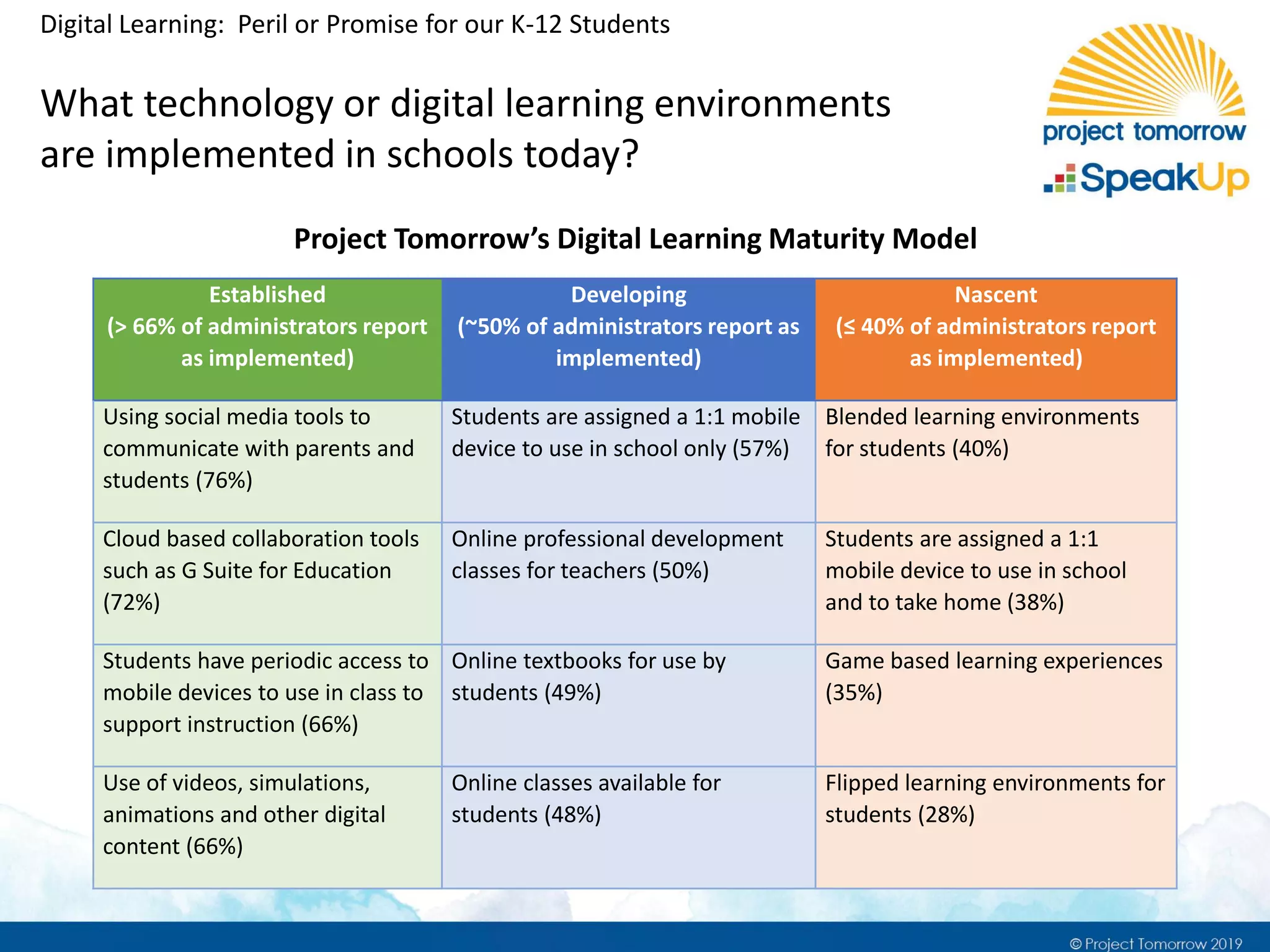
Established
(> 66% of administrators report
as implemented)
Developing
(~50% of administrators report as
implemented)
Nascent
(≤ 40% of administrators report
as implemented)
Using social media tools to
communicate with parents and
students (76%)
Students are assigned a 1:1 mobile
device to use in school only (57%)
Blended learning environments
for students (40%)
Cloud based collaboration tools
such as G Suite for Education
(72%)
Online professional development
classes for teachers (50%)
Students are assigned a 1:1
mobile device to use in school
and to take home (38%)
Students have periodic access to
mobile devices to use in class to
support instruction (66%)
Online textbooks for use by
students (49%)
Game based learning experiences
(35%)
Use of videos, simulations,
animations and other digital
content (66%)
Online classes available for
students (48%)
Flipped learning environments for
students (28%)
Digital Learning: Peril or Promise for our K-12 Students
What technology or digital learning environments
are implemented in schools today?
Project Tomorrow’s Digital Learning Maturity Model
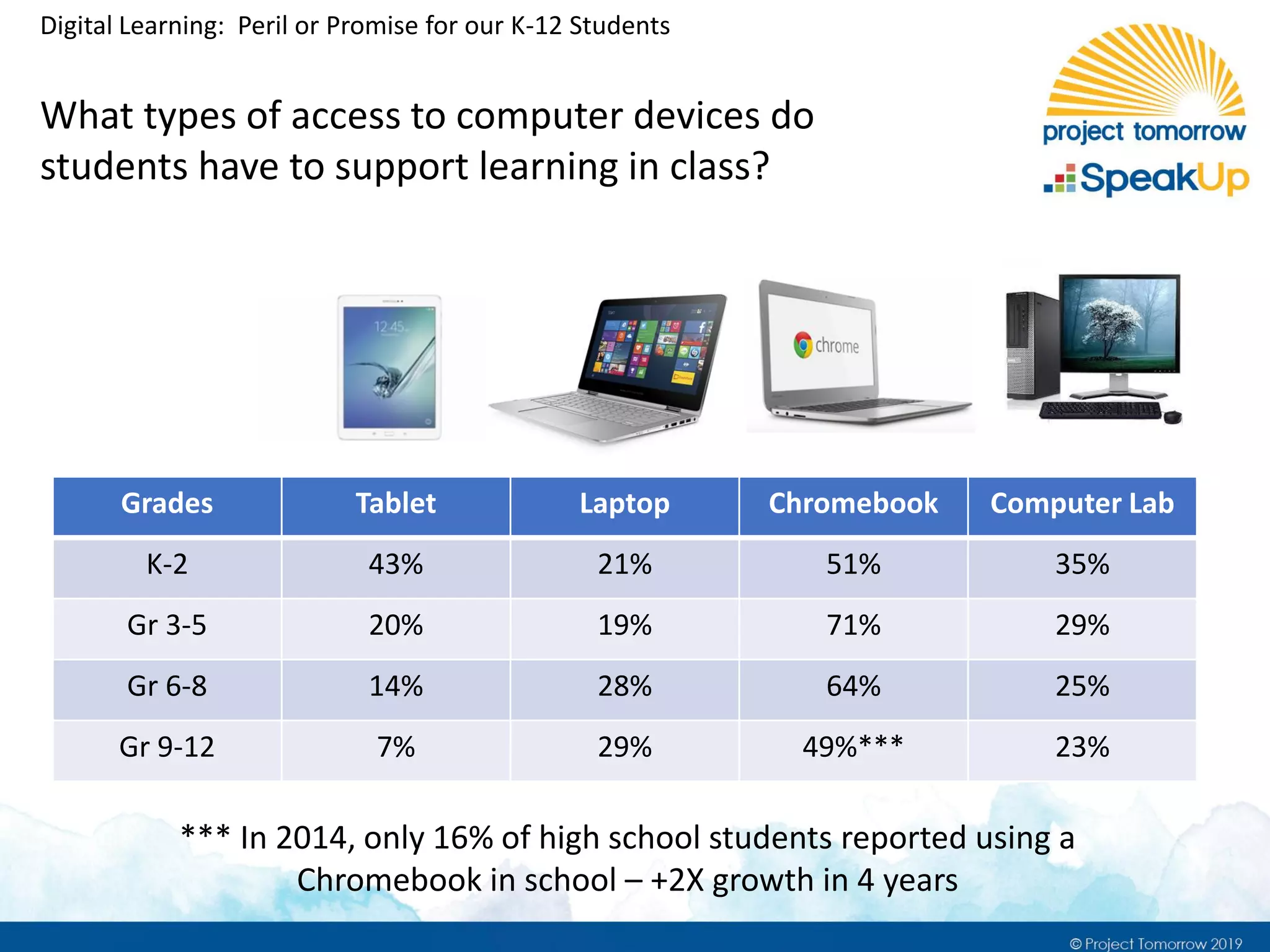
Grades Tablet Laptop Chromebook Computer Lab
K-2 43% 21% 51% 35%
Gr 3-5 20% 19% 71% 29%
Gr 6-8 14% 28% 64% 25%
Gr 9-12 7% 29% 49%*** 23%
What types of access to computer devices do
students have to support learning in class?
*** In 2014, only 16% of high school students reported using a
Chromebook in school – +2X growth in 4 years
Digital Learning: Peril or Promise for our K-12 Students
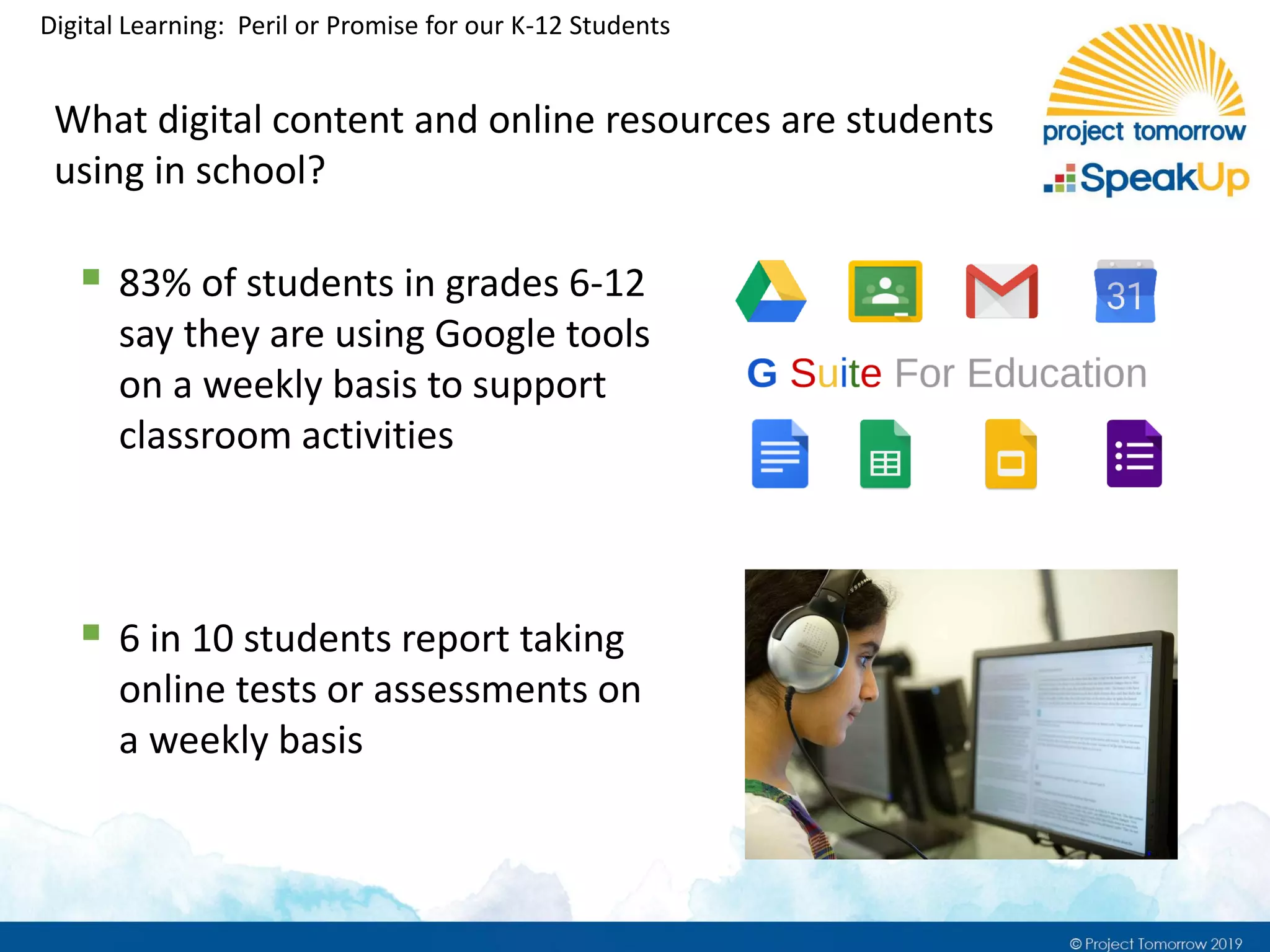
What digital content and online resources are students
using in school?
▪ 83% of students in grades 6-12
say they are using Google tools
on a weekly basis to support
classroom activities
▪ 6 in 10 students report taking
online tests or assessments on
a weekly basis
Digital Learning: Peril or Promise for our K-12 Students
20%
22%
24%
44%
47% 48%
53%
19%
21% 22%
37%
46% 45% 45%
21%
24% 23%
36%
50% 49% 49%
Virtual labs Online
primary
source
documents
Animations
and
simulations
Online
textbooks
Online or
digital games
Online videos Skill
developing
software or
apps
Gr 6-8 students in urban schools Gr 6-8 students in suburban schools
Gr 6-8 students in rural schools
What digital content and online resources are students
using in school?
Weekly usage of digital content by middle school students
Digital Learning: Peril or Promise for our K-12 Students
Does learning = school exclusively?
50% of students in
grades 6-12 say they
use technology more
outside of school than
inside of school for
learning purposes
Digital Learning: Peril or Promise for our K-12 Students
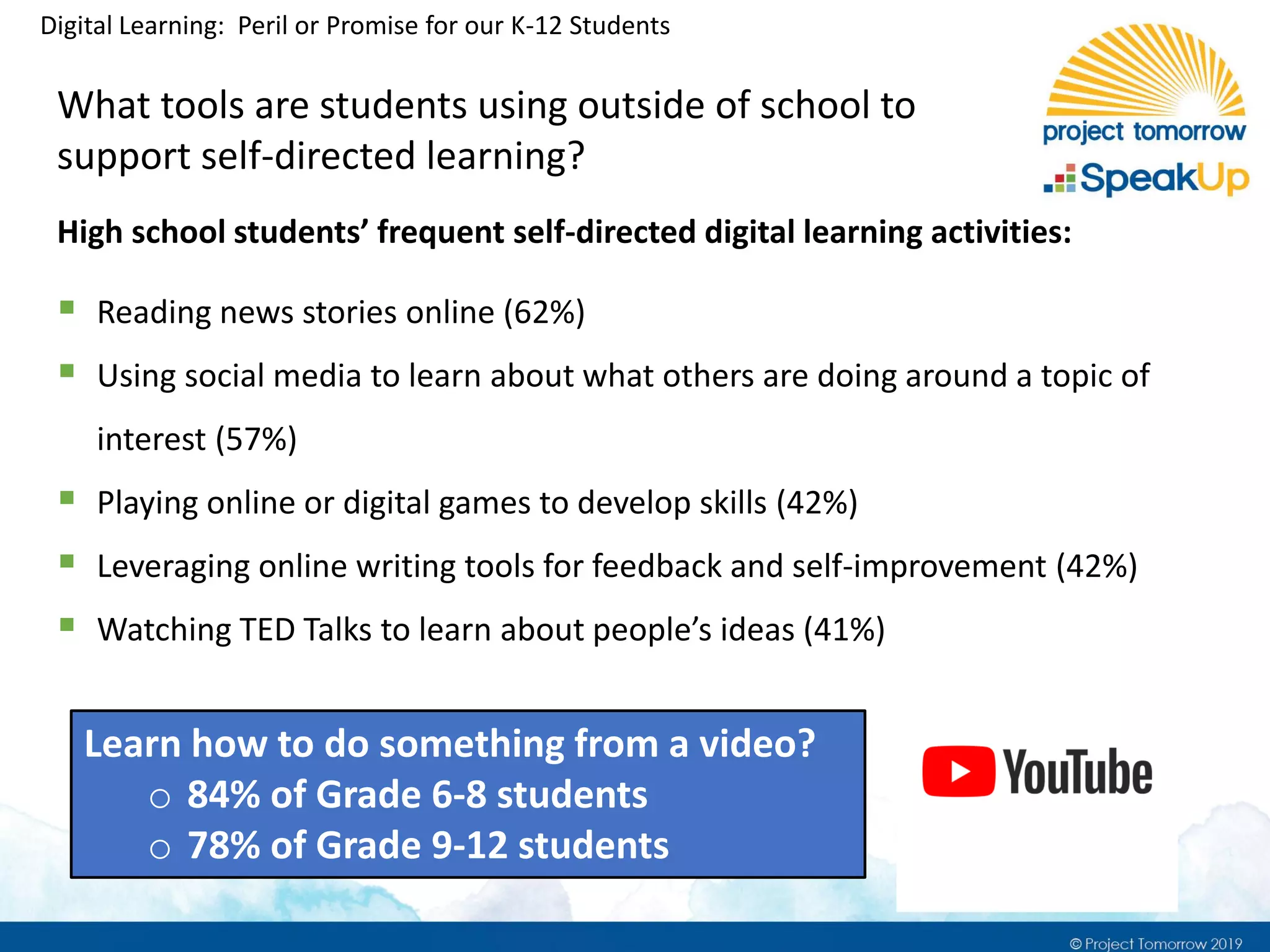
What tools are students using outside of school to
support self-directed learning?
High school students’ frequent self-directed digital learning activities:
▪ Reading news stories online (62%)
▪ Using social media to learn about what others are doing around a topic of
interest (57%)
▪ Playing online or digital games to develop skills (42%)
▪ Leveraging online writing tools for feedback and self-improvement (42%)
▪ Watching TED Talks to learn about people’s ideas (41%)
Digital Learning: Peril or Promise for our K-12 Students
What tools are students using outside of school to
support self-directed learning?
High school students’ frequent self-directed digital learning activities:
▪ Reading news stories online (62%)
▪ Using social media to learn about what others are doing around a topic of
interest (57%)
▪ Playing online or digital games to develop skills (42%)
▪ Leveraging online writing tools for feedback and self-improvement (42%)
▪ Watching TED Talks to learn about people’s ideas (41%)
Learn how to do something from a video?
o 84% of Grade 6-8 students
o 78% of Grade 9-12 students
Natalia
12th grade student – Woodbridge High School
Xaviar
12th grade student – Wakefield High School
Oscar
8th grade student – Frost Middle School
Jessica
8th grade student – Rocky Run Middle School
Tucker
6th grade student – Poplar Tree Elementary School
Mina
6th grade student – Greenbriar Elementary School
What does our expert panel think?
Digital Learning: Peril or Promise for our K-12 Students
Defining the value of digital learning
▪ How do educators define the value of digital learning?
▪ How do students define the value of digital learning?
Digital Learning: Peril or Promise for our K-12 Students
How do educators define the value of digital learning?
Example:
Value of mobile device
usage in class?
86% of
teachers
93% of
principals
Answer:
Increases student
engagement in learning
Digital Learning: Peril or Promise for our K-12 Students
Benefits of using technology to support learning % of students in Grades 6-8 who
agree
✓ Improved academic outcomes
Better grades and test scores 59%
Stronger understanding of class content 52%
More likely to complete homework assignments 49%
✓ Future-ready skill development outcomes
Creativity skill development 55%
Application of knowledge to practical problems 48%
Collaboration skill development 48%
Critical thinking skill development 47%
✓ Personalized learning outcomes
Learning at one’s own pace 56%
In control of the learning process 50%
Fits personal learning goals and style 48%
How do students define the value of digital learning?
Digital Learning: Peril or Promise for our K-12 Students
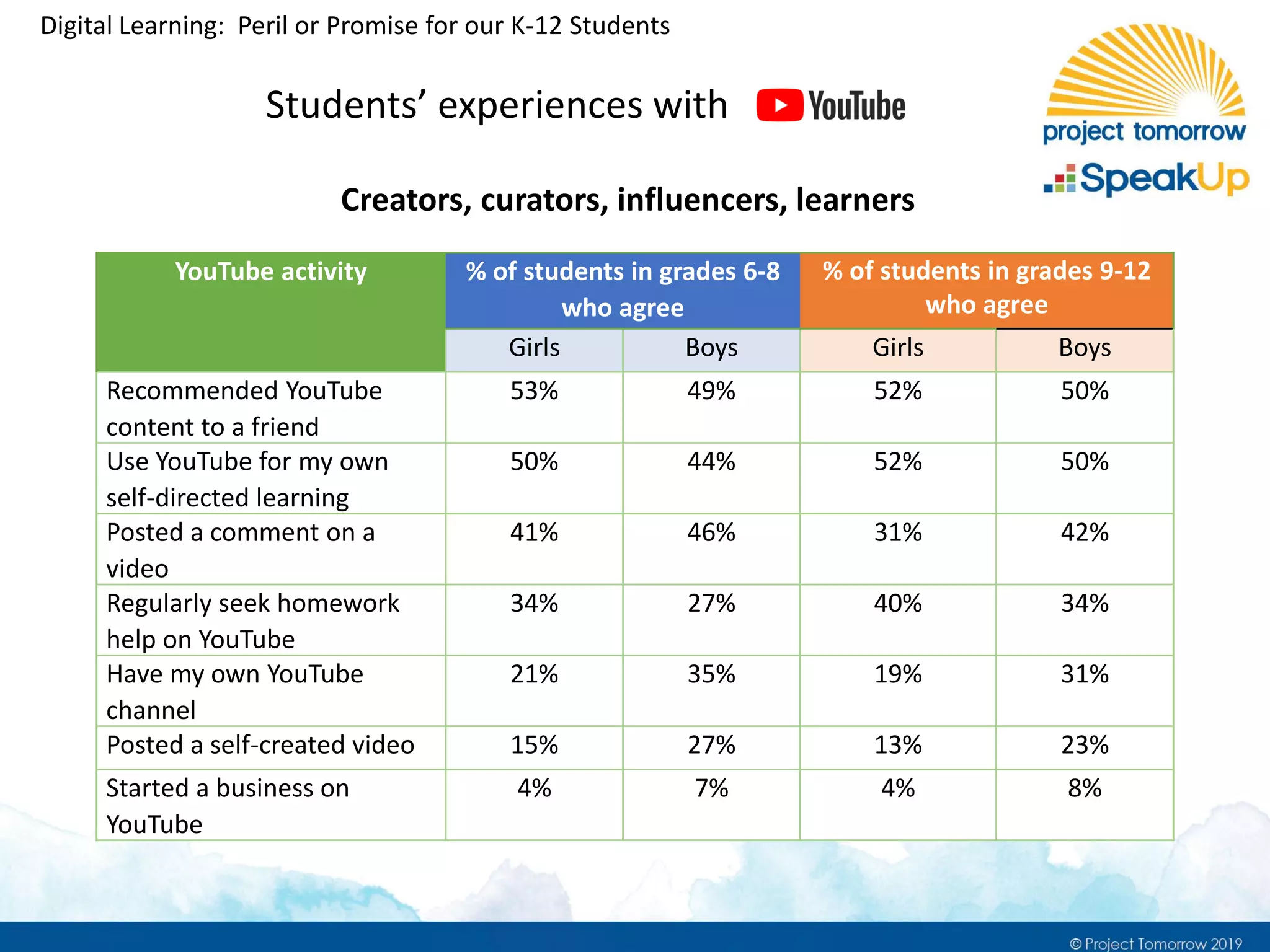
YouTube activity % of students in grades 6-8
who agree
% of students in grades 9-12
who agree
Girls Boys Girls Boys
Recommended YouTube
content to a friend
53% 49% 52% 50%
Use YouTube for my own
self-directed learning
50% 44% 52% 50%
Posted a comment on a
video
41% 46% 31% 42%
Regularly seek homework
help on YouTube
34% 27% 40% 34%
Have my own YouTube
channel
21% 35% 19% 31%
Posted a self-created video 15% 27% 13% 23%
Started a business on
YouTube
4% 7% 4% 8%
Students’ experiences with
Creators, curators, influencers, learners
Digital Learning: Peril or Promise for our K-12 Students
Students’ experiences with
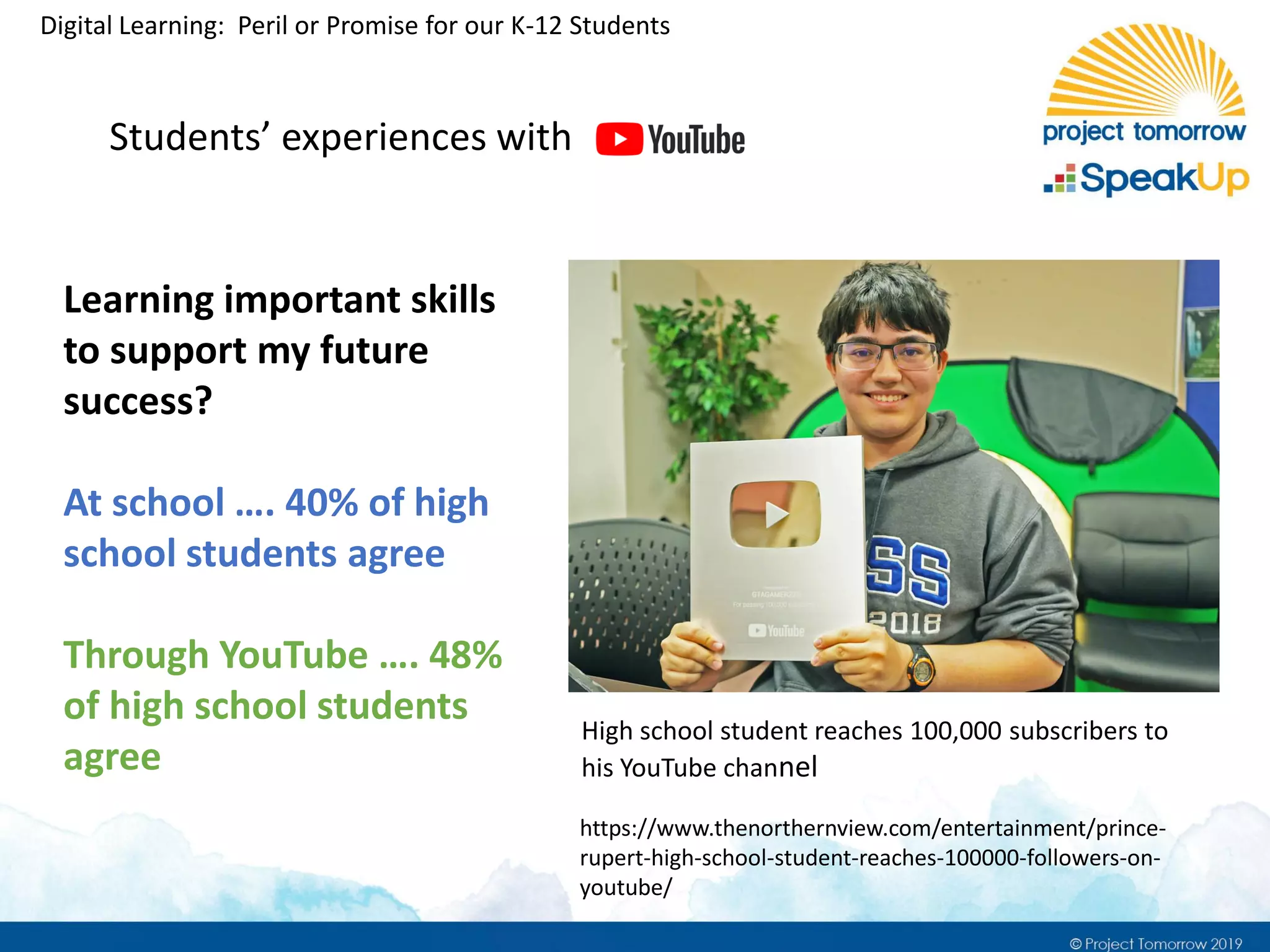
Learning important skills
to support my future
success?
At school …. 40% of high
school students agree
Through YouTube …. 48%
of high school students
agree
High school student reaches 100,000 subscribers to
his YouTube channel
https://www.thenorthernview.com/entertainment/prince-
rupert-high-school-student-reaches-100000-followers-on-
youtube/
Natalia
12th grade student – Woodbridge High School
Xaviar
12th grade student – Wakefield High School
Oscar
8th grade student – Frost Middle School
Jessica
8th grade student – Rocky Run Middle School
Tucker
6th grade student – Poplar Tree Elementary School
Mina
6th grade student – Greenbriar Elementary School
What does our expert panel think?
Digital Learning: Peril or Promise for our K-12 Students
Addressing new concerns around digital learning
▪ Too much screen time
▪ Teacher effectiveness with technology for instruction
▪ Homework Gap and digital equity
Digital Learning: Peril or Promise for our K-12 Students
▪ 82% of parents say effective technology use in school is important for their
child’s future success
▪ 58% say technology use in class is a good way to learn college and career
ready skills
▪ Only 3% of parents say students should not have access to any mobile
devices in class
▪ #1 concern about tech use at school? Not screen time but “tech use varies
too much from teacher to teacher, class to class”
▪ Parents highly value the potential value of technology to personalize the
learning process for their child but wish digital tools were used more
effectively in school
Parents’ views on value of digital learning
But, what about too much screen time???
Digital Learning: Peril or Promise for our K-12 Students
Demographics % of parents who say they are
concerned about too much
screen time in general
All parents nationwide 64%
By grade level of child in
school
K-5
Gr 5-8
Gr 9-12
64%
64%
65%
By community type
Urban
Suburban
Rural
57%
66%
65%
By family income
Under 50K annually
Over 150K annually
50%
70%
Parents’ views on “too much screen time”
Digital Learning: Peril or Promise for our K-12 Students
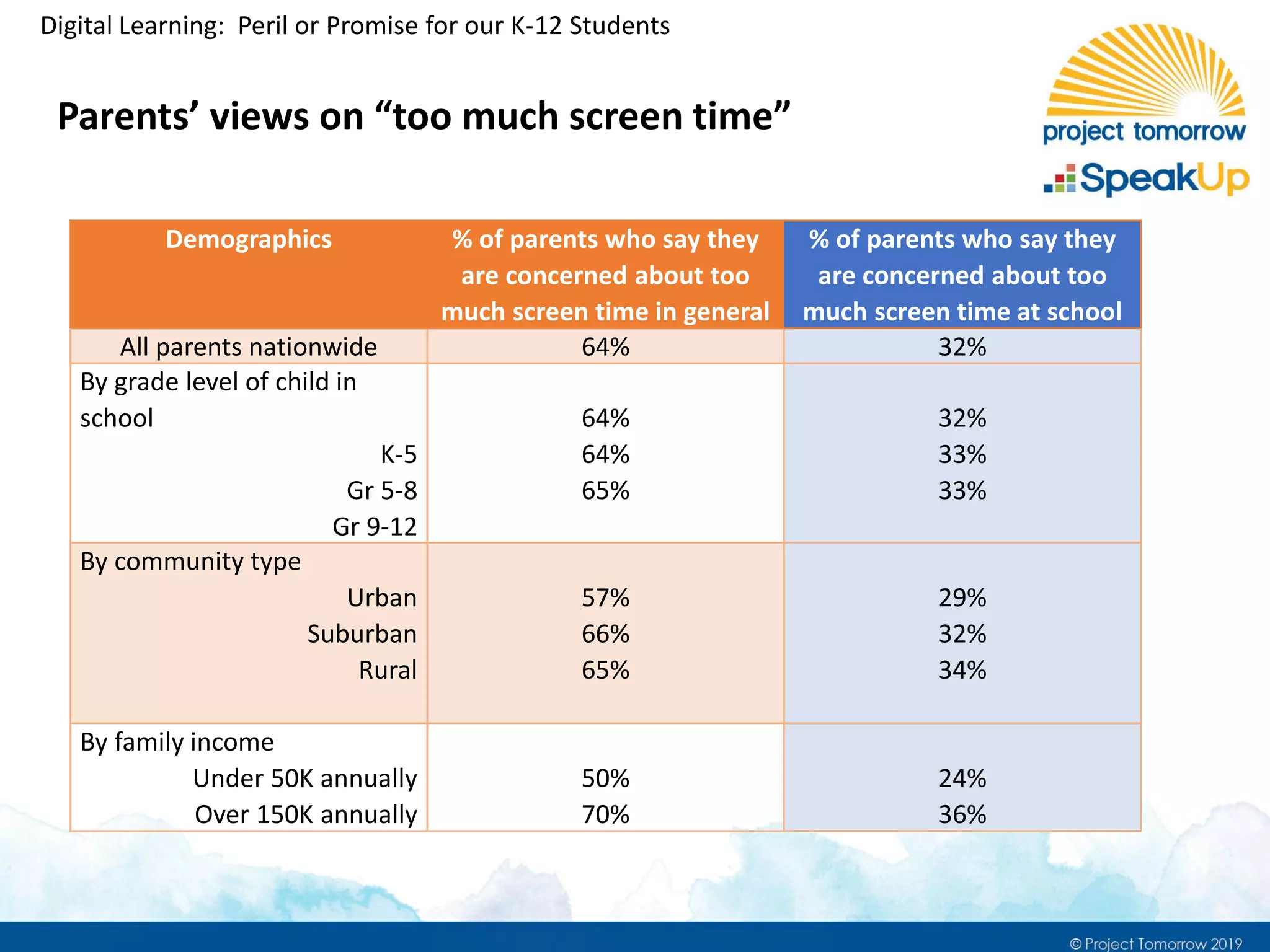
Demographics % of parents who say they
are concerned about too
much screen time in general
% of parents who say they
are concerned about too
much screen time at school
All parents nationwide 64% 32%
By grade level of child in
school
K-5
Gr 5-8
Gr 9-12
64%
64%
65%
32%
33%
33%
By community type
Urban
Suburban
Rural
57%
66%
65%
29%
32%
34%
By family income
Under 50K annually
Over 150K annually
50%
70%
24%
36%
Parents’ views on “too much screen time”
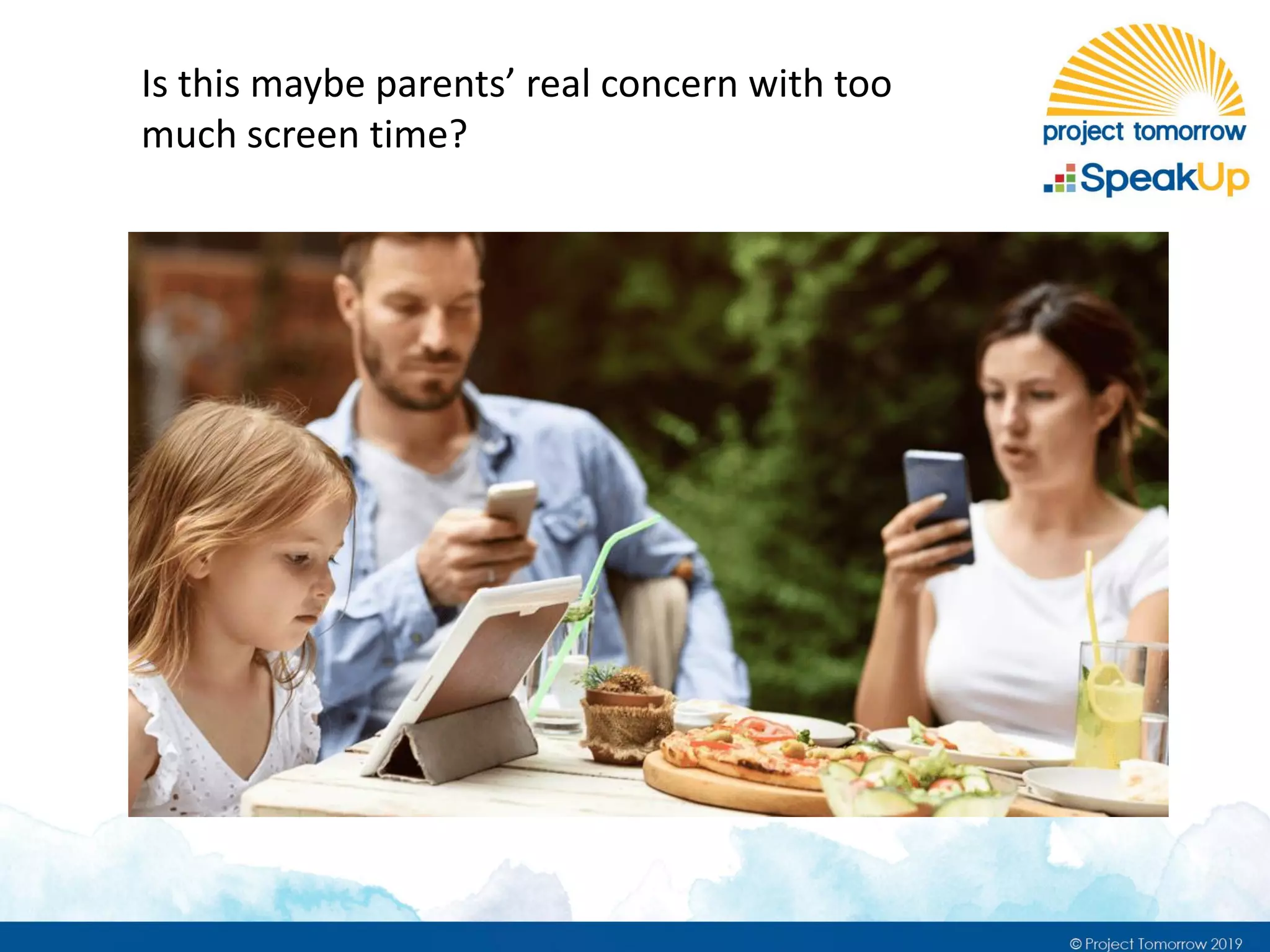
Is this maybe parents’ real concern with too
much screen time?
Or is it that we have maybe “overplayed”
engagement as the only tangible benefit of digital
learning and have not addressed or messaged other
outcomes effectively . . . .
Technology is a tool to customize and personalize the
educational needs of my students. Recently, I learned
about new apps and media tools to take my class
further into the 21st century. I have noticed that they
are more engaged, excited, and taking responsibility
for their own learning. All of this has improved critical
thinking, communication, collaboration and creativity.
For lack of a better word, it's awesome!
Elementary school classroom teacher from California
Digital Learning: Peril or Promise for our K-12 Students
Why this topic this year?
✓ Assessment of progress
✓ Realistic view of impact
✓ Appreciating concerns
✓ What’s next?
Your
questions,
thoughts,
comments,
insights
Let’s talk!
Closing Remarks
Richard Quinones
Senior Vice President
iboss
More resources available at
www.tomorrow.org
National Speak Up reports and infographics
Targeted and thematic reports
Educational Equity
Digital learning trends
School communications
Mobile learning
Blended learning outcomes
Presentations, podcasts and webinars
Services: consulting, workshops, evaluation and efficacy studies
✓ We have expertise in the evaluation of new learning environments including mobile
implementations, online resources, blended learning and digital content usage
We want to hear from you! Share your comments on this year’s national
findings at:
http://bit.ly/2018_19SpeakUpBriefingPaper
Online surveys available for:
o K-12 students – individual + group
o Parents – English and Spanish
o Teachers
o Librarians/Media Specialists
o School Site & District Administrators
o Technology Leaders
o Community Members
o Communications Officers
Speak Up is open now for school and district participation
Learn more at: www.tomorrow.org/speakup
❖ Surveys open from now through June: use them when it makes sense for your district
❖ Two formats: multi-thematic Speak Up 360 or quick, single theme Speak Up Snapshots
❖ 100% free – with full data reports for you!
❖ Have a voice in national education policy – share your ideas through Speak Up!
Go !
Thank you for joining us today for this year’s
Speak Up Congressional Briefing
October 23, 2019
Julie A. Evans, Ed.D.
CEO, Project Tomorrow
@JulieEvans_PT
jevans@tomorrow.org
Digital Learning:
Peril or Promise for
our K-12 Students

Speak Up Oct2019 Congressional Briefing Presentation Slides

  • 1.
    Speak Up NationalFindings Annual Congressional Briefing October 23, 2019 Julie A. Evans, Ed.D. CEO, Project Tomorrow @JulieEvans_PT jevans@tomorrow.org Digital Learning: Peril or Promise for our K-12 Students
  • 2.
    Welcome to thisyear’s Speak Up Briefing! Be part of the discussion: @SpeakUpEd
  • 3.
    ▪ Nonprofit educationorganization supporting K-12 education since 1996 ▪ Mission is to ensure today’s students are well prepared for the future ▪ Programs and research focus on role of innovation and new learning models within the education ecosystem. We believe in the power of transformational teaching and learning to support student preparation for college and career success. About Project Tomorrow Speak Up Research Project on Digital Learning: supporting the development of new leadership capacities within K-12 schools and districts through the effective use of insights and views from key stakeholder audiences
  • 4.
    Today’s discussion ▪ Welcometo this year’s briefing! ▪ Opening remarks from Christina Fleming, Blackboard ▪ About the Speak Up Research Project o Selected research findings from Speak Up 2018-19 o Conversations with our expert panel ▪ Let’s talk! What are your questions, ideas, comments, insights? ▪ Closing remarks from Richard Quinones, iboss ▪ Wrap up call to action
  • 5.
    Natalia 12th grade student– Woodbridge High School Xaviar 12th grade student – Wakefield High School Oscar 8th grade student – Frost Middle School Jessica 8th grade student – Rocky Run Middle School Tucker 6th grade student – Poplar Tree Elementary School Mina 6th grade student – Greenbriar Elementary School Let’s meet our panel of experts!
  • 6.
    Thank you! Senator TammyBaldwin Wisconsin
  • 7.
    We are veryproud of our partnerships with these organizations and many others! Project Tomorrow salutes the following innovative companies and organizations for their support of Speak Up 2018-2019
  • 8.
    Project Tomorrow salutesthe following innovative companies and organizations for their support of Speak Up 2018-2019
  • 9.
  • 10.
    About the SpeakUp Project (www.tomorrow.org/speakup) ▪ Annual research project since 2003 ▪ Facilitated 100% through schools and districts ▪ We provide education leaders with a suite of online surveys they can use to collect feedback from their K-12 stakeholders all year long ▪ All K-12 schools – public, private, parochial, charter, virtual - are eligible to participate ▪ Schools get summary report with all locally collected data + state and national data for benchmarks ▪ Project Tomorrow manages all data collection and reporting for schools as a 100% free service Since 2003, over 5.7 million K-12 stakeholders have submitted a Speak Up survey
  • 11.
    ✓ K-12 students ✓Teachers ✓ Librarians and Media Specialists ✓ Parents ✓ School site administrators ✓ District administrators ✓ Technology leaders ✓ Public Information Officers ✓ Community members About the Speak Up Project (www.tomorrow.org/speakup) Activities: How are education stakeholders implementing new learning models especially using technology? Attitudes: What do they value or care about with those new learning experiences? Aspirations: What their goals or desires for higher impact with these new learning models? Surveys built for . . . . To learn about their ….
  • 12.
    Speak Up isall about translating the views and ideas of K-12 stakeholders into assets
  • 13.
    Education leaders use SpeakUp findings to create “actionable knowledge” About the Speak Up Project (www.tomorrow.org/speakup) Teacher Professional Development Community Engagement Evaluating Outcomes Decision- making Funding Development
  • 14.
    Survey Audience #of Surveys Submitted K-12 Students 289,273 Teachers & Librarians 26,951 Parents 21,951 Administrators 2,190 Community Members 3,861 National participation in Speak Up 2018-19 School demographics: 26% urban, 41% rural, 33% suburban, 59% title 1 eligible
  • 15.
    Digital Learning: Perilor Promise for our K-12 Students Why this topic this year? ✓ Assessment of progress ✓ Realistic view of impact ✓ Appreciating concerns ✓ What’s next?
  • 16.
    How we willbe tackling these important questions …
  • 17.
    How we willbe tackling these important questions …
  • 18.
    How we willbe tackling these important questions …
  • 19.
    How we willbe tackling these important questions …
  • 20.
    Digital Learning: Perilor Promise for our K-12 Students ▪ Students and digital learning today ▪ Defining the value of digital learning ▪ Addressing new concerns about digital learning How we will be tackling these important questions …
  • 21.
    Digital Learning: Perilor Promise for our K-12 Students Students and digital learning today: ▪ What technology or digital learning environments are implemented in schools today? ▪ What access do students have to mobile devices in school? ▪ What digital content and online resources are students using in school? ▪ What tools are students using outside of school to support self-directed learning?
  • 22.
    Established (> 66% ofadministrators report as implemented) Developing (~50% of administrators report as implemented) Nascent (≤ 40% of administrators report as implemented) Using social media tools to communicate with parents and students (76%) Students are assigned a 1:1 mobile device to use in school only (57%) Blended learning environments for students (40%) Cloud based collaboration tools such as G Suite for Education (72%) Online professional development classes for teachers (50%) Students are assigned a 1:1 mobile device to use in school and to take home (38%) Students have periodic access to mobile devices to use in class to support instruction (66%) Online textbooks for use by students (49%) Game based learning experiences (35%) Use of videos, simulations, animations and other digital content (66%) Online classes available for students (48%) Flipped learning environments for students (28%) Digital Learning: Peril or Promise for our K-12 Students What technology or digital learning environments are implemented in schools today? Project Tomorrow’s Digital Learning Maturity Model
  • 23.
    Grades Tablet LaptopChromebook Computer Lab K-2 43% 21% 51% 35% Gr 3-5 20% 19% 71% 29% Gr 6-8 14% 28% 64% 25% Gr 9-12 7% 29% 49%*** 23% What types of access to computer devices do students have to support learning in class? *** In 2014, only 16% of high school students reported using a Chromebook in school – +2X growth in 4 years Digital Learning: Peril or Promise for our K-12 Students
  • 24.
    Digital Learning: Perilor Promise for our K-12 Students What digital content and online resources are students using in school? ▪ 83% of students in grades 6-12 say they are using Google tools on a weekly basis to support classroom activities ▪ 6 in 10 students report taking online tests or assessments on a weekly basis
  • 25.
    Digital Learning: Perilor Promise for our K-12 Students 20% 22% 24% 44% 47% 48% 53% 19% 21% 22% 37% 46% 45% 45% 21% 24% 23% 36% 50% 49% 49% Virtual labs Online primary source documents Animations and simulations Online textbooks Online or digital games Online videos Skill developing software or apps Gr 6-8 students in urban schools Gr 6-8 students in suburban schools Gr 6-8 students in rural schools What digital content and online resources are students using in school? Weekly usage of digital content by middle school students
  • 26.
    Digital Learning: Perilor Promise for our K-12 Students Does learning = school exclusively? 50% of students in grades 6-12 say they use technology more outside of school than inside of school for learning purposes
  • 27.
    Digital Learning: Perilor Promise for our K-12 Students What tools are students using outside of school to support self-directed learning? High school students’ frequent self-directed digital learning activities: ▪ Reading news stories online (62%) ▪ Using social media to learn about what others are doing around a topic of interest (57%) ▪ Playing online or digital games to develop skills (42%) ▪ Leveraging online writing tools for feedback and self-improvement (42%) ▪ Watching TED Talks to learn about people’s ideas (41%)
  • 28.
    Digital Learning: Perilor Promise for our K-12 Students What tools are students using outside of school to support self-directed learning? High school students’ frequent self-directed digital learning activities: ▪ Reading news stories online (62%) ▪ Using social media to learn about what others are doing around a topic of interest (57%) ▪ Playing online or digital games to develop skills (42%) ▪ Leveraging online writing tools for feedback and self-improvement (42%) ▪ Watching TED Talks to learn about people’s ideas (41%) Learn how to do something from a video? o 84% of Grade 6-8 students o 78% of Grade 9-12 students
  • 29.
    Natalia 12th grade student– Woodbridge High School Xaviar 12th grade student – Wakefield High School Oscar 8th grade student – Frost Middle School Jessica 8th grade student – Rocky Run Middle School Tucker 6th grade student – Poplar Tree Elementary School Mina 6th grade student – Greenbriar Elementary School What does our expert panel think?
  • 30.
    Digital Learning: Perilor Promise for our K-12 Students Defining the value of digital learning ▪ How do educators define the value of digital learning? ▪ How do students define the value of digital learning?
  • 31.
    Digital Learning: Perilor Promise for our K-12 Students How do educators define the value of digital learning? Example: Value of mobile device usage in class? 86% of teachers 93% of principals Answer: Increases student engagement in learning
  • 32.
    Digital Learning: Perilor Promise for our K-12 Students Benefits of using technology to support learning % of students in Grades 6-8 who agree ✓ Improved academic outcomes Better grades and test scores 59% Stronger understanding of class content 52% More likely to complete homework assignments 49% ✓ Future-ready skill development outcomes Creativity skill development 55% Application of knowledge to practical problems 48% Collaboration skill development 48% Critical thinking skill development 47% ✓ Personalized learning outcomes Learning at one’s own pace 56% In control of the learning process 50% Fits personal learning goals and style 48% How do students define the value of digital learning?
  • 33.
    Digital Learning: Perilor Promise for our K-12 Students YouTube activity % of students in grades 6-8 who agree % of students in grades 9-12 who agree Girls Boys Girls Boys Recommended YouTube content to a friend 53% 49% 52% 50% Use YouTube for my own self-directed learning 50% 44% 52% 50% Posted a comment on a video 41% 46% 31% 42% Regularly seek homework help on YouTube 34% 27% 40% 34% Have my own YouTube channel 21% 35% 19% 31% Posted a self-created video 15% 27% 13% 23% Started a business on YouTube 4% 7% 4% 8% Students’ experiences with Creators, curators, influencers, learners
  • 34.
    Digital Learning: Perilor Promise for our K-12 Students Students’ experiences with Learning important skills to support my future success? At school …. 40% of high school students agree Through YouTube …. 48% of high school students agree High school student reaches 100,000 subscribers to his YouTube channel https://www.thenorthernview.com/entertainment/prince- rupert-high-school-student-reaches-100000-followers-on- youtube/
  • 35.
    Natalia 12th grade student– Woodbridge High School Xaviar 12th grade student – Wakefield High School Oscar 8th grade student – Frost Middle School Jessica 8th grade student – Rocky Run Middle School Tucker 6th grade student – Poplar Tree Elementary School Mina 6th grade student – Greenbriar Elementary School What does our expert panel think?
  • 36.
    Digital Learning: Perilor Promise for our K-12 Students Addressing new concerns around digital learning ▪ Too much screen time ▪ Teacher effectiveness with technology for instruction ▪ Homework Gap and digital equity
  • 37.
    Digital Learning: Perilor Promise for our K-12 Students ▪ 82% of parents say effective technology use in school is important for their child’s future success ▪ 58% say technology use in class is a good way to learn college and career ready skills ▪ Only 3% of parents say students should not have access to any mobile devices in class ▪ #1 concern about tech use at school? Not screen time but “tech use varies too much from teacher to teacher, class to class” ▪ Parents highly value the potential value of technology to personalize the learning process for their child but wish digital tools were used more effectively in school Parents’ views on value of digital learning
  • 38.
    But, what abouttoo much screen time???
  • 39.
    Digital Learning: Perilor Promise for our K-12 Students Demographics % of parents who say they are concerned about too much screen time in general All parents nationwide 64% By grade level of child in school K-5 Gr 5-8 Gr 9-12 64% 64% 65% By community type Urban Suburban Rural 57% 66% 65% By family income Under 50K annually Over 150K annually 50% 70% Parents’ views on “too much screen time”
  • 40.
    Digital Learning: Perilor Promise for our K-12 Students Demographics % of parents who say they are concerned about too much screen time in general % of parents who say they are concerned about too much screen time at school All parents nationwide 64% 32% By grade level of child in school K-5 Gr 5-8 Gr 9-12 64% 64% 65% 32% 33% 33% By community type Urban Suburban Rural 57% 66% 65% 29% 32% 34% By family income Under 50K annually Over 150K annually 50% 70% 24% 36% Parents’ views on “too much screen time”
  • 41.
    Is this maybeparents’ real concern with too much screen time?
  • 42.
    Or is itthat we have maybe “overplayed” engagement as the only tangible benefit of digital learning and have not addressed or messaged other outcomes effectively . . . . Technology is a tool to customize and personalize the educational needs of my students. Recently, I learned about new apps and media tools to take my class further into the 21st century. I have noticed that they are more engaged, excited, and taking responsibility for their own learning. All of this has improved critical thinking, communication, collaboration and creativity. For lack of a better word, it's awesome! Elementary school classroom teacher from California
  • 43.
    Digital Learning: Perilor Promise for our K-12 Students Why this topic this year? ✓ Assessment of progress ✓ Realistic view of impact ✓ Appreciating concerns ✓ What’s next?
  • 44.
  • 45.
  • 46.
    More resources availableat www.tomorrow.org National Speak Up reports and infographics Targeted and thematic reports Educational Equity Digital learning trends School communications Mobile learning Blended learning outcomes Presentations, podcasts and webinars Services: consulting, workshops, evaluation and efficacy studies ✓ We have expertise in the evaluation of new learning environments including mobile implementations, online resources, blended learning and digital content usage We want to hear from you! Share your comments on this year’s national findings at: http://bit.ly/2018_19SpeakUpBriefingPaper
  • 47.
    Online surveys availablefor: o K-12 students – individual + group o Parents – English and Spanish o Teachers o Librarians/Media Specialists o School Site & District Administrators o Technology Leaders o Community Members o Communications Officers Speak Up is open now for school and district participation Learn more at: www.tomorrow.org/speakup ❖ Surveys open from now through June: use them when it makes sense for your district ❖ Two formats: multi-thematic Speak Up 360 or quick, single theme Speak Up Snapshots ❖ 100% free – with full data reports for you! ❖ Have a voice in national education policy – share your ideas through Speak Up!
  • 48.
  • 49.
    Thank you forjoining us today for this year’s Speak Up Congressional Briefing October 23, 2019 Julie A. Evans, Ed.D. CEO, Project Tomorrow @JulieEvans_PT jevans@tomorrow.org Digital Learning: Peril or Promise for our K-12 Students