78 International Journal for Modern Trends in Science and Technology
Spatiotemporal Analysis of Infant and Maternal
Morality of Mother and Child Tracking System
Dr. B.G. Premasudha1
| Leena H.U.2
| Khadijatul Kubra Shaik3
1Master of Computer Applications, Siddaganga Institute of Technology, Tumkur, Karnataka, India
2Master of Computer Applications, Siddaganga Institute of Technology, Tumkur, Karnataka, India
3 Master of Computer Applications, Siddaganga Institute of Technology, Tumkur, Karnataka, India
To Cite this Article
Dr. B.G. Premasudha, Leena H.U. and Khadijatul Kubra Shaik, “Spatiotemporal Analysis of Infant and Maternal Morality of
Mother and Child Tracking System”, International Journal for Modern Trends in Science and Technology, Vol. 02, Issue 12,
2016, pp. 78 - 81.
Community healthcare is significant societal issue with profound suggestions for government organization
and with huge effect on individual standards of livelihood. The maintaining and monitoring of numerous
health associated government schemes are done through information technology where involvement of
Geographic Information System (GIS) is missing. This Project intends in integrating a GIS with Infant and
Maternal Mortality of Mother and Child Tracking System (MCTS). Thematic Mapping is a component of GIS
where it has constantly characterized to demonstrate the current status of health issues in an influential
way. The open source tool Quantum GIS (QGIS) is used to represent Infant and Maternal Mortality on
Thematic Maps which helps in identifying the areas with higher and weaker distributions of affected
population.
KEYWORDS: GIS, MCTS, QGIS, Maternal Mortality, Infant Mortality
Copyright © 2016 International Journal for Modern Trends in Science and Technology
All rights reserved.
I. INTRODUCTION
Maternal and Child mortality is not an
exceptional occasion in a few sections of the
developing world. Mothers and Infants are at most
astounding danger for disease and demise. While
parenthood is regularly a positive and satisfying
knowledge, for an excess of ladies, it is connected
with ill–health and even demise. The passing of a
lady amid pregnancy is a catastrophe that carries a
huge burden of grief and pain, and has been
portrayed as a noteworthy general wellbeing issue
in developing nations. Ladies play a key role in the
growth of family welfare. Passing of babies under
one are particular and firmly identified with
maternal well being.
The MCTS is an online application, which was
dispatched by Government of India. It tracks
pregnant mothers and infants, and screens the
Health and inoculation of both the mother and
infant. It goes for decreasing the maternal and
infant death rate. Online Submission of name
based data of a Pregnant Women and kids under
MCTS Portal.
II. LITERATURE SURVEY
GIS is a tool used for data collection, storing,
analyzing, managing and visualization. As it is
known that in health sector many of the changes
have strong geospatial components, GIS can
provide an integrated approach to the public health
departments in planning and analysis. It is defined
as the science and technology related to the
gathering, storage, manipulation, analysis and
visualization of geo-referenced data. It integrates
ABSTRACT
International Journal for Modern Trends in Science and Technology
Volume: 02, Issue No: 12, December 2016
ISSN: 2455-3778
http://www.ijmtst.com
79 International Journal for Modern Trends in Science and Technology
Dr. B.G. Premasudha, Leena H.U. and Khadijatul Kubra Shaik : Spatiotemporal Analysis of Infant and Maternal Morality of
Mother and Child Tracking System
non-spatial tabular data with its geographically
referenced spatial data.
The incredible prospective of GIS to benefit the
health care industry is not only appreciated but
also adopted for integration and spatial
visualization of health data. GIS systems make it
possible for public health professionals to visualize
population health problems within the perspective
of available social services, demographic factors
and vary in environmental variables [1]. The
capacity of GIS lies in mapping the population at
risk, health dynamics, aspects of risk and
relationships between them.
MCTS assist monitoring of universal access to
maternal and child health services by all pregnant
women and children [2]. The broad objective is to
reduce Infant Mortality, to progress the nutritional
level of the child, to ensure completion of
immunization in children by tracking the proper
growth of the individual child, and to decrease
maternal mortality rate.
Decision makers can prioritize not only the
affecting factors of the disease, but also the actions
and regulations required for fighting the disease. It
is useful to monitor the performance of different
government schemes and their achievements
against targets. Monitoring nutrition values of the
pregnant women and a new born child in a
community through GIS will be helpful to the
government to decide on where to concentrate
more [3].
Despite these challenges, the emphasis on
reducing mother and infant mortality is an
prospect for new synergies [4]. The health sector
can use Mother and Newborn Health as the driver
to progress GIS capacity, thus benefiting all health
initiatives.
III. GEOGRAPHIC INFORMATION SYSTEM (GIS)
GIS is a computer-based data framework that is
used to digitally represent and analyze the
geographic components present on the Earth's
surface and the event (non-spatial ascribes
connected to the geology under study) that are
occurring on it. GIS has been defined as
“automated systems of software and hardware for
the purpose capturing, storing, retrieving, analysis
and presentation of spatial and non-spatial
information [5]."
A. GIS in Health
At the point when used to the full degree of its
ability, GIS can "illuminate and instruct (experts
and people in general), engage basic leadership at
all levels, help in arranging and tweaking clinically
and savvy activities, in anticipating results before
making any money related duties and crediting
needs in an atmosphere of limited resources,
change practices; and constantly monitor and
analyze changes, and additionally sentinel
occasions [7]." Yet, in spite of the unimaginable
potential advantages of applying GIS
advancements, their utilization in wellbeing
administration arranging and procurement
remains incredibly underutilized.
IV. SPATIOTEMPORAL ANALYSIS
Spatiotemporal analysis is a rising research area
because of the advancement and use of novel
computational methods taking into account the
investigation of extensive spatiotemporal
databases. Spatiotemporal models emerge when
information are gathered crosswise over time and
additionally space and has no less than one spatial
and one transient property. An occasion in a
spatiotemporal dataset depicts a spatial and
worldly marvel that exists at a specific time t and
area x. Different applications for spatiotemporal
examination incorporate cases in the areas of
science, nature, meteorology, medication,
transportation and forestry.
A. Architecture of MCTS
Fig. 1 Architecture of MCTS
Fig. 1 shows how the data is fetched from the
MCTS database and provided to a system enabled
with GIS as input for processing and mapping.
Processing includes spatial analysis and modeling.
The results of processing are used for mapping.
Mapping includes classification and generating of
charts of Mother and Child. The generated outputs
80 International Journal for Modern Trends in Science and Technology
Dr. B.G. Premasudha, Leena H.U. and Khadijatul Kubra Shaik : Spatiotemporal Analysis of Infant and Maternal Morality of
Mother and Child Tracking System
are used for visualization and these are helpful for
decision makers.
V. ANALYSIS AND RESULTS
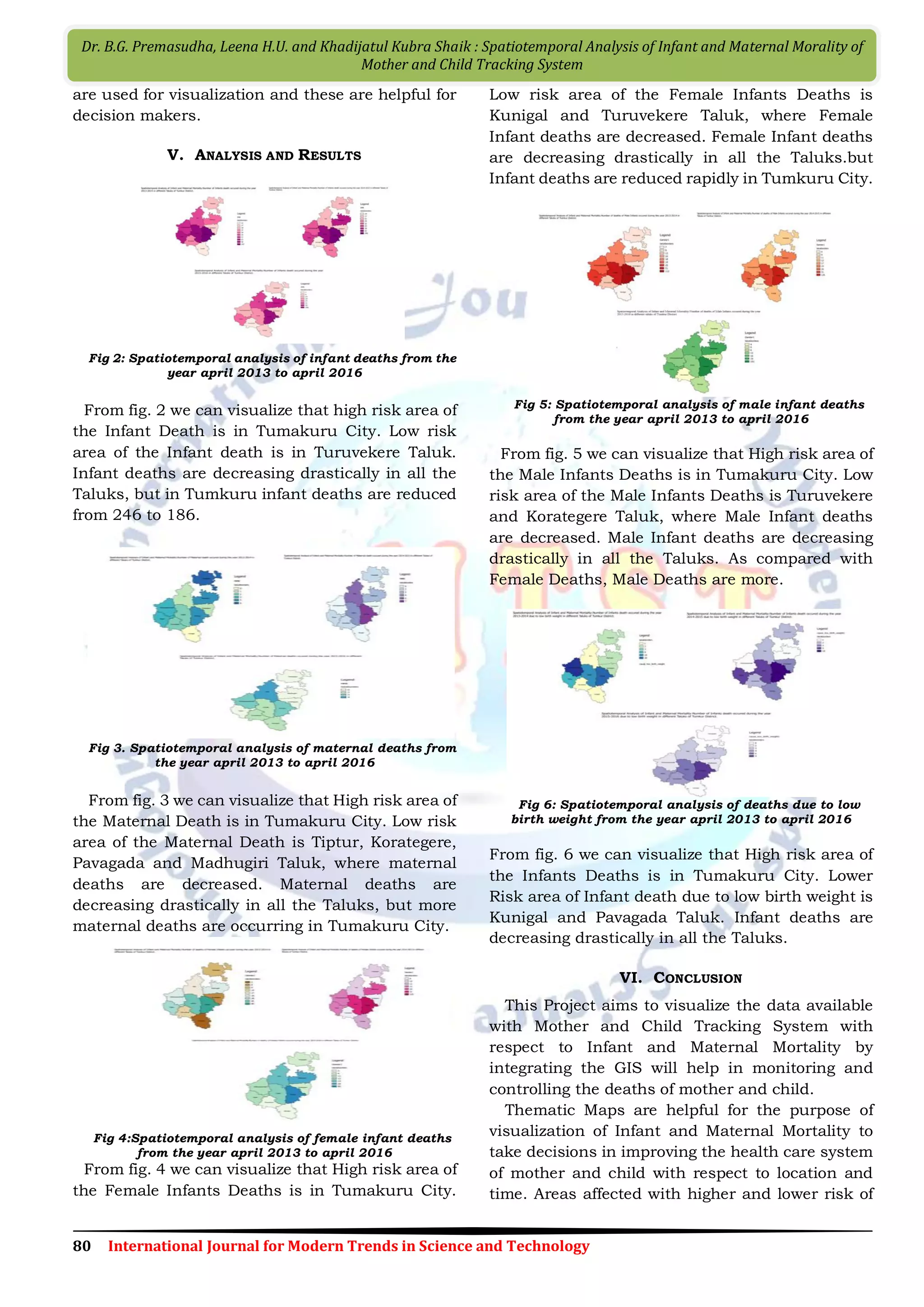
Fig 2: Spatiotemporal analysis of infant deaths from the
year april 2013 to april 2016
From fig. 2 we can visualize that high risk area of
the Infant Death is in Tumakuru City. Low risk
area of the Infant death is in Turuvekere Taluk.
Infant deaths are decreasing drastically in all the
Taluks, but in Tumkuru infant deaths are reduced
from 246 to 186.
Fig 3. Spatiotemporal analysis of maternal deaths from
the year april 2013 to april 2016
From fig. 3 we can visualize that High risk area of
the Maternal Death is in Tumakuru City. Low risk
area of the Maternal Death is Tiptur, Korategere,
Pavagada and Madhugiri Taluk, where maternal
deaths are decreased. Maternal deaths are
decreasing drastically in all the Taluks, but more
maternal deaths are occurring in Tumakuru City.
Fig 4:Spatiotemporal analysis of female infant deaths
from the year april 2013 to april 2016
From fig. 4 we can visualize that High risk area of
the Female Infants Deaths is in Tumakuru City.
Low risk area of the Female Infants Deaths is
Kunigal and Turuvekere Taluk, where Female
Infant deaths are decreased. Female Infant deaths
are decreasing drastically in all the Taluks.but
Infant deaths are reduced rapidly in Tumkuru City.
Fig 5: Spatiotemporal analysis of male infant deaths
from the year april 2013 to april 2016
From fig. 5 we can visualize that High risk area of
the Male Infants Deaths is in Tumakuru City. Low
risk area of the Male Infants Deaths is Turuvekere
and Korategere Taluk, where Male Infant deaths
are decreased. Male Infant deaths are decreasing
drastically in all the Taluks. As compared with
Female Deaths, Male Deaths are more.
Fig 6: Spatiotemporal analysis of deaths due to low
birth weight from the year april 2013 to april 2016
From fig. 6 we can visualize that High risk area of
the Infants Deaths is in Tumakuru City. Lower
Risk area of Infant death due to low birth weight is
Kunigal and Pavagada Taluk. Infant deaths are
decreasing drastically in all the Taluks.
VI. CONCLUSION
This Project aims to visualize the data available
with Mother and Child Tracking System with
respect to Infant and Maternal Mortality by
integrating the GIS will help in monitoring and
controlling the deaths of mother and child.
Thematic Maps are helpful for the purpose of
visualization of Infant and Maternal Mortality to
take decisions in improving the health care system
of mother and child with respect to location and
time. Areas affected with higher and lower risk of
81 International Journal for Modern Trends in Science and Technology
Dr. B.G. Premasudha, Leena H.U. and Khadijatul Kubra Shaik : Spatiotemporal Analysis of Infant and Maternal Morality of
Mother and Child Tracking System
Infant death and maternal death is visualized. The
main cause for Infants death is visualized through
Thematic Maps across all the Taluks of Tumakuru
District.
REFERENCES
[1] A.Roja, V. Raghu, G. Prasada Rao, “Web Based GIS
for Public Health Management in Andhra Pradesh”,
International Journal of Health Sciences and
Research, vol.5, Issue: 8, August 2015, ISSN:
2249-9571, pp. 733-741.
[2] Rajeev Gera, Nithiyananthan Muthusamy, Amruta
Bahulekar, Amit Sharma, Prem Singh, Amrita
Sekhar and Vivek Singh, “An in-depth assessment of
India’s Mother and Child Tracking System (MCTS) in
Rajasthan and Uttar Pradesh”, BMC Health Services
Research (2015) 15:315
[3] Bhaskar Reddy Pulsani, “Implementation of
Open-Source Web Mapping Technologies To Support
Monitoring Of Governmental Schemes”, ISPRS
Annals of the Photogrammetry, Remote Sensing and
Spatial Information Sciences, Volume II-2/W2,
2015.
[4] Steeve Ebener, Maria Guerra-Arias, James
Campbell, Andrew J. Tatem, Allisyn C. Moran, Fiifi
Amoako Johnson, Helga Fogstad, Karin Stenberg,
Sarah Neal, Patricia Bailey, Reid Porter9 and Zoe
Matthews, “The geography of maternal and newborn
health: the state of the art”, International Journal of
Health Geographics, 2015, pp. 14-19.
[5] Usman Ado Kibon and M. Ahmed, "Distribution of
Primary Health Care Facilities in Kano Metropolis
Using GIS (Geographic Information System)",
Research Journal of Environmental and Earth
Sciences 2013, 5(4): pp. 167-176.
[6] Abbas, Idowu I , Auta, Sarah Zaka and Naiya,‎ R‎
Muhammad, "Health‎ Care‎ Facilities Mapping and
Database Creation Using GIS in Chikun Local
Government, Kaduna State, Nigeria, Global Journal
of Human Social Science Geography &
Environmental GeoSciences, 2012, vol.12, Issue 10.
[7] Nicola T. Shaw, “Geographical Information Systems
and Health: Current State and Future Directions”,
Health Informatics Research, 2012 June 18(2),
pp.88-96.
[8] Chris Green PhD, "Geographic Information Systems
and Public Health: Benefits and Challenges", Purple
Paper, 2012, Issue 37.

Spatiotemporal Analysis of Infant and Maternal Morality of Mother and Child Tracking System

  • 1.
    78 International Journalfor Modern Trends in Science and Technology Spatiotemporal Analysis of Infant and Maternal Morality of Mother and Child Tracking System Dr. B.G. Premasudha1 | Leena H.U.2 | Khadijatul Kubra Shaik3 1Master of Computer Applications, Siddaganga Institute of Technology, Tumkur, Karnataka, India 2Master of Computer Applications, Siddaganga Institute of Technology, Tumkur, Karnataka, India 3 Master of Computer Applications, Siddaganga Institute of Technology, Tumkur, Karnataka, India To Cite this Article Dr. B.G. Premasudha, Leena H.U. and Khadijatul Kubra Shaik, “Spatiotemporal Analysis of Infant and Maternal Morality of Mother and Child Tracking System”, International Journal for Modern Trends in Science and Technology, Vol. 02, Issue 12, 2016, pp. 78 - 81. Community healthcare is significant societal issue with profound suggestions for government organization and with huge effect on individual standards of livelihood. The maintaining and monitoring of numerous health associated government schemes are done through information technology where involvement of Geographic Information System (GIS) is missing. This Project intends in integrating a GIS with Infant and Maternal Mortality of Mother and Child Tracking System (MCTS). Thematic Mapping is a component of GIS where it has constantly characterized to demonstrate the current status of health issues in an influential way. The open source tool Quantum GIS (QGIS) is used to represent Infant and Maternal Mortality on Thematic Maps which helps in identifying the areas with higher and weaker distributions of affected population. KEYWORDS: GIS, MCTS, QGIS, Maternal Mortality, Infant Mortality Copyright © 2016 International Journal for Modern Trends in Science and Technology All rights reserved. I. INTRODUCTION Maternal and Child mortality is not an exceptional occasion in a few sections of the developing world. Mothers and Infants are at most astounding danger for disease and demise. While parenthood is regularly a positive and satisfying knowledge, for an excess of ladies, it is connected with ill–health and even demise. The passing of a lady amid pregnancy is a catastrophe that carries a huge burden of grief and pain, and has been portrayed as a noteworthy general wellbeing issue in developing nations. Ladies play a key role in the growth of family welfare. Passing of babies under one are particular and firmly identified with maternal well being. The MCTS is an online application, which was dispatched by Government of India. It tracks pregnant mothers and infants, and screens the Health and inoculation of both the mother and infant. It goes for decreasing the maternal and infant death rate. Online Submission of name based data of a Pregnant Women and kids under MCTS Portal. II. LITERATURE SURVEY GIS is a tool used for data collection, storing, analyzing, managing and visualization. As it is known that in health sector many of the changes have strong geospatial components, GIS can provide an integrated approach to the public health departments in planning and analysis. It is defined as the science and technology related to the gathering, storage, manipulation, analysis and visualization of geo-referenced data. It integrates ABSTRACT International Journal for Modern Trends in Science and Technology Volume: 02, Issue No: 12, December 2016 ISSN: 2455-3778 http://www.ijmtst.com
  • 2.
    79 International Journalfor Modern Trends in Science and Technology Dr. B.G. Premasudha, Leena H.U. and Khadijatul Kubra Shaik : Spatiotemporal Analysis of Infant and Maternal Morality of Mother and Child Tracking System non-spatial tabular data with its geographically referenced spatial data. The incredible prospective of GIS to benefit the health care industry is not only appreciated but also adopted for integration and spatial visualization of health data. GIS systems make it possible for public health professionals to visualize population health problems within the perspective of available social services, demographic factors and vary in environmental variables [1]. The capacity of GIS lies in mapping the population at risk, health dynamics, aspects of risk and relationships between them. MCTS assist monitoring of universal access to maternal and child health services by all pregnant women and children [2]. The broad objective is to reduce Infant Mortality, to progress the nutritional level of the child, to ensure completion of immunization in children by tracking the proper growth of the individual child, and to decrease maternal mortality rate. Decision makers can prioritize not only the affecting factors of the disease, but also the actions and regulations required for fighting the disease. It is useful to monitor the performance of different government schemes and their achievements against targets. Monitoring nutrition values of the pregnant women and a new born child in a community through GIS will be helpful to the government to decide on where to concentrate more [3]. Despite these challenges, the emphasis on reducing mother and infant mortality is an prospect for new synergies [4]. The health sector can use Mother and Newborn Health as the driver to progress GIS capacity, thus benefiting all health initiatives. III. GEOGRAPHIC INFORMATION SYSTEM (GIS) GIS is a computer-based data framework that is used to digitally represent and analyze the geographic components present on the Earth's surface and the event (non-spatial ascribes connected to the geology under study) that are occurring on it. GIS has been defined as “automated systems of software and hardware for the purpose capturing, storing, retrieving, analysis and presentation of spatial and non-spatial information [5]." A. GIS in Health At the point when used to the full degree of its ability, GIS can "illuminate and instruct (experts and people in general), engage basic leadership at all levels, help in arranging and tweaking clinically and savvy activities, in anticipating results before making any money related duties and crediting needs in an atmosphere of limited resources, change practices; and constantly monitor and analyze changes, and additionally sentinel occasions [7]." Yet, in spite of the unimaginable potential advantages of applying GIS advancements, their utilization in wellbeing administration arranging and procurement remains incredibly underutilized. IV. SPATIOTEMPORAL ANALYSIS Spatiotemporal analysis is a rising research area because of the advancement and use of novel computational methods taking into account the investigation of extensive spatiotemporal databases. Spatiotemporal models emerge when information are gathered crosswise over time and additionally space and has no less than one spatial and one transient property. An occasion in a spatiotemporal dataset depicts a spatial and worldly marvel that exists at a specific time t and area x. Different applications for spatiotemporal examination incorporate cases in the areas of science, nature, meteorology, medication, transportation and forestry. A. Architecture of MCTS Fig. 1 Architecture of MCTS Fig. 1 shows how the data is fetched from the MCTS database and provided to a system enabled with GIS as input for processing and mapping. Processing includes spatial analysis and modeling. The results of processing are used for mapping. Mapping includes classification and generating of charts of Mother and Child. The generated outputs
  • 3.
    80 International Journalfor Modern Trends in Science and Technology Dr. B.G. Premasudha, Leena H.U. and Khadijatul Kubra Shaik : Spatiotemporal Analysis of Infant and Maternal Morality of Mother and Child Tracking System are used for visualization and these are helpful for decision makers. V. ANALYSIS AND RESULTS Fig 2: Spatiotemporal analysis of infant deaths from the year april 2013 to april 2016 From fig. 2 we can visualize that high risk area of the Infant Death is in Tumakuru City. Low risk area of the Infant death is in Turuvekere Taluk. Infant deaths are decreasing drastically in all the Taluks, but in Tumkuru infant deaths are reduced from 246 to 186. Fig 3. Spatiotemporal analysis of maternal deaths from the year april 2013 to april 2016 From fig. 3 we can visualize that High risk area of the Maternal Death is in Tumakuru City. Low risk area of the Maternal Death is Tiptur, Korategere, Pavagada and Madhugiri Taluk, where maternal deaths are decreased. Maternal deaths are decreasing drastically in all the Taluks, but more maternal deaths are occurring in Tumakuru City. Fig 4:Spatiotemporal analysis of female infant deaths from the year april 2013 to april 2016 From fig. 4 we can visualize that High risk area of the Female Infants Deaths is in Tumakuru City. Low risk area of the Female Infants Deaths is Kunigal and Turuvekere Taluk, where Female Infant deaths are decreased. Female Infant deaths are decreasing drastically in all the Taluks.but Infant deaths are reduced rapidly in Tumkuru City. Fig 5: Spatiotemporal analysis of male infant deaths from the year april 2013 to april 2016 From fig. 5 we can visualize that High risk area of the Male Infants Deaths is in Tumakuru City. Low risk area of the Male Infants Deaths is Turuvekere and Korategere Taluk, where Male Infant deaths are decreased. Male Infant deaths are decreasing drastically in all the Taluks. As compared with Female Deaths, Male Deaths are more. Fig 6: Spatiotemporal analysis of deaths due to low birth weight from the year april 2013 to april 2016 From fig. 6 we can visualize that High risk area of the Infants Deaths is in Tumakuru City. Lower Risk area of Infant death due to low birth weight is Kunigal and Pavagada Taluk. Infant deaths are decreasing drastically in all the Taluks. VI. CONCLUSION This Project aims to visualize the data available with Mother and Child Tracking System with respect to Infant and Maternal Mortality by integrating the GIS will help in monitoring and controlling the deaths of mother and child. Thematic Maps are helpful for the purpose of visualization of Infant and Maternal Mortality to take decisions in improving the health care system of mother and child with respect to location and time. Areas affected with higher and lower risk of
  • 4.
    81 International Journalfor Modern Trends in Science and Technology Dr. B.G. Premasudha, Leena H.U. and Khadijatul Kubra Shaik : Spatiotemporal Analysis of Infant and Maternal Morality of Mother and Child Tracking System Infant death and maternal death is visualized. The main cause for Infants death is visualized through Thematic Maps across all the Taluks of Tumakuru District. REFERENCES [1] A.Roja, V. Raghu, G. Prasada Rao, “Web Based GIS for Public Health Management in Andhra Pradesh”, International Journal of Health Sciences and Research, vol.5, Issue: 8, August 2015, ISSN: 2249-9571, pp. 733-741. [2] Rajeev Gera, Nithiyananthan Muthusamy, Amruta Bahulekar, Amit Sharma, Prem Singh, Amrita Sekhar and Vivek Singh, “An in-depth assessment of India’s Mother and Child Tracking System (MCTS) in Rajasthan and Uttar Pradesh”, BMC Health Services Research (2015) 15:315 [3] Bhaskar Reddy Pulsani, “Implementation of Open-Source Web Mapping Technologies To Support Monitoring Of Governmental Schemes”, ISPRS Annals of the Photogrammetry, Remote Sensing and Spatial Information Sciences, Volume II-2/W2, 2015. [4] Steeve Ebener, Maria Guerra-Arias, James Campbell, Andrew J. Tatem, Allisyn C. Moran, Fiifi Amoako Johnson, Helga Fogstad, Karin Stenberg, Sarah Neal, Patricia Bailey, Reid Porter9 and Zoe Matthews, “The geography of maternal and newborn health: the state of the art”, International Journal of Health Geographics, 2015, pp. 14-19. [5] Usman Ado Kibon and M. Ahmed, "Distribution of Primary Health Care Facilities in Kano Metropolis Using GIS (Geographic Information System)", Research Journal of Environmental and Earth Sciences 2013, 5(4): pp. 167-176. [6] Abbas, Idowu I , Auta, Sarah Zaka and Naiya,‎ R‎ Muhammad, "Health‎ Care‎ Facilities Mapping and Database Creation Using GIS in Chikun Local Government, Kaduna State, Nigeria, Global Journal of Human Social Science Geography & Environmental GeoSciences, 2012, vol.12, Issue 10. [7] Nicola T. Shaw, “Geographical Information Systems and Health: Current State and Future Directions”, Health Informatics Research, 2012 June 18(2), pp.88-96. [8] Chris Green PhD, "Geographic Information Systems and Public Health: Benefits and Challenges", Purple Paper, 2012, Issue 37.