Schema-on-Read vs Schema-on-Write
Amr Awadallah
CTO, Cloudera, Inc.
aaa@cloudera.com
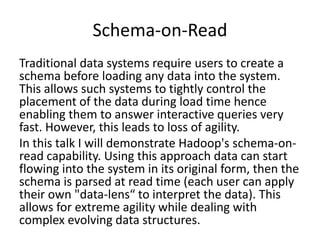
Schema-on-Read
Traditional data systems require users to create a
schema before loading any data into the system.
This allows such systems to tightly control the
placement of the data during load time hence
enabling them to answer interactive queries very
fast. However, this leads to loss of agility.
In this talk I will demonstrate Hadoop's schema-onread capability. Using this approach data can start
flowing into the system in its original form, then the
schema is parsed at read time (each user can apply
their own "data-lens“ to interpret the data). This
allows for extreme agility while dealing with
complex evolving data structures.
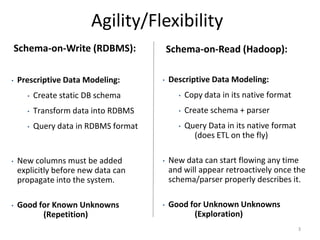
Agility/Flexibility
Schema-on-Write (RDBMS):
•

Prescriptive Data Modeling:

Schema-on-Read (Hadoop):
•

Descriptive Data Modeling:

•

Create static DB schema

•

Copy data in its native format

•

Transform data into RDBMS

•

Create schema + parser

•

Query data in RDBMS format

•

Query Data in its native format
(does ETL on the fly)

•

New columns must be added
explicitly before new data can
propagate into the system.

•

New data can start flowing any time
and will appear retroactively once the
schema/parser properly describes it.

•

Good for Known Unknowns
(Repetition)

•

Good for Unknown Unknowns
(Exploration)
3
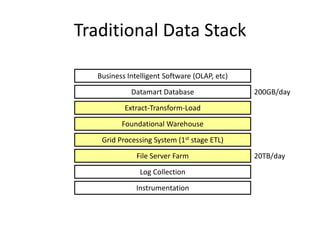
Traditional Data Stack
Business Intelligent Software (OLAP, etc)
Datamart Database

200GB/day

Extract-Transform-Load
Foundational Warehouse
Grid Processing System (1st stage ETL)
File Server Farm
Log Collection

Instrumentation

20TB/day

Schema-on-Read vs Schema-on-Write

  • 1.
    Schema-on-Read vs Schema-on-Write AmrAwadallah CTO, Cloudera, Inc. aaa@cloudera.com
  • 2.
    Schema-on-Read Traditional data systemsrequire users to create a schema before loading any data into the system. This allows such systems to tightly control the placement of the data during load time hence enabling them to answer interactive queries very fast. However, this leads to loss of agility. In this talk I will demonstrate Hadoop's schema-onread capability. Using this approach data can start flowing into the system in its original form, then the schema is parsed at read time (each user can apply their own "data-lens“ to interpret the data). This allows for extreme agility while dealing with complex evolving data structures.
  • 3.
    Agility/Flexibility Schema-on-Write (RDBMS): • Prescriptive DataModeling: Schema-on-Read (Hadoop): • Descriptive Data Modeling: • Create static DB schema • Copy data in its native format • Transform data into RDBMS • Create schema + parser • Query data in RDBMS format • Query Data in its native format (does ETL on the fly) • New columns must be added explicitly before new data can propagate into the system. • New data can start flowing any time and will appear retroactively once the schema/parser properly describes it. • Good for Known Unknowns (Repetition) • Good for Unknown Unknowns (Exploration) 3
  • 4.
    Traditional Data Stack BusinessIntelligent Software (OLAP, etc) Datamart Database 200GB/day Extract-Transform-Load Foundational Warehouse Grid Processing System (1st stage ETL) File Server Farm Log Collection Instrumentation 20TB/day