Michigan Public Employer Labor Relations AssociationThe Wage and Hour Compliance Minefield: Major Concerns for EmployersRobert A. Booninboonin@butzel.com January 17, 2011
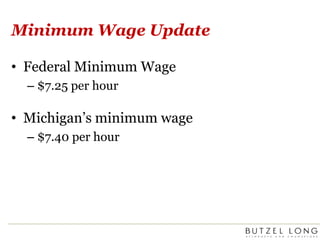
Minimum Wage UpdateFederal Minimum Wage$7.25 per hourMichigan’s minimum wage$7.40 per hour
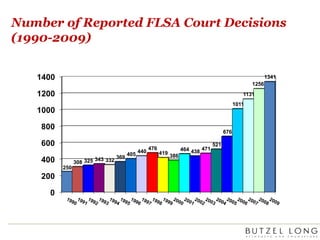
Number of Reported FLSA Court Decisions(1990-2009)
Enforcement InitiativesAdministrator Interpretations250 New InvestigatorsIndependent Contractors“Plan/Prepare/Prevent” Initiative Media Campaigns
“We can help . . .”
“Wecan help….” (cont’d)
April 22nd “Fact Sheet”Unpaid interns in for-profit private sector jobs are employees subject to minimum wage and overtime rulesAn apparent exception applies to non-profit and public employersBasis of another media campaign
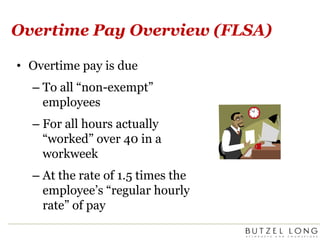
Overtime Pay Overview (FLSA)Overtime pay is dueTo all “non-exempt” employeesFor all hours actually “worked” over 40 in a workweekAt the rate of 1.5 times the employee’s “regular hourly rate” of pay
FLSA Overview (cont’d)The broadest exempt group of employees are certain “white collar” employeesExecutivesAdministrative employeesProfessional employeesHigh level computer-related occupationsProvided they are paid a salary of at least $455 per week or a wage of at least $27.63 per hourOutside sales employees
FLSA Overview (cont’d)Most white collar exemptions require the employee to:Meet the applicable “duties tests” of the exemptionBe paid at least $455 per week (the “salary level test”)Be paid a salary on a “salary basis” (the “salary basis” test)
FLSA Overview (cont’d)Consequence of errorsAmount of unpaid overtime for past 2-3 years (depending on statute of limitation) under federal lawLiability goes back 3 years under state law, if applicableLiquidated damages equal to the amount of unpaid overtimeAttorneys fees for prevailing employee’s attorneysFines, interest and possible criminal sanctions
Wage and Hour ComplianceCommon Errors
1. Misclassifying Employees as ExemptAdministrative EmployeesProduction vs. StaffOnly staff can be exempt administrative employeesPrimary duty is performing office or nonmanual work related to the employer’s management or general business operations, or those of a customerAs a part of their “primary duties” the employee must exercise “independent judgment and discretion” with respect to “matters of significance”
Misclassifying Employees (cont’d)Problem classificationsHelp desk employeesParalegalsCustomer service representativesAdministrative assistants
Misclassifying Employees (cont’d)Professional EmployeesPrimary duties must be in area requiring specialized higher education and the consistent exercise of discretion and judgment Law			MedicineEngineeringTeachingPsychologyScienceSocial WorkProblem classificationsAccountantsEntry level engineers
Misclassifying Employees (cont’d)ExecutivesProblem classificationsAssistant managersLow level supervisorsOutside Sales EmployeesProblem classificationsPharmaceutical sales reps
2. Violating the “Salary Basis” RuleIn order to be exempt, most white collar employees must be paid at least $455 per week on a salary basis, i.e., they must be paid a predetermined fixed amount each workweek without regard to the quantity or quality of work performed in the week.Rule does not apply to:DoctorsLawyersTeachersEmployees in highly skilled computer related occupations earning at least $27.63 per hour
Salary Basis Rule (cont’d)Permissible DeductionsPersonal days of one day or moreSick days of one day or more, if pursuant to bona fide time off planSetoffs for jury, witness or military dutySuspensions for violating “safety rules of major significance” Suspensions of one day or more for violating written workplace conduct rulesProrations for initial or terminal weeks of employmentTime missed due to FMLA leave
Salary Basis Rule (cont’d)NOTE: Under the FLSA, it is permissible to dock PTO and similar leave banks for partial days missed, so long as the employee’s pay is not docked for the partial day missedSome states prohibit this practice as to exempt employees under state law, but not Michigan
3. Off-Clock TimeFailure to pay for all time worked by not properly recording all work timeWork during meal breaks and rest periods must be counted as work time
Off-Clock Time (cont’d)The workday includes….“The period between the commencement and completion on the same workday of an employee’s principal activity or activities.  It includes all time within that period whether or not the employee engages in work throughout all of that period.” “A principal activity is one that’s integral and indispensable to the job.”Pre- and post-shift activities which are integral to employee’s principal job constitute compensable work timeThese are “preparatory” and “concluding” activitiesAs distinguished from “preliminary” and “postliminary” activities, which are not compensable Work during meal breaks and rest periods must be counted as work time
Off-Clock Time (cont’d)Warning!!Problems abound regarding compensation for employees checking e-mails or logging in from homeThis is “work time”, if not de minimusThis may also cause what would otherwise be a noncompensable commute into a compensable commuteBottom line….Too often employers fail to pay for all time worked by not properly recording all work time
4. Compensatory TimePractice is to allow employees working overtime in one workweek to take 1.5 times that time off in other workweek(s)This practice is not permissible as to nonexempt employees in the private sector
5. Miscounting Travel TimeGeneral ruleAll time traveling in the course of a day of work is compensable (other than normal commute)ExceptionOnly applies to travel entailing an overnight stay ifNo work is performed while traveling, andThe traveling occurs during non-normal work hours, even on days normally not working
6. Miscounting Training TimeAttendance at training programs during or outside normal working hours is compensable, unless:Time is outside of normal working hours;Attendance is absolutely voluntary;Program is not directly related to job; andNo productive work is performed during the training
7. Miscalculating the Regular Rate of PayEmployers must roll-into base rate most pay premiums before calculating overtime rate.  Therefore, the regular rate includes extra pay such as:Shift premiumsLead employee premiumsDirty work premiumsNon-discretionary bonusesCommissionsPiece rate payments
Regular Rate of Pay (cont’d)Non-discretionary bonuses, commissions, and other occasional payments must be rolled-into the regular rate of pay for the period applicable to the payment, even if paid monthly, quarterly, annually, etc.A bonus is “discretionary” if both the fact that a payment will be made and the amount of payment is determined at or near end of the period, in the employer’s sole discretion
Regular Rate of Pay (cont’d)Nondiscretionary bonuses generally include:Productivity bonusesAttendance bonusesLongevity bonuses
Regular Rate of Pay (cont’d)Retroactive recalculation of regular rate of pay must occur upon the making of each such payment unless the payment is a percent of all compensation provided during the period
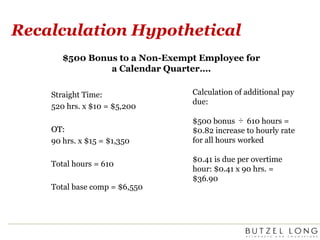
Recalculation Hypothetical$500 Bonus to a Non-Exempt Employee for a Calendar Quarter….Calculation of additional pay due:$500 bonus ÷ 610 hours = $0.82 increase to hourly rate for all hours worked$0.41 is due per overtime hour: $0.41 x 90 hrs. = $36.90Straight Time:520 hrs. x $10 = $5,200 OT:90 hrs. x $15 = $1,350Total hours = 610Total base comp = $6,550
Wage and Hour ComplianceThank YouRobert A. BooninButzel Long350 S. Main Street, Ste. 300Ann Arbor, MI  48104(734) 213-3601boonin@butzel.com

January 2011 - Business Law & Order - Robert Boonin

  • 1.
    Michigan Public EmployerLabor Relations AssociationThe Wage and Hour Compliance Minefield: Major Concerns for EmployersRobert A. Booninboonin@butzel.com January 17, 2011
  • 2.
    Minimum Wage UpdateFederalMinimum Wage$7.25 per hourMichigan’s minimum wage$7.40 per hour
  • 3.
    Number of ReportedFLSA Court Decisions(1990-2009)
  • 4.
    Enforcement InitiativesAdministrator Interpretations250New InvestigatorsIndependent Contractors“Plan/Prepare/Prevent” Initiative Media Campaigns
  • 5.
  • 6.
  • 7.
    April 22nd “FactSheet”Unpaid interns in for-profit private sector jobs are employees subject to minimum wage and overtime rulesAn apparent exception applies to non-profit and public employersBasis of another media campaign
  • 8.
    Overtime Pay Overview(FLSA)Overtime pay is dueTo all “non-exempt” employeesFor all hours actually “worked” over 40 in a workweekAt the rate of 1.5 times the employee’s “regular hourly rate” of pay
  • 9.
    FLSA Overview (cont’d)Thebroadest exempt group of employees are certain “white collar” employeesExecutivesAdministrative employeesProfessional employeesHigh level computer-related occupationsProvided they are paid a salary of at least $455 per week or a wage of at least $27.63 per hourOutside sales employees
  • 10.
    FLSA Overview (cont’d)Mostwhite collar exemptions require the employee to:Meet the applicable “duties tests” of the exemptionBe paid at least $455 per week (the “salary level test”)Be paid a salary on a “salary basis” (the “salary basis” test)
  • 11.
    FLSA Overview (cont’d)Consequenceof errorsAmount of unpaid overtime for past 2-3 years (depending on statute of limitation) under federal lawLiability goes back 3 years under state law, if applicableLiquidated damages equal to the amount of unpaid overtimeAttorneys fees for prevailing employee’s attorneysFines, interest and possible criminal sanctions
  • 12.
    Wage and HourComplianceCommon Errors
  • 13.
    1. Misclassifying Employeesas ExemptAdministrative EmployeesProduction vs. StaffOnly staff can be exempt administrative employeesPrimary duty is performing office or nonmanual work related to the employer’s management or general business operations, or those of a customerAs a part of their “primary duties” the employee must exercise “independent judgment and discretion” with respect to “matters of significance”
  • 14.
    Misclassifying Employees (cont’d)ProblemclassificationsHelp desk employeesParalegalsCustomer service representativesAdministrative assistants
  • 15.
    Misclassifying Employees (cont’d)ProfessionalEmployeesPrimary duties must be in area requiring specialized higher education and the consistent exercise of discretion and judgment Law MedicineEngineeringTeachingPsychologyScienceSocial WorkProblem classificationsAccountantsEntry level engineers
  • 16.
    Misclassifying Employees (cont’d)ExecutivesProblemclassificationsAssistant managersLow level supervisorsOutside Sales EmployeesProblem classificationsPharmaceutical sales reps
  • 17.
    2. Violating the“Salary Basis” RuleIn order to be exempt, most white collar employees must be paid at least $455 per week on a salary basis, i.e., they must be paid a predetermined fixed amount each workweek without regard to the quantity or quality of work performed in the week.Rule does not apply to:DoctorsLawyersTeachersEmployees in highly skilled computer related occupations earning at least $27.63 per hour
  • 18.
    Salary Basis Rule(cont’d)Permissible DeductionsPersonal days of one day or moreSick days of one day or more, if pursuant to bona fide time off planSetoffs for jury, witness or military dutySuspensions for violating “safety rules of major significance” Suspensions of one day or more for violating written workplace conduct rulesProrations for initial or terminal weeks of employmentTime missed due to FMLA leave
  • 19.
    Salary Basis Rule(cont’d)NOTE: Under the FLSA, it is permissible to dock PTO and similar leave banks for partial days missed, so long as the employee’s pay is not docked for the partial day missedSome states prohibit this practice as to exempt employees under state law, but not Michigan
  • 20.
    3. Off-Clock TimeFailureto pay for all time worked by not properly recording all work timeWork during meal breaks and rest periods must be counted as work time
  • 21.
    Off-Clock Time (cont’d)Theworkday includes….“The period between the commencement and completion on the same workday of an employee’s principal activity or activities. It includes all time within that period whether or not the employee engages in work throughout all of that period.” “A principal activity is one that’s integral and indispensable to the job.”Pre- and post-shift activities which are integral to employee’s principal job constitute compensable work timeThese are “preparatory” and “concluding” activitiesAs distinguished from “preliminary” and “postliminary” activities, which are not compensable Work during meal breaks and rest periods must be counted as work time
  • 22.
    Off-Clock Time (cont’d)Warning!!Problemsabound regarding compensation for employees checking e-mails or logging in from homeThis is “work time”, if not de minimusThis may also cause what would otherwise be a noncompensable commute into a compensable commuteBottom line….Too often employers fail to pay for all time worked by not properly recording all work time
  • 23.
    4. Compensatory TimePracticeis to allow employees working overtime in one workweek to take 1.5 times that time off in other workweek(s)This practice is not permissible as to nonexempt employees in the private sector
  • 24.
    5. Miscounting TravelTimeGeneral ruleAll time traveling in the course of a day of work is compensable (other than normal commute)ExceptionOnly applies to travel entailing an overnight stay ifNo work is performed while traveling, andThe traveling occurs during non-normal work hours, even on days normally not working
  • 25.
    6. Miscounting TrainingTimeAttendance at training programs during or outside normal working hours is compensable, unless:Time is outside of normal working hours;Attendance is absolutely voluntary;Program is not directly related to job; andNo productive work is performed during the training
  • 26.
    7. Miscalculating theRegular Rate of PayEmployers must roll-into base rate most pay premiums before calculating overtime rate. Therefore, the regular rate includes extra pay such as:Shift premiumsLead employee premiumsDirty work premiumsNon-discretionary bonusesCommissionsPiece rate payments
  • 27.
    Regular Rate ofPay (cont’d)Non-discretionary bonuses, commissions, and other occasional payments must be rolled-into the regular rate of pay for the period applicable to the payment, even if paid monthly, quarterly, annually, etc.A bonus is “discretionary” if both the fact that a payment will be made and the amount of payment is determined at or near end of the period, in the employer’s sole discretion
  • 28.
    Regular Rate ofPay (cont’d)Nondiscretionary bonuses generally include:Productivity bonusesAttendance bonusesLongevity bonuses
  • 29.
    Regular Rate ofPay (cont’d)Retroactive recalculation of regular rate of pay must occur upon the making of each such payment unless the payment is a percent of all compensation provided during the period
  • 30.
    Recalculation Hypothetical$500 Bonusto a Non-Exempt Employee for a Calendar Quarter….Calculation of additional pay due:$500 bonus ÷ 610 hours = $0.82 increase to hourly rate for all hours worked$0.41 is due per overtime hour: $0.41 x 90 hrs. = $36.90Straight Time:520 hrs. x $10 = $5,200 OT:90 hrs. x $15 = $1,350Total hours = 610Total base comp = $6,550
  • 31.
    Wage and HourComplianceThank YouRobert A. BooninButzel Long350 S. Main Street, Ste. 300Ann Arbor, MI 48104(734) 213-3601boonin@butzel.com