Milwaukee | Madison
411 East Wisconsin Avenue | Suite 1000 | Milwaukee, WI 53202 | www.vonbriesen.com
Presented to
HNI Risk Services
16805 W. Cleveland Ave.
New Berlin, WI
September 30, 2016 - 8:00 a.m. – 9:00 a.m.
By Doris E. Brosnan
An Employer Guide: DOL’s
New Overtime Exemption
Rules
Overview of Upcoming Changes
• In 2014, Pres. Obama asked Dept. of Labor
(“DOL”) to revise the regulations, which
had not been revised since 2004.
• On May 18, 2016, the DOL released its final
rule.
• The changes relate to the minimum salary
threshold for the salaried exempt status.
Review of White-Collar Exemptions
• Salary level test.
• Salary basis test.
• Job duties test.
“Salaried exempt” status
• Exempt from minimum wage and overtime
pay requirements.
• What is salaried basis?
– Paid the same amount every week, regardless
of hours worked (with some exceptions).
– Have to meet standards related to job duties.
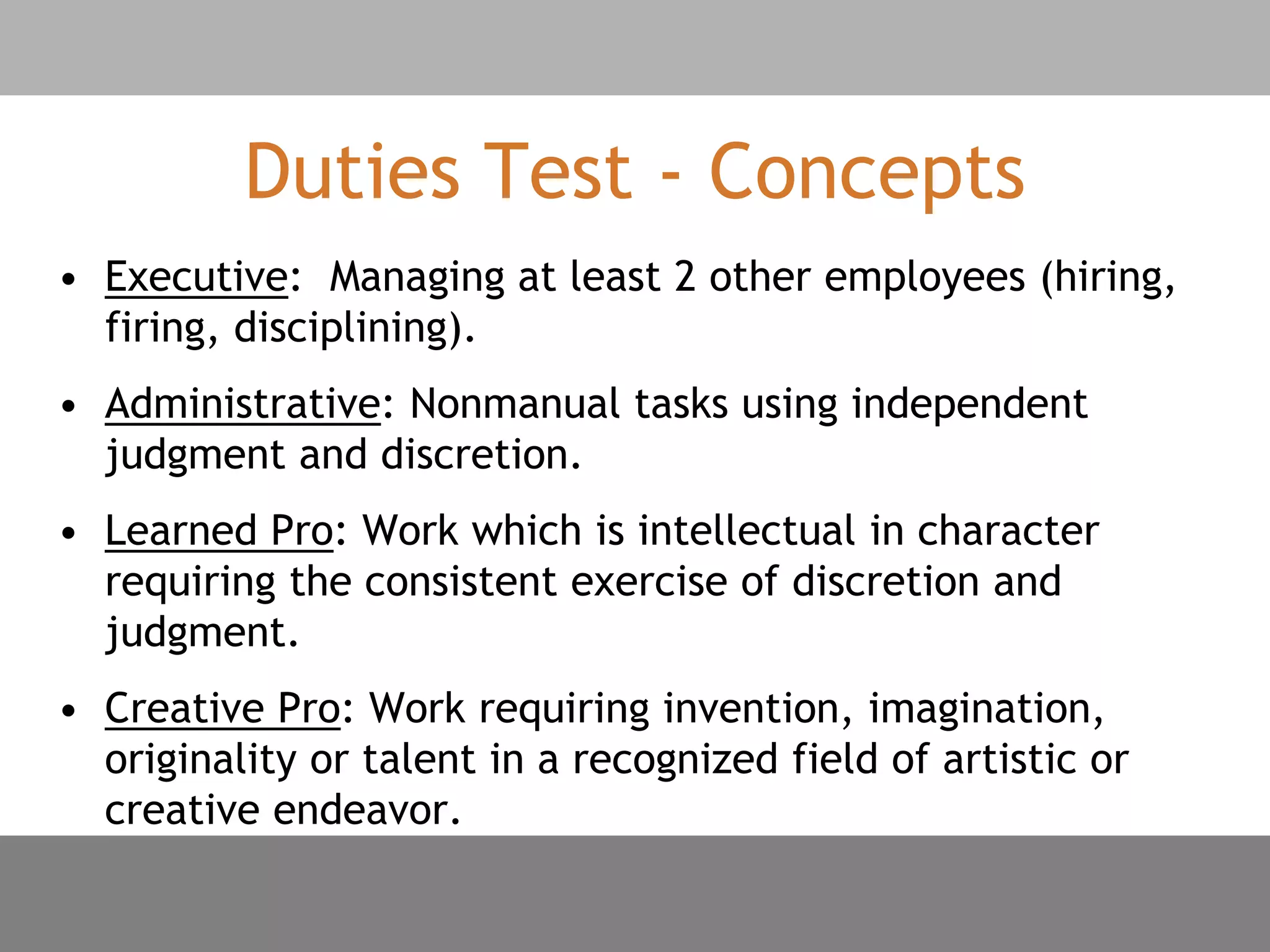
Duties Test - Concepts
• Executive: Managing at least 2 other employees (hiring,
firing, disciplining).
• Administrative: Nonmanual tasks using independent
judgment and discretion.
• Learned Pro: Work which is intellectual in character
requiring the consistent exercise of discretion and
judgment.
• Creative Pro: Work requiring invention, imagination,
originality or talent in a recognized field of artistic or
creative endeavor.
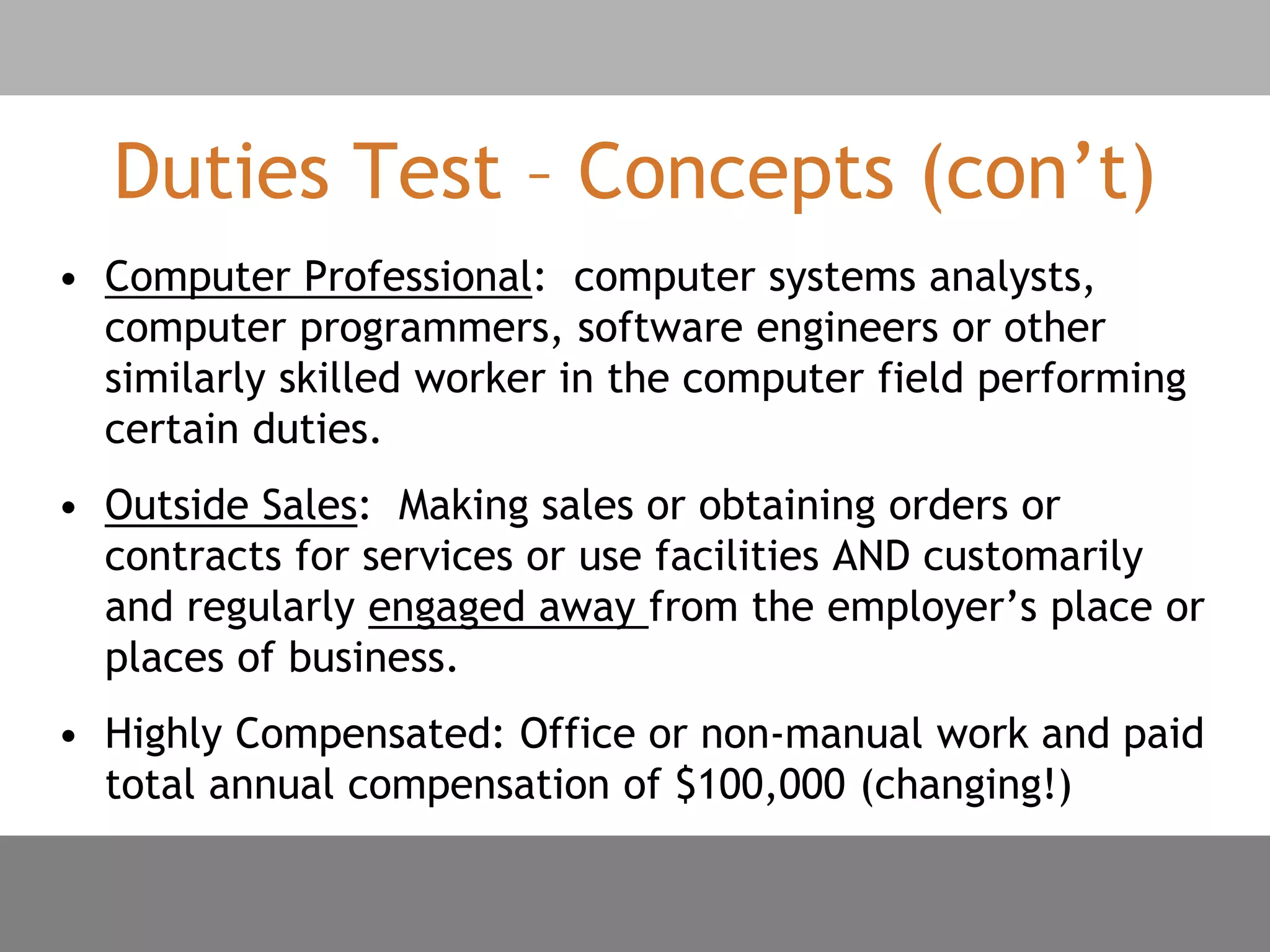
Duties Test – Concepts (con’t)
• Computer Professional: computer systems analysts,
computer programmers, software engineers or other
similarly skilled worker in the computer field performing
certain duties.
• Outside Sales: Making sales or obtaining orders or
contracts for services or use facilities AND customarily
and regularly engaged away from the employer’s place or
places of business.
• Highly Compensated: Office or non-manual work and paid
total annual compensation of $100,000 (changing!)
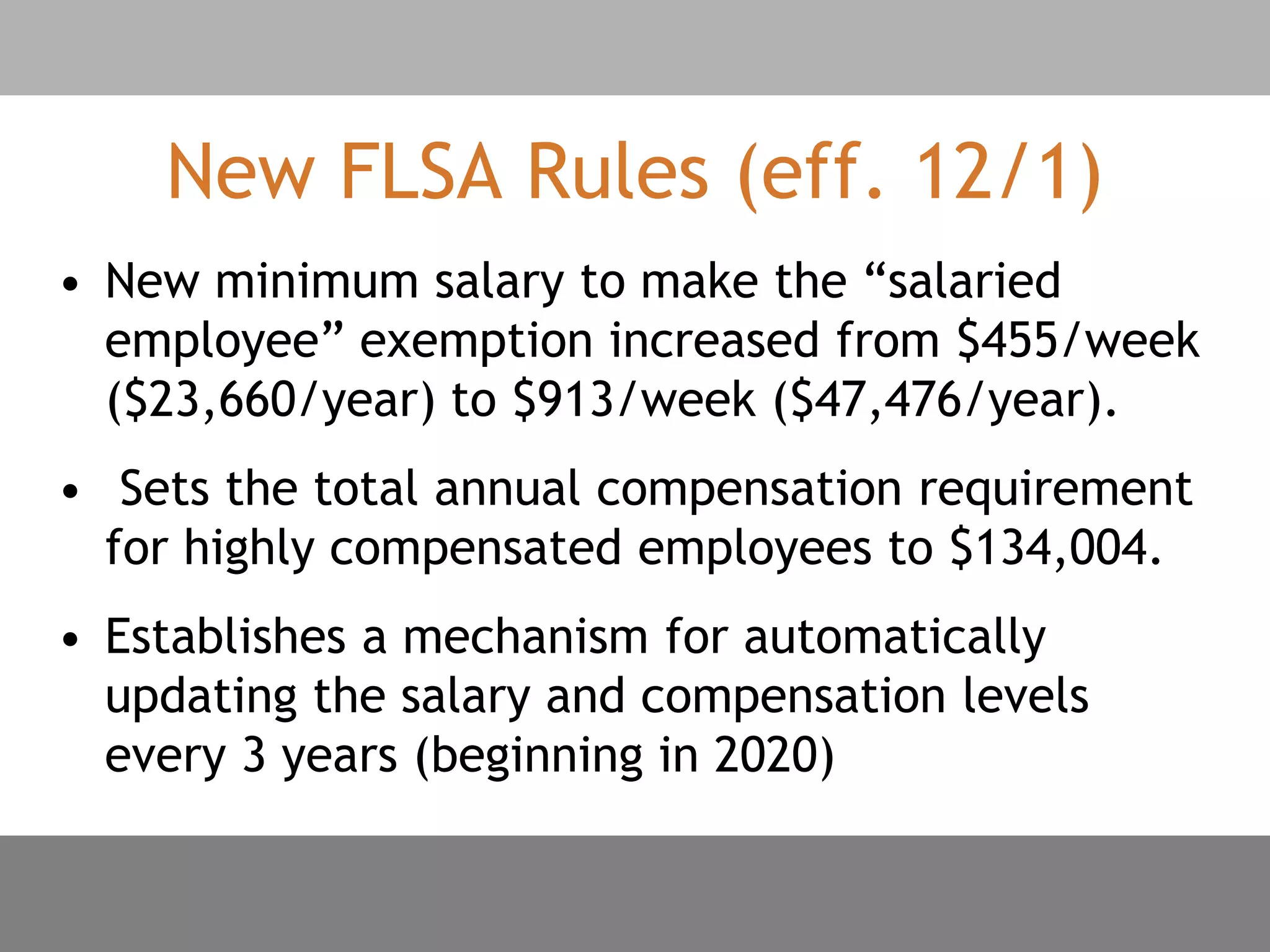
New FLSA Rules (eff. 12/1)
• New minimum salary to make the “salaried
employee” exemption increased from $455/week
($23,660/year) to $913/week ($47,476/year).
• Sets the total annual compensation requirement
for highly compensated employees to $134,004.
• Establishes a mechanism for automatically
updating the salary and compensation levels
every 3 years (beginning in 2020)
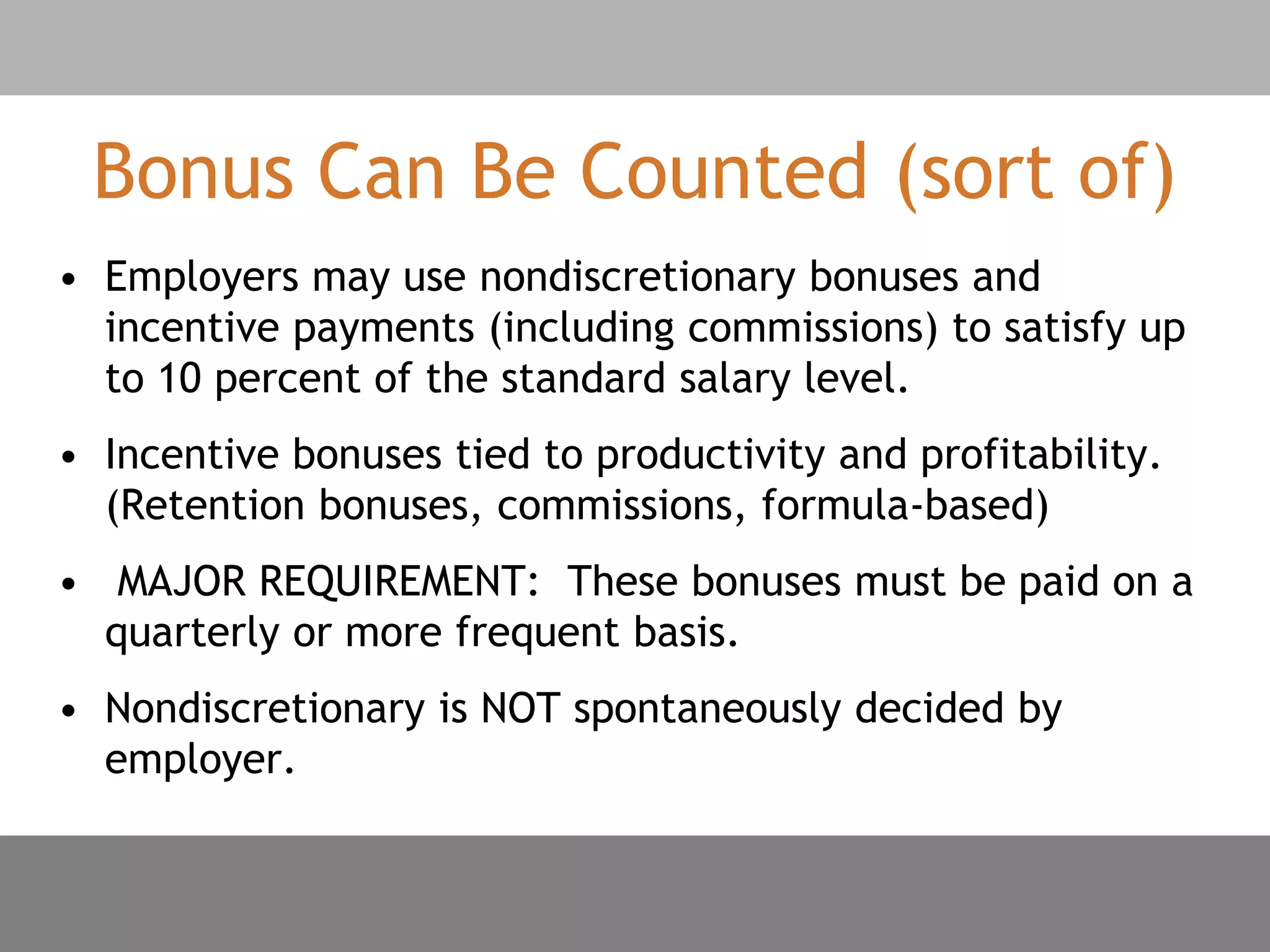
Bonus Can Be Counted (sort of)
• Employers may use nondiscretionary bonuses and
incentive payments (including commissions) to satisfy up
to 10 percent of the standard salary level.
• Incentive bonuses tied to productivity and profitability.
(Retention bonuses, commissions, formula-based)
• MAJOR REQUIREMENT: These bonuses must be paid on a
quarterly or more frequent basis.
• Nondiscretionary is NOT spontaneously decided by
employer.
Consequences
• 4.2 million workers are going to now be
overtime eligible (unless they get a pay
raise).
• May especially hurt rural businesses, small
not-for-profit businesses, and local
governments.
Federal Court Challenge
• On Sept. 19, 2016, a group of 21 states filed a
lawsuit in federal court in the Eastern District of
Texas challenging the rule.
• The group is led by Texas and Nevada, and it
includes Wisconsin.
• Argument: the new rule will force businesses,
including state and local governments to
“unfairly” increase their labor costs.
Federal Court Challenge (con’t)
• State govs. argue that the 10th Amendment
is violated and it will wreck state budgets.
• Challenge to mechanism for automatic
increases every 3 years: violates
Administrative Procedure Act because it is
arbitrary and capricious and does not
follow rulemaking requirement.
Conventional Wisdom
• This lawsuit is….very far from certain to
succeed.
• Employers need to assume the rule will go
into affect on 12/1.
• Do not wait for a federal court to stop the
rules.
How to Prepare?
• Audit your exempt workforce. Identify
anyone making a salary less than the
thresholds.
• Raise salaries or be prepare to pay
overtime for hours worked over 40 in a
workweek.
• Make everyone keep track of time.
Reclassifying Employees
• Work with outside counsel.
• There are pitfalls.
Wisconsin Rules
• Don’t forget about Wisconsin’s wage and
hour rules!
• Not enforced against non-profits.
• If there is a difference in favor of
employee, you must follow Wisconsin rule.
Duties Test – Wisconsin Difference
• Wisconsin rules impose percentage limits on the amount
of nonexempt work an employee may perform.
• Limit = 20% for most exempt jobs, and 40% for retail and
service establishments.
• Wisconsin also says exemption only applies to overtime,
not minimum wage.
• NOTE: Wisconsin overtime law not enforced against non-
profits.
Other Wage and Hour Issues
“Off the clock” work will continue to be the
subject of collective and class actions.
– “Preliminary” and postliminary” time
– “Donning and Doffing”
– Unpaid meal periods that are constantly
interrupted.
– Work from home on digital devices.
QUESTIONS???

An Employer Guide: DOL's New Overtime Exemption Rules

  • 1.
    Milwaukee | Madison 411East Wisconsin Avenue | Suite 1000 | Milwaukee, WI 53202 | www.vonbriesen.com Presented to HNI Risk Services 16805 W. Cleveland Ave. New Berlin, WI September 30, 2016 - 8:00 a.m. – 9:00 a.m. By Doris E. Brosnan An Employer Guide: DOL’s New Overtime Exemption Rules
  • 2.
    Overview of UpcomingChanges • In 2014, Pres. Obama asked Dept. of Labor (“DOL”) to revise the regulations, which had not been revised since 2004. • On May 18, 2016, the DOL released its final rule. • The changes relate to the minimum salary threshold for the salaried exempt status.
  • 3.
    Review of White-CollarExemptions • Salary level test. • Salary basis test. • Job duties test.
  • 4.
    “Salaried exempt” status •Exempt from minimum wage and overtime pay requirements. • What is salaried basis? – Paid the same amount every week, regardless of hours worked (with some exceptions). – Have to meet standards related to job duties.
  • 5.
    Duties Test -Concepts • Executive: Managing at least 2 other employees (hiring, firing, disciplining). • Administrative: Nonmanual tasks using independent judgment and discretion. • Learned Pro: Work which is intellectual in character requiring the consistent exercise of discretion and judgment. • Creative Pro: Work requiring invention, imagination, originality or talent in a recognized field of artistic or creative endeavor.
  • 6.
    Duties Test –Concepts (con’t) • Computer Professional: computer systems analysts, computer programmers, software engineers or other similarly skilled worker in the computer field performing certain duties. • Outside Sales: Making sales or obtaining orders or contracts for services or use facilities AND customarily and regularly engaged away from the employer’s place or places of business. • Highly Compensated: Office or non-manual work and paid total annual compensation of $100,000 (changing!)
  • 7.
    New FLSA Rules(eff. 12/1) • New minimum salary to make the “salaried employee” exemption increased from $455/week ($23,660/year) to $913/week ($47,476/year). • Sets the total annual compensation requirement for highly compensated employees to $134,004. • Establishes a mechanism for automatically updating the salary and compensation levels every 3 years (beginning in 2020)
  • 8.
    Bonus Can BeCounted (sort of) • Employers may use nondiscretionary bonuses and incentive payments (including commissions) to satisfy up to 10 percent of the standard salary level. • Incentive bonuses tied to productivity and profitability. (Retention bonuses, commissions, formula-based) • MAJOR REQUIREMENT: These bonuses must be paid on a quarterly or more frequent basis. • Nondiscretionary is NOT spontaneously decided by employer.
  • 9.
    Consequences • 4.2 millionworkers are going to now be overtime eligible (unless they get a pay raise). • May especially hurt rural businesses, small not-for-profit businesses, and local governments.
  • 10.
    Federal Court Challenge •On Sept. 19, 2016, a group of 21 states filed a lawsuit in federal court in the Eastern District of Texas challenging the rule. • The group is led by Texas and Nevada, and it includes Wisconsin. • Argument: the new rule will force businesses, including state and local governments to “unfairly” increase their labor costs.
  • 11.
    Federal Court Challenge(con’t) • State govs. argue that the 10th Amendment is violated and it will wreck state budgets. • Challenge to mechanism for automatic increases every 3 years: violates Administrative Procedure Act because it is arbitrary and capricious and does not follow rulemaking requirement.
  • 12.
    Conventional Wisdom • Thislawsuit is….very far from certain to succeed. • Employers need to assume the rule will go into affect on 12/1. • Do not wait for a federal court to stop the rules.
  • 13.
    How to Prepare? •Audit your exempt workforce. Identify anyone making a salary less than the thresholds. • Raise salaries or be prepare to pay overtime for hours worked over 40 in a workweek. • Make everyone keep track of time.
  • 14.
    Reclassifying Employees • Workwith outside counsel. • There are pitfalls.
  • 15.
    Wisconsin Rules • Don’tforget about Wisconsin’s wage and hour rules! • Not enforced against non-profits. • If there is a difference in favor of employee, you must follow Wisconsin rule.
  • 16.
    Duties Test –Wisconsin Difference • Wisconsin rules impose percentage limits on the amount of nonexempt work an employee may perform. • Limit = 20% for most exempt jobs, and 40% for retail and service establishments. • Wisconsin also says exemption only applies to overtime, not minimum wage. • NOTE: Wisconsin overtime law not enforced against non- profits.
  • 17.
    Other Wage andHour Issues “Off the clock” work will continue to be the subject of collective and class actions. – “Preliminary” and postliminary” time – “Donning and Doffing” – Unpaid meal periods that are constantly interrupted. – Work from home on digital devices.
  • 18.