
33rd Annual Employment Law Seminar
OCTOBER 27 & 28, 2021 | MULTI-DAY WEBINAR
p a r s o n s b e h l e . c o m
BOISE | HELENA | IDAHO FALLS | LEHI | MISSOULA | RENO | SALT LAKE CITY
FLSA and Regular Rate
of Pay Calculations
Mark A. Wagner
801.536.6776 | mwagner@parsonsbehle.com
General Background
3
Not Just an Employee-Protection Statute
• The Fair Labor Standards Act of 1938 (FLSA) originated in President
Franklin Roosevelt's New Deal
◦ Getting the country out of the Great Depression
◦ Giving employers an economic incentive to spread work around
 Banning child labor (under 16 – with exceptions)
 Establishing a maximum hours standard
 Mandating overtime pay for work in excess of maximum hours
◦ A hodge-podge of politics and legal hoops had to be considered
◦ Result: specific rules to follow but lack of consistency
Statutory Mandate
5
Overtime Pay Requirement
(1) Except as otherwise provided in this section, no
employer shall employ any . . . employees . . . for a
workweek longer than forty hours unless such
employee receives compensation for [all hours over
forty] at a rate not less than one and one-half times
the regular rate at which he is employed.
FLSA § 7(a) (29 U.S.C. § 207(a))
What Is the “Regular Rate?”
7
Regular Rate -- Includes:
All remuneration paid to, or on behalf of, the employee for work
performed during the week, including:
 Wages
 Salary
 Commissions
 Non-discretionary bonuses
FLSA § 7(e) (29 U.S.C. § 207(e))
8
Regular Rate -- Includes:
• Also includes non-cash payments in the form of goods or facilities
◦ Must include in the regular rate the reasonable cost to the employer or fair
value of such goods or facilities.
9
Regular Rate -- Excludes:
1. Gifts
2. Pay for occasional periods of no work, such as paid vacation and sick leave; expense
reimbursements; and other “similar payments” that are not made as compensation
for hours of employment
3. Discretionary bonuses; payments from profit-sharing or savings plan; and talent fees
4. Benefit plan contributions and payments to certain profit-sharing plans
5. The “premium” portion of premium pay for more than 8 hours in a day, more than 40
hours in a week, or more than employees’ normal/regular working hours
6. The “premium” portion of premium pay for work on a Saturday, Sunday, holiday, or
regular day of rest where the rate is at least 1.5 times the rate for work in non-
overtime hours on other days
7. The “premium” portion of premium pay for work outside regular hours established by a contract
as the regular workday (not over 8 hours) or workweek (not over 40 hours) where the rate is at
least 1.5 times the rate for work within the regular workday or workweek
8. Certain stock-related income
FLSA § 7(e)(1)-(8) (29 U.S.C. § 207(e)(1)-(8))
10
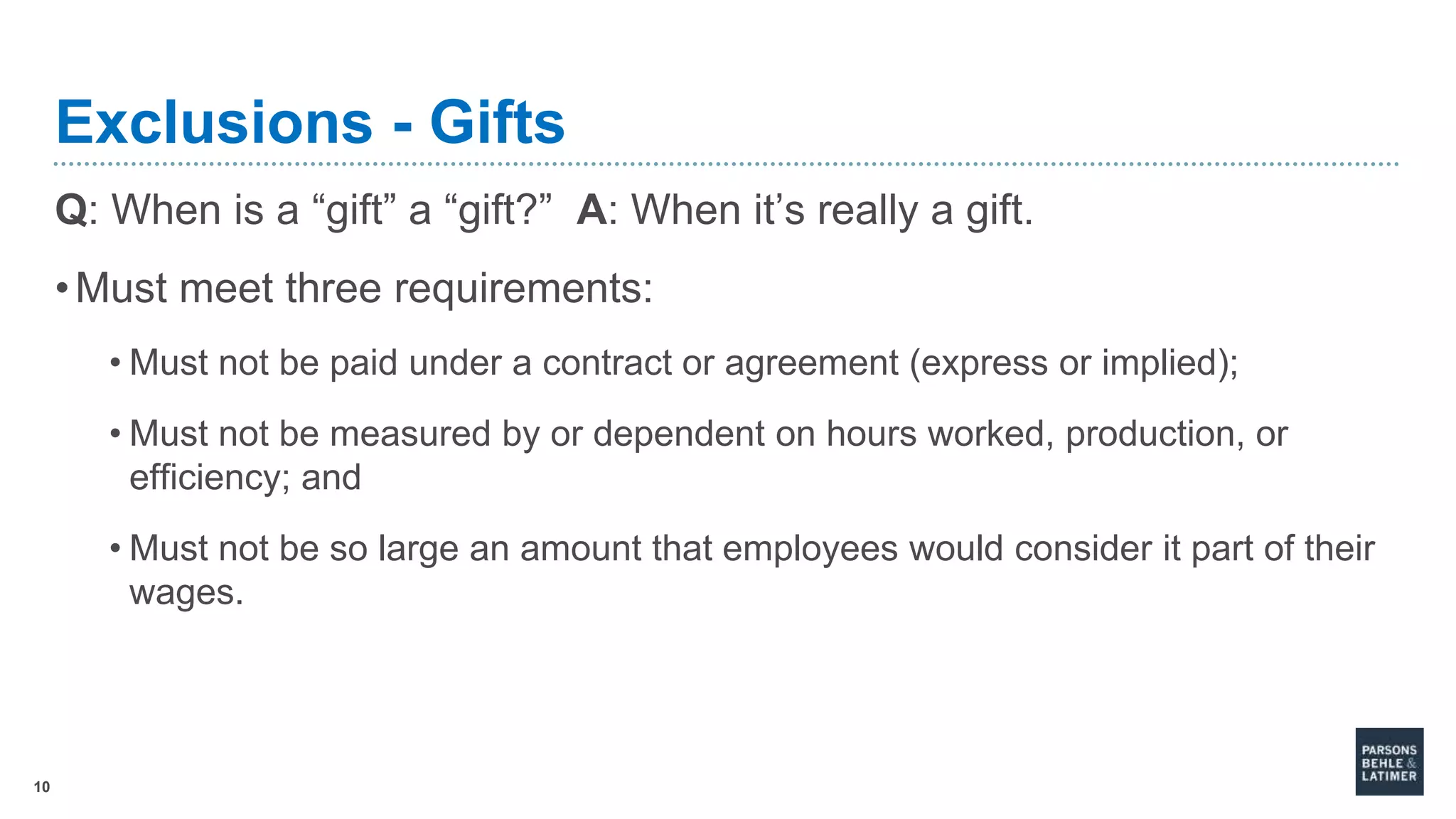
Exclusions - Gifts
Q: When is a “gift” a “gift?” A: When it’s really a gift.
•Must meet three requirements:
• Must not be paid under a contract or agreement (express or implied);
• Must not be measured by or dependent on hours worked, production, or
efficiency; and
• Must not be so large an amount that employees would consider it part of their
wages.
11
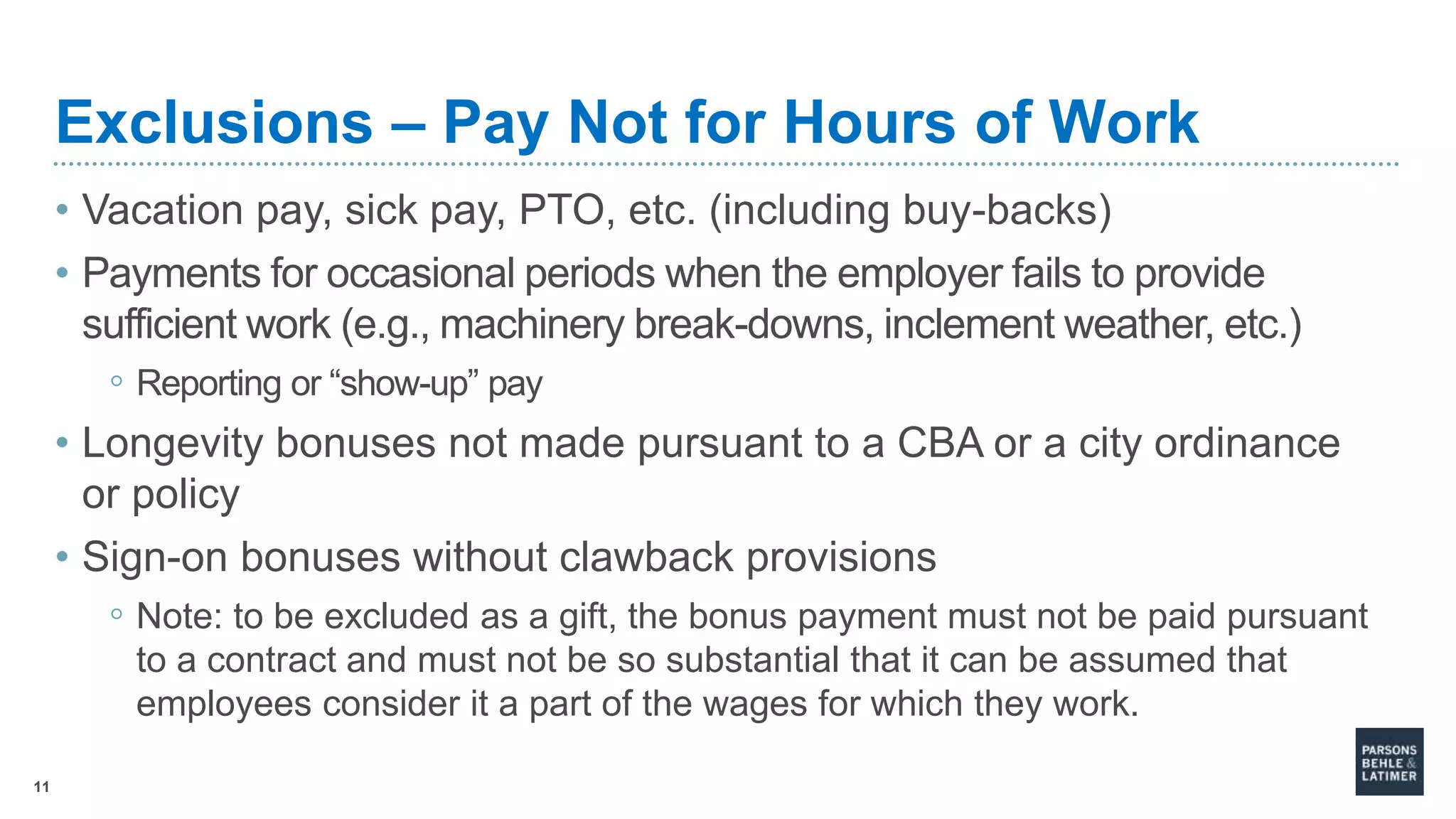
Exclusions – Pay Not for Hours of Work
• Vacation pay, sick pay, PTO, etc. (including buy-backs)
• Payments for occasional periods when the employer fails to provide
sufficient work (e.g., machinery break-downs, inclement weather, etc.)
◦ Reporting or “show-up” pay
• Longevity bonuses not made pursuant to a CBA or a city ordinance
or policy
• Sign-on bonuses without clawback provisions
◦ Note: to be excluded as a gift, the bonus payment must not be paid pursuant
to a contract and must not be so substantial that it can be assumed that
employees consider it a part of the wages for which they work.
12
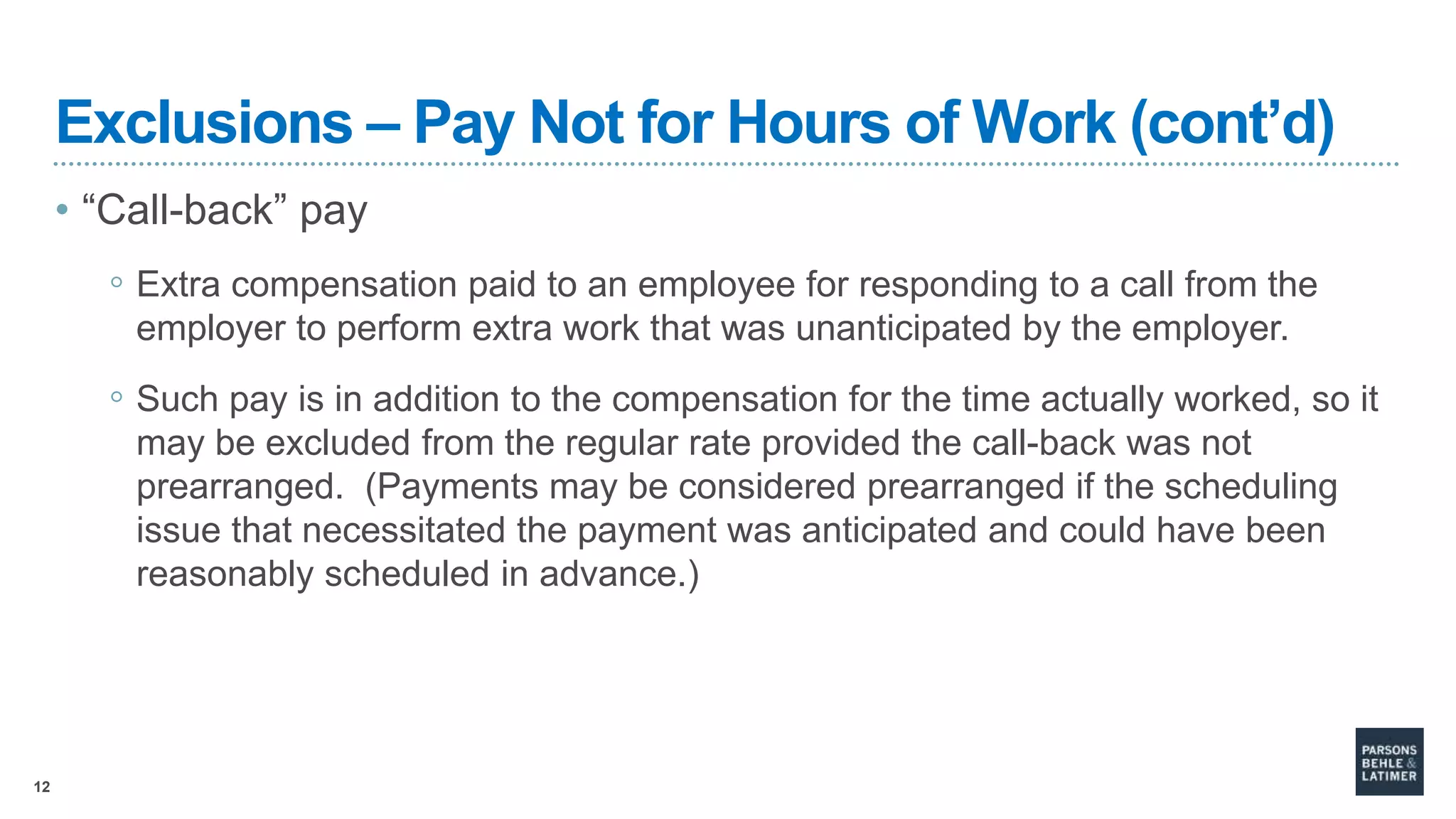
Exclusions – Pay Not for Hours of Work (cont’d)
• “Call-back” pay
◦ Extra compensation paid to an employee for responding to a call from the
employer to perform extra work that was unanticipated by the employer.
◦ Such pay is in addition to the compensation for the time actually worked, so it
may be excluded from the regular rate provided the call-back was not
prearranged. (Payments may be considered prearranged if the scheduling
issue that necessitated the payment was anticipated and could have been
reasonably scheduled in advance.)
13
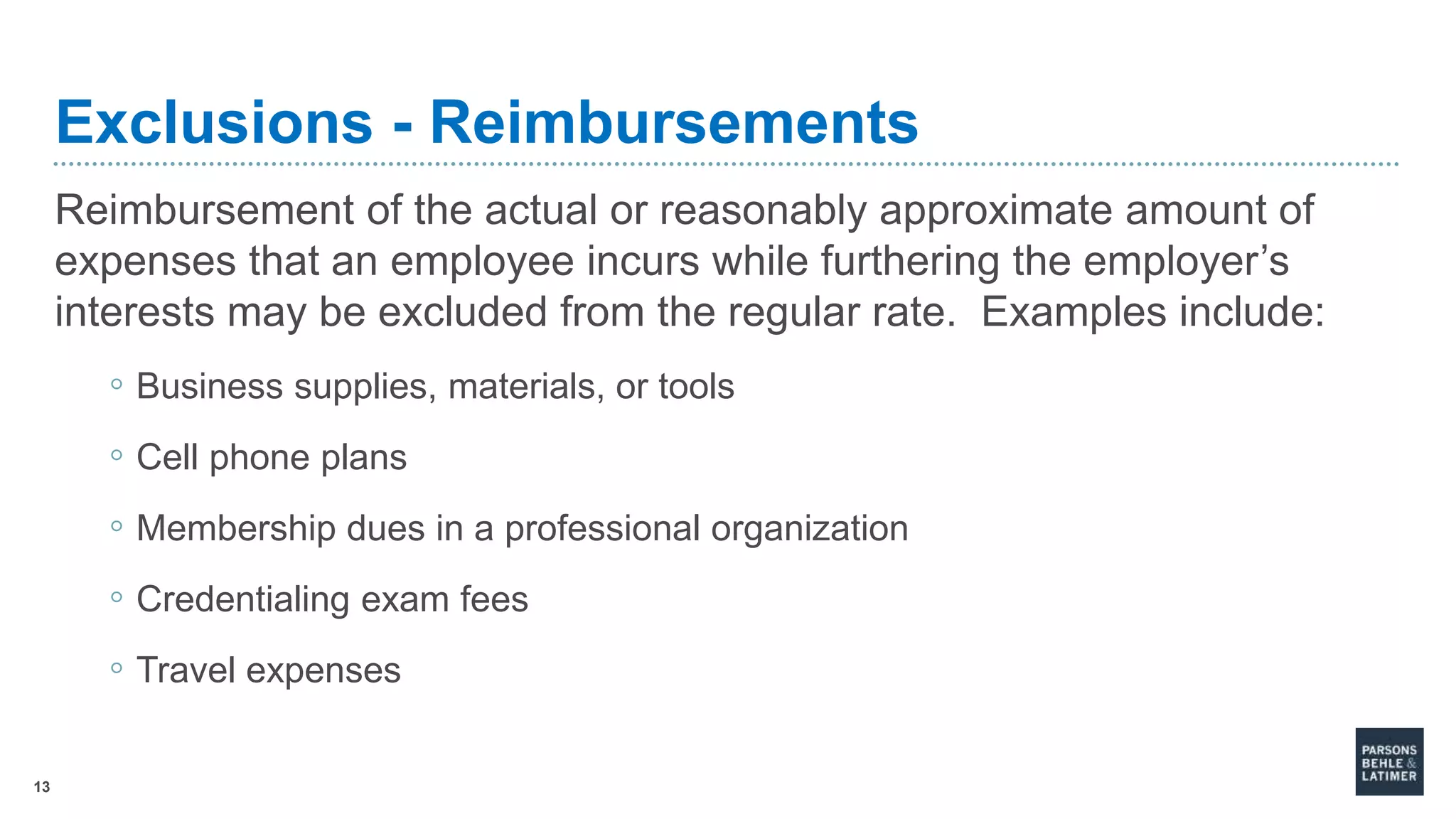
Exclusions - Reimbursements
Reimbursement of the actual or reasonably approximate amount of
expenses that an employee incurs while furthering the employer’s
interests may be excluded from the regular rate. Examples include:
◦ Business supplies, materials, or tools
◦ Cell phone plans
◦ Membership dues in a professional organization
◦ Credentialing exam fees
◦ Travel expenses
14
Exclusions – Pay Not for Hours of Work (cont’d)
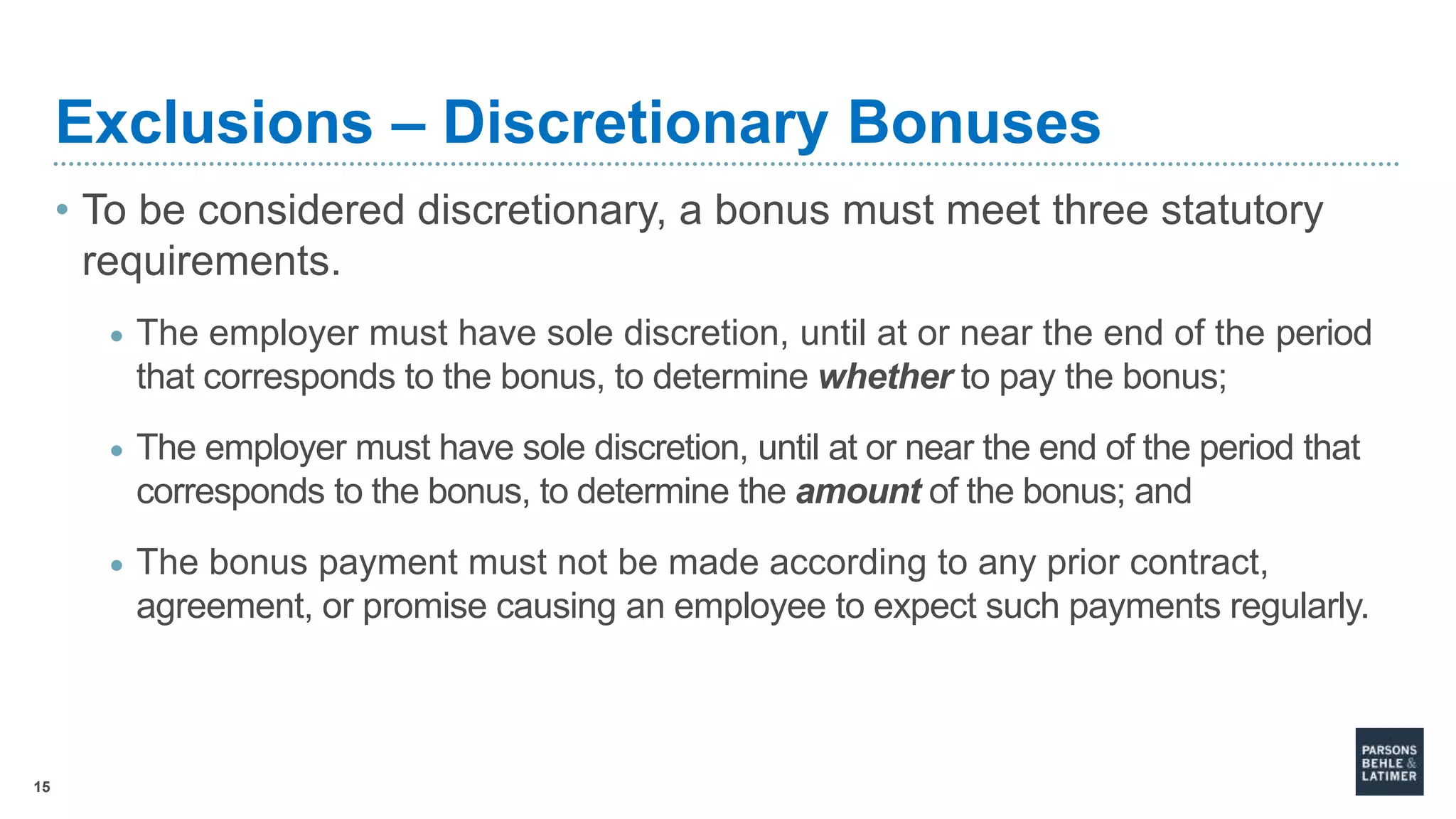
• “Perks” that have no connection to hours worked, job performance, or other
criteria linked to quality or quantity of work
◦ On-the-job medical care and on-site treatment from specialists such as chiropractors,
massage therapists, personal trainers, physical therapists, counselors, or EAPs
◦ Recreational facilities, such as gym access, gym memberships, and fitness classes
◦ Wellness programs, such as health risk assessments, vaccination clinics, nutrition
and weight loss programs, smoking cessation, financial counseling, mental health
wellness programs, etc.
◦ Employee discounts
◦ Parking benefits and spaces
◦ Tuition payments, regardless of whether made to the employee, an education
provider, or a student-loan repayment program
◦ Adoption assistance
15
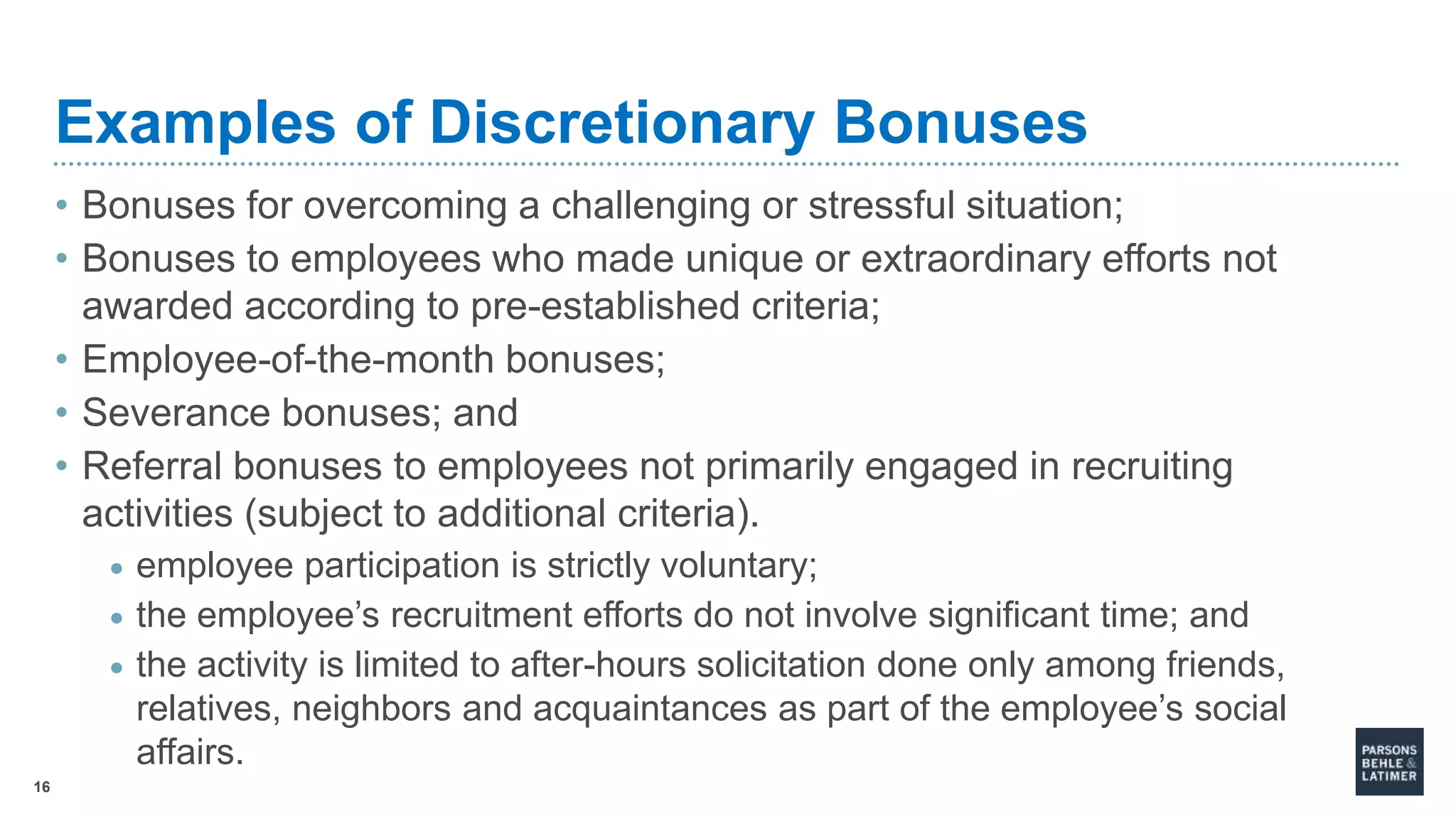
Exclusions – Discretionary Bonuses
• To be considered discretionary, a bonus must meet three statutory
requirements.
• The employer must have sole discretion, until at or near the end of the period
that corresponds to the bonus, to determine whether to pay the bonus;
• The employer must have sole discretion, until at or near the end of the period that
corresponds to the bonus, to determine the amount of the bonus; and
• The bonus payment must not be made according to any prior contract,
agreement, or promise causing an employee to expect such payments regularly.
16
Examples of Discretionary Bonuses
• Bonuses for overcoming a challenging or stressful situation;
• Bonuses to employees who made unique or extraordinary efforts not
awarded according to pre-established criteria;
• Employee-of-the-month bonuses;
• Severance bonuses; and
• Referral bonuses to employees not primarily engaged in recruiting
activities (subject to additional criteria).
• employee participation is strictly voluntary;
• the employee’s recruitment efforts do not involve significant time; and
• the activity is limited to after-hours solicitation done only among friends,
relatives, neighbors and acquaintances as part of the employee’s social
affairs.
17
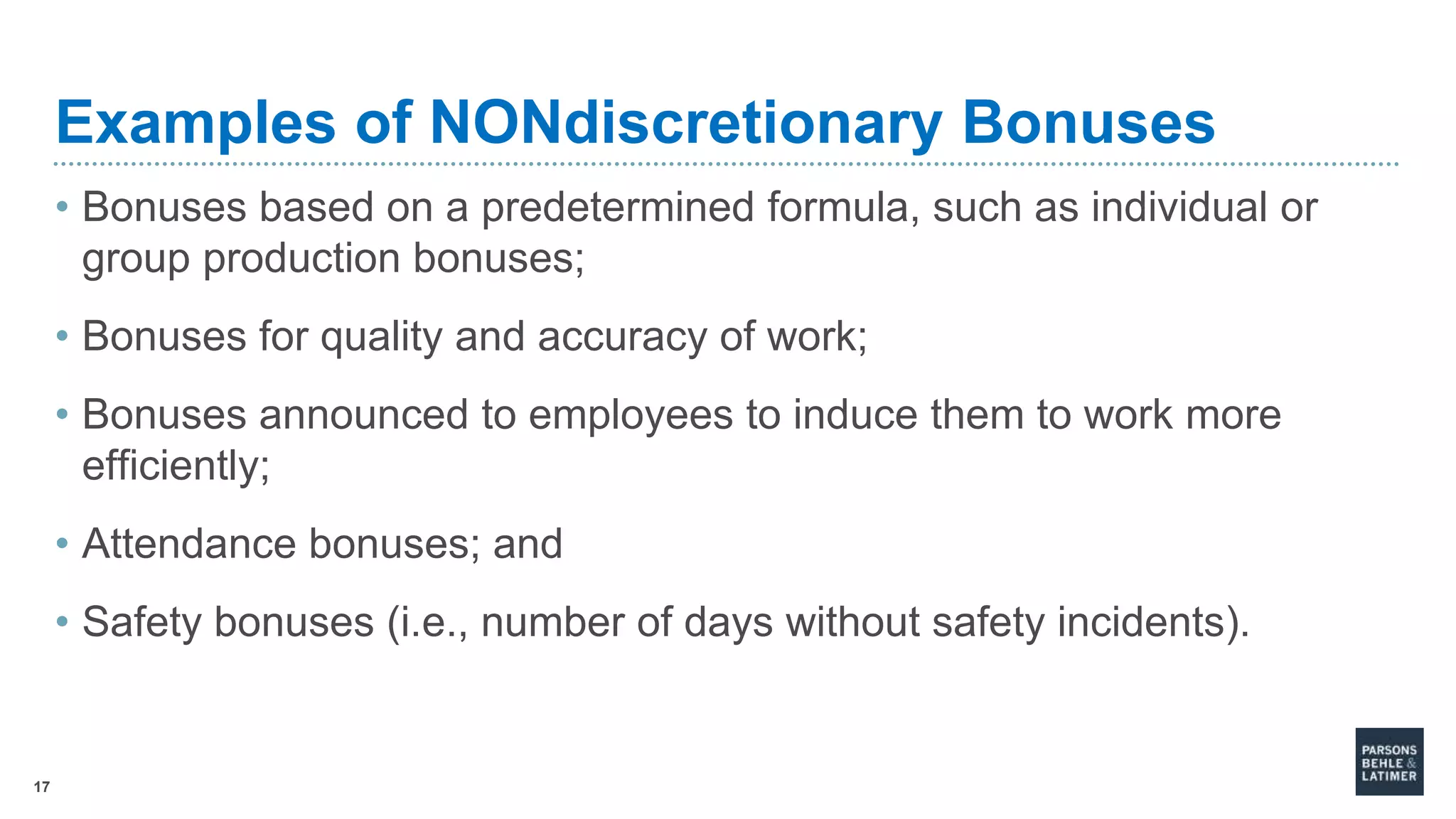
Examples of NONdiscretionary Bonuses
• Bonuses based on a predetermined formula, such as individual or
group production bonuses;
• Bonuses for quality and accuracy of work;
• Bonuses announced to employees to induce them to work more
efficiently;
• Attendance bonuses; and
• Safety bonuses (i.e., number of days without safety incidents).
18
Exclusions – Payments for Non-FLSA Overtime
The “premium” portion of premium pay for certain hours worked
◦ in excess of 8 hours per day or 40 hours in a workweek (or in excess of the
employee’s normal working hours);
◦ on Saturdays, Sundays, holidays, or regular days of rest—if the premium
rate is at least 1.5 times the regular rate for work on other days; and
◦ Outside the hours established by contract or agreement as the normal or
regular workday (up to 8 hours) or workweek (up to 40 hours)—if the
premium rate is at least 1.5 times the regular rate for work during the regular
workday or workweek.
• This extra compensation may be creditable toward overtime pay
under the FLSA
19
Other Types of Pay – On-Call Pay
• Employees are paid at a flat rate equal to four hours at $10/hour per
day when required to be on standby and available for recall.
Q: Included in the regular rate?
A: Yes.
 It is part of the renumeration paid to employees for their employment
 It does not fall within one of the 8 statutory exclusions listed in section 207(e).
Q: Counted as hours worked for overtime calculation purposes?
A: It depends.
20
Other Types of Pay – On-Call Pay (cont’d)
 If it is actually worked (employees are called in), the worked portion IS
counted as hours worked for overtime calculation purposes.
 If it is NOT actually worked (employees are NOT called in), then the
answer depends on how restrictive the accompanying requirements are.
– If the affected employees’ personal activities are significantly restricted during
that time, then the hours covered by that time must be counted in determining
an employee’s entitlement to overtime pay. (29 CFR §§ 778.223 and 785.17.)
– If the affected employees’ personal activities are not significantly restricted
during the on-call time, then the hours do not need to be counted as hours
worked for determining eligibility for overtime pay.
 In either event, the pay is included within the calculation of the regular
rate (along with any other pay to the employee for working the subject
hours.
Calculating the Regular Rate
22
General Principles
• Overtime pay is calculated on a workweek basis, and averaging hours over two
or more weeks is not permitted.
• An employee may be paid on a piece-rate, salary, commission, or some other
basis, but all earnings (except the statutory exclusions) must be totaled and
converted to an hourly rate (the regular rate).
• The regular rate is typically calculated by dividing the total pay in a given
workweek by the total number of hours actually worked that week.
• Unless specifically noted, payments that are excluded from the regular rate may
not be credited towards overtime compensation due under the FLSA
23
Hypothetical 1
John earns $10 an hour. John receives no other compensation.
------
This week, John worked 45 hours. To how much is John entitled for
this week?
24
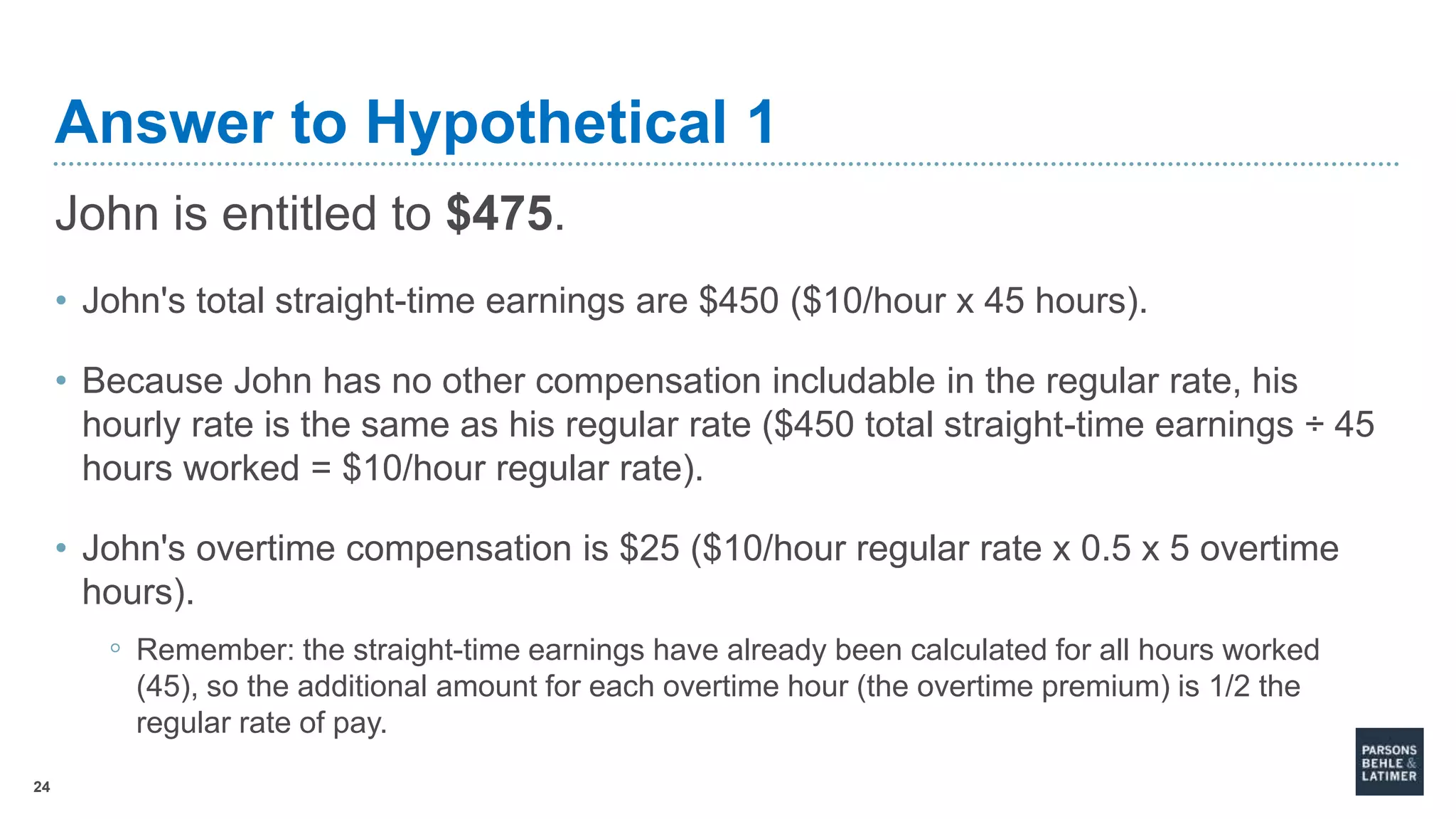
Answer to Hypothetical 1
John is entitled to $475.
• John's total straight-time earnings are $450 ($10/hour x 45 hours).
• Because John has no other compensation includable in the regular rate, his
hourly rate is the same as his regular rate ($450 total straight-time earnings ÷ 45
hours worked = $10/hour regular rate).
• John's overtime compensation is $25 ($10/hour regular rate x 0.5 x 5 overtime
hours).
◦ Remember: the straight-time earnings have already been calculated for all hours worked
(45), so the additional amount for each overtime hour (the overtime premium) is 1/2 the
regular rate of pay.
25
Answer to Hypothetical 1 (cont’d)
John's total pay for the week is $475 or:
◦ $450 total straight-time earnings; plus
◦ $25 additional half-time earnings (overtime premium).
26
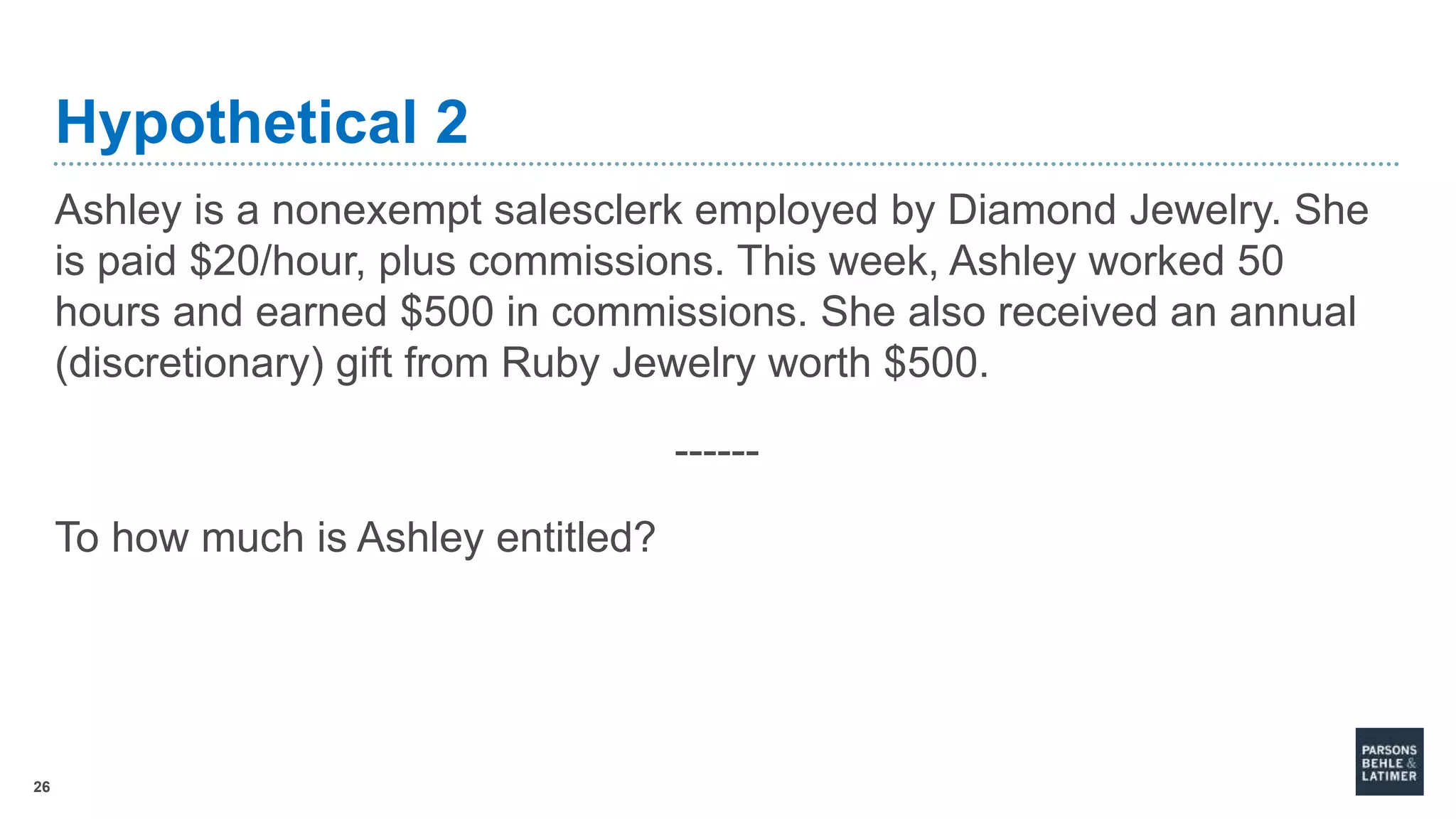
Hypothetical 2
Ashley is a nonexempt salesclerk employed by Diamond Jewelry. She
is paid $20/hour, plus commissions. This week, Ashley worked 50
hours and earned $500 in commissions. She also received an annual
(discretionary) gift from Ruby Jewelry worth $500.
------
To how much is Ashley entitled?
27
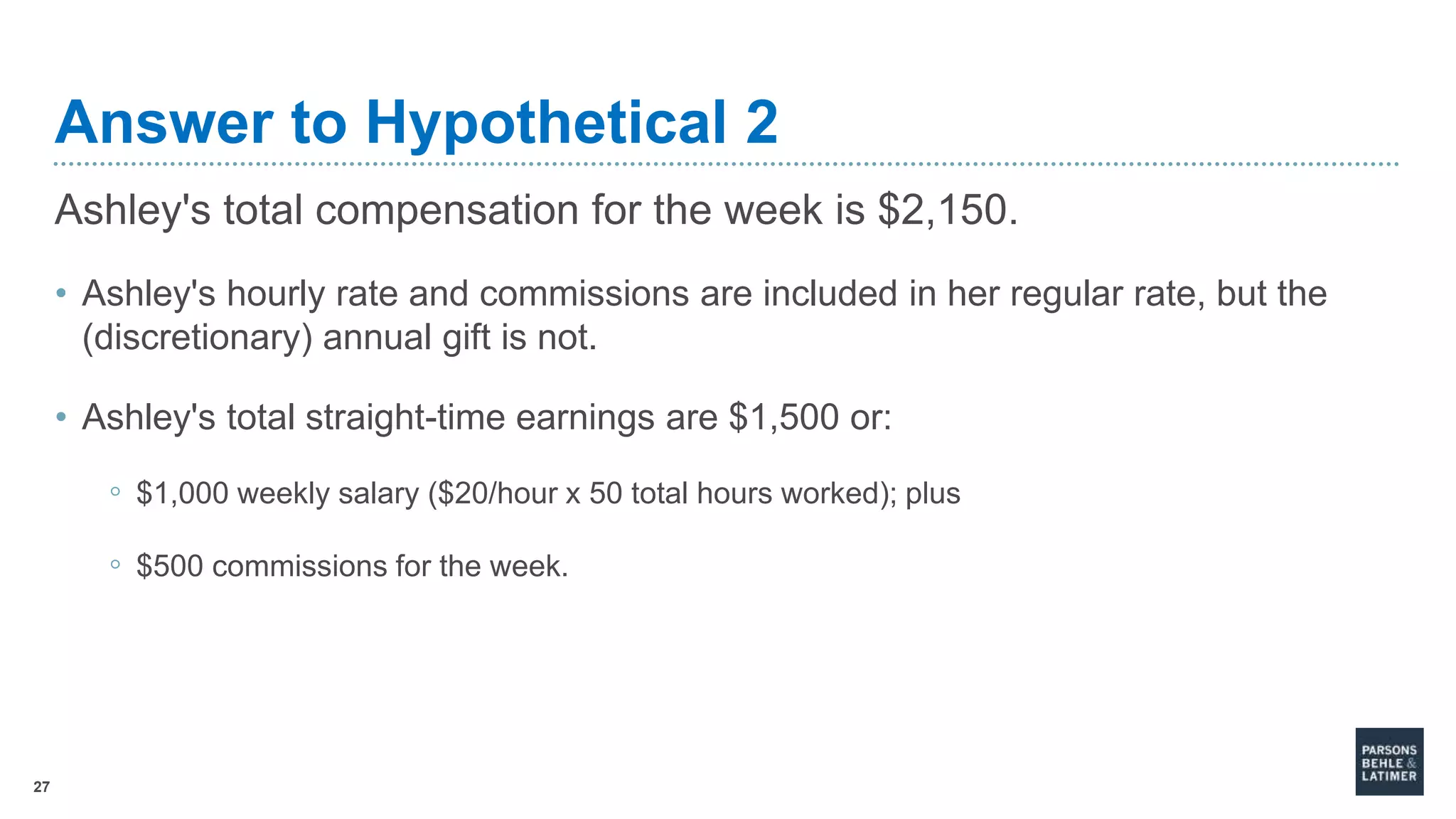
Answer to Hypothetical 2
Ashley's total compensation for the week is $2,150.
• Ashley's hourly rate and commissions are included in her regular rate, but the
(discretionary) annual gift is not.
• Ashley's total straight-time earnings are $1,500 or:
◦ $1,000 weekly salary ($20/hour x 50 total hours worked); plus
◦ $500 commissions for the week.
28
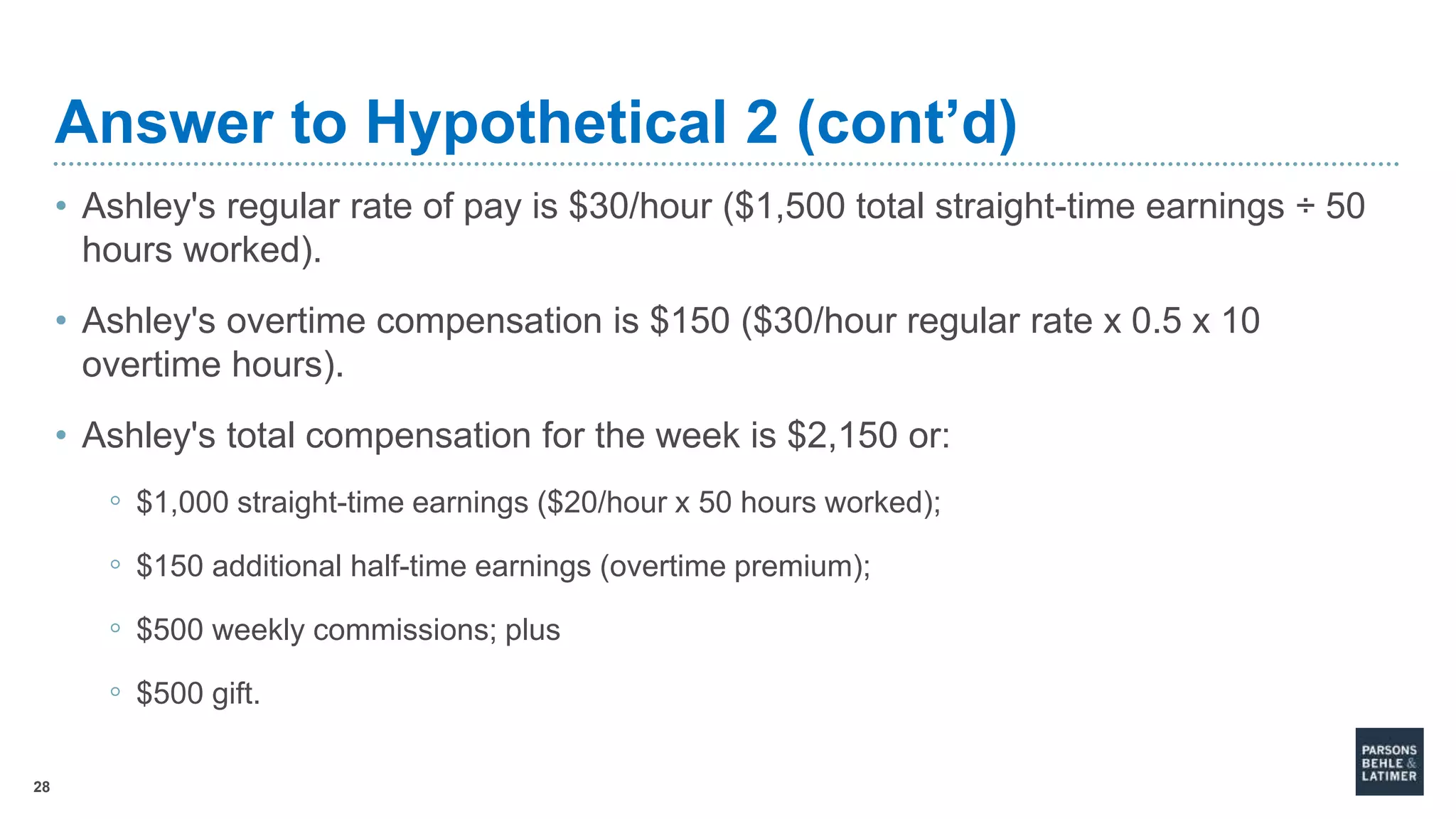
Answer to Hypothetical 2 (cont’d)
• Ashley's regular rate of pay is $30/hour ($1,500 total straight-time earnings ÷ 50
hours worked).
• Ashley's overtime compensation is $150 ($30/hour regular rate x 0.5 x 10
overtime hours).
• Ashley's total compensation for the week is $2,150 or:
◦ $1,000 straight-time earnings ($20/hour x 50 hours worked);
◦ $150 additional half-time earnings (overtime premium);
◦ $500 weekly commissions; plus
◦ $500 gift.
29
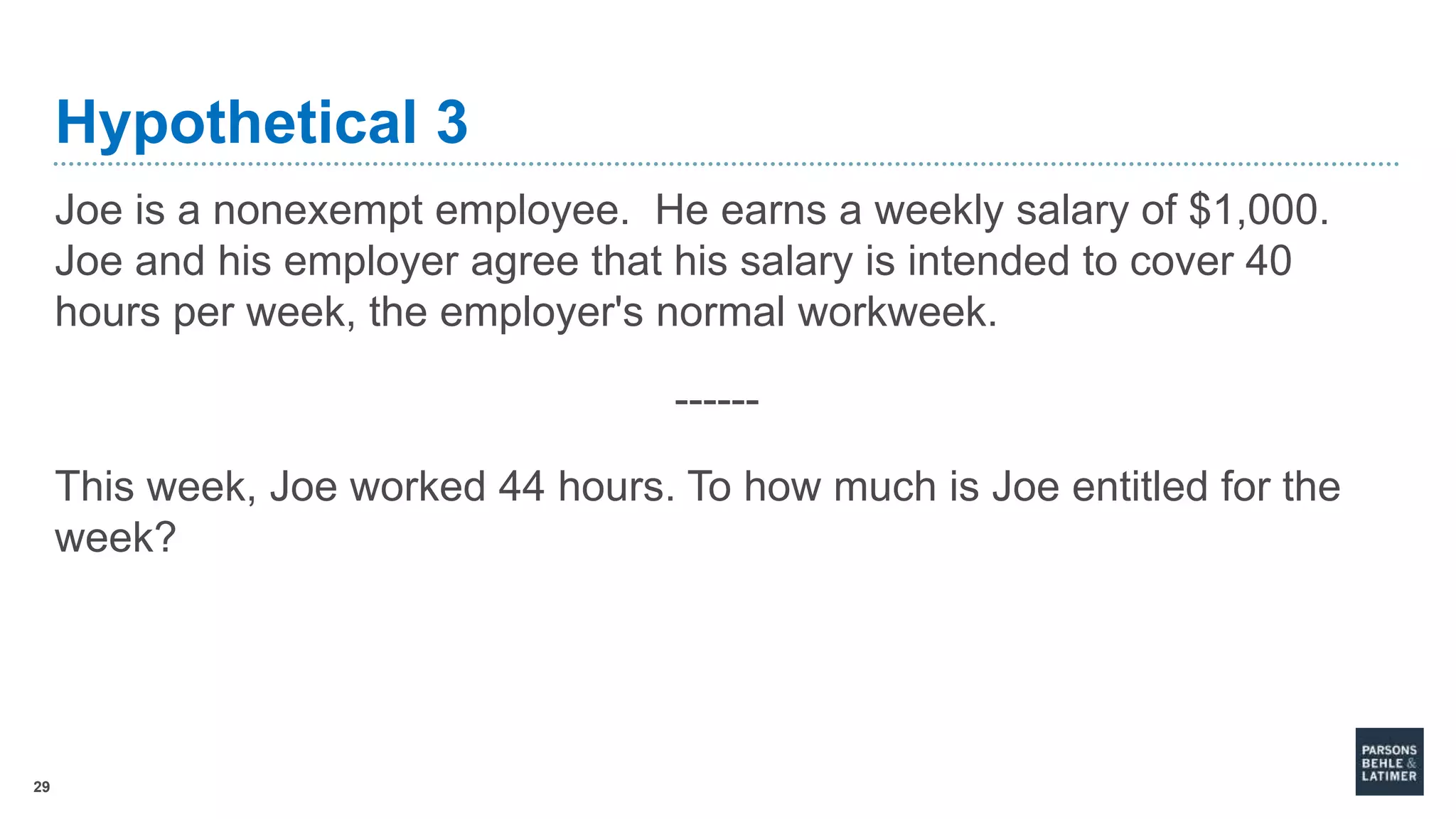
Hypothetical 3
Joe is a nonexempt employee. He earns a weekly salary of $1,000.
Joe and his employer agree that his salary is intended to cover 40
hours per week, the employer's normal workweek.
------
This week, Joe worked 44 hours. To how much is Joe entitled for the
week?
30
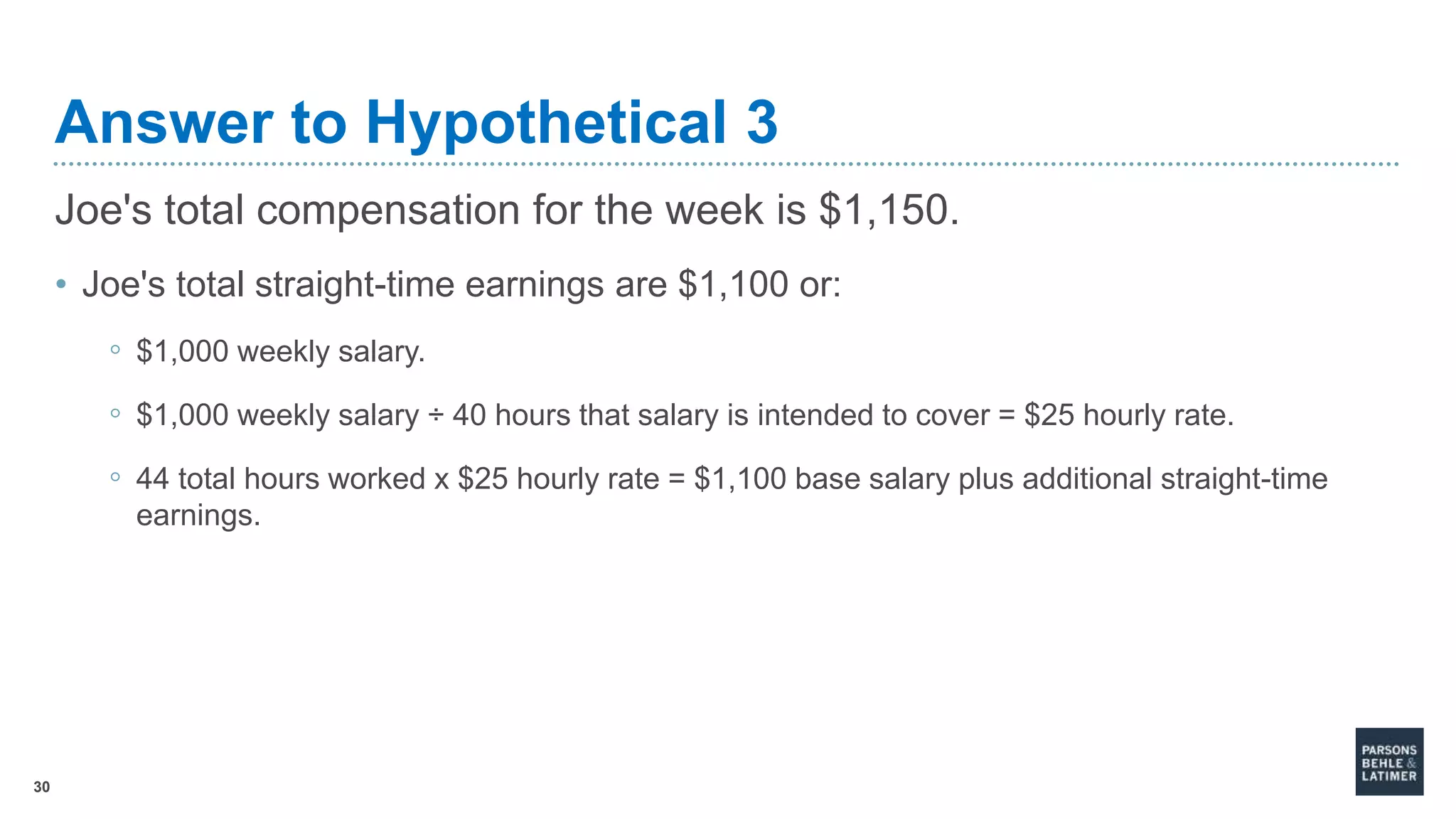
Answer to Hypothetical 3
Joe's total compensation for the week is $1,150.
• Joe's total straight-time earnings are $1,100 or:
◦ $1,000 weekly salary.
◦ $1,000 weekly salary ÷ 40 hours that salary is intended to cover = $25 hourly rate.
◦ 44 total hours worked x $25 hourly rate = $1,100 base salary plus additional straight-time
earnings.
31
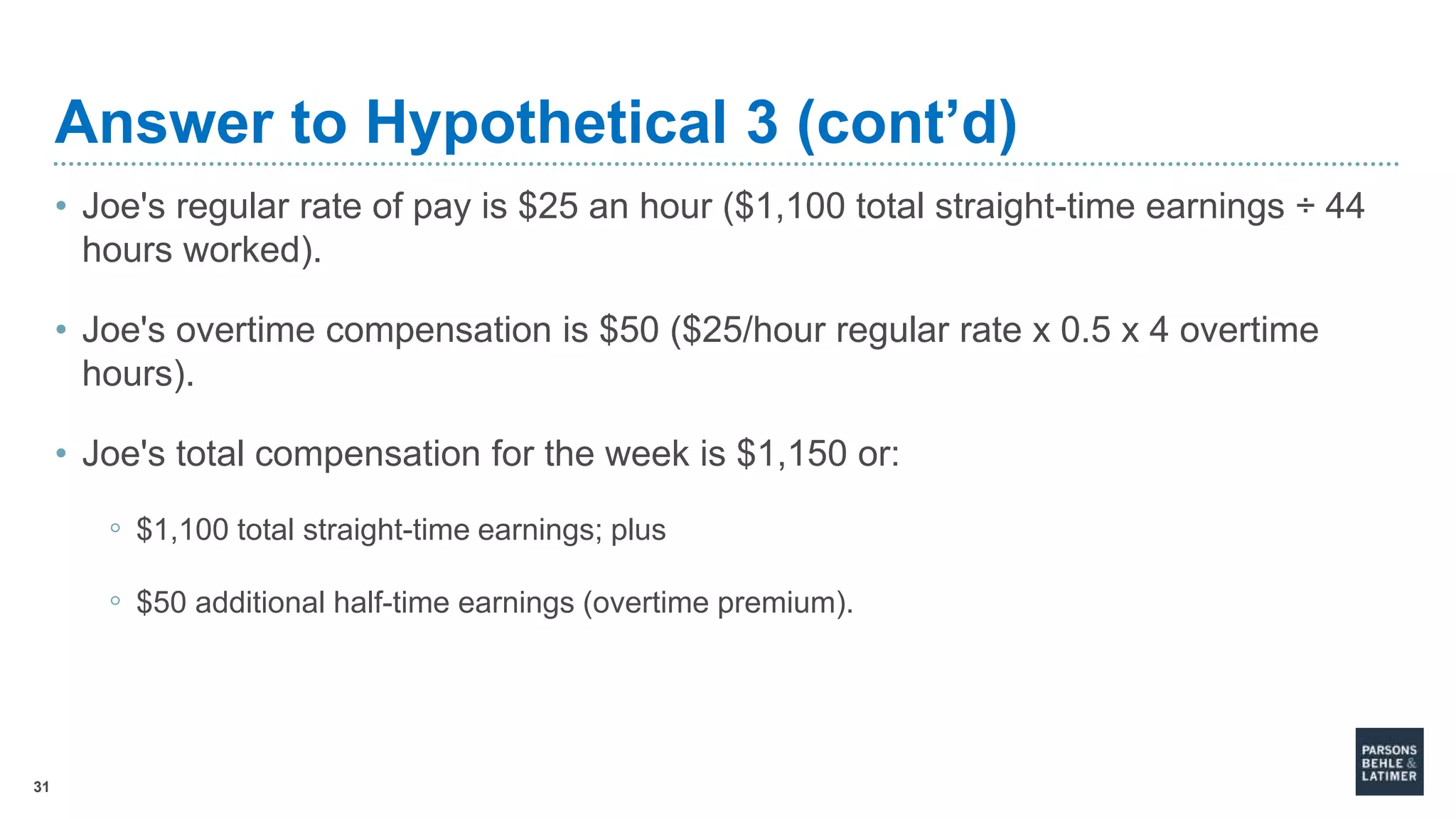
Answer to Hypothetical 3 (cont’d)
• Joe's regular rate of pay is $25 an hour ($1,100 total straight-time earnings ÷ 44
hours worked).
• Joe's overtime compensation is $50 ($25/hour regular rate x 0.5 x 4 overtime
hours).
• Joe's total compensation for the week is $1,150 or:
◦ $1,100 total straight-time earnings; plus
◦ $50 additional half-time earnings (overtime premium).
32
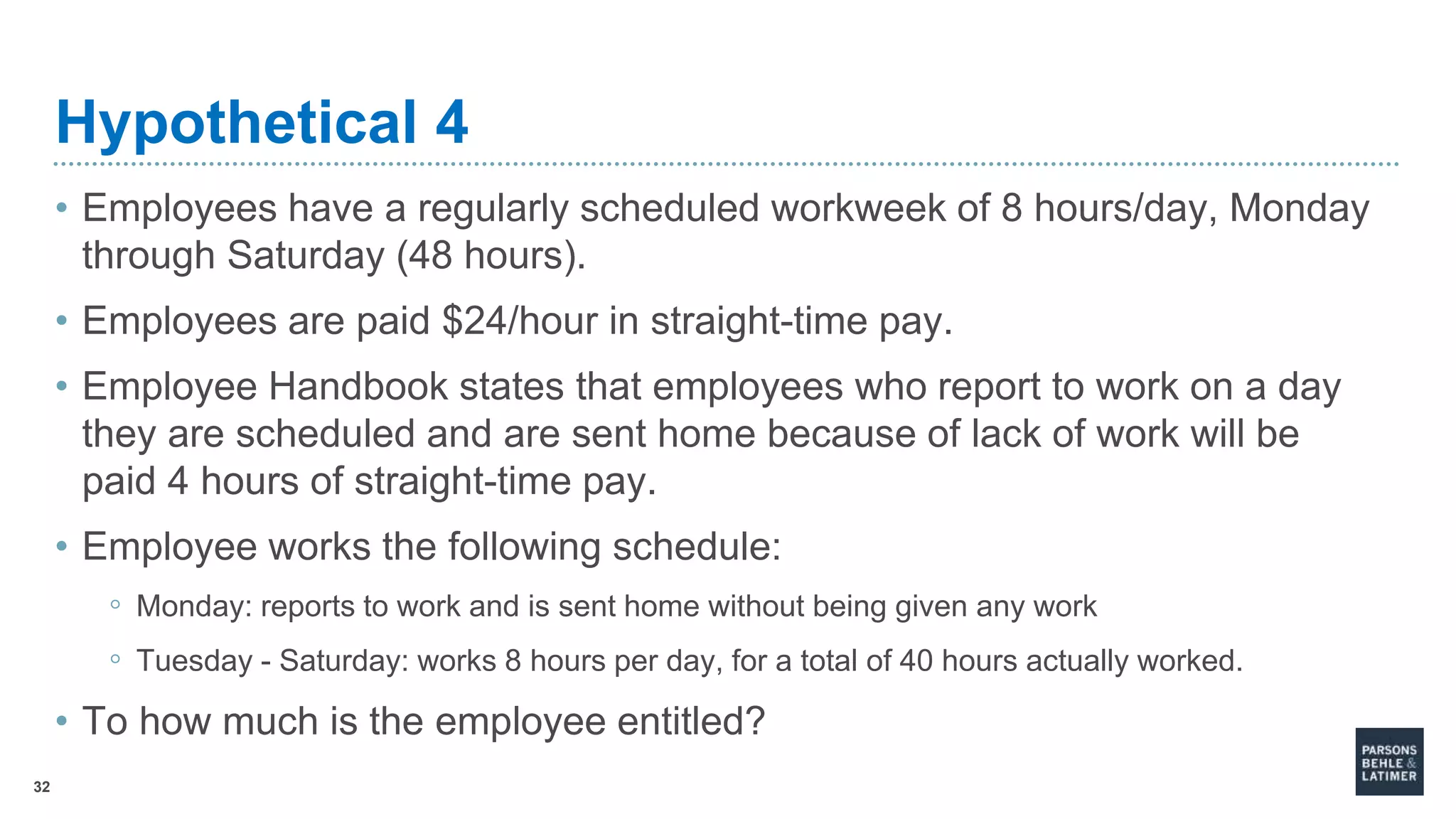
Hypothetical 4
• Employees have a regularly scheduled workweek of 8 hours/day, Monday
through Saturday (48 hours).
• Employees are paid $24/hour in straight-time pay.
• Employee Handbook states that employees who report to work on a day
they are scheduled and are sent home because of lack of work will be
paid 4 hours of straight-time pay.
• Employee works the following schedule:
◦ Monday: reports to work and is sent home without being given any work
◦ Tuesday - Saturday: works 8 hours per day, for a total of 40 hours actually worked.
• To how much is the employee entitled?
33
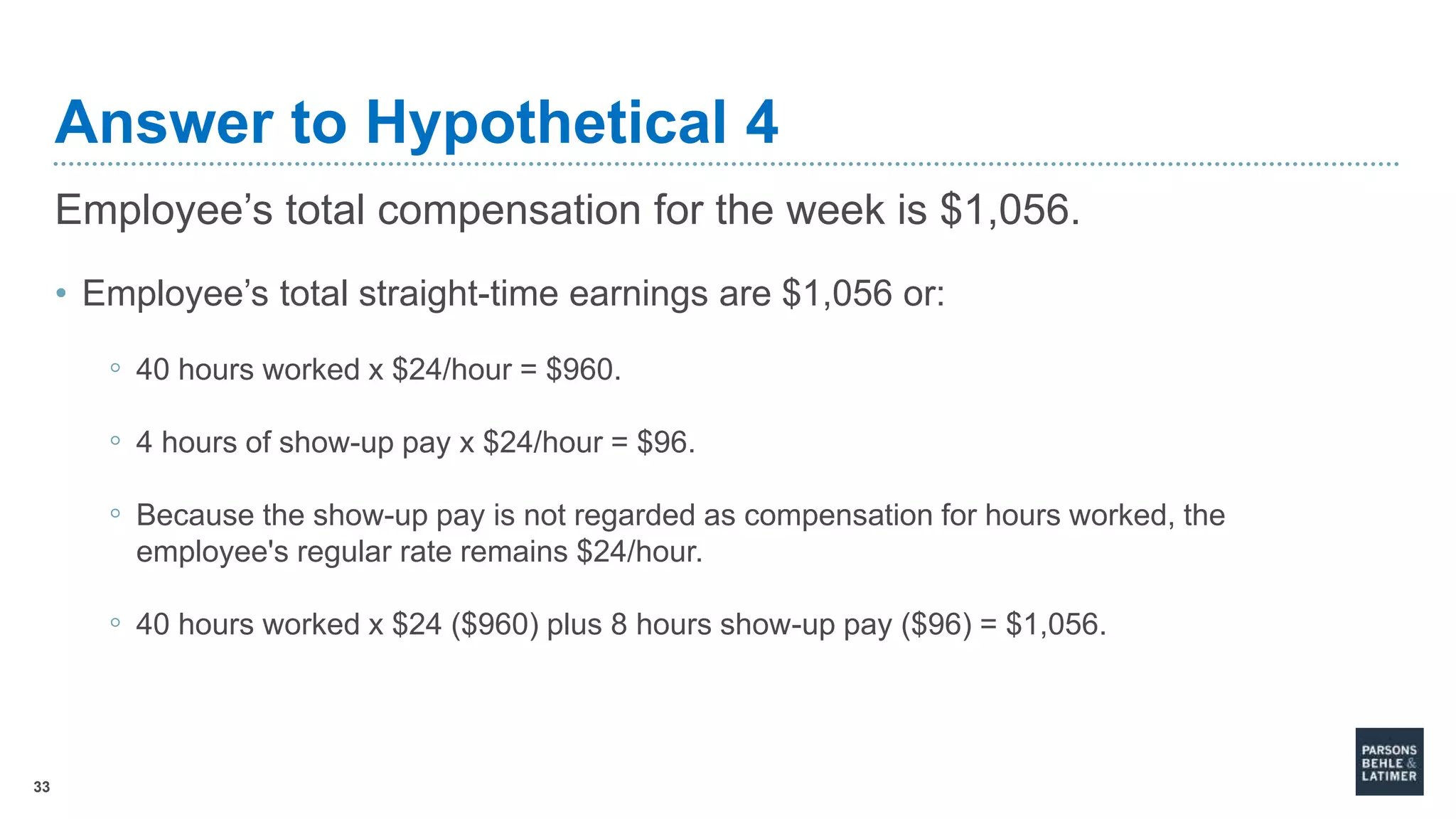
Answer to Hypothetical 4
Employee’s total compensation for the week is $1,056.
• Employee’s total straight-time earnings are $1,056 or:
◦ 40 hours worked x $24/hour = $960.
◦ 4 hours of show-up pay x $24/hour = $96.
◦ Because the show-up pay is not regarded as compensation for hours worked, the
employee's regular rate remains $24/hour.
◦ 40 hours worked x $24 ($960) plus 8 hours show-up pay ($96) = $1,056.
34
Two or More Jobs at Different Rates of Pay
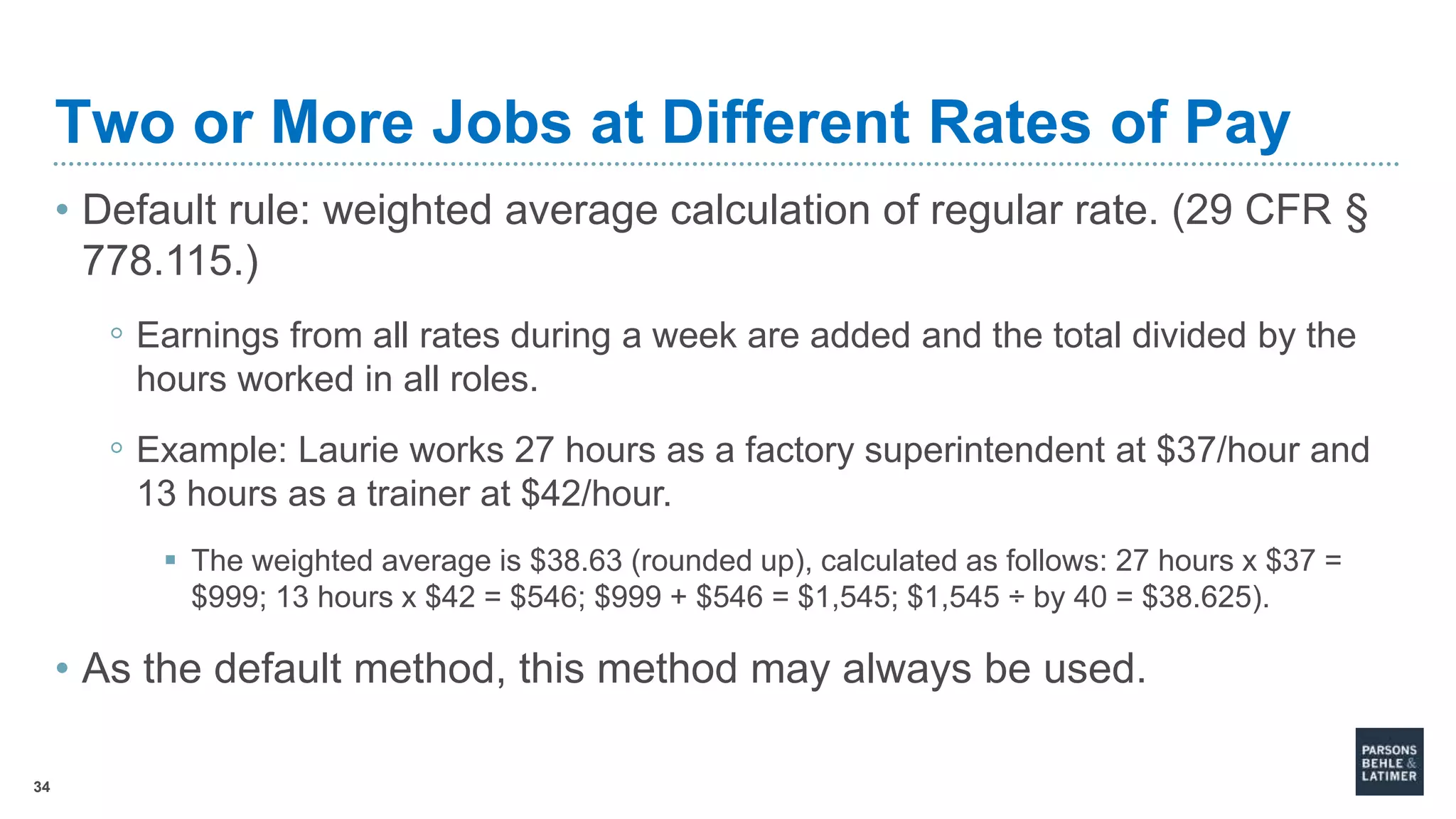
• Default rule: weighted average calculation of regular rate. (29 CFR §
778.115.)
◦ Earnings from all rates during a week are added and the total divided by the
hours worked in all roles.
◦ Example: Laurie works 27 hours as a factory superintendent at $37/hour and
13 hours as a trainer at $42/hour.
 The weighted average is $38.63 (rounded up), calculated as follows: 27 hours x $37 =
$999; 13 hours x $42 = $546; $999 + $546 = $1,545; $1,545 ÷ by 40 = $38.625).
• As the default method, this method may always be used.
35
Two or More Jobs at Different Rates of Pay (cont’d)
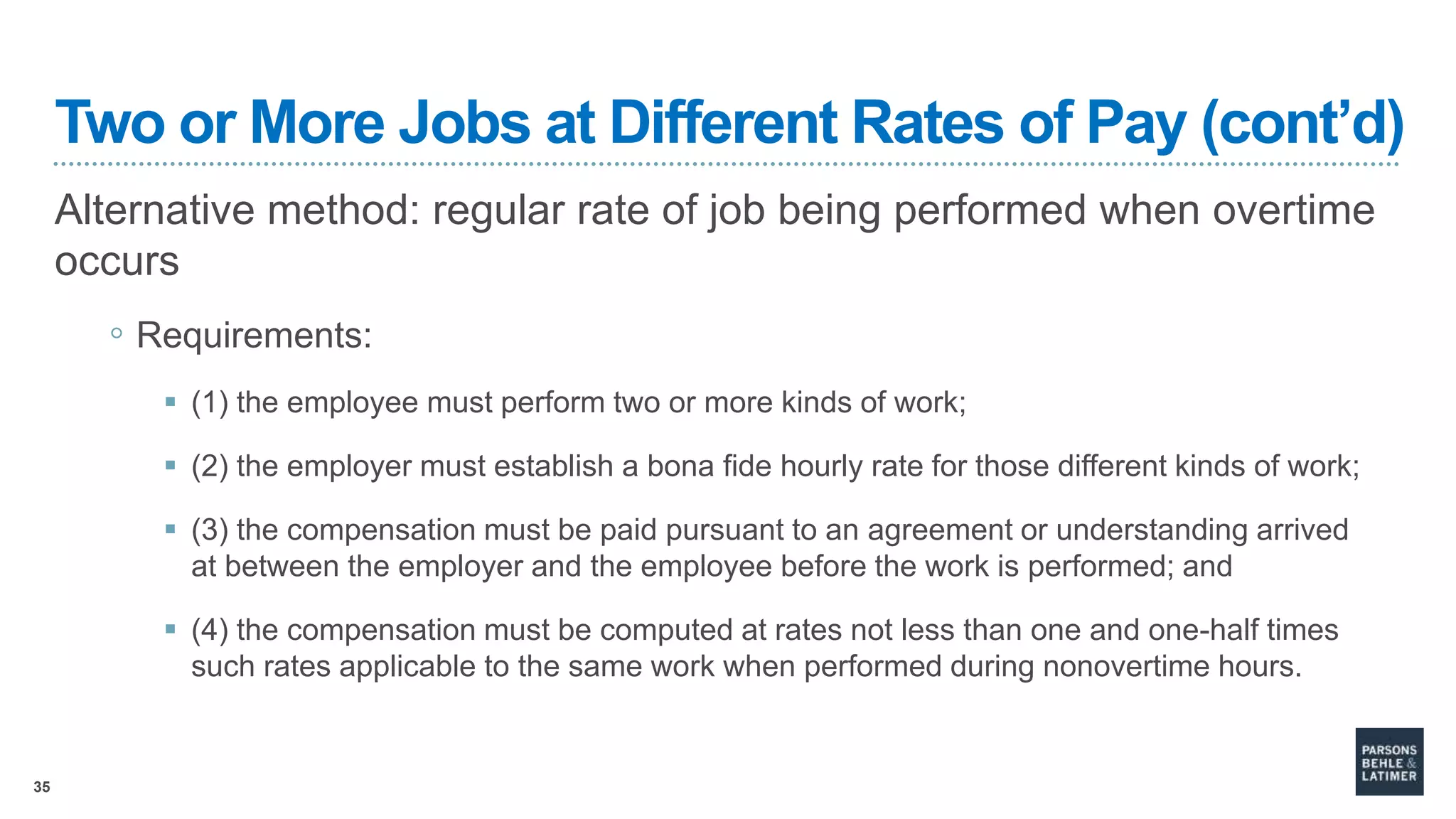
Alternative method: regular rate of job being performed when overtime
occurs
◦ Requirements:
 (1) the employee must perform two or more kinds of work;
 (2) the employer must establish a bona fide hourly rate for those different kinds of work;
 (3) the compensation must be paid pursuant to an agreement or understanding arrived
at between the employer and the employee before the work is performed; and
 (4) the compensation must be computed at rates not less than one and one-half times
such rates applicable to the same work when performed during nonovertime hours.
36
Two or More Jobs at Different Rates of Pay (cont’d)
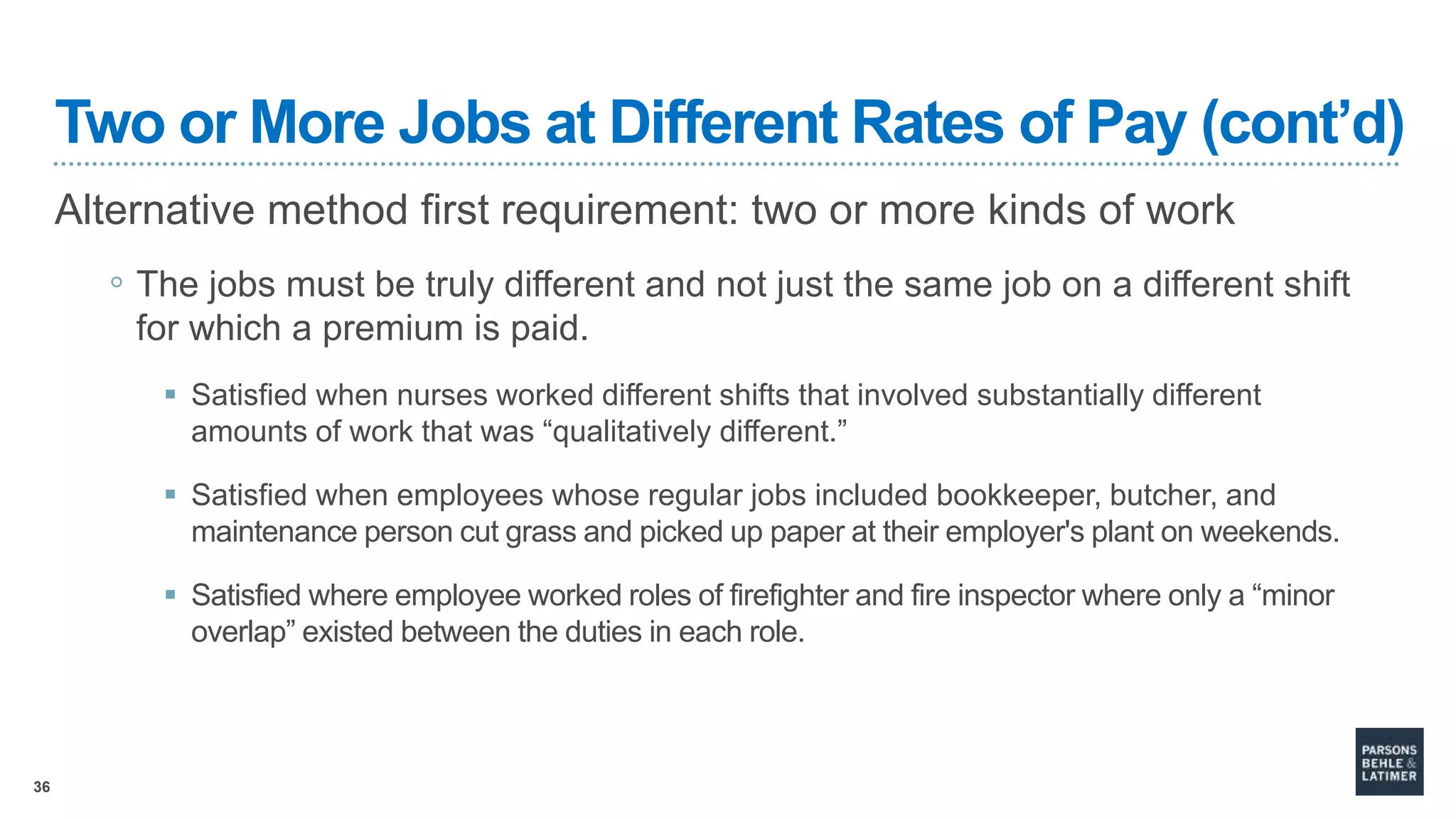
Alternative method first requirement: two or more kinds of work
◦ The jobs must be truly different and not just the same job on a different shift
for which a premium is paid.
 Satisfied when nurses worked different shifts that involved substantially different
amounts of work that was “qualitatively different.”
 Satisfied when employees whose regular jobs included bookkeeper, butcher, and
maintenance person cut grass and picked up paper at their employer's plant on weekends.
 Satisfied where employee worked roles of firefighter and fire inspector where only a “minor
overlap” existed between the duties in each role.
37
Two or More Jobs at Different Rates of Pay (cont’d)
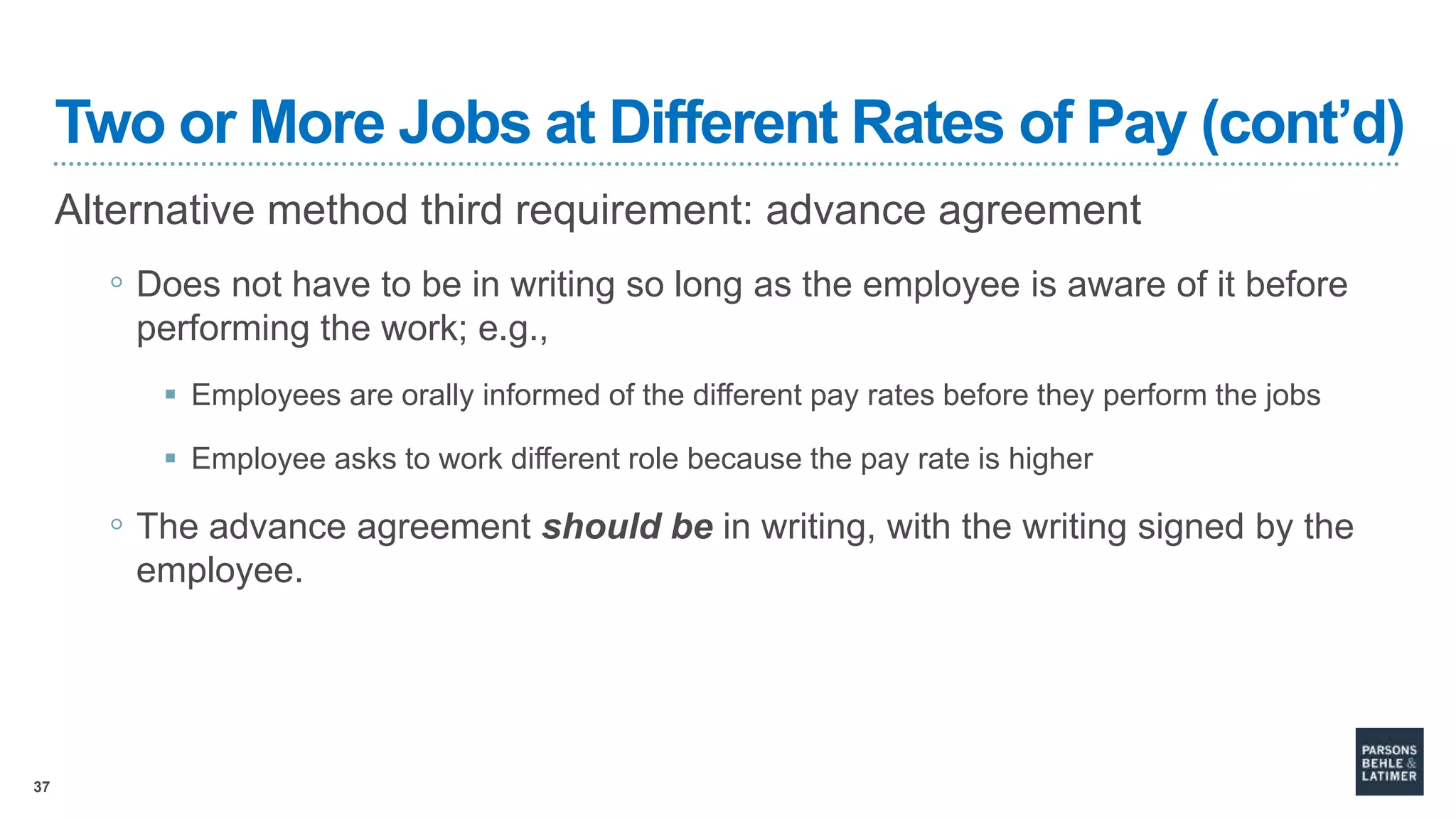
Alternative method third requirement: advance agreement
◦ Does not have to be in writing so long as the employee is aware of it before
performing the work; e.g.,
 Employees are orally informed of the different pay rates before they perform the jobs
 Employee asks to work different role because the pay rate is higher
◦ The advance agreement should be in writing, with the writing signed by the
employee.
Questions?
39
Thank You
• Mark A. Wagner
801.536.6776
mwagner@parsonsbehle.com

FLSA and Regular Rate of Pay Calculations

  • 1.
    33rd Annual EmploymentLaw Seminar OCTOBER 27 & 28, 2021 | MULTI-DAY WEBINAR p a r s o n s b e h l e . c o m BOISE | HELENA | IDAHO FALLS | LEHI | MISSOULA | RENO | SALT LAKE CITY FLSA and Regular Rate of Pay Calculations Mark A. Wagner 801.536.6776 | mwagner@parsonsbehle.com
  • 2.
  • 3.
    3 Not Just anEmployee-Protection Statute • The Fair Labor Standards Act of 1938 (FLSA) originated in President Franklin Roosevelt's New Deal ◦ Getting the country out of the Great Depression ◦ Giving employers an economic incentive to spread work around  Banning child labor (under 16 – with exceptions)  Establishing a maximum hours standard  Mandating overtime pay for work in excess of maximum hours ◦ A hodge-podge of politics and legal hoops had to be considered ◦ Result: specific rules to follow but lack of consistency
  • 4.
  • 5.
    5 Overtime Pay Requirement (1)Except as otherwise provided in this section, no employer shall employ any . . . employees . . . for a workweek longer than forty hours unless such employee receives compensation for [all hours over forty] at a rate not less than one and one-half times the regular rate at which he is employed. FLSA § 7(a) (29 U.S.C. § 207(a))
  • 6.
    What Is the“Regular Rate?”
  • 7.
    7 Regular Rate --Includes: All remuneration paid to, or on behalf of, the employee for work performed during the week, including:  Wages  Salary  Commissions  Non-discretionary bonuses FLSA § 7(e) (29 U.S.C. § 207(e))
  • 8.
    8 Regular Rate --Includes: • Also includes non-cash payments in the form of goods or facilities ◦ Must include in the regular rate the reasonable cost to the employer or fair value of such goods or facilities.
  • 9.
    9 Regular Rate --Excludes: 1. Gifts 2. Pay for occasional periods of no work, such as paid vacation and sick leave; expense reimbursements; and other “similar payments” that are not made as compensation for hours of employment 3. Discretionary bonuses; payments from profit-sharing or savings plan; and talent fees 4. Benefit plan contributions and payments to certain profit-sharing plans 5. The “premium” portion of premium pay for more than 8 hours in a day, more than 40 hours in a week, or more than employees’ normal/regular working hours 6. The “premium” portion of premium pay for work on a Saturday, Sunday, holiday, or regular day of rest where the rate is at least 1.5 times the rate for work in non- overtime hours on other days 7. The “premium” portion of premium pay for work outside regular hours established by a contract as the regular workday (not over 8 hours) or workweek (not over 40 hours) where the rate is at least 1.5 times the rate for work within the regular workday or workweek 8. Certain stock-related income FLSA § 7(e)(1)-(8) (29 U.S.C. § 207(e)(1)-(8))
  • 10.
    10 Exclusions - Gifts Q:When is a “gift” a “gift?” A: When it’s really a gift. •Must meet three requirements: • Must not be paid under a contract or agreement (express or implied); • Must not be measured by or dependent on hours worked, production, or efficiency; and • Must not be so large an amount that employees would consider it part of their wages.
  • 11.
    11 Exclusions – PayNot for Hours of Work • Vacation pay, sick pay, PTO, etc. (including buy-backs) • Payments for occasional periods when the employer fails to provide sufficient work (e.g., machinery break-downs, inclement weather, etc.) ◦ Reporting or “show-up” pay • Longevity bonuses not made pursuant to a CBA or a city ordinance or policy • Sign-on bonuses without clawback provisions ◦ Note: to be excluded as a gift, the bonus payment must not be paid pursuant to a contract and must not be so substantial that it can be assumed that employees consider it a part of the wages for which they work.
  • 12.
    12 Exclusions – PayNot for Hours of Work (cont’d) • “Call-back” pay ◦ Extra compensation paid to an employee for responding to a call from the employer to perform extra work that was unanticipated by the employer. ◦ Such pay is in addition to the compensation for the time actually worked, so it may be excluded from the regular rate provided the call-back was not prearranged. (Payments may be considered prearranged if the scheduling issue that necessitated the payment was anticipated and could have been reasonably scheduled in advance.)
  • 13.
    13 Exclusions - Reimbursements Reimbursementof the actual or reasonably approximate amount of expenses that an employee incurs while furthering the employer’s interests may be excluded from the regular rate. Examples include: ◦ Business supplies, materials, or tools ◦ Cell phone plans ◦ Membership dues in a professional organization ◦ Credentialing exam fees ◦ Travel expenses
  • 14.
    14 Exclusions – PayNot for Hours of Work (cont’d) • “Perks” that have no connection to hours worked, job performance, or other criteria linked to quality or quantity of work ◦ On-the-job medical care and on-site treatment from specialists such as chiropractors, massage therapists, personal trainers, physical therapists, counselors, or EAPs ◦ Recreational facilities, such as gym access, gym memberships, and fitness classes ◦ Wellness programs, such as health risk assessments, vaccination clinics, nutrition and weight loss programs, smoking cessation, financial counseling, mental health wellness programs, etc. ◦ Employee discounts ◦ Parking benefits and spaces ◦ Tuition payments, regardless of whether made to the employee, an education provider, or a student-loan repayment program ◦ Adoption assistance
  • 15.
    15 Exclusions – DiscretionaryBonuses • To be considered discretionary, a bonus must meet three statutory requirements. • The employer must have sole discretion, until at or near the end of the period that corresponds to the bonus, to determine whether to pay the bonus; • The employer must have sole discretion, until at or near the end of the period that corresponds to the bonus, to determine the amount of the bonus; and • The bonus payment must not be made according to any prior contract, agreement, or promise causing an employee to expect such payments regularly.
  • 16.
    16 Examples of DiscretionaryBonuses • Bonuses for overcoming a challenging or stressful situation; • Bonuses to employees who made unique or extraordinary efforts not awarded according to pre-established criteria; • Employee-of-the-month bonuses; • Severance bonuses; and • Referral bonuses to employees not primarily engaged in recruiting activities (subject to additional criteria). • employee participation is strictly voluntary; • the employee’s recruitment efforts do not involve significant time; and • the activity is limited to after-hours solicitation done only among friends, relatives, neighbors and acquaintances as part of the employee’s social affairs.
  • 17.
    17 Examples of NONdiscretionaryBonuses • Bonuses based on a predetermined formula, such as individual or group production bonuses; • Bonuses for quality and accuracy of work; • Bonuses announced to employees to induce them to work more efficiently; • Attendance bonuses; and • Safety bonuses (i.e., number of days without safety incidents).
  • 18.
    18 Exclusions – Paymentsfor Non-FLSA Overtime The “premium” portion of premium pay for certain hours worked ◦ in excess of 8 hours per day or 40 hours in a workweek (or in excess of the employee’s normal working hours); ◦ on Saturdays, Sundays, holidays, or regular days of rest—if the premium rate is at least 1.5 times the regular rate for work on other days; and ◦ Outside the hours established by contract or agreement as the normal or regular workday (up to 8 hours) or workweek (up to 40 hours)—if the premium rate is at least 1.5 times the regular rate for work during the regular workday or workweek. • This extra compensation may be creditable toward overtime pay under the FLSA
  • 19.
    19 Other Types ofPay – On-Call Pay • Employees are paid at a flat rate equal to four hours at $10/hour per day when required to be on standby and available for recall. Q: Included in the regular rate? A: Yes.  It is part of the renumeration paid to employees for their employment  It does not fall within one of the 8 statutory exclusions listed in section 207(e). Q: Counted as hours worked for overtime calculation purposes? A: It depends.
  • 20.
    20 Other Types ofPay – On-Call Pay (cont’d)  If it is actually worked (employees are called in), the worked portion IS counted as hours worked for overtime calculation purposes.  If it is NOT actually worked (employees are NOT called in), then the answer depends on how restrictive the accompanying requirements are. – If the affected employees’ personal activities are significantly restricted during that time, then the hours covered by that time must be counted in determining an employee’s entitlement to overtime pay. (29 CFR §§ 778.223 and 785.17.) – If the affected employees’ personal activities are not significantly restricted during the on-call time, then the hours do not need to be counted as hours worked for determining eligibility for overtime pay.  In either event, the pay is included within the calculation of the regular rate (along with any other pay to the employee for working the subject hours.
  • 21.
  • 22.
    22 General Principles • Overtimepay is calculated on a workweek basis, and averaging hours over two or more weeks is not permitted. • An employee may be paid on a piece-rate, salary, commission, or some other basis, but all earnings (except the statutory exclusions) must be totaled and converted to an hourly rate (the regular rate). • The regular rate is typically calculated by dividing the total pay in a given workweek by the total number of hours actually worked that week. • Unless specifically noted, payments that are excluded from the regular rate may not be credited towards overtime compensation due under the FLSA
  • 23.
    23 Hypothetical 1 John earns$10 an hour. John receives no other compensation. ------ This week, John worked 45 hours. To how much is John entitled for this week?
  • 24.
    24 Answer to Hypothetical1 John is entitled to $475. • John's total straight-time earnings are $450 ($10/hour x 45 hours). • Because John has no other compensation includable in the regular rate, his hourly rate is the same as his regular rate ($450 total straight-time earnings ÷ 45 hours worked = $10/hour regular rate). • John's overtime compensation is $25 ($10/hour regular rate x 0.5 x 5 overtime hours). ◦ Remember: the straight-time earnings have already been calculated for all hours worked (45), so the additional amount for each overtime hour (the overtime premium) is 1/2 the regular rate of pay.
  • 25.
    25 Answer to Hypothetical1 (cont’d) John's total pay for the week is $475 or: ◦ $450 total straight-time earnings; plus ◦ $25 additional half-time earnings (overtime premium).
  • 26.
    26 Hypothetical 2 Ashley isa nonexempt salesclerk employed by Diamond Jewelry. She is paid $20/hour, plus commissions. This week, Ashley worked 50 hours and earned $500 in commissions. She also received an annual (discretionary) gift from Ruby Jewelry worth $500. ------ To how much is Ashley entitled?
  • 27.
    27 Answer to Hypothetical2 Ashley's total compensation for the week is $2,150. • Ashley's hourly rate and commissions are included in her regular rate, but the (discretionary) annual gift is not. • Ashley's total straight-time earnings are $1,500 or: ◦ $1,000 weekly salary ($20/hour x 50 total hours worked); plus ◦ $500 commissions for the week.
  • 28.
    28 Answer to Hypothetical2 (cont’d) • Ashley's regular rate of pay is $30/hour ($1,500 total straight-time earnings ÷ 50 hours worked). • Ashley's overtime compensation is $150 ($30/hour regular rate x 0.5 x 10 overtime hours). • Ashley's total compensation for the week is $2,150 or: ◦ $1,000 straight-time earnings ($20/hour x 50 hours worked); ◦ $150 additional half-time earnings (overtime premium); ◦ $500 weekly commissions; plus ◦ $500 gift.
  • 29.
    29 Hypothetical 3 Joe isa nonexempt employee. He earns a weekly salary of $1,000. Joe and his employer agree that his salary is intended to cover 40 hours per week, the employer's normal workweek. ------ This week, Joe worked 44 hours. To how much is Joe entitled for the week?
  • 30.
    30 Answer to Hypothetical3 Joe's total compensation for the week is $1,150. • Joe's total straight-time earnings are $1,100 or: ◦ $1,000 weekly salary. ◦ $1,000 weekly salary ÷ 40 hours that salary is intended to cover = $25 hourly rate. ◦ 44 total hours worked x $25 hourly rate = $1,100 base salary plus additional straight-time earnings.
  • 31.
    31 Answer to Hypothetical3 (cont’d) • Joe's regular rate of pay is $25 an hour ($1,100 total straight-time earnings ÷ 44 hours worked). • Joe's overtime compensation is $50 ($25/hour regular rate x 0.5 x 4 overtime hours). • Joe's total compensation for the week is $1,150 or: ◦ $1,100 total straight-time earnings; plus ◦ $50 additional half-time earnings (overtime premium).
  • 32.
    32 Hypothetical 4 • Employeeshave a regularly scheduled workweek of 8 hours/day, Monday through Saturday (48 hours). • Employees are paid $24/hour in straight-time pay. • Employee Handbook states that employees who report to work on a day they are scheduled and are sent home because of lack of work will be paid 4 hours of straight-time pay. • Employee works the following schedule: ◦ Monday: reports to work and is sent home without being given any work ◦ Tuesday - Saturday: works 8 hours per day, for a total of 40 hours actually worked. • To how much is the employee entitled?
  • 33.
    33 Answer to Hypothetical4 Employee’s total compensation for the week is $1,056. • Employee’s total straight-time earnings are $1,056 or: ◦ 40 hours worked x $24/hour = $960. ◦ 4 hours of show-up pay x $24/hour = $96. ◦ Because the show-up pay is not regarded as compensation for hours worked, the employee's regular rate remains $24/hour. ◦ 40 hours worked x $24 ($960) plus 8 hours show-up pay ($96) = $1,056.
  • 34.
    34 Two or MoreJobs at Different Rates of Pay • Default rule: weighted average calculation of regular rate. (29 CFR § 778.115.) ◦ Earnings from all rates during a week are added and the total divided by the hours worked in all roles. ◦ Example: Laurie works 27 hours as a factory superintendent at $37/hour and 13 hours as a trainer at $42/hour.  The weighted average is $38.63 (rounded up), calculated as follows: 27 hours x $37 = $999; 13 hours x $42 = $546; $999 + $546 = $1,545; $1,545 ÷ by 40 = $38.625). • As the default method, this method may always be used.
  • 35.
    35 Two or MoreJobs at Different Rates of Pay (cont’d) Alternative method: regular rate of job being performed when overtime occurs ◦ Requirements:  (1) the employee must perform two or more kinds of work;  (2) the employer must establish a bona fide hourly rate for those different kinds of work;  (3) the compensation must be paid pursuant to an agreement or understanding arrived at between the employer and the employee before the work is performed; and  (4) the compensation must be computed at rates not less than one and one-half times such rates applicable to the same work when performed during nonovertime hours.
  • 36.
    36 Two or MoreJobs at Different Rates of Pay (cont’d) Alternative method first requirement: two or more kinds of work ◦ The jobs must be truly different and not just the same job on a different shift for which a premium is paid.  Satisfied when nurses worked different shifts that involved substantially different amounts of work that was “qualitatively different.”  Satisfied when employees whose regular jobs included bookkeeper, butcher, and maintenance person cut grass and picked up paper at their employer's plant on weekends.  Satisfied where employee worked roles of firefighter and fire inspector where only a “minor overlap” existed between the duties in each role.
  • 37.
    37 Two or MoreJobs at Different Rates of Pay (cont’d) Alternative method third requirement: advance agreement ◦ Does not have to be in writing so long as the employee is aware of it before performing the work; e.g.,  Employees are orally informed of the different pay rates before they perform the jobs  Employee asks to work different role because the pay rate is higher ◦ The advance agreement should be in writing, with the writing signed by the employee.
  • 38.
  • 39.
    39 Thank You • MarkA. Wagner 801.536.6776 mwagner@parsonsbehle.com

Editor's Notes

  • #4 It might be helpful to know a little history of the statute. Among other things, knowing the statute’s purpose is sometimes helpful in understanding its requirements and not becoming bothered by what might seem like inconsistencies. Example regarding logic: pay employees for unauthorized overtime and then discipline or fire them—even if both parties would prefer to not pay for the unauthorized time.
  • #9 DOL Fact Sheet #23: Overtime Pay Requirements of the FLSA
  • #10 Typically, an employee's regular rate excludes payments for activities other than productive working time. For example, paid time-off benefits like vacation and sick pay are excluded. In particular, there are 8 statutory classes of exclusions from the regular rate.
  • #11 I’m going to briefly go over some of the exclusions that raise the most questions, then we will go to some examples of how to calculate the regular rate. The first is the gift.
  • #12 Sign-on bonuses given to employees with or without clawback provisions may be excluded as gifts or may be excluded under 29 U.S.C. § 207(e)(2) as other payments that are not compensation for hours of employment, or otherwise tied to quality or quantity of work performed. However, sign-on bonuses paid pursuant to a CBA, ordinance, or policy with a clawback provision may not be excluded as a gift and must be included in the regular rate. FROM DOL Fact Sheets #56A (Overview of the Regular Rate of Pay Under the Fair Labor Standards Act (FLSA)) and #56C (Bonuses under the Fair Labor Standards Act (FLSA)) (Revised December 2019)
  • #13 Sign-on bonuses given to employees with or without clawback provisions may be excluded as gifts or may be excluded under 29 U.S.C. § 207(e)(2) as other payments that are not compensation for hours of employment, or otherwise tied to quality or quantity of work performed. However, sign-on bonuses paid pursuant to a CBA, ordinance, or policy with a clawback provision may not be excluded as a gift and must be included in the regular rate. FROM DOL Fact Sheets #56A (Overview of the Regular Rate of Pay Under the Fair Labor Standards Act (FLSA)) and #56C (Bonuses under the Fair Labor Standards Act (FLSA)) (Revised December 2019)
  • #15 Sign-on bonuses given to employees with or without clawback provisions may be excluded as gifts or may be excluded under 29 U.S.C. § 207(e)(2) as other payments that are not compensation for hours of employment, or otherwise tied to quality or quantity of work performed. However, sign-on bonuses paid pursuant to a CBA, ordinance, or policy with a clawback provision may not be excluded as a gift and must be included in the regular rate. FROM DOL Fact Sheets #56A (Overview of the Regular Rate of Pay Under the Fair Labor Standards Act (FLSA)) and #56C (Bonuses under the Fair Labor Standards Act (FLSA)) (Revised December 2019)
  • #16 Similar principles apply to discretionary bonuses.
  • #17 The label applied to the bonus does not determine whether the bonus is discretionary—the specific facts determine this. A discretionary bonus may not be credited towards overtime compensation due under the FLSA. A nondiscretionary bonus is a bonus that fails to meet the statutory requirements of a discretionary bonus. Nondiscretionary bonuses are included in the regular rate of pay, unless they qualify as excludable under another statutory provision (see below).
  • #18 Such bonuses are nondiscretionary because the employees know about and expect the bonus. The understanding of how an employee earns one may lead to an expectation to receive the bonus regularly. The fact that the employer has the option not to pay the promised bonus does not make the bonus discretionary.
  • #21 29 C.F.R. § 785.17 explains, “An employee who is required to remain on call on the employer's premises or so close thereto that he cannot use the time effectively for his own purposes is working while ‘on call’. An employee who is not required to remain on the employer's premises but is merely required to leave word at his home or with company officials where he may be reached is not working while on call. (Armour & Co. v. Wantock, 323 U.S. 126 (1944); Handler v. Thrasher, 191 F. 2d 120 (C.A. 10, 1951); Walling v. Bank of Waynesboro, Georgia, 61 F. Supp. 384 (S.D. Ga. 1945))”; see also DOL, Fact Sheet # 22: Hours Worked Under the Fair Labor Standards Act (FLSA) (Rev’d July 2008).
  • #24 Some of the overtime calculation examples in this presentation, and the general logic of each of the calculations, are taken from the DOL's guidance. In wage and hour litigation, some parties (and courts) may disagree about the proper method of calculation. Often, employers and employees take different positions based on which calculation is most favorable to them, whether overtime compensation is being calculated for backpay purposes, and other factors. Because calculation methods may differ based on factors such as the jurisdiction where an employer’s employees are located, and differences in state and local law, employers should consult legal counsel for assistance with specific overtime calculations.
  • #27 If Ashley's commissions are more than 50% of her total compensation, she might satisfy the requirements for the commissioned retail sales employee exemption and be exempt from overtime compensation.
  • #28 The annual gift is not included in Ashley's regular rate calculation because the regular rate of pay excludes gifts and discretionary bonuses. Even though the annual gift is not included in the regular rate calculation, it is still wage income to which payroll taxes and withholding obligations still apply.
  • #29 Again, the straight-time earnings have already been calculated for all hours worked (50), so the additional amount for each overtime hour worked (the overtime premium) is 1/2 the regular rate of pay.
  • #30 The number of hours a salary is intended to cover is generally a matter of agreement between the employer and employee. The "agreement" does not need to be in writing or take the form of an express agreement. For example, if the employer's handbook refers to normal working hours as seven per day, or a normal workweek of 35 hours, the salary likely is intended to cover 35 hours. Employers are encouraged, however, to use written agreements to avoid any misunderstanding. Nonexempt employees can be paid a salary. Being classified as nonexempt does not require that the employee be paid on an hourly basis.
  • #32 Again, the straight-time earnings have already been calculated for all hours worked (44), so the additional amount for each overtime hour worked (the overtime premium) is 1/2 the regular rate of pay.
  • #35 The regulations provide, “Where an employee in a single workweek works at two or more different types of work for which different non-overtime rates of pay . . . have been established, his regular rate for that week is the weighted average of such rates. That is, his total earnings (except statutory exclusions) are computed to include his compensation during the workweek from all such rates and are then divided by the total number of hours worked at all jobs.”
  • #37 As a practical matter, issues arise most often under requirements (1) (“two or more kinds of work”) and (3) (“the compensation must be paid pursuant to an agreement or understanding arrived at between the employer and the employee in advance of the performance of the work.”).