Spark & Cassandra
Jose María Muñoz Rey DevFest Córdoba
2016
Who am I?
● Software Engineering Student.
● Data analytics and processing @ s|ngular.
● Community enthusiast.
About talk?
● Motivation
● Cassandra
● Spark
● Spark + Cassandra
● Demo
● Conclusions
What do you need?
● Decent analytical query performance.
● Big throughput of reads/writes.
● New ways of do data analytics.
● Strong consistency is not necessary.
● But Big availability!
● Combine more than one data source.
+
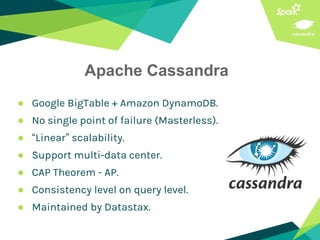
● Google BigTable + Amazon DynamoDB.
● No single point of failure (Masterless).
● “Linear” scalability.
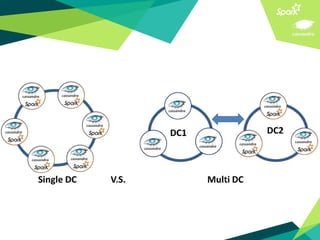
● Support multi-data center.
● CAP Theorem - AP.
● Consistency level on query level.
● Maintained by Datastax.
Apache Cassandra
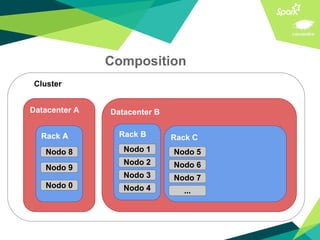
Composition
Datacenter BDatacenter A
Cluster
Rack B Rack C
Nodo 1
...
Nodo 2
Nodo 3
Nodo 4
Nodo 5
Nodo 6
Nodo 7
Rack A
Nodo 8
Nodo 9
Nodo 0
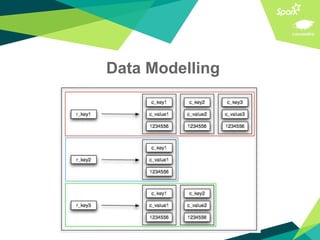
Data Modelling
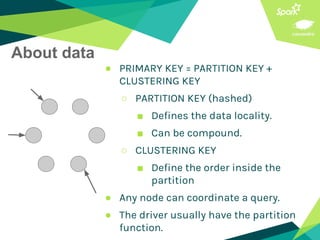
About data
● PRIMARY KEY = PARTITION KEY +
CLUSTERING KEY
○ PARTITION KEY (hashed)
■ Defines the data locality.
■ Can be compound.
○ CLUSTERING KEY
■ Define the order inside the
partition
● Any node can coordinate a query.
● The driver usually have the partition
function.
Basically like standard SQL but significantly limited.
● Restrictions to avoid full-table queries. ***
● We must know how the data is stored.
But it has some nice functionalities.
● Complex data types: JSON, Collections (set, map…) and user
defined.
● User defined functions* in Java/JavaScript.
● Secondary index (columns, any value, even collections)***.
● Materialized views.
CQL
Be careful ***
Amount of data queried:
● Or full partition key (=, IN).
● Or Indexes (limited).
Sorting:
● Remember the clustering column? Use it! (<,>,>=,<=)
Other:
● JSON, CSV output/input support.
● No JOIN, GROUP BY.
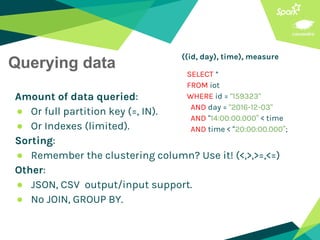
Querying data
SELECT *
FROM iot
WHERE id = "159323"
AND day = "2016-12-03"
AND “14:00:00.000” < time
AND time < “20:00:00.000”;
((id, day), time), measure
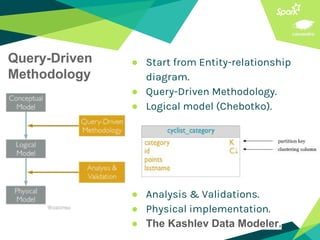
Query-Driven
Methodology
● Start from Entity-relationship
diagram.
● Query-Driven Methodology.
● Logical model (Chebotko).
● Analysis & Validations.
● Physical implementation.
● The Kashlev Data Modeler.
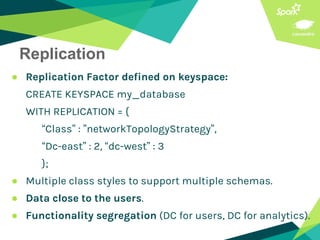
Replication
● Replication Factor defined on keyspace:
CREATE KEYSPACE my_database
WITH REPLICATION = {
“Class” : ”networkTopologyStrategy”,
“Dc-east” : 2, “dc-west” : 3
};
● Multiple class styles to support multiple schemas.
● Data close to the users.
● Functionality segregation (DC for users, DC for analytics).
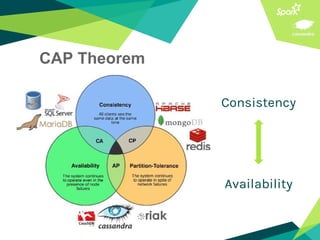
CAP Theorem
Consistency
Availability
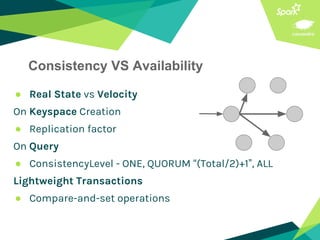
● Real State vs Velocity
On Keyspace Creation
● Replication factor
On Query
● ConsistencyLevel - ONE, QUORUM “(Total/2)+1”, ALL
Lightweight Transactions
● Compare-and-set operations
Consistency VS Availability
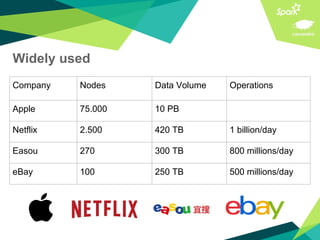
Company Nodes Data Volume Operations
Apple 75.000 10 PB
Netflix 2.500 420 TB 1 billion/day
Easou 270 300 TB 800 millions/day
eBay 100 250 TB 500 millions/day
Widely used
Conclusions
The Bads
● Remember Query Driven Methodology, be careful.
● Queries have low flexibility.
● Use secondary Indexes usually are a bad practice.
The Goods
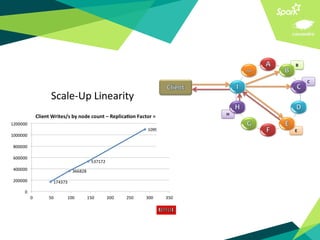
● Linear scaling.
● Storage is cheaper than processing.
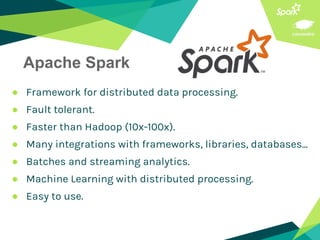
● Framework for distributed data processing.
● Fault tolerant.
● Faster than Hadoop (10x-100x).
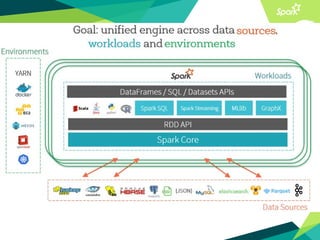
● Many integrations with frameworks, libraries, databases...
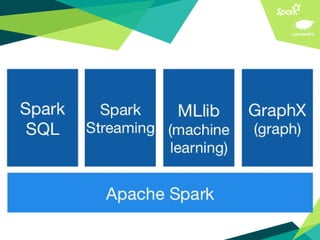
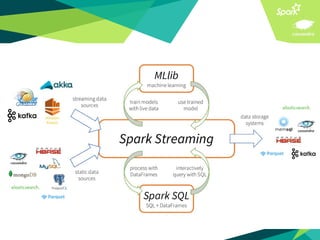
● Batches and streaming analytics.
● Machine Learning with distributed processing.
● Easy to use.
Apache Spark
RDD, DataFrame & Dataset
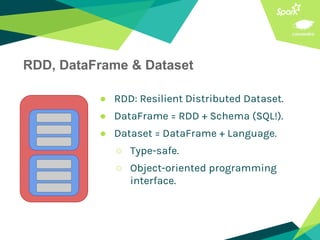
● RDD: Resilient Distributed Dataset.
● DataFrame = RDD + Schema (SQL!).
● Dataset = DataFrame + Language.
○ Type-safe.
○ Object-oriented programming
interface.
SQL or DSL
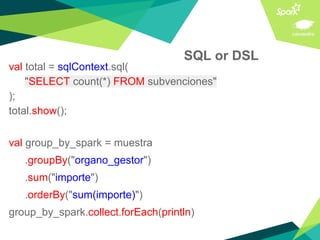
val total = sqlContext.sql(
"SELECT count(*) FROM subvenciones"
);
total.show();
val group_by_spark = muestra
.groupBy("organo_gestor")
.sum("importe")
.orderBy("sum(importe)")
group_by_spark.collect.forEach(println)
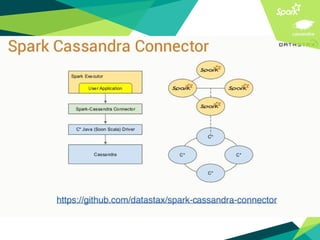
Spark & Cassandra
● Push filters to the server.
● Operations between tables (JOIN, UNION…).
● Know where the data lives (Data Locality).
● Special structures too, like “time-series”.
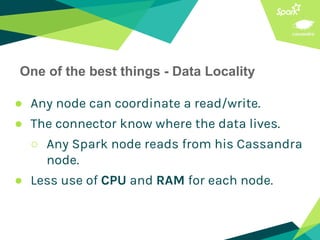
One of the best things - Data Locality
● Any node can coordinate a read/write.
● The connector know where the data lives.
○ Any Spark node reads from his Cassandra
node.
● Less use of CPU and RAM for each node.
I remember nothing!!!
Where can I learn about it?
● Cassandra:
https://academy.datastax.com/courses/
● Spark:
https://databricks.com/training
https://community.cloud.databricks.com/
● Cassandra + Spark:
https://academy.datastax.com/courses/getting-started-apache-spark
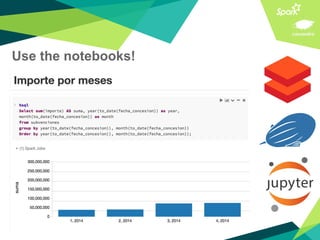
Use the notebooks!
Spark + Cassandra
● Complementary systems.
● Very scalable and fast.
● Complete Analytical possibilities (Window
functions, SQL, ML ...).
● Do you have another database?
○ Do a JOIN with a Cassandra table!
Thanks!
Any question?
You can find me:
Koletzilla
Koletzilla
josemmunoz
● Slide theme: Escalus
http://www.slidescarnival.com/es/plantilla-gratis-de-presentacion-escalus/967
● “The need to lead in data and analytics” :
http://www.mckinsey.com/business-functions/digital-mckinsey/our-insights/the-need-to-lead-in-d
ata-and-analytics
● Left image in pag 13: https://www.youtube.com/watch?v=jxwtmMTMrJA
● CAP image:
https://www.researchgate.net/figure/282519669_fig1_Figure-1-CAP-theorem-with-databases-that-c
hoose-CA-CP-and-AP
● Netflix Benchmark: http://techblog.netflix.com/2011/11/benchmarking-cassandra-scalability-on.html
● Pag 18, extracted from: http://cassandra.apache.org/
● Pag 19, benchmarks:
https://academy.datastax.com/planet-cassandra/NoSQL-performance-benchmarks
Sources
● Pag 22:
https://jaceklaskowski.gitbooks.io/mastering-apache-spark/content/spark-architecture.html
● Pag 24: https://docs.databricks.com/spark/latest/gentle-introduction/for-data-engineers.html
● Pag 26: https://www.datanami.com/2015/11/30/spark-streaming-what-is-it-and-whos-using-it/
● Pag 30:
https://www.instaclustr.com/blog/2016/01/07/multi-data-center-apache-spark-and-apache-cassan
dra-benchmark/
Sources

Spark & Cassandra - DevFest Córdoba

  • 1.
    Spark & Cassandra JoseMaría Muñoz Rey DevFest Córdoba 2016
  • 2.
    Who am I? ●Software Engineering Student. ● Data analytics and processing @ s|ngular. ● Community enthusiast.
  • 3.
    About talk? ● Motivation ●Cassandra ● Spark ● Spark + Cassandra ● Demo ● Conclusions
  • 5.
    What do youneed? ● Decent analytical query performance. ● Big throughput of reads/writes. ● New ways of do data analytics. ● Strong consistency is not necessary. ● But Big availability! ● Combine more than one data source.
  • 6.
  • 7.
    ● Google BigTable+ Amazon DynamoDB. ● No single point of failure (Masterless). ● “Linear” scalability. ● Support multi-data center. ● CAP Theorem - AP. ● Consistency level on query level. ● Maintained by Datastax. Apache Cassandra
  • 8.
    Composition Datacenter BDatacenter A Cluster RackB Rack C Nodo 1 ... Nodo 2 Nodo 3 Nodo 4 Nodo 5 Nodo 6 Nodo 7 Rack A Nodo 8 Nodo 9 Nodo 0
  • 9.
  • 10.
    About data ● PRIMARYKEY = PARTITION KEY + CLUSTERING KEY ○ PARTITION KEY (hashed) ■ Defines the data locality. ■ Can be compound. ○ CLUSTERING KEY ■ Define the order inside the partition ● Any node can coordinate a query. ● The driver usually have the partition function.
  • 11.
    Basically like standardSQL but significantly limited. ● Restrictions to avoid full-table queries. *** ● We must know how the data is stored. But it has some nice functionalities. ● Complex data types: JSON, Collections (set, map…) and user defined. ● User defined functions* in Java/JavaScript. ● Secondary index (columns, any value, even collections)***. ● Materialized views. CQL Be careful ***
  • 12.
    Amount of dataqueried: ● Or full partition key (=, IN). ● Or Indexes (limited). Sorting: ● Remember the clustering column? Use it! (<,>,>=,<=) Other: ● JSON, CSV output/input support. ● No JOIN, GROUP BY. Querying data SELECT * FROM iot WHERE id = "159323" AND day = "2016-12-03" AND “14:00:00.000” < time AND time < “20:00:00.000”; ((id, day), time), measure
  • 13.
    Query-Driven Methodology ● Start fromEntity-relationship diagram. ● Query-Driven Methodology. ● Logical model (Chebotko). ● Analysis & Validations. ● Physical implementation. ● The Kashlev Data Modeler.
  • 14.
    Replication ● Replication Factordefined on keyspace: CREATE KEYSPACE my_database WITH REPLICATION = { “Class” : ”networkTopologyStrategy”, “Dc-east” : 2, “dc-west” : 3 }; ● Multiple class styles to support multiple schemas. ● Data close to the users. ● Functionality segregation (DC for users, DC for analytics).
  • 15.
  • 16.
    ● Real Statevs Velocity On Keyspace Creation ● Replication factor On Query ● ConsistencyLevel - ONE, QUORUM “(Total/2)+1”, ALL Lightweight Transactions ● Compare-and-set operations Consistency VS Availability
  • 18.
    Company Nodes DataVolume Operations Apple 75.000 10 PB Netflix 2.500 420 TB 1 billion/day Easou 270 300 TB 800 millions/day eBay 100 250 TB 500 millions/day Widely used
  • 20.
    Conclusions The Bads ● RememberQuery Driven Methodology, be careful. ● Queries have low flexibility. ● Use secondary Indexes usually are a bad practice. The Goods ● Linear scaling. ● Storage is cheaper than processing.
  • 21.
    ● Framework fordistributed data processing. ● Fault tolerant. ● Faster than Hadoop (10x-100x). ● Many integrations with frameworks, libraries, databases... ● Batches and streaming analytics. ● Machine Learning with distributed processing. ● Easy to use. Apache Spark
  • 25.
    RDD, DataFrame &Dataset ● RDD: Resilient Distributed Dataset. ● DataFrame = RDD + Schema (SQL!). ● Dataset = DataFrame + Language. ○ Type-safe. ○ Object-oriented programming interface.
  • 27.
    SQL or DSL valtotal = sqlContext.sql( "SELECT count(*) FROM subvenciones" ); total.show(); val group_by_spark = muestra .groupBy("organo_gestor") .sum("importe") .orderBy("sum(importe)") group_by_spark.collect.forEach(println)
  • 28.
    Spark & Cassandra ●Push filters to the server. ● Operations between tables (JOIN, UNION…). ● Know where the data lives (Data Locality). ● Special structures too, like “time-series”.
  • 31.
    One of thebest things - Data Locality ● Any node can coordinate a read/write. ● The connector know where the data lives. ○ Any Spark node reads from his Cassandra node. ● Less use of CPU and RAM for each node.
  • 32.
    I remember nothing!!! Wherecan I learn about it? ● Cassandra: https://academy.datastax.com/courses/ ● Spark: https://databricks.com/training https://community.cloud.databricks.com/ ● Cassandra + Spark: https://academy.datastax.com/courses/getting-started-apache-spark
  • 33.
  • 34.
    Spark + Cassandra ●Complementary systems. ● Very scalable and fast. ● Complete Analytical possibilities (Window functions, SQL, ML ...). ● Do you have another database? ○ Do a JOIN with a Cassandra table!
  • 35.
    Thanks! Any question? You canfind me: Koletzilla Koletzilla josemmunoz
  • 36.
    ● Slide theme:Escalus http://www.slidescarnival.com/es/plantilla-gratis-de-presentacion-escalus/967 ● “The need to lead in data and analytics” : http://www.mckinsey.com/business-functions/digital-mckinsey/our-insights/the-need-to-lead-in-d ata-and-analytics ● Left image in pag 13: https://www.youtube.com/watch?v=jxwtmMTMrJA ● CAP image: https://www.researchgate.net/figure/282519669_fig1_Figure-1-CAP-theorem-with-databases-that-c hoose-CA-CP-and-AP ● Netflix Benchmark: http://techblog.netflix.com/2011/11/benchmarking-cassandra-scalability-on.html ● Pag 18, extracted from: http://cassandra.apache.org/ ● Pag 19, benchmarks: https://academy.datastax.com/planet-cassandra/NoSQL-performance-benchmarks Sources
  • 37.
    ● Pag 22: https://jaceklaskowski.gitbooks.io/mastering-apache-spark/content/spark-architecture.html ●Pag 24: https://docs.databricks.com/spark/latest/gentle-introduction/for-data-engineers.html ● Pag 26: https://www.datanami.com/2015/11/30/spark-streaming-what-is-it-and-whos-using-it/ ● Pag 30: https://www.instaclustr.com/blog/2016/01/07/multi-data-center-apache-spark-and-apache-cassan dra-benchmark/ Sources