Downloaded 313 times
![Social Organization and Stratification
• The barangays in some coastal places in Panay,[8] Manila, Cebu, Jolo,
and Butuan, with cosmopolitan cultures and trade relations with
other Countries in Asia, were already established Principalities
before the coming of the Spaniards. In these regions, even though
the majority of these barangays were not large settlements, yet
they had organized societies dominated by the same type of
recognized aristocracy (with birthright claim to allegiance from
followers), as those found in established Principalities. The
aristocratic group in these pre-colonial societies was called
the Datu Class. Its members were presumably the descendants of
the first settlers on the land or, in the case of later arrivals, of those
who were Datus at the time of migration or conquest. Some of
these Principalities have remained, even until the present, in
unhispanized[9] and mostly Islamized parts of the Philippines, in
Mindanao.[10]](https://image.slidesharecdn.com/barangaypre-colonial-130630031505-phpapp02/85/Barangay-pre-colonial-6-320.jpg)
![Social Organization and Stratification
of Pre-colonial Principalities in the
Visayas
• In more developed barangays in Visayas (e.g. Cebu, Bohol, and Panay) which were never conquered
by Spain but were subjugated as vassals by means of pacts, peace treaties, and reciprocal
alliances,[11] the datu was at the top of the social order in a sakop or haop(elsewhere referred to
as barangay).[12]
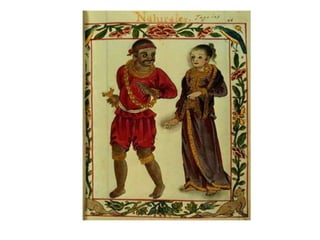
• This social order was divided into three classes. The members of the tumao class (which includes
the datu) were the nobility of pure royal descent,[13] compared by the Boxer Codex to the titled
Spanish lords (señores de titulo).[12] Below the tumao were the vassal warrior class known as
the timawa, characterized by the Jesuit priest Francisco Ignatio Alcina as "the third rank of nobility"
and by theconquistador Miguel de Loarca as "free men, neither chiefs nor slaves". These were
people of lower nobility who were required to render military service to the datu in hunts, land
wars (Mangubat or Managayau), or sea raids (Mangahat or Magahat).[14] Aside from this,
thetimawa also paid taxes and tribute (buwis or handug) and were sometimes called upon for
agricultural labor to the datu, though the personal vassals of the datu may be exempt from such
obligations (the latter were characterized by the Boxer Codex as "knights andhidalgos).[13] Below
the timawa were the oripun class (commoners and slaves), who rendered services to
the tumao and timawa for debts or favors.[13][15]
• To maintain purity of bloodline, the tumao usually marry only among their kind, often seeking high
ranking brides in other barangay, abducting them, or contracting brideprices in gold, slaves and
jewelry. Meanwhile, the datu keep their marriageable daughters secluded for protection and
prestige.[16] These well-guarded and protected highborn women were called binokot (literally
"veiled" or "swaddled"), and the datu of pure descent (at least for four generations) were
called potli nga datu or lubus nga datu.[17]](https://image.slidesharecdn.com/barangaypre-colonial-130630031505-phpapp02/85/Barangay-pre-colonial-7-320.jpg)
![Social Organization and Stratification
of Pre-colonial Principalities in the
Tagalog Region
• The different type of culture prevalent in Luzon gave a less stable and more complex social
structure to the pre-colonial Tagalog barangays of Manila, Pampanga and Laguna. Enjoying a more
extensive commerce than those in Visayas, having the influence of Bornean political contacts, and
engaging in farming wet rice for a living, the Tagalogs were described by the Spanish Augustinian
friarMartin de Rada as more traders than warriors.[18]
• The more complex social structure of the Tagalogs was less stable during the arrival of the
Spaniards because it was still in a process of differentiating. A Jesuit priest Francisco Colin made an
attempt to give an approximate comparison of it with the Visayan social structure in the middle of
the 17th century. The term datu or lakan, or apo refers to the chief, but the noble class to which
the datubelonged to was known as the maginoo class. Any male member of the maginoo class can
become a datu by personal achievement.[19]
• The term timawa referring to freemen came into use in the social structure of the Tagalogs within
just twenty years after the coming of the Spaniards. The term, however, was being incorrectly
applied to former alipin (commoner and slave class) who have escaped bondage by payment, favor,
or flight. Moreover, the Tagalog timawa did not have the military prominence of the
Visayan timawa. The equivalent warrior class in the Tagalog society was present only in Laguna, and
they were known as the maharlika class.[19]
• At the bottom of the social hierarchy are the members of the alipin class. There are two main
subclasses of the alipin class . Thealiping namamahay who owned their own houses and serve their
masters by paying tribute or working on their fields were the commoners and serfs, while
the aliping sa gigilid who lived in their masters' houses were the servants and slaves.](https://image.slidesharecdn.com/barangaypre-colonial-130630031505-phpapp02/85/Barangay-pre-colonial-8-320.jpg)
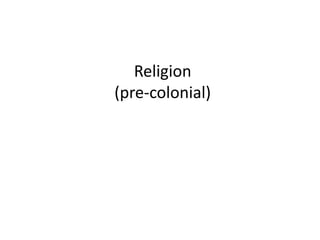

![Animism
• Animism (from Latin animus, -i "soul, life")[1] is
the religious worldview that natural physical entities—including animals,
plants, and often even inanimate objects or phenomena—possess a
spiritual essence.[2][3] Specifically, animism is used in the anthropology of
religion as a term for the religion of someindigenous tribal
peoples,[4] especially prior to the development and/or infiltration of
colonialism and organized religion.[5] Although each culture has its own
different mythologies and rituals, "animism" is said to describe the most
common, foundational thread of indigenous peoples' "spiritual" or
"supernatural" perspectives. The animistic perspective is so fundamental,
mundane, everyday and taken-for-granted that most animistic indigenous
people do not even have a word in their languages that corresponds to
"animism" (or even "religion");[6] the term is an anthropological
construct rather than one designated by the people themselves. Largely
due to such ethnolinguistic and cultural discrepancies, opinion has
differed—ever since SirEdward Tylor's 19th-century popularization of the
term—on whether animism refers to a broadly religious belief or to a full-
fledged religion in its own right.[note 1]](https://image.slidesharecdn.com/barangaypre-colonial-130630031505-phpapp02/85/Barangay-pre-colonial-12-320.jpg)
![Hinduism
• Hinduism is the majority religion[1][2] of the Indian
subcontinent, particularly of Nepal and India.
Hinduism
includes Shaivism, Vaishnavism and Śrautaamong
numerous other traditions. Among other
practices and philosophies, Hinduism includes a
wide spectrum of laws and prescriptions of "daily
morality" based on karma, dharma, and societal
norms. Hinduism is a categorisation of distinct
intellectual or philosophical points of view, rather
than a rigid, common set of beliefs.[3]](https://image.slidesharecdn.com/barangaypre-colonial-130630031505-phpapp02/85/Barangay-pre-colonial-15-320.jpg)
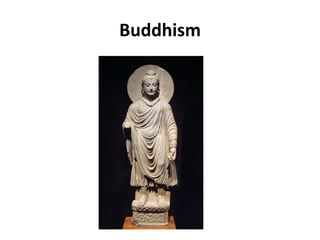
![Buddhism
• Buddhism is a religion indigenous to the Indian subcontinent that
encompasses a variety of traditions, beliefs and practices largely
based on teachings attributed to Siddhartha Gautama, who is
commonly known as the Buddha, meaning "the awakened one".
The Buddha lived and taught in the eastern part of the Indian
subcontinent sometime between the 6th and 4th centuries
BCE.[1] He is recognized by Buddhists as an awakened or
enlightened teacher who shared his insights to help sentient
beings end their suffering (dukkha) through the elimination of
ignorance (avidyā) by way of understanding and the seeing of
dependent origination (pratītyasamutpāda) and the elimination of
craving (taṇhā), and thus the attainment of the cessation of all
suffering, known as the sublime state of nirvāņa.[2]](https://image.slidesharecdn.com/barangaypre-colonial-130630031505-phpapp02/85/Barangay-pre-colonial-17-320.jpg)
![Islam
• Islam (/ˈɪslɑˈm/;[note 1]Arabic: al-ʾIslāmIPA: [ælʔɪsˈlæˈm] ( listen)[note 2]) is
a monotheistic and Abrahamic religion articulated by the Qur'an,
abook considered by its adherents to be the verbatim word
of God (Arabic: Allāh) and by the teachings and normative example (called
the Sunnah and composed of Hadith) of Muhammad, considered by them to be
the last prophet of God. An adherent of Islam is called a Muslim.
• Muslims believe that God is one and incomparable and the purpose of existence is
to love and serve God.[1] Muslims also believe that Islam is the complete and
universal version of a primordial faith that was revealed at many times and places
before, including through Abraham, Moses and Jesus, whom they
consider prophets.[2] They maintain that the previous messages and revelations
have been partially misinterpreted or altered over time,[3] but consider the Arabic
Qur'an to be both the unaltered and the final revelation of God.[4] Religious
concepts and practices include the five pillars of Islam, which are basic concepts
and obligatory acts of worship, and following Islamic law, which touches on
virtually every aspect of life and society, providing guidance on multifarious topics
from banking and welfare, to warfare and the environment.[5][6]](https://image.slidesharecdn.com/barangaypre-colonial-130630031505-phpapp02/85/Barangay-pre-colonial-18-320.jpg)
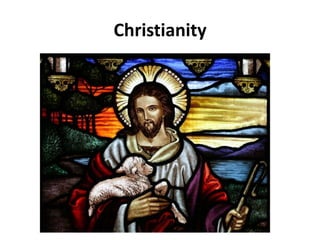
![• Christianity (from the Ancient Greek translation Χριστός, Christos of the Hebrew Mašíaḥ,
meaning "the anointed one"[1] and the Latin suffixes ianand -itas) is
a monotheistic[2] and Abrahamic religion based on the life and teachings of Jesus Christ as
presented in canonical gospels and other New Testament writings as well as the Old Testament.
Most adherents of the Christian faith, known as Christians, believe that Jesus is the Son of
God, fully divine and fully human and the savior of humanity prophesied in the Old Testament.
Consequentially, Christians commonly refer to Jesus as Christ orMessiah.
• The foundation of Christian theology is expressed in the early ecumenical creeds which contain
claims predominantly accepted by followers of the Christian faith. These professions state that
Jesus suffered, died, was buried, and was subsequently resurrected from the dead in order to grant
eternal life to those who believe in him and trust him for the remission of their sins. They further
maintain that Jesus bodily ascended into heaven where he rules and reigns with God the Father.
Most denominations teach that Jesus will return to judge all humans, living and dead, and
grant eternal life to his followers. He is considered the model of a virtuous life, and
his ministry, crucifixion, and resurrection are often referred to as the gospel, meaning "Good News"
(a loan translation of the Greek: εὐαγγέλιον euangélion).](https://image.slidesharecdn.com/barangaypre-colonial-130630031505-phpapp02/85/Barangay-pre-colonial-20-320.jpg)

Before Spanish colonization, the Philippines was made up of independent barangays that functioned as city-states or principalities. Barangays were coastal or riverine communities usually numbering between 50-100 families ruled by a datu. Larger barangays in places like Cebu, Manila and Butuan were cosmopolitan principalities with established social hierarchies and trade relations. The barangays had complex social structures divided into nobility classes like the tumao and warrior classes like the timawa. Upon colonization, smaller barangays were combined into towns headed by a cabeza de barangay under Spanish rule.


