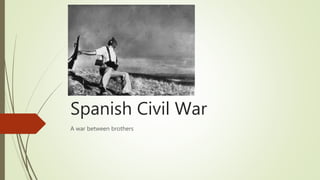
Spanish Civil War
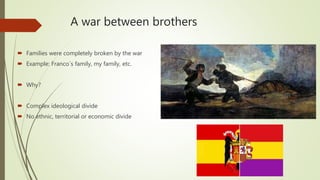
A war between brothers
Spanish Civil War. A fascinating conflict
 It was considered the prelude of the II WW
 One of the most bloodiest European civil wars
 High repercussion in the Spanish history
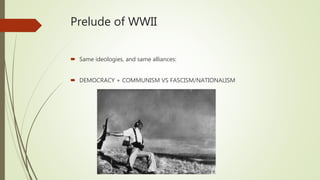
Prelude of WWII
 Same ideologies, and same alliances:
 DEMOCRACY + COMMUNISM VS FASCISM/NATIONALISM
A war between brothers
 Families were completely broken by the war
 Example: Franco´s family, my family, etc.
 Why?
 Complex ideological divide
 No ethnic, territorial or economic divide
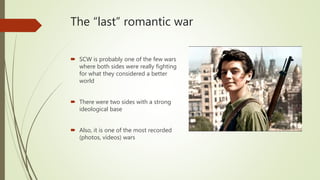
The “last” romantic war
 SCW is probably one of the few wars
where both sides were really fighting
for what they considered a better
world
 There were two sides with a strong
ideological base
 Also, it is one of the most recorded
(photos, videos) wars
Spanish Civil War
 In the Spanish Civil War, it is possible to find a Great Divide (the idea of 2 Spains)
 The Conservative Spain
 The Progressive Spain
 Although the country was divided in several questions:
Spanish Civil War
 Socio-economic question
 Religious question
 Ideological question
 Regional question
Long-term causes
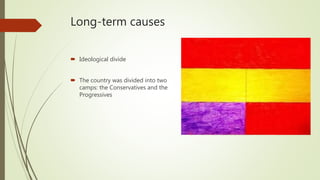
 Ideological divide
 The country was divided into two
camps: the Conservatives and the
Progressives
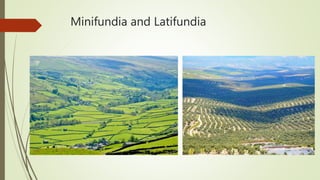
Minifundia and Latifundia
Long-term causes
 What is the traditional ideology of the peasants?
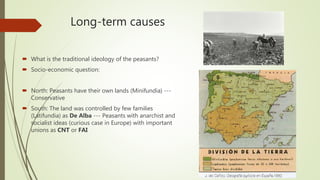
 Socio-economic question:
 North: Peasants have their own lands (Minifundia) ---
Conservative
 South: The land was controlled by few families
(Latifundia) as De Alba --- Peasants with anarchist and
socialist ideas (curious case in Europe) with important
unions as CNT or FAI
Long-term causes
 Religious question
 What is the main religion in Spain?
 Typical phenomena in Southern European countries
(Anticlericalism vs. Catholics)
 Why? The Church played an important role in the
education and politics. The XIXth Century was a
century of separation of powers, creating important
tension in countries such as Spain or Italy
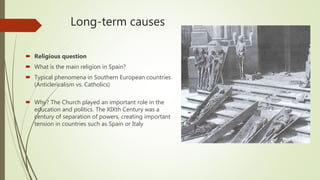
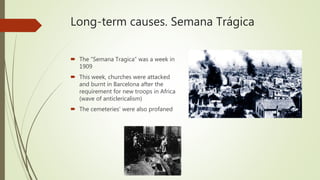
Long-term causes. Semana Trágica
 The “Semana Tragica” was a week in
1909
 This week, churches were attacked
and burnt in Barcelona after the
requirement for new troops in Africa
(wave of anticlericalism)
 The cemeteries' were also profaned
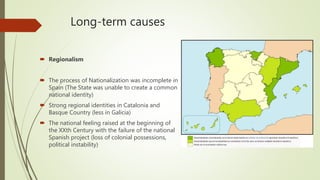
Long-term causes
 Regionalism
 The process of Nationalization was incomplete in
Spain (The State was unable to create a common
national identity)
 Strong regional identities in Catalonia and
Basque Country (less in Galicia)
 The national feeling raised at the beginning of
the XXth Century with the failure of the national
Spanish project (loss of colonial possessions,
political instability)
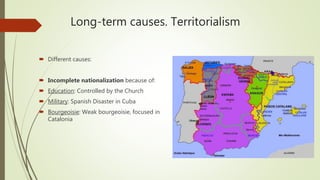
Long-term causes. Territorialism
 Different causes:
 Incomplete nationalization because of:
 Education: Controlled by the Church
 Military: Spanish Disaster in Cuba
 Bourgeoisie: Weak bourgeoisie, focused in
Catalonia
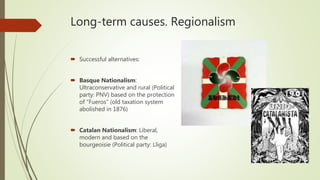
Long-term causes. Regionalism
 Successful alternatives:
 Basque Nationalism:
Ultraconservative and rural (Political
party: PNV) based on the protection
of “Fueros” (old taxation system
abolished in 1876)
 Catalan Nationalism: Liberal,
modern and based on the
bourgeoisie (Political party: Lliga)
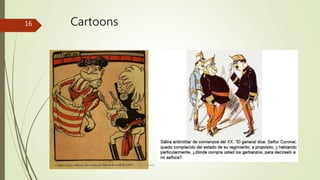
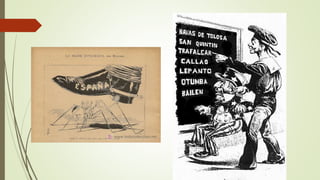
Cartoons
Prof. Samuel Perrino Martínez. Liceo XXII José Martí de Varsovia
16
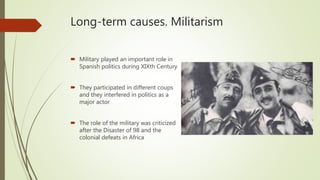
Long-term causes. Militarism
 Military played an important role in
Spanish politics during XIXth Century
 They participated in different coups
and they interfered in politics as a
major actor
 The role of the military was criticized
after the Disaster of 98 and the
colonial defeats in Africa
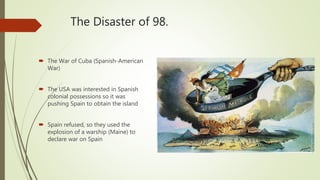
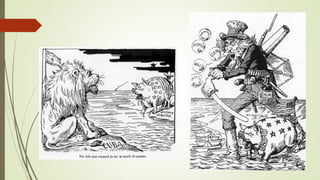
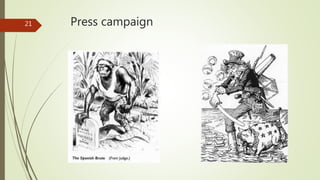
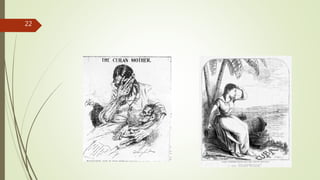
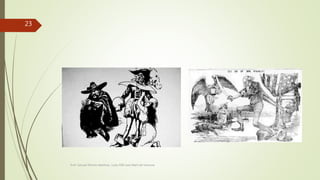
The Disaster of 98.
 The War of Cuba (Spanish-American
War)
 The USA was interested in Spanish
colonial possessions so it was
pushing Spain to obtain the island
 Spain refused, so they used the
explosion of a warship (Maine) to
declare war on Spain
Press campaign21
22
Prof. Samuel Perrino Martínez. Liceo XXII José Martí de Varsovia
23
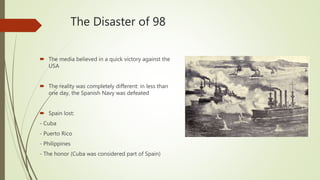
The Disaster of 98
 The media believed in a quick victory against the
USA
 The reality was completely different: in less than
one day, the Spanish Navy was defeated
 Spain lost:
- Cuba
- Puerto Rico
- Philippines
- The honor (Cuba was considered part of Spain)
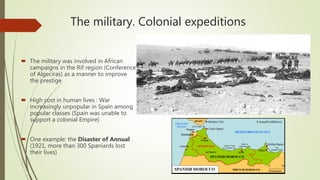
The military. Colonial expeditions
 The military was involved in African
campaigns in the Rif region (Conference
of Algeciras) as a manner to improve
the prestige
 High cost in human lives : War
increasingly unpopular in Spain among
popular classes (Spain was unable to
support a colonial Empire)
 One example: the Disaster of Annual
(1921, more than 300 Spaniards lost
their lives)
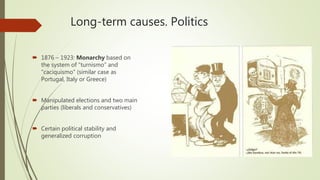
Long-term causes. Politics
 1876 – 1923: Monarchy based on
the system of “turnismo” and
“caciquismo” (similar case as
Portugal, Italy or Greece)
 Manipulated elections and two main
parties (liberals and conservatives)
 Certain political stability and
generalized corruption
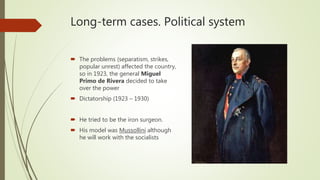
Long-term cases. Political system
 The problems (separatism, strikes,
popular unrest) affected the country,
so in 1923, the general Miguel
Primo de Rivera decided to take
over the power
 Dictatorship (1923 – 1930)
 He tried to be the iron surgeon.
 His model was Mussollini although
he will work with the socialists
The Dictatorship of Primo de Rivera
 Origin
 Why
 Initial goals
 Stages
 Main measures
- Order
- Repression of peripheral nationalism
- Public works
- Organization of labor
 Opposition
 The end of the system
Prof. Samuel Perrino Martínez. Liceo XXII José Martí de Varsovia
29
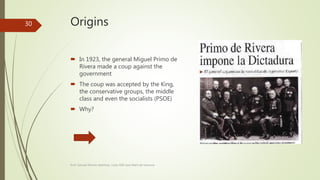
Origins
 In 1923, the general Miguel Primo de
Rivera made a coup against the
government
 The coup was accepted by the King,
the conservative groups, the middle
class and even the socialists (PSOE)
 Why?
Prof. Samuel Perrino Martínez. Liceo XXII José Martí de Varsovia
30
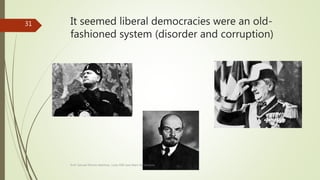
It seemed liberal democracies were an old-
fashioned system (disorder and corruption)
Prof. Samuel Perrino Martínez. Liceo XXII José Martí de Varsovia
31
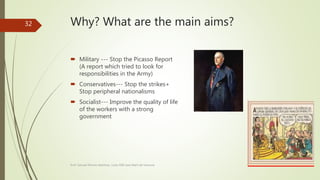
Why? What are the main aims?
 Military --- Stop the Picasso Report
(A report which tried to look for
responsibilities in the Army)
 Conservatives--- Stop the strikes+
Stop peripheral nationalisms
 Socialist--- Improve the quality of life
of the workers with a strong
government
Prof. Samuel Perrino Martínez. Liceo XXII José Martí de Varsovia
32
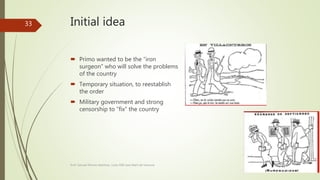
Initial idea
 Primo wanted to be the “iron
surgeon” who will solve the problems
of the country
 Temporary situation, to reestablish
the order
 Military government and strong
censorship to “fix” the country
Prof. Samuel Perrino Martínez. Liceo XXII José Martí de Varsovia
33
Stages
 Directorio Militar (1923 – 1925)
- Idea of provisory government
 Institutionalization of the regime(1925-1930)
- He tried to create a party (Patriotic Union) and include civilian members in the
government to maintain the regime
Prof. Samuel Perrino Martínez. Liceo XXII José Martí de Varsovia
34
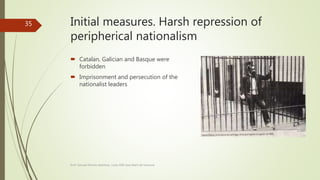
Initial measures. Harsh repression of
peripherical nationalism
 Catalan, Galician and Basque were
forbidden
 Imprisonment and persecution of the
nationalist leaders
Prof. Samuel Perrino Martínez. Liceo XXII José Martí de Varsovia
35
Order and repression
 Use of the police and the army to
repress the public demonstrations
 Strategic Alliance with the Socialist to
calm the workers
Prof. Samuel Perrino Martínez. Liceo XXII José Martí de Varsovia
36
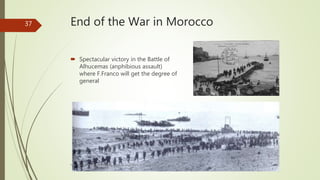
End of the War in Morocco
 Spectacular victory in the Battle of
Alhucemas (anphibious assault)
where F.Franco will get the degree of
general
Prof. Samuel Perrino Martínez. Liceo XXII José Martí de Varsovia
37
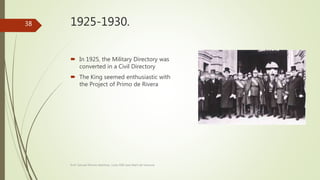
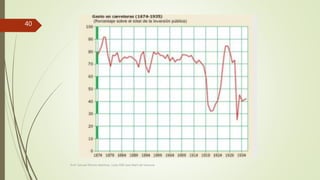
1925-1930.
 In 1925, the Military Directory was
converted in a Civil Directory
 The King seemed enthusiastic with
the Project of Primo de Rivera
Prof. Samuel Perrino Martínez. Liceo XXII José Martí de Varsovia
38
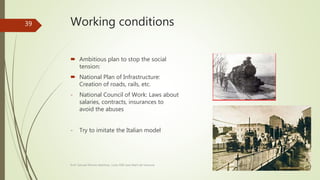
Working conditions
 Ambitious plan to stop the social
tension:
 National Plan of Infrastructure:
Creation of roads, rails, etc.
- National Council of Work: Laws about
salaries, contracts, insurances to
avoid the abuses
- Try to imitate the Italian model
Prof. Samuel Perrino Martínez. Liceo XXII José Martí de Varsovia
39
Prof. Samuel Perrino Martínez. Liceo XXII José Martí de Varsovia
40
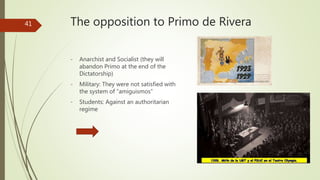
The opposition to Primo de Rivera
- Anarchist and Socialist (they will
abandon Primo at the end of the
Dictatorship)
- Military: They were not satisfied with
the system of “amiguismos”
- Students: Against an authoritarian
regime
41
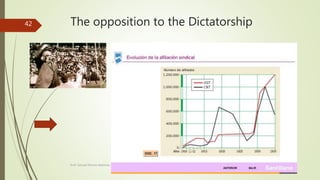
The opposition to the Dictatorship
Prof. Samuel Perrino Martínez. Liceo XXII José Martí de Varsovia
42
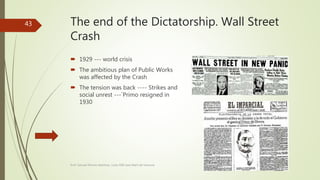
The end of the Dictatorship. Wall Street
Crash
 1929 --- world crisis
 The ambitious plan of Public Works
was affected by the Crash
 The tension was back ---- Strikes and
social unrest ---`Primo resigned in
1930
Prof. Samuel Perrino Martínez. Liceo XXII José Martí de Varsovia
43
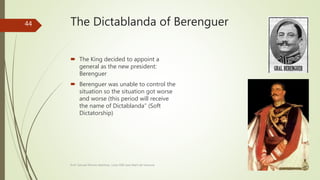
The Dictablanda of Berenguer
 The King decided to appoint a
general as the new president:
Berenguer
 Berenguer was unable to control the
situation so the situation got worse
and worse (this period will receive
the name of Dictablanda” (Soft
Dictatorship)
Prof. Samuel Perrino Martínez. Liceo XXII José Martí de Varsovia
44
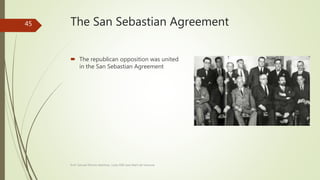
The San Sebastian Agreement
 The republican opposition was united
in the San Sebastian Agreement
Prof. Samuel Perrino Martínez. Liceo XXII José Martí de Varsovia
45
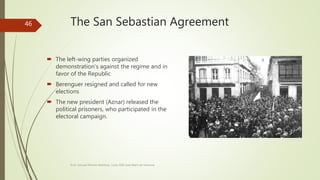
The San Sebastian Agreement
 The left-wing parties organized
demonstration's against the regime and in
favor of the Republic
 Berenguer resigned and called for new
elections
 The new president (Aznar) released the
political prisoners, who participated in the
electoral campaign.
Prof. Samuel Perrino Martínez. Liceo XXII José Martí de Varsovia
46
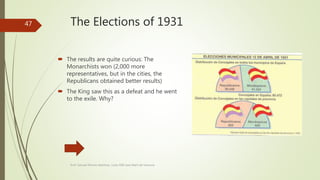
The Elections of 1931
 The results are quite curious: The
Monarchists won (2,000 more
representatives, but in the cities, the
Republicans obtained better results)
 The King saw this as a defeat and he went
to the exile. Why?
Prof. Samuel Perrino Martínez. Liceo XXII José Martí de Varsovia
47
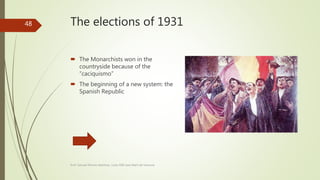
The elections of 1931
 The Monarchists won in the
countryside because of the
“caciquismo”
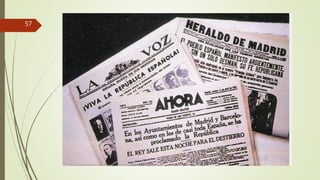
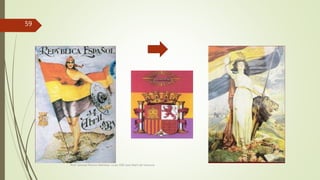
 The beginning of a new system: the
Spanish Republic
Prof. Samuel Perrino Martínez. Liceo XXII José Martí de Varsovia
48
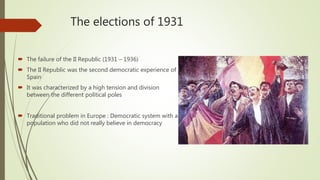
The elections of 1931
 The failure of the II Republic (1931 – 1936)
 The II Republic was the second democratic experience of
Spain
 It was characterized by a high tension and division
between the different political poles
 Traditional problem in Europe : Democratic system with a
population who did not really believe in democracy
II Republic
 Period of important changes in Europe
 Period of disorder
 Truly democratic experience, in a complicated world
Prof. Samuel Perrino Martínez. Liceo XXII José Martí de Varsovia
50
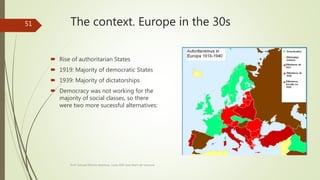
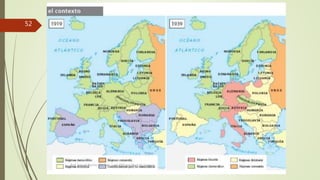
The context. Europe in the 30s
 Rise of authoritarian States
 1919: Majority of democratic States
 1939: Majority of dictatorships
 Democracy was not working for the
majority of social classes, so there
were two more sucessful alternatives:
Prof. Samuel Perrino Martínez. Liceo XXII José Martí de Varsovia
51
Prof. Samuel Perrino Martínez. Liceo XXII José Martí de Varsovia
52
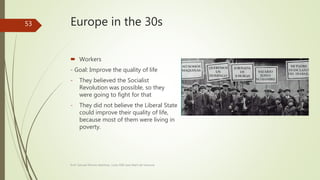
Europe in the 30s
 Workers
- Goal: Improve the quality of life
- They believed the Socialist
Revolution was possible, so they
were going to fight for that
- They did not believe the Liberal State
could improve their quality of life,
because most of them were living in
poverty.
Prof. Samuel Perrino Martínez. Liceo XXII José Martí de Varsovia
53
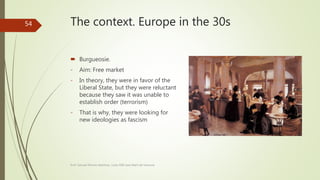
The context. Europe in the 30s
 Burgueosie.
- Aim: Free market
- In theory, they were in favor of the
Liberal State, but they were reluctant
because they saw it was unable to
establish order (terrorism)
- That is why, they were looking for
new ideologies as fascism
Prof. Samuel Perrino Martínez. Liceo XXII José Martí de Varsovia
54
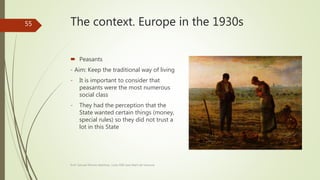
The context. Europe in the 1930s
 Peasants
- Aim: Keep the traditional way of living
- It is important to consider that
peasants were the most numerous
social class
- They had the perception that the
State wanted certain things (money,
special rules) so they did not trust a
lot in this State
Prof. Samuel Perrino Martínez. Liceo XXII José Martí de Varsovia
55
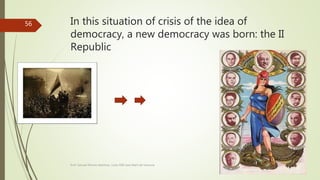
In this situation of crisis of the idea of
democracy, a new democracy was born: the II
Republic
Prof. Samuel Perrino Martínez. Liceo XXII José Martí de Varsovia
56
Prof. Samuel Perrino Martínez. Liceo XXII José Martí de Varsovia
57
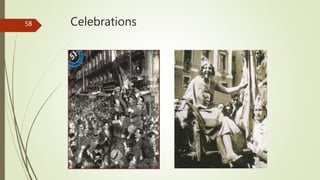
Celebrations
Prof. Samuel Perrino Martínez. Liceo XXII José Martí de Varsovia
58
Prof. Samuel Perrino Martínez. Liceo XXII José Martí de Varsovia
59
The II Republic
 There were three governments during the II Republic:
- Progressive government (1931 – 1933)
- Conservative government (1934 – 1936)
- Popular Front government (1936)
- It is relevant the fact there was a coup attempt with every government by the
political opposition
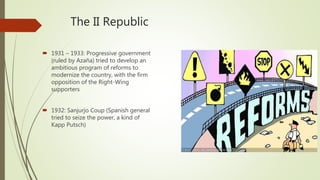
The II Republic
 1931 – 1933: Progressive government
(ruled by Azaña) tried to develop an
ambitious program of reforms to
modernize the country, with the firm
opposition of the Right-Wing
supporters
 1932: Sanjurjo Coup (Spanish general
tried to seize the power, a kind of
Kapp Putsch)
Reforms in the Progressive Years (1931 –
1933)
 Church and educational reform
 Military reform
 Agrarian reform
 Territorial reform
Prof. Samuel Perrino Martínez. Liceo XXII José Martí de Varsovia
62
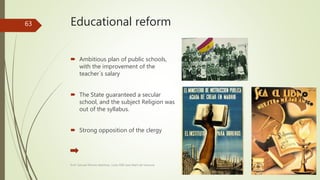
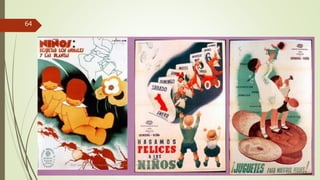
Educational reform
 Ambitious plan of public schools,
with the improvement of the
teacher´s salary
 The State guaranteed a secular
school, and the subject Religion was
out of the syllabus.
 Strong opposition of the clergy
Prof. Samuel Perrino Martínez. Liceo XXII José Martí de Varsovia
63
Prof. Samuel Perrino Martínez. Liceo XXII José Martí de Varsovia
64
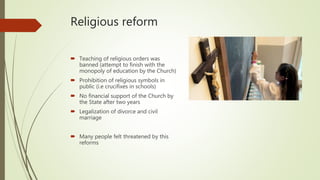
Religious reform
 Teaching of religious orders was
banned (attempt to finish with the
monopoly of education by the Church)
 Prohibition of religious symbols in
public (i.e crucifixes in schools)
 No financial support of the Church by
the State after two years
 Legalization of divorce and civil
marriage
 Many people felt threatened by this
reforms
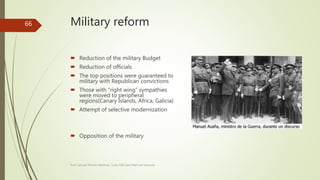
Military reform
 Reduction of the military Budget
 Reduction of officials
 The top positions were guaranteed to
military with Republican convictions
 Those with “right wing” sympathies
were moved to peripheral
regions(Canary Islands, Africa, Galicia)
 Attempt of selective modernization
 Opposition of the military
Prof. Samuel Perrino Martínez. Liceo XXII José Martí de Varsovia
66
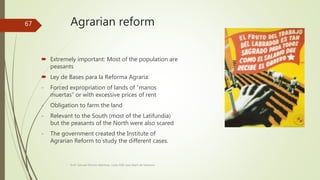
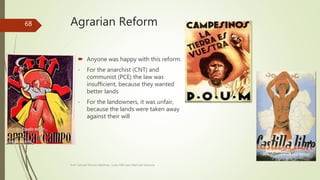
Agrarian reform
 Extremely important: Most of the population are
peasants
 Ley de Bases para la Reforma Agraria:
- Forced expropriation of lands of “manos
muertas” or with excessive prices of rent
- Obligation to farm the land
- Relevant to the South (most of the Latifundia)
but the peasants of the North were also scared
- The government created the Institute of
Agrarian Reform to study the different cases.
Prof. Samuel Perrino Martínez. Liceo XXII José Martí de Varsovia
67
Agrarian Reform
 Anyone was happy with this reform:
- For the anarchist (CNT) and
communist (PCE) the law was
insufficient, because they wanted
better lands
- For the landowners, it was unfair,
because the lands were taken away
against their will
Prof. Samuel Perrino Martínez. Liceo XXII José Martí de Varsovia
68
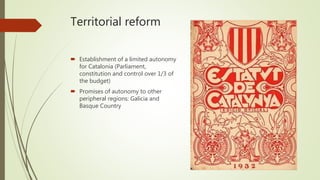
Territorial reform
 Establishment of a limited autonomy
for Catalonia (Parliament,
constitution and control over 1/3 of
the budget)
 Promises of autonomy to other
peripheral regions: Galicia and
Basque Country
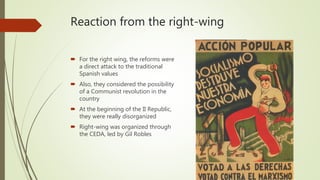
Reaction from the right-wing
 For the right wing, the reforms were
a direct attack to the traditional
Spanish values
 Also, they considered the possibility
of a Communist revolution in the
country
 At the beginning of the II Republic,
they were really disorganized
 Right-wing was organized through
the CEDA, led by Gil Robles
Reaction to the reforms
 Left-wing was divided:
 The most important left-wing party (PSOE) was divided about the reforms, with two
trends:
- Radical trend (led by Caballero): They considered the reforms were not enough
- Moderate trend: In favor of the reforms
- Also, many left-wing supporters were Catholics (i.e, the president of the Republic
Alcala Zamora) so they did not like the Anti-Clericalism
Reaction to the reforms
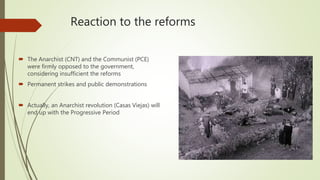
 The Anarchist (CNT) and the Communist (PCE)
were firmly opposed to the government,
considering insufficient the reforms
 Permanent strikes and public demonstrations
 Actually, an Anarchist revolution (Casas Viejas) will
end up with the Progressive Period
The Dark Years
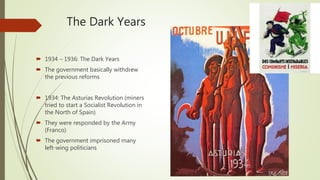
 1934 – 1936: The Dark Years
 The government basically withdrew
the previous reforms
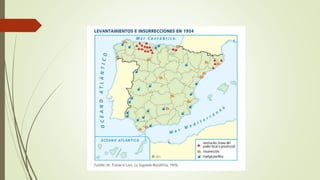
 1934: The Asturias Revolution (miners
tried to start a Socialist Revolution in
the North of Spain)
 They were responded by the Army
(Franco)
 The government imprisoned many
left-wing politicians
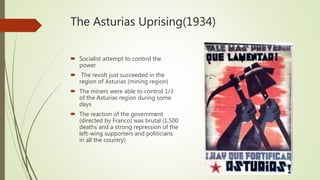
The Asturias Uprising(1934)
 Socialist attempt to control the
power
 The revolt just succeeded in the
region of Asturias (mining region)
 The miners were able to control 1/3
of the Asturias region during some
days
 The reaction of the government
(directed by Franco) was brutal (1,500
deaths and a strong repression of the
left-wing supporters and politicians
in all the country)
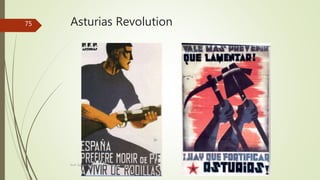
Asturias Revolution
Prof. Samuel Perrino Martínez. Liceo XXII José Martí de Varsovia
75
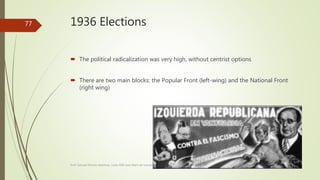
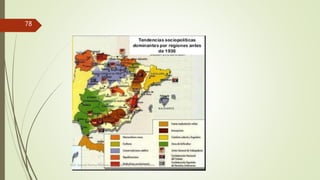
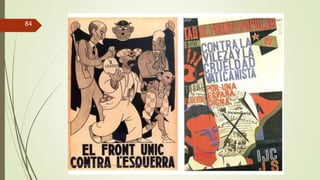
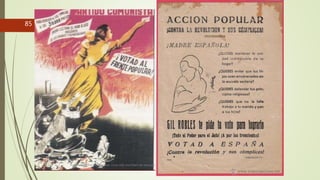
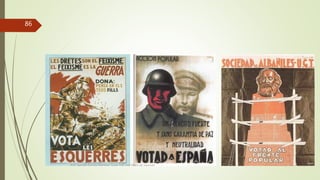
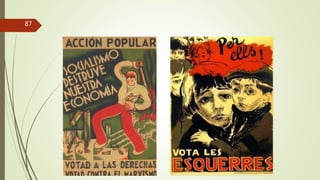
1936 Elections
 The political radicalization was very high, without centrist options
 There are two main blocks: the Popular Front (left-wing) and the National Front
(right wing)
Prof. Samuel Perrino Martínez. Liceo XXII José Martí de Varsovia
77
Prof. Samuel Perrino Martínez. Liceo XXII José Martí de Varsovia
78
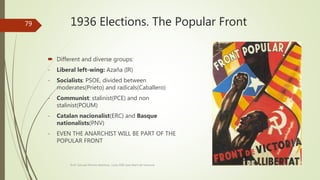
1936 Elections. The Popular Front
 Different and diverse groups:
- Liberal left-wing: Azaña (IR)
- Socialists: PSOE, divided between
moderates(Prieto) and radicals(Caballero)
- Communist: stalinist(PCE) and non
stalinist(POUM)
- Catalan nacionalist(ERC) and Basque
nationalists(PNV)
- EVEN THE ANARCHIST WILL BE PART OF THE
POPULAR FRONT
Prof. Samuel Perrino Martínez. Liceo XXII José Martí de Varsovia
79
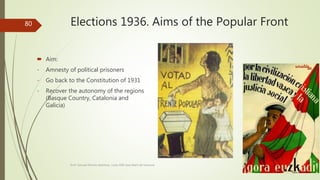
Elections 1936. Aims of the Popular Front
 Aim:
- Amnesty of political prisoners
- Go back to the Constitution of 1931
- Recover the autonomy of the regions
(Basque Country, Catalonia and
Galicia)
Prof. Samuel Perrino Martínez. Liceo XXII José Martí de Varsovia
80
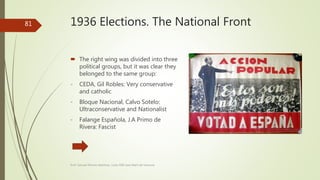
1936 Elections. The National Front
 The right wing was divided into three
political groups, but it was clear they
belonged to the same group:
- CEDA, Gil Robles: Very conservative
and catholic
- Bloque Nacional, Calvo Sotelo:
Ultraconservative and Nationalist
- Falange Española, J.A Primo de
Rivera: Fascist
Prof. Samuel Perrino Martínez. Liceo XXII José Martí de Varsovia
81
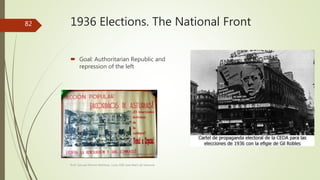
1936 Elections. The National Front
 Goal: Authoritarian Republic and
repression of the left
Prof. Samuel Perrino Martínez. Liceo XXII José Martí de Varsovia
82
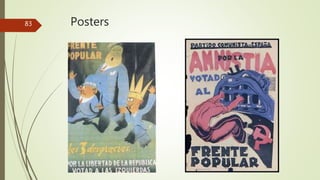
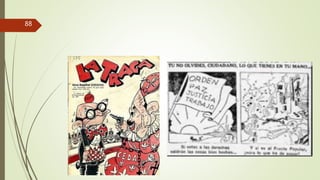
Posters
Prof. Samuel Perrino Martínez. Liceo XXII José Martí de Varsovia
83
Prof. Samuel Perrino Martínez. Liceo XXII José Martí de Varsovia
84
Prof. Samuel Perrino Martínez. Liceo XXII José Martí de Varsovia
85
Prof. Samuel Perrino Martínez. Liceo XXII José Martí de Varsovia
86
Prof. Samuel Perrino Martínez. Liceo XXII José Martí de Varsovia
87
Prof. Samuel Perrino Martínez. Liceo XXII José Martí de Varsovia
88
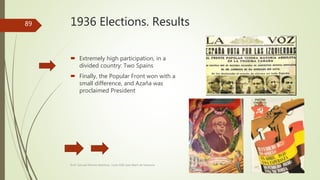
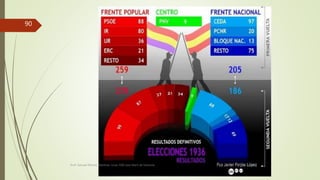
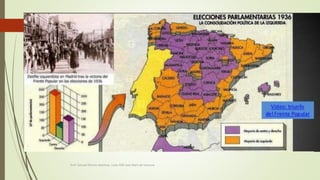
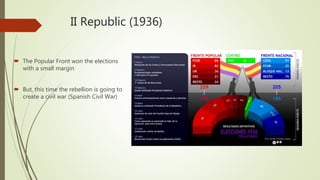
1936 Elections. Results
 Extremely high participation, in a
divided country: Two Spains
 Finally, the Popular Front won with a
small difference, and Azaña was
proclaimed President
Prof. Samuel Perrino Martínez. Liceo XXII José Martí de Varsovia
89
Prof. Samuel Perrino Martínez. Liceo XXII José Martí de Varsovia
90
Prof. Samuel Perrino Martínez. Liceo XXII José Martí de Varsovia
91
II Republic (1936)
 The Popular Front won the elections
with a small margin
 But, this time the rebellion is going to
create a civil war (Spanish Civil War)
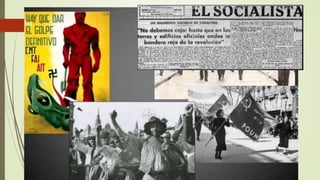
However, after the elections, the tension
raised and raised
Prof. Samuel Perrino Martínez. Liceo XXII José Martí de Varsovia
93
Prof. Samuel Perrino Martínez. Liceo XXII José Martí de Varsovia
94
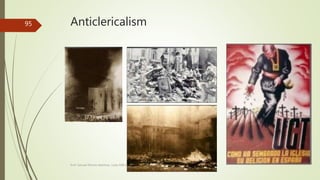
Anticlericalism
Prof. Samuel Perrino Martínez. Liceo XXII José Martí de Varsovia
95
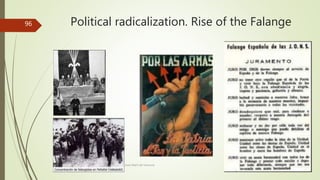
Political radicalization. Rise of the Falange
Prof. Samuel Perrino Martínez. Liceo XXII José Martí de Varsovia
96
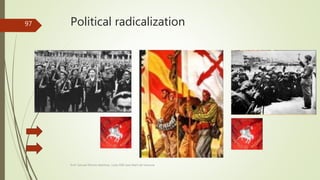
Political radicalization
Prof. Samuel Perrino Martínez. Liceo XXII José Martí de Varsovia
97
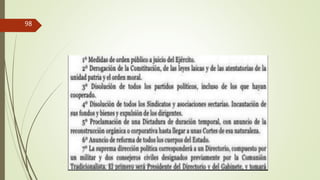
Prof. Samuel Perrino Martínez. Liceo XXII José Martí de Varsovia
98
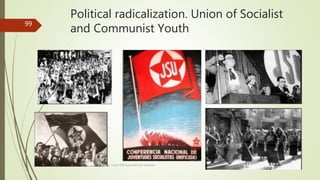
Political radicalization. Union of Socialist
and Communist Youth
Prof. Samuel Perrino Martínez. Liceo XXII José Martí de Varsovia
99
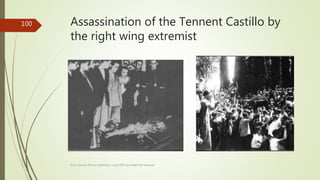
Assassination of the Tennent Castillo by
the right wing extremist
Prof. Samuel Perrino Martínez. Liceo XXII José Martí de Varsovia
100
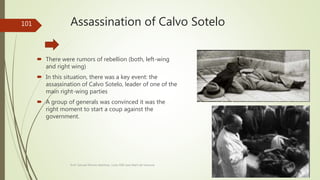
Assassination of Calvo Sotelo
 There were rumors of rebellion (both, left-wing
and right wing)
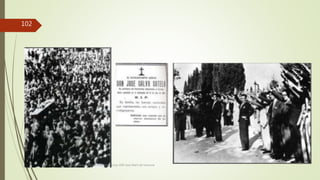
 In this situation, there was a key event: the
assassination of Calvo Sotelo, leader of one of the
main right-wing parties
 A group of generals was convinced it was the
right moment to start a coup against the
government.
Prof. Samuel Perrino Martínez. Liceo XXII José Martí de Varsovia
101
Prof. Samuel Perrino Martínez. Liceo XXII José Martí de Varsovia
102
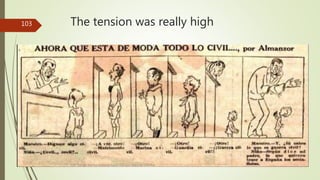
The tension was really high
Prof. Samuel Perrino Martínez. Liceo XXII José Martí de Varsovia
103

Spanish civil war (Causes) IB

  • 1.
    Spanish Civil War Awar between brothers
  • 2.
    Spanish Civil War.A fascinating conflict  It was considered the prelude of the II WW  One of the most bloodiest European civil wars  High repercussion in the Spanish history
  • 3.
    Prelude of WWII Same ideologies, and same alliances:  DEMOCRACY + COMMUNISM VS FASCISM/NATIONALISM
  • 4.
    A war betweenbrothers  Families were completely broken by the war  Example: Franco´s family, my family, etc.  Why?  Complex ideological divide  No ethnic, territorial or economic divide
  • 5.
    The “last” romanticwar  SCW is probably one of the few wars where both sides were really fighting for what they considered a better world  There were two sides with a strong ideological base  Also, it is one of the most recorded (photos, videos) wars
  • 6.
    Spanish Civil War In the Spanish Civil War, it is possible to find a Great Divide (the idea of 2 Spains)  The Conservative Spain  The Progressive Spain  Although the country was divided in several questions:
  • 7.
    Spanish Civil War Socio-economic question  Religious question  Ideological question  Regional question
  • 8.
    Long-term causes  Ideologicaldivide  The country was divided into two camps: the Conservatives and the Progressives
  • 9.
  • 10.
    Long-term causes  Whatis the traditional ideology of the peasants?  Socio-economic question:  North: Peasants have their own lands (Minifundia) --- Conservative  South: The land was controlled by few families (Latifundia) as De Alba --- Peasants with anarchist and socialist ideas (curious case in Europe) with important unions as CNT or FAI
  • 11.
    Long-term causes  Religiousquestion  What is the main religion in Spain?  Typical phenomena in Southern European countries (Anticlericalism vs. Catholics)  Why? The Church played an important role in the education and politics. The XIXth Century was a century of separation of powers, creating important tension in countries such as Spain or Italy
  • 12.
    Long-term causes. SemanaTrágica  The “Semana Tragica” was a week in 1909  This week, churches were attacked and burnt in Barcelona after the requirement for new troops in Africa (wave of anticlericalism)  The cemeteries' were also profaned
  • 13.
    Long-term causes  Regionalism The process of Nationalization was incomplete in Spain (The State was unable to create a common national identity)  Strong regional identities in Catalonia and Basque Country (less in Galicia)  The national feeling raised at the beginning of the XXth Century with the failure of the national Spanish project (loss of colonial possessions, political instability)
  • 14.
    Long-term causes. Territorialism Different causes:  Incomplete nationalization because of:  Education: Controlled by the Church  Military: Spanish Disaster in Cuba  Bourgeoisie: Weak bourgeoisie, focused in Catalonia
  • 15.
    Long-term causes. Regionalism Successful alternatives:  Basque Nationalism: Ultraconservative and rural (Political party: PNV) based on the protection of “Fueros” (old taxation system abolished in 1876)  Catalan Nationalism: Liberal, modern and based on the bourgeoisie (Political party: Lliga)
  • 16.
    Cartoons Prof. Samuel PerrinoMartínez. Liceo XXII José Martí de Varsovia 16
  • 17.
    Long-term causes. Militarism Military played an important role in Spanish politics during XIXth Century  They participated in different coups and they interfered in politics as a major actor  The role of the military was criticized after the Disaster of 98 and the colonial defeats in Africa
  • 18.
    The Disaster of98.  The War of Cuba (Spanish-American War)  The USA was interested in Spanish colonial possessions so it was pushing Spain to obtain the island  Spain refused, so they used the explosion of a warship (Maine) to declare war on Spain
  • 21.
  • 22.
  • 23.
    Prof. Samuel PerrinoMartínez. Liceo XXII José Martí de Varsovia 23
  • 24.
    The Disaster of98  The media believed in a quick victory against the USA  The reality was completely different: in less than one day, the Spanish Navy was defeated  Spain lost: - Cuba - Puerto Rico - Philippines - The honor (Cuba was considered part of Spain)
  • 25.
    The military. Colonialexpeditions  The military was involved in African campaigns in the Rif region (Conference of Algeciras) as a manner to improve the prestige  High cost in human lives : War increasingly unpopular in Spain among popular classes (Spain was unable to support a colonial Empire)  One example: the Disaster of Annual (1921, more than 300 Spaniards lost their lives)
  • 26.
    Long-term causes. Politics 1876 – 1923: Monarchy based on the system of “turnismo” and “caciquismo” (similar case as Portugal, Italy or Greece)  Manipulated elections and two main parties (liberals and conservatives)  Certain political stability and generalized corruption
  • 28.
    Long-term cases. Politicalsystem  The problems (separatism, strikes, popular unrest) affected the country, so in 1923, the general Miguel Primo de Rivera decided to take over the power  Dictatorship (1923 – 1930)  He tried to be the iron surgeon.  His model was Mussollini although he will work with the socialists
  • 29.
    The Dictatorship ofPrimo de Rivera  Origin  Why  Initial goals  Stages  Main measures - Order - Repression of peripheral nationalism - Public works - Organization of labor  Opposition  The end of the system Prof. Samuel Perrino Martínez. Liceo XXII José Martí de Varsovia 29
  • 30.
    Origins  In 1923,the general Miguel Primo de Rivera made a coup against the government  The coup was accepted by the King, the conservative groups, the middle class and even the socialists (PSOE)  Why? Prof. Samuel Perrino Martínez. Liceo XXII José Martí de Varsovia 30
  • 31.
    It seemed liberaldemocracies were an old- fashioned system (disorder and corruption) Prof. Samuel Perrino Martínez. Liceo XXII José Martí de Varsovia 31
  • 32.
    Why? What arethe main aims?  Military --- Stop the Picasso Report (A report which tried to look for responsibilities in the Army)  Conservatives--- Stop the strikes+ Stop peripheral nationalisms  Socialist--- Improve the quality of life of the workers with a strong government Prof. Samuel Perrino Martínez. Liceo XXII José Martí de Varsovia 32
  • 33.
    Initial idea  Primowanted to be the “iron surgeon” who will solve the problems of the country  Temporary situation, to reestablish the order  Military government and strong censorship to “fix” the country Prof. Samuel Perrino Martínez. Liceo XXII José Martí de Varsovia 33
  • 34.
    Stages  Directorio Militar(1923 – 1925) - Idea of provisory government  Institutionalization of the regime(1925-1930) - He tried to create a party (Patriotic Union) and include civilian members in the government to maintain the regime Prof. Samuel Perrino Martínez. Liceo XXII José Martí de Varsovia 34
  • 35.
    Initial measures. Harshrepression of peripherical nationalism  Catalan, Galician and Basque were forbidden  Imprisonment and persecution of the nationalist leaders Prof. Samuel Perrino Martínez. Liceo XXII José Martí de Varsovia 35
  • 36.
    Order and repression Use of the police and the army to repress the public demonstrations  Strategic Alliance with the Socialist to calm the workers Prof. Samuel Perrino Martínez. Liceo XXII José Martí de Varsovia 36
  • 37.
    End of theWar in Morocco  Spectacular victory in the Battle of Alhucemas (anphibious assault) where F.Franco will get the degree of general Prof. Samuel Perrino Martínez. Liceo XXII José Martí de Varsovia 37
  • 38.
    1925-1930.  In 1925,the Military Directory was converted in a Civil Directory  The King seemed enthusiastic with the Project of Primo de Rivera Prof. Samuel Perrino Martínez. Liceo XXII José Martí de Varsovia 38
  • 39.
    Working conditions  Ambitiousplan to stop the social tension:  National Plan of Infrastructure: Creation of roads, rails, etc. - National Council of Work: Laws about salaries, contracts, insurances to avoid the abuses - Try to imitate the Italian model Prof. Samuel Perrino Martínez. Liceo XXII José Martí de Varsovia 39
  • 40.
    Prof. Samuel PerrinoMartínez. Liceo XXII José Martí de Varsovia 40
  • 41.
    The opposition toPrimo de Rivera - Anarchist and Socialist (they will abandon Primo at the end of the Dictatorship) - Military: They were not satisfied with the system of “amiguismos” - Students: Against an authoritarian regime 41
  • 42.
    The opposition tothe Dictatorship Prof. Samuel Perrino Martínez. Liceo XXII José Martí de Varsovia 42
  • 43.
    The end ofthe Dictatorship. Wall Street Crash  1929 --- world crisis  The ambitious plan of Public Works was affected by the Crash  The tension was back ---- Strikes and social unrest ---`Primo resigned in 1930 Prof. Samuel Perrino Martínez. Liceo XXII José Martí de Varsovia 43
  • 44.
    The Dictablanda ofBerenguer  The King decided to appoint a general as the new president: Berenguer  Berenguer was unable to control the situation so the situation got worse and worse (this period will receive the name of Dictablanda” (Soft Dictatorship) Prof. Samuel Perrino Martínez. Liceo XXII José Martí de Varsovia 44
  • 45.
    The San SebastianAgreement  The republican opposition was united in the San Sebastian Agreement Prof. Samuel Perrino Martínez. Liceo XXII José Martí de Varsovia 45
  • 46.
    The San SebastianAgreement  The left-wing parties organized demonstration's against the regime and in favor of the Republic  Berenguer resigned and called for new elections  The new president (Aznar) released the political prisoners, who participated in the electoral campaign. Prof. Samuel Perrino Martínez. Liceo XXII José Martí de Varsovia 46
  • 47.
    The Elections of1931  The results are quite curious: The Monarchists won (2,000 more representatives, but in the cities, the Republicans obtained better results)  The King saw this as a defeat and he went to the exile. Why? Prof. Samuel Perrino Martínez. Liceo XXII José Martí de Varsovia 47
  • 48.
    The elections of1931  The Monarchists won in the countryside because of the “caciquismo”  The beginning of a new system: the Spanish Republic Prof. Samuel Perrino Martínez. Liceo XXII José Martí de Varsovia 48
  • 49.
    The elections of1931  The failure of the II Republic (1931 – 1936)  The II Republic was the second democratic experience of Spain  It was characterized by a high tension and division between the different political poles  Traditional problem in Europe : Democratic system with a population who did not really believe in democracy
  • 50.
    II Republic  Periodof important changes in Europe  Period of disorder  Truly democratic experience, in a complicated world Prof. Samuel Perrino Martínez. Liceo XXII José Martí de Varsovia 50
  • 51.
    The context. Europein the 30s  Rise of authoritarian States  1919: Majority of democratic States  1939: Majority of dictatorships  Democracy was not working for the majority of social classes, so there were two more sucessful alternatives: Prof. Samuel Perrino Martínez. Liceo XXII José Martí de Varsovia 51
  • 52.
    Prof. Samuel PerrinoMartínez. Liceo XXII José Martí de Varsovia 52
  • 53.
    Europe in the30s  Workers - Goal: Improve the quality of life - They believed the Socialist Revolution was possible, so they were going to fight for that - They did not believe the Liberal State could improve their quality of life, because most of them were living in poverty. Prof. Samuel Perrino Martínez. Liceo XXII José Martí de Varsovia 53
  • 54.
    The context. Europein the 30s  Burgueosie. - Aim: Free market - In theory, they were in favor of the Liberal State, but they were reluctant because they saw it was unable to establish order (terrorism) - That is why, they were looking for new ideologies as fascism Prof. Samuel Perrino Martínez. Liceo XXII José Martí de Varsovia 54
  • 55.
    The context. Europein the 1930s  Peasants - Aim: Keep the traditional way of living - It is important to consider that peasants were the most numerous social class - They had the perception that the State wanted certain things (money, special rules) so they did not trust a lot in this State Prof. Samuel Perrino Martínez. Liceo XXII José Martí de Varsovia 55
  • 56.
    In this situationof crisis of the idea of democracy, a new democracy was born: the II Republic Prof. Samuel Perrino Martínez. Liceo XXII José Martí de Varsovia 56
  • 57.
    Prof. Samuel PerrinoMartínez. Liceo XXII José Martí de Varsovia 57
  • 58.
    Celebrations Prof. Samuel PerrinoMartínez. Liceo XXII José Martí de Varsovia 58
  • 59.
    Prof. Samuel PerrinoMartínez. Liceo XXII José Martí de Varsovia 59
  • 60.
    The II Republic There were three governments during the II Republic: - Progressive government (1931 – 1933) - Conservative government (1934 – 1936) - Popular Front government (1936) - It is relevant the fact there was a coup attempt with every government by the political opposition
  • 61.
    The II Republic 1931 – 1933: Progressive government (ruled by Azaña) tried to develop an ambitious program of reforms to modernize the country, with the firm opposition of the Right-Wing supporters  1932: Sanjurjo Coup (Spanish general tried to seize the power, a kind of Kapp Putsch)
  • 62.
    Reforms in theProgressive Years (1931 – 1933)  Church and educational reform  Military reform  Agrarian reform  Territorial reform Prof. Samuel Perrino Martínez. Liceo XXII José Martí de Varsovia 62
  • 63.
    Educational reform  Ambitiousplan of public schools, with the improvement of the teacher´s salary  The State guaranteed a secular school, and the subject Religion was out of the syllabus.  Strong opposition of the clergy Prof. Samuel Perrino Martínez. Liceo XXII José Martí de Varsovia 63
  • 64.
    Prof. Samuel PerrinoMartínez. Liceo XXII José Martí de Varsovia 64
  • 65.
    Religious reform  Teachingof religious orders was banned (attempt to finish with the monopoly of education by the Church)  Prohibition of religious symbols in public (i.e crucifixes in schools)  No financial support of the Church by the State after two years  Legalization of divorce and civil marriage  Many people felt threatened by this reforms
  • 66.
    Military reform  Reductionof the military Budget  Reduction of officials  The top positions were guaranteed to military with Republican convictions  Those with “right wing” sympathies were moved to peripheral regions(Canary Islands, Africa, Galicia)  Attempt of selective modernization  Opposition of the military Prof. Samuel Perrino Martínez. Liceo XXII José Martí de Varsovia 66
  • 67.
    Agrarian reform  Extremelyimportant: Most of the population are peasants  Ley de Bases para la Reforma Agraria: - Forced expropriation of lands of “manos muertas” or with excessive prices of rent - Obligation to farm the land - Relevant to the South (most of the Latifundia) but the peasants of the North were also scared - The government created the Institute of Agrarian Reform to study the different cases. Prof. Samuel Perrino Martínez. Liceo XXII José Martí de Varsovia 67
  • 68.
    Agrarian Reform  Anyonewas happy with this reform: - For the anarchist (CNT) and communist (PCE) the law was insufficient, because they wanted better lands - For the landowners, it was unfair, because the lands were taken away against their will Prof. Samuel Perrino Martínez. Liceo XXII José Martí de Varsovia 68
  • 69.
    Territorial reform  Establishmentof a limited autonomy for Catalonia (Parliament, constitution and control over 1/3 of the budget)  Promises of autonomy to other peripheral regions: Galicia and Basque Country
  • 70.
    Reaction from theright-wing  For the right wing, the reforms were a direct attack to the traditional Spanish values  Also, they considered the possibility of a Communist revolution in the country  At the beginning of the II Republic, they were really disorganized  Right-wing was organized through the CEDA, led by Gil Robles
  • 71.
    Reaction to thereforms  Left-wing was divided:  The most important left-wing party (PSOE) was divided about the reforms, with two trends: - Radical trend (led by Caballero): They considered the reforms were not enough - Moderate trend: In favor of the reforms - Also, many left-wing supporters were Catholics (i.e, the president of the Republic Alcala Zamora) so they did not like the Anti-Clericalism
  • 72.
    Reaction to thereforms  The Anarchist (CNT) and the Communist (PCE) were firmly opposed to the government, considering insufficient the reforms  Permanent strikes and public demonstrations  Actually, an Anarchist revolution (Casas Viejas) will end up with the Progressive Period
  • 73.
    The Dark Years 1934 – 1936: The Dark Years  The government basically withdrew the previous reforms  1934: The Asturias Revolution (miners tried to start a Socialist Revolution in the North of Spain)  They were responded by the Army (Franco)  The government imprisoned many left-wing politicians
  • 74.
    The Asturias Uprising(1934) Socialist attempt to control the power  The revolt just succeeded in the region of Asturias (mining region)  The miners were able to control 1/3 of the Asturias region during some days  The reaction of the government (directed by Franco) was brutal (1,500 deaths and a strong repression of the left-wing supporters and politicians in all the country)
  • 75.
    Asturias Revolution Prof. SamuelPerrino Martínez. Liceo XXII José Martí de Varsovia 75
  • 77.
    1936 Elections  Thepolitical radicalization was very high, without centrist options  There are two main blocks: the Popular Front (left-wing) and the National Front (right wing) Prof. Samuel Perrino Martínez. Liceo XXII José Martí de Varsovia 77
  • 78.
    Prof. Samuel PerrinoMartínez. Liceo XXII José Martí de Varsovia 78
  • 79.
    1936 Elections. ThePopular Front  Different and diverse groups: - Liberal left-wing: Azaña (IR) - Socialists: PSOE, divided between moderates(Prieto) and radicals(Caballero) - Communist: stalinist(PCE) and non stalinist(POUM) - Catalan nacionalist(ERC) and Basque nationalists(PNV) - EVEN THE ANARCHIST WILL BE PART OF THE POPULAR FRONT Prof. Samuel Perrino Martínez. Liceo XXII José Martí de Varsovia 79
  • 80.
    Elections 1936. Aimsof the Popular Front  Aim: - Amnesty of political prisoners - Go back to the Constitution of 1931 - Recover the autonomy of the regions (Basque Country, Catalonia and Galicia) Prof. Samuel Perrino Martínez. Liceo XXII José Martí de Varsovia 80
  • 81.
    1936 Elections. TheNational Front  The right wing was divided into three political groups, but it was clear they belonged to the same group: - CEDA, Gil Robles: Very conservative and catholic - Bloque Nacional, Calvo Sotelo: Ultraconservative and Nationalist - Falange Española, J.A Primo de Rivera: Fascist Prof. Samuel Perrino Martínez. Liceo XXII José Martí de Varsovia 81
  • 82.
    1936 Elections. TheNational Front  Goal: Authoritarian Republic and repression of the left Prof. Samuel Perrino Martínez. Liceo XXII José Martí de Varsovia 82
  • 83.
    Posters Prof. Samuel PerrinoMartínez. Liceo XXII José Martí de Varsovia 83
  • 84.
    Prof. Samuel PerrinoMartínez. Liceo XXII José Martí de Varsovia 84
  • 85.
    Prof. Samuel PerrinoMartínez. Liceo XXII José Martí de Varsovia 85
  • 86.
    Prof. Samuel PerrinoMartínez. Liceo XXII José Martí de Varsovia 86
  • 87.
    Prof. Samuel PerrinoMartínez. Liceo XXII José Martí de Varsovia 87
  • 88.
    Prof. Samuel PerrinoMartínez. Liceo XXII José Martí de Varsovia 88
  • 89.
    1936 Elections. Results Extremely high participation, in a divided country: Two Spains  Finally, the Popular Front won with a small difference, and Azaña was proclaimed President Prof. Samuel Perrino Martínez. Liceo XXII José Martí de Varsovia 89
  • 90.
    Prof. Samuel PerrinoMartínez. Liceo XXII José Martí de Varsovia 90
  • 91.
    Prof. Samuel PerrinoMartínez. Liceo XXII José Martí de Varsovia 91
  • 92.
    II Republic (1936) The Popular Front won the elections with a small margin  But, this time the rebellion is going to create a civil war (Spanish Civil War)
  • 93.
    However, after theelections, the tension raised and raised Prof. Samuel Perrino Martínez. Liceo XXII José Martí de Varsovia 93
  • 94.
    Prof. Samuel PerrinoMartínez. Liceo XXII José Martí de Varsovia 94
  • 95.
    Anticlericalism Prof. Samuel PerrinoMartínez. Liceo XXII José Martí de Varsovia 95
  • 96.
    Political radicalization. Riseof the Falange Prof. Samuel Perrino Martínez. Liceo XXII José Martí de Varsovia 96
  • 97.
    Political radicalization Prof. SamuelPerrino Martínez. Liceo XXII José Martí de Varsovia 97
  • 98.
    Prof. Samuel PerrinoMartínez. Liceo XXII José Martí de Varsovia 98
  • 99.
    Political radicalization. Unionof Socialist and Communist Youth Prof. Samuel Perrino Martínez. Liceo XXII José Martí de Varsovia 99
  • 100.
    Assassination of theTennent Castillo by the right wing extremist Prof. Samuel Perrino Martínez. Liceo XXII José Martí de Varsovia 100
  • 101.
    Assassination of CalvoSotelo  There were rumors of rebellion (both, left-wing and right wing)  In this situation, there was a key event: the assassination of Calvo Sotelo, leader of one of the main right-wing parties  A group of generals was convinced it was the right moment to start a coup against the government. Prof. Samuel Perrino Martínez. Liceo XXII José Martí de Varsovia 101
  • 102.
    Prof. Samuel PerrinoMartínez. Liceo XXII José Martí de Varsovia 102
  • 103.
    The tension wasreally high Prof. Samuel Perrino Martínez. Liceo XXII José Martí de Varsovia 103