Conflict in Spain
(1898-1939)
Vocabulary-Page 196
• Unrest: Agitación
• Caciquism: Caciquismo-the rule of local chiefs and bosses
• Strikes: Huelga
• Election Rigging
• Harshly Repressed: Reprimidas
• Turbulent: Turbulento
• Landscape: Paisaje
Decline of the Spanish dynasty (1898-1917)
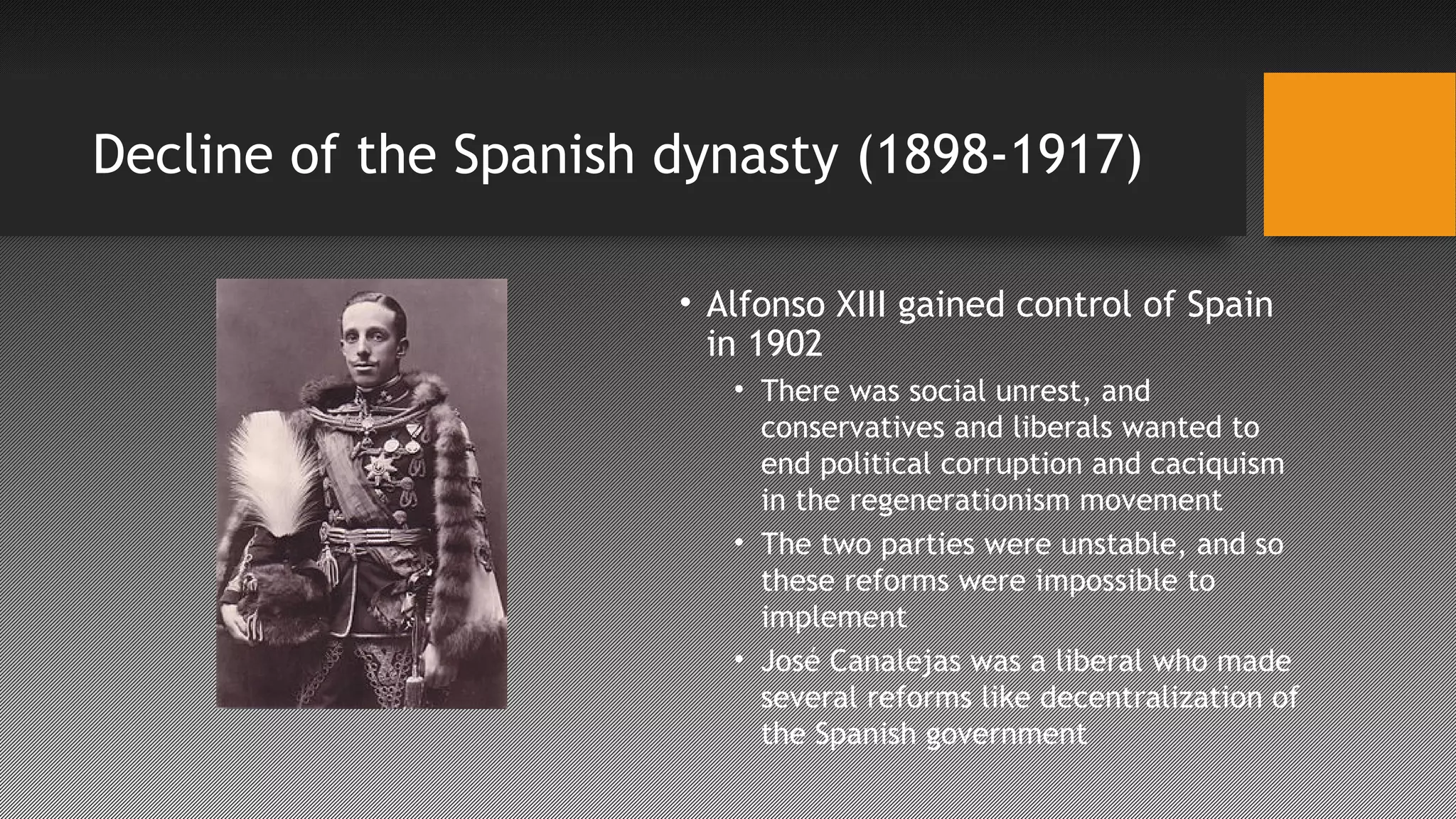
• Alfonso XIII gained control of Spain
in 1902
• There was social unrest, and
conservatives and liberals wanted to
end political corruption and caciquism
in the regenerationism movement
• The two parties were unstable, and so
these reforms were impossible to
implement
• José Canalejas was a liberal who made
several reforms like decentralization of
the Spanish government
Crisis of 1917
• Turbulence in Spain in 1917 led to protest movements due to:
• Public was dissatisfied with the government and Eduardo Dato
• Poverty of the lower classes
• Discontent in the army because of the Rif War
• Opposition parties demanded the government's resignation
• Military juntas censored the government's politics
• CNT and UGT unions wanted a strike
• Deteriorating social and political landscape in Spain
Vocabulary-Pages 198 & 199
• Faced with: Enfrentarse
• Joined together: se unieron
• Became: Convirtió
• Split from: Separar
• Hired gunmen: Sicario
• Threat: Amenaza
• Mounted: Montar
• Prompted: Dar pie a
• Targeted: Dirigirse
Crisis in the dynasty and the dictatorship
• Politicians from different parties joined together to form
governments, but they couldn't establish a new system
• Unions became more powerful
• Laborers and peasants revolted
• Trienio Bolchevique (1918-1921): Laborers clashed with police when they
organized strikes, occupied land and divided large estates
• Pistolerismo: Movement when the government hired gunmen to fight the
leaders of the labor movement who organized workers to strike
• At The Battle of Annual in the Rif more than 12,000 Spaniards were
killed
• A commission found that the military leaders and monarchy were at fault
for these deaths, so there was a coup led by members of the military
Cartoon from a magazine, 1920, Page 198
Primo de Rivera´s Dictatorship (1923-1931)
• In 1923 Captain-General of Catalonia Miguel Primo de Rivera led a
military coup and established a military dictatorship
• New military dictatorship tried to change many things like:
– The system by suspending the Constitution and dissolving the
Pariament and political parties and unions
– Press was censored and intellectuals were targeted
– Workers' organizations that supported a revolution became illegal
– Nationalists were repressed, and only Spanish could be spoken in
public
• Spain sent additional troops to end the Rif War and they secured the
territory in 1927
The Civil Government
• In 1925, a civil government was established
• The strong international economy allowed the Spanish government to
implement a planned economy
• In 1929, the economic crisis began to affect Spain as well
• Primo de Rivera resigned in January 1920 due to pressure from an
increasingly hostile public
• Alfonso XIII then named General Berenguer president, and the
government under Berenguer was known as dictablanda
The Civil Government
• In 1925, a civil government was established
• The strong international economy allowed the Spanish government to
implement a planned economy
• In 1929, the economic crisis began to affect Spain as well
• Primo de Rivera resigned in January 1920 due to pressure from an
increasingly hostile public
• Alfonso XIII then named General Berenguer president, and the
government under Berenguer was known as dictablanda

Spanish Civil War

  • 1.
  • 2.
    Vocabulary-Page 196 • Unrest:Agitación • Caciquism: Caciquismo-the rule of local chiefs and bosses • Strikes: Huelga • Election Rigging • Harshly Repressed: Reprimidas • Turbulent: Turbulento • Landscape: Paisaje
  • 3.
    Decline of theSpanish dynasty (1898-1917) • Alfonso XIII gained control of Spain in 1902 • There was social unrest, and conservatives and liberals wanted to end political corruption and caciquism in the regenerationism movement • The two parties were unstable, and so these reforms were impossible to implement • José Canalejas was a liberal who made several reforms like decentralization of the Spanish government
  • 4.
    Crisis of 1917 •Turbulence in Spain in 1917 led to protest movements due to: • Public was dissatisfied with the government and Eduardo Dato • Poverty of the lower classes • Discontent in the army because of the Rif War • Opposition parties demanded the government's resignation • Military juntas censored the government's politics • CNT and UGT unions wanted a strike • Deteriorating social and political landscape in Spain
  • 5.
    Vocabulary-Pages 198 &199 • Faced with: Enfrentarse • Joined together: se unieron • Became: Convirtió • Split from: Separar • Hired gunmen: Sicario • Threat: Amenaza • Mounted: Montar • Prompted: Dar pie a • Targeted: Dirigirse
  • 6.
    Crisis in thedynasty and the dictatorship • Politicians from different parties joined together to form governments, but they couldn't establish a new system • Unions became more powerful • Laborers and peasants revolted • Trienio Bolchevique (1918-1921): Laborers clashed with police when they organized strikes, occupied land and divided large estates • Pistolerismo: Movement when the government hired gunmen to fight the leaders of the labor movement who organized workers to strike • At The Battle of Annual in the Rif more than 12,000 Spaniards were killed • A commission found that the military leaders and monarchy were at fault for these deaths, so there was a coup led by members of the military
  • 7.
    Cartoon from amagazine, 1920, Page 198
  • 8.
    Primo de Rivera´sDictatorship (1923-1931) • In 1923 Captain-General of Catalonia Miguel Primo de Rivera led a military coup and established a military dictatorship • New military dictatorship tried to change many things like: – The system by suspending the Constitution and dissolving the Pariament and political parties and unions – Press was censored and intellectuals were targeted – Workers' organizations that supported a revolution became illegal – Nationalists were repressed, and only Spanish could be spoken in public • Spain sent additional troops to end the Rif War and they secured the territory in 1927
  • 9.
    The Civil Government •In 1925, a civil government was established • The strong international economy allowed the Spanish government to implement a planned economy • In 1929, the economic crisis began to affect Spain as well • Primo de Rivera resigned in January 1920 due to pressure from an increasingly hostile public • Alfonso XIII then named General Berenguer president, and the government under Berenguer was known as dictablanda
  • 10.
    The Civil Government •In 1925, a civil government was established • The strong international economy allowed the Spanish government to implement a planned economy • In 1929, the economic crisis began to affect Spain as well • Primo de Rivera resigned in January 1920 due to pressure from an increasingly hostile public • Alfonso XIII then named General Berenguer president, and the government under Berenguer was known as dictablanda