o Establishes the basic framework and underlying
principles of government. Prescribes the permanent
framework of the system of government, and assigns to
the different department or branches, their respective
powers and duties. (Art. I).
o Establish certain basic principles on which the
government is founded. (Preamble,Art. I).
o Designed to preserve and protect the rights of the
citizen against the Powers of the State. (Art III).
o Serves as the supreme or fundamental law. It has the status of a supreme
or fundamental law as it speaks for the entire people from whom it derives
its claim to obedience.
o It is the Charter creating the government.
o It is binding to all individual citizens and all organs of the government.
o It is the law to which all other laws must conform.
o It is the test of the legality of all governmental actions.
o Supremacy of the constitution –all must bow to the mandates of the law.
1) As to form, a good written constitution should be:
a. Brief. If the constitution is too detailed, it would lose the advantage of a
fundamental law which in a few provisions outlines the structure of the
government of the whole state and the rights of the citizens. It would
probably never be understood by the public. Furthermore, it would then be
necessary to amend it every once in a while to cover many future
contingencies;
b. Broad. The statement of the powers and functions of government, and
of the relations between the governing body and the governed, requires that it be as
comprehensive as possible; and
c. Definite. Because otherwise the application of its provisions to concrete
situations may prove unduly difficult if not impossible. Any vagueness which may
lead to opposing interpretations of essential features may cause incalculable harm.
Civil war and the disruption of the state may conceivably follow from the ambiguous
expressions in a constitution.
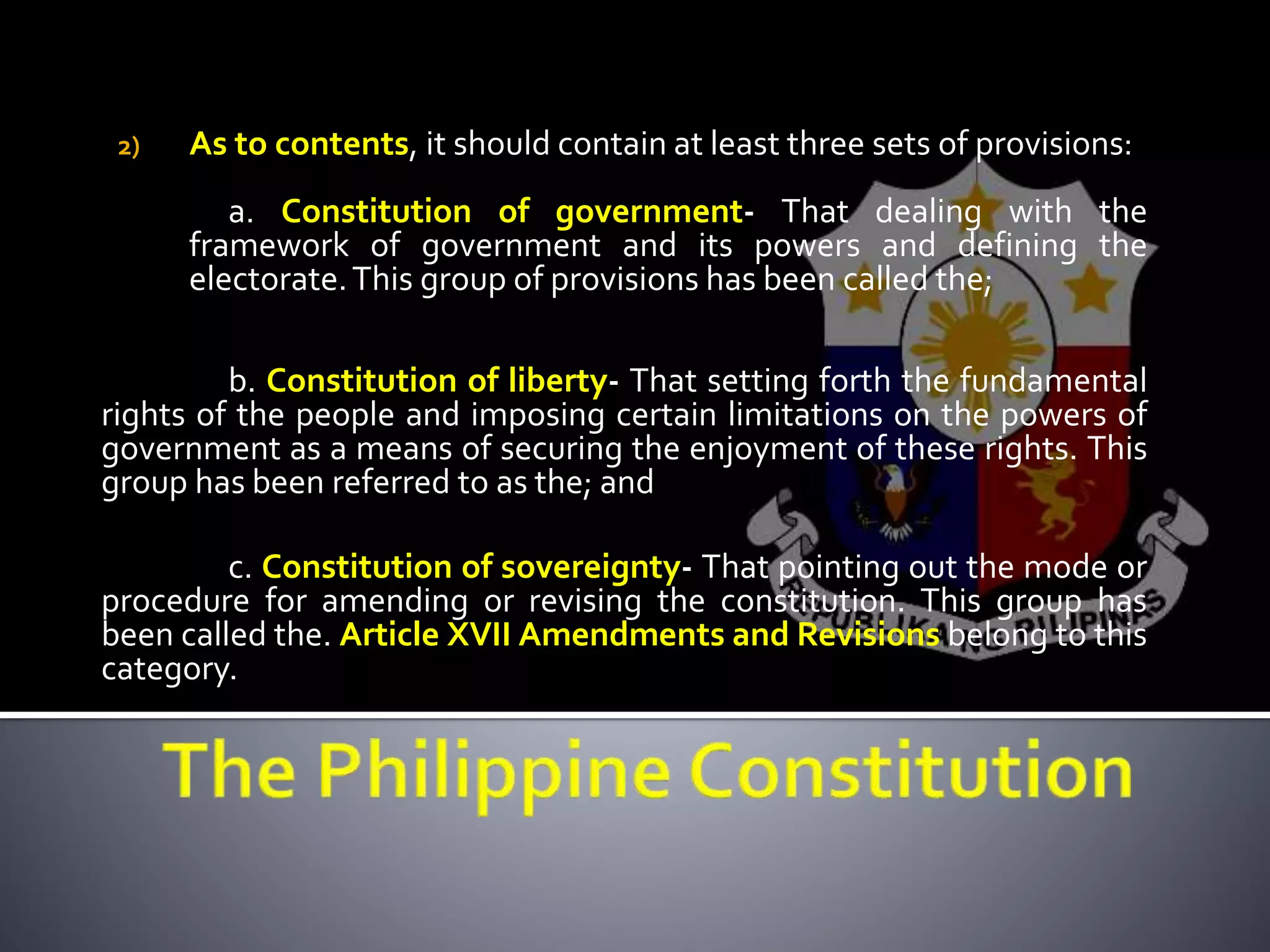
2) As to contents, it should contain at least three sets of provisions:
a. Constitution of government- That dealing with the
framework of government and its powers and defining the
electorate.This group of provisions has been called the;
b. Constitution of liberty- That setting forth the fundamental
rights of the people and imposing certain limitations on the powers of
government as a means of securing the enjoyment of these rights. This
group has been referred to as the; and
c. Constitution of sovereignty- That pointing out the mode or
procedure for amending or revising the constitution. This group has
been called the. Article XVII Amendments and Revisions belong to this
category.
o It has the advantage of clearness and definiteness over an
unwritten one. Since the written constitution is a binding
document, the rights of the citizen are more secured.
o Its disadvantage lies in the difficulty of its amendment. This
prevents the immediate introduction of needed reforms and
may thereby retard the healthy growth and progress of the
State.
Original Constitution
Adopted by the people of a
newly established state.
Constitutional Amendment
In order to make it more
responsive to the demands of
the changing political
environment.
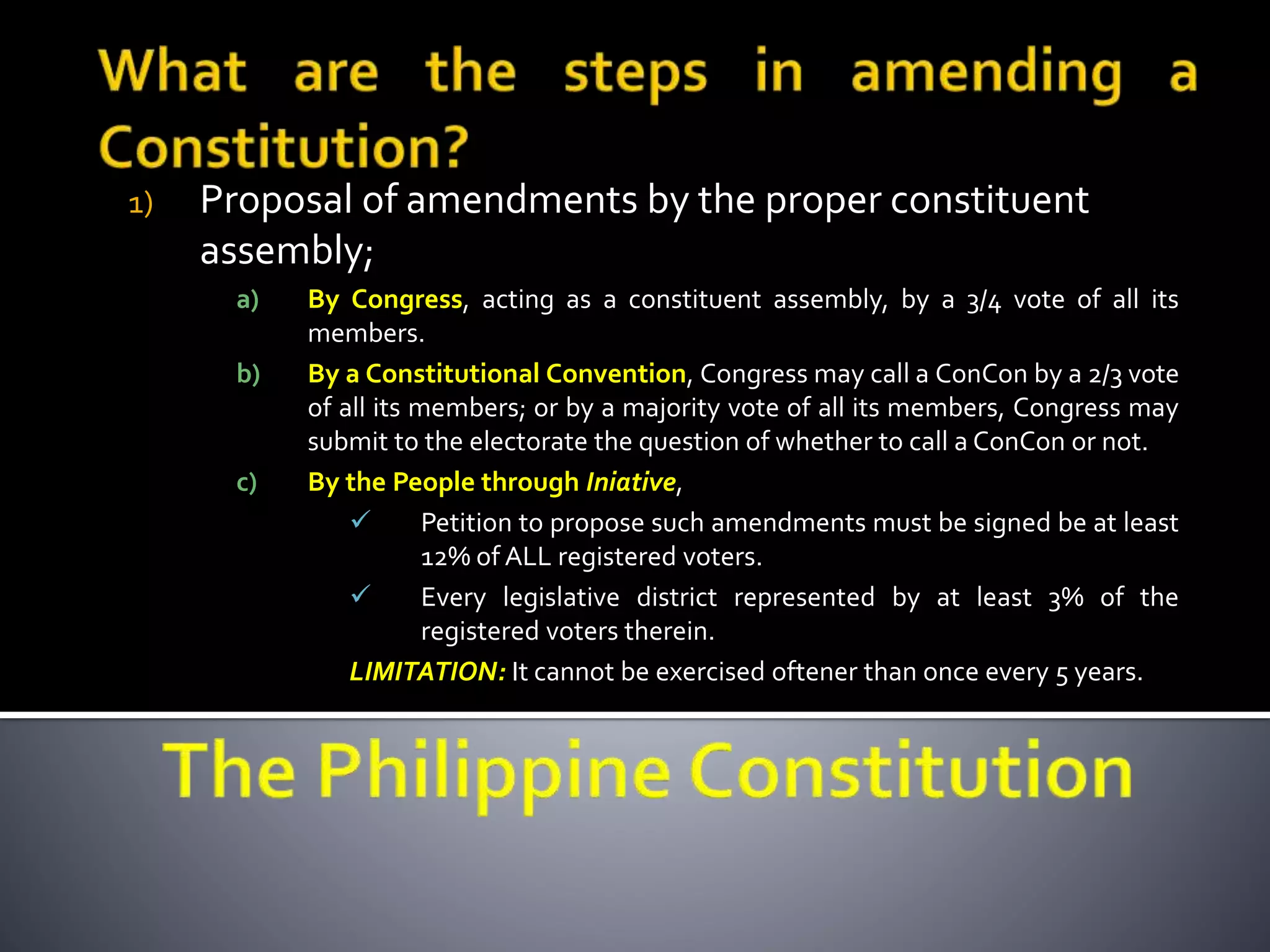
1) Proposal of amendments by the proper constituent
assembly;
a) By Congress, acting as a constituent assembly, by a 3/4 vote of all its
members.
b) By a Constitutional Convention, Congress may call a ConCon by a 2/3 vote
of all its members; or by a majority vote of all its members, Congress may
submit to the electorate the question of whether to call a ConCon or not.
c) By the People through Iniative,
 Petition to propose such amendments must be signed be at least
12% of ALL registered voters.
 Every legislative district represented by at least 3% of the
registered voters therein.
LIMITATION: It cannot be exercised oftener than once every 5 years.
2) Ratification- Valid when ratified by a MAJORITY of votes
cast in a plebiscite.
o Plebiscite is held not earlier than 60 days or later than 90
days after the certification by COMELEC of the petition’s
sufficiency.
Requisites of a valid ratification:
• Held in a plebiscite conducted under the election law;
• Supervised by the COMELEC; and
• Where only franchised voters (registered) voters take part.
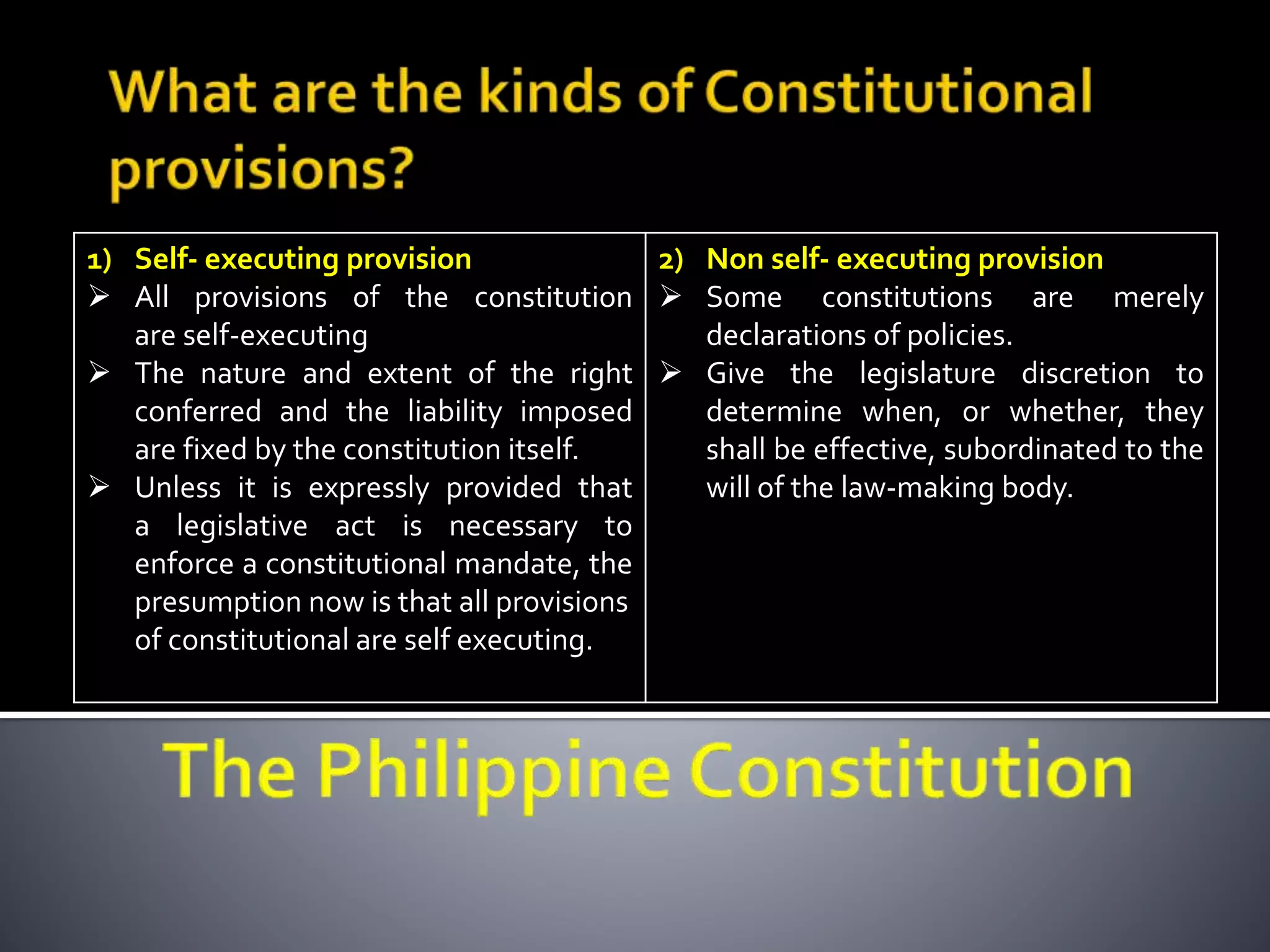
1) Self- executing provision
 All provisions of the constitution
are self-executing
 The nature and extent of the right
conferred and the liability imposed
are fixed by the constitution itself.
 Unless it is expressly provided that
a legislative act is necessary to
enforce a constitutional mandate, the
presumption now is that all provisions
of constitutional are self executing.
2) Non self- executing provision
 Some constitutions are merely
declarations of policies.
 Give the legislature discretion to
determine when, or whether, they
shall be effective, subordinated to the
will of the law-making body.
Malolos Constitution (1899)
Commonwealth andThird Republic (1935)
Martial Law Constitution (1973)
Freedom Constitution (1986)
o The first republican constitution inAsia.
o It declared that sovereignty resides exclusively in the people, stated basic
civil rights, separated the church and state, and called for the creation of an
Assembly of Representatives to act as the legislative body.
o It also called for a Presidential form of government with the president
elected for a term of four years by a majority of the Assembly.
o It was titled "Constitución política", and was written in Spanish following
the declaration of independence from Spain, proclaimed on January 20,
1899, and was enacted and ratified by the Malolos Congress, a Congress
held in Malolos, Bulacan.
The 1935 Constitution Ratified on May 14, 1935
Features:
Established the Commonwealth Government.
Provided a Democratic and Republican government
Inclusion of the Bill of Rights
The 1973 Constitution Ratified on January 17, 1973
Features:
Establishment of a modified parliamentary
government.
Suspension of the Bill of Rights.
Has given greater power to the Executive
Department.
The 1987 Constitution Ratified on February 2, 1987
Features:
Reinstitution of a Democratic Government.
Separation of Church and State.
Sovereignty of the people.
Renunciation of war as a national policy.
Supremacy of Civilian authority over the military.
Separation of Powers
The philippine constitution

The philippine constitution

  • 3.
    o Establishes thebasic framework and underlying principles of government. Prescribes the permanent framework of the system of government, and assigns to the different department or branches, their respective powers and duties. (Art. I). o Establish certain basic principles on which the government is founded. (Preamble,Art. I). o Designed to preserve and protect the rights of the citizen against the Powers of the State. (Art III).
  • 4.
    o Serves asthe supreme or fundamental law. It has the status of a supreme or fundamental law as it speaks for the entire people from whom it derives its claim to obedience. o It is the Charter creating the government. o It is binding to all individual citizens and all organs of the government. o It is the law to which all other laws must conform. o It is the test of the legality of all governmental actions. o Supremacy of the constitution –all must bow to the mandates of the law.
  • 5.
    1) As toform, a good written constitution should be: a. Brief. If the constitution is too detailed, it would lose the advantage of a fundamental law which in a few provisions outlines the structure of the government of the whole state and the rights of the citizens. It would probably never be understood by the public. Furthermore, it would then be necessary to amend it every once in a while to cover many future contingencies; b. Broad. The statement of the powers and functions of government, and of the relations between the governing body and the governed, requires that it be as comprehensive as possible; and c. Definite. Because otherwise the application of its provisions to concrete situations may prove unduly difficult if not impossible. Any vagueness which may lead to opposing interpretations of essential features may cause incalculable harm. Civil war and the disruption of the state may conceivably follow from the ambiguous expressions in a constitution.
  • 6.
    2) As tocontents, it should contain at least three sets of provisions: a. Constitution of government- That dealing with the framework of government and its powers and defining the electorate.This group of provisions has been called the; b. Constitution of liberty- That setting forth the fundamental rights of the people and imposing certain limitations on the powers of government as a means of securing the enjoyment of these rights. This group has been referred to as the; and c. Constitution of sovereignty- That pointing out the mode or procedure for amending or revising the constitution. This group has been called the. Article XVII Amendments and Revisions belong to this category.
  • 7.
    o It hasthe advantage of clearness and definiteness over an unwritten one. Since the written constitution is a binding document, the rights of the citizen are more secured. o Its disadvantage lies in the difficulty of its amendment. This prevents the immediate introduction of needed reforms and may thereby retard the healthy growth and progress of the State.
  • 8.
    Original Constitution Adopted bythe people of a newly established state. Constitutional Amendment In order to make it more responsive to the demands of the changing political environment.
  • 9.
    1) Proposal ofamendments by the proper constituent assembly; a) By Congress, acting as a constituent assembly, by a 3/4 vote of all its members. b) By a Constitutional Convention, Congress may call a ConCon by a 2/3 vote of all its members; or by a majority vote of all its members, Congress may submit to the electorate the question of whether to call a ConCon or not. c) By the People through Iniative,  Petition to propose such amendments must be signed be at least 12% of ALL registered voters.  Every legislative district represented by at least 3% of the registered voters therein. LIMITATION: It cannot be exercised oftener than once every 5 years.
  • 10.
    2) Ratification- Validwhen ratified by a MAJORITY of votes cast in a plebiscite. o Plebiscite is held not earlier than 60 days or later than 90 days after the certification by COMELEC of the petition’s sufficiency. Requisites of a valid ratification: • Held in a plebiscite conducted under the election law; • Supervised by the COMELEC; and • Where only franchised voters (registered) voters take part.
  • 11.
    1) Self- executingprovision  All provisions of the constitution are self-executing  The nature and extent of the right conferred and the liability imposed are fixed by the constitution itself.  Unless it is expressly provided that a legislative act is necessary to enforce a constitutional mandate, the presumption now is that all provisions of constitutional are self executing. 2) Non self- executing provision  Some constitutions are merely declarations of policies.  Give the legislature discretion to determine when, or whether, they shall be effective, subordinated to the will of the law-making body.
  • 12.
    Malolos Constitution (1899) CommonwealthandThird Republic (1935) Martial Law Constitution (1973) Freedom Constitution (1986)
  • 13.
    o The firstrepublican constitution inAsia. o It declared that sovereignty resides exclusively in the people, stated basic civil rights, separated the church and state, and called for the creation of an Assembly of Representatives to act as the legislative body. o It also called for a Presidential form of government with the president elected for a term of four years by a majority of the Assembly. o It was titled "Constitución política", and was written in Spanish following the declaration of independence from Spain, proclaimed on January 20, 1899, and was enacted and ratified by the Malolos Congress, a Congress held in Malolos, Bulacan.
  • 14.
    The 1935 ConstitutionRatified on May 14, 1935 Features: Established the Commonwealth Government. Provided a Democratic and Republican government Inclusion of the Bill of Rights
  • 15.
    The 1973 ConstitutionRatified on January 17, 1973 Features: Establishment of a modified parliamentary government. Suspension of the Bill of Rights. Has given greater power to the Executive Department.
  • 16.
    The 1987 ConstitutionRatified on February 2, 1987 Features: Reinstitution of a Democratic Government. Separation of Church and State. Sovereignty of the people. Renunciation of war as a national policy. Supremacy of Civilian authority over the military. Separation of Powers