• The written instrument by which
the fundamental powers of the
government are established,
limited, and defined and by which
these powers are distributed
among several departments or
branches for their safe and useful
exercise for the benefit of the
people.
1. It serves as the supreme
or fundamental law.
2. It establishes the basic
framework and underlying
principles of government.
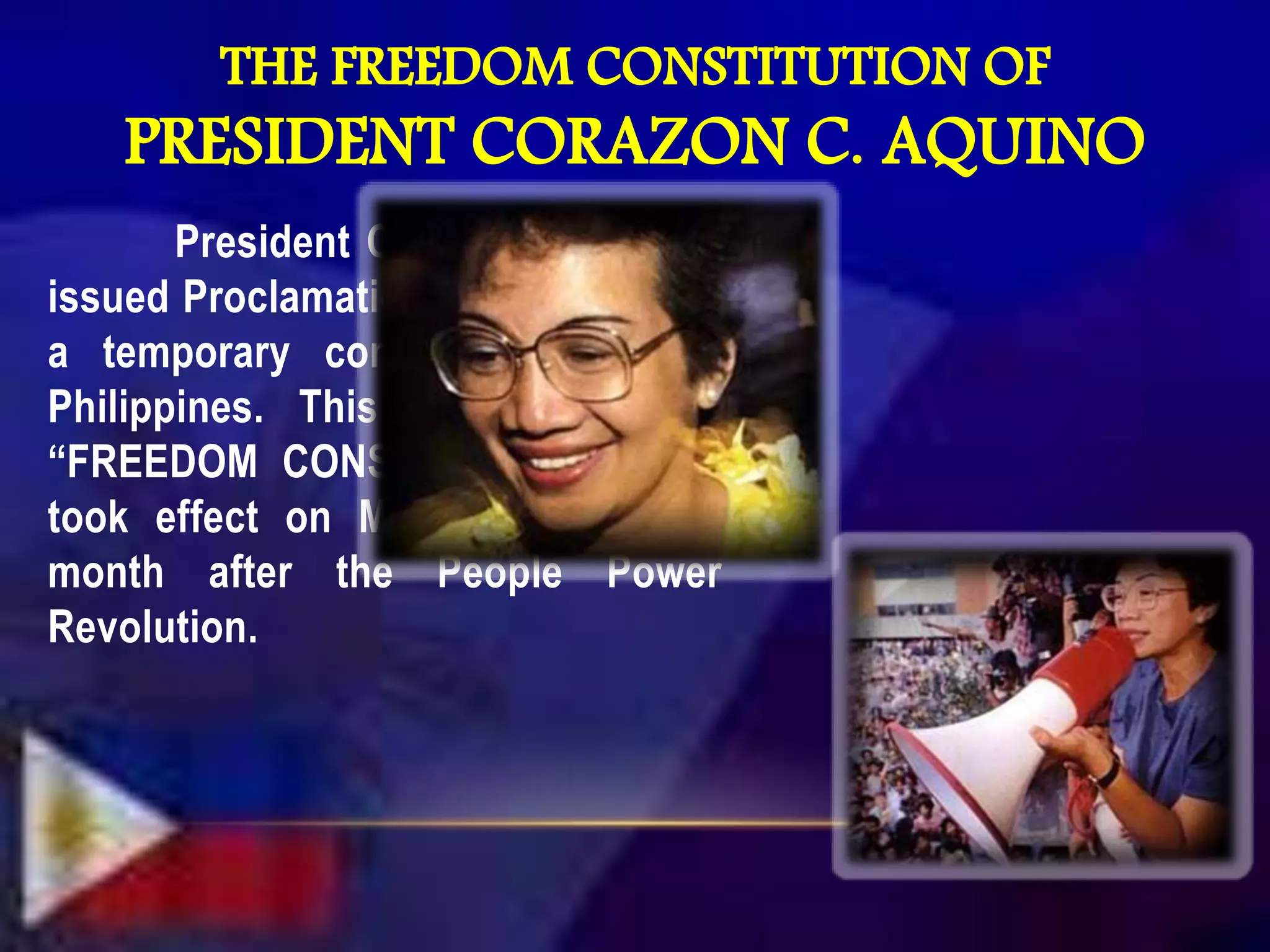
President Corazon C. Aquino
issued Proclamation No. 3. adopting
a temporary constitution for the
Philippines. This was called the
“FREEDOM CONSTITUTION” which
took effect on March 25, 1986, a
month after the People Power
Revolution.
• On April 1986, President Aquino issued Proclamation No. 9 creating a constitutional
commission to draft a new constitution as provided for in the Freedom Constitution.
• President Corazon C. Aquino addressed the opening session on June 2, 1986 at the
former Batasang Pambansa Building.
• Debates and heated arguments took placed.
• On October 12, 1986, the Constitutional Commission finished its work; and the draft
of the said constitution was submitted to the President on October 15, 1986 and;
• On February 2, 1987, a plebiscite for the charter’s ratification was held.
• 76.37% (17,059,495) “YES” votes and 22.65% (5,058,714) “NO” votes.
• On February 2, 1987, the new constitution was ratified and made effective.
• Sovereignty of the people
• Supremacy of civilian
authority over the military
• Separation of powers
Article II. Section 1. The
Philippines is a democratic and
republican state, Sovereignty
resides in the people and all
government authority emanates
from them.
Section 3. Civilian authority is at all times,
supreme over the military. The Armed Forces of the
Philippines is the protector of the people and the
state. Its goal is to secure the sovereignty of the state
and the integrity of the national territory.
BRANCHES OF THE GOVERNMENT
• EXECUTIVE DEPARTMENT
President – implements or approves laws.
• LEGISLATIVE DEPARTMENT
Congress – enact laws.
• JUDICIAL DEPARTMENT
Supreme Court – decide cases.
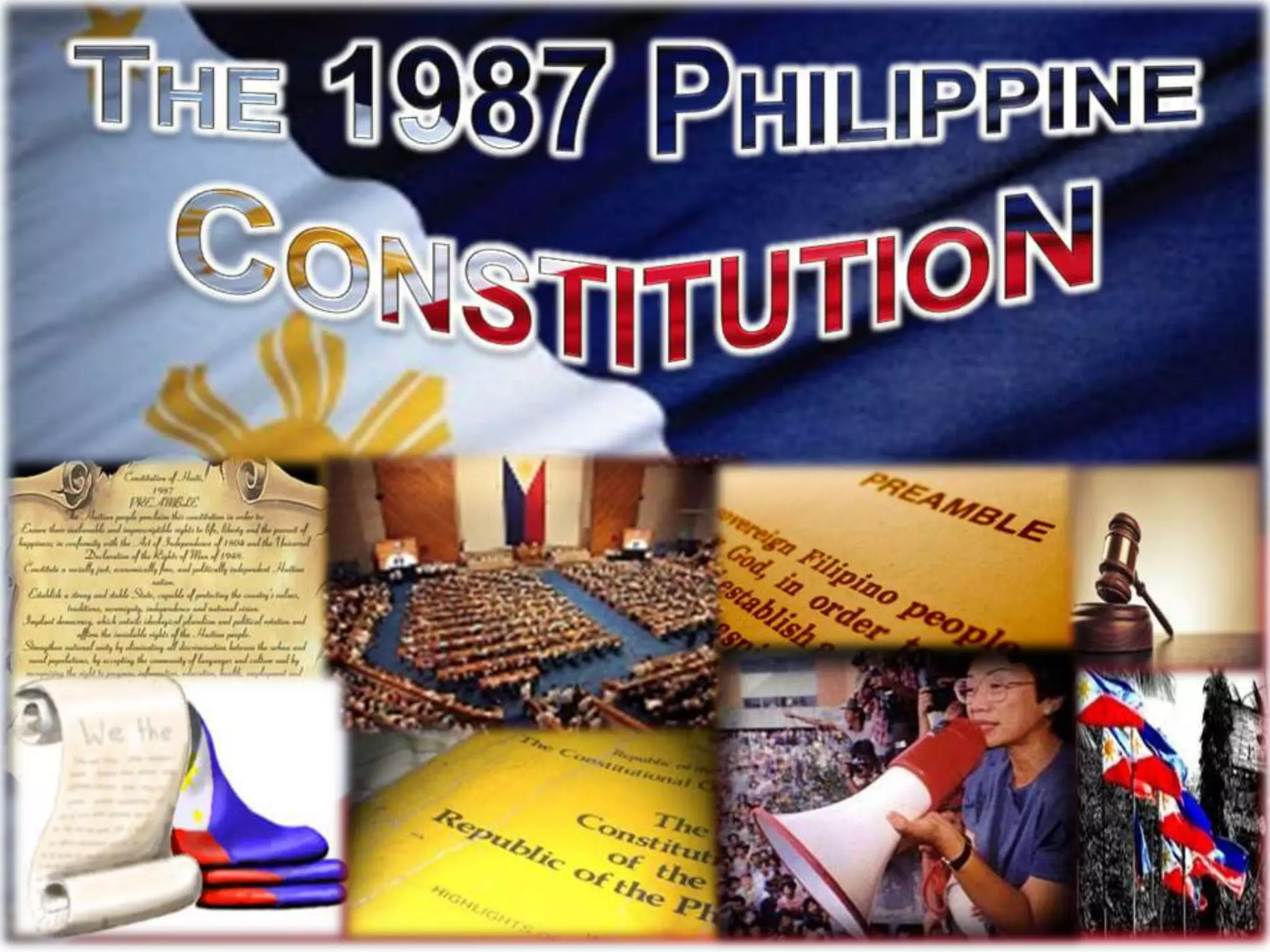
The 1987 philippine constitution

The 1987 philippine constitution

  • 2.
    • The writteninstrument by which the fundamental powers of the government are established, limited, and defined and by which these powers are distributed among several departments or branches for their safe and useful exercise for the benefit of the people.
  • 3.
    1. It servesas the supreme or fundamental law. 2. It establishes the basic framework and underlying principles of government.
  • 4.
    President Corazon C.Aquino issued Proclamation No. 3. adopting a temporary constitution for the Philippines. This was called the “FREEDOM CONSTITUTION” which took effect on March 25, 1986, a month after the People Power Revolution.
  • 5.
    • On April1986, President Aquino issued Proclamation No. 9 creating a constitutional commission to draft a new constitution as provided for in the Freedom Constitution. • President Corazon C. Aquino addressed the opening session on June 2, 1986 at the former Batasang Pambansa Building. • Debates and heated arguments took placed. • On October 12, 1986, the Constitutional Commission finished its work; and the draft of the said constitution was submitted to the President on October 15, 1986 and; • On February 2, 1987, a plebiscite for the charter’s ratification was held. • 76.37% (17,059,495) “YES” votes and 22.65% (5,058,714) “NO” votes. • On February 2, 1987, the new constitution was ratified and made effective.
  • 6.
    • Sovereignty ofthe people • Supremacy of civilian authority over the military • Separation of powers
  • 7.
    Article II. Section1. The Philippines is a democratic and republican state, Sovereignty resides in the people and all government authority emanates from them.
  • 8.
    Section 3. Civilianauthority is at all times, supreme over the military. The Armed Forces of the Philippines is the protector of the people and the state. Its goal is to secure the sovereignty of the state and the integrity of the national territory.
  • 9.
    BRANCHES OF THEGOVERNMENT • EXECUTIVE DEPARTMENT President – implements or approves laws. • LEGISLATIVE DEPARTMENT Congress – enact laws. • JUDICIAL DEPARTMENT Supreme Court – decide cases.