RECRUITMENT
PRESENTED BY:
MOHAMMAD IQBAL
MBA – 1ST SEM
CONTENTS
• MEANING & DEFINITION
• RECRUITMENT NEEDS
• SOURCES OF RECRUITMENT
• INTERNAL SOURCES
• EXTERNAL SOURCES
• RECRUITMENT PROCESS
• SELECTION & SELECTION PROCESS
• DIFFERENCE BETWEEN RECRUITMENT AND SELECTION
• EXAMPLE
• CONCLUSION
MEANING:
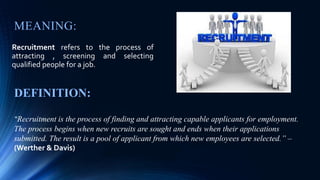
Recruitment refers to the process of
attracting , screening and selecting
qualified people for a job.
DEFINITION:
“Recruitment is the process of finding and attracting capable applicants for employment.
The process begins when new recruits are sought and ends when their applications
submitted. The result is a pool of applicant from which new employees are selected.” –
(Werther & Davis)
RECRUITMENT NEEDS ?
Recruitment needs are of three types:
1. Planned: Arises from changes in organization and retirement policy.
2. Unexpected: Arises during resignations, deaths, accidents and illness.
3. Anticipated: Refers to those movements in personnel which an
organization can predict by studying trends in the internal and external
environments.
SOURCES OF RECRUITMENT:
SOURCES OF
RECRUITMENT
INTERNAL
SOURCES
EXTERNAL
SOURCES
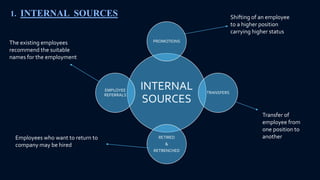
INTERNAL
SOURCES
PROMOTIONS
TRANSFERS
RETIRED
&
RETRENCHED
EMPLOYEE
REFERRALS
1. INTERNAL SOURCES Shifting of an employee
to a higher position
carrying higher status
Transfer of
employee from
one position to
anotherEmployees who want to return to
company may be hired
The existing employees
recommend the suitable
names for the employment
2. EXTERNAL SOURCES
A. ADVERTISEMENT:
• This is most common method for recruiting skilled
workers, clerical staff, managerial personnel, technical
personnel.
• Advertisements in newspapers and journals has wide
reach.
B. GATE HIRING :
• In this method a notice on the noticeboard of the
company specifying job details of job vacancies can be
put.This method is also called direct recruitment.
• Mostly unskilled workers are appointed through this
method.
C. EMPLOYMENT EXCHANGE :
• The workers who want help in finding jobs make their
registration in the nearest employment office where details are
recorded.
• Employment exchanges are the special offices for bringing
together those workers who are in need of employment.
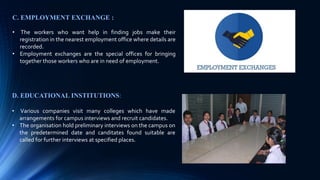
D. EDUCATIONAL INSTITUTIONS:
• Various companies visit many colleges which have made
arrangements for campus interviews and recruit candidates.
• The organisation hold preliminary interviews on the campus on
the predetermined date and canditates found suitable are
called for further interviews at specified places.
E. RECOMMENDATIONS:
• Employees recruited through recommendations by trade unions.
• The existing employees recommend the suitable names for the employment.
F. LABOUR UNIONS :
• In Many organisations ,labour unions are used as source of manpower supply.
• Many such union leaders whose style are cooperative and constructive can be promoted to supervisory level.
D. EMPLOYMENT AGENCIES :
• Many organisations get the information about the
prospective candidates through employment
agencies.In our country ,two types of employment
agencies are operating:
i. Public employment agencies
ii. Private employment agencies
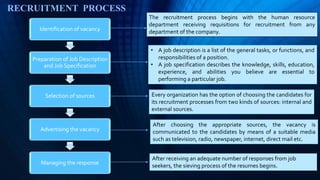
RECRUITMENT PROCESS
Identification of vacancy
Preparation of Job Description
and Job Specification
Selection of sources
Advertising the vacancy
Managing the response
The recruitment process begins with the human resource
department receiving requisitions for recruitment from any
department of the company.
• A job description is a list of the general tasks, or functions, and
responsibilities of a position.
• A job specification describes the knowledge, skills, education,
experience, and abilities you believe are essential to
performing a particular job.
Every organization has the option of choosing the candidates for
its recruitment processes from two kinds of sources: internal and
external sources.
After choosing the appropriate sources, the vacancy is
communicated to the candidates by means of a suitable media
such as television, radio, newspaper, internet, direct mail etc.
After receiving an adequate number of responses from job
seekers, the sieving process of the resumes begins.
SELECTION PROCESS
SCREENING OF
APPLICATIONS
SELECTION
TESTS
INTERVIEW
CHECKING OF
REFERENCES
PHYSICAL
EXAMINATION
APPORAVAL
BY
APPROPIATE
AUTHORITY
PLACEMENT
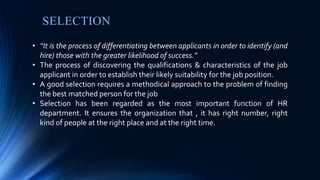
SELECTION
• “It is the process of differentiating between applicants in order to identify (and
hire) those with the greater likelihood of success.”
• The process of discovering the qualifications & characteristics of the job
applicant in order to establish their likely suitability for the job position.
• A good selection requires a methodical approach to the problem of finding
the best matched person for the job
• Selection has been regarded as the most important function of HR
department. It ensures the organization that , it has right number, right
kind of people at the right place and at the right time.
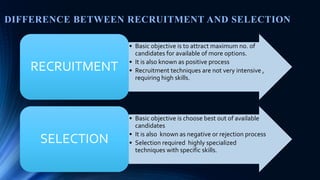
DIFFERENCE BETWEEN RECRUITMENT AND SELECTION
• Basic objective is to attract maximum no. of
candidates for available of more options.
• It is also known as positive process
• Recruitment techniques are not very intensive ,
requiring high skills.
RECRUITMENT
• Basic objective is choose best out of available
candidates
• It is also known as negative or rejection process
• Selection required highly specialized
techniques with specific skills.
SELECTION
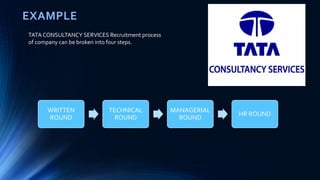
EXAMPLE
WRITTEN
ROUND
TECHNICAL
ROUND
MANAGERIAL
ROUND
HR ROUND
TATA CONSULTANCY SERVICES Recruitment process
of company can be broken into four steps.
CONCLUSION
• To fill a vacancy created in an
organization it should be filled by a
right person at right time at right
cost.
• If recruitment and selection goes
right the goal is achieved , also it
includes cost so it should be done at
predetermined cost.
Recruitment

Recruitment

  • 1.
  • 2.
    CONTENTS • MEANING &DEFINITION • RECRUITMENT NEEDS • SOURCES OF RECRUITMENT • INTERNAL SOURCES • EXTERNAL SOURCES • RECRUITMENT PROCESS • SELECTION & SELECTION PROCESS • DIFFERENCE BETWEEN RECRUITMENT AND SELECTION • EXAMPLE • CONCLUSION
  • 3.
    MEANING: Recruitment refers tothe process of attracting , screening and selecting qualified people for a job. DEFINITION: “Recruitment is the process of finding and attracting capable applicants for employment. The process begins when new recruits are sought and ends when their applications submitted. The result is a pool of applicant from which new employees are selected.” – (Werther & Davis)
  • 4.
    RECRUITMENT NEEDS ? Recruitmentneeds are of three types: 1. Planned: Arises from changes in organization and retirement policy. 2. Unexpected: Arises during resignations, deaths, accidents and illness. 3. Anticipated: Refers to those movements in personnel which an organization can predict by studying trends in the internal and external environments.
  • 5.
    SOURCES OF RECRUITMENT: SOURCESOF RECRUITMENT INTERNAL SOURCES EXTERNAL SOURCES
  • 6.
    INTERNAL SOURCES PROMOTIONS TRANSFERS RETIRED & RETRENCHED EMPLOYEE REFERRALS 1. INTERNAL SOURCESShifting of an employee to a higher position carrying higher status Transfer of employee from one position to anotherEmployees who want to return to company may be hired The existing employees recommend the suitable names for the employment
  • 7.
    2. EXTERNAL SOURCES A.ADVERTISEMENT: • This is most common method for recruiting skilled workers, clerical staff, managerial personnel, technical personnel. • Advertisements in newspapers and journals has wide reach. B. GATE HIRING : • In this method a notice on the noticeboard of the company specifying job details of job vacancies can be put.This method is also called direct recruitment. • Mostly unskilled workers are appointed through this method.
  • 8.
    C. EMPLOYMENT EXCHANGE: • The workers who want help in finding jobs make their registration in the nearest employment office where details are recorded. • Employment exchanges are the special offices for bringing together those workers who are in need of employment. D. EDUCATIONAL INSTITUTIONS: • Various companies visit many colleges which have made arrangements for campus interviews and recruit candidates. • The organisation hold preliminary interviews on the campus on the predetermined date and canditates found suitable are called for further interviews at specified places.
  • 9.
    E. RECOMMENDATIONS: • Employeesrecruited through recommendations by trade unions. • The existing employees recommend the suitable names for the employment. F. LABOUR UNIONS : • In Many organisations ,labour unions are used as source of manpower supply. • Many such union leaders whose style are cooperative and constructive can be promoted to supervisory level. D. EMPLOYMENT AGENCIES : • Many organisations get the information about the prospective candidates through employment agencies.In our country ,two types of employment agencies are operating: i. Public employment agencies ii. Private employment agencies
  • 10.
    RECRUITMENT PROCESS Identification ofvacancy Preparation of Job Description and Job Specification Selection of sources Advertising the vacancy Managing the response The recruitment process begins with the human resource department receiving requisitions for recruitment from any department of the company. • A job description is a list of the general tasks, or functions, and responsibilities of a position. • A job specification describes the knowledge, skills, education, experience, and abilities you believe are essential to performing a particular job. Every organization has the option of choosing the candidates for its recruitment processes from two kinds of sources: internal and external sources. After choosing the appropriate sources, the vacancy is communicated to the candidates by means of a suitable media such as television, radio, newspaper, internet, direct mail etc. After receiving an adequate number of responses from job seekers, the sieving process of the resumes begins.
  • 11.
    SELECTION PROCESS SCREENING OF APPLICATIONS SELECTION TESTS INTERVIEW CHECKINGOF REFERENCES PHYSICAL EXAMINATION APPORAVAL BY APPROPIATE AUTHORITY PLACEMENT
  • 12.
    SELECTION • “It isthe process of differentiating between applicants in order to identify (and hire) those with the greater likelihood of success.” • The process of discovering the qualifications & characteristics of the job applicant in order to establish their likely suitability for the job position. • A good selection requires a methodical approach to the problem of finding the best matched person for the job • Selection has been regarded as the most important function of HR department. It ensures the organization that , it has right number, right kind of people at the right place and at the right time.
  • 13.
    DIFFERENCE BETWEEN RECRUITMENTAND SELECTION • Basic objective is to attract maximum no. of candidates for available of more options. • It is also known as positive process • Recruitment techniques are not very intensive , requiring high skills. RECRUITMENT • Basic objective is choose best out of available candidates • It is also known as negative or rejection process • Selection required highly specialized techniques with specific skills. SELECTION
  • 14.
    EXAMPLE WRITTEN ROUND TECHNICAL ROUND MANAGERIAL ROUND HR ROUND TATA CONSULTANCYSERVICES Recruitment process of company can be broken into four steps.
  • 15.
    CONCLUSION • To filla vacancy created in an organization it should be filled by a right person at right time at right cost. • If recruitment and selection goes right the goal is achieved , also it includes cost so it should be done at predetermined cost.