Padmini y.s
Recruitment and
selection process
INTRODUCTION
• The recruitment and selection process can occur any time in
organization when there is a need of personnel
• There is a great significance of recruitment and selection as a
human resource function in organization. In complicated
marketplace, recruitment and selection is effective tool for
organizations to achieve their current strategic direction and to
maintain innovation.
• Recruitment and selection is important to deliver behaviours
seen as necessary to support organizational strategies
• Successful recruitment and selection can also provide
considerable improvements in productivity and employee morale
and allow organizations to build personnel of more able
employees who collectively provide a superior product or service
“You can’t teach employees to smile. They have to smile before you hire them.” – Arte Nathan
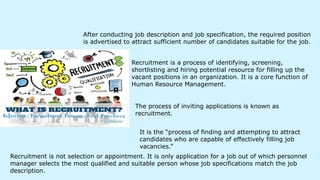
After conducting job description and job specification, the required position
is advertised to attract sufficient number of candidates suitable for the job.
Recruitment is a process of identifying, screening,
shortlisting and hiring potential resource for filling up the
vacant positions in an organization. It is a core function of
Human Resource Management.
The process of inviting applications is known as
recruitment.
It is the “process of finding and attempting to attract
candidates who are capable of effectively filling job
vacancies.”
Recruitment is not selection or appointment. It is only application for a job out of which personnel
manager selects the most qualified and suitable person whose job specifications match the job
description.
Sources of Recruitment
1. Internal Sources of Recruitment
A. Promotion From Within
• It invites applications from people within the organisation.
• If the open position is above entry level
• Applications are invited to promote people to higher posts (promotion) or
transfer to other departments at the same level.
• THROUGH- Notice boards, Circulars, Personal contacts and references
B. Nepotism
• It is the hiring of relatives.
• Many organizations have
• nepotism policies
• When hiring relatives, most employers require family members to work in
different areas of the organization to prevent issues of favoritism and
possible morale problems amongemployees.
• It is never appropriate for family members to be in supervisory positions
where they are required to manage their own relatives.
• Merits of internal recruitment:
(a)Motivation
(b) Recognition
(c)Familiarity with the organisational set up
(d)Costs
(e)Loyalty
(f)It helps in reducing the efforts of induction programs.
Limitations of internal recruitment:
(a)Limitation on the number of employees to be recruited
(b)Promotes complacency
(c)Conflict amongst workers
(d)Dynamic organisations
Sources of Recruitment
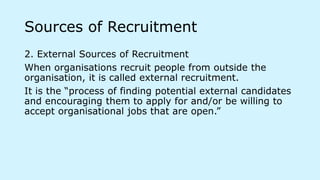
2. External Sources of Recruitment
When organisations recruit people from outside the
organisation, it is called external recruitment.
It is the “process of finding potential external candidates
and encouraging them to apply for and/or be willing to
accept organisational jobs that are open.”
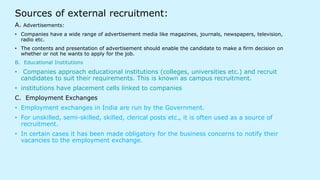
Sources of external recruitment:
A. Advertisements:
• Companies have a wide range of advertisement media like magazines, journals, newspapers, television,
radio etc.
• The contents and presentation of advertisement should enable the candidate to make a firm decision on
whether or not he wants to apply for the job.
B. Educational Institutions
• Companies approach educational institutions (colleges, universities etc.) and recruit
candidates to suit their requirements. This is known as campus recruitment.
• institutions have placement cells linked to companies
C. Employment Exchanges
• Employment exchanges in India are run by the Government.
• For unskilled, semi-skilled, skilled, clerical posts etc., it is often used as a source of
recruitment.
• In certain cases it has been made obligatory for the business concerns to notify their
vacancies to the employment exchange.
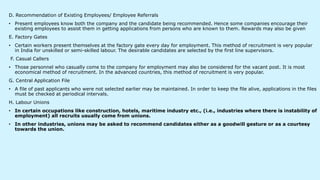
D. Recommendation of Existing Employees/ Employee Referrals
• Present employees know both the company and the candidate being recommended. Hence some companies encourage their
existing employees to assist them in getting applications from persons who are known to them. Rewards may also be given
E. Factory Gates
• Certain workers present themselves at the factory gate every day for employment. This method of recruitment is very popular
in India for unskilled or semi-skilled labour. The desirable candidates are selected by the first line supervisors.
F. Casual Callers
• Those personnel who casually come to the company for employment may also be considered for the vacant post. It is most
economical method of recruitment. In the advanced countries, this method of recruitment is very popular.
G. Central Application File
• A file of past applicants who were not selected earlier may be maintained. In order to keep the file alive, applications in the files
must be checked at periodical intervals.
H. Labour Unions
• In certain occupations like construction, hotels, maritime industry etc., (i.e., industries where there is instability of
employment) all recruits usually come from unions.
• In other industries, unions may be asked to recommend candidates either as a goodwill gesture or as a courtesy
towards the union.
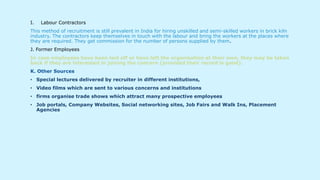
I. Labour Contractors
This method of recruitment is still prevalent in India for hiring unskilled and semi-skilled workers in brick kiln
industry. The contractors keep themselves in touch with the labour and bring the workers at the places where
they are required. They get commission for the number of persons supplied by them.
J. Former Employees
In case employees have been laid off or have left the organisation at their own, they may be taken
back if they are interested in joining the concern (provided their record is good).
K. Other Sources
• Special lectures delivered by recruiter in different institutions,
• Video films which are sent to various concerns and institutions
• firms organise trade shows which attract many prospective employees
• Job portals, Company Websites, Social networking sites, Job Fairs and Walk Ins, Placement
Agencies
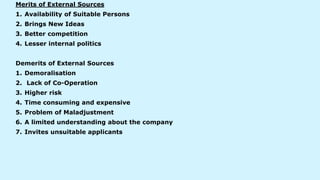
Merits of External Sources
1. Availability of Suitable Persons
2. Brings New Ideas
3. Better competition
4. Lesser internal politics
Demerits of External Sources
1. Demoralisation
2. Lack of Co-Operation
3. Higher risk
4. Time consuming and expensive
5. Problem of Maladjustment
6. A limited understanding about the company
7. Invites unsuitable applicants
SELECTION
• Once recruitment plan is developed and recruitment is made there will be plenty of
people to choose from. That is when Selection Process Begins
• Managers and supervisors will be ultimately responsible for the hiring of
individuals, but the role of human resource management (HRM) is to define and
guide managers in this process
• It is process of interviewing the candidates and evaluating their qualities, which are
required for a specific job and then choosing the suitable candidate for the position.
• selection of a right applicant for a vacant position will be an asset to the
organization, which will be helping the organization in reaching its objectives.
Steps Involved in Recruitment and
Selection Process in HRM
1. Initial Screening
• It is done so that unqualified ones are drop out at the initial stage.
• To save the time, cost & effort of the selection committee in the
following steps of the selection process.
• The main source of initial screening is the curriculum vitae of the
applicant along with the job application
• Following information is included in the above mentioned documents.
Education & employment History
Evaluation of character
Evaluation of job performance
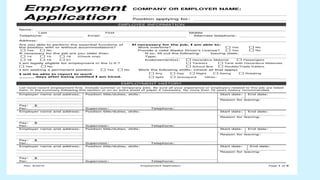
2. Application Blank
• The person’s application for employment is formally
recorded in the shape of application blank
• An application form for the employment is completed
by the prospective applicant.
• The information contained in the application blank
differ from one organization to another organization
and in job posts, it may vary even within the same
organization.
• The historical data from the candidate can be quickly
collected through the application blanks so that
further verification about the accuracy of the data is
carried out.
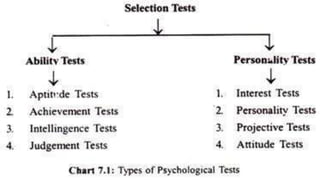
3. Pre-employment Test
• The physical & mental abilities, knowledge, skills, personal characteristics
& other aspects of behaviour can be effectively measured through the pre-
employment tests.
• It should be objective, standardized and sample of behaviour
• Kinds of Pre-employment Tests;
a. Cognitive Aptitude tests
In this test the ability to learn & perform a job by an individual is judged.
The abilities related to job are as follow.
Verbal
Reasoning
Numerical
Perceptual Speed
Spatial
b. Psycho – motor Abilities Test
In this test, the coordination, strength & dexterity of an
individual is judged. Other abilities related to routine office jobs
& production jobs can also be measured through these tests.
c. Job knowledge Tests
This test is used to measure the knowledge of the person about
the duties of a particular job.
d. Work Sample Tests
A set of tasks that represent a job are identified in this test
through which the productivity level, ability to face adverse
conditions by the applicants are judged.
e. Vocational Interest test
This test identifies the occupations that are preferred by the
candidate & that can provide him maximum satisfaction.
f. Personality Tests
These tests are not considered to be so reliable & valid as compared to other
pre-employment tests because these tests require external psychologist who
interprets the results of the tests subjectively.
g. Drug & Alcohol Tests
For the security, productivity & safety of the workplace drug testing
programs are used as pre-employment tests.
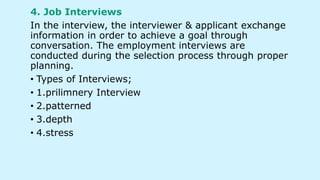
4. Job Interviews
In the interview, the interviewer & applicant exchange
information in order to achieve a goal through
conversation. The employment interviews are
conducted during the selection process through proper
planning.
• Types of Interviews;
• 1.prilimnery Interview
• 2.patterned
• 3.depth
• 4.stress
5. Back Ground/ Reference Checks
The accuracy of the application form of the candidate is verified through references & former
employer. The educational, criminal record & legal status to work are verified. Personal
references of applicant are contacted to confirm the validity & accuracy of the provided
information.
6. Conditional Job Offer
After going through all the previous steps of selection process, there comes the most important
step of the selection process in which the decision of hiring is made. The applicant that best
meets the requirements of the job is selected. At start conditional job letter is issued which
must be followed by medical exam.
7. Medical Exam
When the conditional job letter is issued the next step of the selection process starts in which
the physical/medical examination of the selected candidate is conducted. The medical exam of
the candidate is essential to check either he takes the drugs or not. If he passes the exam, he
would be finally selected for the job.
8. Final Selection Decision
After passing the medical exam by the candidate, the final offer for the job is made to the
candidate by the relative department.
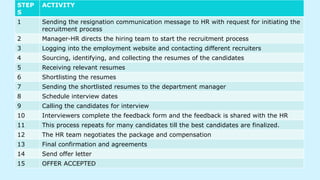
PROCESS
STEP
S
ACTIVITY
1 Sending the resignation communication message to HR with request for initiating the
recruitment process
2 Manager-HR directs the hiring team to start the recruitment process
3 Logging into the employment website and contacting different recruiters
4 Sourcing, identifying, and collecting the resumes of the candidates
5 Receiving relevant resumes
6 Shortlisting the resumes
7 Sending the shortlisted resumes to the department manager
8 Schedule interview dates
9 Calling the candidates for interview
10 Interviewers complete the feedback form and the feedback is shared with the HR
11 This process repeats for many candidates till the best candidates are finalized.
12 The HR team negotiates the package and compensation
13 Final confirmation and agreements
14 Send offer letter
15 OFFER ACCEPTED

Recruitment and selection

  • 2.
  • 3.
    INTRODUCTION • The recruitmentand selection process can occur any time in organization when there is a need of personnel • There is a great significance of recruitment and selection as a human resource function in organization. In complicated marketplace, recruitment and selection is effective tool for organizations to achieve their current strategic direction and to maintain innovation. • Recruitment and selection is important to deliver behaviours seen as necessary to support organizational strategies • Successful recruitment and selection can also provide considerable improvements in productivity and employee morale and allow organizations to build personnel of more able employees who collectively provide a superior product or service “You can’t teach employees to smile. They have to smile before you hire them.” – Arte Nathan
  • 4.
    After conducting jobdescription and job specification, the required position is advertised to attract sufficient number of candidates suitable for the job. Recruitment is a process of identifying, screening, shortlisting and hiring potential resource for filling up the vacant positions in an organization. It is a core function of Human Resource Management. The process of inviting applications is known as recruitment. It is the “process of finding and attempting to attract candidates who are capable of effectively filling job vacancies.” Recruitment is not selection or appointment. It is only application for a job out of which personnel manager selects the most qualified and suitable person whose job specifications match the job description.
  • 5.
    Sources of Recruitment 1.Internal Sources of Recruitment A. Promotion From Within • It invites applications from people within the organisation. • If the open position is above entry level • Applications are invited to promote people to higher posts (promotion) or transfer to other departments at the same level. • THROUGH- Notice boards, Circulars, Personal contacts and references B. Nepotism • It is the hiring of relatives. • Many organizations have • nepotism policies • When hiring relatives, most employers require family members to work in different areas of the organization to prevent issues of favoritism and possible morale problems amongemployees. • It is never appropriate for family members to be in supervisory positions where they are required to manage their own relatives.
  • 6.
    • Merits ofinternal recruitment: (a)Motivation (b) Recognition (c)Familiarity with the organisational set up (d)Costs (e)Loyalty (f)It helps in reducing the efforts of induction programs. Limitations of internal recruitment: (a)Limitation on the number of employees to be recruited (b)Promotes complacency (c)Conflict amongst workers (d)Dynamic organisations
  • 7.
    Sources of Recruitment 2.External Sources of Recruitment When organisations recruit people from outside the organisation, it is called external recruitment. It is the “process of finding potential external candidates and encouraging them to apply for and/or be willing to accept organisational jobs that are open.”
  • 8.
    Sources of externalrecruitment: A. Advertisements: • Companies have a wide range of advertisement media like magazines, journals, newspapers, television, radio etc. • The contents and presentation of advertisement should enable the candidate to make a firm decision on whether or not he wants to apply for the job. B. Educational Institutions • Companies approach educational institutions (colleges, universities etc.) and recruit candidates to suit their requirements. This is known as campus recruitment. • institutions have placement cells linked to companies C. Employment Exchanges • Employment exchanges in India are run by the Government. • For unskilled, semi-skilled, skilled, clerical posts etc., it is often used as a source of recruitment. • In certain cases it has been made obligatory for the business concerns to notify their vacancies to the employment exchange.
  • 9.
    D. Recommendation ofExisting Employees/ Employee Referrals • Present employees know both the company and the candidate being recommended. Hence some companies encourage their existing employees to assist them in getting applications from persons who are known to them. Rewards may also be given E. Factory Gates • Certain workers present themselves at the factory gate every day for employment. This method of recruitment is very popular in India for unskilled or semi-skilled labour. The desirable candidates are selected by the first line supervisors. F. Casual Callers • Those personnel who casually come to the company for employment may also be considered for the vacant post. It is most economical method of recruitment. In the advanced countries, this method of recruitment is very popular. G. Central Application File • A file of past applicants who were not selected earlier may be maintained. In order to keep the file alive, applications in the files must be checked at periodical intervals. H. Labour Unions • In certain occupations like construction, hotels, maritime industry etc., (i.e., industries where there is instability of employment) all recruits usually come from unions. • In other industries, unions may be asked to recommend candidates either as a goodwill gesture or as a courtesy towards the union.
  • 10.
    I. Labour Contractors Thismethod of recruitment is still prevalent in India for hiring unskilled and semi-skilled workers in brick kiln industry. The contractors keep themselves in touch with the labour and bring the workers at the places where they are required. They get commission for the number of persons supplied by them. J. Former Employees In case employees have been laid off or have left the organisation at their own, they may be taken back if they are interested in joining the concern (provided their record is good). K. Other Sources • Special lectures delivered by recruiter in different institutions, • Video films which are sent to various concerns and institutions • firms organise trade shows which attract many prospective employees • Job portals, Company Websites, Social networking sites, Job Fairs and Walk Ins, Placement Agencies
  • 11.
    Merits of ExternalSources 1. Availability of Suitable Persons 2. Brings New Ideas 3. Better competition 4. Lesser internal politics Demerits of External Sources 1. Demoralisation 2. Lack of Co-Operation 3. Higher risk 4. Time consuming and expensive 5. Problem of Maladjustment 6. A limited understanding about the company 7. Invites unsuitable applicants
  • 13.
    SELECTION • Once recruitmentplan is developed and recruitment is made there will be plenty of people to choose from. That is when Selection Process Begins • Managers and supervisors will be ultimately responsible for the hiring of individuals, but the role of human resource management (HRM) is to define and guide managers in this process • It is process of interviewing the candidates and evaluating their qualities, which are required for a specific job and then choosing the suitable candidate for the position. • selection of a right applicant for a vacant position will be an asset to the organization, which will be helping the organization in reaching its objectives.
  • 14.
    Steps Involved inRecruitment and Selection Process in HRM 1. Initial Screening • It is done so that unqualified ones are drop out at the initial stage. • To save the time, cost & effort of the selection committee in the following steps of the selection process. • The main source of initial screening is the curriculum vitae of the applicant along with the job application • Following information is included in the above mentioned documents. Education & employment History Evaluation of character Evaluation of job performance
  • 15.
    2. Application Blank •The person’s application for employment is formally recorded in the shape of application blank • An application form for the employment is completed by the prospective applicant. • The information contained in the application blank differ from one organization to another organization and in job posts, it may vary even within the same organization. • The historical data from the candidate can be quickly collected through the application blanks so that further verification about the accuracy of the data is carried out.
  • 17.
    3. Pre-employment Test •The physical & mental abilities, knowledge, skills, personal characteristics & other aspects of behaviour can be effectively measured through the pre- employment tests. • It should be objective, standardized and sample of behaviour • Kinds of Pre-employment Tests; a. Cognitive Aptitude tests In this test the ability to learn & perform a job by an individual is judged. The abilities related to job are as follow. Verbal Reasoning Numerical Perceptual Speed Spatial
  • 18.
    b. Psycho –motor Abilities Test In this test, the coordination, strength & dexterity of an individual is judged. Other abilities related to routine office jobs & production jobs can also be measured through these tests. c. Job knowledge Tests This test is used to measure the knowledge of the person about the duties of a particular job. d. Work Sample Tests A set of tasks that represent a job are identified in this test through which the productivity level, ability to face adverse conditions by the applicants are judged. e. Vocational Interest test This test identifies the occupations that are preferred by the candidate & that can provide him maximum satisfaction.
  • 19.
    f. Personality Tests Thesetests are not considered to be so reliable & valid as compared to other pre-employment tests because these tests require external psychologist who interprets the results of the tests subjectively. g. Drug & Alcohol Tests For the security, productivity & safety of the workplace drug testing programs are used as pre-employment tests.
  • 21.
    4. Job Interviews Inthe interview, the interviewer & applicant exchange information in order to achieve a goal through conversation. The employment interviews are conducted during the selection process through proper planning. • Types of Interviews; • 1.prilimnery Interview • 2.patterned • 3.depth • 4.stress
  • 22.
    5. Back Ground/Reference Checks The accuracy of the application form of the candidate is verified through references & former employer. The educational, criminal record & legal status to work are verified. Personal references of applicant are contacted to confirm the validity & accuracy of the provided information. 6. Conditional Job Offer After going through all the previous steps of selection process, there comes the most important step of the selection process in which the decision of hiring is made. The applicant that best meets the requirements of the job is selected. At start conditional job letter is issued which must be followed by medical exam. 7. Medical Exam When the conditional job letter is issued the next step of the selection process starts in which the physical/medical examination of the selected candidate is conducted. The medical exam of the candidate is essential to check either he takes the drugs or not. If he passes the exam, he would be finally selected for the job. 8. Final Selection Decision After passing the medical exam by the candidate, the final offer for the job is made to the candidate by the relative department.
  • 23.
    PROCESS STEP S ACTIVITY 1 Sending theresignation communication message to HR with request for initiating the recruitment process 2 Manager-HR directs the hiring team to start the recruitment process 3 Logging into the employment website and contacting different recruiters 4 Sourcing, identifying, and collecting the resumes of the candidates 5 Receiving relevant resumes 6 Shortlisting the resumes 7 Sending the shortlisted resumes to the department manager 8 Schedule interview dates 9 Calling the candidates for interview 10 Interviewers complete the feedback form and the feedback is shared with the HR 11 This process repeats for many candidates till the best candidates are finalized. 12 The HR team negotiates the package and compensation 13 Final confirmation and agreements 14 Send offer letter 15 OFFER ACCEPTED