Dynamical Systems Methods in
Early-Universe Cosmology
!
SONAD 2014 Talk - May 15, 2014
Ikjyot Singh Kohli, Ph.D. Candidate - Dept.
of Physics and Astronomy - York
University

www.yorku.ca/kohli
Introduction
Introduction
• Much of my research (with Michael Haslam) is focused on applying
dynamical systems methods to the Einstein field equations to develop
models of the early universe.
Introduction
• Much of my research (with Michael Haslam) is focused on applying
dynamical systems methods to the Einstein field equations to develop
models of the early universe.
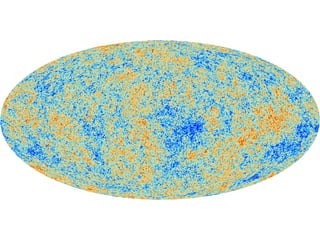
• Our present-day universe is isotropic (to a very high degree) and spatially
homogeneous. The universe is then described by the Friedmann-
Lemaitre-Robertson-Walker (FLRW) metric.
Introduction
• Much of my research (with Michael Haslam) is focused on applying
dynamical systems methods to the Einstein field equations to develop
models of the early universe.
• Our present-day universe is isotropic (to a very high degree) and spatially
homogeneous. The universe is then described by the Friedmann-
Lemaitre-Robertson-Walker (FLRW) metric.
• We would like to understand how this is possible given that the early
universe had a very high temperature and hence was unstable.
Introduction
• Much of my research (with Michael Haslam) is focused on applying
dynamical systems methods to the Einstein field equations to develop
models of the early universe.
• Our present-day universe is isotropic (to a very high degree) and spatially
homogeneous. The universe is then described by the Friedmann-
Lemaitre-Robertson-Walker (FLRW) metric.
• We would like to understand how this is possible given that the early
universe had a very high temperature and hence was unstable.
• In our work, we relax the condition of isotropy to obtain cosmological
models that admit Killing vectors that describe spatial translations only,
and as a result are spatially homogeneous and anisotropic in general.
Such models are known as the Bianchi models.
Introduction
Introduction
• This task is non-trivial, as in General Relativity, space and
time are one entity, spacetime, so it is not immediately
clear how one should essentially “define” a time variable to
get some idea of dynamics.
Introduction
• This task is non-trivial, as in General Relativity, space and
time are one entity, spacetime, so it is not immediately
clear how one should essentially “define” a time variable to
get some idea of dynamics.
• I will describe in this talk the method of orthonormal
frames (Ellis and MacCallum, Comm. Math. Phys, 12,
108-141,1969), which turn the Einstein field equations into
a coupled system of nonlinear ordinary differential
equations, and then describe the importance of numerical
methods in understanding the global behaviour of the
system.
Spacetime Splitting
Spacetime Splitting
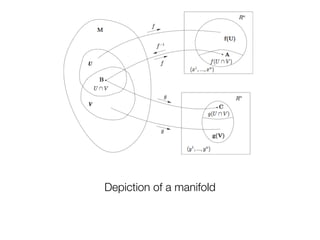
• M is a manifold if for every point of M there is an open
neighbourhood of that point for which there is a
continuous one-to-one and onto map f to an open
neighbourhood of R^n for some integer n.
Spacetime Splitting
• M is a manifold if for every point of M there is an open
neighbourhood of that point for which there is a
continuous one-to-one and onto map f to an open
neighbourhood of R^n for some integer n.
• The local region of M then can be made to look like R^n
locally.
Spacetime Splitting
• M is a manifold if for every point of M there is an open
neighbourhood of that point for which there is a
continuous one-to-one and onto map f to an open
neighbourhood of R^n for some integer n.
• The local region of M then can be made to look like R^n
locally.
• In general relativity, n = 4, for three spatial coordinates,
and one time coordinate.
Depiction of a manifold
Spacetime Splitting
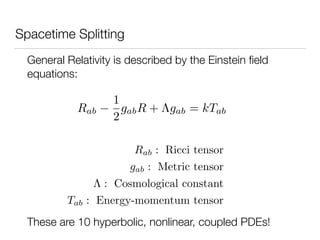
General Relativity is described by the Einstein field
equations:
Rab
1
2
gabR + gab = kTab
Rab : Ricci tensor
gab : Metric tensor
: Cosmological constant
Tab : Energy-momentum tensor
These are 10 hyperbolic, nonlinear, coupled PDEs!
Spacetime Splitting
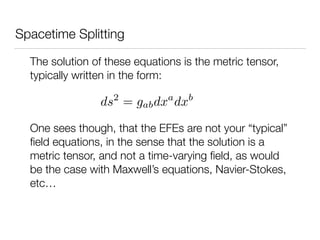
The solution of these equations is the metric tensor,
typically written in the form:
ds2
= gabdxa
dxb
One sees though, that the EFEs are not your “typical”
field equations, in the sense that the solution is a
metric tensor, and not a time-varying field, as would
be the case with Maxwell’s equations, Navier-Stokes,
etc…
Spacetime Splitting
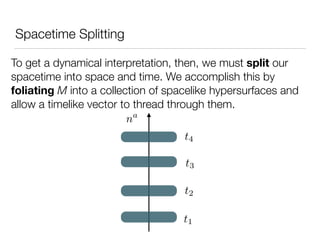
To get a dynamical interpretation, then, we must split our
spacetime into space and time. We accomplish this by
foliating M into a collection of spacelike hypersurfaces and
allow a timelike vector to thread through them.
na
t1
t2
t3
t4
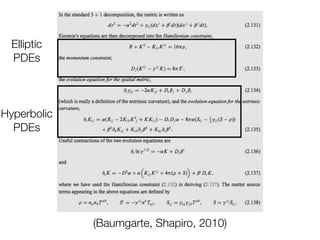
(Baumgarte, Shapiro, 2010)
Elliptic
PDEs
Hyperbolic
PDEs
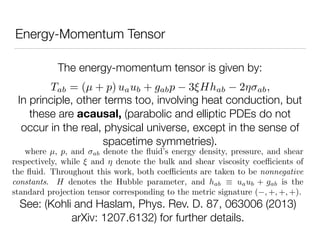
Energy-Momentum Tensor
The energy-momentum tensor is given by:
Tab = (µ + p) uaub + gabp 3⇠Hhab 2⌘ ab,
where µ, p, and ab denote the fluid’s energy density, pressure, and shear
respectively, while and denote the bulk and shear viscosity coe cients of
the fluid. Throughout this work, both coe cients are taken to be nonnegative
constants. H denotes the Hubble parameter, and hab uaub + gab is the
standard projection tensor corresponding to the metric signature ( , +, +, +).
See: (Kohli and Haslam, Phys. Rev. D. 87, 063006 (2013)
arXiv: 1207.6132) for further details.
In principle, other terms too, involving heat conduction, but
these are acausal, (parabolic and elliptic PDEs do not
occur in the real, physical universe, except in the sense of
spacetime symmetries).
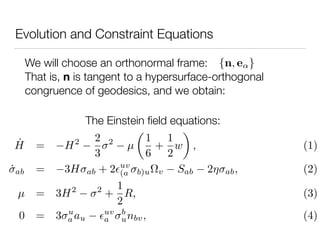
Evolution and Constraint Equations
We will choose an orthonormal frame: {n, e }
That is, n is tangent to a hypersurface-orthogonal
congruence of geodesics, and we obtain:
˙H = H2 2
3
2
µ
1
6
+
1
2
w , (1)
˙ab = 3H ab + 2 uv
(a b)u v Sab 2 ab, (2)
µ = 3H2 2
+
1
2
R, (3)
0 = 3 u
a au
uv
a
b
unbv, (4)
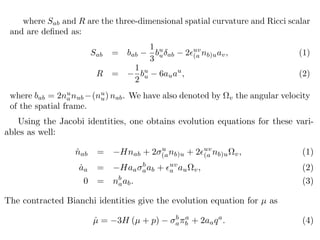
The Einstein field equations:
where Sab and R are the three-dimensional spatial curvature and Ricci scalar
and are defined as:
Sab = bab
1
3
bu
u ab 2 uv
(a nb)uav, (1)
R =
1
2
bu
u 6auau
, (2)
where bab = 2nu
anub (nu
u) nab. We have also denoted by v the angular velocity
of the spatial frame.
Using the Jacobi identities, one obtains evolution equations for these vari-
ables as well:
˙nab = Hnab + 2 u
(anb)u + 2 uv
(a nb)u v, (1)
˙aa = Haa
b
aab + uv
a au v, (2)
0 = nb
aab. (3)
The contracted Bianchi identities give the evolution equation for µ as
˙µ = 3H (µ + p) b
a
a
b + 2aaqa
. (4)
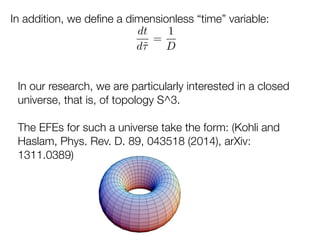
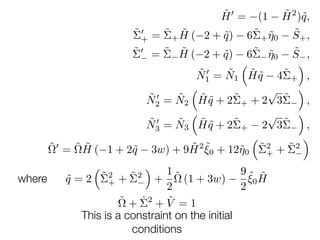
In addition, we define a dimensionless “time” variable:
dt
d˜⌧
=
1
D
In our research, we are particularly interested in a closed
universe, that is, of topology S^3.
!
The EFEs for such a universe take the form: (Kohli and
Haslam, Phys. Rev. D. 89, 043518 (2014), arXiv:
1311.0389)
˜H0
= (1 ˜H2
)˜q,
˜⌃0
+ = ˜⌃+
˜H ( 2 + ˜q) 6˜⌃+ ˜⌘0
˜S+,
˜⌃0
= ˜⌃ ˜H ( 2 + ˜q) 6˜⌃ ˜⌘0
˜S ,
˜N0
1 = ˜N1
⇣
˜H ˜q 4˜⌃+
⌘
,
˜N0
2 = ˜N2
⇣
˜H ˜q + 2˜⌃+ + 2
p
3˜⌃
⌘
,
˜N0
3 = ˜N3
⇣
˜H ˜q + 2˜⌃+ 2
p
3˜⌃
⌘
,
˜⌦0
= ˜⌦ ˜H ( 1 + 2˜q 3w) + 9 ˜H2 ˜⇠0 + 12˜⌘0
⇣
˜⌃2
+ + ˜⌃2
⌘
where ˜q = 2
⇣
˜⌃2
+ + ˜⌃2
⌘
+
1
2
˜⌦ (1 + 3w)
9
2
˜⇠0
˜H
˜⌦ + ˆ⌃2
+ ˜V = 1
This is a constraint on the initial
conditions
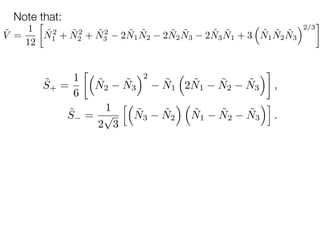
Note that:
˜V =
1
12

˜N2
1 + ˜N2
2 + ˜N2
3 2 ˜N1
˜N2 2 ˜N2
˜N3 2 ˜N3
˜N1 + 3
⇣
˜N1
˜N2
˜N3
⌘2/3
˜S+ =
1
6
⇣
˜N2
˜N3
⌘2
˜N1
⇣
2 ˜N1
˜N2
˜N3
⌘
,
˜S =
1
2
p
3
h⇣
˜N3
˜N2
⌘ ⇣
˜N1
˜N2
˜N3
⌘i
.
Dynamical Analysis
Dynamical Analysis
• To understand the dynamics of such a universe, we typically proceed in the
following manner:
Dynamical Analysis
• To understand the dynamics of such a universe, we typically proceed in the
following manner:
1. Determine whether the state space is compact
Dynamical Analysis
• To understand the dynamics of such a universe, we typically proceed in the
following manner:
1. Determine whether the state space is compact
2. Identify the invariant sets of the system
Dynamical Analysis
• To understand the dynamics of such a universe, we typically proceed in the
following manner:
1. Determine whether the state space is compact
2. Identify the invariant sets of the system
3. Find all equilibrium points and analyze their local stability
Dynamical Analysis
• To understand the dynamics of such a universe, we typically proceed in the
following manner:
1. Determine whether the state space is compact
2. Identify the invariant sets of the system
3. Find all equilibrium points and analyze their local stability
4. Find monotone functions in the various invariant sets
Dynamical Analysis
• To understand the dynamics of such a universe, we typically proceed in the
following manner:
1. Determine whether the state space is compact
2. Identify the invariant sets of the system
3. Find all equilibrium points and analyze their local stability
4. Find monotone functions in the various invariant sets
5. Investigate bifurcations that occur as per the parameter space
Dynamical Analysis
• To understand the dynamics of such a universe, we typically proceed in the
following manner:
1. Determine whether the state space is compact
2. Identify the invariant sets of the system
3. Find all equilibrium points and analyze their local stability
4. Find monotone functions in the various invariant sets
5. Investigate bifurcations that occur as per the parameter space
6. Knowing all this information allows one to state precisely information about
the asymptotic past and future evolution of the universe model under
consideration.
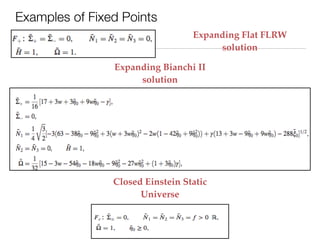
Examples of Fixed Points
Expanding Flat FLRW
solution
Expanding Bianchi II
solution
Closed Einstein Static
Universe
Stability AnalysisEquilibrium
Point
EFE Solution Local Sink Local Source Saddle
F+
Expanding
k=0 FLRW
solution
Yes No Yes
F-
Contracting
k=0 FLRW
solution
Yes Yes Yes
P+(II)
Expanding
Bianchi Type II
Solution
No No Yes
P_(II) (new
discovery!)
Contracting
Bianchi Type II
Solution
No No Yes
21
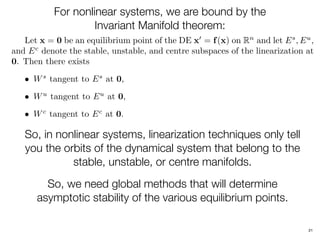
For nonlinear systems, we are bound by the
Invariant Manifold theorem:
Let x = 0 be an equilibrium point of the DE x0
= f(x) on Rn
and let Es
, Eu
,
and Ec
denote the stable, unstable, and centre subspaces of the linearization at
0. Then there exists
• Ws
tangent to Es
at 0,
• Wu
tangent to Eu
at 0,
• Wc
tangent to Ec
at 0.
So, in nonlinear systems, linearization techniques only tell
you the orbits of the dynamical system that belong to the
stable, unstable, or centre manifolds.
So, we need global methods that will determine
asymptotic stability of the various equilibrium points.
Global Methods
22
Global Methods
• There are many such methods, although, the majority of the
methods used only apply to planar dynamical systems.
22
Global Methods
• There are many such methods, although, the majority of the
methods used only apply to planar dynamical systems.
• The methods that we have found useful are:
22
Global Methods
• There are many such methods, although, the majority of the
methods used only apply to planar dynamical systems.
• The methods that we have found useful are:
• Finding Lyapunov and Chetaev functions
22
Global Methods
• There are many such methods, although, the majority of the
methods used only apply to planar dynamical systems.
• The methods that we have found useful are:
• Finding Lyapunov and Chetaev functions
• LaSalle invariance principle
22
Global Methods
• There are many such methods, although, the majority of the
methods used only apply to planar dynamical systems.
• The methods that we have found useful are:
• Finding Lyapunov and Chetaev functions
• LaSalle invariance principle
• Monotonicity Principle
22
Global Methods
• There are many such methods, although, the majority of the
methods used only apply to planar dynamical systems.
• The methods that we have found useful are:
• Finding Lyapunov and Chetaev functions
• LaSalle invariance principle
• Monotonicity Principle
• Numerical methods
22
Global Methods
• There are many such methods, although, the majority of the
methods used only apply to planar dynamical systems.
• The methods that we have found useful are:
• Finding Lyapunov and Chetaev functions
• LaSalle invariance principle
• Monotonicity Principle
• Numerical methods
• The first three give information on the alpha and omega limit sets of
the dynamical system.
22
Numerical Experiments
• Numerical methods are key, and without them, we would
be somewhat limited in how far we can take the analysis
of the dynamical system.
Numerical Experiments
• Numerical methods are key, and without them, we would
be somewhat limited in how far we can take the analysis
of the dynamical system.
• In general, we need numerical methods to verify and
check our topology-based work as outlined before, but,
also, because of the dimension and nonlinearity of the
dynamical system, there are situations in which a stability
analysis will not yield any information, and where the
global methods outline above will only give limited
information.
Numerical Experiments
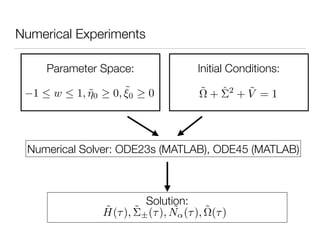
Parameter Space: Initial Conditions:
˜⌦ + ˆ⌃2
+ ˜V = 1
Numerical Solver: ODE23s (MATLAB), ODE45 (MATLAB)
Solution:
˜H( ), ˜±( ), ˜N ( ), ˜( )
1 w 1, ˜0 0, ˜0 0
−1
−0.5
0
0.5
1
−1
−0.8
−0.6
−0.4
−0.2
0
0.2
0.4
0.6
0.8
1
0
0.5
1
1.5
2
2.5
3
˜Σ +
˜Σ −
˜N1
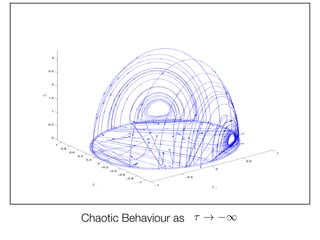
Chaotic Behaviour as
−1.5
−1
−0.5
0
0.5
1
1.5
−1
−0.5
0
0.5
1
1.5
−1.5
−1
−0.5
0
0.5
1
1.5
˜H
˜Σ +
˜Σ−
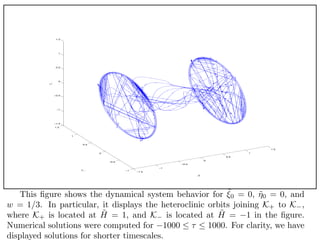
This figure shows the dynamical system behavior for ˜0 = 0, ˜0 = 0, and
w = 1/3. In particular, it displays the heteroclinic orbits joining K+ to K ,
where K+ is located at ˜H = 1, and K is located at ˜H = 1 in the figure.
Numerical solutions were computed for 1000 1000. For clarity, we have
displayed solutions for shorter timescales.
−0.5
−0.4
−0.3
−0.2
−0.1
0
0.1
0.2
0.3
0.4
0.5
−0.4
−0.3
−0.2
−0.1
0
0.1
0.2
0.3
0.4
0.5
0
0.1
0.2
0.3
0.4
0.5
0.6
0.7
0.8
˜Σ +
˜Σ −
˜N1
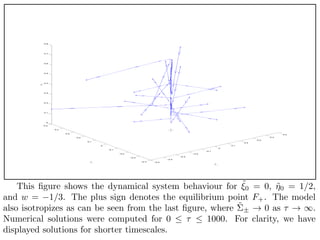
This figure shows the dynamical system behaviour for ˜0 = 0, ˜0 = 1/2,
and w = 1/3. The plus sign denotes the equilibrium point F+. The model
also isotropizes as can be seen from the last figure, where ˜± 0 as .
Numerical solutions were computed for 0 1000. For clarity, we have
displayed solutions for shorter timescales.
−0.4
−0.3
−0.2
−0.1
0
0.1
0.2
0.3
0.4
0.5
−0.5
−0.4
−0.3
−0.2
−0.1
0
0.1
0.2
0.3
0.4
0.5
−0.5
0
0.5
1
1.5
2
2.5
3
˜Σ +
˜Σ −
˜N1
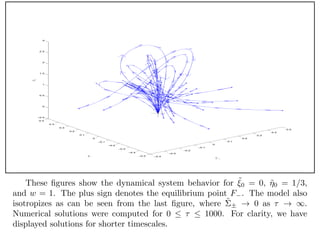
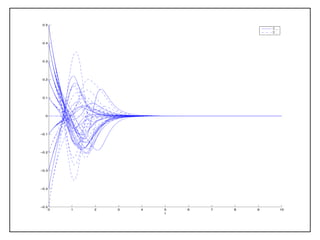
These figures show the dynamical system behavior for ˜0 = 0, ˜0 = 1/3,
and w = 1. The plus sign denotes the equilibrium point F . The model also
isotropizes as can be seen from the last figure, where ˜± 0 as .
Numerical solutions were computed for 0 1000. For clarity, we have
displayed solutions for shorter timescales.
0 1 2 3 4 5 6 7 8 9 10
−0.5
−0.4
−0.3
−0.2
−0.1
0
0.1
0.2
0.3
0.4
0.5
˜Σ +
˜Σ −
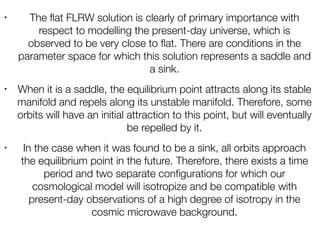
• The flat FLRW solution is clearly of primary importance with
respect to modelling the present-day universe, which is
observed to be very close to flat. There are conditions in the
parameter space for which this solution represents a saddle and
a sink.
• The flat FLRW solution is clearly of primary importance with
respect to modelling the present-day universe, which is
observed to be very close to flat. There are conditions in the
parameter space for which this solution represents a saddle and
a sink.
• When it is a saddle, the equilibrium point attracts along its stable
manifold and repels along its unstable manifold. Therefore, some
orbits will have an initial attraction to this point, but will eventually
be repelled by it.
• The flat FLRW solution is clearly of primary importance with
respect to modelling the present-day universe, which is
observed to be very close to flat. There are conditions in the
parameter space for which this solution represents a saddle and
a sink.
• When it is a saddle, the equilibrium point attracts along its stable
manifold and repels along its unstable manifold. Therefore, some
orbits will have an initial attraction to this point, but will eventually
be repelled by it.
• In the case when it was found to be a sink, all orbits approach
the equilibrium point in the future. Therefore, there exists a time
period and two separate configurations for which our
cosmological model will isotropize and be compatible with
present-day observations of a high degree of isotropy in the
cosmic microwave background.

Dynamical Systems Methods in Early-Universe Cosmologies

  • 1.
    Dynamical Systems Methodsin Early-Universe Cosmology ! SONAD 2014 Talk - May 15, 2014 Ikjyot Singh Kohli, Ph.D. Candidate - Dept. of Physics and Astronomy - York University www.yorku.ca/kohli
  • 2.
  • 3.
    Introduction • Much ofmy research (with Michael Haslam) is focused on applying dynamical systems methods to the Einstein field equations to develop models of the early universe.
  • 4.
    Introduction • Much ofmy research (with Michael Haslam) is focused on applying dynamical systems methods to the Einstein field equations to develop models of the early universe. • Our present-day universe is isotropic (to a very high degree) and spatially homogeneous. The universe is then described by the Friedmann- Lemaitre-Robertson-Walker (FLRW) metric.
  • 5.
    Introduction • Much ofmy research (with Michael Haslam) is focused on applying dynamical systems methods to the Einstein field equations to develop models of the early universe. • Our present-day universe is isotropic (to a very high degree) and spatially homogeneous. The universe is then described by the Friedmann- Lemaitre-Robertson-Walker (FLRW) metric. • We would like to understand how this is possible given that the early universe had a very high temperature and hence was unstable.
  • 6.
    Introduction • Much ofmy research (with Michael Haslam) is focused on applying dynamical systems methods to the Einstein field equations to develop models of the early universe. • Our present-day universe is isotropic (to a very high degree) and spatially homogeneous. The universe is then described by the Friedmann- Lemaitre-Robertson-Walker (FLRW) metric. • We would like to understand how this is possible given that the early universe had a very high temperature and hence was unstable. • In our work, we relax the condition of isotropy to obtain cosmological models that admit Killing vectors that describe spatial translations only, and as a result are spatially homogeneous and anisotropic in general. Such models are known as the Bianchi models.
  • 9.
  • 10.
    Introduction • This taskis non-trivial, as in General Relativity, space and time are one entity, spacetime, so it is not immediately clear how one should essentially “define” a time variable to get some idea of dynamics.
  • 11.
    Introduction • This taskis non-trivial, as in General Relativity, space and time are one entity, spacetime, so it is not immediately clear how one should essentially “define” a time variable to get some idea of dynamics. • I will describe in this talk the method of orthonormal frames (Ellis and MacCallum, Comm. Math. Phys, 12, 108-141,1969), which turn the Einstein field equations into a coupled system of nonlinear ordinary differential equations, and then describe the importance of numerical methods in understanding the global behaviour of the system.
  • 12.
  • 13.
    Spacetime Splitting • Mis a manifold if for every point of M there is an open neighbourhood of that point for which there is a continuous one-to-one and onto map f to an open neighbourhood of R^n for some integer n.
  • 14.
    Spacetime Splitting • Mis a manifold if for every point of M there is an open neighbourhood of that point for which there is a continuous one-to-one and onto map f to an open neighbourhood of R^n for some integer n. • The local region of M then can be made to look like R^n locally.
  • 15.
    Spacetime Splitting • Mis a manifold if for every point of M there is an open neighbourhood of that point for which there is a continuous one-to-one and onto map f to an open neighbourhood of R^n for some integer n. • The local region of M then can be made to look like R^n locally. • In general relativity, n = 4, for three spatial coordinates, and one time coordinate.
  • 16.
  • 17.
    Spacetime Splitting General Relativityis described by the Einstein field equations: Rab 1 2 gabR + gab = kTab Rab : Ricci tensor gab : Metric tensor : Cosmological constant Tab : Energy-momentum tensor These are 10 hyperbolic, nonlinear, coupled PDEs!
  • 18.
    Spacetime Splitting The solutionof these equations is the metric tensor, typically written in the form: ds2 = gabdxa dxb One sees though, that the EFEs are not your “typical” field equations, in the sense that the solution is a metric tensor, and not a time-varying field, as would be the case with Maxwell’s equations, Navier-Stokes, etc…
  • 19.
    Spacetime Splitting To geta dynamical interpretation, then, we must split our spacetime into space and time. We accomplish this by foliating M into a collection of spacelike hypersurfaces and allow a timelike vector to thread through them. na t1 t2 t3 t4
  • 20.
  • 21.
    Energy-Momentum Tensor The energy-momentumtensor is given by: Tab = (µ + p) uaub + gabp 3⇠Hhab 2⌘ ab, where µ, p, and ab denote the fluid’s energy density, pressure, and shear respectively, while and denote the bulk and shear viscosity coe cients of the fluid. Throughout this work, both coe cients are taken to be nonnegative constants. H denotes the Hubble parameter, and hab uaub + gab is the standard projection tensor corresponding to the metric signature ( , +, +, +). See: (Kohli and Haslam, Phys. Rev. D. 87, 063006 (2013) arXiv: 1207.6132) for further details. In principle, other terms too, involving heat conduction, but these are acausal, (parabolic and elliptic PDEs do not occur in the real, physical universe, except in the sense of spacetime symmetries).
  • 22.
    Evolution and ConstraintEquations We will choose an orthonormal frame: {n, e } That is, n is tangent to a hypersurface-orthogonal congruence of geodesics, and we obtain: ˙H = H2 2 3 2 µ 1 6 + 1 2 w , (1) ˙ab = 3H ab + 2 uv (a b)u v Sab 2 ab, (2) µ = 3H2 2 + 1 2 R, (3) 0 = 3 u a au uv a b unbv, (4) The Einstein field equations:
  • 23.
    where Sab andR are the three-dimensional spatial curvature and Ricci scalar and are defined as: Sab = bab 1 3 bu u ab 2 uv (a nb)uav, (1) R = 1 2 bu u 6auau , (2) where bab = 2nu anub (nu u) nab. We have also denoted by v the angular velocity of the spatial frame. Using the Jacobi identities, one obtains evolution equations for these vari- ables as well: ˙nab = Hnab + 2 u (anb)u + 2 uv (a nb)u v, (1) ˙aa = Haa b aab + uv a au v, (2) 0 = nb aab. (3) The contracted Bianchi identities give the evolution equation for µ as ˙µ = 3H (µ + p) b a a b + 2aaqa . (4)
  • 24.
    In addition, wedefine a dimensionless “time” variable: dt d˜⌧ = 1 D In our research, we are particularly interested in a closed universe, that is, of topology S^3. ! The EFEs for such a universe take the form: (Kohli and Haslam, Phys. Rev. D. 89, 043518 (2014), arXiv: 1311.0389)

  • 25.
    ˜H0 = (1 ˜H2 )˜q, ˜⌃0 += ˜⌃+ ˜H ( 2 + ˜q) 6˜⌃+ ˜⌘0 ˜S+, ˜⌃0 = ˜⌃ ˜H ( 2 + ˜q) 6˜⌃ ˜⌘0 ˜S , ˜N0 1 = ˜N1 ⇣ ˜H ˜q 4˜⌃+ ⌘ , ˜N0 2 = ˜N2 ⇣ ˜H ˜q + 2˜⌃+ + 2 p 3˜⌃ ⌘ , ˜N0 3 = ˜N3 ⇣ ˜H ˜q + 2˜⌃+ 2 p 3˜⌃ ⌘ , ˜⌦0 = ˜⌦ ˜H ( 1 + 2˜q 3w) + 9 ˜H2 ˜⇠0 + 12˜⌘0 ⇣ ˜⌃2 + + ˜⌃2 ⌘ where ˜q = 2 ⇣ ˜⌃2 + + ˜⌃2 ⌘ + 1 2 ˜⌦ (1 + 3w) 9 2 ˜⇠0 ˜H ˜⌦ + ˆ⌃2 + ˜V = 1 This is a constraint on the initial conditions
  • 26.
    Note that: ˜V = 1 12  ˜N2 1+ ˜N2 2 + ˜N2 3 2 ˜N1 ˜N2 2 ˜N2 ˜N3 2 ˜N3 ˜N1 + 3 ⇣ ˜N1 ˜N2 ˜N3 ⌘2/3 ˜S+ = 1 6 ⇣ ˜N2 ˜N3 ⌘2 ˜N1 ⇣ 2 ˜N1 ˜N2 ˜N3 ⌘ , ˜S = 1 2 p 3 h⇣ ˜N3 ˜N2 ⌘ ⇣ ˜N1 ˜N2 ˜N3 ⌘i .
  • 27.
  • 28.
    Dynamical Analysis • Tounderstand the dynamics of such a universe, we typically proceed in the following manner:
  • 29.
    Dynamical Analysis • Tounderstand the dynamics of such a universe, we typically proceed in the following manner: 1. Determine whether the state space is compact

  • 30.
    Dynamical Analysis • Tounderstand the dynamics of such a universe, we typically proceed in the following manner: 1. Determine whether the state space is compact 2. Identify the invariant sets of the system
  • 31.
    Dynamical Analysis • Tounderstand the dynamics of such a universe, we typically proceed in the following manner: 1. Determine whether the state space is compact 2. Identify the invariant sets of the system 3. Find all equilibrium points and analyze their local stability
  • 32.
    Dynamical Analysis • Tounderstand the dynamics of such a universe, we typically proceed in the following manner: 1. Determine whether the state space is compact 2. Identify the invariant sets of the system 3. Find all equilibrium points and analyze their local stability 4. Find monotone functions in the various invariant sets
  • 33.
    Dynamical Analysis • Tounderstand the dynamics of such a universe, we typically proceed in the following manner: 1. Determine whether the state space is compact 2. Identify the invariant sets of the system 3. Find all equilibrium points and analyze their local stability 4. Find monotone functions in the various invariant sets 5. Investigate bifurcations that occur as per the parameter space
  • 34.
    Dynamical Analysis • Tounderstand the dynamics of such a universe, we typically proceed in the following manner: 1. Determine whether the state space is compact 2. Identify the invariant sets of the system 3. Find all equilibrium points and analyze their local stability 4. Find monotone functions in the various invariant sets 5. Investigate bifurcations that occur as per the parameter space 6. Knowing all this information allows one to state precisely information about the asymptotic past and future evolution of the universe model under consideration.
  • 35.
    Examples of FixedPoints Expanding Flat FLRW solution Expanding Bianchi II solution Closed Einstein Static Universe
  • 36.
    Stability AnalysisEquilibrium Point EFE SolutionLocal Sink Local Source Saddle F+ Expanding k=0 FLRW solution Yes No Yes F- Contracting k=0 FLRW solution Yes Yes Yes P+(II) Expanding Bianchi Type II Solution No No Yes P_(II) (new discovery!) Contracting Bianchi Type II Solution No No Yes
  • 37.
    21 For nonlinear systems,we are bound by the Invariant Manifold theorem: Let x = 0 be an equilibrium point of the DE x0 = f(x) on Rn and let Es , Eu , and Ec denote the stable, unstable, and centre subspaces of the linearization at 0. Then there exists • Ws tangent to Es at 0, • Wu tangent to Eu at 0, • Wc tangent to Ec at 0. So, in nonlinear systems, linearization techniques only tell you the orbits of the dynamical system that belong to the stable, unstable, or centre manifolds. So, we need global methods that will determine asymptotic stability of the various equilibrium points.
  • 38.
  • 39.
    Global Methods • Thereare many such methods, although, the majority of the methods used only apply to planar dynamical systems. 22
  • 40.
    Global Methods • Thereare many such methods, although, the majority of the methods used only apply to planar dynamical systems. • The methods that we have found useful are: 22
  • 41.
    Global Methods • Thereare many such methods, although, the majority of the methods used only apply to planar dynamical systems. • The methods that we have found useful are: • Finding Lyapunov and Chetaev functions 22
  • 42.
    Global Methods • Thereare many such methods, although, the majority of the methods used only apply to planar dynamical systems. • The methods that we have found useful are: • Finding Lyapunov and Chetaev functions • LaSalle invariance principle 22
  • 43.
    Global Methods • Thereare many such methods, although, the majority of the methods used only apply to planar dynamical systems. • The methods that we have found useful are: • Finding Lyapunov and Chetaev functions • LaSalle invariance principle • Monotonicity Principle 22
  • 44.
    Global Methods • Thereare many such methods, although, the majority of the methods used only apply to planar dynamical systems. • The methods that we have found useful are: • Finding Lyapunov and Chetaev functions • LaSalle invariance principle • Monotonicity Principle • Numerical methods 22
  • 45.
    Global Methods • Thereare many such methods, although, the majority of the methods used only apply to planar dynamical systems. • The methods that we have found useful are: • Finding Lyapunov and Chetaev functions • LaSalle invariance principle • Monotonicity Principle • Numerical methods • The first three give information on the alpha and omega limit sets of the dynamical system. 22
  • 46.
  • 47.
    Numerical Experiments • Numericalmethods are key, and without them, we would be somewhat limited in how far we can take the analysis of the dynamical system.
  • 48.
    Numerical Experiments • Numericalmethods are key, and without them, we would be somewhat limited in how far we can take the analysis of the dynamical system. • In general, we need numerical methods to verify and check our topology-based work as outlined before, but, also, because of the dimension and nonlinearity of the dynamical system, there are situations in which a stability analysis will not yield any information, and where the global methods outline above will only give limited information.
  • 49.
    Numerical Experiments Parameter Space:Initial Conditions: ˜⌦ + ˆ⌃2 + ˜V = 1 Numerical Solver: ODE23s (MATLAB), ODE45 (MATLAB) Solution: ˜H( ), ˜±( ), ˜N ( ), ˜( ) 1 w 1, ˜0 0, ˜0 0
  • 50.
  • 53.
    −1.5 −1 −0.5 0 0.5 1 1.5 −1 −0.5 0 0.5 1 1.5 −1.5 −1 −0.5 0 0.5 1 1.5 ˜H ˜Σ + ˜Σ− This figureshows the dynamical system behavior for ˜0 = 0, ˜0 = 0, and w = 1/3. In particular, it displays the heteroclinic orbits joining K+ to K , where K+ is located at ˜H = 1, and K is located at ˜H = 1 in the figure. Numerical solutions were computed for 1000 1000. For clarity, we have displayed solutions for shorter timescales.
  • 54.
    −0.5 −0.4 −0.3 −0.2 −0.1 0 0.1 0.2 0.3 0.4 0.5 −0.4 −0.3 −0.2 −0.1 0 0.1 0.2 0.3 0.4 0.5 0 0.1 0.2 0.3 0.4 0.5 0.6 0.7 0.8 ˜Σ + ˜Σ − ˜N1 Thisfigure shows the dynamical system behaviour for ˜0 = 0, ˜0 = 1/2, and w = 1/3. The plus sign denotes the equilibrium point F+. The model also isotropizes as can be seen from the last figure, where ˜± 0 as . Numerical solutions were computed for 0 1000. For clarity, we have displayed solutions for shorter timescales.
  • 55.
    −0.4 −0.3 −0.2 −0.1 0 0.1 0.2 0.3 0.4 0.5 −0.5 −0.4 −0.3 −0.2 −0.1 0 0.1 0.2 0.3 0.4 0.5 −0.5 0 0.5 1 1.5 2 2.5 3 ˜Σ + ˜Σ − ˜N1 Thesefigures show the dynamical system behavior for ˜0 = 0, ˜0 = 1/3, and w = 1. The plus sign denotes the equilibrium point F . The model also isotropizes as can be seen from the last figure, where ˜± 0 as . Numerical solutions were computed for 0 1000. For clarity, we have displayed solutions for shorter timescales.
  • 56.
    0 1 23 4 5 6 7 8 9 10 −0.5 −0.4 −0.3 −0.2 −0.1 0 0.1 0.2 0.3 0.4 0.5 ˜Σ + ˜Σ −
  • 58.
    • The flatFLRW solution is clearly of primary importance with respect to modelling the present-day universe, which is observed to be very close to flat. There are conditions in the parameter space for which this solution represents a saddle and a sink.
  • 59.
    • The flatFLRW solution is clearly of primary importance with respect to modelling the present-day universe, which is observed to be very close to flat. There are conditions in the parameter space for which this solution represents a saddle and a sink. • When it is a saddle, the equilibrium point attracts along its stable manifold and repels along its unstable manifold. Therefore, some orbits will have an initial attraction to this point, but will eventually be repelled by it.
  • 60.
    • The flatFLRW solution is clearly of primary importance with respect to modelling the present-day universe, which is observed to be very close to flat. There are conditions in the parameter space for which this solution represents a saddle and a sink. • When it is a saddle, the equilibrium point attracts along its stable manifold and repels along its unstable manifold. Therefore, some orbits will have an initial attraction to this point, but will eventually be repelled by it. • In the case when it was found to be a sink, all orbits approach the equilibrium point in the future. Therefore, there exists a time period and two separate configurations for which our cosmological model will isotropize and be compatible with present-day observations of a high degree of isotropy in the cosmic microwave background.