 A process where an embryo is derived from a single
somatic cell or group of somatic cells. Somatic
embryos (SEs) are formed from plant cells that are
not normally involved in embryo formation.
 Embryos formed by somatic embryogenesis are called
embryoids.
 The process was discovered for the first time in
Daucas carota L. (carrot) by Steward (1958), Reinert
(1959).
 The most basic requirement for embryo development
is the physical and chemical environment which is
available only inside the ‘Magic Bath’ of embryo sac.
 In vitro embryo can be developed if we provide the
nutritional conditions same as in magic bath.
1. Direct SE
when embryos are formed directly from explant tissue
creating an identical clone without production of
intervening callus. The explants capable of direct
embryogenesis seem to carry competent or “pre-
embryonic determined cells”(PEDCs).These cells are
committed to Embryo development and need only to be
released.
2. Indirect SE
when explants produced undifferentiated mass of
cells(callus) which is maintained or differentiated into
embryo. Specific growth regulators and culture conditions
are required for callus formation and the redetermination
of embryogenic development pattern called “induced
embryogenic determined cells”(IEDCs).
 Embryoid
◦ It is a small well organized structure comparable of
the sexual embryo, which is produced in tissue
culture of dividing somatic cells which are
embryogenically potential.
Embryogenic Potential
◦ The capability of the somatic plant cell of a culture
to produce embryoids is known as embryogenic
potential.
Embryogenic callus
◦ In somatic embryogenesis small compact cell divide
asymmetrically and their daughter cells stick
together to produce cell masses called pro
embryogenic masses or embryogenic clumps.
 1.Immature zygotic embryos
 2.Inflorescence
 3.Cell suspension cultures
 4.Petioles
 5.Protoplasts
 6.Leaves
 7.Stems
 8.Roots
 Single cells
 Group of cells
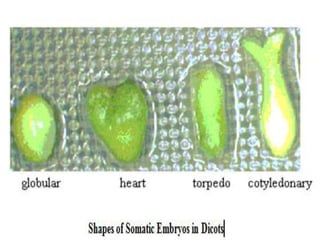
 Globular stage
 Heart shaped embryo
 Torpedo stage embryo
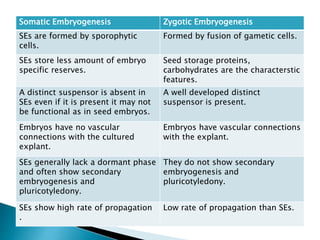
Somatic Embryogenesis Zygotic Embryogenesis
SEs are formed by sporophytic
cells.
Formed by fusion of gametic cells.
SEs store less amount of embryo
specific reserves.
Seed storage proteins,
carbohydrates are the characterstic
features.
A distinct suspensor is absent in
SEs even if it is present it may not
be functional as in seed embryos.
A well developed distinct
suspensor is present.
Embryos have no vascular
connections with the cultured
explant.
Embryos have vascular connections
with the explant.
SEs generally lack a dormant phase
and often show secondary
embryogenesis and
pluricotyledony.
They do not show secondary
embryogenesis and
pluricotyledony.
SEs show high rate of propagation
.
Low rate of propagation than SEs.
 Characters of explants:
 Even though a variety of explants can be
utilized, the correct developmental stage of
the explants are also crucial for the initiation
of embryogenic callus.
 Young or juvenile explants produced more
somatic embryos than older explants
 As a further complexity, different explants
tissue from the same mother plant produced
embryogenic callus at different frequencies.
 ADVANTAGES
• It is observable, as its various culture conditions can be
controlled.
• Lack of material is not a limiting factor for
experimentation.
• High propagation rate.
• Somaclonal variations.
• Germplasm conservation.
• Labour saving.
• Elimination of diseases and viruses.
 DISADVANTAGES
• Confined to few species.
• The somatic embryos show very poor germination because
of their physiological and biochemical immaturity.
• Instability of cultured cells in long-term cultures is a major
limitation in commercial exploitation and mass
propagation of SEs.

Somatic Embryogenesis.pptx

  • 2.
     A processwhere an embryo is derived from a single somatic cell or group of somatic cells. Somatic embryos (SEs) are formed from plant cells that are not normally involved in embryo formation.  Embryos formed by somatic embryogenesis are called embryoids.  The process was discovered for the first time in Daucas carota L. (carrot) by Steward (1958), Reinert (1959).  The most basic requirement for embryo development is the physical and chemical environment which is available only inside the ‘Magic Bath’ of embryo sac.  In vitro embryo can be developed if we provide the nutritional conditions same as in magic bath.
  • 3.
    1. Direct SE whenembryos are formed directly from explant tissue creating an identical clone without production of intervening callus. The explants capable of direct embryogenesis seem to carry competent or “pre- embryonic determined cells”(PEDCs).These cells are committed to Embryo development and need only to be released. 2. Indirect SE when explants produced undifferentiated mass of cells(callus) which is maintained or differentiated into embryo. Specific growth regulators and culture conditions are required for callus formation and the redetermination of embryogenic development pattern called “induced embryogenic determined cells”(IEDCs).
  • 4.
     Embryoid ◦ Itis a small well organized structure comparable of the sexual embryo, which is produced in tissue culture of dividing somatic cells which are embryogenically potential. Embryogenic Potential ◦ The capability of the somatic plant cell of a culture to produce embryoids is known as embryogenic potential. Embryogenic callus ◦ In somatic embryogenesis small compact cell divide asymmetrically and their daughter cells stick together to produce cell masses called pro embryogenic masses or embryogenic clumps.
  • 5.
     1.Immature zygoticembryos  2.Inflorescence  3.Cell suspension cultures  4.Petioles  5.Protoplasts  6.Leaves  7.Stems  8.Roots
  • 6.
     Single cells Group of cells  Globular stage  Heart shaped embryo  Torpedo stage embryo
  • 8.
    Somatic Embryogenesis ZygoticEmbryogenesis SEs are formed by sporophytic cells. Formed by fusion of gametic cells. SEs store less amount of embryo specific reserves. Seed storage proteins, carbohydrates are the characterstic features. A distinct suspensor is absent in SEs even if it is present it may not be functional as in seed embryos. A well developed distinct suspensor is present. Embryos have no vascular connections with the cultured explant. Embryos have vascular connections with the explant. SEs generally lack a dormant phase and often show secondary embryogenesis and pluricotyledony. They do not show secondary embryogenesis and pluricotyledony. SEs show high rate of propagation . Low rate of propagation than SEs.
  • 9.
     Characters ofexplants:  Even though a variety of explants can be utilized, the correct developmental stage of the explants are also crucial for the initiation of embryogenic callus.  Young or juvenile explants produced more somatic embryos than older explants  As a further complexity, different explants tissue from the same mother plant produced embryogenic callus at different frequencies.
  • 10.
     ADVANTAGES • Itis observable, as its various culture conditions can be controlled. • Lack of material is not a limiting factor for experimentation. • High propagation rate. • Somaclonal variations. • Germplasm conservation. • Labour saving. • Elimination of diseases and viruses.  DISADVANTAGES • Confined to few species. • The somatic embryos show very poor germination because of their physiological and biochemical immaturity. • Instability of cultured cells in long-term cultures is a major limitation in commercial exploitation and mass propagation of SEs.