Dawna Perez, PhD
Dean, Student Success
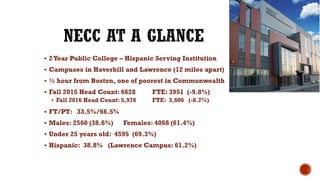
 2Year Public College – Hispanic Serving Institution
 Campuses in Haverhill and Lawrence (12 miles apart)
 ½ hour from Boston, one of poorest in Commonwealth
 Fall 2015 Head Count: 6628 FTE: 3951 (-9.8%)
 Fall 2016 Head Count: 5,976 FTE: 3,606 (-8.7%)
 FT/PT: 33.5%/66.5%
 Males: 2560 (38.6%) Females: 4068 (61.4%)
 Under 25 years old: 4595 (69.3%)
 Hispanic: 38.8% (Lawrence Campus: 61.2%)
AN INTEGRATED STUDENT EXPERIENCE
NECC 2020, our new strategic plan this fall. One of our four goals is to create an
INTEGRATED STUDENT EXPERIENCE
Colleges flourish when the student experience empowers students to take
ownership of their success. Every stop on the student pathway—from recruitment
and early college, to financial aid and support services, to academic achievements,
retention, and completion—is guided and seamlessly connected
through personal relationships with faculty and staff,
buttressed by an efficient infrastructure that links
organization, technology,facilities, and services across
campuses. Ensuring access for students and preparing them to meet their
educational goals, enter the world of work, and be informed, active citizens in our
global society is paramount.
2016-2020 ACADEMIC MASTER PLAN VISION
Students will identify and achieve their academic and career goals
through highly structured academic experiences that provide
opportunities to build relationships with their peers,faculty and staff
in meaningful and substantial ways.Students will experience a
personalized,integrated support system as part of clearly articulated
student academic pathways.Faculty and staff will engage in a team-
based approach to educating and supporting students that recognizes
their key role in student success,and values the contributions of each
employee at every level.
IPASS – INTEGRATED PLANNING AND
ADVISING FOR STUDENT SUCCESS
 Creating urgency around transforming our work with students:
 Lower enrollment
 flat retention rates
 tighter budget, ending of Title V and no new big grants
 Recognizing high-functioning areas that only touch small percentages of
students—too random and disconnected from each other
 Multiple technology platforms for students, staff and faculty to master and use
regularly, but they don’t always speak to each other
 For all these reasons, we have begun the work of re-imagining how
we work with students, how we are organized and the processes we
use. STARFISH Early Alert is a part of that equation.We’ve used it
successfully on a small scale; how will we integrate it with our BIG
PICTURE?
HOW WE’RE LEVERAGING
TECHNOLOGY FOR STUDENT
SUCCESS GOALS
1) Quicker, easier way for faculty to alert for early struggle,
report progress, and communicate with staff connected to
students.
2) More efficient system for support services to respond to
alerts
3) More face time with students who need intervention
4) Greater Student Success as measured by higher retention
rates and better course completion rates.
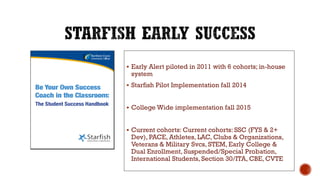
 Early Alert piloted in 2011 with 6 cohorts; in-house
system
 Starfish Pilot Implementation fall 2014
 College Wide implementation fall 2015
 Current cohorts: Current cohorts: SSC (FYS & 2+
Dev), PACE, Athletes, LAC, Clubs & Organizations,
Veterans & Military Svcs, STEM, Early College &
Dual Enrollment, Suspended/Special Probation,
International Students, Section 30/ITA, CBE, CVTE
MODULES, FEATURES AND
INTEGRATION
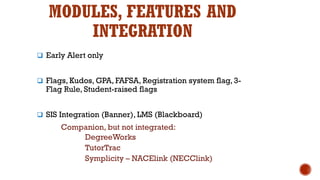
 Early Alert only
 Flags, Kudos, GPA, FAFSA, Registration system flag, 3-
Flag Rule, Student-raised flags
 SIS Integration (Banner), LMS (Blackboard)
Companion, but not integrated:
DegreeWorks
TutorTrac
Symplicity – NACElink (NECClink)
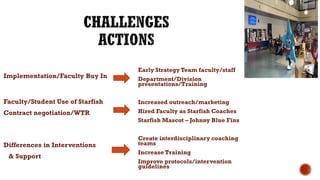
Implementation/Faculty Buy In
Faculty/Student Use of Starfish
Contract negotiation/WTR
Differences in Interventions
& Support
Early Strategy Team faculty/staff
Department/Division
presentations/Training
Increased outreach/marketing
Hired Faculty as Starfish Coaches
Starfish Mascot – Johnny Blue Fins
Create interdisciplinary coaching
teams
Increase Training
Improve protocols/intervention
guidelines
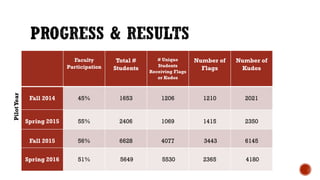
Faculty
Participation
Total #
Students
# Unique
Students
Receiving Flags
or Kudos
Number of
Flags
Number of
Kudos
Fall 2014 45% 1653 1206 1210 2021
Spring 2015 55% 2406 1069 1415 2350
Fall 2015 56% 6628 4077 3443 6145
Spring 2016 51% 5649 5530 2365 4180
PilotYear
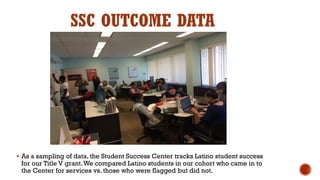
SSC OUTCOME DATA
 As a sampling of data, the Student Success Center tracks Latino student success
for our Title V grant.We compared Latino students in our cohort who came in to
the Center for services vs. those who were flagged but did not.
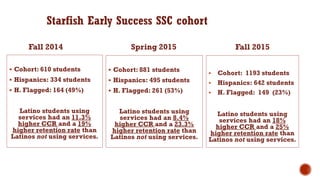
Starfish Early Success SSC cohort
Fall 2014
 Cohort: 610 students
 Hispanics: 334 students
 H. Flagged: 164 (49%)
Latino students using
services had an 11.3%
higher CCR and a 19%
higher retention rate than
Latinos not using services.
Spring 2015
 Cohort: 881 students
 Hispanics: 495 students
 H. Flagged: 261 (53%)
Latino students using
services had an 8.4%
higher CCR and a 23.3%
higher retention rate than
Latinos not using services.
 Cohort: 1193 students
 Hispanics: 642 students
 H. Flagged: 149 (23%)
Latino students using
services had an 18%
higher CCR and a 25%
higher retention rate than
Latinos not using services.
Fall 2015
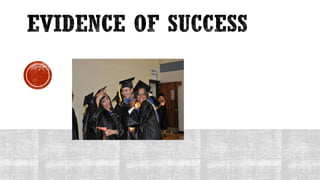
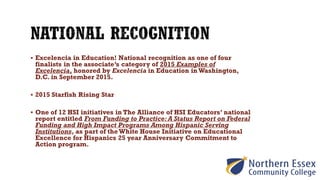
 Excelencia in Education! National recognition as one of four
finalists in the associate’s category of 2015 Examples of
Excelencia, honored by Excelencia in Education in Washington,
D.C. in September 2015.
 2015 Starfish Rising Star
 One of 12 HSI initiatives in The Alliance of HSI Educators’ national
report entitled From Funding to Practice: A Status Report on Federal
Funding and High Impact Programs Among Hispanic Serving
Institutions, as part of the White House Initiative on Educational
Excellence for Hispanics 25 year Anniversary Commitment to
Action program.
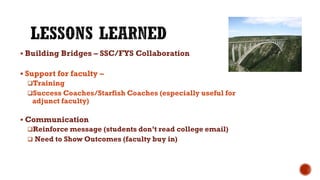
 Building Bridges – SSC/FYS Collaboration
 Support for faculty –
Training
Success Coaches/Starfish Coaches (especially useful for
adjunct faculty)
 Communication
Reinforce message (students don’t read college email)
 Need to Show Outcomes (faculty buy in)
 Increase functionalities as possible
 Build Starfish Training into Orientation/FYE
 Refine intervention guidelines/training
 Create interdisciplinary coaching teams to streamline student
support services and optimize use of technology to support student
success
 Continue evaluating delivery of services, student outcomes
(college wide)
For more information, please contact:
Dawna M. Perez, Ph.D., Dean, Student Success
dperez@necc.mass.edu
(978) 738-7605
Questions?

Increasing Retention Through an Integrated Student Experience Approach

  • 1.
    Dawna Perez, PhD Dean,Student Success
  • 2.
     2Year PublicCollege – Hispanic Serving Institution  Campuses in Haverhill and Lawrence (12 miles apart)  ½ hour from Boston, one of poorest in Commonwealth  Fall 2015 Head Count: 6628 FTE: 3951 (-9.8%)  Fall 2016 Head Count: 5,976 FTE: 3,606 (-8.7%)  FT/PT: 33.5%/66.5%  Males: 2560 (38.6%) Females: 4068 (61.4%)  Under 25 years old: 4595 (69.3%)  Hispanic: 38.8% (Lawrence Campus: 61.2%)
  • 3.
    AN INTEGRATED STUDENTEXPERIENCE NECC 2020, our new strategic plan this fall. One of our four goals is to create an INTEGRATED STUDENT EXPERIENCE Colleges flourish when the student experience empowers students to take ownership of their success. Every stop on the student pathway—from recruitment and early college, to financial aid and support services, to academic achievements, retention, and completion—is guided and seamlessly connected through personal relationships with faculty and staff, buttressed by an efficient infrastructure that links organization, technology,facilities, and services across campuses. Ensuring access for students and preparing them to meet their educational goals, enter the world of work, and be informed, active citizens in our global society is paramount.
  • 4.
    2016-2020 ACADEMIC MASTERPLAN VISION Students will identify and achieve their academic and career goals through highly structured academic experiences that provide opportunities to build relationships with their peers,faculty and staff in meaningful and substantial ways.Students will experience a personalized,integrated support system as part of clearly articulated student academic pathways.Faculty and staff will engage in a team- based approach to educating and supporting students that recognizes their key role in student success,and values the contributions of each employee at every level.
  • 5.
    IPASS – INTEGRATEDPLANNING AND ADVISING FOR STUDENT SUCCESS  Creating urgency around transforming our work with students:  Lower enrollment  flat retention rates  tighter budget, ending of Title V and no new big grants  Recognizing high-functioning areas that only touch small percentages of students—too random and disconnected from each other  Multiple technology platforms for students, staff and faculty to master and use regularly, but they don’t always speak to each other  For all these reasons, we have begun the work of re-imagining how we work with students, how we are organized and the processes we use. STARFISH Early Alert is a part of that equation.We’ve used it successfully on a small scale; how will we integrate it with our BIG PICTURE?
  • 6.
    HOW WE’RE LEVERAGING TECHNOLOGYFOR STUDENT SUCCESS GOALS 1) Quicker, easier way for faculty to alert for early struggle, report progress, and communicate with staff connected to students. 2) More efficient system for support services to respond to alerts 3) More face time with students who need intervention 4) Greater Student Success as measured by higher retention rates and better course completion rates.
  • 7.
     Early Alertpiloted in 2011 with 6 cohorts; in-house system  Starfish Pilot Implementation fall 2014  College Wide implementation fall 2015  Current cohorts: Current cohorts: SSC (FYS & 2+ Dev), PACE, Athletes, LAC, Clubs & Organizations, Veterans & Military Svcs, STEM, Early College & Dual Enrollment, Suspended/Special Probation, International Students, Section 30/ITA, CBE, CVTE
  • 8.
    MODULES, FEATURES AND INTEGRATION Early Alert only  Flags, Kudos, GPA, FAFSA, Registration system flag, 3- Flag Rule, Student-raised flags  SIS Integration (Banner), LMS (Blackboard) Companion, but not integrated: DegreeWorks TutorTrac Symplicity – NACElink (NECClink)
  • 9.
    Implementation/Faculty Buy In Faculty/StudentUse of Starfish Contract negotiation/WTR Differences in Interventions & Support Early Strategy Team faculty/staff Department/Division presentations/Training Increased outreach/marketing Hired Faculty as Starfish Coaches Starfish Mascot – Johnny Blue Fins Create interdisciplinary coaching teams Increase Training Improve protocols/intervention guidelines
  • 10.
    Faculty Participation Total # Students # Unique Students ReceivingFlags or Kudos Number of Flags Number of Kudos Fall 2014 45% 1653 1206 1210 2021 Spring 2015 55% 2406 1069 1415 2350 Fall 2015 56% 6628 4077 3443 6145 Spring 2016 51% 5649 5530 2365 4180 PilotYear
  • 12.
    SSC OUTCOME DATA As a sampling of data, the Student Success Center tracks Latino student success for our Title V grant.We compared Latino students in our cohort who came in to the Center for services vs. those who were flagged but did not.
  • 13.
    Starfish Early SuccessSSC cohort Fall 2014  Cohort: 610 students  Hispanics: 334 students  H. Flagged: 164 (49%) Latino students using services had an 11.3% higher CCR and a 19% higher retention rate than Latinos not using services. Spring 2015  Cohort: 881 students  Hispanics: 495 students  H. Flagged: 261 (53%) Latino students using services had an 8.4% higher CCR and a 23.3% higher retention rate than Latinos not using services.  Cohort: 1193 students  Hispanics: 642 students  H. Flagged: 149 (23%) Latino students using services had an 18% higher CCR and a 25% higher retention rate than Latinos not using services. Fall 2015
  • 14.
     Excelencia inEducation! National recognition as one of four finalists in the associate’s category of 2015 Examples of Excelencia, honored by Excelencia in Education in Washington, D.C. in September 2015.  2015 Starfish Rising Star  One of 12 HSI initiatives in The Alliance of HSI Educators’ national report entitled From Funding to Practice: A Status Report on Federal Funding and High Impact Programs Among Hispanic Serving Institutions, as part of the White House Initiative on Educational Excellence for Hispanics 25 year Anniversary Commitment to Action program.
  • 15.
     Building Bridges– SSC/FYS Collaboration  Support for faculty – Training Success Coaches/Starfish Coaches (especially useful for adjunct faculty)  Communication Reinforce message (students don’t read college email)  Need to Show Outcomes (faculty buy in)
  • 16.
     Increase functionalitiesas possible  Build Starfish Training into Orientation/FYE  Refine intervention guidelines/training  Create interdisciplinary coaching teams to streamline student support services and optimize use of technology to support student success  Continue evaluating delivery of services, student outcomes (college wide)
  • 18.
    For more information,please contact: Dawna M. Perez, Ph.D., Dean, Student Success dperez@necc.mass.edu (978) 738-7605 Questions?