1
Ideal Solutions
A Solution is any homogeneous phase that contains more
than one component. These components can’t be physically
differentiated.
A Solvent is the component with the larger proportion or
quantity in the solution. A Solute is the component with the
smaller proportion or quantity in the solution.
The idea of Ideal Solutions is used to simplify the study of
the phase equilibrium for solution. The solution is considered
to be ideal when:
 its components are assumed to have similar structures
and sizes, and when
 it represents complete uniformity of molecular forces
(basically attraction forces).
2
Ideal Solutions
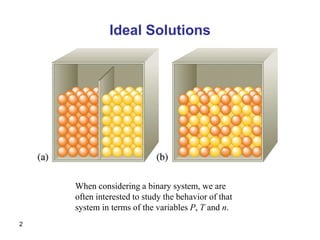
When considering a binary system, we are
often interested to study the behavior of that
system in terms of the variables P, T and n.
3
Raoult’s Law
Recall that the vapor pressure is
a measure of the tendency of
the substance to escape from
the liquid.
For an ideal solution composed
of two components (binary
systems) , Raoult’s law relates
between the vapor pressure of
each component in its pure state
(P*) to the partial vapor
pressure of that component
when it is in the ideal solution
(P).
4
Raoult’s Law
To know what partial vapor
pressure a component in a
solution has is important. This
is because it gives you
information about the cohesive
forces in the system.
5
Raoult’s Law
If the solution has partial
vapor pressures that follow:
*
2
2
2
*
1
1
1
P
x
P
P
x
P


then the system is said to obey
Raoult’s law and to be ideal,
taken into consideration T is
fixed for the solvent and
solution.
Examples include:
 Benzene – toluene.
 C2H5Cl – C2H5Br.
 CHCl3 – HClC=CCl2.
6
Application of Raoult’s Law
Problem 5.21:
Benzene and toluene form nearly ideal solutions. If at 300
K, P*(toluene) = 3.572 kPa and P*(benzene) = 9.657 kPa,
compute the vapor pressure of a solution containing 0.60
mole fraction of toluene. What is the mole fraction of
toluene in the vapor over this liquid?
7
Deviations from Raoult’s Law
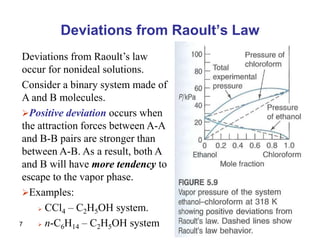
Deviations from Raoult’s law
occur for nonideal solutions.
Consider a binary system made of
A and B molecules.
Positive deviation occurs when
the attraction forces between A-A
and B-B pairs are stronger than
between A-B. As a result, both A
and B will have more tendency to
escape to the vapor phase.
Examples:
 CCl4 – C2H5OH system.
 n-C6H14 – C2H5OH system
8
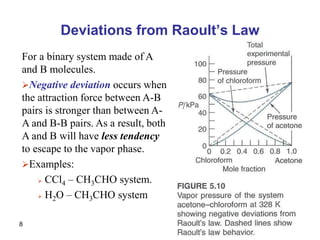
Deviations from Raoult’s Law
For a binary system made of A
and B molecules.
Negative deviation occurs when
the attraction force between A-B
pairs is stronger than between A-
A and B-B pairs. As a result, both
A and B will have less tendency
to escape to the vapor phase.
Examples:
 CCl4 – CH3CHO system.
 H2O – CH3CHO system
9
Deviations from Raoult’s Law
Another important
observation is that
at the limits of infinite
dilution, the vapor
pressure of the solvent
obeys Raoult’s law.
10
Henry’s Law
 The mass of a gas (m2)
dissolved by a given
volume of solvent at
constant T is
proportional to the
pressure of the gas (P2)
above and in equilibrium
with the solution.
m2 = k2 P2
where k2 is the Henry’s
law constant.
11
Henry’s Law
 For a mixture of gases
dissolved in a solution.
Henry’s law can be
applied for each gas
independently.
 The more commonly
used forms of Henry’s
law are:
P2 = k’ x2
P2 = k” c2
12
Henry’s Law
 The vapor pressure of a
solute, P2 , in a solution in
which the solute has a mole
fraction of x2 is given by:
P2 = x2 P2*
where P2* is the vapor pressure
of the solute in a pure liquefied
state.
 It is also found that at the
limits of infinite dilution, the
vapor pressure of the solute
obeys Henry’s law.
13
Application of Henry’s Law
14
Partial Molar Quantities
 The method using partial molar quantities enables us to
treat nonideal solutions. In this method we consider the
changes in the properties of the system as its compositions
change by adding or subtracting.
 The thermodynamic quantities, such as U, H, and G, are
extensive functions, i.e. they depend on the amounts of the
components in the system. Also they depend on the P and
T. For example, G = G(P, T, n1, n2, n3, …).
15
In this treatment, the volume is used as starting point to
lead to the thermodynamic functions in terms of partial
molar quantities.
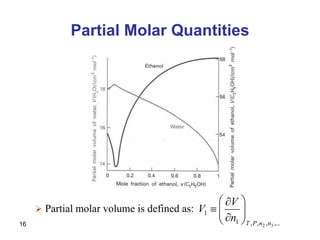
 The volume occupied by H2O molecules added is
dependent on the nature of surrounding molecules.
Partial Molar Volume
water
V = Vw
ethanol
V = Veth
V*(H2O) = 18 mL
Vtot = Vw + 18 mL Vtot = Vw + 14 mL
16
Partial Molar Quantities
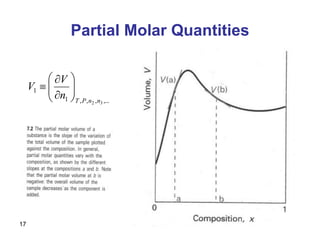
 Partial molar volume is defined as:
,...
,
,
,
1
1
3
2 n
n
P
T
n
V
V 










17
Partial Molar Quantities
,...
,
,
,
1
1
3
2 n
n
P
T
n
V
V 










18
Partial Molar Volumes
Exercise:
The partial molar volumes of acetone and
chloroform in a solution mixture in which mole
fraction of chloroform is 0.4693 are 74.166
cm3/mol and 80.235 cm3/mol, respectively. What
is the volume of a solution of a mass 1.000 kg?
19
Chemical Potential
 The chemical potential (μi) of a thermodynamic system
is the amount by which the energy of the system would
change if an additional particle (dni) were introduced.
If a system contains more than one species of particles,
there is a separate chemical potential associated with each
species (μi , μj , …).
20
Chemical Potential
 The chemical potential (μi) of a thermodynamic system
is the amount by which the energy of the system would
change if an additional particle (dni) were introduced.
If a system contains more than one species of particles,
there is a separate chemical potential associated with each
species (μi , μj , …).
21
Chemical Potential
In spontaneous processes at constant T and P, system moves towards a
state of minimum Gibbs energy. (dG < 0)
In the condition of equilibrium at constant T and P, there is no change
in Gibbs energy (dG = 0)
22
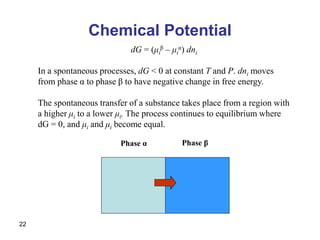
Chemical Potential
dG = (μi
β – μi
α) dni
In a spontaneous processes, dG < 0 at constant T and P. dni moves
from phase α to phase β to have negative change in free energy.
The spontaneous transfer of a substance takes place from a region with
a higher μi to a lower μi. The process continues to equilibrium where
dG = 0, and μi and μi become equal.
Phase β
Phase α
23
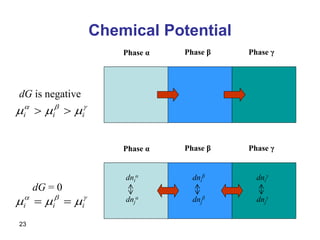
Chemical Potential
dG is negative
Phase β
Phase α Phase γ
dG = 0
Phase β
Phase α Phase γ





 i
i
i 






 i
i
i 

dni
α
dnj
α
dni
β
dnj
β
dni
γ
dnj
γ
24
Thermodynamic of an Ideal Solution
25
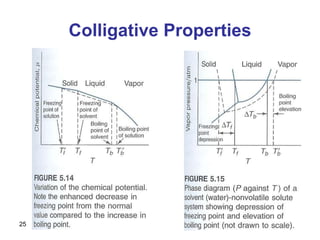
Colligative Properties
26
Colligative Properties
27
Colligative Properties
28
Colligative Properties
29
Colligative Properties
30
Colligative Properties
31
Colligative Properties
32
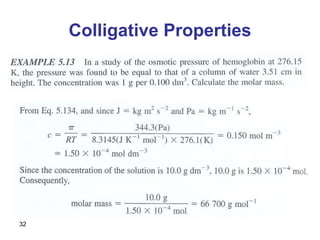
Colligative Properties
33
Colligative Properties

Solutions-introduction.ppt

  • 1.
    1 Ideal Solutions A Solutionis any homogeneous phase that contains more than one component. These components can’t be physically differentiated. A Solvent is the component with the larger proportion or quantity in the solution. A Solute is the component with the smaller proportion or quantity in the solution. The idea of Ideal Solutions is used to simplify the study of the phase equilibrium for solution. The solution is considered to be ideal when:  its components are assumed to have similar structures and sizes, and when  it represents complete uniformity of molecular forces (basically attraction forces).
  • 2.
    2 Ideal Solutions When consideringa binary system, we are often interested to study the behavior of that system in terms of the variables P, T and n.
  • 3.
    3 Raoult’s Law Recall thatthe vapor pressure is a measure of the tendency of the substance to escape from the liquid. For an ideal solution composed of two components (binary systems) , Raoult’s law relates between the vapor pressure of each component in its pure state (P*) to the partial vapor pressure of that component when it is in the ideal solution (P).
  • 4.
    4 Raoult’s Law To knowwhat partial vapor pressure a component in a solution has is important. This is because it gives you information about the cohesive forces in the system.
  • 5.
    5 Raoult’s Law If thesolution has partial vapor pressures that follow: * 2 2 2 * 1 1 1 P x P P x P   then the system is said to obey Raoult’s law and to be ideal, taken into consideration T is fixed for the solvent and solution. Examples include:  Benzene – toluene.  C2H5Cl – C2H5Br.  CHCl3 – HClC=CCl2.
  • 6.
    6 Application of Raoult’sLaw Problem 5.21: Benzene and toluene form nearly ideal solutions. If at 300 K, P*(toluene) = 3.572 kPa and P*(benzene) = 9.657 kPa, compute the vapor pressure of a solution containing 0.60 mole fraction of toluene. What is the mole fraction of toluene in the vapor over this liquid?
  • 7.
    7 Deviations from Raoult’sLaw Deviations from Raoult’s law occur for nonideal solutions. Consider a binary system made of A and B molecules. Positive deviation occurs when the attraction forces between A-A and B-B pairs are stronger than between A-B. As a result, both A and B will have more tendency to escape to the vapor phase. Examples:  CCl4 – C2H5OH system.  n-C6H14 – C2H5OH system
  • 8.
    8 Deviations from Raoult’sLaw For a binary system made of A and B molecules. Negative deviation occurs when the attraction force between A-B pairs is stronger than between A- A and B-B pairs. As a result, both A and B will have less tendency to escape to the vapor phase. Examples:  CCl4 – CH3CHO system.  H2O – CH3CHO system
  • 9.
    9 Deviations from Raoult’sLaw Another important observation is that at the limits of infinite dilution, the vapor pressure of the solvent obeys Raoult’s law.
  • 10.
    10 Henry’s Law  Themass of a gas (m2) dissolved by a given volume of solvent at constant T is proportional to the pressure of the gas (P2) above and in equilibrium with the solution. m2 = k2 P2 where k2 is the Henry’s law constant.
  • 11.
    11 Henry’s Law  Fora mixture of gases dissolved in a solution. Henry’s law can be applied for each gas independently.  The more commonly used forms of Henry’s law are: P2 = k’ x2 P2 = k” c2
  • 12.
    12 Henry’s Law  Thevapor pressure of a solute, P2 , in a solution in which the solute has a mole fraction of x2 is given by: P2 = x2 P2* where P2* is the vapor pressure of the solute in a pure liquefied state.  It is also found that at the limits of infinite dilution, the vapor pressure of the solute obeys Henry’s law.
  • 13.
  • 14.
    14 Partial Molar Quantities The method using partial molar quantities enables us to treat nonideal solutions. In this method we consider the changes in the properties of the system as its compositions change by adding or subtracting.  The thermodynamic quantities, such as U, H, and G, are extensive functions, i.e. they depend on the amounts of the components in the system. Also they depend on the P and T. For example, G = G(P, T, n1, n2, n3, …).
  • 15.
    15 In this treatment,the volume is used as starting point to lead to the thermodynamic functions in terms of partial molar quantities.  The volume occupied by H2O molecules added is dependent on the nature of surrounding molecules. Partial Molar Volume water V = Vw ethanol V = Veth V*(H2O) = 18 mL Vtot = Vw + 18 mL Vtot = Vw + 14 mL
  • 16.
    16 Partial Molar Quantities Partial molar volume is defined as: ,... , , , 1 1 3 2 n n P T n V V           
  • 17.
    17 Partial Molar Quantities ,... , , , 1 1 3 2n n P T n V V           
  • 18.
    18 Partial Molar Volumes Exercise: Thepartial molar volumes of acetone and chloroform in a solution mixture in which mole fraction of chloroform is 0.4693 are 74.166 cm3/mol and 80.235 cm3/mol, respectively. What is the volume of a solution of a mass 1.000 kg?
  • 19.
    19 Chemical Potential  Thechemical potential (μi) of a thermodynamic system is the amount by which the energy of the system would change if an additional particle (dni) were introduced. If a system contains more than one species of particles, there is a separate chemical potential associated with each species (μi , μj , …).
  • 20.
    20 Chemical Potential  Thechemical potential (μi) of a thermodynamic system is the amount by which the energy of the system would change if an additional particle (dni) were introduced. If a system contains more than one species of particles, there is a separate chemical potential associated with each species (μi , μj , …).
  • 21.
    21 Chemical Potential In spontaneousprocesses at constant T and P, system moves towards a state of minimum Gibbs energy. (dG < 0) In the condition of equilibrium at constant T and P, there is no change in Gibbs energy (dG = 0)
  • 22.
    22 Chemical Potential dG =(μi β – μi α) dni In a spontaneous processes, dG < 0 at constant T and P. dni moves from phase α to phase β to have negative change in free energy. The spontaneous transfer of a substance takes place from a region with a higher μi to a lower μi. The process continues to equilibrium where dG = 0, and μi and μi become equal. Phase β Phase α
  • 23.
    23 Chemical Potential dG isnegative Phase β Phase α Phase γ dG = 0 Phase β Phase α Phase γ       i i i         i i i   dni α dnj α dni β dnj β dni γ dnj γ
  • 24.
    24 Thermodynamic of anIdeal Solution
  • 25.
  • 26.
  • 27.
  • 28.
  • 29.
  • 30.
  • 31.
  • 32.
  • 33.