PRESENTED BY NIMRA IRSHAD
STUDENT OF B.ED HONOURS
4TH SEMESTER (MORNING)
SUBJECT: CLASSROOM ASSESSMENT
UNIVERSITY OF EDUCATION, ATTOCK CAMPUS
SOLO TAXONOMY
SOLO TAXONOMY IN THE CURRICULUM
DEVELOPMENT
Content:
• Structure of solo taxonomy
• Definition
• Main five stages
• Sample verbs Indicating levels of understanding
• Solo station protocol
• Uses of Solo taxonomy
• Advantages of solo taxonomy
STRUCTURE OF SOLO TAXONOMY
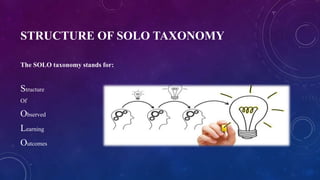
The SOLO taxonomy stands for:
Structure
Of
Observed
Learning
Outcomes
DEFINATIONS OF SOLO TAXONOMY
• The structure of observed learning outcomes(SOLO) taxonomy is a model that
describes levels of increasing complexity in students understanding of subject. It
encourages students to think about where they are currently with their learning,
and what they need to do in order to progress.
• Solo taxonomy provides a simple and robust way of describe how learning out
comes grow in complexity from surface to deep understanding.
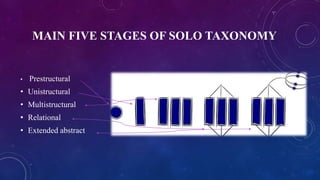
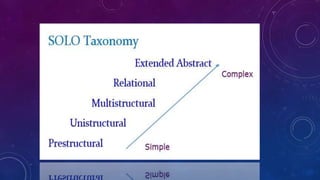
MAIN FIVE STAGES OF SOLO TAXONOMY
• Prestructural
• Unistructural
• Multistructural
• Relational
• Extended abstract
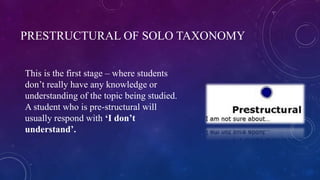
PRESTRUCTURAL OF SOLO TAXONOMY
This is the first stage – where students
don’t really have any knowledge or
understanding of the topic being studied.
A student who is pre-structural will
usually respond with ‘I don’t
understand’.
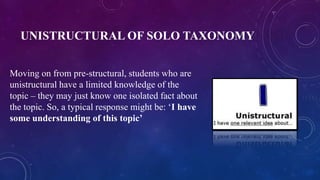
UNISTRUCTURAL OF SOLO TAXONOMY
Moving on from pre-structural, students who are
unistructural have a limited knowledge of the
topic – they may just know one isolated fact about
the topic. So, a typical response might be: ‘I have
some understanding of this topic’
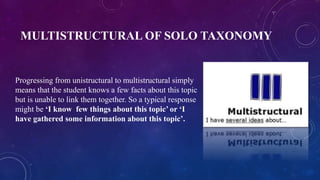
MULTISTRUCTURAL OF SOLO TAXONOMY
Progressing from unistructural to multistructural simply
means that the student knows a few facts about this topic
but is unable to link them together. So a typical response
might be ‘I know few things about this topic’ or ‘I
have gathered some information about this topic’.
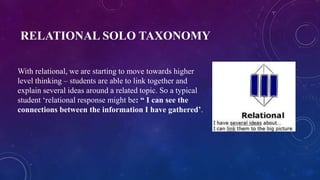
RELATIONAL SOLO TAXONOMY
With relational, we are starting to move towards higher
level thinking – students are able to link together and
explain several ideas around a related topic. So a typical
student ‘relational response might be: “ I can see the
connections between the information I have gathered’.
EXTENDED ABSTRACT OF SOLO
TAXONOMY
The final and most complex level is extended abstract. With
this, not only are students able to link lots of related ideas
together, but they can also link these to other bigger ideas and
concepts. So a student response at this level might sound like:
‘By reflecting and evaluating on my learning, I am able to
look at the bigger picture and link lots of different ideas
together’.
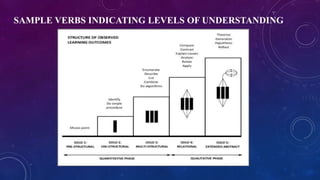
SAMPLE VERBS INDICATING LEVELS OF UNDERSTANDING
SOLO STATION PROTOCOLS:
• Think carefully about which SOLO station you should start at-the aim of the lesson is for you
to have deeper understanding of the topic and make progress, not to see who finished first!
• Move around in order (Prestructural, Unistructural, Multistructural, Relational, Extended
abstract) you can start at any SOLO station though-see point 1.
• Read the first criteria for each SOLO station carefully.
• Only move on when you feel confident enough to move onto the next SOLO station (use the
success criteria at each stage to help you)-you could always go back a station to secure your
understanding.
• Make sure that you have spent time on the reflection tables during the lesson and shared your
ideas.
USES OF SOLO TAXONOMY
• It supports students to reflect on their own thinking.
• It makes it easy to identify and use effective’s success criteria.
• It provides feedback and feedforward with regards to learning outcomes.
• It helps students to reflect meaningfully on what the next steps in their
learning are.
• The diagrams provide a simple and easy to remember staged approach for
students, in terms of these next steps.
ADVANTAGES OF SOLO TAXONOMY
• SOLO is a theory about teaching and learning.
• SOLO is based on levels of ascending cognitive complexity
• SOLO levels can be communicated through text, hand signs and symbols - across
large and noisy learning environments.
• SOLO allows task and outcome to be at different levels.
• SOLO can be used to look at levels of declarative knowledge and functioning
knowledge including metacognitive reflection. Kinds of knowledge.
DISADVANTAGES OF SOLO TAXONOMY:
• Students may get disheartened by being put into the understanding levels. Especially for the
ones who are in the prestructural and unistructural.
• Students may lose the understanding of the purpose and may not see the big picture of what
they are learning due to them focusing so much on the simple steps.
• Too often it’s a one size fits all model of teaching and learning which assumes everyone learns
at the same pace
• Very demanding for teachers when there are students placed at each different levels on
different tasks.
•
THEORY REFERENCES:
• https://en.wikipedia.org/wiki/Structure_of_observed_learning_outcome
• https://g.co/kgs/rq9chp
• https://www.iitms.co.in/blog/what-is-solo-taxonomy-important-and-levels.html
• https://www.slideshare.net/sqjafery/solo-taxonomy-45353566
• https://solotaxonomy.weebly.com/critique.html
PICTURES REFERENCES:
• https://images.app.goo.gl/WyaqwALoMjdmzyZ78
• https://images.app.goo.gl/TZqsDK9c7BDTQoin8
• https://images.app.goo.gl/jeufS2WFhPJEt4YW9
• https://images.app.goo.gl/NYvVXp3ewSr63U1r7
• https://images.app.goo.gl/qpZS4pG2XW7cT8o87
• https://images.app.goo.gl/u3AAqt1bjHCq3riQ7
• https://images.app.goo.gl/9GUqASaQMpwukMDU6
ANY QUESTION?
SOLO Taxonomy

SOLO Taxonomy

  • 1.
    PRESENTED BY NIMRAIRSHAD STUDENT OF B.ED HONOURS 4TH SEMESTER (MORNING) SUBJECT: CLASSROOM ASSESSMENT UNIVERSITY OF EDUCATION, ATTOCK CAMPUS SOLO TAXONOMY
  • 2.
    SOLO TAXONOMY INTHE CURRICULUM DEVELOPMENT Content: • Structure of solo taxonomy • Definition • Main five stages • Sample verbs Indicating levels of understanding • Solo station protocol • Uses of Solo taxonomy • Advantages of solo taxonomy
  • 3.
    STRUCTURE OF SOLOTAXONOMY The SOLO taxonomy stands for: Structure Of Observed Learning Outcomes
  • 4.
    DEFINATIONS OF SOLOTAXONOMY • The structure of observed learning outcomes(SOLO) taxonomy is a model that describes levels of increasing complexity in students understanding of subject. It encourages students to think about where they are currently with their learning, and what they need to do in order to progress. • Solo taxonomy provides a simple and robust way of describe how learning out comes grow in complexity from surface to deep understanding.
  • 5.
    MAIN FIVE STAGESOF SOLO TAXONOMY • Prestructural • Unistructural • Multistructural • Relational • Extended abstract
  • 7.
    PRESTRUCTURAL OF SOLOTAXONOMY This is the first stage – where students don’t really have any knowledge or understanding of the topic being studied. A student who is pre-structural will usually respond with ‘I don’t understand’.
  • 8.
    UNISTRUCTURAL OF SOLOTAXONOMY Moving on from pre-structural, students who are unistructural have a limited knowledge of the topic – they may just know one isolated fact about the topic. So, a typical response might be: ‘I have some understanding of this topic’
  • 9.
    MULTISTRUCTURAL OF SOLOTAXONOMY Progressing from unistructural to multistructural simply means that the student knows a few facts about this topic but is unable to link them together. So a typical response might be ‘I know few things about this topic’ or ‘I have gathered some information about this topic’.
  • 10.
    RELATIONAL SOLO TAXONOMY Withrelational, we are starting to move towards higher level thinking – students are able to link together and explain several ideas around a related topic. So a typical student ‘relational response might be: “ I can see the connections between the information I have gathered’.
  • 11.
    EXTENDED ABSTRACT OFSOLO TAXONOMY The final and most complex level is extended abstract. With this, not only are students able to link lots of related ideas together, but they can also link these to other bigger ideas and concepts. So a student response at this level might sound like: ‘By reflecting and evaluating on my learning, I am able to look at the bigger picture and link lots of different ideas together’.
  • 12.
    SAMPLE VERBS INDICATINGLEVELS OF UNDERSTANDING
  • 13.
    SOLO STATION PROTOCOLS: •Think carefully about which SOLO station you should start at-the aim of the lesson is for you to have deeper understanding of the topic and make progress, not to see who finished first! • Move around in order (Prestructural, Unistructural, Multistructural, Relational, Extended abstract) you can start at any SOLO station though-see point 1. • Read the first criteria for each SOLO station carefully. • Only move on when you feel confident enough to move onto the next SOLO station (use the success criteria at each stage to help you)-you could always go back a station to secure your understanding. • Make sure that you have spent time on the reflection tables during the lesson and shared your ideas.
  • 14.
    USES OF SOLOTAXONOMY • It supports students to reflect on their own thinking. • It makes it easy to identify and use effective’s success criteria. • It provides feedback and feedforward with regards to learning outcomes. • It helps students to reflect meaningfully on what the next steps in their learning are. • The diagrams provide a simple and easy to remember staged approach for students, in terms of these next steps.
  • 15.
    ADVANTAGES OF SOLOTAXONOMY • SOLO is a theory about teaching and learning. • SOLO is based on levels of ascending cognitive complexity • SOLO levels can be communicated through text, hand signs and symbols - across large and noisy learning environments. • SOLO allows task and outcome to be at different levels. • SOLO can be used to look at levels of declarative knowledge and functioning knowledge including metacognitive reflection. Kinds of knowledge.
  • 16.
    DISADVANTAGES OF SOLOTAXONOMY: • Students may get disheartened by being put into the understanding levels. Especially for the ones who are in the prestructural and unistructural. • Students may lose the understanding of the purpose and may not see the big picture of what they are learning due to them focusing so much on the simple steps. • Too often it’s a one size fits all model of teaching and learning which assumes everyone learns at the same pace • Very demanding for teachers when there are students placed at each different levels on different tasks. •
  • 17.
    THEORY REFERENCES: • https://en.wikipedia.org/wiki/Structure_of_observed_learning_outcome •https://g.co/kgs/rq9chp • https://www.iitms.co.in/blog/what-is-solo-taxonomy-important-and-levels.html • https://www.slideshare.net/sqjafery/solo-taxonomy-45353566 • https://solotaxonomy.weebly.com/critique.html
  • 18.
    PICTURES REFERENCES: • https://images.app.goo.gl/WyaqwALoMjdmzyZ78 •https://images.app.goo.gl/TZqsDK9c7BDTQoin8 • https://images.app.goo.gl/jeufS2WFhPJEt4YW9 • https://images.app.goo.gl/NYvVXp3ewSr63U1r7 • https://images.app.goo.gl/qpZS4pG2XW7cT8o87 • https://images.app.goo.gl/u3AAqt1bjHCq3riQ7 • https://images.app.goo.gl/9GUqASaQMpwukMDU6
  • 19.