Re-Skilling of
Teachers on Test
Constructions
Pablo B. Matel
SOLO TAXONOMY
What is SOLO?
Structure of the Observed Learning Outcome
It was first described by Kevin Collis and John Biggs in
1982 in their book Evaluating the Quality of Learning: The
SOLO Taxonomy.
Why is SOLO Taxonomy useful?
 It helps learners reflect meaningfully on the next
levels in their learning.
 It helps instructors to thoughtfully design
learning experiences and learning intentions.
 It is used by the teachers and students together.
 It makes it convenient to identify and implement
effective success criteria.
Why is SOLO Taxonomy useful?
 It offers feedforward and feedback for the
learning outcomes.
 Students understand the reasons for everything
they do and realize improvements are due to
their own strategies.
 It shows the difference between deep and
surface understanding, helping learners
understand where they are on that spectrum,
and what they must do to progress.
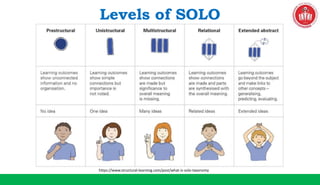
Levels of SOLO
https://www.structural-learning.com/post/what-is-solo-taxonomy
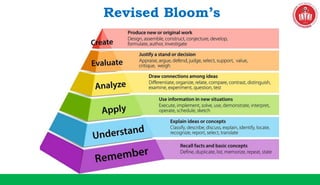
Revised Bloom’s
Taxonomy
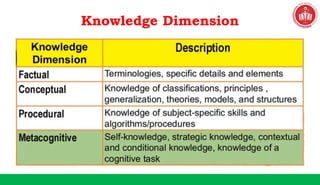
Knowledge Dimension
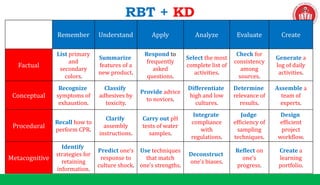
Remember Understand Apply Analyze Evaluate Create
Factual
List primary
and
secondary
colors.
Summarize
features of a
new product.
Respond to
frequently
asked
questions.
Select the most
complete list of
activities.
Check for
consistency
among
sources.
Generate a
log of daily
activities.
Conceptual
Recognize
symptoms of
exhaustion.
Classify
adhesives by
toxicity.
Provide advice
to novices.
Differentiate
high and low
cultures.
Determine
relevance of
results.
Assemble a
team of
experts.
Procedural
Recall how to
perform CPR.
Clarify
assembly
instructions.
Carry out pH
tests of water
samples.
Integrate
compliance
with
regulations.
Judge
efficiency of
sampling
techniques.
Design
efficient
project
workflow.
Metacognitive
Identify
strategies for
retaining
information.
Predict one’s
response to
culture shock.
Use techniques
that match
one's strengths.
Deconstruct
one's biases.
Reflect on
one's
progress.
Create a
learning
portfolio.
RBT + KD
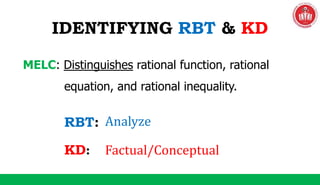
IDENTIFYING RBT & KD
MELC: Distinguishes rational function, rational
equation, and rational inequality.
RBT:
KD:
Analyze
Factual/Conceptual
IDENTIFYING RBT & KD
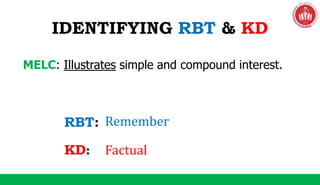
MELC: Illustrates simple and compound interest.
RBT:
KD:
Remember
Factual
IDENTIFYING RBT & KD
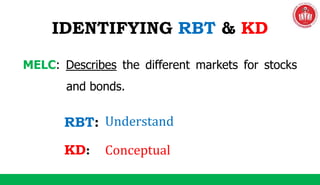
MELC: Describes the different markets for stocks
and bonds.
RBT:
KD:
Understand
Conceptual
IDENTIFYING RBT & KD
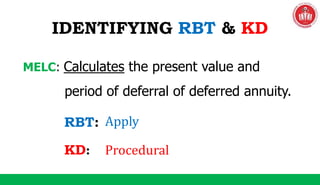
MELC: Calculates the present value and
period of deferral of deferred annuity.
RBT:
KD:
Apply
Procedural
WRITING TEST ITEM
Prime: What is the present value of the deferred
annuity?
Stimuli: Mr. Y availed an installment plan that is
deferred for six months paying ₱1,500
every three months for 8 years at 10%
interest compounded quarterly.
A. ₱1,500.00 B. ₱12,150.00
C. ₱31,194.54 D. ₱34,519.41
WRITING TEST ITEM
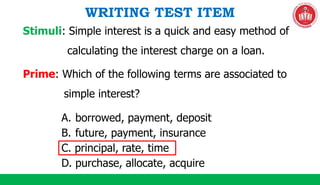
Prime: Which of the following terms are associated to
simple interest?
Stimuli: Simple interest is a quick and easy method of
calculating the interest charge on a loan.
A. borrowed, payment, deposit
B. future, payment, insurance
C. principal, rate, time
D. purchase, allocate, acquire
References
https://www.johnbiggs.com.au/academic/solo-taxonomy/.
https://www.structural-learning.com/post/what-is-solo-
taxonomy
https://www.celt.iastate.edu/instructional-strategies/effective-
teaching-practices/revised-blooms-taxonomy/
Thank You
&
Happy Learning!

Solo-Taxonomy.pptx

  • 1.
    Re-Skilling of Teachers onTest Constructions
  • 2.
  • 3.
    What is SOLO? Structureof the Observed Learning Outcome It was first described by Kevin Collis and John Biggs in 1982 in their book Evaluating the Quality of Learning: The SOLO Taxonomy.
  • 4.
    Why is SOLOTaxonomy useful?  It helps learners reflect meaningfully on the next levels in their learning.  It helps instructors to thoughtfully design learning experiences and learning intentions.  It is used by the teachers and students together.  It makes it convenient to identify and implement effective success criteria.
  • 5.
    Why is SOLOTaxonomy useful?  It offers feedforward and feedback for the learning outcomes.  Students understand the reasons for everything they do and realize improvements are due to their own strategies.  It shows the difference between deep and surface understanding, helping learners understand where they are on that spectrum, and what they must do to progress.
  • 6.
  • 7.
  • 8.
  • 9.
    Remember Understand ApplyAnalyze Evaluate Create Factual List primary and secondary colors. Summarize features of a new product. Respond to frequently asked questions. Select the most complete list of activities. Check for consistency among sources. Generate a log of daily activities. Conceptual Recognize symptoms of exhaustion. Classify adhesives by toxicity. Provide advice to novices. Differentiate high and low cultures. Determine relevance of results. Assemble a team of experts. Procedural Recall how to perform CPR. Clarify assembly instructions. Carry out pH tests of water samples. Integrate compliance with regulations. Judge efficiency of sampling techniques. Design efficient project workflow. Metacognitive Identify strategies for retaining information. Predict one’s response to culture shock. Use techniques that match one's strengths. Deconstruct one's biases. Reflect on one's progress. Create a learning portfolio. RBT + KD
  • 10.
    IDENTIFYING RBT &KD MELC: Distinguishes rational function, rational equation, and rational inequality. RBT: KD: Analyze Factual/Conceptual
  • 11.
    IDENTIFYING RBT &KD MELC: Illustrates simple and compound interest. RBT: KD: Remember Factual
  • 12.
    IDENTIFYING RBT &KD MELC: Describes the different markets for stocks and bonds. RBT: KD: Understand Conceptual
  • 13.
    IDENTIFYING RBT &KD MELC: Calculates the present value and period of deferral of deferred annuity. RBT: KD: Apply Procedural
  • 14.
    WRITING TEST ITEM Prime:What is the present value of the deferred annuity? Stimuli: Mr. Y availed an installment plan that is deferred for six months paying ₱1,500 every three months for 8 years at 10% interest compounded quarterly. A. ₱1,500.00 B. ₱12,150.00 C. ₱31,194.54 D. ₱34,519.41
  • 15.
    WRITING TEST ITEM Prime:Which of the following terms are associated to simple interest? Stimuli: Simple interest is a quick and easy method of calculating the interest charge on a loan. A. borrowed, payment, deposit B. future, payment, insurance C. principal, rate, time D. purchase, allocate, acquire
  • 16.
  • 17.

Editor's Notes

  • #7 Biggs and Collis defined the Structure of the Observed Learning Outcomes produced by learners on basis of complexity. Their proposed model explained levels of growing complexity in a learner’s understanding of performance tasks or subjects. There are five stages of understanding of SOLO Taxonomy. It's levels are hierarchal and each level is affected by the previous level and contributes something to it. As well as providing classrooms with a language of learning, the learning verbs can also be used to create assessment tasks. The complexity of student response can be increased as their depth of understanding grows. The student response can be used to develop a coherent understanding of subjects.