What is it?
SOLO (Structure of Observed
Learning Outcomes) is a model of
learning that helps develop a
common understanding &
language of learning that helps
teachers (and students)
understand the learning process.
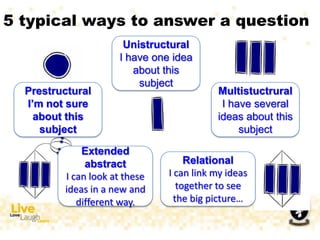
5 typical ways to answer a question
Prestructural
I’m not sure
about this
subject
Unistructural
I have one idea
about this
subject
Multistuctrural
I have several
ideas about this
subject
Relational
I can link my ideas
together to see
the big picture…
Extended
abstract
I can look at these
ideas in a new and
different way.
Unistructural Multistructural Relational Extended abstract
Define
Identify
Do simple
procedure
Define
Describe
List
Do algorithm
Combine
Compare/contrast
Explain causes
Sequence
Classify
Analyse
Part/whole
Relate
Analogy
Apply
Formulate questions
Evaluate
Theorise
Generalise
Predict
Create
Imagine
Hypothesise
Reflect
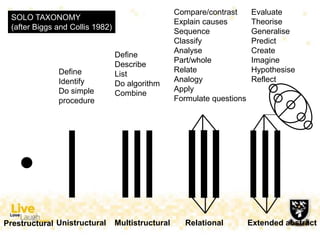
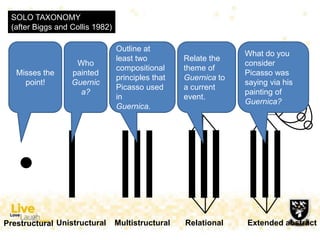
SOLO TAXONOMY
(after Biggs and Collis 1982)
Prestructural
Unistructural Multistructural Relational Extended abstract
Define
Identify
Do simple
procedure
Define
Describe
List
Do algorithm
Combine
Compare/contrast
Explain causes
Sequence
Classify
Analyse
Part/whole
Relate
Analogy
Apply
Formulate questions
Evaluate
Theorise
Generalise
Predict
Create
Imagine
Hypothesise
Reflect
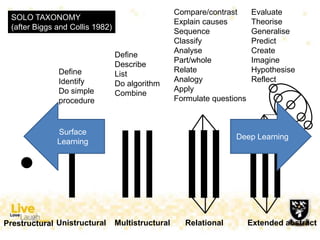
SOLO TAXONOMY
(after Biggs and Collis 1982)
Prestructural
Surface
Learning
Deep Learning
Unistructural Multistructural Relational Extended abstract
SOLO TAXONOMY
(after Biggs and Collis 1982)
Prestructural
Misses the
point!
Who
painted
Guernic
a?
Outline at
least two
compositional
principles that
Picasso used
in
Guernica.
Relate the
theme of
Guernica to
a current
event.
What do you
consider
Picasso was
saying via his
painting of
Guernica?
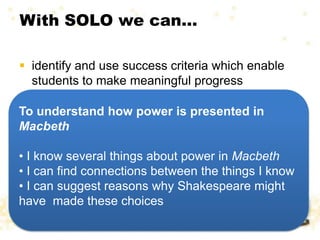
With SOLO we can…
 identify and use success criteria which enable
students to make meaningful progress
To understand how power is presented in
Macbeth
• I know several things about power in Macbeth
• I can find connections between the things I know
• I can suggest reasons why Shakespeare might
have made these choices
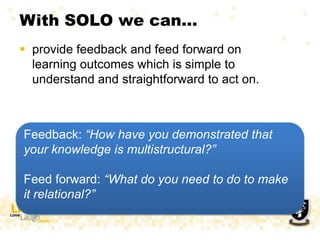
With SOLO we can…
 provide feedback and feed forward on
learning outcomes which is simple to
understand and straightforward to act on.
Feedback: “How have you demonstrated that
your knowledge is multistructural?”
Feed forward: “What do you need to do to make
it relational?”
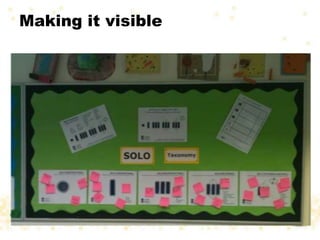
Making it visible
“SOLO Taxonomy provides a
simple and robust way of
describing how learning
outcomes grow in complexity
from surface to deep
understanding”
Biggs & Collis 1982
Why?
 How should we show that
“progress” has been made
in a lesson (or 20 minutes of
a lesson)?
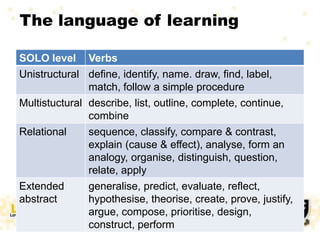
The language of learning
SOLO level Verbs
Unistructural define, identify, name. draw, find, label,
match, follow a simple procedure
Multistuctural describe, list, outline, complete, continue,
combine
Relational sequence, classify, compare & contrast,
explain (cause & effect), analyse, form an
analogy, organise, distinguish, question,
relate, apply
Extended
abstract
generalise, predict, evaluate, reflect,
hypothesise, theorise, create, prove, justify,
argue, compose, prioritise, design,
construct, perform
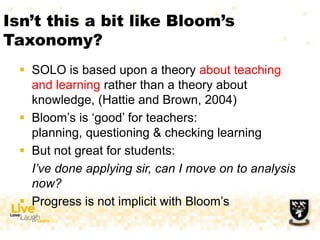
Isn‟t this a bit like Bloom‟s
Taxonomy?
 SOLO is based upon a theory about teaching
and learning rather than a theory about
knowledge, (Hattie and Brown, 2004)
 Bloom‟s is „good‟ for teachers:
planning, questioning & checking learning
 But not great for students:
I’ve done applying sir, can I move on to analysis
now?
 Progress is not implicit with Bloom‟s
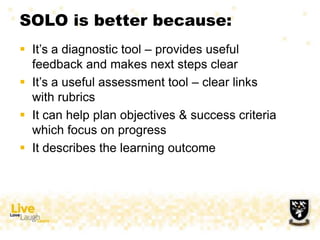
SOLO is better because:
 It‟s a diagnostic tool – provides useful
feedback and makes next steps clear
 It‟s a useful assessment tool – clear links
with rubrics
 It can help plan objectives & success criteria
which focus on progress
 It describes the learning outcome
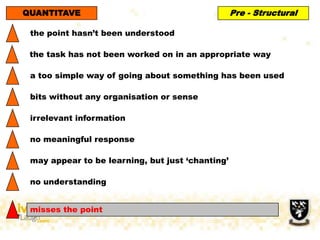
the point hasn‟t been understood
the task has not been worked on in an appropriate way
a too simple way of going about something has been used
bits without any organisation or sense
irrelevant information
no meaningful response
may appear to be learning, but just „chanting‟
no understanding
QUANTITAVE Pre - Structural
misses the point
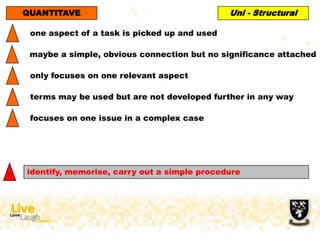
one aspect of a task is picked up and used
maybe a simple, obvious connection but no significance attached
only focuses on one relevant aspect
terms may be used but are not developed further in any way
focuses on one issue in a complex case
Uni - Structural
identify, memorise, carry out a simple procedure
QUANTITAVE
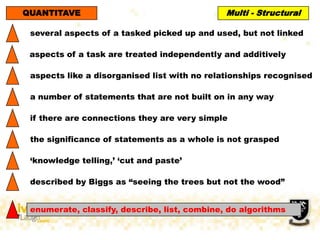
several aspects of a tasked picked up and used, but not linked
aspects of a task are treated independently and additively
aspects like a disorganised list with no relationships recognised
a number of statements that are not built on in any way
if there are connections they are very simple
the significance of statements as a whole is not grasped
„knowledge telling,‟ „cut and paste‟
described by Biggs as “seeing the trees but not the wood”
Multi - Structural
enumerate, classify, describe, list, combine, do algorithms
QUANTITAVE
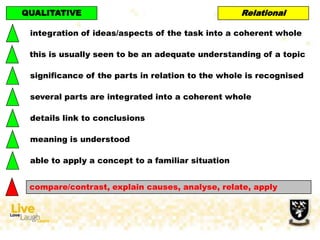
integration of ideas/aspects of the task into a coherent whole
this is usually seen to be an adequate understanding of a topic
significance of the parts in relation to the whole is recognised
several parts are integrated into a coherent whole
details link to conclusions
meaning is understood
able to apply a concept to a familiar situation
QUALITATIVE Relational
compare/contrast, explain causes, analyse, relate, apply
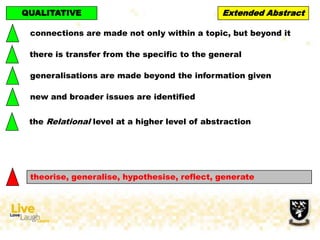
connections are made not only within a topic, but beyond it
there is transfer from the specific to the general
generalisations are made beyond the information given
new and broader issues are identified
the Relational level at a higher level of abstraction
QUALITATIVE Extended Abstract
theorise, generalise, hypothesise, reflect, generate
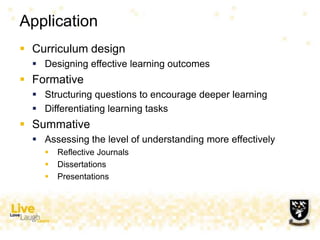
Application
 Curriculum design
 Designing effective learning outcomes
 Formative
 Structuring questions to encourage deeper learning
 Differentiating learning tasks
 Summative
 Assessing the level of understanding more effectively
 Reflective Journals
 Dissertations
 Presentations
Whole School
 For SOLO to work effectively it must be used
whole school
 Students will develop a deep understanding of
SOLO when used in all subjects and will be able
to transfer knowledge of SOLO to every lesson.
“If you want students to be clear about their learning
you need the teacher to be clear first.” Tom
Sherrington (@headguruteacher)
Useful Links
 http://leadinglearner.me/2013/04/14/redesign
ing-classrooms-using-solo-to-increase-
challenge/
 http://www.learningspy.co.uk/solo-taxonomy/
 http://www.slideshare.net/LizSaddler/inset-
may-2013-solo-sll
 http://pamhook.com/solo-taxonomy/
St. Aidans solo taxonomy

St. Aidans solo taxonomy

  • 2.
    What is it? SOLO(Structure of Observed Learning Outcomes) is a model of learning that helps develop a common understanding & language of learning that helps teachers (and students) understand the learning process.
  • 3.
    5 typical waysto answer a question Prestructural I’m not sure about this subject Unistructural I have one idea about this subject Multistuctrural I have several ideas about this subject Relational I can link my ideas together to see the big picture… Extended abstract I can look at these ideas in a new and different way.
  • 4.
    Unistructural Multistructural RelationalExtended abstract Define Identify Do simple procedure Define Describe List Do algorithm Combine Compare/contrast Explain causes Sequence Classify Analyse Part/whole Relate Analogy Apply Formulate questions Evaluate Theorise Generalise Predict Create Imagine Hypothesise Reflect SOLO TAXONOMY (after Biggs and Collis 1982) Prestructural
  • 5.
    Unistructural Multistructural RelationalExtended abstract Define Identify Do simple procedure Define Describe List Do algorithm Combine Compare/contrast Explain causes Sequence Classify Analyse Part/whole Relate Analogy Apply Formulate questions Evaluate Theorise Generalise Predict Create Imagine Hypothesise Reflect SOLO TAXONOMY (after Biggs and Collis 1982) Prestructural Surface Learning Deep Learning
  • 6.
    Unistructural Multistructural RelationalExtended abstract SOLO TAXONOMY (after Biggs and Collis 1982) Prestructural Misses the point! Who painted Guernic a? Outline at least two compositional principles that Picasso used in Guernica. Relate the theme of Guernica to a current event. What do you consider Picasso was saying via his painting of Guernica?
  • 7.
    With SOLO wecan…  identify and use success criteria which enable students to make meaningful progress To understand how power is presented in Macbeth • I know several things about power in Macbeth • I can find connections between the things I know • I can suggest reasons why Shakespeare might have made these choices
  • 8.
    With SOLO wecan…  provide feedback and feed forward on learning outcomes which is simple to understand and straightforward to act on. Feedback: “How have you demonstrated that your knowledge is multistructural?” Feed forward: “What do you need to do to make it relational?”
  • 9.
  • 10.
    “SOLO Taxonomy providesa simple and robust way of describing how learning outcomes grow in complexity from surface to deep understanding” Biggs & Collis 1982
  • 11.
    Why?  How shouldwe show that “progress” has been made in a lesson (or 20 minutes of a lesson)?
  • 12.
    The language oflearning SOLO level Verbs Unistructural define, identify, name. draw, find, label, match, follow a simple procedure Multistuctural describe, list, outline, complete, continue, combine Relational sequence, classify, compare & contrast, explain (cause & effect), analyse, form an analogy, organise, distinguish, question, relate, apply Extended abstract generalise, predict, evaluate, reflect, hypothesise, theorise, create, prove, justify, argue, compose, prioritise, design, construct, perform
  • 13.
    Isn‟t this abit like Bloom‟s Taxonomy?  SOLO is based upon a theory about teaching and learning rather than a theory about knowledge, (Hattie and Brown, 2004)  Bloom‟s is „good‟ for teachers: planning, questioning & checking learning  But not great for students: I’ve done applying sir, can I move on to analysis now?  Progress is not implicit with Bloom‟s
  • 14.
    SOLO is betterbecause:  It‟s a diagnostic tool – provides useful feedback and makes next steps clear  It‟s a useful assessment tool – clear links with rubrics  It can help plan objectives & success criteria which focus on progress  It describes the learning outcome
  • 15.
    the point hasn‟tbeen understood the task has not been worked on in an appropriate way a too simple way of going about something has been used bits without any organisation or sense irrelevant information no meaningful response may appear to be learning, but just „chanting‟ no understanding QUANTITAVE Pre - Structural misses the point
  • 16.
    one aspect ofa task is picked up and used maybe a simple, obvious connection but no significance attached only focuses on one relevant aspect terms may be used but are not developed further in any way focuses on one issue in a complex case Uni - Structural identify, memorise, carry out a simple procedure QUANTITAVE
  • 17.
    several aspects ofa tasked picked up and used, but not linked aspects of a task are treated independently and additively aspects like a disorganised list with no relationships recognised a number of statements that are not built on in any way if there are connections they are very simple the significance of statements as a whole is not grasped „knowledge telling,‟ „cut and paste‟ described by Biggs as “seeing the trees but not the wood” Multi - Structural enumerate, classify, describe, list, combine, do algorithms QUANTITAVE
  • 18.
    integration of ideas/aspectsof the task into a coherent whole this is usually seen to be an adequate understanding of a topic significance of the parts in relation to the whole is recognised several parts are integrated into a coherent whole details link to conclusions meaning is understood able to apply a concept to a familiar situation QUALITATIVE Relational compare/contrast, explain causes, analyse, relate, apply
  • 19.
    connections are madenot only within a topic, but beyond it there is transfer from the specific to the general generalisations are made beyond the information given new and broader issues are identified the Relational level at a higher level of abstraction QUALITATIVE Extended Abstract theorise, generalise, hypothesise, reflect, generate
  • 21.
    Application  Curriculum design Designing effective learning outcomes  Formative  Structuring questions to encourage deeper learning  Differentiating learning tasks  Summative  Assessing the level of understanding more effectively  Reflective Journals  Dissertations  Presentations
  • 22.
    Whole School  ForSOLO to work effectively it must be used whole school  Students will develop a deep understanding of SOLO when used in all subjects and will be able to transfer knowledge of SOLO to every lesson. “If you want students to be clear about their learning you need the teacher to be clear first.” Tom Sherrington (@headguruteacher)
  • 23.
    Useful Links  http://leadinglearner.me/2013/04/14/redesign ing-classrooms-using-solo-to-increase- challenge/ http://www.learningspy.co.uk/solo-taxonomy/  http://www.slideshare.net/LizSaddler/inset- may-2013-solo-sll  http://pamhook.com/solo-taxonomy/

Editor's Notes

  • #3 It’s about transferring knowledge from surface learning to deep learning, finding common knowledge between them and using a language of learning that we can all share.
  • #4 Prestructural – not sure, it’s where we start off (e.g. what is a volcano?)Unistructural– it’s where we have one idea about something (e.g. lava comes out of volcanos,It’s a bit like a mountain, the lava that comes out is molten rock)Their knowledge (the three things) becomes multi structural. Multi structural – there are several strands of things that they know. We now know that lava comes out of volcanos, it’s a bit like a mountain, the lava that comes out is molten rock. Building up that multi structural base is vital, you can’t go much further without it. A lot of what we do in the classroom is about extending that multi structural knowledge. But it only stays on the surface unless we try and link those ideas together.Relational We then move on to the relational stage where we begin to relate these ideas together. The volcano is a bit like a mountain because the lava comes out of it and because it’s molten rock it cools and forms that mountain shape. He can usefully link those ideas together. It’s much more likely that that knowledge will stick because he understands the relationship between them. Extended abstract – we can hypothesize, we can start to think about ‘what would happen if there was water inside instead of lava? We know it wouldn’t make a mountain shape – what would happen?ASK STAFF to fill in A3 sheet and put where they are at this minute regarding SOLO.
  • #5 An overview of the various stages and common words that can be used at each stage by students as well as staff.
  • #7 Guernica is a painting by Pablo Picasso. It was created in response to the bombing of Guernica, a Basque Country village in northern Spain, by German and Italianwarplanes at the behest of the Spanish Nationalist forces on 26 April 1937 during the Spanish Civil War.
  • #8 Once students know about the different levels we have these different ways of thinking – we can shortcut those above and just say I want you to move your knowledge of Power of Macbeth from Multi-structural to relational - what does that mean? Oh yes I need to connect my ideas together. Can explain what they need to do to move forward.
  • #9 Feedback on what they have done but an also explain what they need to do to move forward. Using clear success criteria for each level the students should easily be able to understand they need to do move up the learning ladder.
  • #10 This is great way to show where the students are upto/ what they have understood/ how much learning has taken place and also is great to plan your next lesson with differentiation. E.g. various at different stages and all moving according to ability. So if some students are still unistructural you can see they havent quite grasped the topic and need a lot more help to understand.
  • #14 Good for teachers not so good for students.