SOLO
Taxonomy
David Didau
@Learning Spy
What is it?
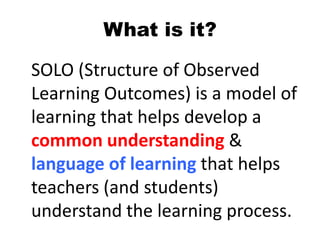
SOLO (Structure of Observed
Learning Outcomes) is a model of
learning that helps develop a
common understanding &
language of learning that helps
teachers (and students)
understand the learning process.
Volunteers!
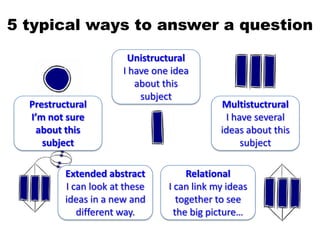
5 typical ways to answer a question
Prestructural
I’m not sure
about this
subject
Unistructural
I have one idea
about this
subject
Multistuctrural
I have several
ideas about this
subject
Relational
I can link my ideas
together to see
the big picture…
Extended abstract
I can look at these
ideas in a new and
different way.
With SOLO we can…
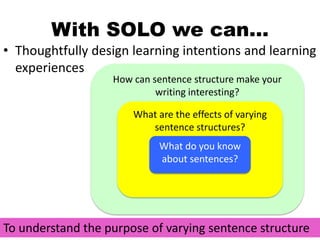
• Thoughtfully design learning intentions and learning
experiences
How can sentence structure make your
writing interesting?
What are the effects of varying
sentence structures?
What do you know
about sentences?
To understand the purpose of varying sentence structure
With SOLO we can…
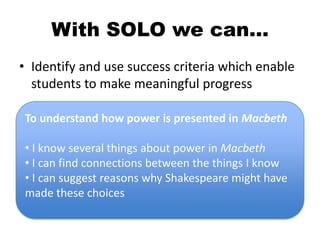
• Identify and use success criteria which enable
students to make meaningful progress
To understand how power is presented in Macbeth
• I know several things about power in Macbeth
• I can find connections between the things I know
• I can suggest reasons why Shakespeare might have
made these choices
With SOLO we can…
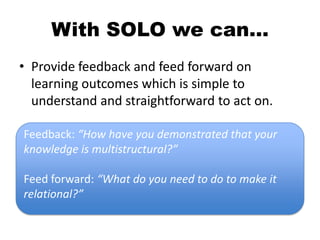
• Provide feedback and feed forward on
learning outcomes which is simple to
understand and straightforward to act on.
Feedback: “How have you demonstrated that your
knowledge is multistructural?”
Feed forward: “What do you need to do to make it
relational?”
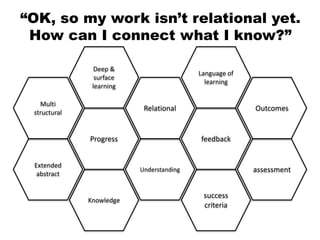
“OK, so my work isn’t relational yet.
How can I connect what I know?”
Progress
Relational
Understanding
feedback
Deep &
surface
learning
Extended
abstract
Multi
structural
Knowledge
success
criteria
Language of
learning
assessment
Outcomes
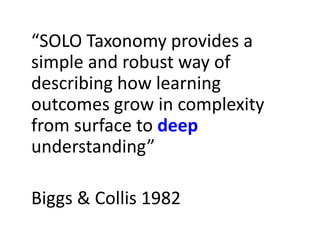
“SOLO Taxonomy provides a
simple and robust way of
describing how learning
outcomes grow in complexity
from surface to deep
understanding”
Biggs & Collis 1982
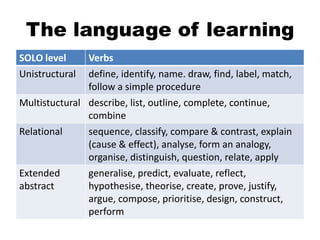
The language of learning
SOLO level Verbs
Unistructural define, identify, name. draw, find, label, match,
follow a simple procedure
Multistuctural describe, list, outline, complete, continue,
combine
Relational sequence, classify, compare & contrast, explain
(cause & effect), analyse, form an analogy,
organise, distinguish, question, relate, apply
Extended
abstract
generalise, predict, evaluate, reflect,
hypothesise, theorise, create, prove, justify,
argue, compose, prioritise, design, construct,
perform
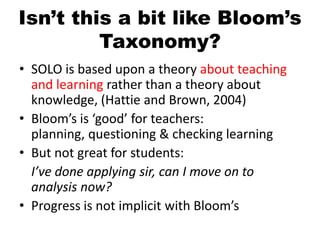
Isn’t this a bit like Bloom’s
Taxonomy?
• SOLO is based upon a theory about teaching
and learning rather than a theory about
knowledge, (Hattie and Brown, 2004)
• Bloom’s is ‘good’ for teachers:
planning, questioning & checking learning
• But not great for students:
I’ve done applying sir, can I move on to
analysis now?
• Progress is not implicit with Bloom’s
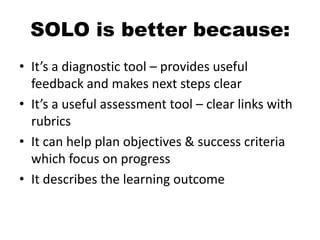
SOLO is better because:
• It’s a diagnostic tool – provides useful
feedback and makes next steps clear
• It’s a useful assessment tool – clear links with
rubrics
• It can help plan objectives & success criteria
which focus on progress
• It describes the learning outcome
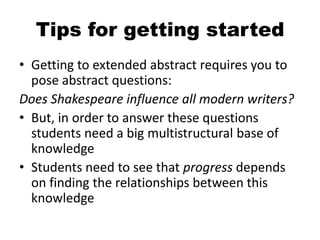
Tips for getting started
• Getting to extended abstract requires you to
pose abstract questions:
Does Shakespeare influence all modern writers?
• But, in order to answer these questions
students need a big multistructural base of
knowledge
• Students need to see that progress depends
on finding the relationships between this
knowledge
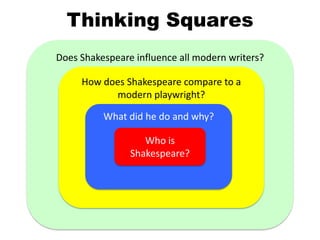
Does Shakespeare influence all modern writers?
How does Shakespeare compare to a
modern playwright?
Thinking Squares
What did he do and why?
Who is
Shakespeare?
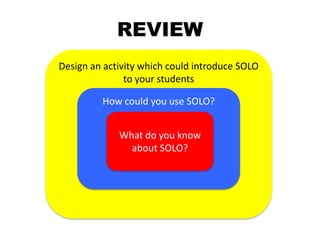
REVIEW
Design an activity which could introduce SOLO
to your students
How could you use SOLO?
What do you know
about SOLO?
With SOLO we can…
• thoughtfully design learning intentions and
learning experiences
• identify and use effective success criteria
• provide feedback and feed forward on
learning outcomes
• reflect meaningfully on what to do next
Next steps
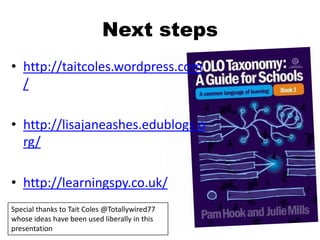
• http://taitcoles.wordpress.com
/
• http://lisajaneashes.edublogs.o
rg/
• http://learningspy.co.uk/
Special thanks to Tait Coles @Totallywired77
whose ideas have been used liberally in this
presentation

Inset May 2013 solo SLL

  • 1.
  • 2.
    What is it? SOLO(Structure of Observed Learning Outcomes) is a model of learning that helps develop a common understanding & language of learning that helps teachers (and students) understand the learning process.
  • 3.
  • 4.
    5 typical waysto answer a question Prestructural I’m not sure about this subject Unistructural I have one idea about this subject Multistuctrural I have several ideas about this subject Relational I can link my ideas together to see the big picture… Extended abstract I can look at these ideas in a new and different way.
  • 5.
    With SOLO wecan… • Thoughtfully design learning intentions and learning experiences How can sentence structure make your writing interesting? What are the effects of varying sentence structures? What do you know about sentences? To understand the purpose of varying sentence structure
  • 6.
    With SOLO wecan… • Identify and use success criteria which enable students to make meaningful progress To understand how power is presented in Macbeth • I know several things about power in Macbeth • I can find connections between the things I know • I can suggest reasons why Shakespeare might have made these choices
  • 7.
    With SOLO wecan… • Provide feedback and feed forward on learning outcomes which is simple to understand and straightforward to act on. Feedback: “How have you demonstrated that your knowledge is multistructural?” Feed forward: “What do you need to do to make it relational?”
  • 8.
    “OK, so mywork isn’t relational yet. How can I connect what I know?” Progress Relational Understanding feedback Deep & surface learning Extended abstract Multi structural Knowledge success criteria Language of learning assessment Outcomes
  • 9.
    “SOLO Taxonomy providesa simple and robust way of describing how learning outcomes grow in complexity from surface to deep understanding” Biggs & Collis 1982
  • 10.
    The language oflearning SOLO level Verbs Unistructural define, identify, name. draw, find, label, match, follow a simple procedure Multistuctural describe, list, outline, complete, continue, combine Relational sequence, classify, compare & contrast, explain (cause & effect), analyse, form an analogy, organise, distinguish, question, relate, apply Extended abstract generalise, predict, evaluate, reflect, hypothesise, theorise, create, prove, justify, argue, compose, prioritise, design, construct, perform
  • 11.
    Isn’t this abit like Bloom’s Taxonomy? • SOLO is based upon a theory about teaching and learning rather than a theory about knowledge, (Hattie and Brown, 2004) • Bloom’s is ‘good’ for teachers: planning, questioning & checking learning • But not great for students: I’ve done applying sir, can I move on to analysis now? • Progress is not implicit with Bloom’s
  • 12.
    SOLO is betterbecause: • It’s a diagnostic tool – provides useful feedback and makes next steps clear • It’s a useful assessment tool – clear links with rubrics • It can help plan objectives & success criteria which focus on progress • It describes the learning outcome
  • 13.
    Tips for gettingstarted • Getting to extended abstract requires you to pose abstract questions: Does Shakespeare influence all modern writers? • But, in order to answer these questions students need a big multistructural base of knowledge • Students need to see that progress depends on finding the relationships between this knowledge
  • 14.
    Does Shakespeare influenceall modern writers? How does Shakespeare compare to a modern playwright? Thinking Squares What did he do and why? Who is Shakespeare?
  • 15.
    REVIEW Design an activitywhich could introduce SOLO to your students How could you use SOLO? What do you know about SOLO?
  • 16.
    With SOLO wecan… • thoughtfully design learning intentions and learning experiences • identify and use effective success criteria • provide feedback and feed forward on learning outcomes • reflect meaningfully on what to do next
  • 17.
    Next steps • http://taitcoles.wordpress.com / •http://lisajaneashes.edublogs.o rg/ • http://learningspy.co.uk/ Special thanks to Tait Coles @Totallywired77 whose ideas have been used liberally in this presentation

Editor's Notes

  • #3 It’s about transferring knowledge from surface learning to deep learning, finding common knowledge between them and using a language of learning that we can all share.
  • #5 Prestructural – not sure, it’s where we start off (e.g. what is a volcano?)Unistructural– it’s where we have one idea about something (e.g. lava comes out of volcanos,It’s a bit like a mountain, the lava that comes out is molten rock)Their knowledge (the three things) becomes multi structural. Multi structural – there are several strands of things that they know. We now know that lava comes out of volcanos, it’s a bit like a mountain, the lava that comes out is molten rock. Building up that multi structural base is vital, you can’t go much further without it. A lot of what we do in the classroom is about extending that multi structural knowledge. But it only stays on the surface unless we try and link those ideas together.Relational We then move on to the relational stage where we begin to relate these ideas together. The volcano is a bit like a mountain because the lava comes out of it and because it’s molten rock it cools and forms that mountain shape. He can usefully link those ideas together. It’s much more likely that that knowledge will stick because he understands the relationship between them. Extended abstract – we can hypothesize, we can start to think about ‘what would happen if there was water inside instead of lava? We know it wouldn’t make a mountain shape – what would happen?
  • #6 Thinking squares
  • #7 Once they are familiar with it you can use the language of SOLO Taxonomy with your pupils. ‘I want your understanding of the power in MacBeth to move from unistructural to multistructural.’ And they will know that they have to connect their ideas together.
  • #8 It is great for providing feedback – ‘so you know these features of volcanos, but can you connect them on a multi structural level?’
  • #9 Laminated hexagons for a subject area, making links between the things that they know, making connections. Moving from multi structural to relational, from surface to deep thinking.
  • #12 Blooms. The difference is that SOLO is based on a theory of teaching and learning and Blooms is about knowledge. Blooms is great for teaching, for planning and questioning, it’s not so good for students, you don’t hear them say ‘I’ve done applying now Miss, can I move on to analysing?’ SOLO provides clear links with mark schemes. It focuses on progress