UNIT – I
INTRODUCTION – THEORY AND BEHAVIOUR
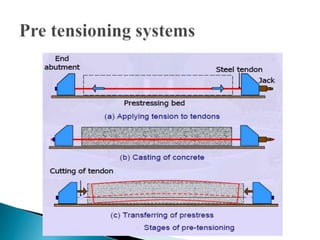
 Pre tensioning system
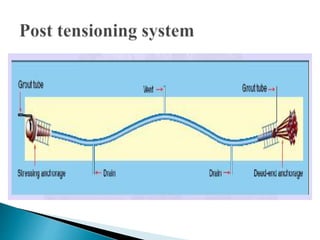
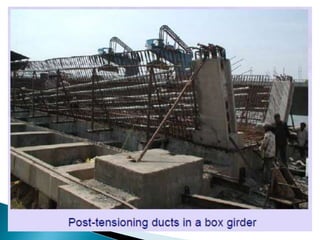
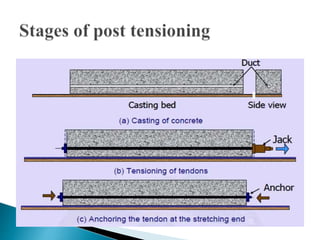
 Post tensioning system
 The various types of devices used for tensioning steel
are grouped under four principal catagories.
◦ Mechanical
◦ Hydraulic
◦ Electrical or Thermal
◦ Chemical
Mechanical devices Hydraulic devices
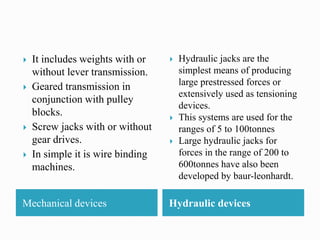
 It includes weights with or
without lever transmission.
 Geared transmission in
conjunction with pulley
blocks.
 Screw jacks with or without
gear drives.
 In simple it is wire binding
machines.
 Hydraulic jacks are the
simplest means of producing
large prestressed forces or
extensively used as tensioning
devices.
 This systems are used for the
ranges of 5 to 100tonnes
 Large hydraulic jacks for
forces in the range of 200 to
600tonnes have also been
developed by baur-leonhardt.
Electrical or Thermal devices Chemical devices
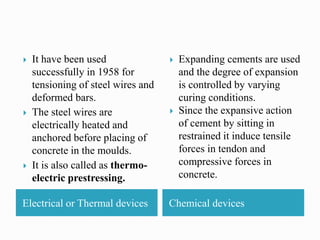
 It have been used
successfully in 1958 for
tensioning of steel wires and
deformed bars.
 The steel wires are
electrically heated and
anchored before placing of
concrete in the moulds.
 It is also called as thermo-
electric prestressing.
 Expanding cements are used
and the degree of expansion
is controlled by varying
curing conditions.
 Since the expansive action
of cement by sitting in
restrained it induce tensile
forces in tendon and
compressive forces in
concrete.
 Freyssinet anchorage system
 Gifford Udall systems
 Lee-McCall systems
 Magnel blaton system
 BBRV system
 Baur Leonhardt system
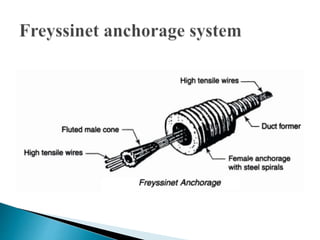
 This system is widely used in Europe and India
 It consists of a cylinder with a conical interior through
which the high tensile wires pass and against the walls
of which the wedged by a conical plug lined
longitudinally with grooves to house the wires.
 The main advantage of this system is that a large
number of wires or strands can be simultaneously
tensioned using double acting hydraulic jacks.
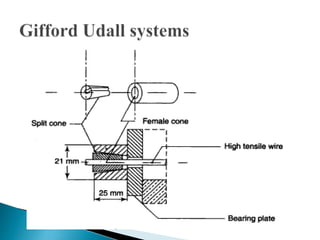
 It is developed in UK.
 It consists of steel split cone and cylindrical female
cone anchorages to house the high tensile wires bearing
against steel plates.
 Each wire is tensioned separately and anchored by
forcing a sleeve wedge into a cylindrical grip resting
against a bearing plate.
 The ducts are generally formed by metal sheaths cast
into the concrete member.
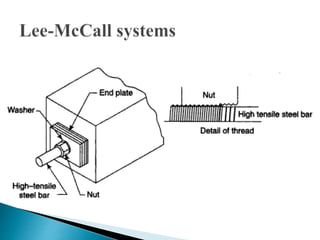
 In this method, the tendons comprise high tensile bars
of diameter varying from 12 to 40mm which are
threaded at the ends.
 After tensioning, each bar is anchored by screwing a
nut and washer tightly against the end plates.
 In this system the forces are transmitted by the bearing
at the end blocks.
 While the system eliminates the loss of stress due to
anchorage slip, it has a disadvantage in that curved
tendons cannot be used.
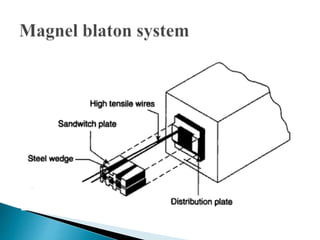
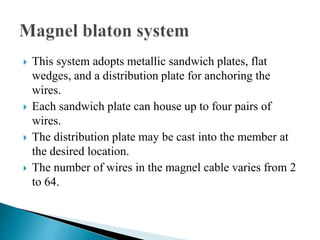
 This system adopts metallic sandwich plates, flat
wedges, and a distribution plate for anchoring the
wires.
 Each sandwich plate can house up to four pairs of
wires.
 The distribution plate may be cast into the member at
the desired location.
 The number of wires in the magnel cable varies from 2
to 64.
 This system is well suited for transmitting large forces.
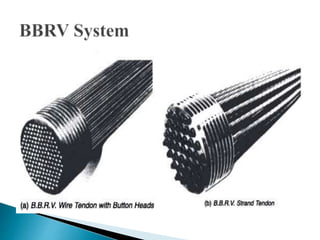
 A BBRV tendon consists of several parallel lengths of
high tensile wires, with each end terminating in cold
formed button head with a machined anchorage fixture.
 In the case of tendons formed by strands, they are
anchored to the machined fixture by split cone sleeves.

Unit 1 anchorage systems

  • 1.
    UNIT – I INTRODUCTION– THEORY AND BEHAVIOUR
  • 2.
     Pre tensioningsystem  Post tensioning system
  • 8.
     The varioustypes of devices used for tensioning steel are grouped under four principal catagories. ◦ Mechanical ◦ Hydraulic ◦ Electrical or Thermal ◦ Chemical
  • 9.
    Mechanical devices Hydraulicdevices  It includes weights with or without lever transmission.  Geared transmission in conjunction with pulley blocks.  Screw jacks with or without gear drives.  In simple it is wire binding machines.  Hydraulic jacks are the simplest means of producing large prestressed forces or extensively used as tensioning devices.  This systems are used for the ranges of 5 to 100tonnes  Large hydraulic jacks for forces in the range of 200 to 600tonnes have also been developed by baur-leonhardt.
  • 10.
    Electrical or Thermaldevices Chemical devices  It have been used successfully in 1958 for tensioning of steel wires and deformed bars.  The steel wires are electrically heated and anchored before placing of concrete in the moulds.  It is also called as thermo- electric prestressing.  Expanding cements are used and the degree of expansion is controlled by varying curing conditions.  Since the expansive action of cement by sitting in restrained it induce tensile forces in tendon and compressive forces in concrete.
  • 11.
     Freyssinet anchoragesystem  Gifford Udall systems  Lee-McCall systems  Magnel blaton system  BBRV system  Baur Leonhardt system
  • 13.
     This systemis widely used in Europe and India  It consists of a cylinder with a conical interior through which the high tensile wires pass and against the walls of which the wedged by a conical plug lined longitudinally with grooves to house the wires.  The main advantage of this system is that a large number of wires or strands can be simultaneously tensioned using double acting hydraulic jacks.
  • 15.
     It isdeveloped in UK.  It consists of steel split cone and cylindrical female cone anchorages to house the high tensile wires bearing against steel plates.  Each wire is tensioned separately and anchored by forcing a sleeve wedge into a cylindrical grip resting against a bearing plate.  The ducts are generally formed by metal sheaths cast into the concrete member.
  • 17.
     In thismethod, the tendons comprise high tensile bars of diameter varying from 12 to 40mm which are threaded at the ends.  After tensioning, each bar is anchored by screwing a nut and washer tightly against the end plates.  In this system the forces are transmitted by the bearing at the end blocks.  While the system eliminates the loss of stress due to anchorage slip, it has a disadvantage in that curved tendons cannot be used.
  • 19.
     This systemadopts metallic sandwich plates, flat wedges, and a distribution plate for anchoring the wires.  Each sandwich plate can house up to four pairs of wires.  The distribution plate may be cast into the member at the desired location.  The number of wires in the magnel cable varies from 2 to 64.
  • 21.
     This systemis well suited for transmitting large forces.  A BBRV tendon consists of several parallel lengths of high tensile wires, with each end terminating in cold formed button head with a machined anchorage fixture.  In the case of tendons formed by strands, they are anchored to the machined fixture by split cone sleeves.