2017-18
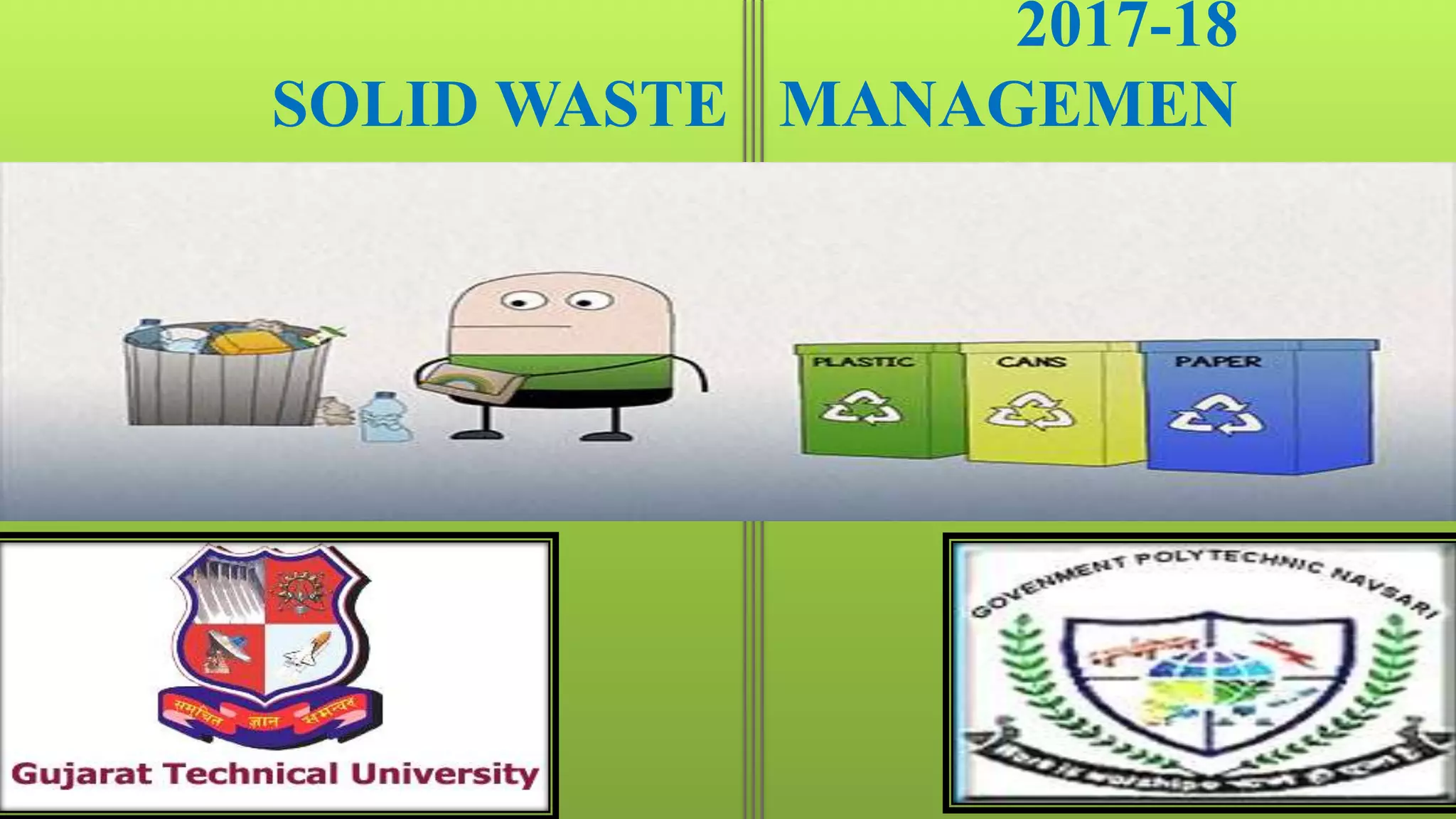
SOLID WASTE MANAGEMEN
T
A PROJECT REPORT ON
“SOLID WASTE MANAGEMENT – A CASE STUDY”
In partial fulfillment for the award of the degree of DIPLOMA IN CIVIL
ENGINEERING.
Submitted by:
1. PATEL CHIRAG A. 139754306001
2. DUMASIA KUNTAL M. 149750306005
3. PATEL DARSHANKUMAR B. 149750306026
4. PATEL RUSHABHKUMAR R. 149750306039
5. PRAJAPATI NISHANTKUMAR A. 149750306047
6. SARVAIYA NIKUNJ N. 149750306051
7. SHARMA RAJKUMAR S. 149750306052
8. VORA MOHIT V. 149750306058
9. PATEL KEVALKUMAR B. 159758306007
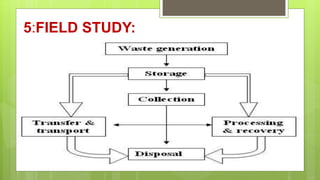
5:FIELD STUDY:
 Waste can be segregated easily.
 collected by the society.
 organic waste can be collected in Green coloured dustbin and the Red one.
 the municipal truck arrives, the collection people comes to know the
segregation and proper action can be taken so that mixing of waste does not
take place.
 Dry waste can be collected separately.
 Minimum odour & more cleanliness during transportation of waste.
 Better health & hygiene conditions of the people.
 Organic waste can be directly dumped / composted / landfill / used for
Power generation etc.
 segregation there will be cleanliness in the surrounding &
in the environment where it is stored.
 Dry waste can further be processed as per the requirements.
 Various alternatives can be designed for disposal.
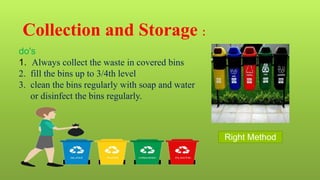
Collection and Storage :
do's
1. Always collect the waste in covered bins
2. fill the bins up to 3/4th level
3. clean the bins regularly with soap and water
or disinfect the bins regularly.
Right Method
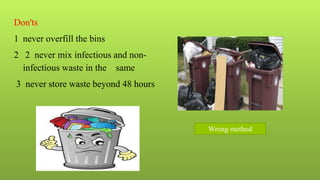
Don'ts
1 never overfill the bins
2 2 never mix infectious and non-
infectious waste in the same
3 never store waste beyond 48 hours
Wrong method
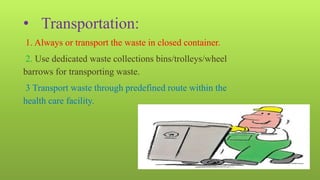
• Transportation:
1. Always or transport the waste in closed container.
2. Use dedicated waste collections bins/trolleys/wheel
barrows for transporting waste.
3 Transport waste through predefined route within the
health care facility.
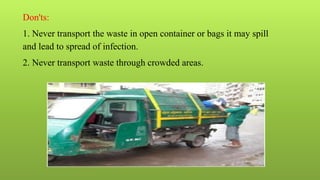
Don'ts:
1. Never transport the waste in open container or bags it may spill
and lead to spread of infection.
2. Never transport waste through crowded areas.
Treatment and disposal:
Do's:
1. Always remember to disinfect and mutilate the waste before its final disposal.
2. remember the following while treating the waste streams
3. A.anatomical waste to be deep buried lincinerated
4. syrings to be cut (with hub cutters) and chemically disinfected with 1%
bleaching powder solution at source of generation before final disposal into
shapes pit.
5. General waste without any treatment to be sent to municipal dumps for final
disposal.
Don'ts:
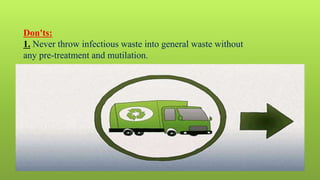
1. Never throw infectious waste into general waste without
any pre-treatment and mutilation.
 OVERVIEW OF MUNICIPAL SOLID WASTE
MANAGEMENT SYSTEM OF NAVSARI :
 First the storage of waste at site near to bandar road’
 The area of site is 8 vigha.
 Comprehensive waste management system to collect around 65 TO 70
TPD of municipal solid waste from city has been designed over the time
and consist of following components:
 The collection of waste is done by mehod of Door To Door.
 Primary collection and transportation of MSW
Transfer station and secondary transportation of MSW
Treatment of MSW
Final disposal of MSW
Solid waste management of Chhapra village:
 Chhapra village is located about 2 TO 4 km. From the Navsari. In
this village, we have studied about solid waste management of this
village which is divided into two parts:
1. Solid waste management
2. Biomedical waste management
Basic info. About village:
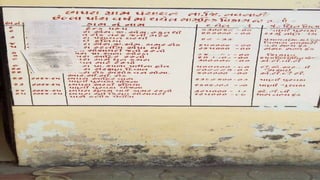
o Total population: 13,398
o Male population: 7398
o Female population: 6000
o Male – (94.46 %)
o Female – (89.52 %)
o Main occupation: Farming
o Society - 31
o Numbers of temple: 6
o Sarpanch: Hasumatiben Rakeshbhai Patel
o Number of schools: 1
o Number of hospitals: 1
o Bank- 4
o Number of garden: 1
o Panchayat established - 1960 Years
 procedure of solid waste management of this village :
o Basically there is no proper way of management done by this village.
o The way village doing solid waste management is by following ways:
o Collection
o Direct disposal
 Collection:
o In this village for collection following things are done:
o Door to door:
o About 1 trailers attached to tractors and 5 collection bins are used
o Collection is done l time in 2 days
 Disposal:
o Here there is no proper process of disposal of solid waste
collected but here they dumped these waste on open ground
o The open ground which is allocated for cow feeds is used for
solid waste disposal
o 8 vigha
o For supervision 5 men are provided jobs fro it
o Here for disposal 2 methods are employed there
o Underground disposal
o Surface disposal
Bio- medical waste management in this village:
Here in this village there is a proper management, but due to
village far from the city it becomes little difficult to maintain and
transfer the waste to the treatment plant. Basically presently there
is no way to counter this. Present system of bio- medical waste is
done in 4 steps:
 Collection
 Storage
 Treatment
 Transportation
 Disposal
FIELD STUDY OF CHHAPRA VILLAGE :
 Though limited to house hold garbage enervated in Chhapra village near
lunsikui, Navsari .
 The scope of study is applicable to most villages with special hasis on the
solid waste management cycle from collection to ultimate disposal.
 Other area of focus includes the economic value of garbage generated from
house hold in addition to identifying the potential of establishing a plastic
waste collection center.
 We will try to suggest feasible and economical viable solution for solid waste
disposal at Chhapra village in safe manner.
 This report is based on the findings of a case study of Chhapra village
practicing no proper solid waste disposal.
 Initial Data, which includes interviews with residents, photos of waste
disposal, collected in February 2016 hints at potentially hazardous
environmental situation.
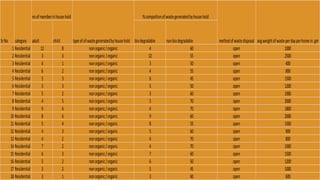
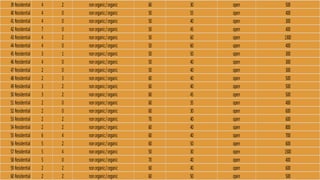
adult child biodegradable nonbiodegradable
1 Residential 12 8 nonorganic/organic 4 60 open 1000
2 Residential 3 3 nonorganic/organic 12 55 open 2500
3 Residential 4 1 nonorganic/organic 3 50 open 400
4 Residential 6 2 nonorganic/organic 4 55 open 800
5 Residential 5 3 nonorganic/organic 6 45 open 1500
6 Residential 3 3 nonorganic/organic 5 50 open 1200
7 Residential 5 2 nonorganic/organic 3 60 open 1000
8 Residential 4 5 nonorganic/organic 5 70 open 2000
9 Residential 9 6 nonorganic/organic 4 70 open 1800
10 Residential 8 6 nonorganic/organic 9 60 open 2000
11 Residential 5 4 nonorganic/organic 8 55 open 1500
12 Residential 4 3 nonorganic/organic 5 60 open 900
13 Residential 4 2 nonorganic/organic 4 70 open 800
14 Residential 7 2 nonorganic/organic 4 70 open 1000
15 Residential 6 3 nonorganic/organic 7 60 open 1500
16 Residential 5 2 nonorganic/organic 6 50 open 1200
17 Residential 3 2 nonorganic/organic 5 45 open 1000
18 Residential 3 1 nonorganic/organic 3 60 open 600
methodofwastedisposal avg.weightofwasteperdayperhomein.gmSrNo category
noofmemberinhousehold
typeofofwastegeneratedbyhousehold
%compoitionofwastegeneratedbyhousehold
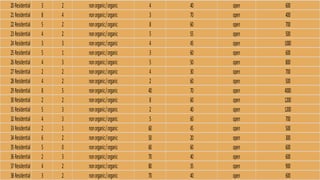
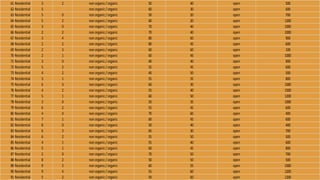
20Residential 3 2 nonorganic/organic 4 40 open 600
21Residential 8 4 nonorganic/organic 3 70 open 400
22Residential 5 2 nonorganic/organic 8 60 open 700
23Residential 4 2 nonorganic/organic 5 55 open 500
24Residential 3 3 nonorganic/organic 4 45 open 1000
25Residential 5 1 nonorganic/organic 3 60 open 600
26Residential 4 3 nonorganic/organic 5 50 open 800
27Residential 2 2 nonorganic/organic 4 30 open 700
28Residential 4 2 nonorganic/organic 2 60 open 500
29Residential 8 5 nonorganic/organic 40 70 open 4000
30Residential 2 2 nonorganic/organic 8 60 open 1200
31Residential 5 3 nonorganic/organic 2 40 open 1200
32Residential 4 3 nonorganic/organic 5 60 open 700
33Residential 2 1 nonorganic/organic 60 45 open 500
34Residential 6 2 nonorganic/organic 50 20 open 300
35Residential 5 0 nonorganic/organic 60 60 open 600
36Residential 2 3 nonorganic/organic 70 40 open 600
37Residential 4 2 nonorganic/organic 80 35 open 900
38Residential 3 2 nonorganic/organic 70 40 open 600
39 Residential 4 2 nonorganic/organic 60 30 open 500
40 Residential 4 0 nonorganic/organic 50 55 open 400
41 Residential 4 0 nonorganic/organic 50 40 open 300
42 Residential 7 0 nonorganic/organic 50 45 open 400
43 Residential 4 2 nonorganic/organic 50 60 open 1300
44 Residential 4 0 nonorganic/organic 50 60 open 400
45 Residential 3 1 nonorganic/organic 50 50 open 300
46 Residential 4 0 nonorganic/organic 50 40 open 300
47 Residential 2 0 nonorganic/organic 50 40 open 300
48 Residential 2 3 nonorganic/organic 60 40 open 500
49 Residential 3 2 nonorganic/organic 60 40 open 500
50 Residential 3 2 nonorganic/organic 60 45 open 500
51 Residential 2 0 nonorganic/organic 60 35 open 400
52 Residential 2 0 nonorganic/organic 60 30 open 600
53 Residential 2 2 nonorganic/organic 70 40 open 600
54 Residential 2 2 nonorganic/organic 60 40 open 800
55 Residential 6 4 nonorganic/organic 60 40 open 700
56 Residential 5 2 nonorganic/organic 60 50 open 600
57 Residential 5 4 nonorganic/organic 50 30 open 1500
58 Residential 5 0 nonorganic/organic 70 40 open 400
59 Residential 2 2 nonorganic/organic 60 40 open 600
60 Residential 2 2 nonorganic/organic 60 50 open 500
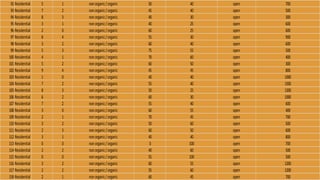
61 Residential 3 2 non organic/ organic 50 40 open 500
62 Residential 5 non organic/ organic 60 30 open 600
63 Residential 5 0 non organic/ organic 50 20 open 700
64 Residential 5 2 non organic/ organic 60 20 open 1200
65 Residential 3 0 non organic/ organic 70 40 open 1000
66 Residential 2 2 non organic/ organic 70 40 open 1000
67 Residential 3 4 non organic/ organic 80 60 open 900
68 Residential 2 2 non organic/ organic 80 45 open 600
69 Residential 2 3 non organic/ organic 60 60 open 100
70 Residential 2 1 non organic/ organic 60 45 open 1000
71 Residential 3 0 non organic/ organic 40 40 open 900
72 Residential 5 2 non organic/ organic 55 45 open 600
73 Residential 4 2 non organic/ organic 40 50 open 500
74 Residential 3 1 non organic/ organic 55 35 open 800
75 Residential 6 3 non organic/ organic 60 30 open 1000
76 Residential 4 2 non organic/ organic 55 40 open 1500
77 Residential 5 1 non organic/ organic 60 50 open 1200
78 Residential 3 0 non organic/ organic 50 35 open 1000
79 Residential 6 2 non organic/ organic 55 45 open 600
80 Residential 4 0 non organic/ organic 70 60 open 400
81 Residential 7 1 non organic/ organic 60 45 open 600
82 Residential 8 0 non organic/ organic 50 40 open 400
83 Residential 6 3 non organic/ organic 65 30 open 700
84 Residential 6 2 non organic/ organic 55 50 open 500
85 Residential 4 1 non organic/ organic 55 40 open 600
86 Residential 5 1 non organic/ organic 60 45 open 800
87 Residential 2 0 non organic/ organic 70 50 open 700
88 Residential 8 2 non organic/ organic 50 50 open 500
89 Residential 9 3 non organic/ organic 60 55 open 1000
90 Residential 9 4 non organic/ organic 55 60 open 1200
91 Residential 5 2 non organic/ organic 50 60 open 1200
92 Residential 5 1 nonorganic/organic 50 40 open 700
93 Residential 7 2 nonorganic/organic 45 40 open 500
94 Residential 8 3 nonorganic/organic 40 30 open 300
95 Residential 3 1 nonorganic/organic 40 25 open 600
96 Residential 2 0 nonorganic/organic 60 25 open 600
97 Residential 8 4 nonorganic/organic 55 30 open 900
98 Residential 3 2 nonorganic/organic 60 40 open 600
99 Residential 5 3 nonorganic/organic 75 55 open 500
100 Residential 4 1 nonorganic/organic 70 60 open 400
101 Residential 5 2 nonorganic/organic 60 50 open 300
102 Residential 9 4 nonorganic/organic 45 45 open 800
103 Residential 1 0 nonorganic/organic 40 40 open 1000
104 Residential 7 2 nonorganic/organic 55 40 open 1500
105 Residential 8 3 nonorganic/organic 50 25 open 1200
106 Residential 6 2 nonorganic/organic 60 30 open 1000
107 Residential 7 2 nonorganic/organic 55 40 open 600
108 Residential 3 0 nonorganic/organic 60 55 open 400
109 Residential 2 1 nonorganic/organic 70 45 open 700
110 Residential 3 2 nonorganic/organic 50 60 open 500
111 Residential 2 3 nonorganic/organic 60 50 open 600
112 Residential 3 1 nonorganic/organic 40 40 open 800
113 Residential 0 0 nonorganic/organic 0 100 open 700
114 Residential 2 2 nonorganic/organic 40 60 open 500
115 Residential 0 0 nonorganic/organic 55 100 open 500
116 Residential 3 2 nonorganic/organic 60 55 open 1200
117 Residential 2 2 nonorganic/organic 55 60 open 1200
118 Residential 2 1 nonorganic/organic 60 45 open 700
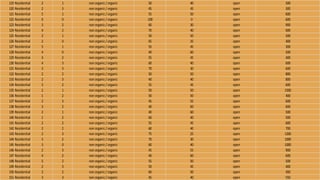
119 Residential 2 1 non organic/ organic 50 40 open 500
120 Residential 2 3 non organic/ organic 45 45 open 300
121 Residential 5 1 non organic/ organic 55 50 open 600
122 Residential 0 0 non organic/ organic 100 0 open 600
123 Residential 3 2 non organic/ organic 60 30 open 900
124 Residential 4 2 non organic/ organic 70 40 open 600
125 Residential 2 1 non organic/ organic 50 50 open 500
126 Residential 2 0 non organic/ organic 65 35 open 400
127 Residential 5 1 non organic/ organic 55 45 open 300
128 Residential 4 0 non organic/ organic 40 60 open 500
129 Residential 3 2 non organic/ organic 55 45 open 400
130 Residential 4 3 non organic/ organic 60 40 open 600
131 Residential 3 3 non organic/ organic 70 30 open 600
132 Residential 2 2 non organic/ organic 50 50 open 800
133 Residential 2 3 non organic/ organic 40 40 open 800
134 Residential 3 2 non organic/ organic 55 45 open 600
135 Residential 2 1 non organic/ organic 50 50 open 1500
136 Residential 1 2 non organic/ organic 50 50 open 400
137 Residential 2 3 non organic/ organic 45 55 open 600
138 Residential 3 2 non organic/ organic 40 60 open 600
139 Residential 2 1 non organic/ organic 40 60 open 500
140 Residential 1 2 non organic/ organic 60 40 open 500
141 Residential 2 2 non organic/ organic 55 45 open 600
142 Residential 2 2 non organic/ organic 60 40 open 700
143 Residential 2 3 non organic/ organic 75 25 open 1200
144 Residential 3 2 non organic/ organic 70 30 open 1000
145 Residential 3 0 non organic/ organic 60 40 open 1000
146 Residential 2 3 non organic/ organic 45 55 open 900
147 Residential 4 2 non organic/ organic 40 60 open 600
148 Residential 5 2 non organic/ organic 55 50 open 500
149 Residential 2 3 non organic/ organic 50 45 open 400
150 Residential 2 2 non organic/ organic 60 50 open 450
151 Residential 3 3 non organic/ organic 45 40 open 550
INFRASTRUCTURAL SHORTAGE :
 Village neither have proper facility to dispose the waste nor have segregating
facility.
 There are only five rectangular waste bin in village
 Village does not have proper Waste collection system
 Provision stores produce more non-biodegradable waste and do not dispose that
waste in proper way.
 Biodegradable waste is more in the household having no children or less number
of children. degradable waste is more in the household where children are more.
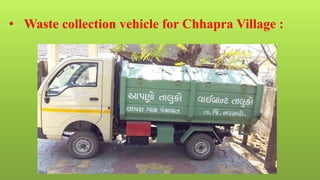
• Waste collection vehicle for Chhapra Village :
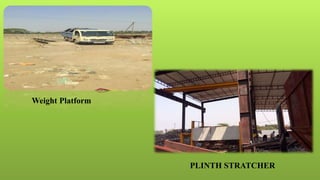
Weight Platform
PLINTH STRATCHER
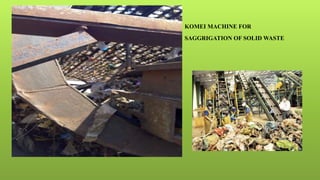
KOMEI MACHINE FOR
SAGGRIGATION OF SOLID WASTE
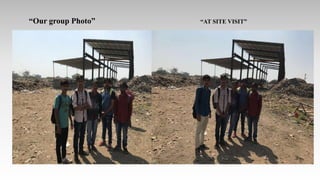
“Our group Photo” “AT SITE VISIT”
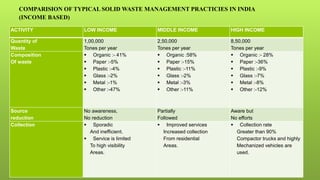
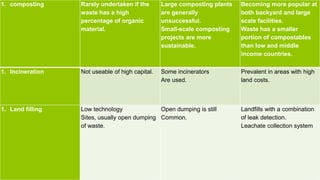
COMPARISION OF TYPICAL SOLID WASTE MANAGEMENT PRACTICIES IN INDIA
(INCOME BASED)
ACTIVITY LOW INCOME MIDDLE INCOME HIGH INCOME
Quantity of
Waste
1,00,000
Tones per year
2,50,000
Tones per year
8,50,000
Tones per year
Composition
Of waste
 Organic :- 41%
 Paper :-5%
 Plastic :-4%
 Glass :-2%
 Metal :-1%
 Other :-47%
 Organic :58%
 Paper :-15%
 Plastic :-11%
 Glass :-2%
 Metal :-3%
 Other :-11%
 Organic :- 28%
 Paper :-36%
 Plastic :-9%
 Glass :-7%
 Metal :-8%
 Other :-12%
Source
reduction
No awareness,
No reduction
Partially
Followed
Aware but
No efforts
Collection  Sporadic
And inefficient.
 Service is limited
To high visibility
Areas.
 Improved services
Increased collection
From residential
Areas.
 Collection rate
Greater than 90%
Compactor trucks and highly
Mechanized vehicles are
used.
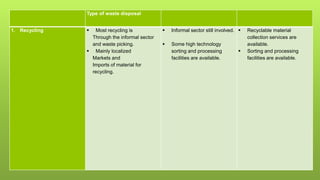
Type of waste disposal
1. Recycling  Most recycling is
Through the informal sector
and waste picking.
 Mainly localized
Markets and
Imports of material for
recycling.
 Informal sector still involved.
 Some high technology
sorting and processing
facilities are available.
 Recyclable material
collection services are
available.
 Sorting and processing
facilities are available.
1. composting Rarely undertaken if the
waste has a high
percentage of organic
material.
Large composting plants
are generally
unsuccessful.
Small-scale composting
projects are more
sustainable.
Becoming more popular at
both backyard and large
scale facilities.
Waste has a smaller
portion of compostables
than low and middle
income countries.
1. Incineration Not useable of high capital. Some incinerators
Are used.
Prevalent in areas with high
land costs.
1. Land filling Low technology
Sites, usually open dumping
of waste.
Open dumping is still
Common.
Landfills with a combination
of leak detection.
Leachate collection system
Solid waste management cost:
 In INDIA estimated waste generation is 1,00,000 MT/day
 In INDIA per capita efficiency in bigger sized cities ranges from
0.20 to 0.60 kg.
 Waste collection efficiency in bigger sized cities ranges from 70 to
90% and in small
 Sized towns it is up to 50-60%.
 Local authorized spend less than 5% of their budgt on waste
disposal and maximum
 Coat is incurred on street sweeping and collecting and
transportation of waste.
SOLID WASTE GENERATION RATES:
 Factors influence waste generation rates
1. Socioeconomic activities
2. Geographic locating
3. Standard of living
4. Climates.
 Greater the economic wealth and percentage of population,
greater is the amount of solid waste produced.
 Low income countries have the lowest waste generation
rates.
 Waste generation rate for low income countries increase by
approximately 0.2 kg per day.
 Packaging wastes, such as paper, plastic and glass, will increase as economy
improves.
 For middle income countries increase of about 0.3 kg/C.D is anticipated.
 Low and middle income countries have a high percentage of compostable
organic matter (40 to 85%) in waste generated.
 Overall, waste composition is predicted to become even more varied as the
percentage of compostable matter declines, and packaging waste, especially
paper and plastic, increase.
WASTE MANAGEMENT PRACTICIES IN RURAL INDIA:
SOLID WASTE GENERATION:
 Different activity may generate waste which may be solid of
liquid.
Generation of solid waste in rural areas is a major problem now
days.
 Generation of solid waste in rural areas ranges between 50
gm/cap/day 250 gm/cap/day as mentioned below:
Rural (peri-urban or urban outgrowth) 150 to 250 gm/cap/day
Desirable collection method:
The following process is desired to be done for solid waste collection in
rural area.
1. Household segregation (organic and inorganic: recyclables/non
recyclables.)
2. Household storage (in plastic containers)
3. Containerized collection (house to house)
4. Transportation (pedal tricycle /handcart/other types)
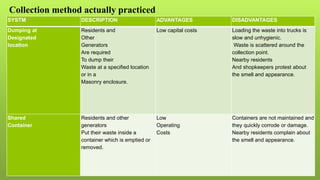
Collection method actually practiced
SYSTM DESCRIPTION ADVANTAGES DISADVANTAGES
Dumping at
Designated
location
Residents and
Other
Generators
Are required
To dump their
Waste at a specified location
or in a
Masonry enclosure.
Low capital costs Loading the waste into trucks is
slow and unhygienic.
Waste is scattered around the
collection point.
Nearby residents
And shopkeepers protest about
the smell and appearance.
Shared
Container
Residents and other
generators
Put their waste inside a
container which is emptied or
removed.
Low
Operating
Costs
Containers are not maintained and
they quickly corrode or damage.
Nearby residents complain about
the smell and appearance.
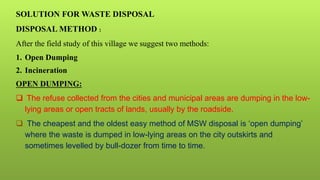
SOLUTION FOR WASTE DISPOSAL
DISPOSAL METHOD :
After the field study of this village we suggest two methods:
1. Open Dumping
2. Incineration
OPEN DUMPING:
 The refuse collected from the cities and municipal areas are dumping in the low-
lying areas or open tracts of lands, usually by the roadside.
 The cheapest and the oldest easy method of MSW disposal is ‘open dumping’
where the waste is dumped in low-lying areas on the city outskirts and
sometimes levelled by bull-dozer from time to time.
SUGGESTION INFORMATION ABOUT DISPOSAL SITE:
Location of site:
Area of site:
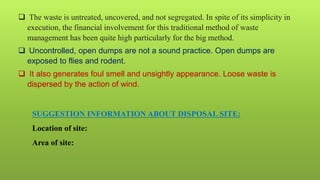
 The waste is untreated, uncovered, and not segregated. In spite of its simplicity in
execution, the financial involvement for this traditional method of waste
management has been quite high particularly for the big method.
 Uncontrolled, open dumps are not a sound practice. Open dumps are
exposed to flies and rodent.
 It also generates foul smell and unsightly appearance. Loose waste is
dispersed by the action of wind.
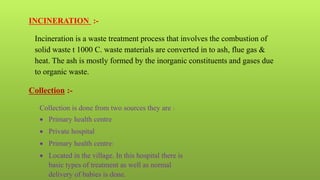
INCINERATION :-
Incineration is a waste treatment process that involves the combustion of
solid waste t 1000 C. waste materials are converted in to ash, flue gas &
heat. The ash is mostly formed by the inorganic constituents and gases due
to organic waste.
Collection :-
Collection is done from two sources they are :
 Primary health centre
 Private hospital
 Primary health centre:
 Located in the village. In this hospital there is
basic types of treatment as well as normal
delivery of babies is done.
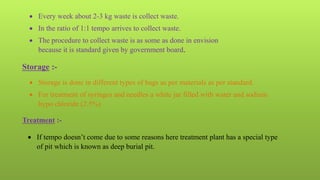
 Every week about 2-3 kg waste is collect waste.
 In the ratio of 1:1 tempo arrives to collect waste.
 The procedure to collect waste is as some as done in envision
because it is standard given by government board.
Storage :-
 Storage is done in different types of bags as per materials as per standard.
 For treatment of syringes and needles a white jar filled with water and sodium
hypo chloride (2.5%)
Treatment :-
 If tempo doesn’t come due to some reasons here treatment plant has a special type
of pit which is known as deep burial pit.
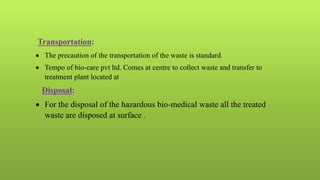
Transportation:
 The precaution of the transportation of the waste is standard.
 Tempo of bio-care pvt ltd. Comes at centre to collect waste and transfer to
treatment plant located at
Disposal:
 For the disposal of the hazardous bio-medical waste all the treated
waste are disposed at surface .
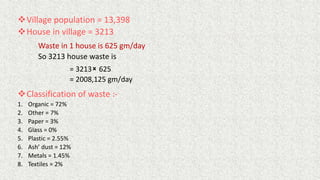
Village population = 13,398
House in village = 3213
Waste in 1 house is 625 gm/day
So 3213 house waste is
= 3213 625
= 2008,125 gm/day
Classification of waste :-
1. Organic = 72%
2. Other = 7%
3. Paper = 3%
4. Glass = 0%
5. Plastic = 2.55%
6. Ash’ dust = 12%
7. Metals = 1.45%
8. Textiles = 2%
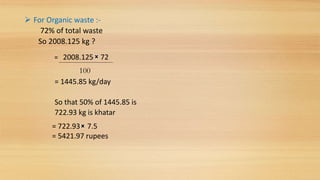
 For Organic waste :-
72% of total waste
So 2008.125 kg ?
= 2008.125 72
100
= 1445.85 kg/day
So that 50% of 1445.85 is
722.93 kg is khatar
= 722.93 7.5
= 5421.97 rupees
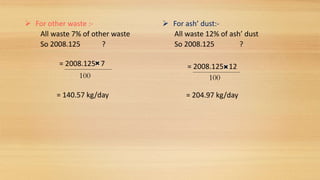
 For other waste :-
All waste 7% of other waste
So 2008.125 ?
= 2008.125 7
= 140.57 kg/day
100
 For ash’ dust:-
All waste 12% of ash’ dust
So 2008.125 ?
= 2008.125 12
100
= 204.97 kg/day
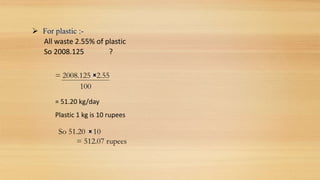
 For plastic :-
All waste 2.55% of plastic
So 2008.125 ?
= 2008.125 2.55
100
= 51.20 kg/day
Plastic 1 kg is 10 rupees
So 51.20 10
= 512.07 rupees
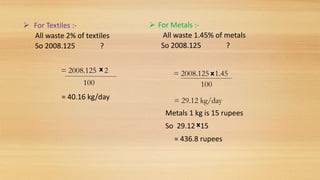
 For Textiles :-
All waste 2% of textiles
So 2008.125 ?
= 2008.125 2
100
= 40.16 kg/day
 For Metals :-
All waste 1.45% of metals
So 2008.125 ?
= 2008.125 1.45
100
= 29.12 kg/day
Metals 1 kg is 15 rupees
So 29.12 15
= 436.8 rupees
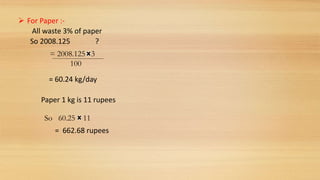
 For Paper :-
All waste 3% of paper
So 2008.125 ?
= 2008.125 3
100
= 60.24 kg/day
Paper 1 kg is 11 rupees
So 60.25 11
= 662.68 rupees
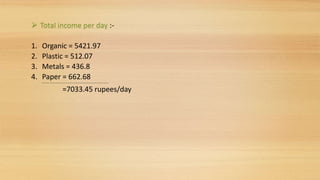
 Total income per day :-
1. Organic = 5421.97
2. Plastic = 512.07
3. Metals = 436.8
4. Paper = 662.68
=7033.45 rupees/day
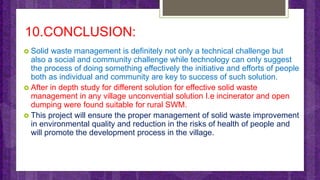
10.CONCLUSION:
 Solid waste management is definitely not only a technical challenge but
also a social and community challenge while technology can only suggest
the process of doing something effectively the initiative and efforts of people
both as individual and community are key to success of such solution.
 After in depth study for different solution for effective solid waste
management in any village unconvential solution I.e incinerator and open
dumping were found suitable for rural SWM.
 This project will ensure the proper management of solid waste improvement
in environmental quality and reduction in the risks of health of people and
will promote the development process in the village.
REFRENCES:
http://www.yourarticlelibrary.com/waste-management/solid-waste-management-types-sources-effects-
and-metods-of-solid-waste-management/9949/ -->
http://www.almitrapatel.com/supreme.htm
http://www.healthcarewaste.org
Solid and liquid waste management in Rural Area: a technical note report, New Delhi.
R.K Sinha 2005 “Solid waste management in India Book” vedams Books pvt. Ltd., NEW DELHI.
http://www.britannica.com
http://www.tatvaglobal.com
http://www.cyen.org
Solid waste management

Solid waste management

  • 1.
  • 2.
    A PROJECT REPORTON “SOLID WASTE MANAGEMENT – A CASE STUDY” In partial fulfillment for the award of the degree of DIPLOMA IN CIVIL ENGINEERING. Submitted by: 1. PATEL CHIRAG A. 139754306001 2. DUMASIA KUNTAL M. 149750306005 3. PATEL DARSHANKUMAR B. 149750306026 4. PATEL RUSHABHKUMAR R. 149750306039 5. PRAJAPATI NISHANTKUMAR A. 149750306047 6. SARVAIYA NIKUNJ N. 149750306051 7. SHARMA RAJKUMAR S. 149750306052 8. VORA MOHIT V. 149750306058 9. PATEL KEVALKUMAR B. 159758306007
  • 3.
  • 5.
     Waste canbe segregated easily.  collected by the society.  organic waste can be collected in Green coloured dustbin and the Red one.  the municipal truck arrives, the collection people comes to know the segregation and proper action can be taken so that mixing of waste does not take place.  Dry waste can be collected separately.
  • 7.
     Minimum odour& more cleanliness during transportation of waste.  Better health & hygiene conditions of the people.  Organic waste can be directly dumped / composted / landfill / used for Power generation etc.  segregation there will be cleanliness in the surrounding & in the environment where it is stored.  Dry waste can further be processed as per the requirements.  Various alternatives can be designed for disposal.
  • 8.
    Collection and Storage: do's 1. Always collect the waste in covered bins 2. fill the bins up to 3/4th level 3. clean the bins regularly with soap and water or disinfect the bins regularly. Right Method
  • 9.
    Don'ts 1 never overfillthe bins 2 2 never mix infectious and non- infectious waste in the same 3 never store waste beyond 48 hours Wrong method
  • 10.
    • Transportation: 1. Alwaysor transport the waste in closed container. 2. Use dedicated waste collections bins/trolleys/wheel barrows for transporting waste. 3 Transport waste through predefined route within the health care facility.
  • 11.
    Don'ts: 1. Never transportthe waste in open container or bags it may spill and lead to spread of infection. 2. Never transport waste through crowded areas.
  • 12.
    Treatment and disposal: Do's: 1.Always remember to disinfect and mutilate the waste before its final disposal. 2. remember the following while treating the waste streams 3. A.anatomical waste to be deep buried lincinerated 4. syrings to be cut (with hub cutters) and chemically disinfected with 1% bleaching powder solution at source of generation before final disposal into shapes pit. 5. General waste without any treatment to be sent to municipal dumps for final disposal.
  • 13.
    Don'ts: 1. Never throwinfectious waste into general waste without any pre-treatment and mutilation.
  • 14.
     OVERVIEW OFMUNICIPAL SOLID WASTE MANAGEMENT SYSTEM OF NAVSARI :  First the storage of waste at site near to bandar road’  The area of site is 8 vigha.  Comprehensive waste management system to collect around 65 TO 70 TPD of municipal solid waste from city has been designed over the time and consist of following components:  The collection of waste is done by mehod of Door To Door.  Primary collection and transportation of MSW Transfer station and secondary transportation of MSW Treatment of MSW Final disposal of MSW
  • 16.
    Solid waste managementof Chhapra village:  Chhapra village is located about 2 TO 4 km. From the Navsari. In this village, we have studied about solid waste management of this village which is divided into two parts: 1. Solid waste management 2. Biomedical waste management Basic info. About village: o Total population: 13,398 o Male population: 7398 o Female population: 6000 o Male – (94.46 %) o Female – (89.52 %)
  • 17.
    o Main occupation:Farming o Society - 31 o Numbers of temple: 6 o Sarpanch: Hasumatiben Rakeshbhai Patel o Number of schools: 1 o Number of hospitals: 1 o Bank- 4 o Number of garden: 1 o Panchayat established - 1960 Years
  • 18.
     procedure ofsolid waste management of this village : o Basically there is no proper way of management done by this village. o The way village doing solid waste management is by following ways: o Collection o Direct disposal  Collection: o In this village for collection following things are done: o Door to door: o About 1 trailers attached to tractors and 5 collection bins are used o Collection is done l time in 2 days
  • 19.
     Disposal: o Herethere is no proper process of disposal of solid waste collected but here they dumped these waste on open ground o The open ground which is allocated for cow feeds is used for solid waste disposal o 8 vigha o For supervision 5 men are provided jobs fro it o Here for disposal 2 methods are employed there o Underground disposal o Surface disposal
  • 20.
    Bio- medical wastemanagement in this village: Here in this village there is a proper management, but due to village far from the city it becomes little difficult to maintain and transfer the waste to the treatment plant. Basically presently there is no way to counter this. Present system of bio- medical waste is done in 4 steps:  Collection  Storage  Treatment  Transportation  Disposal
  • 21.
    FIELD STUDY OFCHHAPRA VILLAGE :  Though limited to house hold garbage enervated in Chhapra village near lunsikui, Navsari .  The scope of study is applicable to most villages with special hasis on the solid waste management cycle from collection to ultimate disposal.  Other area of focus includes the economic value of garbage generated from house hold in addition to identifying the potential of establishing a plastic waste collection center.  We will try to suggest feasible and economical viable solution for solid waste disposal at Chhapra village in safe manner.  This report is based on the findings of a case study of Chhapra village practicing no proper solid waste disposal.  Initial Data, which includes interviews with residents, photos of waste disposal, collected in February 2016 hints at potentially hazardous environmental situation.
  • 23.
    adult child biodegradablenonbiodegradable 1 Residential 12 8 nonorganic/organic 4 60 open 1000 2 Residential 3 3 nonorganic/organic 12 55 open 2500 3 Residential 4 1 nonorganic/organic 3 50 open 400 4 Residential 6 2 nonorganic/organic 4 55 open 800 5 Residential 5 3 nonorganic/organic 6 45 open 1500 6 Residential 3 3 nonorganic/organic 5 50 open 1200 7 Residential 5 2 nonorganic/organic 3 60 open 1000 8 Residential 4 5 nonorganic/organic 5 70 open 2000 9 Residential 9 6 nonorganic/organic 4 70 open 1800 10 Residential 8 6 nonorganic/organic 9 60 open 2000 11 Residential 5 4 nonorganic/organic 8 55 open 1500 12 Residential 4 3 nonorganic/organic 5 60 open 900 13 Residential 4 2 nonorganic/organic 4 70 open 800 14 Residential 7 2 nonorganic/organic 4 70 open 1000 15 Residential 6 3 nonorganic/organic 7 60 open 1500 16 Residential 5 2 nonorganic/organic 6 50 open 1200 17 Residential 3 2 nonorganic/organic 5 45 open 1000 18 Residential 3 1 nonorganic/organic 3 60 open 600 methodofwastedisposal avg.weightofwasteperdayperhomein.gmSrNo category noofmemberinhousehold typeofofwastegeneratedbyhousehold %compoitionofwastegeneratedbyhousehold
  • 24.
    20Residential 3 2nonorganic/organic 4 40 open 600 21Residential 8 4 nonorganic/organic 3 70 open 400 22Residential 5 2 nonorganic/organic 8 60 open 700 23Residential 4 2 nonorganic/organic 5 55 open 500 24Residential 3 3 nonorganic/organic 4 45 open 1000 25Residential 5 1 nonorganic/organic 3 60 open 600 26Residential 4 3 nonorganic/organic 5 50 open 800 27Residential 2 2 nonorganic/organic 4 30 open 700 28Residential 4 2 nonorganic/organic 2 60 open 500 29Residential 8 5 nonorganic/organic 40 70 open 4000 30Residential 2 2 nonorganic/organic 8 60 open 1200 31Residential 5 3 nonorganic/organic 2 40 open 1200 32Residential 4 3 nonorganic/organic 5 60 open 700 33Residential 2 1 nonorganic/organic 60 45 open 500 34Residential 6 2 nonorganic/organic 50 20 open 300 35Residential 5 0 nonorganic/organic 60 60 open 600 36Residential 2 3 nonorganic/organic 70 40 open 600 37Residential 4 2 nonorganic/organic 80 35 open 900 38Residential 3 2 nonorganic/organic 70 40 open 600
  • 25.
    39 Residential 42 nonorganic/organic 60 30 open 500 40 Residential 4 0 nonorganic/organic 50 55 open 400 41 Residential 4 0 nonorganic/organic 50 40 open 300 42 Residential 7 0 nonorganic/organic 50 45 open 400 43 Residential 4 2 nonorganic/organic 50 60 open 1300 44 Residential 4 0 nonorganic/organic 50 60 open 400 45 Residential 3 1 nonorganic/organic 50 50 open 300 46 Residential 4 0 nonorganic/organic 50 40 open 300 47 Residential 2 0 nonorganic/organic 50 40 open 300 48 Residential 2 3 nonorganic/organic 60 40 open 500 49 Residential 3 2 nonorganic/organic 60 40 open 500 50 Residential 3 2 nonorganic/organic 60 45 open 500 51 Residential 2 0 nonorganic/organic 60 35 open 400 52 Residential 2 0 nonorganic/organic 60 30 open 600 53 Residential 2 2 nonorganic/organic 70 40 open 600 54 Residential 2 2 nonorganic/organic 60 40 open 800 55 Residential 6 4 nonorganic/organic 60 40 open 700 56 Residential 5 2 nonorganic/organic 60 50 open 600 57 Residential 5 4 nonorganic/organic 50 30 open 1500 58 Residential 5 0 nonorganic/organic 70 40 open 400 59 Residential 2 2 nonorganic/organic 60 40 open 600 60 Residential 2 2 nonorganic/organic 60 50 open 500
  • 26.
    61 Residential 32 non organic/ organic 50 40 open 500 62 Residential 5 non organic/ organic 60 30 open 600 63 Residential 5 0 non organic/ organic 50 20 open 700 64 Residential 5 2 non organic/ organic 60 20 open 1200 65 Residential 3 0 non organic/ organic 70 40 open 1000 66 Residential 2 2 non organic/ organic 70 40 open 1000 67 Residential 3 4 non organic/ organic 80 60 open 900 68 Residential 2 2 non organic/ organic 80 45 open 600 69 Residential 2 3 non organic/ organic 60 60 open 100 70 Residential 2 1 non organic/ organic 60 45 open 1000 71 Residential 3 0 non organic/ organic 40 40 open 900 72 Residential 5 2 non organic/ organic 55 45 open 600 73 Residential 4 2 non organic/ organic 40 50 open 500 74 Residential 3 1 non organic/ organic 55 35 open 800 75 Residential 6 3 non organic/ organic 60 30 open 1000 76 Residential 4 2 non organic/ organic 55 40 open 1500 77 Residential 5 1 non organic/ organic 60 50 open 1200 78 Residential 3 0 non organic/ organic 50 35 open 1000 79 Residential 6 2 non organic/ organic 55 45 open 600 80 Residential 4 0 non organic/ organic 70 60 open 400 81 Residential 7 1 non organic/ organic 60 45 open 600 82 Residential 8 0 non organic/ organic 50 40 open 400 83 Residential 6 3 non organic/ organic 65 30 open 700 84 Residential 6 2 non organic/ organic 55 50 open 500 85 Residential 4 1 non organic/ organic 55 40 open 600 86 Residential 5 1 non organic/ organic 60 45 open 800 87 Residential 2 0 non organic/ organic 70 50 open 700 88 Residential 8 2 non organic/ organic 50 50 open 500 89 Residential 9 3 non organic/ organic 60 55 open 1000 90 Residential 9 4 non organic/ organic 55 60 open 1200 91 Residential 5 2 non organic/ organic 50 60 open 1200
  • 27.
    92 Residential 51 nonorganic/organic 50 40 open 700 93 Residential 7 2 nonorganic/organic 45 40 open 500 94 Residential 8 3 nonorganic/organic 40 30 open 300 95 Residential 3 1 nonorganic/organic 40 25 open 600 96 Residential 2 0 nonorganic/organic 60 25 open 600 97 Residential 8 4 nonorganic/organic 55 30 open 900 98 Residential 3 2 nonorganic/organic 60 40 open 600 99 Residential 5 3 nonorganic/organic 75 55 open 500 100 Residential 4 1 nonorganic/organic 70 60 open 400 101 Residential 5 2 nonorganic/organic 60 50 open 300 102 Residential 9 4 nonorganic/organic 45 45 open 800 103 Residential 1 0 nonorganic/organic 40 40 open 1000 104 Residential 7 2 nonorganic/organic 55 40 open 1500 105 Residential 8 3 nonorganic/organic 50 25 open 1200 106 Residential 6 2 nonorganic/organic 60 30 open 1000 107 Residential 7 2 nonorganic/organic 55 40 open 600 108 Residential 3 0 nonorganic/organic 60 55 open 400 109 Residential 2 1 nonorganic/organic 70 45 open 700 110 Residential 3 2 nonorganic/organic 50 60 open 500 111 Residential 2 3 nonorganic/organic 60 50 open 600 112 Residential 3 1 nonorganic/organic 40 40 open 800 113 Residential 0 0 nonorganic/organic 0 100 open 700 114 Residential 2 2 nonorganic/organic 40 60 open 500 115 Residential 0 0 nonorganic/organic 55 100 open 500 116 Residential 3 2 nonorganic/organic 60 55 open 1200 117 Residential 2 2 nonorganic/organic 55 60 open 1200 118 Residential 2 1 nonorganic/organic 60 45 open 700
  • 28.
    119 Residential 21 non organic/ organic 50 40 open 500 120 Residential 2 3 non organic/ organic 45 45 open 300 121 Residential 5 1 non organic/ organic 55 50 open 600 122 Residential 0 0 non organic/ organic 100 0 open 600 123 Residential 3 2 non organic/ organic 60 30 open 900 124 Residential 4 2 non organic/ organic 70 40 open 600 125 Residential 2 1 non organic/ organic 50 50 open 500 126 Residential 2 0 non organic/ organic 65 35 open 400 127 Residential 5 1 non organic/ organic 55 45 open 300 128 Residential 4 0 non organic/ organic 40 60 open 500 129 Residential 3 2 non organic/ organic 55 45 open 400 130 Residential 4 3 non organic/ organic 60 40 open 600 131 Residential 3 3 non organic/ organic 70 30 open 600 132 Residential 2 2 non organic/ organic 50 50 open 800 133 Residential 2 3 non organic/ organic 40 40 open 800 134 Residential 3 2 non organic/ organic 55 45 open 600 135 Residential 2 1 non organic/ organic 50 50 open 1500 136 Residential 1 2 non organic/ organic 50 50 open 400 137 Residential 2 3 non organic/ organic 45 55 open 600 138 Residential 3 2 non organic/ organic 40 60 open 600 139 Residential 2 1 non organic/ organic 40 60 open 500 140 Residential 1 2 non organic/ organic 60 40 open 500 141 Residential 2 2 non organic/ organic 55 45 open 600 142 Residential 2 2 non organic/ organic 60 40 open 700 143 Residential 2 3 non organic/ organic 75 25 open 1200 144 Residential 3 2 non organic/ organic 70 30 open 1000 145 Residential 3 0 non organic/ organic 60 40 open 1000 146 Residential 2 3 non organic/ organic 45 55 open 900 147 Residential 4 2 non organic/ organic 40 60 open 600 148 Residential 5 2 non organic/ organic 55 50 open 500 149 Residential 2 3 non organic/ organic 50 45 open 400 150 Residential 2 2 non organic/ organic 60 50 open 450 151 Residential 3 3 non organic/ organic 45 40 open 550
  • 29.
    INFRASTRUCTURAL SHORTAGE : Village neither have proper facility to dispose the waste nor have segregating facility.  There are only five rectangular waste bin in village  Village does not have proper Waste collection system  Provision stores produce more non-biodegradable waste and do not dispose that waste in proper way.  Biodegradable waste is more in the household having no children or less number of children. degradable waste is more in the household where children are more.
  • 30.
    • Waste collectionvehicle for Chhapra Village :
  • 31.
  • 33.
  • 34.
    “Our group Photo”“AT SITE VISIT”
  • 35.
    COMPARISION OF TYPICALSOLID WASTE MANAGEMENT PRACTICIES IN INDIA (INCOME BASED) ACTIVITY LOW INCOME MIDDLE INCOME HIGH INCOME Quantity of Waste 1,00,000 Tones per year 2,50,000 Tones per year 8,50,000 Tones per year Composition Of waste  Organic :- 41%  Paper :-5%  Plastic :-4%  Glass :-2%  Metal :-1%  Other :-47%  Organic :58%  Paper :-15%  Plastic :-11%  Glass :-2%  Metal :-3%  Other :-11%  Organic :- 28%  Paper :-36%  Plastic :-9%  Glass :-7%  Metal :-8%  Other :-12% Source reduction No awareness, No reduction Partially Followed Aware but No efforts Collection  Sporadic And inefficient.  Service is limited To high visibility Areas.  Improved services Increased collection From residential Areas.  Collection rate Greater than 90% Compactor trucks and highly Mechanized vehicles are used.
  • 36.
    Type of wastedisposal 1. Recycling  Most recycling is Through the informal sector and waste picking.  Mainly localized Markets and Imports of material for recycling.  Informal sector still involved.  Some high technology sorting and processing facilities are available.  Recyclable material collection services are available.  Sorting and processing facilities are available.
  • 37.
    1. composting Rarelyundertaken if the waste has a high percentage of organic material. Large composting plants are generally unsuccessful. Small-scale composting projects are more sustainable. Becoming more popular at both backyard and large scale facilities. Waste has a smaller portion of compostables than low and middle income countries. 1. Incineration Not useable of high capital. Some incinerators Are used. Prevalent in areas with high land costs. 1. Land filling Low technology Sites, usually open dumping of waste. Open dumping is still Common. Landfills with a combination of leak detection. Leachate collection system
  • 38.
    Solid waste managementcost:  In INDIA estimated waste generation is 1,00,000 MT/day  In INDIA per capita efficiency in bigger sized cities ranges from 0.20 to 0.60 kg.  Waste collection efficiency in bigger sized cities ranges from 70 to 90% and in small  Sized towns it is up to 50-60%.  Local authorized spend less than 5% of their budgt on waste disposal and maximum  Coat is incurred on street sweeping and collecting and transportation of waste.
  • 39.
    SOLID WASTE GENERATIONRATES:  Factors influence waste generation rates 1. Socioeconomic activities 2. Geographic locating 3. Standard of living 4. Climates.  Greater the economic wealth and percentage of population, greater is the amount of solid waste produced.  Low income countries have the lowest waste generation rates.  Waste generation rate for low income countries increase by approximately 0.2 kg per day.
  • 40.
     Packaging wastes,such as paper, plastic and glass, will increase as economy improves.  For middle income countries increase of about 0.3 kg/C.D is anticipated.  Low and middle income countries have a high percentage of compostable organic matter (40 to 85%) in waste generated.  Overall, waste composition is predicted to become even more varied as the percentage of compostable matter declines, and packaging waste, especially paper and plastic, increase.
  • 41.
    WASTE MANAGEMENT PRACTICIESIN RURAL INDIA: SOLID WASTE GENERATION:  Different activity may generate waste which may be solid of liquid. Generation of solid waste in rural areas is a major problem now days.  Generation of solid waste in rural areas ranges between 50 gm/cap/day 250 gm/cap/day as mentioned below: Rural (peri-urban or urban outgrowth) 150 to 250 gm/cap/day
  • 42.
    Desirable collection method: Thefollowing process is desired to be done for solid waste collection in rural area. 1. Household segregation (organic and inorganic: recyclables/non recyclables.) 2. Household storage (in plastic containers) 3. Containerized collection (house to house) 4. Transportation (pedal tricycle /handcart/other types)
  • 43.
    Collection method actuallypracticed SYSTM DESCRIPTION ADVANTAGES DISADVANTAGES Dumping at Designated location Residents and Other Generators Are required To dump their Waste at a specified location or in a Masonry enclosure. Low capital costs Loading the waste into trucks is slow and unhygienic. Waste is scattered around the collection point. Nearby residents And shopkeepers protest about the smell and appearance. Shared Container Residents and other generators Put their waste inside a container which is emptied or removed. Low Operating Costs Containers are not maintained and they quickly corrode or damage. Nearby residents complain about the smell and appearance.
  • 44.
    SOLUTION FOR WASTEDISPOSAL DISPOSAL METHOD : After the field study of this village we suggest two methods: 1. Open Dumping 2. Incineration OPEN DUMPING:  The refuse collected from the cities and municipal areas are dumping in the low- lying areas or open tracts of lands, usually by the roadside.  The cheapest and the oldest easy method of MSW disposal is ‘open dumping’ where the waste is dumped in low-lying areas on the city outskirts and sometimes levelled by bull-dozer from time to time.
  • 45.
    SUGGESTION INFORMATION ABOUTDISPOSAL SITE: Location of site: Area of site:  The waste is untreated, uncovered, and not segregated. In spite of its simplicity in execution, the financial involvement for this traditional method of waste management has been quite high particularly for the big method.  Uncontrolled, open dumps are not a sound practice. Open dumps are exposed to flies and rodent.  It also generates foul smell and unsightly appearance. Loose waste is dispersed by the action of wind.
  • 46.
    INCINERATION :- Incineration isa waste treatment process that involves the combustion of solid waste t 1000 C. waste materials are converted in to ash, flue gas & heat. The ash is mostly formed by the inorganic constituents and gases due to organic waste. Collection :- Collection is done from two sources they are :  Primary health centre  Private hospital  Primary health centre:  Located in the village. In this hospital there is basic types of treatment as well as normal delivery of babies is done.
  • 47.
     Every weekabout 2-3 kg waste is collect waste.  In the ratio of 1:1 tempo arrives to collect waste.  The procedure to collect waste is as some as done in envision because it is standard given by government board. Storage :-  Storage is done in different types of bags as per materials as per standard.  For treatment of syringes and needles a white jar filled with water and sodium hypo chloride (2.5%) Treatment :-  If tempo doesn’t come due to some reasons here treatment plant has a special type of pit which is known as deep burial pit.
  • 48.
    Transportation:  The precautionof the transportation of the waste is standard.  Tempo of bio-care pvt ltd. Comes at centre to collect waste and transfer to treatment plant located at Disposal:  For the disposal of the hazardous bio-medical waste all the treated waste are disposed at surface .
  • 49.
    Village population =13,398 House in village = 3213 Waste in 1 house is 625 gm/day So 3213 house waste is = 3213 625 = 2008,125 gm/day Classification of waste :- 1. Organic = 72% 2. Other = 7% 3. Paper = 3% 4. Glass = 0% 5. Plastic = 2.55% 6. Ash’ dust = 12% 7. Metals = 1.45% 8. Textiles = 2%
  • 50.
     For Organicwaste :- 72% of total waste So 2008.125 kg ? = 2008.125 72 100 = 1445.85 kg/day So that 50% of 1445.85 is 722.93 kg is khatar = 722.93 7.5 = 5421.97 rupees
  • 51.
     For otherwaste :- All waste 7% of other waste So 2008.125 ? = 2008.125 7 = 140.57 kg/day 100  For ash’ dust:- All waste 12% of ash’ dust So 2008.125 ? = 2008.125 12 100 = 204.97 kg/day
  • 52.
     For plastic:- All waste 2.55% of plastic So 2008.125 ? = 2008.125 2.55 100 = 51.20 kg/day Plastic 1 kg is 10 rupees So 51.20 10 = 512.07 rupees
  • 53.
     For Textiles:- All waste 2% of textiles So 2008.125 ? = 2008.125 2 100 = 40.16 kg/day  For Metals :- All waste 1.45% of metals So 2008.125 ? = 2008.125 1.45 100 = 29.12 kg/day Metals 1 kg is 15 rupees So 29.12 15 = 436.8 rupees
  • 54.
     For Paper:- All waste 3% of paper So 2008.125 ? = 2008.125 3 100 = 60.24 kg/day Paper 1 kg is 11 rupees So 60.25 11 = 662.68 rupees
  • 55.
     Total incomeper day :- 1. Organic = 5421.97 2. Plastic = 512.07 3. Metals = 436.8 4. Paper = 662.68 =7033.45 rupees/day
  • 56.
    10.CONCLUSION:  Solid wastemanagement is definitely not only a technical challenge but also a social and community challenge while technology can only suggest the process of doing something effectively the initiative and efforts of people both as individual and community are key to success of such solution.  After in depth study for different solution for effective solid waste management in any village unconvential solution I.e incinerator and open dumping were found suitable for rural SWM.  This project will ensure the proper management of solid waste improvement in environmental quality and reduction in the risks of health of people and will promote the development process in the village.
  • 57.
    REFRENCES: http://www.yourarticlelibrary.com/waste-management/solid-waste-management-types-sources-effects- and-metods-of-solid-waste-management/9949/ --> http://www.almitrapatel.com/supreme.htm http://www.healthcarewaste.org Solid andliquid waste management in Rural Area: a technical note report, New Delhi. R.K Sinha 2005 “Solid waste management in India Book” vedams Books pvt. Ltd., NEW DELHI. http://www.britannica.com http://www.tatvaglobal.com http://www.cyen.org