UNIT-1 THE SOLID STATE
PART -1 OUTLINE
Characteristics of solids
Classification of solids
Classification of crystalline solids
Characteristics of Solids
 Solids have definite shape
and volume, rigidity
incompressibility and high
density .
 In solids the constituent
particles are very closely
packed and occupy fixed
positions.
Constituent particles
oscillate about their mean
position
CLASSIFICATION OF SOLIDS
Types:-
1.Crystalline solid. 2.Amorphous solid.
Amorphous(Glass)
800px-Quartz,_Tibet from
wikipedia.jpg ,
Crystalline(Quartz)
220px-Oldf_Fashioned_Glass from
wikipedia
AMORPHOUS SOLIDS
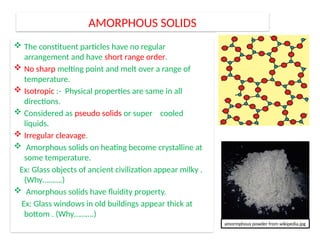
 The constituent particles have no regular
arrangement and have short range order.
 No sharp melting point and melt over a range of
temperature.
 Isotropic :- Physical properties are same in all
directions.
 Considered as pseudo solids or super cooled
liquids.
 Irregular cleavage.
 Amorphous solids on heating become crystalline at
some temperature.
Ex: Glass objects of ancient civilization appear milky .
(Why……….)
 Amorphous solids have fluidity property.
Ex: Glass windows in old buildings appear thick at
bottom . (Why……….)
amormphous powder from wikipedia.jpg
CRYSTALLINE SOLIDS
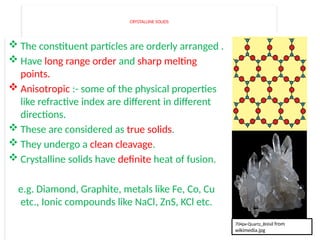
 The constituent particles are orderly arranged .
 Have long range order and sharp melting
points.
 Anisotropic :- some of the physical properties
like refractive index are different in different
directions.
 These are considered as true solids.
 They undergo a clean cleavage.
 Crystalline solids have definite heat of fusion.
e.g. Diamond, Graphite, metals like Fe, Co, Cu
etc., Ionic compounds like NaCl, ZnS, KCl etc.
704px-Quartz_Brésil from
wikimedia.jpg
TYPES
OF
CRYSTA
LLINE
SOLIDS
Iodine-unit-cell-3D-vdW
from wikimedia
Iodine
TYPES OF CRYSTALLINE SOLIDS
1.MOLECULAR CRYSTALLINE SOLIDS
Constituent particles are polar or non –
polar molecules or H-bonded molecules.
Force of attraction is dispersion force
or dipole- dipole interaction or hydrogen
bonding.
Low melting and boiling point.
Insulators
EX: Iodine
TYPES OF CRYSTALLINE SOLIDS
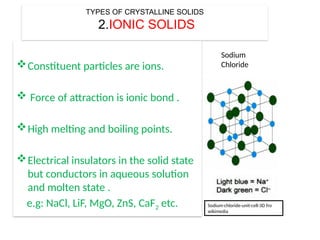
2.IONIC SOLIDS
Constituent particles are ions.
 Force of attraction is ionic bond .
High melting and boiling points.
Electrical insulators in the solid state
but conductors in aqueous solution
and molten state .
e.g: NaCl, LiF, MgO, ZnS, CaF2 etc. Sodium-chloride-unit-cell-3D fro
wikimedia
Sodium
Chloride
TYPES OF CRYSTALLINE SOLIDS
3.METALLIC SOLIDS
 Constituent particles are +vely
charged metal ions and free electrons.
 Force of attraction is metallic bond.
 High electrical and thermal
conductivity.
 Malleable and ductile.
 High melting and boiling point.
e.g.: Fe, Cu, Ag, Mg etc
Iron_from.jpg from wikimedia
Iron
TYPES OF CRYSTALLINE SOLIDS
4. COVALENT AND NETWORK SOLIDS
 Constituent particles are neutral
atoms.
 Force of attraction is covalent
bond .
 High melting point
 Insulators
e.g.: Diamond, quartz, SiC, AlN,
 Conductor :- Graphite Graphite-233436.jpg from
wikipedia
Graphite
SUMMARY
Characteristics of solids
Classification of solids:-Crystalline and
amorphous
Classification of crystalline solids :-
Molecular , Ionic, Metallic and Covalent
solids .
QUESTIONS
1. Write a feature that will distinguish a metallic solid
from an ionic solid.
 2. Write a distinguish feature of covalent solid.
 3.Why graphite is good conductor of electricity although
it is a network (covalent solid)?
 4. What type of interactions hold the molecules
together in a polar molecular solid?
PART-2 OUTLINE
Crystal lattice and lattice points
Unit cell
Bravais lattices
Lattice points in unit cell
CRYSTAL LATTICE AND LATTICE POINT
 The regular arrangement of the
constituent particles (atoms ,ions
or molecules )of a crystal in three
dimensional space is called crystal
lattice or space lattice.
Each point in a crystal lattice is
called lattice point or lattice site.
UNIT CELL
Unit cell is the smallest
portion of the crystal lattice
which , when repeated in
different directions generates
the entire lattice .
Unit cell is characterized by 6
parameters.
(i) Edges (a, b ,c)
(ii)Angle between the edges .
CLASSIFICATION OF UNIT CELLS
Types :-
Primitive or simple Unit cells
Centered unit cells
PRIMITIVE UNIT CELLS:
When constituent particles are
present only at the corners of a
unit cell, it is called primitive
unit cell.
Classification of Unit cells
CENTERED UNIT CELLS:
Constituent particles are present at and other
other centred positions.
(i) BODY CENTERED UNIT CELL:
Constituent particles at each corners and one at
the centre of the body.
(ii) FACE CENTERED UNIT CELLS:
Constituent particles at each corners and other
at the centre of the faces.
(iii) END CENTERED UNIT CELL:
Constituent particles at each corners and other
at the centre of the alternate faces.
BRAVAIS LATTICES
On the basis of six parameters of unit cell , The total number of
possible unit cells (primitive and centred) in 3-dimensional lattice is
14.which are called Bravais Lattices.
S.NO. CRYSTAL SYSTEM EDGELENGTH BOND ANGLE EXAMPLES
1 CUBIC a=b=c α=β=γ=900
NaCl,KCl,diamond,Cu
2 TETRAGONAL a=b≠c α=β=γ=900
SnO2 ,CaSO4
3 RHOMBIC a≠b≠c α=β=γ=900
Rhombic S,KNO3 Ba2SO4
4 MONOCLINIC a≠b≠c α=γ=900,
β≠900
Monoclinic S,Na2SO4
5 TRICLINIC a≠b≠c α≠β≠γ≠900
K2Cr2O7,CuSO4 ,H2O
6 TRIGONAL a=b=c α=β=γ≠900
CaCO3,HgS
7 HEXAGONAL a=b≠c α=β=900
γ=1200
Graphite,ZnO,Ice
BRAVAIS LATTICES
BRAVAIS LATTICES
BRAVAIS LATTICES
NUMBER OF ATOMS IN UNIT CELL
 Primitive or simple cubic
unit cell :-
Total no. of atoms for unit
cell
= 8 x 1/8 = 1 atom
 Body centred unit cell :-
Total no. of atoms for unit
cell
= 8 x 1/8 + 1= 2 atoms
NO. OF ATOMS IN A UNIT CELL
 Face centred unit cell :-
Total no. of atoms for unit cell
= 8 x 1/8 + 6x1/2 = 4 atoms
VISUALIZATION OF UNIT CELL
Courtesy – Next Education
SUMMARY
Crystal lattice and lattice point
Unit cell :- Primitive and Centred(bcc, fcc ,
ecc)
Bravais lattice:- 14 types(7 Primitive and 7
Centred )
No. of atoms of unit cell :- For scc-1atom,
bcc-2 atoms and fcc-4 atoms.
QUESTIONS
1. What is the significance of lattice point?
2. Explain how much portion of an atom
located at (i) corner an (ii) body centre of a
cubic unit cell is part of its neighbouring unit
cell.
• Review of previous session
• Closed packing in solids
• Voids in solids
PART -3 OUTLINE
Characteristics of solids
Classification of solids:-Crystalline and amorphous
Classification of crystalline solids :- Molecular , Ionic,
Metallic and Covalent solids .
Crystal lattice and lattice points
Unit cell :- Primitive and Centred(bcc, fcc , ecc)
Bravais lattices:- 14 types(7 Primitive and 7 Centred )
No. of atoms of unit cell :- For scc-1atom,
bcc-2 atoms and fcc-4 atoms.
REVIEW OF PREVIOUS SESSION
 The constituent particles in solids are
close packed leaving minimum vacant
space .
 The packing pattern follows in one
dimension , two dimension and three
dimension .
 The no. of spheres neighbor to one
sphere is called its co-ordination no.
CLOSE PACKING IN SOLIDS
CLOSE PACKING IN ONE DIMENSION
• In one dimensional close packing arrangement , each sphere is in
contact with two of its neighbours .
• Coordination number is 2 .
CLOSE PACKING IN TWO DIMENSION
Square close packing in 2D(AAA….type ) :-
 Second row is placed adjacent to the
first row and so on .
 Co-ordination no. is 4 .
Hexagonal close packing in
2D(ABAB….type) :-
 second row is placed in the depressions
of spheres adjacent to first row .
 Co-ordination no. is 6 .
• When the second layer of spheres is placed in
the depressions in first layer , two types of voids
get formed.
PLACING OF SECOND LAYER ON FIRST LAYER
 Tetrahedral
voids
 Octahedral
voids
VOIDS IN SOLIDS
• The vacant space surrounded by
the spheres in the solids are called
voids.
Types:-
1. Tetrahedral voids :-
Holes surrounded by 4 spheres.
2. Octahedral voids :-
Holes surrounded by 6 spheres.
NUMBER OF VOIDS IN SOLIDS

Let the no. of close packed spheres = N
Then the no. of octahedral voids = N
 Then the no. of tetrahedral voids = 2N
Visualisation(voids in solid)
Courtesy:- university of north carolina
CLOSE PACKING IN THREE DIMENSION(AAA…
TYPE)
3D close packing from 2D square
close packed layers :-
• Spheres of the second layer are
placed just above the first layer and
so on
as AAA…..type .
• The lattice generated in simple
cubic lattice .
• Unit cell is primitive .
• e.g. polonium
3D close packing from 2D
hexagonal close packed
layers :-
• Spheres of the second layer are
placed in the depression of first layer .
• The third layer covers the tetrahedral
voids and forms ABAB…. Pattern and
forms hcp .
• Coordination no. is 12 .
CLOSE PACKING IN THREE DIMENSION
3D close packing from 2D
hexagonal close packed
layers :-
• Spheres of the second layer are
placed in the depression of first
layer .
• The third layer covers the
octahedral voids and forms
ABCABC…. Pattern and forms ccp .
• Coordination no. is 12 .
CLOSE PACKING IN THREE DIMENSION
Visualisation(close packing in solids)
Courtesy- Shiksha House
SUMMARY
• Close packing pattern in one , two and three
dimension in solids.
• Tetrahedral and octahedral void .The number
of tetrahedral voids are double the number of
spheres in the solid.
QUESTIONS
1. Distinguish between
a)hexagonal close packing and cubic close
packing.
b) Tetrahedral void and octahedral void
PART -4 OUTLINE
• Packing efficiency
• Calculation of packing efficiency in simple
cube ,bcc and fcc
RELATION BETWEEN EDGE LENGTH(a) AND
RADIUS(r) OF ATOM
scc fcc bcc
PACKING EFFICIENCY
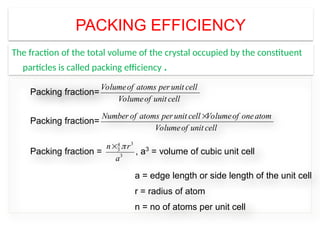
The fraction of the total volume of the crystal occupied by the constituent
particles is called packing efficiency .
The fraction of the total volume of the crystal occupied by the constituent p
is called packing fraction or efficiency.
The packing fraction of the unit cell is same with that of crystal.
Packing fraction=
Volumeof atoms per unit cell
Volumeof unit cell
Packing fraction=
Number of atoms per unit cell Volumeof oneatom
Volumeof unit cell

Packing fraction =
3
4
3
3
n r
a


, a3
= volume of cubic unit cell
a = edge length or side length of the unit cell
r = radius of atom
n = no of atoms per unit cell
Packing efficiency of simple cubic unit cell :-
PACKING EFFICIENCY
a =2r
Volume of cubic unit cell = a3
PACKING EFFICIENCY
= volume occupied by four spheresx 100%
total volume of the unit cell
= 1 x (4/3)πr3
x
100%
(2r)3
= π x 100 = 52.36% = 52.4%
6
PACKING EFFICIENCY
Packing efficiency of face centred cubic unit cell :-
In ∆ABC AC2
=BC2
+AB2
b2
=a2
+a2
b= √2 a
If r is the radius of the sphere
b= 4r= √2 a
a=4r/√2
PACKING EFFICIENCY = volume occupied by four spheresx 100%
total volume of the unit cell
= 4 x (4/3)πr3
%
(2 √2r)3
= (16/3)πr3
%
(16 √2r)3
= 74%
Packing efficiency of body centred cubic unit cell :-
PACKING EFFICIENCY
In ∆ EDF
b2
=a2
+a2
b= √2 a
Now in ∆ AFD
c2
= a2
+ b2
= a2
+ 2 a2
= 3a2
c= √3 a
c = 4r
4r= √3 a
r = √3/4 a ,a = (4/√3) r
PACKING EFFICIENCY = volume occupied by four spheres x 100%
total volume of the unit cell
= 2 x (4/3)πr3
x100%
( (4/√3) r )3
= (8/3)πr3
x100% = 68%
64/3√3) r 3
COMPARISON OF PACKING EFFICIENCIES
Summary
• Packing efficiency :- scc - 52.4% , fcc – 74% ,
bcc – 68 % .
• packing efficiency is maximum in fcc unit cell.
Questions
1.Calculate the packing efficiency in case of a
metal crystal for body centred cubic .
2.What is the packing efficiency of a simple
cube?
3.Which unit cell has maximum packing
efficiency and what is the packing efficiency
percentage?
PART 5 OUTLINE
• REVIEW OF PREVIOUS SESSION
• IMPERFECTIONS IN SOLIDS
• TYPES OF POINT DEFECTS
REVIEW OF PREVIOUS SESSION
• Close packing pattern in one , two and three
dimension in solids.
• Tetrahedral and octahedral void .
• Packing efficiency :- scc - 52.4% , fcc – 74% ,
bcc – 68 % .
IMPERFECTION IN SOLIDS
Any deviation from perfectly ordered arrangement of
constituent particles In crystal lattice is called
imperfection in solids .
Ideal crystal After imperfection
Types of imperfections
There are 2 types of imperfections known in crystal
lattice.
• Point defect :- Arises due to disorder in the regular
arrangement of constituent particles around a
point .
• Line defect :- Arises due to disorder in the regular
arrangement of constituent particles in entire row .
TYPES OF IMPERFECTIONS
1. Impurity defect
Types of point defect :- 2.Stoichiometric defect
3.Non- stoichiometric defect
STOICHIOMETRIC DEFECT NON- STOICHIOMETRIC DEFECT
Vacancy defect Metal excess defect
Interstitial defect Metal deficiency defect
Frenkel defect
Schottky defect
IMPURITY DEFECT
• Arises when foreign atoms are present at
the lattice site in place of host atoms
generates impurity defect.
• When a little amount of SrCl2 is added to
NaCl, then at some lattice sites Na+
ions are
substituted by Sr 2+
maintaining electrical
neutrality .
• The cationic vacancies produced are equal
to number of Sr 2+
ions added .
SrCl2 added to NaCl
VACANCY AND INTERSTITIAL DEFECT
• These are seen in non ionic compounds.
• Vacancy defect :- Arises when some of the
lattice points are left vacant during the
crystal formation .
• Interstitial defect :- Arises when some of the
constituent particles accommodate in the
interstitial sites other than the lattice points.
SCHOTTKY DEFECT
• It is seen in ionic compounds.
• Equal no of cations and anions are missing
from their lattice sites generates schottky
defect.
• The vacancy defect(schottky) of ionic solids
decreases the density of solid
• Shown by the crystals with high
coordination no. and similar size of cation
and anion .
• e.g.NaCl, KCl, NaBr, AgBr
FRANKEL DEFECT
• It is seen in ionic compounds.
• In ionic solids in which the smaller ion i.e.
cation is dislocated from its normal site to an
interstitial site generates Frenkel defect.
• In the interstitial defect (Frankel) of ionic
solid ,density remains same .
• Shown by the crystals with low coordination
no. and large difference in the size of cation
and anion .
• e.g. ZnS, AgCl, AgBr, AgI.
METAL EXCESS DEFECT
By anion vacancies :-
It is seen in alkali halides.
• An anion may be missing from the lattice sites, and
the hole is occupied by an electron that maintains
electrical neutrality is known as
F-centre. ( Farbenzenter)
• The crystals become coloured due to excitation of
these unpaired electrons when they absorb energy
from visible light falling on the crystals .
• Excess of Li-makes LiCl crystals pink , K -makes KCl
crystals violet and Na –makes NaCl crystals yellow .
METAL EXCESS DEFECT
By extra cations :-
• Arises due to the presence .of extra cations in
the interstitial sites .
• Electrical neutrality is maintained by an electron
present in neighbouring interstitial sites.
• ZnO is white in colour at room temp. When ZnO
is heated, it loses oxygen and turns yellow.
ZnO Zn 2+
+ 1/2 O2 + 2 e-
e-
A
+
white yellow
SUMMARY
• IMPERFECTIONS IN SOLIDS :
• Line and point defects
• TYPES OF POINT DEFECTS –
• Vacancy defect, interstitial defect,Schottky
defect,Frenkel defect
• Impurity defect, stoichiometric defect, non
scoichiometric defect
INTEXT QUESTIONS
• What type of stoichiometric defect is shown by AgCl?
• What are F-centres?
• Which crystal defect lowers the density of solid?
• Which point defect in its crystal unit increases the density of a
solid?
• Why ZnO becomes yellow on heating ?
PART-6 OUTLINE
• Electrical properties of solids
• Magnetic properties of solids
ELECTRICAL PROPERTIES OF SOLIDS
Solid are classified as conductor, semi-conductor and insulator
on the basis of the magnitude of electrical conductivity
CONDUCTORS : The solids with conductance ranging between 104
to
107
ohm-1
m-1
are called conductors .Metals have conductivities in the order
107
ohm-1
m-1
are good conductors.
INSULATORS : These are the solids with very low conductivities ranging
between 10-20
to 10-10
ohm-1
m-1
SEMICONDUCTORS: These are the solids with conductivities in the
intermediate range from 10-6
to 104
ohm-1
m-1
VALENCE BAND THEORY
The conductivity
of solids depend
upon a number of
valence electron
available for atom
which can jump
from valance band
to conduction
band .
SEMICONDUCTORS
INTRINSIC SEMICONDUCTOR :-
Elements like Si and Ge
• Show too low electrical conductivity which
increases with temperature .
e.g. Si and Ge.
• Conductivity can also be increased by adding
appropriate amount of suitable impurity ,
process is called doping .
• Impurity is of two types :-
Electron rich impurity and
Electron deficit impurity. Silicon_(14_Si) from
wikimedia
Polycrystalline-germanium from wikimedia
Silicon
Germanium
SEMICONDUCTORS
EXTRINSIC SEMICONDUCTOR :-
• A doped intrinsic semiconductor is called extrinsic semiconductor .
• Types :-
1. n-type semiconductor (Doped with electron rich impurities )
2. p-type semi conductor (Doped with electron deficient impurities)
Visualization of n- type semiconductor
Courtesy- Physics4students
Visualization of p- type semiconductor
Courtesy – Physics4students
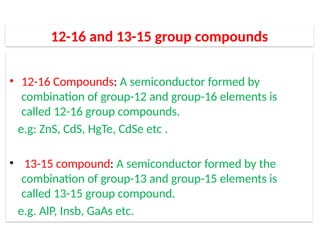
12-16 and 13-15 group compounds
• 12-16 Compounds: A semiconductor formed by
combination of group-12 and group-16 elements is
called 12-16 group compounds.
e.g: ZnS, CdS, HgTe, CdSe etc .
• 13-15 compound: A semiconductor formed by the
combination of group-13 and group-15 elements is
called 13-15 group compound.
e.g. AlP, Insb, GaAs etc.
MAGNETIC PROPERTIES OF SOLIDS
The magnetic properties of different solids are
due to orbital motion and spinning motion
of the electrons which are studied in term of
magnetic moments .
TYPES OF MAGNETIC SUBSTANCES
• Paramagnetic substance
• Diamagnetic substance
• Ferromagnetic substance
• Anti ferromagnetic substance
• Ferrimagnetic substance
Magnetic properties of solids
• Paramagnetic substance: -
• Weakly attracted by external magnetic field.
• Due to presence of one on more unpaired electrons.
e.g.: O2, Cu 2+
, Cr 3+ etc.
• Diamagnetic substance :-
• Weakly repelled by external magnetic field .
• Due to absence of unpaired electrons.
e.g. H2O, NaCl, C6H6 etc.
Magnetic properties of solids
• Ferromagnetic substance: -
• Strongly attracted by external magnetic field and
show permanent magnetism.
• As the metal ions of ferromagnetic substance are
grouped into small regions called domains
e.g. Fe, Ni, Co, Gd, CrO2 etc
Magnetic properties of solids
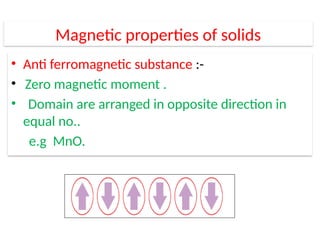
• Anti ferromagnetic substance :-
• Zero magnetic moment .
• Domain are arranged in opposite direction in
equal no..
e.g MnO.
Magnetic properties of solids
• Ferrimagnetic substance : -
• Attracted by external magnetic field .
• Domains are aligned unequally in opposite
direction .
e.g. Fe3O4, MgFe2O4 (ferrite) etc
SUMMARY
PROPERTIES OF SOLIDS
• ELECTRICAL PROPERTIES point defect and line defect
• Impurity , Stoichiometric , Non- stoichiometric defect .
• – Band theory , Electrical conduction , n- and p- type
semiconductor
• MAGNETIC PROPERTIES OF SOLID
• – Para magnetism , Diamagnetism , Ferromagnetism ,
Anti ferromagnetism , Ferrimagnetism .
QUESTIONS
• How may the conductivity of an intrinsic
semiconductor be increased?
• What type of semi-conductor is obtained when
silicon is doped with arsenic?
• What is meant by ‘forbidden zone’ in reference to
the band theory of solid?
• What type of semi-conductor is obtained when
silicon is doped with Indium?
PART -7 NUMERICALS
NUMERICALS IN SOLID STATE
• Determination of the formula of the
compound
• Calculations involving unit cell dimensions.
• Calculation of fraction of metal ion in a non
stoichiometric metal oxides.
• A cubic solid is made of two elements X and Y.
Atoms Y are at the corners of the cube and X at
the body centre. What is the formula of the
compound?
Ans :-
Number of X atom per unit cell = 1
Number of Y atom per unit cell = 1/8 x 8 = 1
Formula of compound = XY
DETERMINATION OF THE FORMULA OF THE COMPOUND
• A cubic solid is made of two elements X and Y.
Atoms Y(anions) are at the corners of the cube and
X(cations) at present at face-centre of the cubic
lattice. What is the formula of the compound?
Ans :-
Number of X atom per unit cell = 1/2 x 6 = 3
Number of Y atom per unit cell = 1/8 x 8 = 1
Formula of compound = X3Y
DETERMINATION OF THE FORMULA OF THE
COMPOUND
CALCULATION OF THE DENSITY OF THE
UNIT CELL
• 1.Chromium metal crystallises with a body centred cubic
lattice The length of unit cell is found to be 287 pm.
Calculate atomic radius, the number of atoms per unit cell
and density of chromium. (Atomic mass of Cr = 52. g/ mol
Avogadro No. = 6.02 x 10²³
)
• 2. Silver forms ccp lattice and X-ray studies of its crystals
show that the edge length of its unit cell is 408.6pm.
Calculate the density of silver( Atomic mass = 107.9 u)
• 3. Niobium crystallizes in body centered cubic structure. If density
is 8.55 gm/cm3
, calculate atomic radius of niobium using its
atomic mass 93u .
NUMERICALS
Silver crystallises in fcc lattice. If edge length of the
cell is 4.07 × 10⁻⁸
cm and density is 10.5 g cm–3
,
calculate the atomic mass of silver
Ans:
Given:
Edge length, a = 4.077 × 10⁻⁸
cm
Density, d = 10.5 g cm−3
The given lattice is of fcc type,
Thus the number of atoms per unit cell, z = 4
We also know that NA = 6.022 × 10²³
/ mol
let M be the atomic mass of silver.
We know, d = zM/a3
NA
=> M = da3
Na / z
• = 10.5 x 4.077 × 10−8
x 6.022 × 1023
) / 4 = 107.13 g /mol
CALCULATION OF FRACTION OF METAL ION IN
A NON STOICHIOMETRIC METAL OXIDES.
• Analysis shows that nickel oxide has formula Ni 0.98O 1.00 .What fraction of
nickel exists as Ni2+
and Ni3+
ions?
A. Let the number of Ni2+
= x
The number of Ni3+
=(0.98-x)
sum of positive ions is equal to negative ions
2(x) + 3(0.98-x)= 2(1.00)
2x + 2.94-3x=2.00
X = 0.94 x= Ni2+
% of Ni2+
=0.94/0.98x 100=96%
% of Ni3+
= 100-96= 4%
THE SOLID STATE -nli-PPT.pptx IMPORTANT FOR STUDENTS

THE SOLID STATE -nli-PPT.pptx IMPORTANT FOR STUDENTS

  • 1.
  • 2.
    PART -1 OUTLINE Characteristicsof solids Classification of solids Classification of crystalline solids
  • 3.
    Characteristics of Solids Solids have definite shape and volume, rigidity incompressibility and high density .  In solids the constituent particles are very closely packed and occupy fixed positions. Constituent particles oscillate about their mean position
  • 4.
    CLASSIFICATION OF SOLIDS Types:- 1.Crystallinesolid. 2.Amorphous solid. Amorphous(Glass) 800px-Quartz,_Tibet from wikipedia.jpg , Crystalline(Quartz) 220px-Oldf_Fashioned_Glass from wikipedia
  • 5.
    AMORPHOUS SOLIDS  Theconstituent particles have no regular arrangement and have short range order.  No sharp melting point and melt over a range of temperature.  Isotropic :- Physical properties are same in all directions.  Considered as pseudo solids or super cooled liquids.  Irregular cleavage.  Amorphous solids on heating become crystalline at some temperature. Ex: Glass objects of ancient civilization appear milky . (Why……….)  Amorphous solids have fluidity property. Ex: Glass windows in old buildings appear thick at bottom . (Why……….) amormphous powder from wikipedia.jpg
  • 6.
    CRYSTALLINE SOLIDS  Theconstituent particles are orderly arranged .  Have long range order and sharp melting points.  Anisotropic :- some of the physical properties like refractive index are different in different directions.  These are considered as true solids.  They undergo a clean cleavage.  Crystalline solids have definite heat of fusion. e.g. Diamond, Graphite, metals like Fe, Co, Cu etc., Ionic compounds like NaCl, ZnS, KCl etc. 704px-Quartz_Brésil from wikimedia.jpg
  • 7.
  • 8.
    Iodine-unit-cell-3D-vdW from wikimedia Iodine TYPES OFCRYSTALLINE SOLIDS 1.MOLECULAR CRYSTALLINE SOLIDS Constituent particles are polar or non – polar molecules or H-bonded molecules. Force of attraction is dispersion force or dipole- dipole interaction or hydrogen bonding. Low melting and boiling point. Insulators EX: Iodine
  • 9.
    TYPES OF CRYSTALLINESOLIDS 2.IONIC SOLIDS Constituent particles are ions.  Force of attraction is ionic bond . High melting and boiling points. Electrical insulators in the solid state but conductors in aqueous solution and molten state . e.g: NaCl, LiF, MgO, ZnS, CaF2 etc. Sodium-chloride-unit-cell-3D fro wikimedia Sodium Chloride
  • 10.
    TYPES OF CRYSTALLINESOLIDS 3.METALLIC SOLIDS  Constituent particles are +vely charged metal ions and free electrons.  Force of attraction is metallic bond.  High electrical and thermal conductivity.  Malleable and ductile.  High melting and boiling point. e.g.: Fe, Cu, Ag, Mg etc Iron_from.jpg from wikimedia Iron
  • 11.
    TYPES OF CRYSTALLINESOLIDS 4. COVALENT AND NETWORK SOLIDS  Constituent particles are neutral atoms.  Force of attraction is covalent bond .  High melting point  Insulators e.g.: Diamond, quartz, SiC, AlN,  Conductor :- Graphite Graphite-233436.jpg from wikipedia Graphite
  • 12.
    SUMMARY Characteristics of solids Classificationof solids:-Crystalline and amorphous Classification of crystalline solids :- Molecular , Ionic, Metallic and Covalent solids .
  • 13.
    QUESTIONS 1. Write afeature that will distinguish a metallic solid from an ionic solid.  2. Write a distinguish feature of covalent solid.  3.Why graphite is good conductor of electricity although it is a network (covalent solid)?  4. What type of interactions hold the molecules together in a polar molecular solid?
  • 14.
    PART-2 OUTLINE Crystal latticeand lattice points Unit cell Bravais lattices Lattice points in unit cell
  • 15.
    CRYSTAL LATTICE ANDLATTICE POINT  The regular arrangement of the constituent particles (atoms ,ions or molecules )of a crystal in three dimensional space is called crystal lattice or space lattice. Each point in a crystal lattice is called lattice point or lattice site.
  • 16.
    UNIT CELL Unit cellis the smallest portion of the crystal lattice which , when repeated in different directions generates the entire lattice . Unit cell is characterized by 6 parameters. (i) Edges (a, b ,c) (ii)Angle between the edges .
  • 17.
    CLASSIFICATION OF UNITCELLS Types :- Primitive or simple Unit cells Centered unit cells PRIMITIVE UNIT CELLS: When constituent particles are present only at the corners of a unit cell, it is called primitive unit cell.
  • 18.
    Classification of Unitcells CENTERED UNIT CELLS: Constituent particles are present at and other other centred positions. (i) BODY CENTERED UNIT CELL: Constituent particles at each corners and one at the centre of the body. (ii) FACE CENTERED UNIT CELLS: Constituent particles at each corners and other at the centre of the faces. (iii) END CENTERED UNIT CELL: Constituent particles at each corners and other at the centre of the alternate faces.
  • 19.
    BRAVAIS LATTICES On thebasis of six parameters of unit cell , The total number of possible unit cells (primitive and centred) in 3-dimensional lattice is 14.which are called Bravais Lattices. S.NO. CRYSTAL SYSTEM EDGELENGTH BOND ANGLE EXAMPLES 1 CUBIC a=b=c α=β=γ=900 NaCl,KCl,diamond,Cu 2 TETRAGONAL a=b≠c α=β=γ=900 SnO2 ,CaSO4 3 RHOMBIC a≠b≠c α=β=γ=900 Rhombic S,KNO3 Ba2SO4 4 MONOCLINIC a≠b≠c α=γ=900, β≠900 Monoclinic S,Na2SO4 5 TRICLINIC a≠b≠c α≠β≠γ≠900 K2Cr2O7,CuSO4 ,H2O 6 TRIGONAL a=b=c α=β=γ≠900 CaCO3,HgS 7 HEXAGONAL a=b≠c α=β=900 γ=1200 Graphite,ZnO,Ice
  • 20.
  • 21.
  • 22.
  • 23.
    NUMBER OF ATOMSIN UNIT CELL  Primitive or simple cubic unit cell :- Total no. of atoms for unit cell = 8 x 1/8 = 1 atom  Body centred unit cell :- Total no. of atoms for unit cell = 8 x 1/8 + 1= 2 atoms
  • 24.
    NO. OF ATOMSIN A UNIT CELL  Face centred unit cell :- Total no. of atoms for unit cell = 8 x 1/8 + 6x1/2 = 4 atoms
  • 25.
    VISUALIZATION OF UNITCELL Courtesy – Next Education
  • 26.
    SUMMARY Crystal lattice andlattice point Unit cell :- Primitive and Centred(bcc, fcc , ecc) Bravais lattice:- 14 types(7 Primitive and 7 Centred ) No. of atoms of unit cell :- For scc-1atom, bcc-2 atoms and fcc-4 atoms.
  • 27.
    QUESTIONS 1. What isthe significance of lattice point? 2. Explain how much portion of an atom located at (i) corner an (ii) body centre of a cubic unit cell is part of its neighbouring unit cell.
  • 28.
    • Review ofprevious session • Closed packing in solids • Voids in solids PART -3 OUTLINE
  • 29.
    Characteristics of solids Classificationof solids:-Crystalline and amorphous Classification of crystalline solids :- Molecular , Ionic, Metallic and Covalent solids . Crystal lattice and lattice points Unit cell :- Primitive and Centred(bcc, fcc , ecc) Bravais lattices:- 14 types(7 Primitive and 7 Centred ) No. of atoms of unit cell :- For scc-1atom, bcc-2 atoms and fcc-4 atoms. REVIEW OF PREVIOUS SESSION
  • 30.
     The constituentparticles in solids are close packed leaving minimum vacant space .  The packing pattern follows in one dimension , two dimension and three dimension .  The no. of spheres neighbor to one sphere is called its co-ordination no. CLOSE PACKING IN SOLIDS
  • 31.
    CLOSE PACKING INSOLIDS CLOSE PACKING IN ONE DIMENSION • In one dimensional close packing arrangement , each sphere is in contact with two of its neighbours . • Coordination number is 2 .
  • 32.
    CLOSE PACKING INTWO DIMENSION Square close packing in 2D(AAA….type ) :-  Second row is placed adjacent to the first row and so on .  Co-ordination no. is 4 . Hexagonal close packing in 2D(ABAB….type) :-  second row is placed in the depressions of spheres adjacent to first row .  Co-ordination no. is 6 .
  • 33.
    • When thesecond layer of spheres is placed in the depressions in first layer , two types of voids get formed. PLACING OF SECOND LAYER ON FIRST LAYER  Tetrahedral voids  Octahedral voids
  • 34.
    VOIDS IN SOLIDS •The vacant space surrounded by the spheres in the solids are called voids. Types:- 1. Tetrahedral voids :- Holes surrounded by 4 spheres. 2. Octahedral voids :- Holes surrounded by 6 spheres.
  • 35.
    NUMBER OF VOIDSIN SOLIDS  Let the no. of close packed spheres = N Then the no. of octahedral voids = N  Then the no. of tetrahedral voids = 2N
  • 36.
    Visualisation(voids in solid) Courtesy:-university of north carolina
  • 37.
    CLOSE PACKING INTHREE DIMENSION(AAA… TYPE) 3D close packing from 2D square close packed layers :- • Spheres of the second layer are placed just above the first layer and so on as AAA…..type . • The lattice generated in simple cubic lattice . • Unit cell is primitive . • e.g. polonium
  • 38.
    3D close packingfrom 2D hexagonal close packed layers :- • Spheres of the second layer are placed in the depression of first layer . • The third layer covers the tetrahedral voids and forms ABAB…. Pattern and forms hcp . • Coordination no. is 12 . CLOSE PACKING IN THREE DIMENSION
  • 39.
    3D close packingfrom 2D hexagonal close packed layers :- • Spheres of the second layer are placed in the depression of first layer . • The third layer covers the octahedral voids and forms ABCABC…. Pattern and forms ccp . • Coordination no. is 12 . CLOSE PACKING IN THREE DIMENSION
  • 40.
    Visualisation(close packing insolids) Courtesy- Shiksha House
  • 41.
    SUMMARY • Close packingpattern in one , two and three dimension in solids. • Tetrahedral and octahedral void .The number of tetrahedral voids are double the number of spheres in the solid.
  • 42.
    QUESTIONS 1. Distinguish between a)hexagonalclose packing and cubic close packing. b) Tetrahedral void and octahedral void
  • 43.
    PART -4 OUTLINE •Packing efficiency • Calculation of packing efficiency in simple cube ,bcc and fcc
  • 44.
    RELATION BETWEEN EDGELENGTH(a) AND RADIUS(r) OF ATOM scc fcc bcc
  • 45.
    PACKING EFFICIENCY The fractionof the total volume of the crystal occupied by the constituent particles is called packing efficiency . The fraction of the total volume of the crystal occupied by the constituent p is called packing fraction or efficiency. The packing fraction of the unit cell is same with that of crystal. Packing fraction= Volumeof atoms per unit cell Volumeof unit cell Packing fraction= Number of atoms per unit cell Volumeof oneatom Volumeof unit cell  Packing fraction = 3 4 3 3 n r a   , a3 = volume of cubic unit cell a = edge length or side length of the unit cell r = radius of atom n = no of atoms per unit cell
  • 46.
    Packing efficiency ofsimple cubic unit cell :- PACKING EFFICIENCY a =2r Volume of cubic unit cell = a3 PACKING EFFICIENCY = volume occupied by four spheresx 100% total volume of the unit cell = 1 x (4/3)πr3 x 100% (2r)3 = π x 100 = 52.36% = 52.4% 6
  • 47.
    PACKING EFFICIENCY Packing efficiencyof face centred cubic unit cell :- In ∆ABC AC2 =BC2 +AB2 b2 =a2 +a2 b= √2 a If r is the radius of the sphere b= 4r= √2 a a=4r/√2 PACKING EFFICIENCY = volume occupied by four spheresx 100% total volume of the unit cell = 4 x (4/3)πr3 % (2 √2r)3 = (16/3)πr3 % (16 √2r)3 = 74%
  • 48.
    Packing efficiency ofbody centred cubic unit cell :- PACKING EFFICIENCY In ∆ EDF b2 =a2 +a2 b= √2 a Now in ∆ AFD c2 = a2 + b2 = a2 + 2 a2 = 3a2 c= √3 a c = 4r 4r= √3 a r = √3/4 a ,a = (4/√3) r PACKING EFFICIENCY = volume occupied by four spheres x 100% total volume of the unit cell = 2 x (4/3)πr3 x100% ( (4/√3) r )3 = (8/3)πr3 x100% = 68% 64/3√3) r 3
  • 49.
  • 50.
    Summary • Packing efficiency:- scc - 52.4% , fcc – 74% , bcc – 68 % . • packing efficiency is maximum in fcc unit cell.
  • 51.
    Questions 1.Calculate the packingefficiency in case of a metal crystal for body centred cubic . 2.What is the packing efficiency of a simple cube? 3.Which unit cell has maximum packing efficiency and what is the packing efficiency percentage?
  • 52.
    PART 5 OUTLINE •REVIEW OF PREVIOUS SESSION • IMPERFECTIONS IN SOLIDS • TYPES OF POINT DEFECTS
  • 53.
    REVIEW OF PREVIOUSSESSION • Close packing pattern in one , two and three dimension in solids. • Tetrahedral and octahedral void . • Packing efficiency :- scc - 52.4% , fcc – 74% , bcc – 68 % .
  • 54.
    IMPERFECTION IN SOLIDS Anydeviation from perfectly ordered arrangement of constituent particles In crystal lattice is called imperfection in solids . Ideal crystal After imperfection
  • 55.
    Types of imperfections Thereare 2 types of imperfections known in crystal lattice. • Point defect :- Arises due to disorder in the regular arrangement of constituent particles around a point . • Line defect :- Arises due to disorder in the regular arrangement of constituent particles in entire row .
  • 56.
    TYPES OF IMPERFECTIONS 1.Impurity defect Types of point defect :- 2.Stoichiometric defect 3.Non- stoichiometric defect STOICHIOMETRIC DEFECT NON- STOICHIOMETRIC DEFECT Vacancy defect Metal excess defect Interstitial defect Metal deficiency defect Frenkel defect Schottky defect
  • 57.
    IMPURITY DEFECT • Ariseswhen foreign atoms are present at the lattice site in place of host atoms generates impurity defect. • When a little amount of SrCl2 is added to NaCl, then at some lattice sites Na+ ions are substituted by Sr 2+ maintaining electrical neutrality . • The cationic vacancies produced are equal to number of Sr 2+ ions added . SrCl2 added to NaCl
  • 58.
    VACANCY AND INTERSTITIALDEFECT • These are seen in non ionic compounds. • Vacancy defect :- Arises when some of the lattice points are left vacant during the crystal formation . • Interstitial defect :- Arises when some of the constituent particles accommodate in the interstitial sites other than the lattice points.
  • 59.
    SCHOTTKY DEFECT • Itis seen in ionic compounds. • Equal no of cations and anions are missing from their lattice sites generates schottky defect. • The vacancy defect(schottky) of ionic solids decreases the density of solid • Shown by the crystals with high coordination no. and similar size of cation and anion . • e.g.NaCl, KCl, NaBr, AgBr
  • 60.
    FRANKEL DEFECT • Itis seen in ionic compounds. • In ionic solids in which the smaller ion i.e. cation is dislocated from its normal site to an interstitial site generates Frenkel defect. • In the interstitial defect (Frankel) of ionic solid ,density remains same . • Shown by the crystals with low coordination no. and large difference in the size of cation and anion . • e.g. ZnS, AgCl, AgBr, AgI.
  • 61.
    METAL EXCESS DEFECT Byanion vacancies :- It is seen in alkali halides. • An anion may be missing from the lattice sites, and the hole is occupied by an electron that maintains electrical neutrality is known as F-centre. ( Farbenzenter) • The crystals become coloured due to excitation of these unpaired electrons when they absorb energy from visible light falling on the crystals . • Excess of Li-makes LiCl crystals pink , K -makes KCl crystals violet and Na –makes NaCl crystals yellow .
  • 62.
    METAL EXCESS DEFECT Byextra cations :- • Arises due to the presence .of extra cations in the interstitial sites . • Electrical neutrality is maintained by an electron present in neighbouring interstitial sites. • ZnO is white in colour at room temp. When ZnO is heated, it loses oxygen and turns yellow. ZnO Zn 2+ + 1/2 O2 + 2 e- e- A + white yellow
  • 63.
    SUMMARY • IMPERFECTIONS INSOLIDS : • Line and point defects • TYPES OF POINT DEFECTS – • Vacancy defect, interstitial defect,Schottky defect,Frenkel defect • Impurity defect, stoichiometric defect, non scoichiometric defect
  • 64.
    INTEXT QUESTIONS • Whattype of stoichiometric defect is shown by AgCl? • What are F-centres? • Which crystal defect lowers the density of solid? • Which point defect in its crystal unit increases the density of a solid? • Why ZnO becomes yellow on heating ?
  • 65.
    PART-6 OUTLINE • Electricalproperties of solids • Magnetic properties of solids
  • 66.
    ELECTRICAL PROPERTIES OFSOLIDS Solid are classified as conductor, semi-conductor and insulator on the basis of the magnitude of electrical conductivity CONDUCTORS : The solids with conductance ranging between 104 to 107 ohm-1 m-1 are called conductors .Metals have conductivities in the order 107 ohm-1 m-1 are good conductors. INSULATORS : These are the solids with very low conductivities ranging between 10-20 to 10-10 ohm-1 m-1 SEMICONDUCTORS: These are the solids with conductivities in the intermediate range from 10-6 to 104 ohm-1 m-1
  • 67.
    VALENCE BAND THEORY Theconductivity of solids depend upon a number of valence electron available for atom which can jump from valance band to conduction band .
  • 68.
    SEMICONDUCTORS INTRINSIC SEMICONDUCTOR :- Elementslike Si and Ge • Show too low electrical conductivity which increases with temperature . e.g. Si and Ge. • Conductivity can also be increased by adding appropriate amount of suitable impurity , process is called doping . • Impurity is of two types :- Electron rich impurity and Electron deficit impurity. Silicon_(14_Si) from wikimedia Polycrystalline-germanium from wikimedia Silicon Germanium
  • 69.
    SEMICONDUCTORS EXTRINSIC SEMICONDUCTOR :- •A doped intrinsic semiconductor is called extrinsic semiconductor . • Types :- 1. n-type semiconductor (Doped with electron rich impurities ) 2. p-type semi conductor (Doped with electron deficient impurities)
  • 70.
    Visualization of n-type semiconductor Courtesy- Physics4students
  • 71.
    Visualization of p-type semiconductor Courtesy – Physics4students
  • 72.
    12-16 and 13-15group compounds • 12-16 Compounds: A semiconductor formed by combination of group-12 and group-16 elements is called 12-16 group compounds. e.g: ZnS, CdS, HgTe, CdSe etc . • 13-15 compound: A semiconductor formed by the combination of group-13 and group-15 elements is called 13-15 group compound. e.g. AlP, Insb, GaAs etc.
  • 73.
    MAGNETIC PROPERTIES OFSOLIDS The magnetic properties of different solids are due to orbital motion and spinning motion of the electrons which are studied in term of magnetic moments .
  • 74.
    TYPES OF MAGNETICSUBSTANCES • Paramagnetic substance • Diamagnetic substance • Ferromagnetic substance • Anti ferromagnetic substance • Ferrimagnetic substance
  • 75.
    Magnetic properties ofsolids • Paramagnetic substance: - • Weakly attracted by external magnetic field. • Due to presence of one on more unpaired electrons. e.g.: O2, Cu 2+ , Cr 3+ etc. • Diamagnetic substance :- • Weakly repelled by external magnetic field . • Due to absence of unpaired electrons. e.g. H2O, NaCl, C6H6 etc.
  • 76.
    Magnetic properties ofsolids • Ferromagnetic substance: - • Strongly attracted by external magnetic field and show permanent magnetism. • As the metal ions of ferromagnetic substance are grouped into small regions called domains e.g. Fe, Ni, Co, Gd, CrO2 etc
  • 77.
    Magnetic properties ofsolids • Anti ferromagnetic substance :- • Zero magnetic moment . • Domain are arranged in opposite direction in equal no.. e.g MnO.
  • 78.
    Magnetic properties ofsolids • Ferrimagnetic substance : - • Attracted by external magnetic field . • Domains are aligned unequally in opposite direction . e.g. Fe3O4, MgFe2O4 (ferrite) etc
  • 79.
    SUMMARY PROPERTIES OF SOLIDS •ELECTRICAL PROPERTIES point defect and line defect • Impurity , Stoichiometric , Non- stoichiometric defect . • – Band theory , Electrical conduction , n- and p- type semiconductor • MAGNETIC PROPERTIES OF SOLID • – Para magnetism , Diamagnetism , Ferromagnetism , Anti ferromagnetism , Ferrimagnetism .
  • 80.
    QUESTIONS • How maythe conductivity of an intrinsic semiconductor be increased? • What type of semi-conductor is obtained when silicon is doped with arsenic? • What is meant by ‘forbidden zone’ in reference to the band theory of solid? • What type of semi-conductor is obtained when silicon is doped with Indium?
  • 81.
    PART -7 NUMERICALS NUMERICALSIN SOLID STATE • Determination of the formula of the compound • Calculations involving unit cell dimensions. • Calculation of fraction of metal ion in a non stoichiometric metal oxides.
  • 82.
    • A cubicsolid is made of two elements X and Y. Atoms Y are at the corners of the cube and X at the body centre. What is the formula of the compound? Ans :- Number of X atom per unit cell = 1 Number of Y atom per unit cell = 1/8 x 8 = 1 Formula of compound = XY DETERMINATION OF THE FORMULA OF THE COMPOUND
  • 83.
    • A cubicsolid is made of two elements X and Y. Atoms Y(anions) are at the corners of the cube and X(cations) at present at face-centre of the cubic lattice. What is the formula of the compound? Ans :- Number of X atom per unit cell = 1/2 x 6 = 3 Number of Y atom per unit cell = 1/8 x 8 = 1 Formula of compound = X3Y DETERMINATION OF THE FORMULA OF THE COMPOUND
  • 84.
    CALCULATION OF THEDENSITY OF THE UNIT CELL
  • 85.
    • 1.Chromium metalcrystallises with a body centred cubic lattice The length of unit cell is found to be 287 pm. Calculate atomic radius, the number of atoms per unit cell and density of chromium. (Atomic mass of Cr = 52. g/ mol Avogadro No. = 6.02 x 10²³ ) • 2. Silver forms ccp lattice and X-ray studies of its crystals show that the edge length of its unit cell is 408.6pm. Calculate the density of silver( Atomic mass = 107.9 u) • 3. Niobium crystallizes in body centered cubic structure. If density is 8.55 gm/cm3 , calculate atomic radius of niobium using its atomic mass 93u . NUMERICALS
  • 86.
    Silver crystallises infcc lattice. If edge length of the cell is 4.07 × 10⁻⁸ cm and density is 10.5 g cm–3 , calculate the atomic mass of silver Ans: Given: Edge length, a = 4.077 × 10⁻⁸ cm Density, d = 10.5 g cm−3 The given lattice is of fcc type, Thus the number of atoms per unit cell, z = 4 We also know that NA = 6.022 × 10²³ / mol let M be the atomic mass of silver. We know, d = zM/a3 NA => M = da3 Na / z • = 10.5 x 4.077 × 10−8 x 6.022 × 1023 ) / 4 = 107.13 g /mol
  • 87.
    CALCULATION OF FRACTIONOF METAL ION IN A NON STOICHIOMETRIC METAL OXIDES. • Analysis shows that nickel oxide has formula Ni 0.98O 1.00 .What fraction of nickel exists as Ni2+ and Ni3+ ions? A. Let the number of Ni2+ = x The number of Ni3+ =(0.98-x) sum of positive ions is equal to negative ions 2(x) + 3(0.98-x)= 2(1.00) 2x + 2.94-3x=2.00 X = 0.94 x= Ni2+ % of Ni2+ =0.94/0.98x 100=96% % of Ni3+ = 100-96= 4%