
Solar Cell Fundamentals


                      1
History of Cell Efficiency
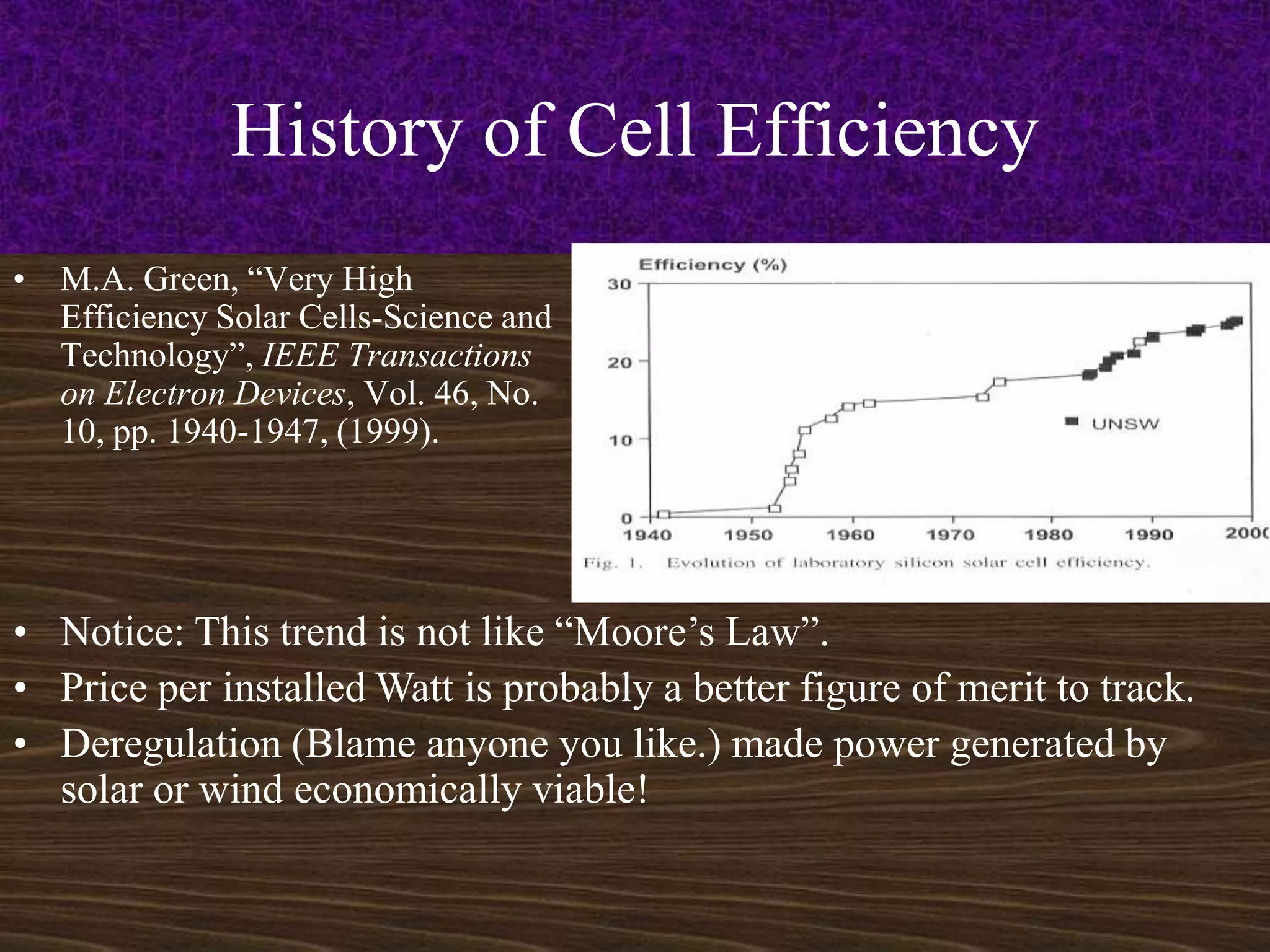
• M.A. Green, “Very High
  Efficiency Solar Cells-Science and
  Technology”, IEEE Transactions
  on Electron Devices, Vol. 46, No.
  10, pp. 1940-1947, (1999).


• Notice: This trend is not like “Moore’s Law”.
• Price per installed Watt is probably a better figure of merit to track.
• Deregulation (Blame anyone you like.) made power generated by
  solar or wind economically viable!

                                                                      2
What is a Solar Cell?
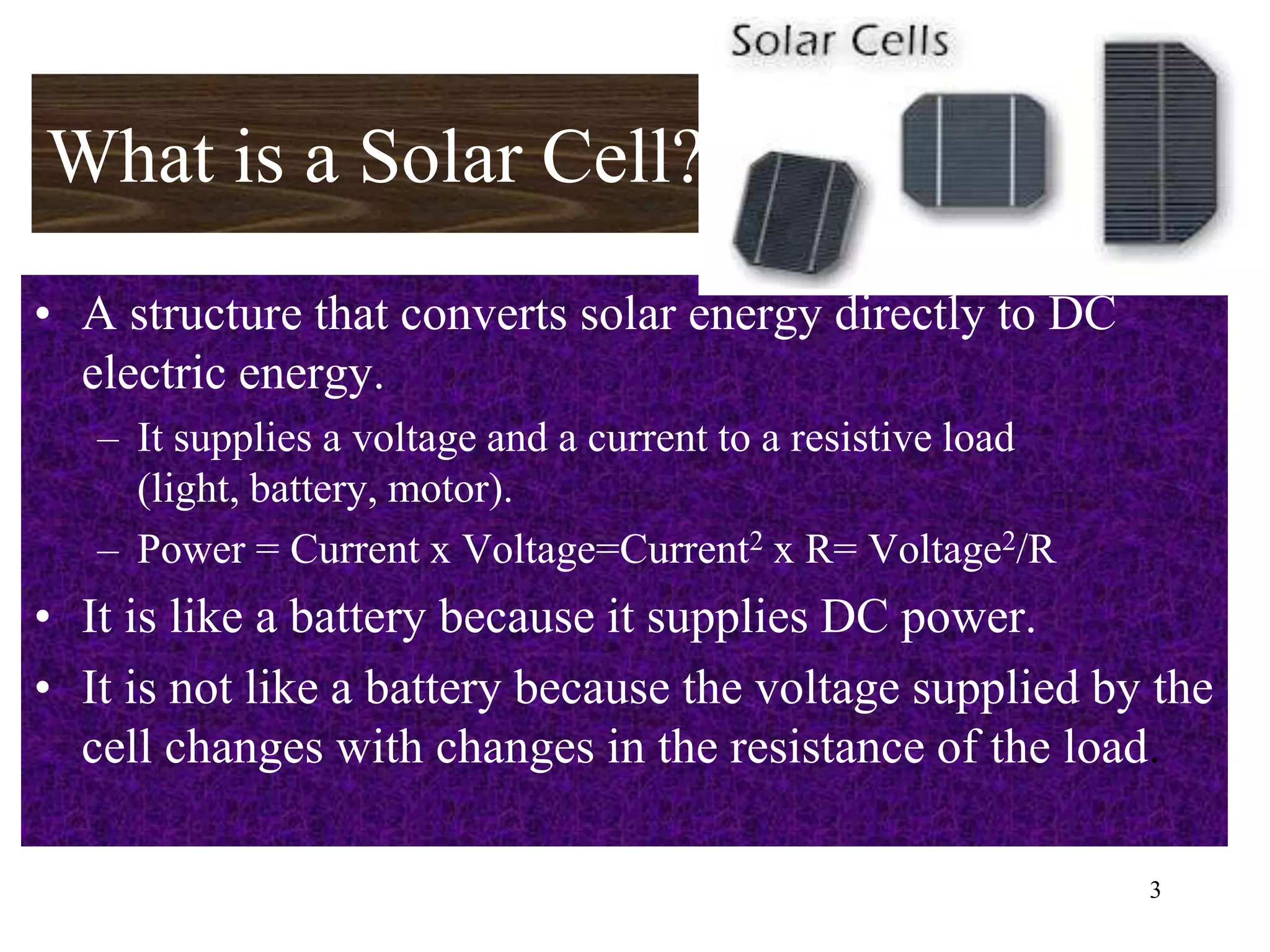
• A structure that converts solar energy directly to DC
  electric energy.
   – It supplies a voltage and a current to a resistive load
     (light, battery, motor).
   – Power = Current x Voltage=Current2 x R= Voltage2/R
• It is like a battery because it supplies DC power.
• It is not like a battery because the voltage supplied by the
  cell changes with changes in the resistance of the load.

                                                               3
Uses for Solar Energy
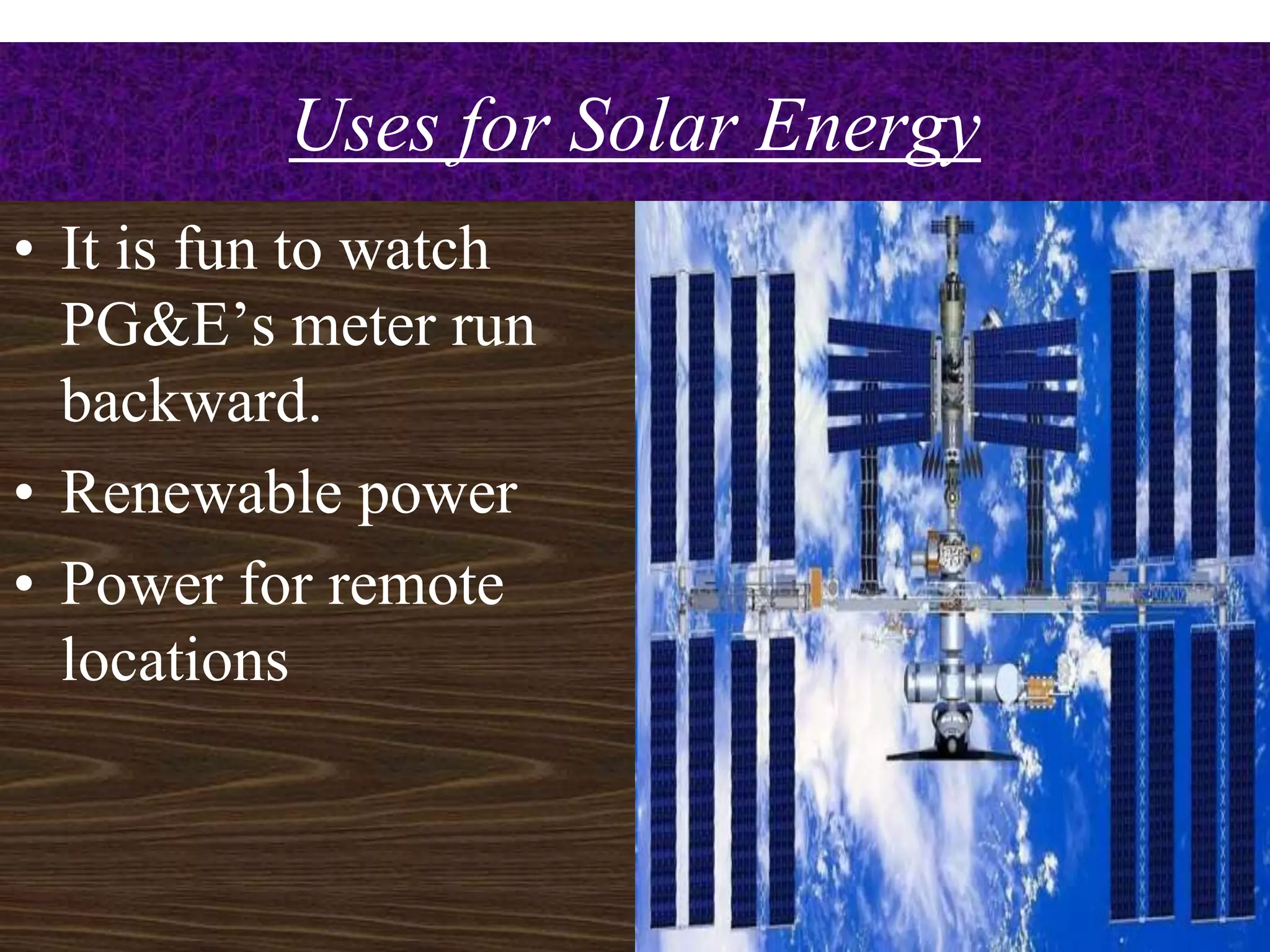
• It is fun to watch
  PG&E’s meter run
  backward.
• Renewable power
• Power for remote
  locations


                                  4
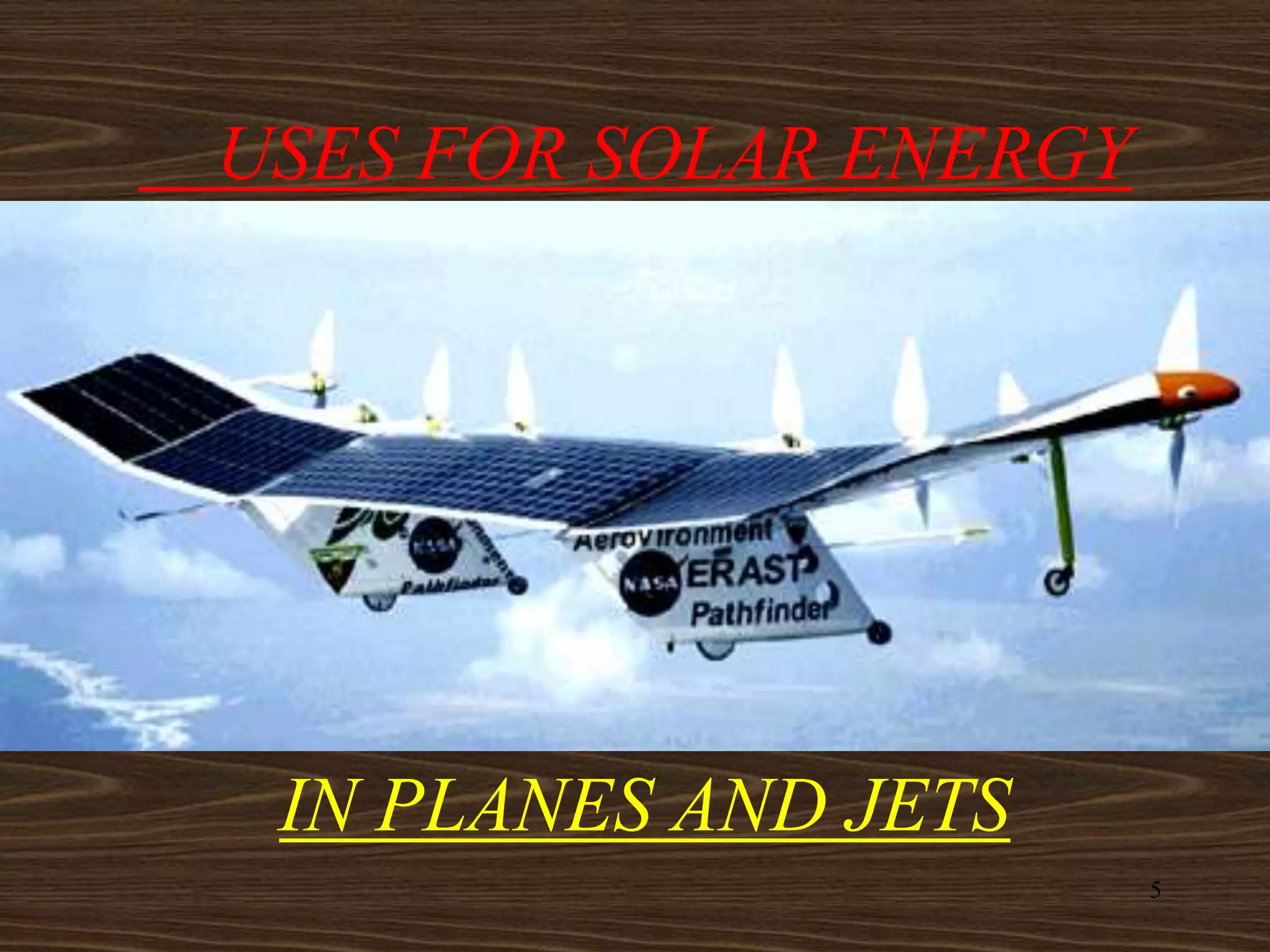
USES FOR SOLAR ENERGY


 IN PLANES AND JETS
                        5
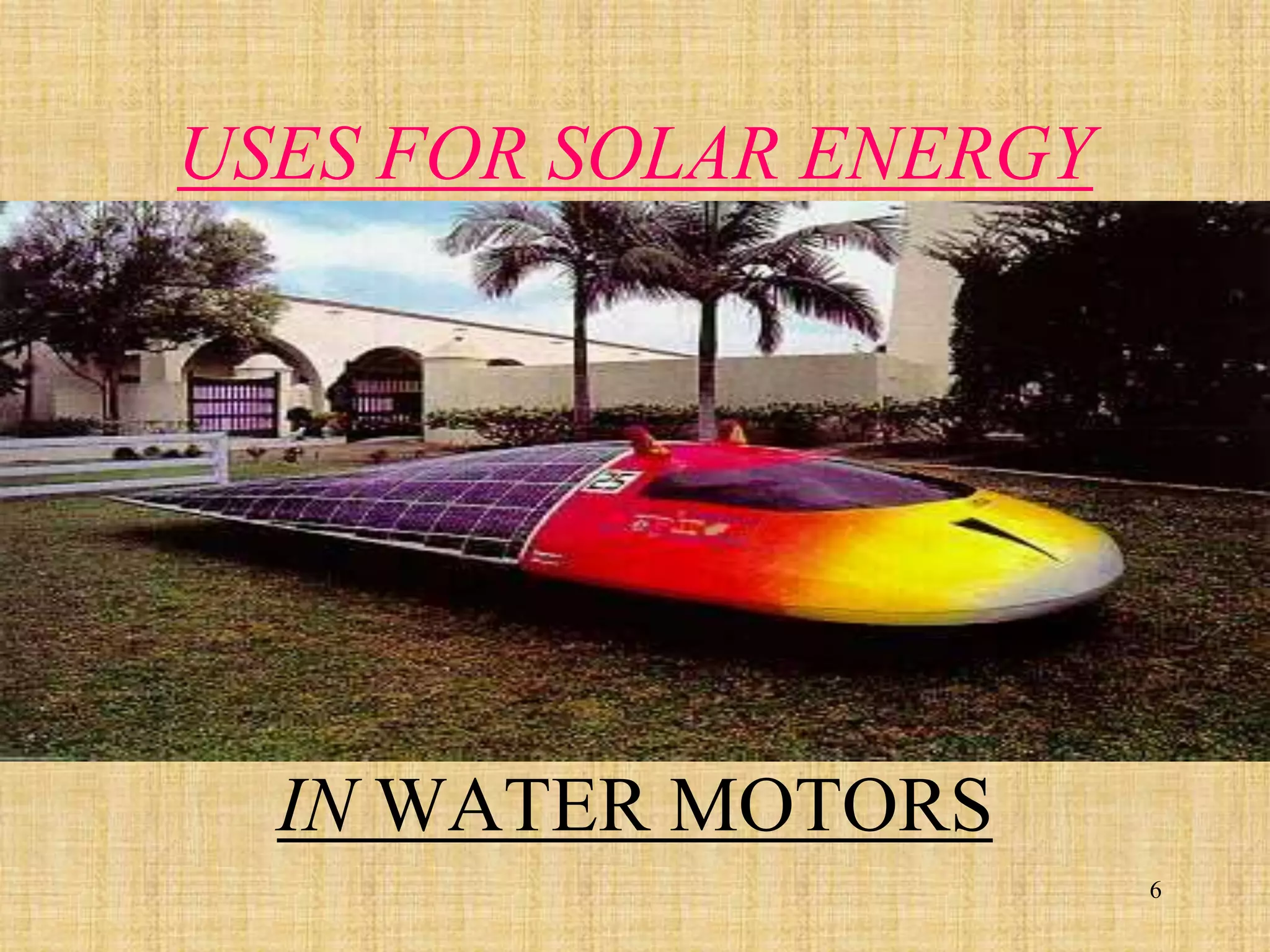
USES FOR SOLAR ENERGY


  IN WATER MOTORS
                        6
Basic Physics of Solar Cells

• Silicon (Si) is from group 4 of the period
  table. When many Si atoms are in close
  proximity, the energy states form bands
  of forbidden energy states.
• One of these bands is called the band
  gap(Eg) and the absorption of light in Si
  is a strong function of Eg.
                                        7
Basic Physics of Solar Cells
• Si is covalently bonded: It shares electrons.
  – When a Si atom is replaced with a group 3 (Al, B) it
    forms a positive particle called a hole that can move
    around the crystal through diffusion or drift (electric
    field).
  – When a Si atom is replaced with a group 5 (As, P) it
    forms an electron that can move around the crystal.
  – By selectively doping the Si Crystal when can change the
    resistivity and which type of carrier transfers charge
    (carries current). Because we can selectively dope a Si
    crystal it is called a semiconductor.                  8
Basic Physics of Solar Cells
• A solar cell is a very large diode.
  – When Si that is doped p-type is next to a region of Si
    doped n-type, the holes from the p-type side diffuse to
    the n-type side. The electrons diffuse to the p-type side.
  – This creates an electric field.
  – This electric field makes it easy for current to flow in one
    direction, but hard to flow in the other.
  – This electric field also separates electrons and holes that
    have been created by the absorption of sun light. When
    the electrons and holes are separated electric power can
    be extracted from the circuit.                         9
Thank you all…!

                  10

Solarcell

  • 1.
  • 2.
    History of CellEfficiency • M.A. Green, “Very High Efficiency Solar Cells-Science and Technology”, IEEE Transactions on Electron Devices, Vol. 46, No. 10, pp. 1940-1947, (1999). • Notice: This trend is not like “Moore’s Law”. • Price per installed Watt is probably a better figure of merit to track. • Deregulation (Blame anyone you like.) made power generated by solar or wind economically viable! 2
  • 3.
    What is aSolar Cell? • A structure that converts solar energy directly to DC electric energy. – It supplies a voltage and a current to a resistive load (light, battery, motor). – Power = Current x Voltage=Current2 x R= Voltage2/R • It is like a battery because it supplies DC power. • It is not like a battery because the voltage supplied by the cell changes with changes in the resistance of the load. 3
  • 4.
    Uses for SolarEnergy • It is fun to watch PG&E’s meter run backward. • Renewable power • Power for remote locations 4
  • 5.
    USES FOR SOLARENERGY IN PLANES AND JETS 5
  • 6.
    USES FOR SOLARENERGY IN WATER MOTORS 6
  • 7.
    Basic Physics ofSolar Cells • Silicon (Si) is from group 4 of the period table. When many Si atoms are in close proximity, the energy states form bands of forbidden energy states. • One of these bands is called the band gap(Eg) and the absorption of light in Si is a strong function of Eg. 7
  • 8.
    Basic Physics ofSolar Cells • Si is covalently bonded: It shares electrons. – When a Si atom is replaced with a group 3 (Al, B) it forms a positive particle called a hole that can move around the crystal through diffusion or drift (electric field). – When a Si atom is replaced with a group 5 (As, P) it forms an electron that can move around the crystal. – By selectively doping the Si Crystal when can change the resistivity and which type of carrier transfers charge (carries current). Because we can selectively dope a Si crystal it is called a semiconductor. 8
  • 9.
    Basic Physics ofSolar Cells • A solar cell is a very large diode. – When Si that is doped p-type is next to a region of Si doped n-type, the holes from the p-type side diffuse to the n-type side. The electrons diffuse to the p-type side. – This creates an electric field. – This electric field makes it easy for current to flow in one direction, but hard to flow in the other. – This electric field also separates electrons and holes that have been created by the absorption of sun light. When the electrons and holes are separated electric power can be extracted from the circuit. 9
  • 10.