WELCOME
GROUP PROJECT
ON
SOLAR TRACKER SYSTEM
Solar Trackers : Powering India's
Renewable Future
This presentation delves into how solar trackers are revolutionising
renewable energy in India. We'll explore their role in maximising solar
energy capture, their importance for utility-scale projects, and how
they contribute to India's ambitious clean energy goals by offering
significantly higher energy yields compared to fixed-tilt systems.
SOLAR ENERGY—RENEWABLE SOURCE
solar energy is one of the best renewable sources.
The definition of solar energy is energy harnessed from the sun that is
then converted into electricity or heat.
This is accomplished through a range of evolving technologies, and the
captured or converted energy is then used to meet a variety of
everyday needs.
Uses of solar energy: powering homes and buildings , heating
water ,desalination of water, some agriculture purposes, cooking food
5
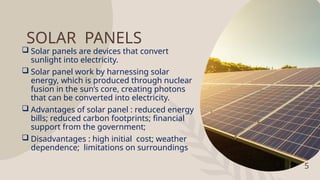
SOLAR PANELS
 Solar panels are devices that convert
sunlight into electricity.
 Solar panel work by harnessing solar
energy, which is produced through nuclear
fusion in the sun’s core, creating photons
that can be converted into electricity.
 Advantages of solar panel : reduced energy
bills; reduced carbon footprints; financial
support from the government;
 Disadvantages : high initial cost; weather
dependence; limitations on surroundings
What are solar trackers?
Solar tracking systems are designed to dynamically orient solar panels to
face the sun as it moves across the sky.
 By increasing the amount of time that panels are directly exposed to
sunlight, solar trackers can significantly improve energy collection,
making them particularly valuable in off-grid, remote, or small-scale
applications where maximizing efficiency is crucial .
 Not only does it enhance the efficiency of solar energy systems, but it
also provides a practical example of automation and control technology in
action, making it a valuable educational tool.
7
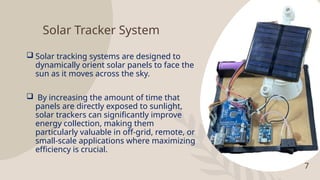
Solar Tracker System
 Solar tracking systems are designed to
dynamically orient solar panels to face the
sun as it moves across the sky.
 By increasing the amount of time that
panels are directly exposed to sunlight,
solar trackers can significantly improve
energy collection, making them
particularly valuable in off-grid, remote, or
small-scale applications where maximizing
efficiency is crucial.
8
Construction of solar tracker system
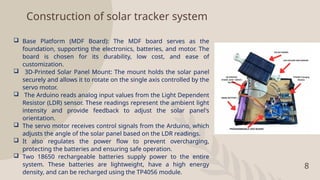
 Base Platform (MDF Board): The MDF board serves as the
foundation, supporting the electronics, batteries, and motor. The
board is chosen for its durability, low cost, and ease of
customization.
 3D-Printed Solar Panel Mount: The mount holds the solar panel
securely and allows it to rotate on the single axis controlled by the
servo motor.
 The Arduino reads analog input values from the Light Dependent
Resistor (LDR) sensor. These readings represent the ambient light
intensity and provide feedback to adjust the solar panel's
orientation.
 The servo motor receives control signals from the Arduino, which
adjusts the angle of the solar panel based on the LDR readings.
 It also regulates the power flow to prevent overcharging,
protecting the batteries and ensuring safe operation.
 Two 18650 rechargeable batteries supply power to the entire
system. These batteries are lightweight, have a high energy
density, and can be recharged using the TP4056 module.
Working of solar tracker system
The working principle of the solar tracker revolves around the interaction between light
detection, signal processing, and mechanical movement.
 In the solar tracker, two LDRs are positioned to detect light from different directions—
one facing east and the other west.
This setup enables the system to determine which direction has more sunlight.
The output from the LDRs is read by the Arduino’s analog pins.
The Arduino continuously monitors these readings to assess which LDR is detecting more
light.
When the Arduino determines that one LDR is receiving more light, it sends a signal to the
servo motor to rotate the solar panel toward that direction.
For instance, if LDR 1 detects more light, the servo will
rotate to the left to align the panel with the sun
When charging module is connected to the solar panel, it provides the appropriate
current to charge the battery while preventing overcharging, which can damage lithium
cells

10
Results and Testing of Solar Tracker
 Initial Setup: The solar tracker was assembled and placed in an open area with
unobstructed sunlight. The orientation of the tracker was adjusted to face south (in
the Northern Hemisphere) for initial testing.
 LDR Calibration: Before conducting performance tests, the LDR sensors were
calibrated. This involved recording their readings under varying light conditions and
adjusting the thresholds in the Arduino code to optimize sensitivity.
 Controlled Testing: The performance of the solar tracker was evaluated at different
times of the day (morning, noon, and afternoon) to assess its responsiveness to
changing sun positions.
 Data Collection: The voltage output from the solar panel was measured and logged
during the testing periods. This data helped evaluate the energy capture efficiency
of the solar tracker compared to a fixed panel
 Repeatability Tests: The tests were repeated on multiple days to ensure consistent
performance under different weather conditions.
Power management
11
 Charging Mechanism:
The TP4056 is a lithium-ion battery charger designed for single-cell applications. It
features a constant current/constant voltage (CC/CV) charging profile, ensuring the battery is
charged efficiently and safely .When connected to the solar panel, the TP4056 regulates the
input voltage, providing the appropriate current to charge the battery while preventing
overcharging, which can damage lithium cells.
 Battery Protection:
The module includes protection features such as overcurrent protection, thermal
protection, and automatic shut-off once the battery reaches full charge. This is critical for
maintaining battery health over extended use.
 Status Indicators:
The TP4056 typically features LED indicators that show charging status. A red LED
indicates charging, while a green LED signifies that the battery is fully charged. Monitoring these
indicators during testing allowed for better understanding of the charging cycle
12
Role of Arduino-uno
Sensor Data Processing:
The Arduino reads analog input values from the Light Dependent
Resistor (LDR) sensor.
System Monitoring:
Monitors system inputs to prevent unnecessary adjustments ,
especially during low-light conditions
Advantages of Arduino:
Easy to use and accessible to everyone.
Open source and available for use by everyone.
Types of solar tracker
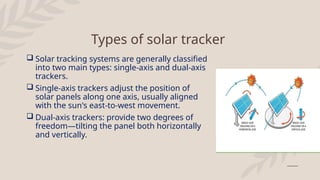
 Solar tracking systems are generally classified
into two main types: single-axis and dual-axis
trackers.
 Single-axis trackers adjust the position of
solar panels along one axis, usually aligned
with the sun's east-to-west movement.
 Dual-axis trackers: provide two degrees of
freedom—tilting the panel both horizontally
and vertically.
14
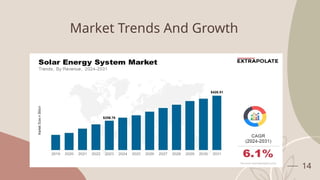
Market Trends And Growth
15
Uses of solar tracker
The current produced from the solar tracker can be
used for cooking
It is used another in street lights
We can carry these battery for far off places where
there is shortage shortage
16
Advantages And Disadvantages of
solar tracker system
Advantages of solar tracker system :
Trackers generate more electricity than their stationary counterparts
due to increased direct exposure to solar rays.
Single-axis trackers usually move from the east to the west and follow the Sun’s direction.
Disadvantages of solar tracker system:
Its initial investment cost is relatively high due to the presence of moving parts.
Not ideal in snowy weather and are more beneficial in hot climates.
Requires more maintenance, with the level depending on the type and quality
of the tracking system.
17
Indian Applications and Future Goals
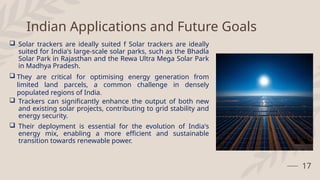
 Solar trackers are ideally suited f Solar trackers are ideally
suited for India's large-scale solar parks, such as the Bhadla
Solar Park in Rajasthan and the Rewa Ultra Mega Solar Park
in Madhya Pradesh.
1.Trackers can significantly enhance the output of both new
and existing solar projects, contributing to grid stability and
energy security.
 Trackers can significantly enhance the output of both new
and existing solar projects, contributing to grid stability and
energy security.
 Their deployment is essential for the evolution of India's
energy mix, enabling a more efficient and sustainable
transition towards renewable power.
 They are critical for optimising energy generation from
limited land parcels, a common challenge in densely
populated regions of India.
18
Real time Monitoring
Implementing a monitoring system that
tracks battery voltage and solar panel output
can provide real-time data for further
optimization.
This information allows for timely
adjustments to the tracking logic or charging
parameters based on current conditions
19
Conclusion
Increased Energy Production:
○ Through extensive testing, it was established that the solar tracker could
generate 20-30% more energy than a static solar panel
Autonomous Functionality:
○ The design successfully integrates an autonomous tracking mechanism
that operates with minimal human intervention.
Robust Power Management:
○ The inclusion of the TP4056 charging module and 18650 lithium battery
provides effective power management, ensuring that the solar tracker
remains operational during non-sunny periods.
Feasibility and Scalability:
○ The project's design was scalable, demonstrating adaptability for various
applications, from small residential setups to larger commercial systems.
THANK YOU
20

Solar tracker system of renewable future

  • 1.
  • 2.
  • 3.
    Solar Trackers :Powering India's Renewable Future This presentation delves into how solar trackers are revolutionising renewable energy in India. We'll explore their role in maximising solar energy capture, their importance for utility-scale projects, and how they contribute to India's ambitious clean energy goals by offering significantly higher energy yields compared to fixed-tilt systems.
  • 4.
    SOLAR ENERGY—RENEWABLE SOURCE solarenergy is one of the best renewable sources. The definition of solar energy is energy harnessed from the sun that is then converted into electricity or heat. This is accomplished through a range of evolving technologies, and the captured or converted energy is then used to meet a variety of everyday needs. Uses of solar energy: powering homes and buildings , heating water ,desalination of water, some agriculture purposes, cooking food
  • 5.
    5 SOLAR PANELS  Solarpanels are devices that convert sunlight into electricity.  Solar panel work by harnessing solar energy, which is produced through nuclear fusion in the sun’s core, creating photons that can be converted into electricity.  Advantages of solar panel : reduced energy bills; reduced carbon footprints; financial support from the government;  Disadvantages : high initial cost; weather dependence; limitations on surroundings
  • 6.
    What are solartrackers? Solar tracking systems are designed to dynamically orient solar panels to face the sun as it moves across the sky.  By increasing the amount of time that panels are directly exposed to sunlight, solar trackers can significantly improve energy collection, making them particularly valuable in off-grid, remote, or small-scale applications where maximizing efficiency is crucial .  Not only does it enhance the efficiency of solar energy systems, but it also provides a practical example of automation and control technology in action, making it a valuable educational tool.
  • 7.
    7 Solar Tracker System Solar tracking systems are designed to dynamically orient solar panels to face the sun as it moves across the sky.  By increasing the amount of time that panels are directly exposed to sunlight, solar trackers can significantly improve energy collection, making them particularly valuable in off-grid, remote, or small-scale applications where maximizing efficiency is crucial.
  • 8.
    8 Construction of solartracker system  Base Platform (MDF Board): The MDF board serves as the foundation, supporting the electronics, batteries, and motor. The board is chosen for its durability, low cost, and ease of customization.  3D-Printed Solar Panel Mount: The mount holds the solar panel securely and allows it to rotate on the single axis controlled by the servo motor.  The Arduino reads analog input values from the Light Dependent Resistor (LDR) sensor. These readings represent the ambient light intensity and provide feedback to adjust the solar panel's orientation.  The servo motor receives control signals from the Arduino, which adjusts the angle of the solar panel based on the LDR readings.  It also regulates the power flow to prevent overcharging, protecting the batteries and ensuring safe operation.  Two 18650 rechargeable batteries supply power to the entire system. These batteries are lightweight, have a high energy density, and can be recharged using the TP4056 module.
  • 9.
    Working of solartracker system The working principle of the solar tracker revolves around the interaction between light detection, signal processing, and mechanical movement.  In the solar tracker, two LDRs are positioned to detect light from different directions— one facing east and the other west. This setup enables the system to determine which direction has more sunlight. The output from the LDRs is read by the Arduino’s analog pins. The Arduino continuously monitors these readings to assess which LDR is detecting more light. When the Arduino determines that one LDR is receiving more light, it sends a signal to the servo motor to rotate the solar panel toward that direction. For instance, if LDR 1 detects more light, the servo will rotate to the left to align the panel with the sun When charging module is connected to the solar panel, it provides the appropriate current to charge the battery while preventing overcharging, which can damage lithium cells 
  • 10.
    10 Results and Testingof Solar Tracker  Initial Setup: The solar tracker was assembled and placed in an open area with unobstructed sunlight. The orientation of the tracker was adjusted to face south (in the Northern Hemisphere) for initial testing.  LDR Calibration: Before conducting performance tests, the LDR sensors were calibrated. This involved recording their readings under varying light conditions and adjusting the thresholds in the Arduino code to optimize sensitivity.  Controlled Testing: The performance of the solar tracker was evaluated at different times of the day (morning, noon, and afternoon) to assess its responsiveness to changing sun positions.  Data Collection: The voltage output from the solar panel was measured and logged during the testing periods. This data helped evaluate the energy capture efficiency of the solar tracker compared to a fixed panel  Repeatability Tests: The tests were repeated on multiple days to ensure consistent performance under different weather conditions.
  • 11.
    Power management 11  ChargingMechanism: The TP4056 is a lithium-ion battery charger designed for single-cell applications. It features a constant current/constant voltage (CC/CV) charging profile, ensuring the battery is charged efficiently and safely .When connected to the solar panel, the TP4056 regulates the input voltage, providing the appropriate current to charge the battery while preventing overcharging, which can damage lithium cells.  Battery Protection: The module includes protection features such as overcurrent protection, thermal protection, and automatic shut-off once the battery reaches full charge. This is critical for maintaining battery health over extended use.  Status Indicators: The TP4056 typically features LED indicators that show charging status. A red LED indicates charging, while a green LED signifies that the battery is fully charged. Monitoring these indicators during testing allowed for better understanding of the charging cycle
  • 12.
    12 Role of Arduino-uno SensorData Processing: The Arduino reads analog input values from the Light Dependent Resistor (LDR) sensor. System Monitoring: Monitors system inputs to prevent unnecessary adjustments , especially during low-light conditions Advantages of Arduino: Easy to use and accessible to everyone. Open source and available for use by everyone.
  • 13.
    Types of solartracker  Solar tracking systems are generally classified into two main types: single-axis and dual-axis trackers.  Single-axis trackers adjust the position of solar panels along one axis, usually aligned with the sun's east-to-west movement.  Dual-axis trackers: provide two degrees of freedom—tilting the panel both horizontally and vertically.
  • 14.
  • 15.
    15 Uses of solartracker The current produced from the solar tracker can be used for cooking It is used another in street lights We can carry these battery for far off places where there is shortage shortage
  • 16.
    16 Advantages And Disadvantagesof solar tracker system Advantages of solar tracker system : Trackers generate more electricity than their stationary counterparts due to increased direct exposure to solar rays. Single-axis trackers usually move from the east to the west and follow the Sun’s direction. Disadvantages of solar tracker system: Its initial investment cost is relatively high due to the presence of moving parts. Not ideal in snowy weather and are more beneficial in hot climates. Requires more maintenance, with the level depending on the type and quality of the tracking system.
  • 17.
    17 Indian Applications andFuture Goals  Solar trackers are ideally suited f Solar trackers are ideally suited for India's large-scale solar parks, such as the Bhadla Solar Park in Rajasthan and the Rewa Ultra Mega Solar Park in Madhya Pradesh. 1.Trackers can significantly enhance the output of both new and existing solar projects, contributing to grid stability and energy security.  Trackers can significantly enhance the output of both new and existing solar projects, contributing to grid stability and energy security.  Their deployment is essential for the evolution of India's energy mix, enabling a more efficient and sustainable transition towards renewable power.  They are critical for optimising energy generation from limited land parcels, a common challenge in densely populated regions of India.
  • 18.
    18 Real time Monitoring Implementinga monitoring system that tracks battery voltage and solar panel output can provide real-time data for further optimization. This information allows for timely adjustments to the tracking logic or charging parameters based on current conditions
  • 19.
    19 Conclusion Increased Energy Production: ○Through extensive testing, it was established that the solar tracker could generate 20-30% more energy than a static solar panel Autonomous Functionality: ○ The design successfully integrates an autonomous tracking mechanism that operates with minimal human intervention. Robust Power Management: ○ The inclusion of the TP4056 charging module and 18650 lithium battery provides effective power management, ensuring that the solar tracker remains operational during non-sunny periods. Feasibility and Scalability: ○ The project's design was scalable, demonstrating adaptability for various applications, from small residential setups to larger commercial systems.

  • 20.